Market Snapshot
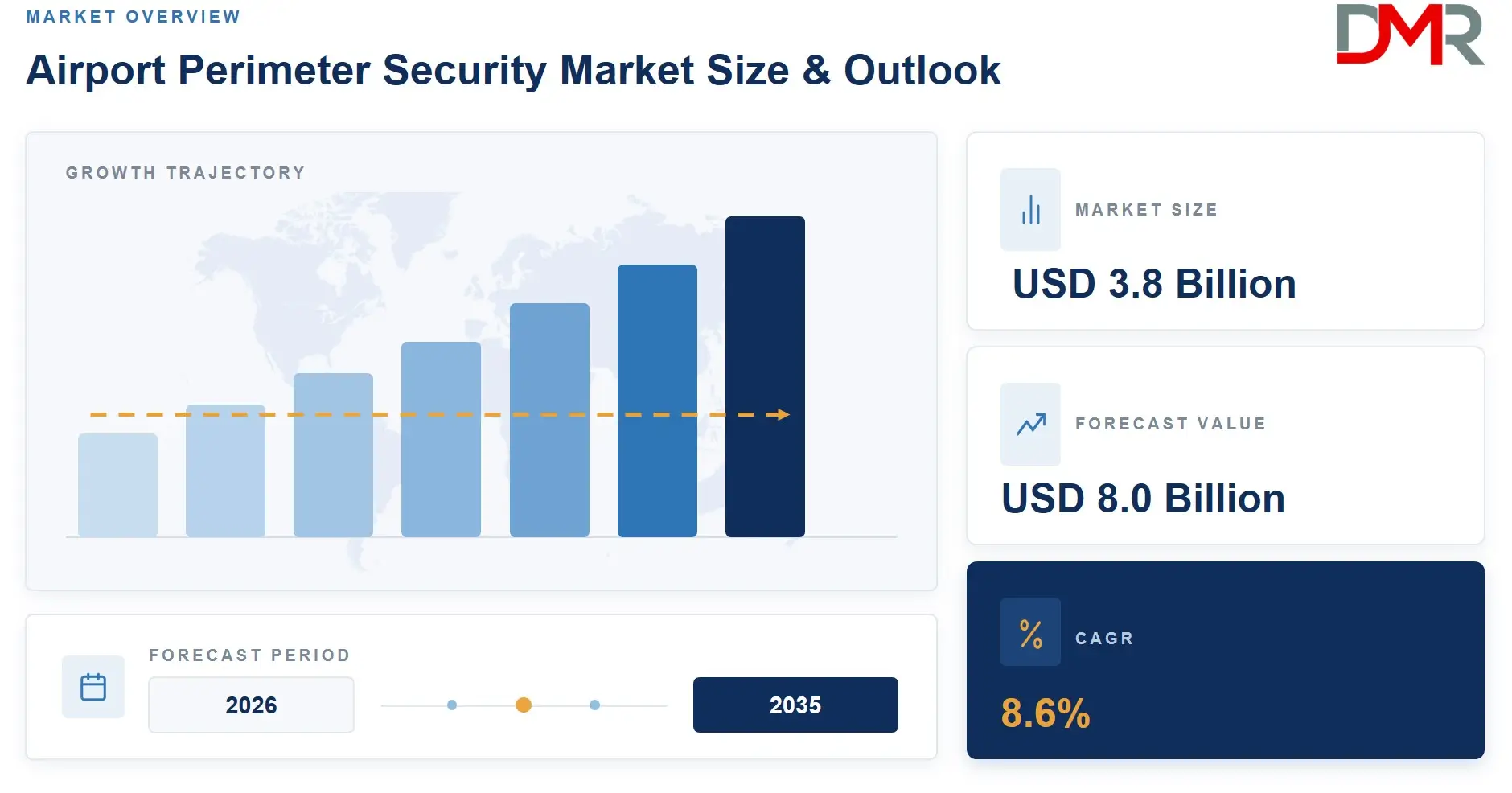
- Market Size (2026): USD 3.8 Bn
- Forecast Value (2035): USD 8.0 Bn
- CAGR (2026-2035): 8.6%
- Largest Region (2026): North America, approximately 29%
- Fastest-Growing Region: Asia-Pacific
- Leading Component (2026): Physical Barriers & Fencing, around 24%
- Leading Technology (2026): Ground Surveillance Radar, close to 23%
- Key Players: Honeywell International, Johnson Controls, Bosch Security and Safety Systems, and others
What is Airport Perimeter Security Market and its Market Size?
Global Airport Perimeter Security Market size is estimated to reach USD 3.8 Bn in 2026 and is further anticipated to reach USD 8.0 Bn by 2035, at a CAGR of 8.6%.
ℹ
To learn more about this report –
Download Your Free Sample Report Here
The market covers the hardware, sensors, video systems, access control and associated software that airport operators and their integrators deploy along the fenced or unfenced boundary of an airport, plus the installation and maintenance work that keeps those systems operational. It excludes terminal-interior screening equipment such as baggage scanners and passenger walk-through detectors, which sit inside a separate airport security category, and it excludes general commercial perimeter security sold outside aviation sites.
Airport operators, whether municipal authorities, private concession holders or national civil aviation bodies, are the direct buyers, and they typically procure perimeter systems through multi-year capital programs tied to terminal expansion or regulator-mandated upgrades rather than as a recurring line item. Military and joint-use airfields buy through defence procurement channels instead, which run on longer cycles and stricter vendor vetting. Integrators and managed-service providers increasingly sit between the airport and the equipment vendor, bundling design, installation and ongoing monitoring into a single contract.
What is changing structurally is the shift away from a perimeter built solely on physical deterrence, fencing, lighting and patrol, toward one that fuses buried-cable or fiber-optic sensing with radar and video analytics so a single verified alarm can be traced to an exact boundary segment. That fusion is what has turned software and analytics into the fastest-expanding line item inside an otherwise mature hardware category, and it is also what has let counter-drone detection attach itself onto systems originally designed only to catch ground intrusion.
New-build airports across Asia-Pacific and the Gulf specify sensor-fused perimeters from the outset, while airports across North America and Europe retrofit decades-old fence lines, and that split shapes vendor selection across the two regions.
Use Cases
- Hub Airport Perimeter Hardening: international hub airport operators deploy layered fencing, buried-cable sensors and radar-cued cameras across long boundary runs, replacing manual patrol-only regimes so security teams can trace a verified breach point in minutes rather than waiting on scheduled foot patrols.
- Regional Airport Retrofit Programs: regional and domestic airport authorities retrofit legacy chain-link boundaries with fiber-optic and microwave detection after national aviation regulators tighten baseline perimeter standards, closing coverage gaps that previously relied on visual inspection alone.
- Cargo and Freight Terminal Protection: cargo-handling airports and freight terminal operators prioritize access control integration with cargo tracking systems, since a perimeter breach near freight aprons carries theft and supply-chain liability exposure that passenger terminals do not face in the same way.
- Counter-Drone Airspace Monitoring: airport security directors add radar and RF-detection layers to existing perimeter systems to flag unauthorized drone incursions near runways, a use case that grew directly out of a rise in drone-related runway closures rather than the ground-intrusion threat perimeter systems were originally built for.
Key Takeaways
- Market Size & Share: global airport perimeter security demand is estimated at USD 3.8 Bn in 2026, advancing toward USD 8.0 Bn by 2035.
- Component Analysis: Physical Barriers & Fencing leads the component split, accounting for approximately 24% of 2026 revenue, while Software & Video Analytics is expanding fastest at a CAGR of 17.2%.
- Regional Analysis: North America holds the largest regional share at around 29% in 2026, with Asia-Pacific advancing as the fastest-growing region on the back of new airport construction.
- Technology Shift: Ground Surveillance Radar remains the leading detection technology, close to 23% of 2026 share, as Video Analytics & AI-Based Detection scales at a 16.5% CAGR.
- Application Mix: Intrusion Detection & Deterrence dominates application demand at nearly 38% in 2026, while Counter-Drone/UAS Detection is the fastest-moving application segment.
- Regulatory Pressure: tightening national aviation security mandates are pushing airports to replace visual-inspection-only perimeters with sensor-based detection layers.
- Competitive Structure: the market spans global security conglomerates and specialist perimeter-sensor vendors, with consolidation concentrated among video analytics providers.
How AI/Gen AI is Transforming the Airport Perimeter Security Market?
Artificial intelligence has entered airport perimeter security primarily through video analytics rather than through any generative application, since the operational task, distinguishing a person, vehicle or animal from wind-blown debris across kilometers of fence line, is a computer-vision classification problem rather than a content-generation one. Deep-learning models trained on airport-specific footage now cut the false-alarm rates that previously led security operators to tune sensor sensitivity down and, in doing so, miss genuine breaches.
The same models are increasingly deployed at the edge, on the camera or sensor controller itself, rather than in a central control room, which lets an airport add coverage without proportionally scaling network bandwidth or control-room staff. Generative AI's more direct contribution so far sits in documentation and compliance, drafting the incident reports and regulatory submissions that follow a verified breach, rather than in detection itself.
- Computer Vision Intrusion Classification: distinguishes humans, vehicles and wildlife from environmental noise along fence lines, cutting nuisance alarms that previously desensitized control-room operators.
- Sensor Fusion and Alarm Correlation: cross-references fiber-optic, radar and camera triggers against a single boundary segment so one confirmed event, not three separate alerts, reaches the operator.
- Edge-Based Video Processing: runs classification models directly on perimeter cameras, reducing the bandwidth and central compute an airport needs to add coverage.
- LLM-Assisted Incident Documentation: drafts breach reports and regulatory submission paperwork from logged sensor and video data, cutting the administrative load on security teams.
Key Drivers in the Global Airport Perimeter Security Market
Demand for airport perimeter security is shaped by two forces that reinforce each other: tightening regulation and the physical growth of the airport estate itself.
- Escalating Regulatory Mandates for Perimeter Detection: civil aviation authorities across major markets have moved from prescribing physical barriers alone to mandating detection capability, requiring airports to demonstrate that any boundary breach triggers a verifiable alarm rather than relying on scheduled patrols. That shift, driven by post-incident reviews at airports where fence breaches went undetected for extended periods, has turned perimeter intrusion detection from an optional upgrade into a licensing condition at many international airports. Airports renewing their security certification now budget for sensor coverage across the full boundary length rather than the highest-risk segments alone, which has widened the addressable base beyond the largest hub airports to the regional and cargo airports that previously deferred the investment.
- Airport Capacity Expansion and New Terminal Construction: the pipeline of new runways, terminals and cargo aprons under construction across Asia-Pacific and the Middle East is extending the total boundary length that needs coverage faster than any single retrofit program could. Airport operators specifying a new perimeter from the ground up favor integrated fiber-optic and radar systems over the standalone fencing that dominates older sites, since designing detection in from the outset costs less than retrofitting it later and avoids the phased shutdowns a live-airport retrofit requires. Every new greenfield airport therefore adds a full perimeter security contract rather than an incremental one, keeping the market moving roughly in step with global air traffic growth.
Restraints in the Global Airport Perimeter Security Market
Two constraints slow adoption below what regulatory pressure alone would predict: the cost of retrofitting a live facility and the absence of a single interoperability standard.
- High Capital Cost of Live-Airport Retrofits: replacing a perimeter system at an operating airport is materially more expensive than specifying one for a new build, because trenching for fiber-optic cable or repositioning radar poles has to happen in short maintenance windows without disrupting runway operations or existing security coverage. Smaller regional airports, which often run on thin capital budgets and cannot spread the cost across a large terminal expansion, tend to defer the upgrade until a regulator deadline forces it, slowing replacement of aging fence-mounted sensors even where newer technology is readily available.
- Fragmented Standards Across Detection Technologies: no single interoperability standard governs how fiber-optic sensors, microwave barriers, radar and video management software exchange alarm data, so airports that buy from more than one vendor over successive procurement cycles often end up running parallel control-room interfaces rather than one consolidated view. That fragmentation raises integration cost on every subsequent purchase and gives incumbent vendors an advantage in follow-on contracts, since switching means re-integrating the entire alarm chain.
Growth Opportunities in the Global Airport Perimeter Security Market
The clearest white space sits where the existing perimeter was never designed to detect the threat now driving budget conversations.
- Counter-Drone Integration into Existing Perimeter Systems: airports that already operate a fiber-optic or radar-based ground perimeter represent a lower-cost upgrade path for counter-drone detection than a standalone deployment, since the control-room software, power and communications backbone already exist. Vendors that can add RF-detection and airspace radar as a software-and-sensor add-on to an installed base, rather than sell a separate system, are positioned to capture budget that airports are allocating specifically in response to drone-related runway closures, a threat category the original perimeter investment was never built to address.
- Retrofit Demand at Regional and Secondary Airports: the regulatory tightening that has already reached international hub airports is extending to regional and domestic airports on a lag, creating a multi-year replacement cycle for the thousands of smaller facilities still running visual-inspection-only perimeters. Vendors that offer modular, lower-cost sensor packages sized for a shorter boundary and a smaller security staff can capture this tier before larger competitors adapt their product lines downward, since regional airport budgets do not support the same per-meter spend as a major hub.
Trends in the Global Airport Perimeter Security Market
Two shifts are visible in how airports are buying and running perimeter security right now, distinct from the drivers pushing the spend in the first place.
- Convergence of Video Analytics with Perimeter Sensors: airports are increasingly procuring video management software and physical intrusion sensors as a single integrated package rather than sourcing cameras from one vendor and fence sensors from another, since analytics vendors now build direct alarm-correlation interfaces for the major fiber-optic and radar sensor lines. That convergence is compressing what used to be a three-vendor procurement, barrier, sensor, video, into a two-vendor one, and it is shifting negotiating leverage toward vendors that can credibly offer both the detection hardware and the software layer that makes sense of it.
- Shift Toward Managed and Outsourced Perimeter Security Services: a growing share of airports, particularly regional operators without a large in-house security engineering team, are contracting perimeter monitoring out to managed-service providers rather than operating the control room themselves. That shift moves spend from a capital line to an operating one and gives smaller airports access to round-the-clock monitoring expertise they could not staff internally, while giving integrators recurring revenue that is more stable than the project-based installation work perimeter security has historically been.
Research Scope and Analysis
Segment performance is assessed across five axes: component, technology, airport type, application and end user. Each axis identifies the sub-segment carrying the largest share of 2026 revenue and the one expanding fastest through 2035, along with the commercial reason behind each position.
ℹ
To learn more about this report –
Download Your Free Sample Report Here
By Component
Physical Barriers & Fencing holds the largest share of component revenue in 2026, accounting for close to 24%, because every airport perimeter, however sensor-dense, still requires a physical boundary as the baseline layer that detection technology attaches to, and most airports replace fencing on a longer capital cycle that keeps this line item large even as spend shifts elsewhere. Growth is concentrated in software and video analytics, expanding at a CAGR of 17.2% between 2026 and 2035, as airports that already own sensor and camera hardware add analytics licensing to cut false alarms and correlate sensor types into one verified event, a purchase requiring no new trenching and rolled out far faster than hardware replacement.
By Technology
Ground Surveillance Radar leads the technology split in 2026 at approximately 23% of revenue, reflecting its role as the default long-range detection layer at large international airports, where radar can cover open apron and taxiway approaches that fence-mounted fiber sensors cannot reach on their own. The sharper trajectory sits with Video Analytics & AI-Based Detection, forecast to grow at a 16.5% CAGR through 2035, pulled by falling camera hardware costs and the availability of pre-trained classification models that no longer require an airport to build its own dataset from scratch, lowering the barrier for mid-sized airports to adopt analytics-driven detection previously affordable only at the largest hubs.
By Airport Type
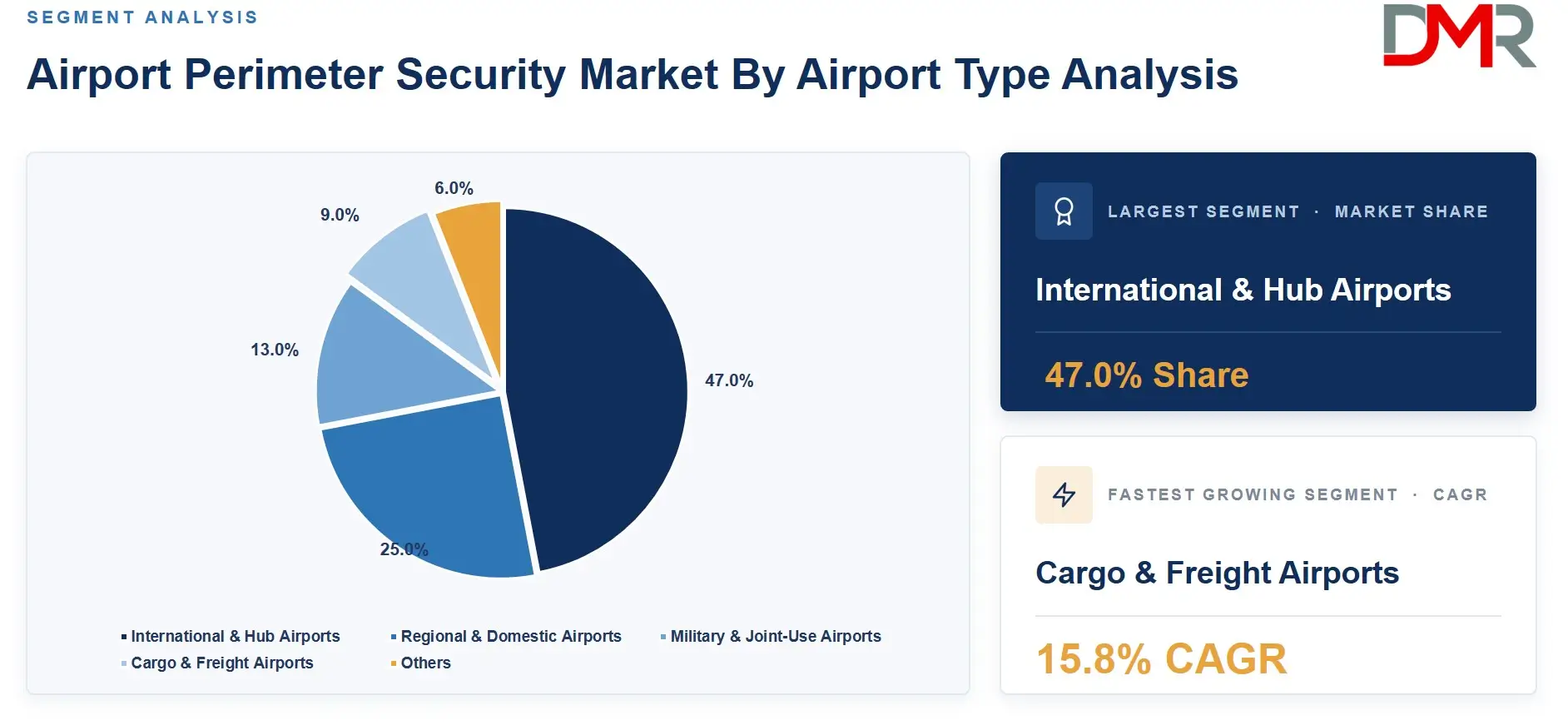
International and hub airports account for the largest share of demand in 2026, at around 47%, since these facilities carry both the longest perimeter boundaries and the strictest certification requirements, and they operate the capital budgets to fund full sensor-fused coverage in a single program. The fastest growth, though, belongs to cargo and freight airports, projected at a 15.8% CAGR to 2035, as e-commerce-driven freight volumes push dedicated cargo hubs to formalize perimeter security around apron and warehouse zones that previously relied on generic industrial fencing, a category regulators have started treating as a distinct compliance segment rather than folding into passenger-terminal rules.
By Application
Intrusion Detection & Deterrence remains the leading application in 2026, holding nearly 38% of demand, because it is the function every certification standard requires an airport to demonstrate before any other capability is considered, keeping baseline sensor and barrier spend concentrated here regardless of what else an airport adds later. Counter-Drone and UAS Detection is expanding fastest, at a 19.8% CAGR through 2035, as airports respond to a rising count of drone-related runway closures by extending existing perimeter budgets into airspace monitoring, a category that barely existed as a line item five years ago and is now specified alongside ground-intrusion detection in new procurement rather than as an afterthought.
By End User
Airport operators deploying systems directly account for the largest share of 2026 revenue, at approximately 55%, since most civil airports retain ownership and operational control of perimeter security even when installation and maintenance are contracted out, keeping procurement authority and budget concentrated with the airport authority itself. Third-party security integrators represent the fastest-growing end-user category, forecast at a 13.4% CAGR to 2035, as regional airports without in-house security engineering teams increasingly hand full system design, installation and monitoring to integrators under managed-service contracts, shifting a growing share of spend toward outsourced delivery.
The Global Airport Perimeter Security Market Report is Segmented Based on the Following
By Component
- Physical Barriers & Fencing
- Perimeter Intrusion Detection Sensors (PIDS)
- Video Surveillance & Thermal Imaging Systems
- Access Control Systems
- Software & Video Analytics
- Installation & Maintenance Services
- Others
By Technology
- Fiber-Optic Perimeter Sensors
- Microwave Barrier Sensors
- Ground Surveillance Radar
- Video Analytics & AI-Based Detection
- Taut-Wire & Electromagnetic Sensors
- Others
By Airport Type
- International & Hub Airports
- Regional & Domestic Airports
- Military & Joint-Use Airports
- Cargo & Freight Airports
- Others
By Application
- Intrusion Detection & Deterrence
- Perimeter Surveillance & Monitoring
- Access Control & Credentialing
- Counter-Drone/UAS Detection
- Others
By End User
- Airport Operators
- Government & Defence-Owned Airports
- Third-Party Security Integrators
- Others
Regional Analysis
Region with the Largest Revenue Share
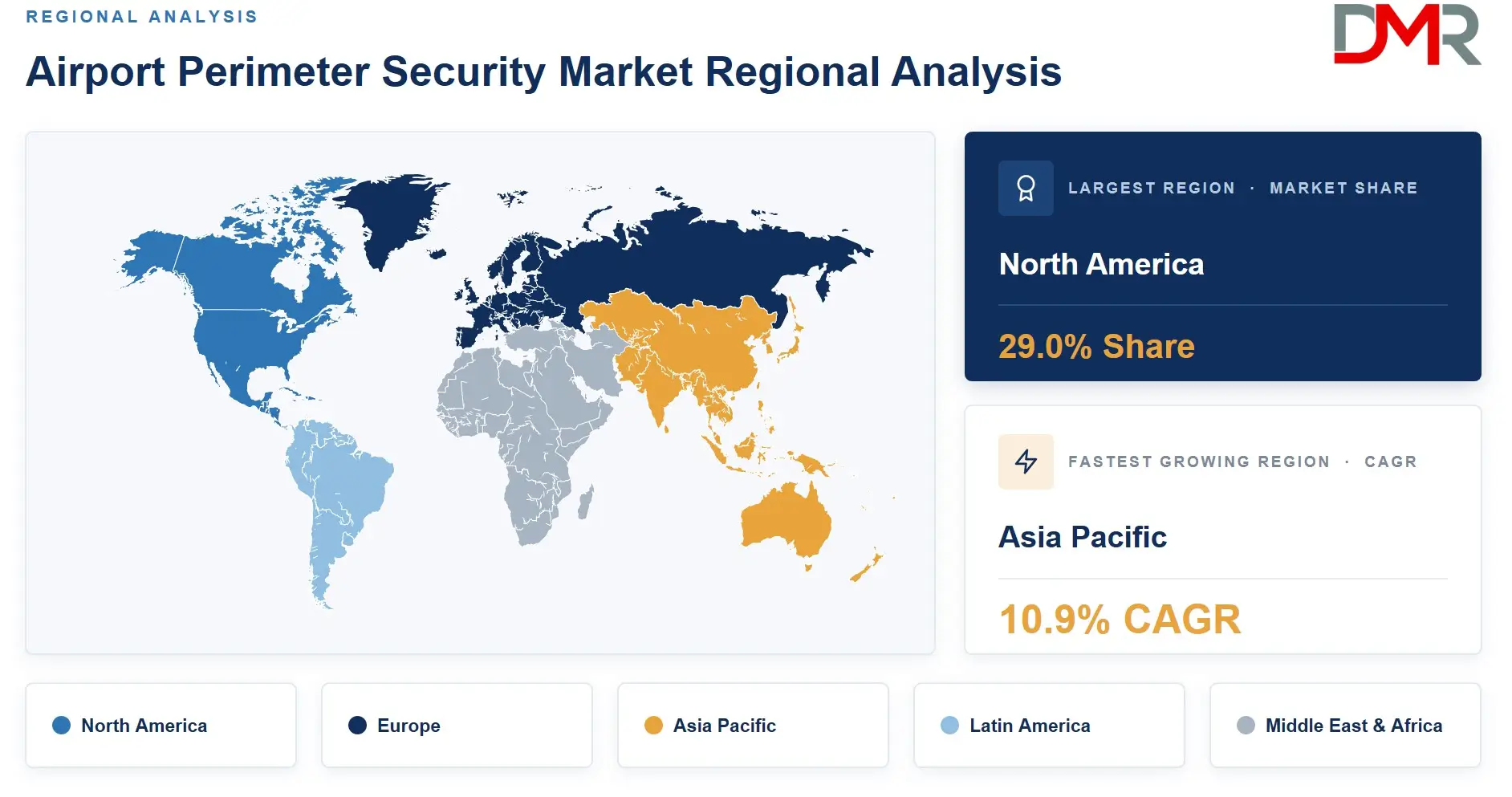
North America holds the largest regional share of the market in 2026, accounting for approximately 29% of global revenue, anchored by federally mandated security standards applied across the country's largest hub airports and by a replacement cycle now reaching fence and sensor systems installed during earlier waves of heightened security spending. Airport authorities across the region fund upgrades through capital improvement programs tied to terminal modernization, which keeps procurement steady without a single new mandate driving it. The presence of several of the market's largest system integrators and video analytics vendors headquartered in the region reinforces this share, since domestic airports favor vendors with established local support and certification history.
ℹ
To learn more about this report –
Download Your Free Sample Report Here
Region with the Highest CAGR
Asia-Pacific is expected to grow fastest, at a CAGR of approximately 10.9% between 2026 and 2035, driven by an active pipeline of new airport construction across China, India and Southeast Asia that adds boundary length requiring coverage from the day a facility opens rather than retrofitting it later. Government aviation authorities across the region are also formalizing perimeter security standards for the first time at many regional airports, converting what was previously ad hoc procurement into a defined compliance requirement. Local manufacturing of fiber-optic and radar sensor components is also lowering landed cost for airports in the region compared with importing fully assembled systems from elsewhere.
By Region
North America
Europe
- Germany
- France
- The UK
- Italy
- Spain
- Rest of Europe
Asia-Pacific
- China
- Japan
- India
- Australia
- South Korea
- Rest of APAC
Latin America
- Mexico
- Brazil
- Colombia
- Argentina
- Rest of LATAM
Middle East & Africa
- Saudi Arabia
- The UAE
- South Africa
- Rest of MEA
Regulatory Landscape
Airport perimeter security sits under a patchwork of national civil aviation regulations rather than a single global technical standard, with international guidance such as the ICAO Annex 17 framework interpreted differently by each domestic regulator that sets its own certification thresholds for detection coverage. What is shifting now is a move from prescribing physical barriers toward mandating demonstrable detection capability, a shift most advanced in North America, which holds approximately 29% of global 2026 revenue on the strength of its established certification regime. The commercial opening sits with vendors that can document compliance across multiple regimes at once; the risk is that a faster-tightening threshold delays procurement rather than accelerating it, leaving some airports on interim, lower-specification systems.
Technology Analysis
Detection technology in this market is consolidating around sensor fusion rather than any single sensing method, as fiber-optic cable, radar and video analytics increasingly report into one alarm-correlation platform instead of three separate control-room interfaces. What is shifting now is the migration of classification workloads to the edge, onto the camera or sensor controller itself, cutting the central compute and bandwidth an airport needs to expand coverage. The commercial opening favors vendors that can supply both sensing hardware and the analytics layer, since Video Analytics & AI-Based Detection is expanding fastest among detection technologies at a 16.5% CAGR. The risk is integration debt: airports mixing vendors across cycles accumulate interfaces that make later consolidation expensive.
Competitive Landscape
Competition in airport perimeter security spans two tiers that rarely compete head to head. Diversified security and defence conglomerates sell integrated systems bundling barriers, sensors, video and access control into a single hub-airport contract, competing primarily on system integration capability and long-term service agreements rather than on unit price. A second tier of specialist vendors, concentrated in fiber-optic sensing, radar and video analytics, competes on detection accuracy and false-alarm performance, often supplying components into the larger integrators' systems rather than selling directly to airports. Consolidation is most active among video analytics providers, as larger security firms acquire smaller AI-detection specialists to avoid building classification models in-house. Regional manufacturers across Asia-Pacific and the Middle East are gaining share in local procurement by offering lower-cost sensor hardware paired with domestic installation networks that global vendors often subcontract out.
Some of the Prominent Players in the Global Airport Perimeter Security Market Are
- Honeywell International
- Johnson Controls
- Bosch Security and Safety Systems
- Siemens
- Thales Group
- Leidos
- L3Harris Technologies
- Teledyne FLIR
- Motorola Solutions
- ASSA ABLOY
- Senstar Corporation
- Southwest Microwave
- Fiber SenSys
- Magal Security Systems
- Gallagher Group
- Optex Group
- Fotech Solutions
- Betafence
- Ameristar Perimeter Security
- Zaun Limited
- Genetec
- Milestone Systems
- Pelco
- Vicon Industries
- Nortek Control
- Axis Communications
- Bandweaver
- Detection Technology Inc
- Hikvision
- Dahua Technology
- Uniview Technologies
- CP Plus
- Matrix Comsec
- Suprema Inc
- Hanwha Vision
- RBtec Perimeter Security Systems
- Controp Precision Technologies
- Elbit Systems
- Allied Universal
- Convergint Technologies
- Other Key Players
Recent Developments
- In June 2026, Teledyne FLIR expanded its thermal camera lineup with a variant optimized for long-range perimeter detection at low-visibility airports, giving operators coverage during fog conditions that previously relied on radar alone.
- In March 2026, Honeywell International integrated its perimeter intrusion detection software with a counter-drone radar module, allowing airport customers to add airspace monitoring to an existing ground-detection contract without a separate procurement cycle.
- In November 2025, Genetec added native alarm-correlation support for two additional fiber-optic sensing vendors to its video management platform, reducing the integration work airports face when mixing sensor brands.
- In July 2025, Hikvision opened a manufacturing line dedicated to airport-grade thermal and radar-fused cameras, aimed at reducing lead times for airport contracts across Asia-Pacific.
- In February 2025, Siemens won a multi-year contract to modernize perimeter fencing and fiber-optic sensing at a major European hub airport as part of a broader terminal expansion program.
Report Details
| Report Characteristics |
| Market Size (2026) |
USD 3.8 Bn |
| Forecast Value (2035) |
USD 8.0 Bn |
| CAGR (2026-2035) |
8.6% |
| The US Market Size (2026) |
USD 0.9 Bn |
| Historical Data |
2021 - 2025 |
| Forecast Data |
2026 - 2035 |
| Base Year |
2025 |
| Segments Covered |
By Component, By Technology, By Airport Type, By Application, By End User |
| Regional Coverage |
North America - The US and Canada; Europe - Germany, France, The UK, Italy, Spain, Rest of Europe; Asia-Pacific - China, Japan, India, Australia, South Korea, Rest of APAC; Latin America - Mexico, Brazil, Colombia, Argentina, Rest of LATAM; Middle East & Africa - Saudi Arabia, The UAE, South Africa, Rest of MEA |
Frequently Asked Questions
How big is the Global Airport Perimeter Security Market?
▾ The Global Airport Perimeter Security Market size is estimated to reach USD 3.8 Bn in 2026, covering the fencing, sensors, video systems, access control and associated software deployed along airport boundaries worldwide. The market is projected to expand to USD 8.0 Bn by 2035, driven by tightening aviation security regulation and new perimeter coverage at greenfield airports across Asia-Pacific and the Middle East.
What is the growth rate of the Global Airport Perimeter Security Market?
▾ The Global Airport Perimeter Security Market is projected to grow at a CAGR of 8.6% between 2026 and 2035. Growth is concentrated less in physical barrier hardware, which forms the market's largest but slowest-growing base, and more in software, video analytics and counter-drone detection layered onto existing perimeter installations.
Which region holds the largest share in the Global Airport Perimeter Security Market?
▾ North America holds the largest share of the Global Airport Perimeter Security Market, accounting for approximately 29% of revenue in 2026. The region's share reflects an established certification regime, mature capital improvement programs at major hub airports, and a concentration of leading system integrators and video analytics vendors headquartered domestically.
Who are the key players in the Global Airport Perimeter Security Market?
▾ Key players include Honeywell International, Johnson Controls, Bosch Security and Safety Systems, Siemens, Thales Group, Senstar Corporation and Genetec, among others. Competition spans diversified security conglomerates offering integrated hub-airport systems and specialist vendors in fiber-optic sensing, radar and video analytics, with regional manufacturers gaining share across Asia-Pacific and the Middle East.
What component holds the largest share of the Airport Perimeter Security Market?
▾ Physical Barriers & Fencing holds the largest component share, accounting for close to 24% of 2026 revenue, since every perimeter still requires a physical boundary regardless of the sensor technology layered on top of it. Software & Video Analytics is the fastest-growing component, expanding at a 17.2% CAGR through 2035.
How is AI changing the Airport Perimeter Security Market?
▾ Artificial intelligence is reshaping the Airport Perimeter Security Market mainly through computer-vision analytics that classify intrusions along the fence line and cut false alarms, plus edge processing that runs classification on the camera or sensor itself. Generative AI's clearer contribution so far is in drafting incident reports and regulatory documentation rather than in detection itself.