Market Snapshot
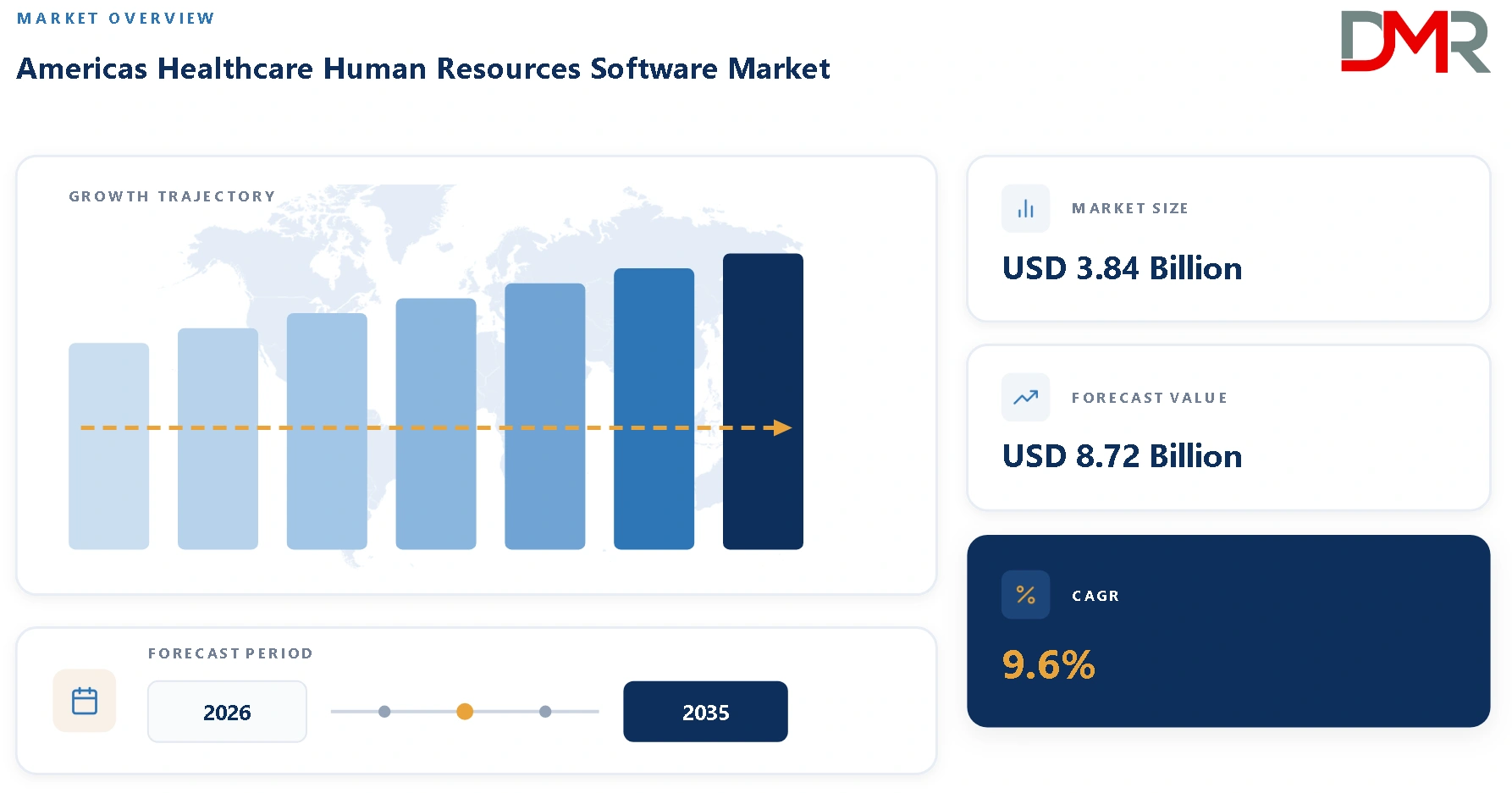
- Market Size (2026): USD 3.84 Bn
- Forecast Value (2035): USD 8.72 Bn
- CAGR (2026-2035): 9.6%
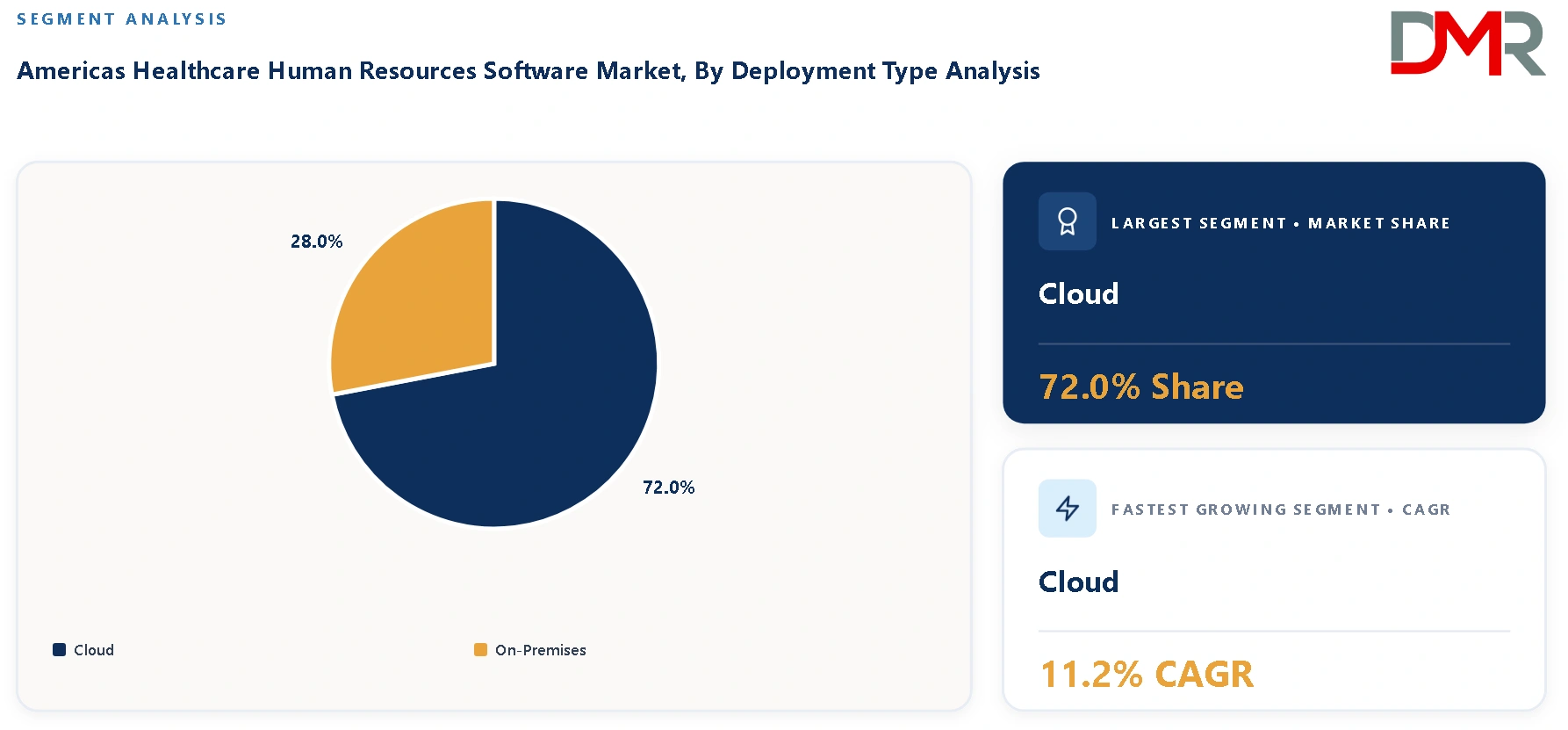
- Leading Deployment (2026): Cloud, approximately 72%
- Fastest-Growing Deployment: Cloud, at a CAGR of 11.2%
- Leading Component (2026): Software, around 68%
- Leading Function (2026): Payroll & Compensation, close to 24%
- Leading End User (2026): Hospitals & Health Systems, approximately 43%
- Key Players: Workday, Oracle, UKG, ADP, Dayforce, symplr, HealthcareSource and others
What is Americas Healthcare Human Resources Software Market and its Market Size?
The Americas Healthcare Human Resources Software Market size is estimated to reach USD 3.84 Bn in 2026 and is further anticipated to reach USD 8.72 Bn by 2035, at a CAGR of 9.6%.
ℹ
To learn more about this report –
Download Your Free Sample Report Here
The market covers software platforms and related services used by healthcare organizations across the Americas to manage employees, workforce planning, payroll, recruitment, onboarding, benefits, learning, performance and employee engagement. The scope includes human capital management suites, healthcare-focused workforce management platforms, talent acquisition systems, scheduling applications, payroll applications and supporting analytics.
Healthcare HR software differs from general enterprise HR technology because staffing requirements are closely connected with patient demand, credentialing, shift coverage, labor regulations and workforce shortages. Hospitals and health systems therefore increasingly require systems that combine employee records with scheduling, time and attendance, workforce analytics and compliance workflows. Specialized healthcare platforms can also address clinical credentialing, provider lifecycle management and workforce-specific scheduling requirements.
Cloud deployment is increasingly favored because healthcare organizations can access frequent software updates without maintaining extensive local infrastructure. Integration with payroll, electronic health records, timekeeping, identity systems and financial platforms is also becoming a central purchasing criterion. Buyers increasingly evaluate data security, interoperability, implementation support, workforce analytics and the ability to configure complex staffing rules.
The Americas market is led by the United States because of its large healthcare employment base, complex labor environment, high healthcare IT spending and broad adoption of enterprise software. Canada represents a significant secondary market, while Brazil, Mexico and other Latin American countries provide additional opportunities as hospitals modernize administrative infrastructure and expand digital workforce management.
Use Cases
- Workforce Scheduling: Hospitals use HR software to align employee availability, qualifications, shift requirements and patient demand. Automated scheduling can reduce manual administration and improve visibility into staffing gaps, overtime and shift coverage.
- Payroll and Compensation: Healthcare organizations use payroll modules to manage complex pay rules, differentials, overtime, bonuses and multi-location employee records. Integration with time and attendance systems reduces duplicate data entry and supports more consistent payroll processing.
- Recruitment and Onboarding: Healthcare employers use applicant tracking and onboarding workflows to accelerate hiring for nurses, physicians, allied health professionals and administrative staff. Digital credential collection and workflow automation can reduce administrative delays before employees become operational.
- Employee Engagement and Retention: HR platforms combine surveys, performance data, learning records and workforce analytics to identify retention risks and improve employee experience. Healthcare organizations can use these insights to prioritize interventions in high-turnover roles.
Key Takeaways
- Market Size & Share: The market is estimated at USD 3.84 Bn in 2026 and is projected to reach USD 8.72 Bn by 2035.
- Deployment Analysis: Cloud deployment is expected to account for approximately 72% of 2026 revenue and expand at a CAGR of 11.2%.
- Component Analysis: Software is projected to represent around 68% of 2026 revenue, while services remain important for implementation, integration and managed support.
- Function Analysis: Payroll & Compensation is projected to lead 2026 demand at approximately 24%, while workforce management and recruitment remain major growth areas.
- End User Analysis: Hospitals & Health Systems are expected to account for approximately 43% of 2026 demand due to workforce scale and staffing complexity.
- Organization Size Analysis: Large healthcare organizations are expected to lead 2026 revenue at around 64%, while small and mid-sized providers are adopting cloud HR platforms at a faster rate.
How AI/Gen AI is Transforming the Americas Healthcare Human Resources Software Market?
AI is becoming an increasingly important layer in healthcare HR software, particularly for workforce forecasting, recruitment, employee support and scheduling. Machine learning models can analyze staffing patterns, turnover indicators, absence rates and demand signals to help organizations forecast workforce requirements. AI-assisted scheduling can also recommend staffing combinations subject to employee availability, qualifications, labor rules and organizational policies.
Generative AI is expanding the employee-service layer. LLMs can answer routine HR questions, summarize policies and assist employees with benefits, leave and payroll queries. Generative tools can also help recruiters draft job descriptions, summarize candidate information and support onboarding communications. In healthcare settings, governance remains important because HR platforms contain sensitive employee and credentialing information. Buyers therefore increasingly require access controls, auditability, human review and enterprise data protections.
- Workforce Forecasting: Predictive models can estimate staffing requirements using historical workforce and operational demand patterns.
- Intelligent Scheduling: AI can recommend schedules that consider availability, skills, shift requirements and workforce constraints.
- LLM Employee Assistants: Generative AI can answer routine HR questions and guide employees through benefits, leave and policy workflows.
- Recruitment Automation: AI can assist with job-description generation, candidate matching and workflow prioritization while retaining human oversight.
Key Drivers in the Americas Healthcare Human Resources Software Market
Demand is being supported by healthcare workforce shortages, increasing administrative complexity and the shift toward integrated cloud-based human capital management.
- Healthcare Workforce Shortages and Staffing Complexity: Healthcare organizations face persistent challenges in recruiting, scheduling and retaining qualified personnel. Staffing requirements can change by shift, department, patient volume and employee qualification, making manual workforce planning increasingly difficult. HR software helps centralize employee information and automate scheduling, timekeeping, recruitment and workforce analytics. The commercial effect is strongest for large hospitals and multi-site health systems that manage thousands of employees across multiple facilities. As labor costs remain a major operating expense, organizations have greater incentive to use software that improves workforce utilization and reduces avoidable overtime or vacancy periods.
- Migration to Cloud-Based HCM Platforms: Healthcare organizations are moving administrative workloads toward cloud software to reduce infrastructure requirements and gain faster access to new functionality. Cloud platforms support centralized workforce data across distributed hospitals and clinics and simplify software updates. They also make advanced analytics and AI features easier to deploy at scale. The shift creates recurring subscription revenue for vendors and encourages customers to consolidate payroll, workforce management, talent and employee-experience applications. Integration remains essential because healthcare HR systems must exchange data with financial, clinical and identity platforms.
Restraints in the Americas Healthcare Human Resources Software Market
Adoption can be slowed by integration complexity, data-security requirements and the cost of replacing legacy workforce systems.
- Complex Integration and Legacy Infrastructure: Large healthcare organizations often operate heterogeneous IT environments built through years of acquisitions and system additions. HR platforms must integrate with payroll, finance, timekeeping, identity, credentialing and other systems, creating substantial implementation requirements. Data mapping and workflow redesign can extend deployment timelines and increase project costs. Organizations may also delay replacement of legacy HR systems because critical payroll and staffing processes cannot tolerate prolonged disruption. Vendors that provide strong integration tooling and implementation services have an advantage, but complexity remains a significant barrier to rapid adoption.
- Data Privacy and Cybersecurity Requirements: HR software contains sensitive employee, payroll, benefits and credentialing information. Healthcare organizations therefore place strong requirements on access control, encryption, audit trails, data residency and incident response. Although these requirements can increase trust in mature enterprise platforms, they also raise procurement and compliance costs. Cloud vendors must demonstrate robust security controls and support organizational governance. Smaller healthcare providers may have limited internal cybersecurity resources, making vendor security capabilities a critical selection criterion.
Growth Opportunities in the Americas Healthcare Human Resources Software Market
Commercial opportunities are concentrated in healthcare-specific workforce analytics, AI-enabled scheduling and integrated employee platforms.
- AI-Enabled Workforce Management: Predictive staffing and intelligent scheduling can help hospitals improve coverage while controlling overtime and agency labor costs.
- Healthcare-Specific Talent Platforms: Recruitment, credentialing and onboarding solutions designed around clinical roles can shorten time-to-productivity and reduce administrative burden.
- Integrated Employee Experience: Vendors can expand wallet share by connecting payroll, benefits, learning, performance, engagement and employee self-service in a single workflow.
Trends in the Americas Healthcare Human Resources Software Market
The market is moving toward cloud-first, integrated and analytics-driven HR environments. Healthcare organizations increasingly expect workforce platforms to connect employee data with scheduling, recruitment, learning and operational planning.
- AI-Powered Workforce Planning: Predictive analytics and machine learning are increasingly used to forecast staffing needs and identify workforce risks.
- Intelligent Scheduling: Automated scheduling is becoming more sophisticated as platforms incorporate skills, availability, labor rules and demand signals.
- Employee Self-Service: Mobile-first employee portals and conversational assistants are reducing HR administrative workload.
- Healthcare Workforce Analytics: Dashboards increasingly combine turnover, vacancy, overtime, absenteeism and staffing metrics to support workforce decisions.
Research Scope and Analysis
Segment performance is assessed across deployment, component, function, end user and organization size. Each axis identifies the sub-segment carrying the largest share of 2026 revenue and the one expanding fastest through 2035, with the commercial reason behind each position.
ℹ
To learn more about this report –
Download Your Free Sample Report Here
By Deployment
Cloud deployment is projected to hold the largest share by deployment in 2026, accounting for approximately 72% of revenue because healthcare organizations increasingly prefer subscription-based platforms with centralized updates, scalable infrastructure and remote accessibility. On-premises deployments remain relevant for organizations with legacy systems or specific control requirements. Growth is also concentrated in cloud deployment, expanding at a CAGR of 11.2% between 2026 and 2035 as hospitals modernize HCM environments and consolidate fragmented HR applications. Integration, security and implementation capabilities will determine how quickly cloud adoption progresses among large health systems.
By Component
Software is expected to lead the component axis in 2026, representing around 68% of revenue because core HR, payroll, workforce management, talent and employee-experience applications generate recurring subscription revenue. Services remain important because healthcare deployments often require integration, configuration, data migration, training and managed support. Growth is concentrated in software, expanding at a CAGR of 10.1% through 2035 as cloud subscriptions and AI-enabled modules increase. Service revenue continues to benefit from complex enterprise implementations, but recurring software revenue is the primary long-term growth engine.
By Function
Payroll & Compensation is projected to represent approximately 24% of 2026 revenue because payroll is a mission-critical HR function and healthcare organizations manage complex pay structures, overtime, differentials and multi-site employee populations. Workforce management and recruitment are also major application areas. Growth is concentrated in Workforce Management, expanding at a CAGR of 11.5% from 2026 to 2035 as hospitals seek better control over staffing, scheduling, overtime and contingent labor. The increasing use of analytics and intelligent scheduling strengthens the value proposition of workforce-management modules.
By End User
Hospitals & Health Systems are projected to account for approximately 43% of 2026 revenue because they manage large workforces with complex clinical scheduling, credentialing, payroll and compliance requirements. Pharmaceutical and biotechnology companies have different workforce structures, while ambulatory and long-term care organizations are smaller but increasingly digitizing HR processes. Growth is concentrated in long-term care and senior living providers, expanding at a CAGR of 12.4% as staffing shortages and turnover increase demand for recruitment, scheduling and employee-retention tools.
By Organization Size
Large healthcare organizations are expected to lead in 2026, representing around 64% of revenue because large health systems have substantial employee populations, multiple facilities and greater budgets for enterprise HCM implementations. Small and mid-sized providers have historically relied more heavily on basic payroll and HR systems. Growth is concentrated in small and mid-sized organizations, expanding at a CAGR of 12.8% from 2026 to 2035 as cloud subscriptions lower implementation and infrastructure barriers. Standardized SaaS products can therefore broaden the addressable customer base beyond large hospital systems.
The Americas Healthcare Human Resources Software Market Report is Segmented Based on the Following
By Deployment
By Component
By Function
- Payroll & Compensation
- Workforce Management
- Recruitment & Onboarding
- Benefits Administration
- Learning & Development
- Performance Management
- Employee Engagement
- Others
By End User
- Hospitals & Health Systems
- Ambulatory Care Providers
- Long-Term Care & Senior Living
- Pharmaceutical & Biotechnology Companies
- Other Healthcare Organizations
By Organization Size
- Large Organizations
- Small & Mid-Sized Organizations
Regulatory Landscape
Healthcare HR software must address both general employment requirements and sector-specific data governance considerations. In the United States, platforms may need to support federal and state labor requirements, payroll rules, benefits administration and healthcare-specific workforce compliance. Organizations also evaluate privacy and security controls because HR systems store sensitive employee information. Canada and Latin American countries add national and regional requirements governing employment, payroll, privacy and data processing. The commercial opportunity is for vendors that provide configurable compliance capabilities and strong audit trails. The restraint is the cost of maintaining localized regulatory functionality across multiple jurisdictions.
Technology Analysis
Healthcare HR technology is moving from standalone payroll and personnel systems toward integrated HCM suites that combine workforce management, talent, analytics and employee experience. Cloud architecture is enabling more frequent feature releases and easier integration with external applications. AI is becoming a differentiating layer for forecasting, scheduling, recruitment and employee support. The commercial white space lies in healthcare-specific platforms that combine enterprise HR functionality with clinical workforce requirements such as credentialing, shift scheduling and skills management. The principal technology challenge is interoperability across legacy payroll, HR, financial and healthcare systems.
Competitive Landscape
Competition includes diversified HCM vendors, payroll providers, talent-management specialists and healthcare-specific workforce software companies. Large enterprise vendors benefit from broad product suites and established customer relationships, while healthcare specialists compete through industry-specific workflows, credentialing, scheduling and workforce analytics. Competitive differentiation increasingly depends on cloud scalability, integration, AI functionality, mobile experience, security and the ability to support complex healthcare workforce rules.
Some of the Prominent Players in the Americas Healthcare Human Resources Software Market Are
- Workday
- Oracle
- SAP
- UKG
- ADP
- Dayforce
- Paylocity
- Paycom
- Cornerstone OnDemand
- Infor
- Microsoft
- Ceridian
- Kronos
- iCIMS
- Greenhouse Software
- SmartRecruiters
- Eightfold AI
- Beamery
- Phenom
- Visier
- Culture Amp
- Qualtrics
- Lattice
- HiBob
- BambooHR
- Paycor
- HealthcareSource
- symplr
- QGenda
- ShiftKey
- NurseGrid
- StaffDNA
- Medefy
- Deputy
- TCP Software
- Altera Digital Health
- Oracle Health
- UKG Ready
- Axonify
- Relias
- Other Key Players
Recent Developments
- In 2026, healthcare HR technology vendors continued expanding AI-enabled workforce planning, employee assistants and talent-management capabilities to improve staffing visibility and automate repetitive HR workflows.
- In 2026, cloud HCM providers continued strengthening integrations between payroll, workforce management, talent and employee-experience modules, supporting consolidation among large healthcare organizations.
- In 2026, healthcare workforce platforms continued increasing emphasis on scheduling optimization, analytics and mobile employee workflows in response to staffing shortages and complex shift requirements.
- In 2025, enterprise HCM vendors continued investing in generative AI assistants and embedded analytics, expanding the role of AI in HR service delivery and workforce decision support.
- In 2025, healthcare organizations continued modernizing workforce-management systems, with cloud adoption and integration capabilities becoming increasingly important in technology procurement decisions.
Report Details
| Report Characteristics |
| Market Size (2026) |
USD 3.84 Bn |
| Forecast Value (2035) |
USD 8.72 Bn |
| CAGR (2026–2035) |
9.6% |
| Historical Data |
2021 – 2025 |
| Forecast Data |
2026 – 2035 |
| Base Year |
2025 |
| Segments Covered |
By Deployment, By Component, By Function, By End User, and By Organization Size |
| Regional Coverage |
Americas - United States, Canada, Brazil, Mexico, Argentina, Colombia, Chile, and Rest of Latin America |
Frequently Asked Questions
How big is the Americas Healthcare Human Resources Software Market?
▾ The Americas Healthcare Human Resources Software Market is estimated at USD 3.84 Bn in 2026 and is projected to reach USD 8.72 Bn by 2035. The scope includes software and related services used for payroll, workforce management, recruitment, benefits, learning, performance and employee engagement across healthcare organizations.
What is the growth rate of the Americas Healthcare Human Resources Software Market?
▾ The market is projected to expand at a CAGR of 9.6% from 2026 to 2035. Growth is supported by healthcare workforce shortages, cloud migration, increasing workforce-management complexity and demand for integrated analytics and employee self-service.
Which country holds the largest share in the Americas Healthcare Human Resources Software Market?
▾ The United States is expected to hold the largest share because of its large healthcare employment base, mature HCM software ecosystem, high healthcare IT expenditure and complex workforce-management requirements.
Who are the key players in the Americas Healthcare Human Resources Software Market?
▾ Key players include Workday, Oracle, UKG, ADP, Dayforce, Paylocity, Paycom, Cornerstone OnDemand, Infor, HealthcareSource, symplr, QGenda, Visier and other enterprise HCM and healthcare workforce software providers.
What is the leading deployment in the Americas Healthcare Human Resources Software Market?
▾ Cloud deployment is expected to remain the leading deployment model, accounting for approximately 72% of 2026 revenue. Cloud platforms provide scalable infrastructure, centralized workforce data, frequent updates and easier access to AI and analytics capabilities.
Which deployment is growing fastest in Americas Healthcare Human Resources Software Market?
▾ Cloud deployment is projected to expand at a CAGR of approximately 11.2% from 2026 to 2035. Migration away from fragmented legacy systems and demand for integrated workforce platforms support continued cloud adoption.
Which end user represents the largest demand pool in Americas Healthcare Human Resources Software Market?
▾ Hospitals and health systems are expected to represent approximately 43% of 2026 demand because of their large employee populations and complex scheduling, payroll, recruitment, credentialing and compliance requirements.