Americas Sterility Testing Market Snapshot
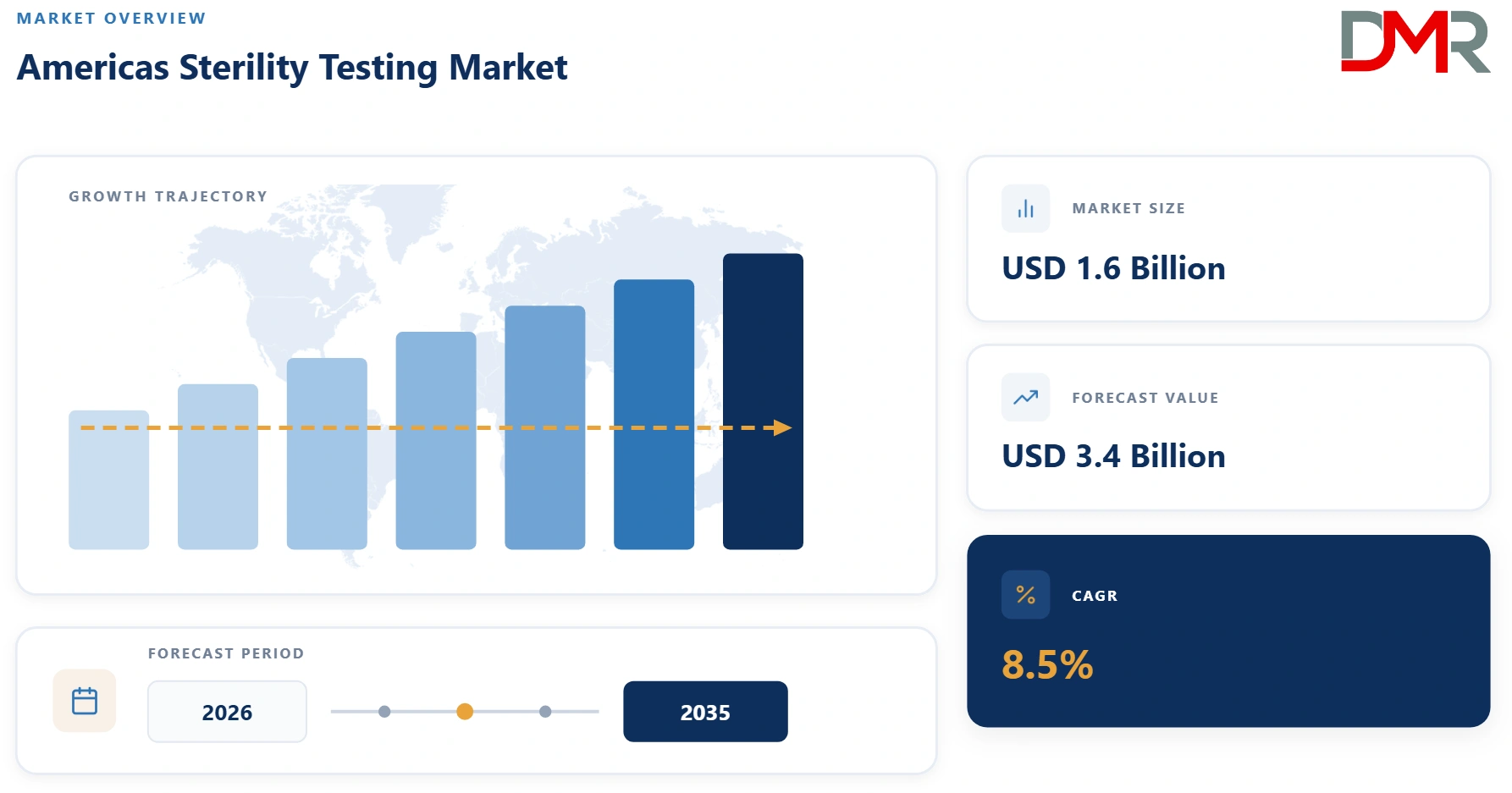
- Americas Sterility Testing Market Size in 2026: USD 1.6 Billion
- Americas Sterility Testing Market Size in 2035: USD 3.4 Billion
- Americas CAGR from 2026 to 2035: 8.5%
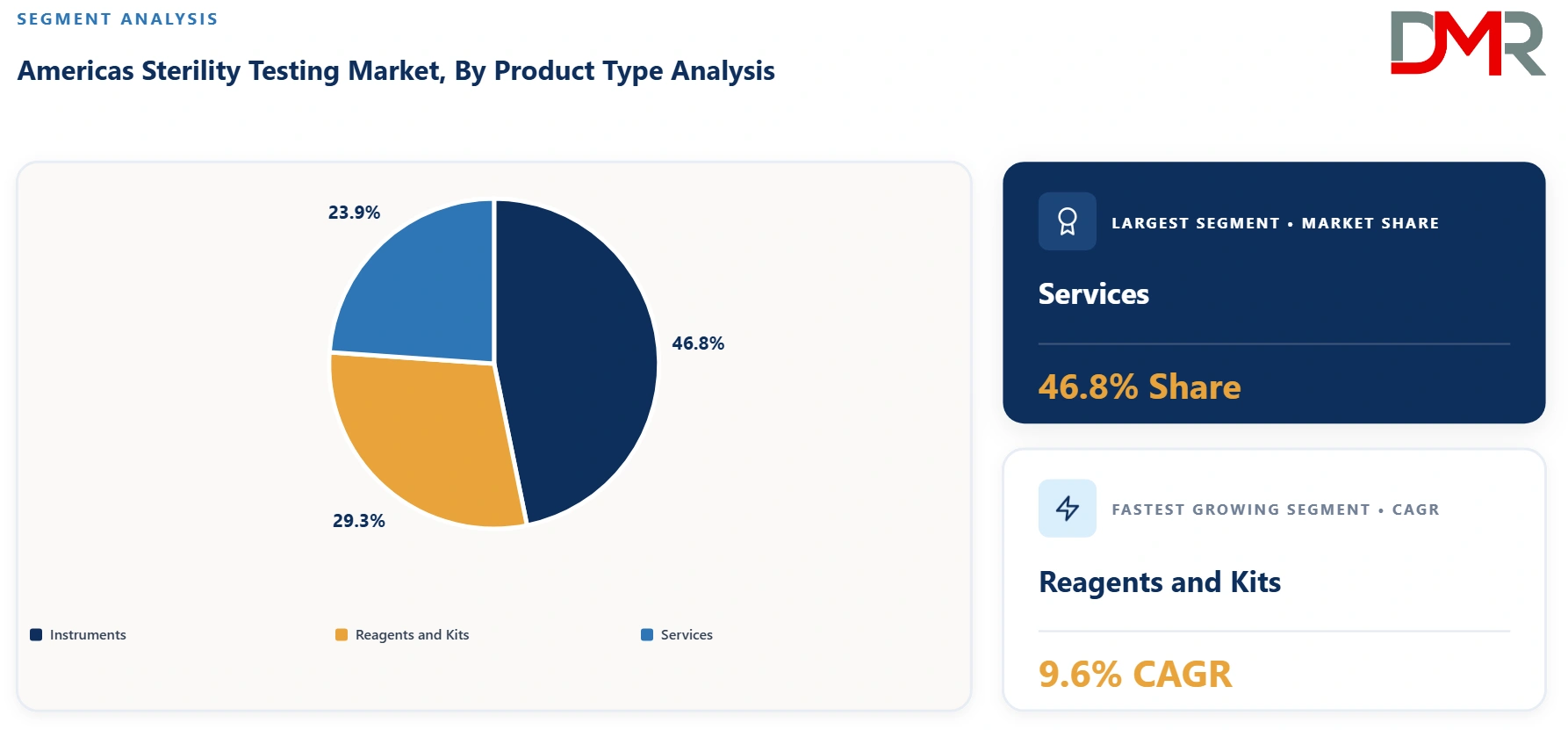
- Services is the leading product type segment in 2026: 46.8%
- Membrane Filtration is the leading test type segment in 2026: 52.4%
- Pharmaceutical Manufacturing is the leading application segment in 2026: 44.6%
- Pharmaceutical and Biotechnology Companies is the leading end user segment in 2026: 58.3%
What is the Americas Sterility Testing Market and its Market Size?
The Americas Sterility Testing Market is projected to be valued at USD 1.6 Billion in 2026 and is projected to reach USD 3.4 Billion by 2035, expanding at a CAGR of 8.5% during the forecast period.
ℹ
To learn more about this report –
Download Your Free Sample Report Here
Growth is being propelled by rapidly expanding cell and gene therapy manufacturing activity across the United States requiring rigorous, product-specific sterility testing protocols distinct from traditional pharmaceutical manufacturing quality control, sustained pharmaceutical and biologics manufacturing growth across the region driving baseline sterility testing volume, and continued regulatory emphasis from the FDA and Latin American regulatory authorities on rigorous sterility assurance throughout the biopharmaceutical manufacturing supply chain. The maturing of rapid sterility testing technologies offering substantially faster time-to-result compared to traditional compendial methods requiring extended incubation periods, growing contract testing laboratory capacity expansion serving both established pharmaceutical manufacturers and an expanding base of smaller biotechnology companies lacking in-house testing infrastructure, and continued Latin American pharmaceutical and medical device manufacturing capacity growth across Brazil, Mexico, and other leading regional economies are reshaping the market from a traditional, compendial-method-dominated quality control function into an increasingly rapid, technology-enabled, and outsourced testing service industry. Investment is accelerating as sterility testing providers expand rapid testing capability and contract laboratory capacity to serve the region's growing and increasingly complex biopharmaceutical manufacturing base.
Use Cases
- Sterility Testing for Cell and Gene Therapy Product Release: Cell and gene therapy manufacturers use specialized sterility testing protocols, often incorporating rapid testing methods, to support product release decisions for these typically short-shelf-life, patient-specific therapeutic products where traditional multi-day compendial sterility testing timelines can be clinically impractical.
- Membrane Filtration Sterility Testing for Injectable Pharmaceutical Products: Pharmaceutical manufacturers use membrane filtration sterility testing methods to validate the sterility of injectable drug products prior to batch release, representing one of the most widely used traditional sterility testing approaches across the pharmaceutical manufacturing industry.
- Contract Sterility Testing Services for Smaller Biotechnology Companies: Smaller biotechnology companies without in-house sterility testing infrastructure engage contract testing laboratories to perform required sterility testing supporting both clinical trial material release and eventual commercial product manufacturing quality control.
- Medical Device Sterility Validation Testing: Medical device manufacturers use sterility testing services to validate sterilization process effectiveness and support regulatory submissions for both new device approvals and ongoing quality control of sterile medical device manufacturing.
Key Takeaways
- Market Size: The Americas Sterility Testing Market is anticipated to be valued at USD 1.6 Billion in 2026 and is forecast to reach USD 3.4 Billion by 2035, expanding at a CAGR of 8.5%.
- Growth Outlook: Market expansion is sustained by rapidly expanding cell and gene therapy manufacturing activity requiring specialized sterility testing, sustained pharmaceutical and biologics manufacturing growth, and continued Latin American pharmaceutical and medical device manufacturing capacity expansion.
- Primary Growth Drivers: Rapidly expanding cell and gene therapy manufacturing requiring specialized rapid sterility testing protocols, sustained pharmaceutical and biologics manufacturing volume growth, continued regulatory emphasis on rigorous sterility assurance, and growing contract testing laboratory capacity serving smaller biotechnology companies are accelerating market growth.
- By Product Type Analysis: Services is projected to lead the product type segment with a 46.8% share in 2026, reflecting substantial contract testing laboratory service demand from biopharmaceutical manufacturers. Reagents and Kits is the fastest-growing product type segment at 9.6% CAGR, driven by rising testing volume and adoption of rapid testing method consumables.
- By Test Type Analysis: Membrane Filtration is expected to dominate with a 52.4% share in 2026, reflecting its established, widely validated role as a standard compendial sterility testing method. Rapid Sterility Testing is the fastest-growing test type segment at 12.8% CAGR, driven by cell and gene therapy manufacturing demand for faster time-to-result testing methods.
- By Application Analysis: Pharmaceutical Manufacturing is poised to lead with a 44.6% share in 2026, reflecting the substantial scale of the region's pharmaceutical manufacturing base. Cell and Gene Therapy Manufacturing is the fastest-growing application segment at 16.4% CAGR, driven by rapidly expanding advanced therapy manufacturing activity, particularly across the United States.
- By End User Analysis: Pharmaceutical and Biotechnology Companies are projected to dominate with a 58.3% share in 2026, reflecting their position as the primary demand source for sterility testing across both in-house and outsourced testing models. Contract Testing Laboratories is the fastest-growing end user segment at 10.9% CAGR, driven by growing outsourcing of sterility testing among smaller biotechnology companies.
- By Region Analysis: North America is expected to command a 78.4% share in 2026, reflecting the scale of its pharmaceutical, biotechnology, and cell and gene therapy manufacturing base relative to Latin America. Latin America is the fastest-growing region segment at 10.6% CAGR, driven by continued pharmaceutical and medical device manufacturing capacity growth across Brazil, Mexico, and other leading regional economies.
Key Drivers in the Americas Sterility Testing Market
Rapidly Expanding Cell and Gene Therapy Manufacturing Requiring Specialized Sterility Testing
The United States has experienced substantial growth in cell and gene therapy manufacturing activity, supporting an expanding pipeline of advanced therapy products progressing through clinical development toward commercial approval. These products often present unique sterility testing challenges given their typically short shelf life, patient-specific manufacturing processes, and the clinical impracticality of traditional compendial sterility testing methods requiring multi-day incubation periods before product release. This dynamic is driving substantial demand for rapid sterility testing methods and specialized testing protocols specifically adapted to advanced therapy manufacturing requirements, representing one of the most significant growth drivers within the broader sterility testing market.
Sustained Pharmaceutical and Biologics Manufacturing Volume Growth
Continued growth in pharmaceutical and biologics manufacturing volume across the Americas, reflecting both sustained demand for established drug products and continued approval and commercial launch of new biopharmaceutical products, provides a broad and durable underlying demand base for sterility testing services. As baseline pharmaceutical manufacturing activity continues to expand across the region, corresponding sterility testing volume requirements grow correspondingly, given the essential and non-discretionary nature of sterility testing as a quality control requirement for sterile pharmaceutical and biologic products.
Restraints in the Americas Sterility Testing Market
Extended Timeline and Cost Requirements of Traditional Compendial Sterility Testing Methods
Traditional compendial sterility testing methods, requiring extended incubation periods of fourteen days or more under standard regulatory guidelines, represent a meaningful restraint on the Americas Sterility Testing Market by creating manufacturing and supply chain timeline constraints, particularly for products with time-sensitive release requirements. While rapid testing methods continue to gain regulatory acceptance and adoption, the continued predominance of traditional compendial methods for many product categories creates ongoing operational friction and cost burden for manufacturers, particularly smaller companies with more limited capital available for extended product inventory holding periods during testing.
Growth Opportunities in the Americas Sterility Testing Market
Rapid Sterility Testing Method Validation and Regulatory Acceptance Expansion
Growing regulatory openness to rapid sterility testing methods, particularly for time-sensitive advanced therapy products, presents a substantial opportunity for testing technology companies and contract laboratories to expand validated rapid testing method availability and regulatory acceptance across a broader range of product categories beyond cell and gene therapy applications alone. Companies capable of generating the validation data supporting expanded rapid method regulatory acceptance can capture significant market share as manufacturers increasingly seek to reduce testing-related timeline and cost burden.
Latin American Contract Testing Laboratory Capacity Expansion
Continued pharmaceutical and medical device manufacturing capacity growth across Brazil, Mexico, and other leading Latin American markets presents a substantial opportunity for contract testing laboratory companies to expand regional testing capacity and service capability, reducing manufacturer reliance on testing services located in North America or requiring international sample shipment. Companies establishing strong regional testing laboratory infrastructure and regulatory expertise serving Latin American manufacturers can capture significant growth as regional manufacturing capacity continues expanding.
Trends in the Americas Sterility Testing Market
Growing Regulatory Acceptance and Adoption of Rapid Sterility Testing Methods
Regulatory authorities across the Americas, led by the FDA's continued engagement with rapid microbiological method validation frameworks, are increasingly accepting rapid sterility testing methods as valid alternatives to traditional compendial approaches for an expanding range of product categories. This growing regulatory acceptance trend is encouraging broader manufacturer adoption of rapid testing technology, supporting faster product release timelines and reduced testing-related inventory holding costs.
Continued Consolidation Among Contract Sterility Testing Service Providers
The Americas Sterility Testing Market is experiencing continued consolidation as larger contract testing laboratory companies acquire smaller specialized providers to expand geographic coverage, testing method capability breadth, and therapeutic area expertise, particularly within the rapidly growing cell and gene therapy testing segment. This consolidation trend reflects the capital intensity required for comprehensive rapid testing technology investment and the scale advantages available to larger providers serving increasingly complex, multi-product manufacturer testing needs.
Research Scope and Analysis
The Americas Sterility Testing Market is segmented by product type, test type, application, end user, and region, covering instruments, reagents, and services, membrane filtration, direct inoculation, and rapid testing methods, and pharmaceutical, medical device, and cell and gene therapy applications across North American and Latin American country markets.
ℹ
To learn more about this report –
Download Your Free Sample Report Here
By Product Type Analysis
Services is projected to dominate the Americas Sterility Testing Market with approximately 46.8% share in 2026, reflecting substantial contract testing laboratory service demand from pharmaceutical, biotechnology, and medical device manufacturers, particularly smaller companies lacking in-house testing infrastructure. Reagents and Kits is expected to register the highest CAGR of 9.6% during 2026-2035, driven by rising overall testing volume and growing adoption of rapid testing method consumables supporting faster time-to-result sterility testing protocols.
By Test Type Analysis
Membrane Filtration is anticipated to dominate the Americas Sterility Testing Market by test type, accounting for approximately 52.4% share in 2026, supported by its established and widely validated role as the standard compendial sterility testing method across the majority of pharmaceutical and biologic product categories. Rapid Sterility Testing is projected to register the highest CAGR of 12.8% between 2026 and 2035, driven by growing cell and gene therapy manufacturing demand for faster time-to-result testing methods supporting time-sensitive advanced therapy product release requirements.
By Application Analysis
Pharmaceutical Manufacturing is projected to lead the Americas Sterility Testing Market with an estimated 44.6% share in 2026, reflecting the substantial scale of the region's established pharmaceutical manufacturing base requiring routine sterility testing as part of standard quality control processes. Cell and Gene Therapy Manufacturing is expected to register the fastest CAGR of 16.4% through 2035, driven by rapidly expanding advanced therapy manufacturing activity, particularly across the United States, requiring specialized and often rapid sterility testing protocols.
By End User Analysis
Pharmaceutical and Biotechnology Companies are projected to dominate the Americas Sterility Testing Market with approximately 58.3% share in 2026, reflecting their position as the primary demand source for sterility testing across both in-house testing capability and outsourced contract laboratory service models. Contract Testing Laboratories is expected to register the fastest CAGR of 10.9% through 2035, driven by growing outsourcing of sterility testing among smaller biotechnology companies lacking capital for in-house testing infrastructure investment.
The Americas Sterility Testing Market Report is segmented based on the following:
By Product Type
- Instruments
- Reagents and Kits
- Services
By Test Type
- Membrane Filtration
- Direct Inoculation
- Rapid Sterility Testing
By Application
- Pharmaceutical Manufacturing
- Medical Device Manufacturing
- Cell and Gene Therapy Manufacturing
- Vaccine Manufacturing
- Others
By End User
- Pharmaceutical and Biotechnology Companies
- Medical Device Companies
- Contract Testing Laboratories
- Academic and Research Institutes
By Region Analysis
North America, comprising the United States and Canada, is projected to lead the Americas Sterility Testing Market with an estimated 78.4% share in 2026, reflecting the substantial scale of its pharmaceutical, biotechnology, and cell and gene therapy manufacturing base relative to Latin America. Latin America, comprising Mexico, Brazil, Colombia, Argentina, and the Rest of LATAM, is expected to register the fastest CAGR of 10.6% through 2035, driven by continued pharmaceutical and medical device manufacturing capacity growth across the region's leading economies.
By Region
North America
Latin America
- Mexico
- Brazil
- Colombia
- Argentina
- Rest of LATAM
Technology Analysis
Technology development is central to the trajectory of the Americas Sterility Testing Market as companies invest in rapid microbiological detection technology leveraging ATP bioluminescence, flow cytometry, and molecular detection methods capable of substantially reducing sterility testing time-to-result compared to traditional compendial approaches. Growing use of automated testing platforms is improving testing throughput and reducing manual handling-related contamination risk across high-volume testing laboratory operations. Opportunities are expanding for companies developing validated rapid testing methods suited to an expanding range of product categories beyond cell and gene therapy applications, as well as digital laboratory information management systems supporting testing data documentation and regulatory compliance. However, achieving broad regulatory acceptance and manufacturer confidence in rapid testing method equivalence to traditional compendial approaches remains an ongoing validation and industry adoption challenge.
Investment and White Space Analysis
Investment opportunities in the Americas Sterility Testing Market are expanding alongside rapidly growing cell and gene therapy manufacturing activity, sustained pharmaceutical and biologics manufacturing volume growth, and continued Latin American pharmaceutical and medical device manufacturing capacity expansion. Significant white space exists in rapid sterility testing method validation and regulatory acceptance expansion, Latin American contract testing laboratory capacity development, and specialized testing protocols supporting advanced therapy manufacturing requirements. Companies with strong rapid testing technology capability, established regulatory validation expertise, and regional testing laboratory infrastructure across both North and Latin America are positioned to capture premium, longer-duration growth opportunities. However, the extended timeline and cost requirements of traditional compendial methods, combined with the capital intensity of rapid testing technology validation and regulatory acceptance efforts, can constrain the pace of market transformation toward faster testing approaches.
Competitive Landscape
The Americas Sterility Testing Market is moderately consolidated and increasingly competitive, comprising large diversified global contract testing and laboratory services companies with substantial Americas operations, specialized rapid sterility testing technology companies, and regional Latin American testing laboratories. Competition centers on rapid testing technology capability and regulatory validation credentials, established relationships with pharmaceutical, biotechnology, and cell and gene therapy manufacturers, testing laboratory capacity and geographic coverage, and regulatory compliance expertise across diverse Americas regulatory jurisdictions. Large diversified testing companies benefit from broad service capability and established manufacturer relationships, while specialized rapid testing technology companies compete through deep technical expertise in faster time-to-result testing methods. Companies increasingly differentiate through rapid testing capability and cell and gene therapy-specific testing protocol expertise rather than traditional compendial testing capacity alone.
Some of the prominent players in the Americas Sterility Testing Market are:
- Charles River Laboratories
- Sartorius AG
- Merck KGaA (MilliporeSigma)
- Thermo Fisher Scientific
- SGS Life Sciences
- Eurofins Scientific
- Lonza Group
- WuXi AppTec (Americas Operations)
- Nelson Laboratories (Sotera Health)
- STERIS Applied Sterilization Technologies
- BioMérieux
- Rapid Micro Biosystems
- Cherwell Laboratories
- Boston Analytical
- Pace Analytical Life Sciences
- North American Science Associates (NAMSA)
- WuXi Biologics Testing Services
- Toxikon Corporation
- Analytical Bio-Chemistry Laboratories (ABC Laboratories)
- Other Key Players
Recent Developments
- July 2026: Charles River Laboratories International, Inc. announced the expansion of its rapid sterility testing laboratory capacity in the United States, targeting rising demand from cell and gene therapy manufacturers requiring faster product release timelines.
- June 2026: Eurofins Scientific announced a new Brazilian testing facility, aimed at reducing sample shipment requirements for pharmaceutical and medical device manufacturers across Latin America.
- May 2026: Rapid Micro Biosystems, Inc. announced FDA validation acceptance for an expanded product category range, broadening the applicability of its Growth Direct rapid sterility testing platform.
- April 2026: Nelson Laboratories, LLC announced a strategic partnership with a leading U.S. cell therapy manufacturer to develop specialized sterility testing protocols supporting commercial-scale advanced therapy product release.
Report Details
| Report Characteristics |
| Market Size (2026) |
USD 1.6 Bn |
| Forecast Value (2035) |
USD 3.4 Bn |
| CAGR (2026–2035) |
8.5% |
| Historical Data |
2021 – 2025 |
| Forecast Data |
2026 – 2035 |
| Base Year |
2025 |
| Segments Covered |
By Product Type, By Test Type, By Application, and By End User |
| Country Coverage |
North America (United States, Canada); Latin America (Mexico, Brazil, Colombia, Argentina, Rest of LATAM) |
Frequently Asked Questions
How big is the Americas Sterility Testing Market?
▾ The Americas Sterility Testing Market is projected to valued at USD 1.6 Billion in 2026 and is projected to reach USD 3.4 Billion by 2035, reflecting rapidly expanding cell and gene therapy manufacturing activity and sustained pharmaceutical manufacturing growth across the region.
What is the CAGR of the Americas Sterility Testing Market from 2026 to 2035?
▾ The market is projected to expand at a compound annual growth rate (CAGR) of 8.5% between 2026 and 2035, supported by growing rapid testing method adoption, cell and gene therapy manufacturing expansion, and continued Latin American manufacturing capacity growth.
What factors are driving the growth of the Americas Sterility Testing Market?
▾ Growth is driven by rapidly expanding cell and gene therapy manufacturing requiring specialized rapid sterility testing protocols, sustained pharmaceutical and biologics manufacturing volume growth, continued regulatory emphasis on rigorous sterility assurance, and growing contract testing laboratory capacity serving smaller biotechnology companies.
What are the major trends in the Americas Sterility Testing Market?
▾ Major trends include growing regulatory acceptance and adoption of rapid sterility testing methods, continued consolidation among contract sterility testing service providers, and rising demand for specialized testing protocols supporting advanced therapy manufacturing.
Who are the key players in the Americas Sterility Testing Market?
▾ Key market participants include Charles River Laboratories, Sartorius AG, Merck KGaA (MilliporeSigma), Thermo Fisher Scientific, and SGS Life Sciences, among other global and regional sterility testing service providers.
How is the Americas Sterility Testing Market segmented?
▾ The market is segmented by product type, test type, application, end user, and region, with North America comprising the United States and Canada, and Latin America comprising Mexico, Brazil, Colombia, Argentina, and the Rest of LATAM.