Americas Wearable Medical Device Market Snapshot
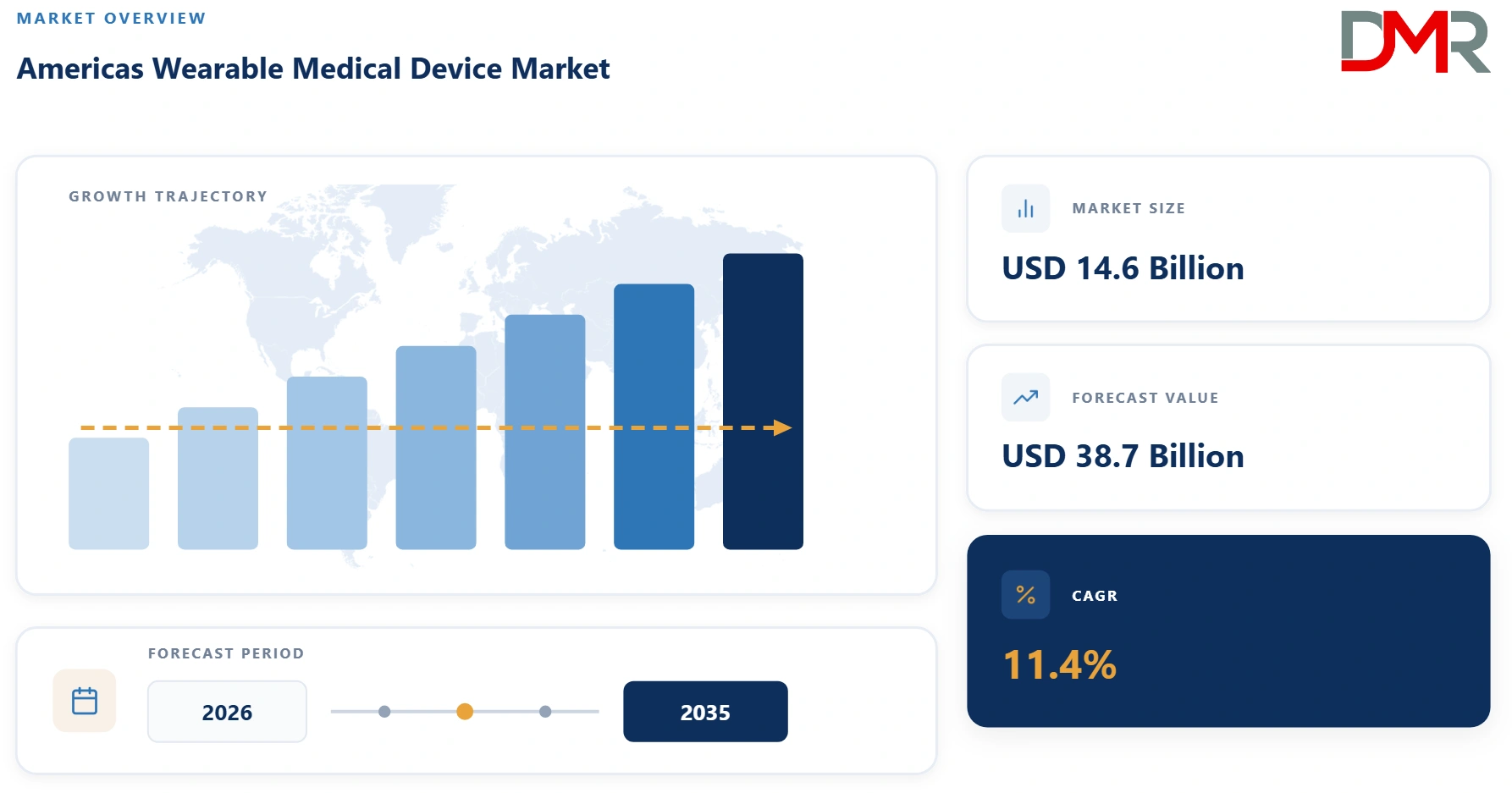
- Americas Wearable Medical Device Market Size in 2026: USD 14.6 Billion
- Americas Wearable Medical Device Market Size in 2035: USD 38.7 Billion
- Americas CAGR from 2026 to 2035: 11.4%
- Diagnostic Devices is the leading product segment in 2026: 54.8%
- Strap/Clip/Bracelet is the leading site segment in 2026: 46.3%
- Remote Patient Monitoring is the leading application segment in 2026: 42.7%
What is the Americas Wearable Medical Device Market and its Market Size?
The Americas Wearable Medical Device Market is projected to be valued at USD 14.6 Billion in 2026 and is projected to reach USD 38.7 Billion by 2035, expanding at a CAGR of 11.4% during the forecast period.
ℹ
To learn more about this report –
Download Your Free Sample Report Here
Growth is being propelled by rapid expansion of remote patient monitoring programs across U.S. and Canadian healthcare systems supporting virtual care and hospital-at-home models, sustained growth in chronic disease prevalence including diabetes and cardiovascular disease driving demand for continuous glucose monitoring and cardiac monitoring wearables, and rising consumer health consciousness across the Americas supporting sustained growth in sport and fitness-oriented wearable device adoption that increasingly incorporates clinical-grade diagnostic capability. The maturing of miniaturized sensor technology enabling increasingly sophisticated diagnostic and therapeutic wearable devices, growing insurance payer and healthcare system reimbursement support for remote patient monitoring reducing hospital readmission rates and supporting value-based care models, and continued Latin American healthcare technology adoption expansion across Brazil, Mexico, and other leading regional markets are reshaping the market from a largely consumer fitness-oriented device category into an increasingly clinically integrated, diagnostic and therapeutic wearable medical device industry. Investment is accelerating as device manufacturers and healthcare systems expand wearable device integration into mainstream clinical care pathways across the region.
Use Cases
- Continuous Glucose Monitoring for Diabetes Management: Patients with diabetes across the United States, Canada, and growing Latin American markets use wearable continuous glucose monitoring devices providing real-time metabolic data, reducing reliance on traditional fingerstick testing and supporting improved diabetes management outcomes.
- Remote Patient Monitoring for Post-Discharge and Hospital-at-Home Programs: Healthcare systems deploy wearable vital sign monitoring devices, including heart rate monitors and pulse oximeters, supporting hospital-at-home and post-discharge remote patient monitoring programs that allow patients to receive appropriate levels of monitoring while recovering at home.
- Sleep Monitoring for Sleep Disorder Diagnosis and Management: Patients and sleep medicine specialists use wearable sleep tracking devices and portable polysomnography systems to diagnose and monitor sleep disorders, offering a more accessible alternative to traditional in-laboratory sleep studies.
- Neurostimulation Devices for Chronic Pain Management: Patients with chronic pain conditions use wearable neurostimulation devices as a non-pharmacological pain management approach, reflecting growing clinical and patient interest in alternatives to opioid-based pain management given ongoing opioid-related public health concerns across the Americas.
Key Takeaways
- Market Size: The Americas Wearable Medical Device Market is anticipated to be valued at USD 14.6 Billion in 2026 and is forecast to reach USD 38.7 Billion by 2035, expanding at a CAGR of 11.4%.
- Growth Outlook: Market expansion is sustained by rapid expansion of remote patient monitoring programs, sustained chronic disease prevalence growth driving diagnostic and therapeutic wearable demand, and rising consumer health consciousness supporting clinical-grade fitness wearable adoption.
- Primary Growth Drivers: Rapid expansion of remote patient monitoring and hospital-at-home programs, sustained growth in diabetes and cardiovascular disease prevalence, growing insurance payer reimbursement support for remote monitoring, and rising consumer adoption of clinical-grade fitness and health monitoring wearables are accelerating market growth.
- By Product Analysis: Diagnostic Devices is projected to lead the product segment with a 54.8% share in 2026, reflecting substantial vital sign and sleep monitoring device adoption across both clinical and consumer use cases. Therapeutic Devices is the fastest-growing product segment at 13.6% CAGR, driven by expanding insulin pump, neurostimulation, and respiratory therapy device adoption.
- By Site Analysis: Strap/Clip/Bracelet is expected to dominate with a 46.3% share in 2026, reflecting the widespread comfort and convenience of wrist and body-worn form factors for continuous monitoring. Handheld is the fastest-growing site segment at 10.8% CAGR, driven by growing portable diagnostic and therapeutic device adoption.
- By Application Analysis: Remote Patient Monitoring is poised to lead with a 42.7% share in 2026, reflecting rapid healthcare system adoption of virtual care and hospital-at-home program infrastructure. Remote Patient Monitoring is also the fastest-growing application segment given sustained healthcare system investment in this care delivery model.
- By Region Analysis: North America is expected to command a 76.4% share in 2026, reflecting the scale of its healthcare system and established remote patient monitoring infrastructure relative to Latin America. Latin America is the fastest-growing region segment at 13.9% CAGR, driven by growing healthcare technology adoption and expanding chronic disease management program investment across Brazil, Mexico, and other leading Latin American markets.
Key Drivers in the Americas Wearable Medical Device Market
Rapid Expansion of Remote Patient Monitoring and Hospital-at-Home Programs
U.S. and Canadian healthcare systems continue to rapidly expand remote patient monitoring and hospital-at-home program infrastructure, driven by both patient preference for receiving care at home and healthcare system interest in reducing hospital bed occupancy while maintaining appropriate clinical oversight for eligible patients. This expansion is directly driving substantial wearable medical device demand, as these programs rely fundamentally on wearable vital sign and other monitoring devices to provide the continuous clinical data necessary to safely manage patients outside traditional hospital settings, positioning wearable devices as essential infrastructure for this rapidly growing care delivery model.
Sustained Growth in Diabetes and Cardiovascular Disease Prevalence
Continued growth in diabetes and cardiovascular disease prevalence across the Americas, reflecting demographic aging and lifestyle factors affecting both North American and Latin American populations, is driving sustained demand for wearable diagnostic and therapeutic devices including continuous glucose monitors, insulin pumps, and cardiac monitoring wearables. This chronic disease-driven demand provides a durable, clinically necessary foundation for wearable medical device market growth that is largely independent of shorter-term consumer technology adoption trends affecting the broader wearables market.
Restraints in the Americas Wearable Medical Device Market
Data Privacy and Cybersecurity Concerns for Connected Medical Devices
Growing consumer and regulatory attention to data privacy and cybersecurity risks associated with connected wearable medical devices, given the sensitive nature of health data these devices collect and transmit, represents a meaningful restraint on the Americas Wearable Medical Device Market. Manufacturers must invest substantially in data security and privacy protection to comply with evolving healthcare data protection regulation across both U.S. and Latin American jurisdictions, while well-publicized data security incidents affecting connected health device manufacturers can undermine broader consumer and clinical trust in wearable medical device adoption.
Growth Opportunities in the Americas Wearable Medical Device Market
Insurance Reimbursement Pathway Development for Remote Monitoring Device Categories
Growing insurance payer interest in reimbursing remote patient monitoring services given demonstrated value in reducing hospital readmissions and supporting value-based care models presents a significant opportunity for wearable device manufacturers capable of navigating reimbursement pathway development effectively. Companies that develop strong clinical evidence supporting cost and outcome benefits of their wearable monitoring devices can capture substantial adoption growth as healthcare systems and payers increasingly view remote monitoring wearables as reimbursable, value-generating clinical tools rather than optional consumer conveniences.
Latin American Healthcare Technology Adoption and Chronic Disease Management Expansion
Continued healthcare technology adoption and chronic disease management program development across Brazil, Mexico, Colombia, and Argentina presents a substantial opportunity for wearable medical device manufacturers to expand regional distribution and market development presence. Companies establishing strong distribution relationships and affordable product positioning suited to Latin American healthcare system economics can capture significant growth as regional chronic disease management and remote monitoring program investment continues expanding.
Trends in the Americas Wearable Medical Device Market
Growing Convergence Between Consumer Fitness Wearables and Clinical-Grade Diagnostic Capability
Consumer fitness wearable devices across the Americas increasingly incorporate clinical-grade diagnostic sensing capability, including electrocardiogram functionality and blood oxygen monitoring, blurring the traditional distinction between consumer wellness devices and clinically validated medical devices. This convergence trend is expanding the addressable market for wearable sensing technology while creating new regulatory and clinical validation considerations as consumer-oriented devices increasingly perform functions traditionally associated with dedicated medical devices.
Continued Integration of Wearable Data with Electronic Health Record and Digital Health Platforms
Wearable medical device manufacturers across the Americas are increasingly developing products designed for seamless integration with hospital electronic health record systems and broader digital health platforms, enabling wearable-generated diagnostic and monitoring data to flow directly into clinical workflows. This integration trend reflects both technical necessity for supporting remote patient monitoring and hospital-at-home programs and growing recognition that data integration capability represents an increasingly important competitive differentiator for wearable medical device adoption within clinical settings.
Research Scope and Analysis
The Americas Wearable Medical Device Market is segmented by product, site, application, and region, covering diagnostic devices, neuromonitoring devices, therapeutic devices, wearable form factors, and home healthcare, sport and fitness, and remote patient monitoring applications across North American and Latin American country markets.
ℹ
To learn more about this report –
Download Your Free Sample Report Here
By Product Analysis
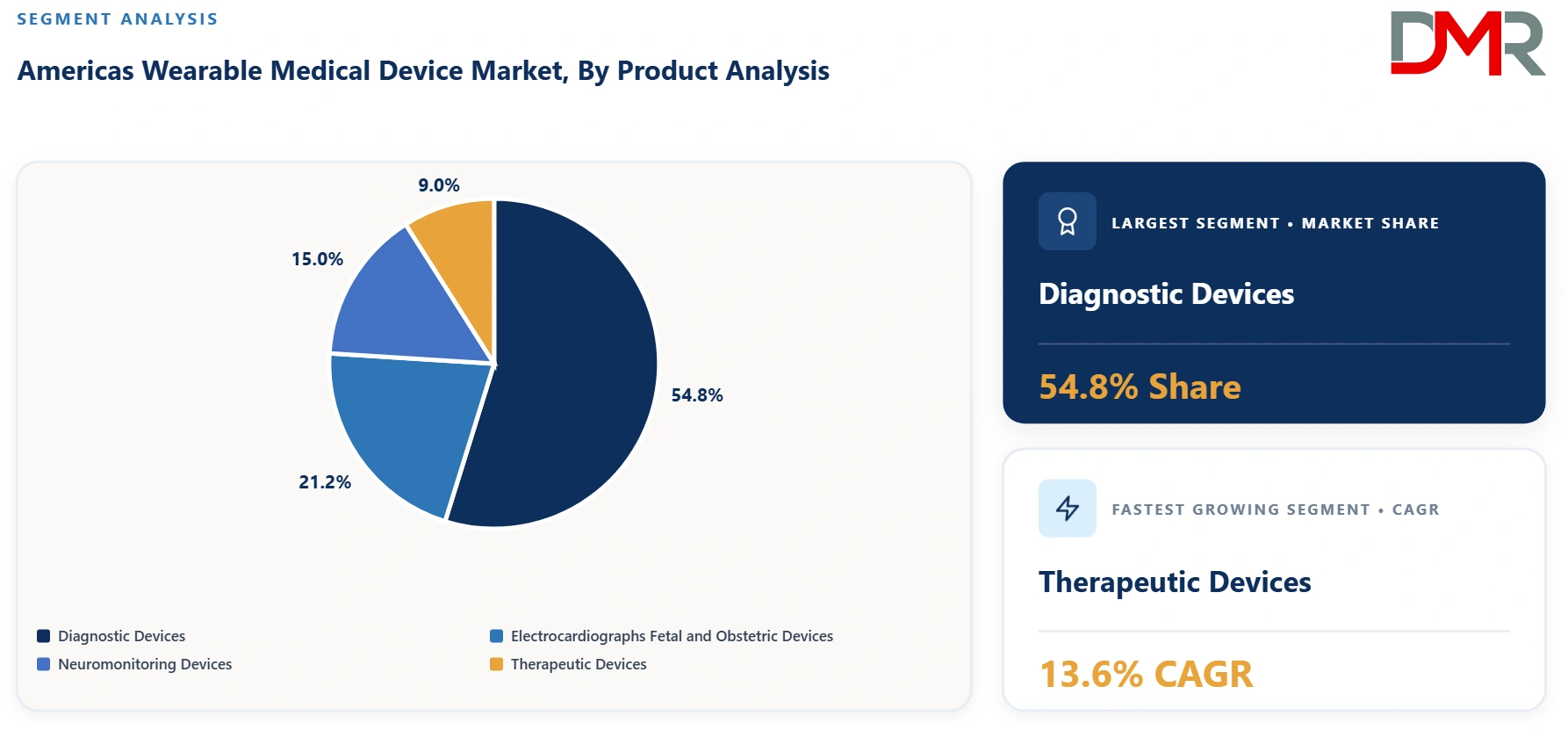
Diagnostic Devices is projected to dominate the Americas Wearable Medical Device Market with approximately 54.8% share in 2026, reflecting substantial vital sign monitoring device adoption spanning heart rate monitors, activity monitors, electrocardiographs, and pulse oximeters across both clinical remote monitoring and consumer health tracking use cases. Therapeutic Devices is expected to register the highest CAGR of 13.6% during 2026-2035, driven by expanding insulin pump, neurostimulation pain management, and respiratory therapy device adoption addressing the region's substantial chronic disease burden.
By Site Analysis
Strap/Clip/Bracelet is anticipated to dominate the Americas Wearable Medical Device Market by site, accounting for approximately 46.3% share in 2026, reflecting the widespread comfort, convenience, and continuous wear suitability of wrist and body-worn form factors across both diagnostic monitoring and consumer fitness applications. Handheld is projected to register the highest CAGR of 10.8% between 2026 and 2035, driven by growing portable diagnostic and therapeutic device adoption offering flexible, on-demand monitoring and treatment capability.
By Application Analysis
Remote Patient Monitoring is projected to lead the Americas Wearable Medical Device Market with an estimated 42.7% share in 2026, reflecting rapid U.S. and Canadian healthcare system adoption of virtual care and hospital-at-home program infrastructure requiring continuous wearable device-based patient monitoring. Remote Patient Monitoring also represents the fastest-growing application segment overall, given sustained and accelerating healthcare system investment in this increasingly reimbursed and clinically validated care delivery model.
The Americas Wearable Medical Device Market Report is segmented based on the following:
By Product
- Diagnostic Devices
- Vital Sign Monitoring Devices
- Heart Rate Monitors
- Activity Monitors
- Electrocardiographs
- Pulse Oximeters
- Spirometers
- Others
- Sleep Monitoring Devices
- Sleep Trackers
- Wrist Actigraphs
- Polysomnography
- Others
- Electrocardiographs Fetal and Obstetric Devices
- Neuromonitoring Devices
- Electroencephalographs
- Electromyographs
- Others
- Therapeutic Devices
- Pain Management Devices
- Neurostimulation Devices
- Others
- Insulin/Glucose Monitoring Devices
- Rehabilitation Devices
- Accelerometers
- Sensing Devices
- Ultrasound Platform
- Others
- Respiratory Therapy Devices
- Ventilators
- Positive Airway Pressure Devices
- Portable Oxygen Concentrators
- Others
By Site
- Strap/Clip/Bracelet
- Headband
- Handheld
- Shoe Sensors
- Others
By Application
- Home Healthcare
- Sport & Fitness
- Remote Patient Monitoring
By Region Analysis
North America, comprising the United States and Canada, is projected to lead the Americas Wearable Medical Device Market with an estimated 76.4% share in 2026, reflecting the substantial scale of its healthcare system, established remote patient monitoring infrastructure, and consumer wearable technology adoption relative to Latin America. Latin America, comprising Mexico, Brazil, Colombia, Argentina, and the Rest of LATAM, is expected to register the fastest CAGR of 13.9% through 2035, driven by growing healthcare technology adoption and expanding chronic disease management program investment across the region's leading economies.
By Region
North America
Latin America
- Mexico
- Brazil
- Colombia
- Argentina
- Rest of LATAM
Technology Analysis
Technology development is central to the trajectory of the Americas Wearable Medical Device Market as companies invest in miniaturized, low-power sensor technology enabling increasingly sophisticated continuous monitoring capability, AI-enhanced signal processing improving diagnostic accuracy and reducing false alerts, and advanced battery technology extending device wear time between charging. Growing integration of cellular and Bluetooth connectivity is supporting seamless data transmission from wearable devices to clinical monitoring platforms without requiring separate smartphone intermediary devices. Opportunities are expanding for companies developing multi-parameter wearable devices capable of simultaneously monitoring several vital signs or biomarkers, as well as devices specifically engineered for elderly and dexterity-limited patient populations who represent a substantial portion of the chronic disease monitoring market. However, achieving reliable, clinically validated device performance while managing data privacy and cybersecurity requirements remains an ongoing technical and regulatory consideration across the industry.
Investment and White Space Analysis
Investment opportunities in the Americas Wearable Medical Device Market are expanding alongside rapid remote patient monitoring program growth, sustained chronic disease prevalence increases, and rising consumer adoption of clinical-grade health monitoring wearables. Significant white space exists in insurance reimbursement pathway development for remote monitoring device categories, Latin American healthcare technology adoption and distribution expansion, and continued convergence between consumer fitness and clinical diagnostic device capability. Companies with strong clinical evidence generation capability, established relationships with major North American healthcare systems and payers, and Latin American market development capability are positioned to capture premium, longer-duration growth opportunities. However, data privacy and cybersecurity concerns for connected medical devices, along with the regulatory complexity of navigating both consumer product and medical device regulatory pathways, can constrain the pace of market expansion for smaller or newly entering manufacturers.
Competitive Landscape
The Americas Wearable Medical Device Market is moderately consolidated and increasingly competitive, comprising large diversified global medical device and consumer technology companies with substantial Americas operations, specialized wearable medical device manufacturers focused on specific diagnostic or therapeutic categories, and regional Latin American medical device distributors. Competition centers on clinical validation and regulatory approval credentials, data privacy and cybersecurity capability, established relationships with major North American healthcare systems and payers, and Latin American market distribution and affordability positioning. Large diversified companies benefit from substantial research and development resources and broad product portfolios spanning both consumer and clinical wearable categories, while specialized manufacturers compete through deep technical expertise in specific diagnostic or therapeutic device categories. Companies increasingly differentiate through clinical evidence generation and healthcare system integration capability rather than device functionality alone.
Some of the prominent players in the Americas Wearable Medical Device Market are:
- Abbott Laboratories
- Apple Inc.
- Garmin Ltd.
- Fitbit, Inc.
- Medtronic plc
- Dexcom, Inc.
- Masimo Corporation
- Koninklijke Philips N.V.
- GE HealthCare Technologies Inc.
- Boston Scientific Corporation
- BioTelemetry, Inc.
- iRhythm Technologies, Inc.
- Insulet Corporation
- ResMed Inc.
- Omron Healthcare, Inc.
- BioIntelliSense, Inc.
- VitalConnect, Inc.
- Preventice Solutions, Inc.
- AliveCor, Inc.
- Biobeat Technologies Ltd.
- Empatica Inc.
- Current Health Ltd.
- WHOOP, Inc.
- Oura Health Oy
- Polar Electro Oy
- Withings SA
- Huawei Technologies Co., Ltd.
- Samsung Electronics Co., Ltd.
- Xiaomi Corporation
- Sony Corporation
- Zephyr Technology Corporation
- Sotera Wireless, Inc.
- LifeSignals Group Inc.
- Cardiac Insight, Inc.
- Biovotion AG
- Qardio, Inc.
- MC10, Inc.
- Valencell, Inc.
- Nuubo Smart Solutions Technologies, S.L.
- Vivalink Inc.
- Other Key Players
Recent Developments
- July 2026: Dexcom was selected as the first participant in the U.S. FDA’s TEMPO Digital Health Devices Pilot Program, supporting an AI-powered glucose health program integrating Dexcom G7 and Stelo data for chronic disease management. DexCom Investors
- June 2026: Masimo received FDA 510(k) clearance for AI-enabled opioid-induced respiratory depression detection on its Radius VSM wearable continuous patient monitor, strengthening continuous hospital-based vital-sign monitoring capabilities. Masimo
- May 2026: HeartBeam initiated a clinical pilot study of its 12-lead ECG extended-wear patch, designed to provide continuous rhythm monitoring and on-demand 12-lead ECG recordings outside traditional clinical settings. HeartBeam, Inc.+1
- April 2026: Withings Health Solutions was accepted into the inaugural CMS ACCESS Model, enabling its connected-health technologies to support technology-enabled chronic care for Medicare beneficiaries across the United States.
Report Details
| Report Characteristics |
| Market Size (2026) |
USD 14.6 Bn |
| Forecast Value (2035) |
USD 38.7 Bn |
| CAGR (2026–2035) |
11.4% |
| Historical Data |
2021 – 2025 |
| Forecast Data |
2026 – 2035 |
| Base Year |
2025 |
| Segments Covered |
By Product, By Site, By Application |
| Country Coverage |
North America (United States, Canada), Latin America (Mexico, Brazil, Colombia, Argentina, Rest of LATAM) |
Frequently Asked Questions
How big is the Americas Wearable Medical Device Market?
▾ The Americas Wearable Medical Device Market is projected to be valued at USD 14.6 Billion in 2026 and is projected to reach USD 38.7 Billion by 2035, reflecting rapid remote patient monitoring program expansion and sustained chronic disease prevalence growth across the region.
What is the CAGR of the Americas Wearable Medical Device Market from 2026 to 2035?
▾ The market is projected to expand at a compound annual growth rate (CAGR) of 11.4% between 2026 and 2035, supported by remote patient monitoring adoption, growing insurance reimbursement support, and expanding Latin American healthcare technology adoption.
What factors are driving the growth of the Americas Wearable Medical Device Market?
▾ Growth is driven by rapid expansion of remote patient monitoring and hospital-at-home programs, sustained growth in diabetes and cardiovascular disease prevalence, growing insurance payer reimbursement support for remote monitoring, and rising consumer adoption of clinical-grade fitness and health monitoring wearables.
What are the major trends in the Americas Wearable Medical Device Market?
▾ Major trends include growing convergence between consumer fitness wearables and clinical-grade diagnostic capability, continued integration of wearable data with electronic health record and digital health platforms, and rising adoption of multi-parameter monitoring devices.
Who are the key players in the Americas Wearable Medical Device Market?
▾ Key market participants include Medtronic, Abbott Laboratories, Dexcom Inc., Insulet Corporation, and Philips Healthcare, among other global medical device and consumer technology companies.
How is the Americas Wearable Medical Device Market segmented?
▾ The market is segmented by product, site, and application, with North America comprising the United States and Canada, and Latin America comprising Mexico, Brazil, Colombia, Argentina, and the Rest of LATAM.