Australia Meat Processing Equipment Market Snapshot
- Australia Meat Processing Equipment Market Size in 2026: USD 620.3 million
- Australia Meat Processing Equipment Market Size in 2035: USD 985.0 million
- Australia CAGR from 2026 to 2035: 5.3%
- Cutting and Slicing Equipment is the leading equipment type segment in 2026: 25.4%
- Fully Automated is the leading automation level segment in 2026: 52.6%
- Beef and Veal is the leading meat type segment in 2026: 42.3%
What Is the Australia Meat Processing Equipment Market and Its Market Size?
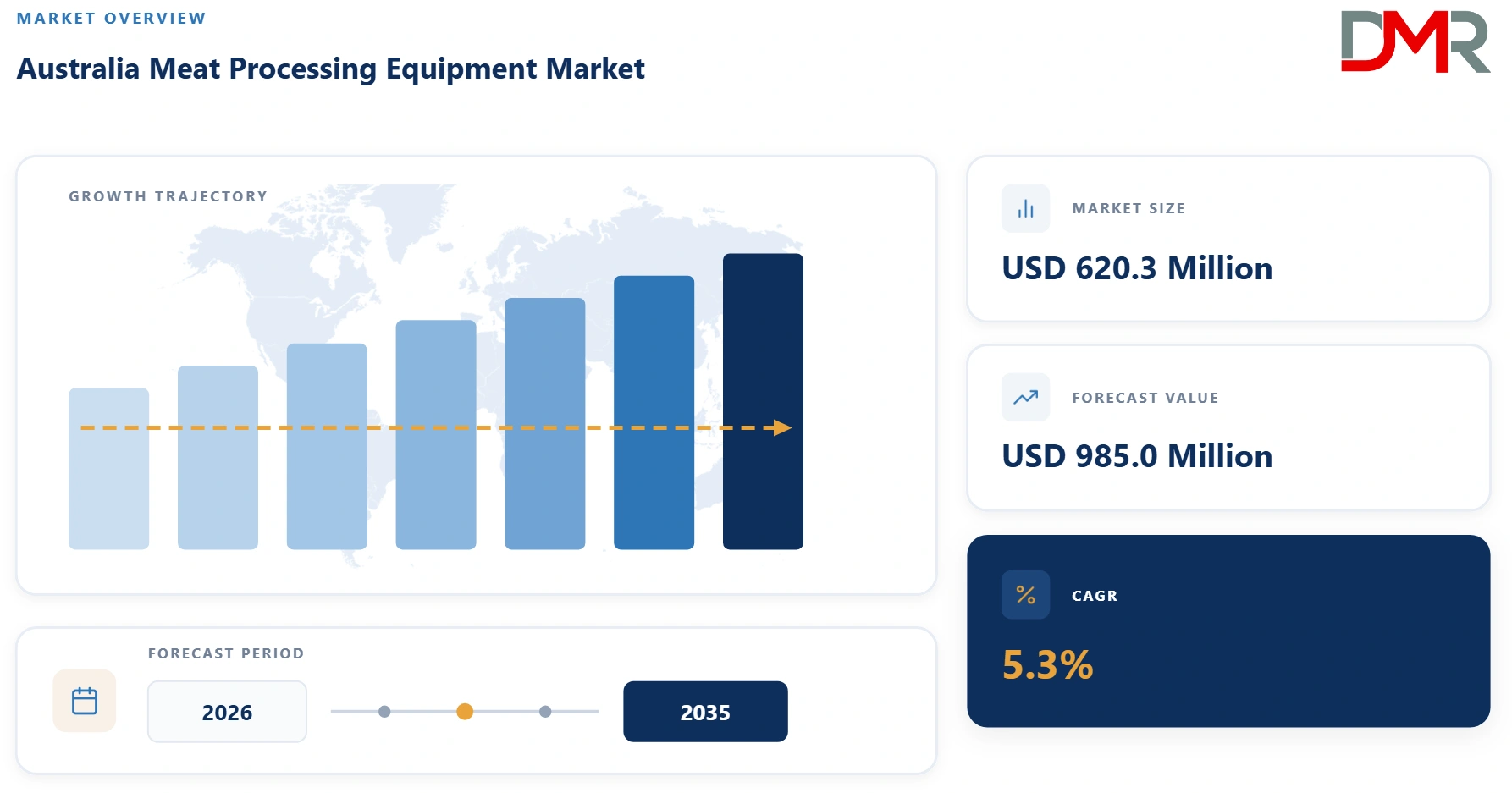
The Australia Meat Processing Equipment Market is projected to reach USD 620.3 million in 2026 and grow at a compound annual growth rate of 5.3% until 2035 to reach a value of USD 985.0 million.
ℹ
To learn more about this report –
Download Your Free Sample Report Here
Meat processing equipment includes machinery used for cutting, slicing, grinding, mixing, tenderizing, tumbling, filling, smoking, cooking, dicing, and portioning meat products. Australia has an advanced meat-processing industry supported by large cattle and sheep populations, high domestic poultry consumption, export-oriented abattoirs, established cold-chain infrastructure, and strict food-safety standards. Growing automation, workforce constraints, export demand, yield optimization, traceability, and processor investment in value-added products are strengthening demand for modern equipment.
Use Cases
- Primary meat processing: Australian abattoirs use cutting, slicing, deboning, trimming, tenderizing, and portioning equipment to convert carcasses into standardized commercial cuts. Automated systems improve processing speed, worker safety, carcass yield, hygiene, and cut consistency. Machine vision and robotic cutting technologies can identify anatomical features, optimize cutting paths, reduce product loss, and support high-volume beef, lamb, pork, and poultry processing operations.
- Value-added meat manufacturing: Manufacturers use grinders, mixers, tumblers, fillers, cookers, smokers, and portioning systems to produce sausages, patties, marinated meat, deli products, nuggets, ready meals, and other prepared foods. Programmable equipment maintains recipe consistency, temperature, texture, moisture retention, cooking accuracy, and standardized weights while helping suppliers meet changing requirements across supermarkets, restaurants, foodservice operators, convenience stores, and institutional customers.
- Export compliance and traceability: Export-oriented processors use automated weighing, grading, labeling, inspection, temperature monitoring, and traceability technologies to satisfy destination-market requirements. Connected equipment records production batches, carcass identification, quality parameters, processing conditions, and packaging information. These systems support audits, reduce recall risk, demonstrate halal or customer-specific compliance, and help Australian processors maintain access to high-value markets across Asia, North America, Europe, and the Middle East.
Key Takeaways
- Market Size: The Australia Meat Processing Equipment Market is anticipated to be valued at USD 620.3 million in 2026 and is forecast to reach USD 985.0 million by 2035, expanding at a CAGR of 5.3%.
- Growth Rate and Outlook: Market expansion is supported by record meat exports, strong beef and sheep-meat production, growing poultry consumption, labor-saving automation, processing-facility modernization, food-safety requirements, digital traceability, and rising demand for portioned, marinated, cooked, and ready-to-eat meat products.
- Primary Growth Drivers: Increasing slaughter volumes, strong export demand, high labor costs, workforce shortages, worker-safety concerns, strict buyer specifications, sustainability requirements, and processor efforts to increase usable carcass yield are accelerating investment in automated cutting, portioning, mixing, cooking, inspection, and factory-control systems.
- By Equipment Type Analysis: Cutting and Slicing Equipment is projected to lead with approximately 25.4% of market revenue in 2026, supported by its essential role in carcass breakdown, trimming, portion preparation, slicing, and retail-ready production. Dicing and Portioning Equipment is forecast to record the highest CAGR of approximately 6.2% through 2035.
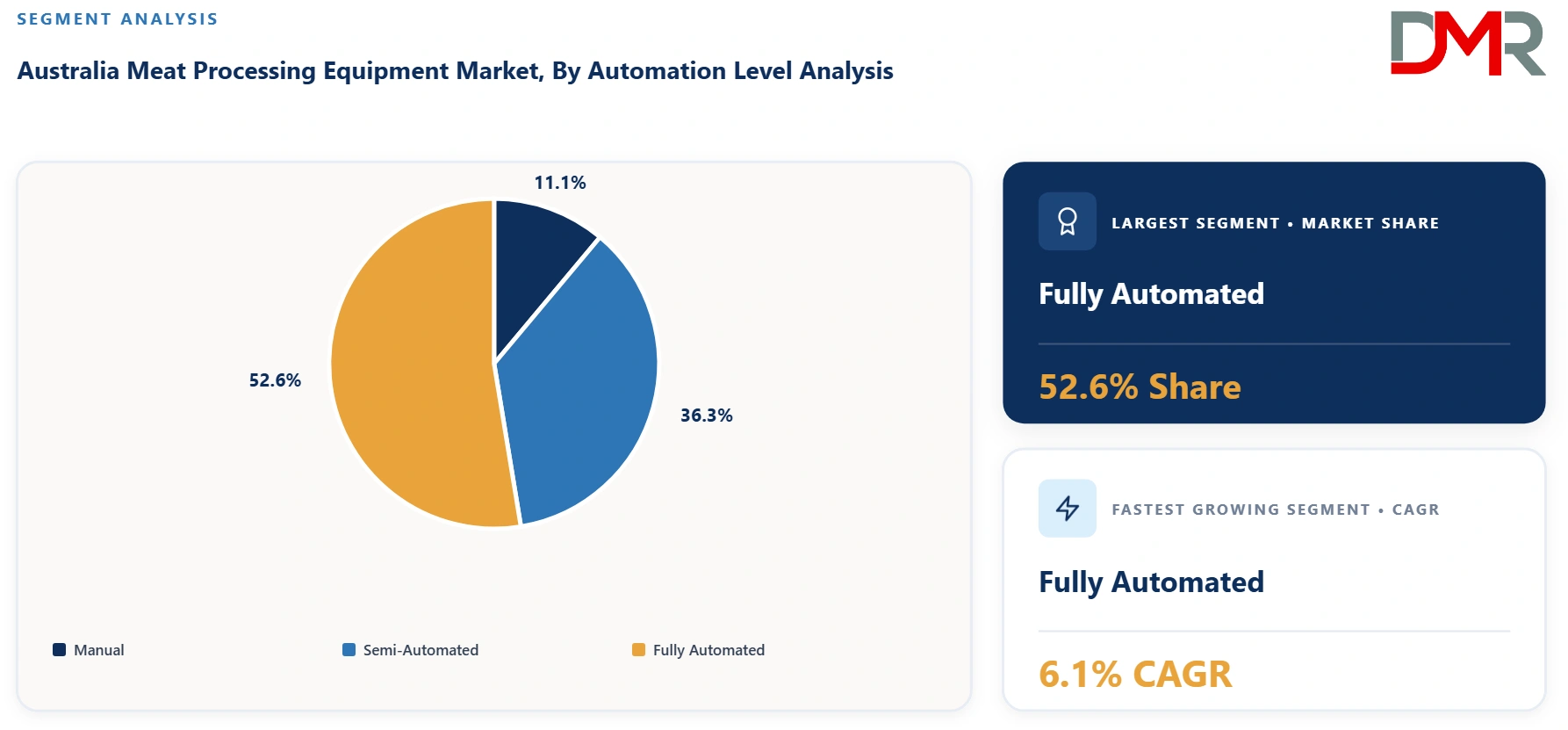
- By Automation Level Analysis: Fully Automated equipment is anticipated to dominate with approximately 52.6% of the market in 2026. Its position reflects Australia’s high labor costs, large export-oriented processing plants, worker-safety priorities, and demand for consistent output. The segment is also projected to grow fastest at approximately 6.1% through 2035.
- By Meat Type Analysis: Beef and Veal is expected to lead with approximately 42.3% of the market in 2026, supported by Australia’s large cattle population and export-focused beef industry. Poultry is forecast to achieve the highest CAGR of approximately 5.9%, driven by affordability, high domestic consumption, vertical integration, and demand for convenient chicken products.
How AI and Generative AI Are Transforming the Australia Meat Processing Equipment Market
Artificial intelligence is improving carcass grading, robotic cutting, defect detection, portion control, predictive maintenance, and production planning. AI-enabled cameras analyze carcass shape, fat coverage, marbling, color, and cut locations, allowing automated systems to maximize yield and consistency. Connected sensors identify equipment wear before breakdowns occur. Generative AI supports troubleshooting, operator training, maintenance documentation, production scheduling, and recipe development. Digital twins also help processors simulate line layouts, production speeds, bottlenecks, energy requirements, and equipment configurations before committing capital to factory modernization.
Key Drivers in the Australia Meat Processing Equipment Market
Record Beef and Sheep-Meat Export Volumes
Australia exported a record 1,545,784 tonnes of beef in 2025, representing a 15% increase from 2024, according to Meat and Livestock Australia. Sheep-meat exports were also projected to reach a record 657,000 tonnes in 2024-2025, supported by demand from the United States, China, the Middle East, and other markets. High export volumes require processors to increase throughput while meeting exact specifications for cut size, weight, quality, labeling, traceability, and hygiene, encouraging investment in automated cutting, portioning, inspection, weighing, packaging, and production-control technologies.
Large Production Base and Strong Domestic Consumption
The Australian Bureau of Statistics recorded approximately 2.3 million cattle slaughtered and 706,296 tonnes of beef produced during the June 2025 quarter. Australia’s chicken industry also generated an estimated gross production value of AUD 4.2 billion in 2024-2025, while annual chicken consumption reached approximately 54 kilograms per person. These volumes support continuous demand for replacement machinery, capacity expansion, processing-line upgrades, and maintenance services. Producers are investing in grinders, mixers, fillers, cookers, slicers, deboning systems, and automated material-handling solutions to meet retail, foodservice, export, and value-added manufacturing requirements.
Restraints in the Australia Meat Processing Equipment Market
High Capital Expenditure and Integration Costs
Advanced processing systems require significant spending on machinery, factory redesign, installation, controls, refrigeration, utilities, sanitation, software, employee training, and regulatory validation. Fully automated cutting or deboning lines may also require machine vision, robotic cells, conveyors, weighing systems, safety barriers, and production-management platforms. These costs can limit adoption among smaller regional processors. Imported equipment is additionally exposed to currency fluctuations, shipping expenses, spare-parts availability, and overseas technical-support costs. Processors may delay modernization when livestock availability, selling prices, export demand, or utilization levels create uncertainty around investment payback periods.
Operational Complexity and Variable Raw Materials
Cattle, sheep, pigs, and poultry differ by weight, breed, age, fat distribution, bone structure, and carcass dimensions. This biological variation makes automation more complex than processing standardized manufactured inputs. Equipment must adapt without damaging premium cuts or reducing usable yield. Seasonal livestock availability, drought, disease, feed costs, and regional supply changes can also affect facility utilization. Processors require flexible systems, skilled technicians, accurate calibration, and effective operator training. Technology that performs well in large standardized facilities may deliver weaker returns in smaller plants handling several species or frequently changing product specifications.
Growth Opportunities in the Australia Meat Processing Equipment Market
Robotic Automation and Worker-Safety Improvement
Robotic cutting, lifting, handling, deboning, packing, and palletizing systems offer strong opportunities because meat processing involves repetitive tasks, sharp tools, cold working environments, and heavy physical loads. Automation can reduce worker exposure to injuries while improving production consistency and throughput. Opportunities are growing for collaborative robots, machine-vision cutting systems, automated carcass measurement, and retrofit solutions that modernize selected operations without replacing complete lines. Equipment manufacturers can differentiate through local application engineering, operator training, remote diagnostics, preventive maintenance, and solutions designed specifically for Australian beef, lamb, pork, and poultry-processing conditions.
Expansion of Value-Added Meat Production
Demand for marinated meat, portion-controlled cuts, sausages, burger patties, deli products, cooked meat, ready meals, and convenient poultry products creates opportunities beyond primary slaughtering. These products require grinding, mixing, tumbling, filling, coating, cooking, smoking, slicing, and precision-portioning systems. Processors can improve margins by converting lower-value cuts and trimmings into branded or retail-ready products. Flexible equipment with rapid recipe changes and hygienic cleaning can support multiple products on one line. Growth in supermarkets, foodservice, online grocery, meal kits, and export-ready packaged products will strengthen this opportunity.
Trends in the Australia Meat Processing Equipment Market
Connected Factories and Digital Traceability
Processors are connecting machinery with manufacturing-execution systems to monitor yield, downtime, throughput, temperatures, energy use, labor efficiency, and maintenance requirements. Digital platforms can link livestock identification and carcass data with processing, packaging, storage, and shipment records. This improves traceability, audit preparation, production planning, and recall management. Predictive-maintenance tools use vibration, temperature, load, and operating data to identify emerging equipment problems. Demand is consequently shifting from isolated machines toward integrated solutions combining processing equipment, controls, sensors, software, analytics, cybersecurity, technical services, and long-term performance support.
Sustainability and Yield Optimization
Australian processors are focusing on equipment that reduces water, energy, product giveaway, waste, and refrigeration requirements. Intelligent cutting systems can increase recoverable meat from each carcass, while accurate portioning reduces overweight packs. Variable-speed motors, efficient cooking systems, heat recovery, optimized cleaning, and automated shutdown controls can lower operating costs. Processors are also investing in equipment that converts fat, bones, blood, offal, and trimmings into pet food, rendered products, ingredients, fertilizers, and bioenergy. Sustainability performance is becoming increasingly important for export customers, retailers, investors, and corporate reporting.
Research Scope and Analysis
Australia Meat Processing Equipment Market research covers cutting and slicing equipment, grinding and mixing equipment, massaging and tumbling equipment, tenderizing equipment, filling and stuffing equipment, smoking and cooking equipment, dicing and portioning equipment, other processing equipment, manual systems, semi-automated systems, fully automated systems, pork, beef and veal, poultry, mutton and lamb, other meat categories nationwide.
ℹ
To learn more about this report –
Download Your Free Sample Report Here
By Equipment Type Analysis
Cutting and Slicing Equipment is projected to dominate with approximately 25.4% of market revenue in 2026, supported by extensive use in primary carcass processing, trimming, slicing, and retail portion preparation. Automated systems improve precision, throughput, safety, and usable yield. Dicing and Portioning Equipment is expected to record the highest CAGR of approximately 6.2%, exceeding overall market growth as demand for standardized retail, foodservice, and export portions increases.
By Automation Level Analysis
Fully Automated equipment is anticipated to lead with approximately 52.6% of market revenue in 2026, reflecting Australia’s high labor costs, large processing plants, worker-safety requirements, and export-oriented production. The segment is also forecast to record the highest CAGR of approximately 6.1% through 2035. Machine vision, robotics, digital controls, automated inspection, and predictive maintenance will support adoption across beef, lamb, pork, and poultry facilities.
By Meat Type Analysis
Beef and Veal is projected to dominate with approximately 42.3% of the market in 2026, supported by Australia’s large cattle population, substantial beef production, and record export volumes. Poultry is anticipated to record the highest CAGR of approximately 5.9% through 2035. Its growth is supported by affordability, high per-capita consumption, vertically integrated production, and demand for portioned, marinated, cooked, and convenience-oriented chicken products.
The Australia Meat Processing Equipment Market Report Is Segmented Based on the Following
By Equipment Type
- Cutting and Slicing Equipment
- Grinding and Mixing Equipment
- Massaging and Tumbling Equipment
- Tenderizing Equipment
- Filling and Stuffing Equipment
- Smoking and Cooking Equipment
- Dicing and Portioning Equipment
- Other Processing Equipment
By Automation Level
- Manual
- Semi-Automated
- Fully Automated
By Meat Type
- Pork
- Beef and Veal
- Poultry
- Mutton and Lamb
- Others
Technology Analysis
Australia’s meat-processing industry is adopting robotic cutting, machine vision, artificial intelligence, digital traceability, automated grading, predictive maintenance, and factory-management software. Advanced cameras and sensors can analyze carcass dimensions, identify cutting locations, assess quality, and guide robotic equipment. These technologies improve yield, consistency, safety, and throughput while reducing reliance on difficult-to-recruit labor. Opportunities exist for modular automation, equipment retrofits, local software integration, and remote servicing. However, high implementation costs, legacy-system incompatibility, cybersecurity risks, calibration requirements, and shortages of specialist technicians may slow adoption. Technology leadership will increasingly determine equipment-supplier competitiveness and processor profitability.
Export-Import Analysis
Australia’s large beef, lamb, mutton, and offal exports generate sustained demand for processing equipment capable of meeting diverse destination-market specifications. The country exports meat to more than 160 markets, requiring flexible cutting, halal processing, inspection, labeling, and traceability capabilities. Record beef exports and expanding tariff-free quotas under trade agreements support processing-line investment. Australia nevertheless depends substantially on imported high-precision machinery, robotics, sensors, and components from Europe, North America, and Asia. Currency movements, shipping costs, technical-support availability, and spare-parts lead times create procurement risks. Opportunities exist for international manufacturers establishing local distribution, assembly, training, servicing, and parts inventories.
Competitive Landscape
The Australia Meat Processing Equipment Market features global processing-line manufacturers, specialist machinery companies, Australian engineering firms, distributors, automation integrators, and service providers. Competition centers on equipment reliability, yield improvement, hygienic design, processing speed, automation, worker safety, energy efficiency, and lifecycle cost. International suppliers compete through integrated lines, robotics, digital platforms, and application expertise. Australian companies provide localized engineering, fabrication, installation, spare parts, and rapid maintenance. Strong customer relationships are important because processors require equipment trials, customized line design, commissioning, operator training, preventive maintenance, and continuous technical support.
Some of the Prominent Players in the Australia Meat Processing Equipment Market Are
- JBT Marel Corporation
- GEA Group AG
- The Middleby Corporation
- Provisur Technologies Inc.
- Heat and Control Inc.
- TNA Solutions Pty Ltd.
- MULTIVAC Group
- Fortifi Food Processing Solutions
- Frontmatec
- Bettcher Industries Inc.
- Jarvis Products Corporation
- Kentmaster Manufacturing Company
- BAADER
- Bühler Group
- Alfa Laval AB
- Bizerba SE and Co. KG
- Handtmann Group
- VEMAG Maschinenbau GmbH
- Weber Food Technology SE and Co. KG
- Scott Technology Limited
- Foodmate B.V.
- Meyn Food Processing Technology B.V.
- BANSS Schlacht und Fördertechnik GmbH
- Cozzini LLC
- Urschel Laboratories Inc.
- FAM STUMABO
- NOCK Maschinenbau GmbH
- RÜHLE GmbH
- Maschinenfabrik Seydelmann KG
- K+G Wetter GmbH
- LASKA Maschinenfabrik GmbH
- RISCO S.p.A.
- Minerva Omega Group S.r.l.
- Hollymatic Corporation
- BIRO Manufacturing Company
- MAINCA
- Thompson Meat Machinery Pty Ltd.
- Pacific Food Machinery
- Barnco Sales
- CBS Foodtech Pty Ltd.
- Other Key Players
Recent Developments
- April 2026: GEA introduced the MultiJector 500, a modular brine-injection system developed for small and medium-capacity processing lines handling ham, bacon, poultry, fish, and deli products. The system incorporates configurable needles and modular filtration to improve consistency, sanitation, and line availability.
- June 2025: Heat and Control announced the acquisition of Fabcon Food Systems, expanding its capabilities in customized food-processing and handling equipment. The transaction strengthened the company’s ability to offer integrated solutions focused on production yield, efficiency, safety, and material handling.
- May 2025: JBT Marel presented automated meat-processing technologies at IFFA 2025, including the SensorX Magna system for automated detection, rejection, and rework and a compact weigh-price labeler capable of processing up to 70 packages per minute.
Report Details
| Report Characteristics |
| Market Size (2026) |
USD 620.3 Mn |
| Forecast Value (2035) |
USD 985.0 Mn |
| CAGR (2026–2035) |
5.3% |
| Historical Data |
2021 – 2025 |
| Forecast Data |
2026 – 2035 |
| Base Year |
2025 |
| Segments Covered |
By Equipment Type, By Automation Level, By Meat Type |
Frequently Asked Questions
How big is the Australia Meat Processing Equipment Market?
▾ The Australia Meat Processing Equipment Market is projected to reach USD 620.3 million in 2026 and USD 985.0 million by 2035.
What is the CAGR of the Australia Meat Processing Equipment Market from 2026 to 2035?
▾ The market is expected to expand at a compound annual growth rate of approximately 5.3% from 2026 to 2035.
What factors are driving the growth of the Australia Meat Processing Equipment Market?
▾ Growth is driven by record meat exports, high domestic poultry consumption, large cattle and sheep production, workforce shortages, factory modernization, worker-safety requirements, value-added product demand, digital traceability, and adoption of automated processing technologies.
What are the major trends in the Australia Meat Processing Equipment Market?
▾ Major trends include robotic cutting, AI-enabled carcass grading, machine vision, automated portioning, predictive maintenance, connected factories, digital traceability, energy-efficient equipment, sustainable processing, by-product recovery, and flexible multipurpose production lines.
Who are the key players in the Australia Meat Processing Equipment Market?
▾ Key players include JBT Marel, GEA Group, Middleby, Provisur Technologies, Heat and Control, TNA Solutions, MULTIVAC, Fortifi Food Processing Solutions, Frontmatec, Bettcher Industries, Scott Technology, Thompson Meat Machinery, and Pacific Food Machinery.
How is the Australia Meat Processing Equipment Market segmented?
▾ The market is segmented by equipment type into cutting and slicing, grinding and mixing, massaging and tumbling, tenderizing, filling and stuffing, smoking and cooking, dicing and portioning, and other equipment. It is also segmented by automation level and meat type.