Market Snapshot
- Market Size (2026): USD 1.1 Bn
- Forecast Value (2035): USD 4.1 Bn
- CAGR (2026-2035): 15.8%
- Leading By Offering (2026): Cloud Storage & File Hosting, around 43%
- Leading By Deployment Mode (2026): Public Cloud, close to 61%
- Key Players: Google, Microsoft, Apple, and others
What is Australia Personal Cloud Market and its Market Size?
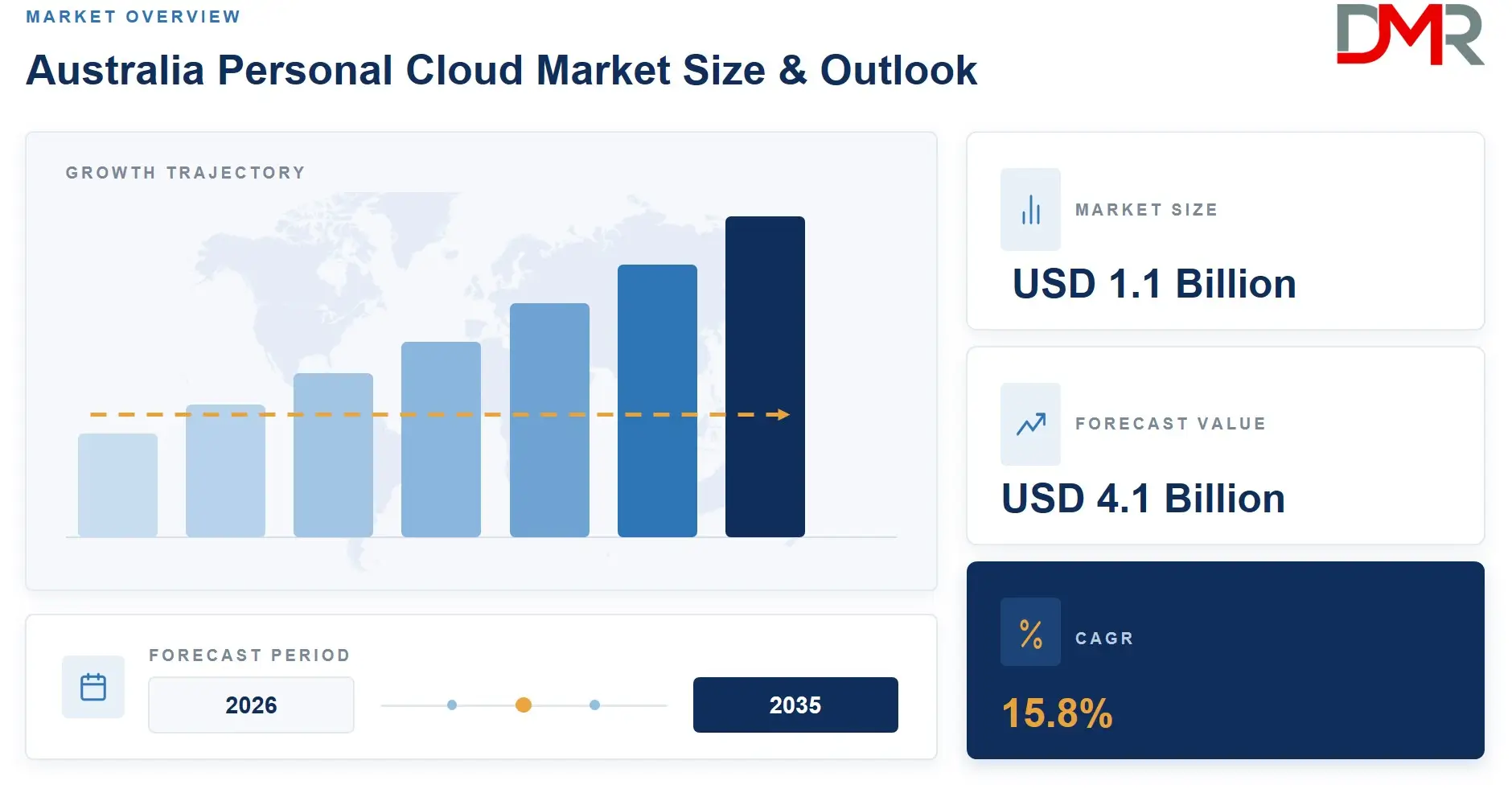
The Australia Personal Cloud Market size is estimated to reach USD 1.1 Bn in 2026 and is further anticipated to reach USD 4.1 Bn by 2035, at a CAGR of 15.8%.
ℹ
To learn more about this report –
Download Your Free Sample Report Here
Personal cloud covers the storage, backup, synchronisation and sharing of individual and household digital content, photos, videos, documents and device backups, delivered through subscription or bundled services rather than self-managed infrastructure. In Australia, the market spans multinational consumer platforms alongside domestically operated storage and NAS offerings from local telecommunications carriers, hosting companies and hardware vendors. The figures reported here describe demand generated by consumers and households located inside Australia, not the worldwide revenue of companies headquartered in the country.
Buyers range from individual smartphone owners backing up photo libraries to multi-person households consolidating storage under a family plan, and increasingly to freelancers who blur the line between personal and small business use. Adoption tracks smartphone camera resolution, home broadband speeds and the accumulation of files that outgrow on-device capacity. As full-fibre and 5G coverage extend across regional Australia, upload speed has stopped being the binding constraint it once was.
What is changing structurally is the blending of storage with intelligence. Providers increasingly bundle automatic photo organisation, duplicate detection and AI-assisted search into the base subscription, turning what was once a passive backup product into an active management layer for a household's digital life. Tightened privacy law and heightened awareness of offshore data handling are pushing buyers toward providers that can demonstrate Australian data residency, even at a premium.
Vendor competition therefore plays out on two axes at once: price per gigabyte for the value-conscious majority, and jurisdictional trust for a smaller but growing segment willing to pay for local hosting. Both dynamics are reshaping how storage, backup and device-management services are packaged and sold to Australian consumers through 2035.
Use Cases
- Family Photo Consolidation: A household with several smartphones and a shared family plan backs up every member's camera roll to one account, deduplicating images across devices and cutting the manual sorting that once consumed hours after school holidays and family events.
- Sole Trader Document Backup: A freelance tradesperson or consultant without an in-house IT function keeps invoices, contracts and project files synced across a phone, laptop and tablet, avoiding the data loss that would otherwise follow a lost or damaged device mid job.
- Regional Household Connectivity: A family outside a capital city, now on faster fixed-wireless or fibre broadband, joins the public cloud majority, approximately 61% of Australian personal cloud users in 2026, replacing external hard drives with cloud backup and cutting the risk of losing family photos to a single device failure.
- Small Business Prosumer Continuity: A two-person design or trades business without dedicated servers relies on shared cloud folders and automatic version history to keep client files synchronised between an office tablet and a technician's phone, avoiding the downtime a lost device would cause.
Key Takeaways
- Market Size & Share: The market is projected to expand from USD 1.1 Bn in 2026 to USD 4.1 Bn by 2035, growing at 15.8% a year as smartphone-led content volumes outpace free storage allowances.
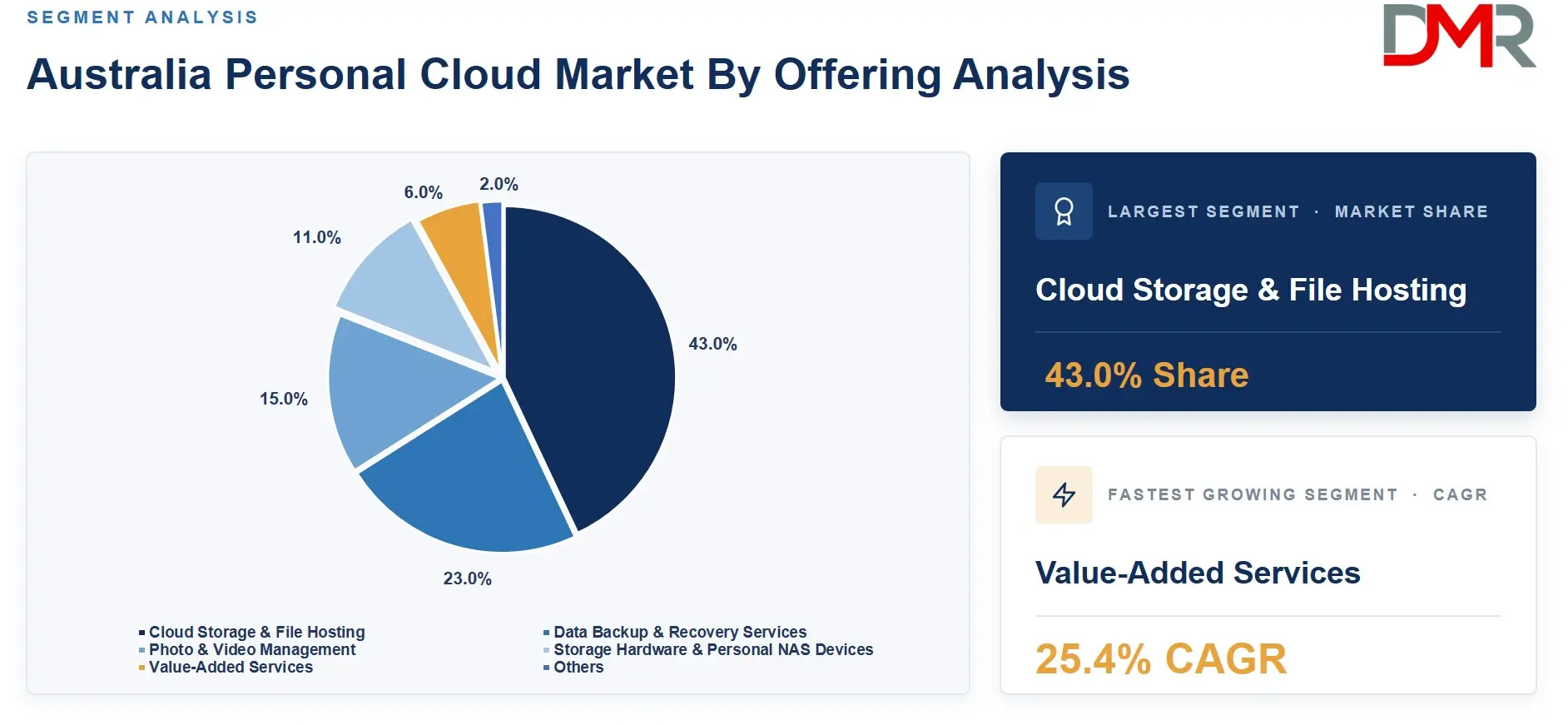
- By Offering Analysis: Cloud Storage & File Hosting holds approximately 43% of 2026 revenue, while Value-Added Services expands at a CAGR of 25.4% through 2035.
- Demand Concentration: Public cloud deployment accounts for close to 61% of 2026 demand, concentrated among smartphone-first consumers in Australia's major metropolitan markets.
- Device Shift: Smartphones are estimated to generate around 48% of 2026 revenue, ahead of laptops and desktops, as camera resolution keeps outpacing free storage tiers.
- Household Adoption: Individual retail consumers represent approximately 54% of 2026 demand, though freelancers and small business users are the fastest-growing end-user group through 2035.
- Regulatory Pressure: Tightened obligations under the Privacy and Other Legislation Amendment Act 2024 are pushing buyers toward providers offering Australian data residency.
How AI/Gen AI is Transforming the Australia Personal Cloud Market?
Artificial intelligence has moved from a marketing add-on to a core differentiator in Australian personal cloud services. Providers use on-device and cloud-side machine learning to organise the photos and video a typical household generates, surfacing faces, places and events without manual tagging. Because this processing runs against content already stored for backup, it costs providers little extra infrastructure while giving subscribers a reason to stay on a paid tier rather than migrate elsewhere.
The more consequential shift is operational rather than consumer-facing. Storage providers apply machine learning to predict capacity growth per account, pre-position frequently accessed files closer to Australian users, and flag anomalous access patterns, a capability regulators increasingly expect given tightened breach notification rules. Generative features remain secondary, layered onto storage rather than replacing it, since Australians still pay chiefly for reliable, private capacity.
- Computer Vision Photo Organisation: Automatic face, object and location tagging across a camera roll, cutting the manual sorting that once discouraged consumers from consolidating storage.
- Anomaly Detection: Machine learning flags unusual sign-ins or bulk downloads, helping providers meet tightened breach notification expectations under Australian privacy law.
- Predictive Tiering: Usage-pattern models forecast which accounts will need more capacity, letting providers cache frequently accessed files closer to Australian users.
- Generative Search and Recall: Natural-language queries let subscribers locate a document or photo by describing its content rather than a file name.
Key Drivers in the Australia Personal Cloud Market
Two forces account for most of the demand growth in Australia's personal cloud market through 2035.
- Smartphone Content Volume Outpacing Free Storage: Australian smartphone cameras now routinely capture images and video at resolutions that fill a free storage allowance within months rather than years, and the average household owns multiple connected devices, each generating its own backlog of photos, documents and app data. As free tiers have stayed largely static while file sizes have grown, a rising share of consumers reach the point where they must delete content or pay for more capacity, and most choose to pay. This is compounded by rising smartphone use among older Australians digitising decades of printed records, widening the buyer base beyond the historically dominant younger, urban cohort.
- Broadband Quality Removing the Upload Bottleneck: For years, patchy fixed-line broadband outside Australia's largest cities made uploading a full photo library or backing up a laptop slow enough to discourage the habit, leaving external hard drives as the default. As full-fibre and fixed-wireless coverage has extended into regional and outer-suburban areas, upload speeds have stopped being the binding constraint, and providers report higher backup completion rates outside capital cities. This removes what was previously the largest practical barrier to converting a household from occasional backups to a standing cloud subscription, and it benefits providers whose applications are tuned for intermittent connections.
Restraints in the Australia Personal Cloud Market
Two brakes temper otherwise favourable adoption trends.
- Data Sovereignty Concerns Over Offshore Storage: A meaningful share of privacy-conscious Australian consumers and small operators remain reluctant to store personal or client records with providers whose servers, and legal jurisdiction, sit outside the country, a concern sharpened by the 2024 tightening of Australia's Privacy Act and its accompanying statutory tort for serious privacy invasions. Switching an entire photo library between providers is also time-consuming for a non-technical user, which locks some households into a provider they are not fully comfortable with, softening the pricing power local challengers might otherwise exercise against multinational incumbents.
- Free-Tier Ceilings and Price Sensitivity: Free storage allowances from the largest platforms remain generous enough that a meaningful share of light users, particularly those who do not shoot much photo or video content, never convert to a paid plan at all, capping the addressable base below total device ownership. Among those who do pay, Australia's relatively high cost of living has made subscription fatigue a visible concern, and personal cloud competes for the same household budget as streaming video and other recurring subscriptions, giving providers limited room to raise prices without triggering cancellations.
Growth Opportunities in the Australia Personal Cloud Market
Two areas of white space stand out for providers willing to specialise.
- Bundling Through Australian Telecommunications Carriers: Telecommunications providers already bill millions of Australian households monthly for mobile and broadband services, giving them a low-friction channel to attach personal cloud storage as a line-item add-on rather than requiring a separate sign-up. Carriers that succeed in bundling storage with existing plans can capture switching-averse customers who would never shop for a dedicated subscription, and the approach also suits older, less technical users who prefer a single monthly bill. This channel remains underdeveloped in Australia relative to other markets, leaving room for a carrier that commits to the category.
- Sovereign and Locally Hosted Tiers for Regulated Households: A small but growing segment, self-employed professionals in regulated fields, trust and estate administrators, and privacy-conscious households, will pay a premium for storage contractually and technically confined to Australian data centres, addressing the compliance anxiety created by recent privacy reform. Providers able to credibly market Australian-only hosting, verified rather than merely claimed, can charge above the undifferentiated worldwide rate, particularly as more domestic data centre capacity comes online to support exactly this kind of domestically anchored offering, a positioning few multinational platforms can credibly claim.
Trends in the Australia Personal Cloud Market
Two shifts are reshaping how personal cloud is bought and used in Australia.
- Convergence of Backup, Photo Management and Family Sharing: What used to be sold as three separate categories, raw file backup, photo-specific storage and family sharing, are converging into a single subscription tier marketed around the household rather than the individual account. Providers increasingly price by household seat count rather than raw gigabytes, reflecting how Australians actually use the product: several family members drawing from one shared pool of storage, with permissions layered on top rather than each person maintaining a separate account and paying independently for their own capacity in isolation from the rest of the household.
- Hardware and Cloud Hybridisation: Rather than choosing between a personal NAS device and a cloud subscription, a growing share of technically confident Australian households run both, using a local device for fast access and large media libraries while syncing a subset to the cloud for off-site disaster recovery. NAS vendors have responded by building cloud relay and mobile-access layers directly into hardware, blurring the line between a one-time hardware purchase and a recurring subscription, and creating a hybrid purchase pattern that pure cloud-only providers cannot fully match on their own.
Research Scope and Analysis
Segment performance is assessed across four axes: offering, deployment mode, device type and end user. Each axis identifies the sub-segment carrying the largest share of 2026 revenue and the one expanding fastest through 2035, along with the commercial reason behind each position.
ℹ
To learn more about this report –
Download Your Free Sample Report Here
By Offering
Cloud Storage & File Hosting is projected to hold the largest share of 2026 revenue, accounting for approximately 43%, since general-purpose file and photo backup remains the default entry point through which most consumers first adopt a paid plan. Its scale reflects the installed base of smartphone and laptop users and the fact that most providers still price this offering as the headline tier. Growth, however, is concentrated in Value-Added Services, layered features such as advanced sharing controls and identity protection, expanding at a CAGR of 25.4% between 2026 and 2035 as providers unbundle premium capability from raw storage and sell it as an incremental upgrade to an already-paying subscriber base.
By Deployment Mode
Public cloud deployment is expected to remain dominant in 2026, accounting for close to 61% of revenue, since the overwhelming majority of Australian consumers have neither the technical inclination nor the hardware budget to run a private storage server, and public platforms offer the lowest-friction path from device to backup. Growth, however, is concentrated in multi-cloud and federated storage arrangements, expanding at a CAGR of 24.1% through 2035, as privacy-conscious households and small operators split sensitive documents onto an Australian-hosted service while keeping bulk photo and video backup on a lower-cost multinational platform, a pattern encouraged by tightened data handling obligations that make single-provider concentration a compliance question rather than a matter of convenience alone.
By Device Type
Smartphones are projected to generate the largest share of 2026 revenue by device type, around 48%, reflecting their role as the primary camera and file-creation device for most Australians and the automatic backup defaults built into mobile operating systems. Growth, however, is concentrated in smart home and IoT devices, security cameras, connected doorbells and home hubs generating continuous video and sensor data, expanding at a CAGR of 26.2% between 2026 and 2035 as smart home adoption climbs from a low base, and each additional connected device adds its own recurring storage requirement, a category most providers only began pricing for separately in the past two to three years, well behind established hardware and storage categories.
By End User
Individual retail consumers account for the largest share of 2026 demand, approximately 54%, purchasing storage primarily for personal photo, video and document backup outside any shared household or business arrangement. Growth, however, is concentrated among freelancers and small business or prosumer users, expanding at a CAGR of 23.7% through 2035, as Australia's rising population of sole traders and gig workers adopts personal cloud tiers to manage client files and invoices without the cost of a dedicated business cloud contract, a segment providers increasingly target with hybrid personal-professional feature sets rather than forcing a choice between consumer and enterprise products, a positioning increasingly common across subscription-based digital service categories in Australia and abroad.
The Australia Personal Cloud Market Report is Segmented Based on the Following
By Offering
- Cloud Storage & File Hosting
- Data Backup & Recovery Services
- Photo & Video Management
- Storage Hardware & Personal NAS Devices
- Value-Added Services
- Others
By Deployment Mode
- Public Cloud
- Hybrid Cloud
- Private Cloud
- Multi-Cloud & Federated Storage
- Others
By Device Type
- Smartphones
- Laptops & Desktops
- Tablets
- Smart Home & IoT Devices
- Others
By End User
- Individual/Retail Consumers
- Households & Family Plans
- Freelancers & Small Business
- Others
Regulatory Landscape
Australia's privacy framework tightened materially with the Privacy and Other Legislation Amendment Act 2024, which raised penalties for serious interference with personal information and introduced a statutory tort that took effect through 2025, giving individuals a direct right of action against organisations that mishandle their data. For personal cloud providers, this raises the stakes of where and how Australian customer data is stored, pushing buyers, particularly small business and prosumer customers, toward providers that can demonstrate local hosting and clear breach response commitments. The opening favours domestically anchored operators able to market compliance credibly, though the added audit and notification burden also raises fixed costs that smaller Australian challengers must absorb before competing on price against larger multinational platforms.
Technology Analysis
Storage infrastructure serving Australian personal cloud demand is shifting from pure object storage toward tiered architectures that pair solid-state caching for frequently accessed files with lower-cost archival layers for cold backups, enabled by falling flash pricing and rising domestic data centre capacity. Machine learning increasingly predicts per-account growth and pre-positions content closer to Australian users, narrowing the latency gap that once separated local services from cheaper offshore alternatives. The commercial opening sits with providers pairing this shift with visible Australian hosting, turning a technical upgrade into a trust argument. The risk is capital intensity: building domestic capacity at the density modern services require is expensive, and providers that cannot fund it risk losing ground as demand concentrates on fewer platforms.
Competitive Landscape
Competition in the Australia Personal Cloud Market spans three groups operating side by side. Multinational technology platforms compete primarily on integrated ecosystem value, bundling storage with an operating system, productivity suite or device family most Australians already use daily, and they compete on price per gigabyte at a scale domestic operators cannot match. Category specialists compete on encryption, privacy positioning or niche feature sets such as unlimited photo storage, carving out buyers who distrust the largest platforms. Domestically headquartered telecommunications carriers, data centre operators and hosting companies compete on a different basis entirely, Australian data residency, bundled billing and local support, a proposition that resonates most with privacy-conscious households and small operators handling regulated client data rather than the price-driven majority of buyers.
Some of the Prominent Players in the Australia Personal Cloud Market Are
- Google
- Microsoft
- Apple
- Amazon
- Dropbox
- Box
- Western Digital
- Seagate Technology
- Synology
- QNAP Systems
- Backblaze
- IDrive
- pCloud
- Sync.com
- Tresorit
- Internxt
- Icedrive
- MEGA Limited
- Degoo
- Koofr
- SpiderOak
- Egnyte
- Code42
- Acronis
- Zoolz
- Telstra Group Limited
- TPG Telecom Limited
- Optus
- Aussie Broadband Limited
- Macquarie Technology Group
- NEXTDC Limited
- Vocus Group Limited
- Micron21 Data Centres
- Interactive Pty Ltd
- Anchor
- Digital Pacific
- Vault Systems (Vault Cloud)
- CloudCover
- Netgear
- Buffalo Technology
- Other Key Players
Recent Developments
- In August 2026, Synology launched the DiskStation neo+ Series in Australia, four desktop NAS models starting from AUD 894 that lower the entry cost into Plus-class home storage hardware.
- In July 2026, NEXTDC confirmed binding documentation for an expanded AUD 2.3 billion senior debt facility to accelerate its Sydney data centre campus, widening the domestic infrastructure base that increasingly hosts consumer cloud storage workloads.
- In October 2025, Synology released DSM 7.3 across Australia and New Zealand, reversing earlier restrictions on third-party hard drives in desktop Plus-series NAS units and adding an AI Console with local data-masking controls.
- In June 2025, the statutory tort for serious invasions of privacy took effect under the Privacy and Other Legislation Amendment Act 2024, giving Australians a direct right of action against providers that mishandle personal data stored in the cloud.
- In April 2025, Synology launched the DiskStation DS925+ and DX525 expansion unit across Australia and New Zealand, refreshing the flagship desktop NAS line widely used for home backup.
- In February 2025, Google raised Google One subscription prices in Australia, its first broad repricing of consumer cloud storage plans in the market in several years.
Report Details
| Report Characteristics |
| Market Size (2026) |
USD 1.1 Bn |
| Forecast Value (2035) |
USD 4.1 Bn |
| CAGR (2026-2035) |
15.8% |
| Historical Data |
2021 - 2025 |
| Forecast Data |
2026 - 2035 |
| Base Year |
2025 |
| Segments Covered |
By Offering, By Deployment Mode, By Device Type, and By End User |
| Regional Coverage |
Australia |
Frequently Asked Questions
How big is the Australia Personal Cloud Market?
▾ The Australia Personal Cloud Market size is estimated at USD 1.1 Bn in 2026. Demand is concentrated among individual consumers and households backing up smartphone photos, videos and documents, with additional contribution from freelancers and small business users adopting personal cloud tiers for client file management outside dedicated enterprise contracts.
What is the growth rate of the Australia Personal Cloud Market?
▾ The market is projected to grow at a CAGR of 15.8% between 2026 and 2035, reaching an estimated USD 4.1 Bn by the end of the forecast period. Growth is led by rising smartphone content volumes, improved broadband coverage outside major cities, and AI-assisted photo organisation added to standard subscription tiers.
What is driving demand in the Australia Personal Cloud Market?
▾ Demand is driven primarily by smartphone content volumes outpacing free storage allowances and by broadband quality improvements that have removed upload speed as a practical barrier to automatic backup, particularly outside Australia's largest cities. A secondary driver is tightened privacy regulation, which is pushing privacy-conscious buyers toward providers offering Australian data residency.
Who are the key players in the Australia Personal Cloud Market?
▾ Prominent players include Google, Microsoft, Apple, Amazon, Dropbox, Western Digital and Synology, alongside Australian-headquartered operators such as Telstra Group, TPG Telecom, Macquarie Technology Group and NEXTDC, plus category specialists including Backblaze, IDrive and pCloud, which compete on price, privacy positioning or niche feature sets rather than platform scale alone, particularly among privacy-conscious buyers.
Which offering leads the Australia Personal Cloud Market?
▾ Cloud Storage & File Hosting leads the Australia Personal Cloud Market by offering, accounting for approximately 43% of 2026 revenue, as general-purpose backup remains the entry point through which most Australian consumers first adopt a paid personal cloud subscription before layering on further storage, backup and value-added services over time.
What role does data privacy regulation play in the Australia Personal Cloud Market?
▾ Australia's Privacy and Other Legislation Amendment Act 2024 raised penalties for mishandling personal data and introduced a statutory tort effective through 2025, increasing scrutiny of where consumer data is stored. This has strengthened demand for providers able to demonstrate Australian hosting, particularly among small business and privacy-conscious household buyers assessing where their information is ultimately held.
Which end user segment is growing fastest in the Australia Personal Cloud Market?
▾ Freelancers and small business or prosumer users are the fastest-growing end-user group in the Australia Personal Cloud Market, expanding at a CAGR of 23.7% through 2035 as Australia's growing population of sole traders and gig workers adopts personal cloud subscriptions to manage client files without the cost and complexity of a dedicated business cloud contract.