B2B Service Automation Market Snapshot
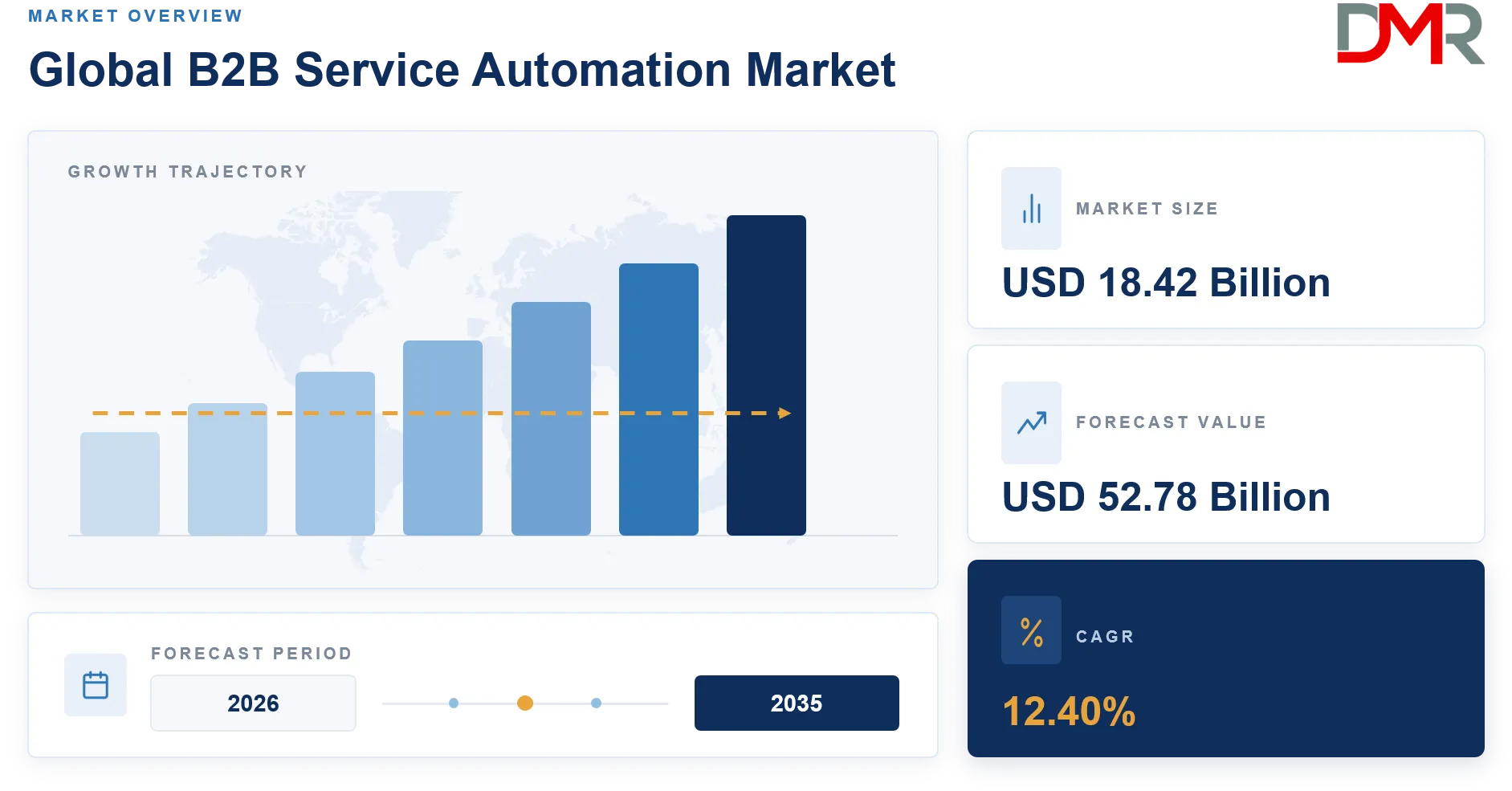
- Market Value: B2B Service Automation Market is valued at USD 18.42 billion in 2026 and is expected to reach USD 52.78 billion by 2035.
- CAGR: B2B Service Automation Market is expected to grow at a CAGR of 12.4% from 2026 to 2035.
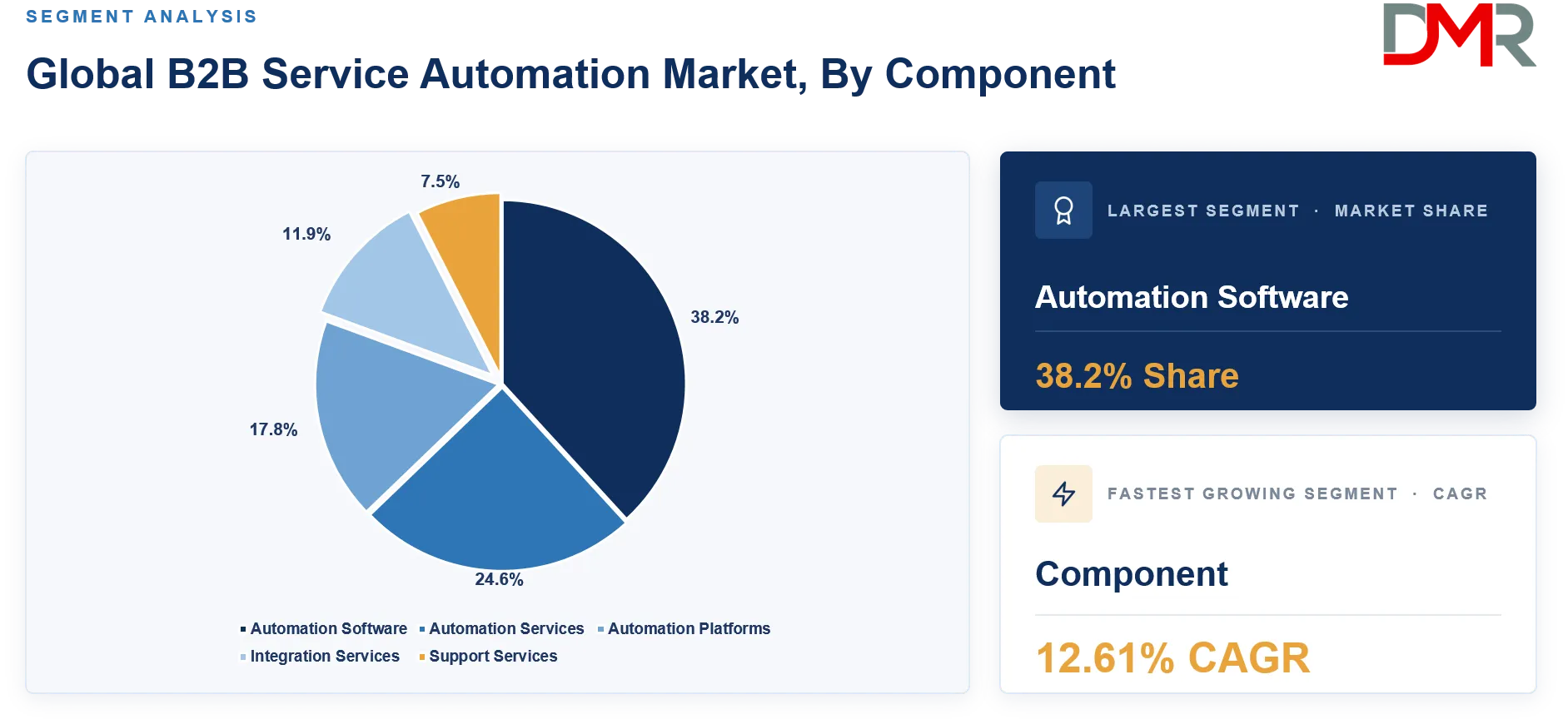
- By Component Analysis: Automation Software segment dominated with 38.2% share in 2026.
- By Automation Technology Segment Analysis: Robotic Process Automation led product types with 29.4% share in 2026.
- By Business Function Industry Segment Analysis: Customer Service Automation Segment held 26.3% share in 2026.
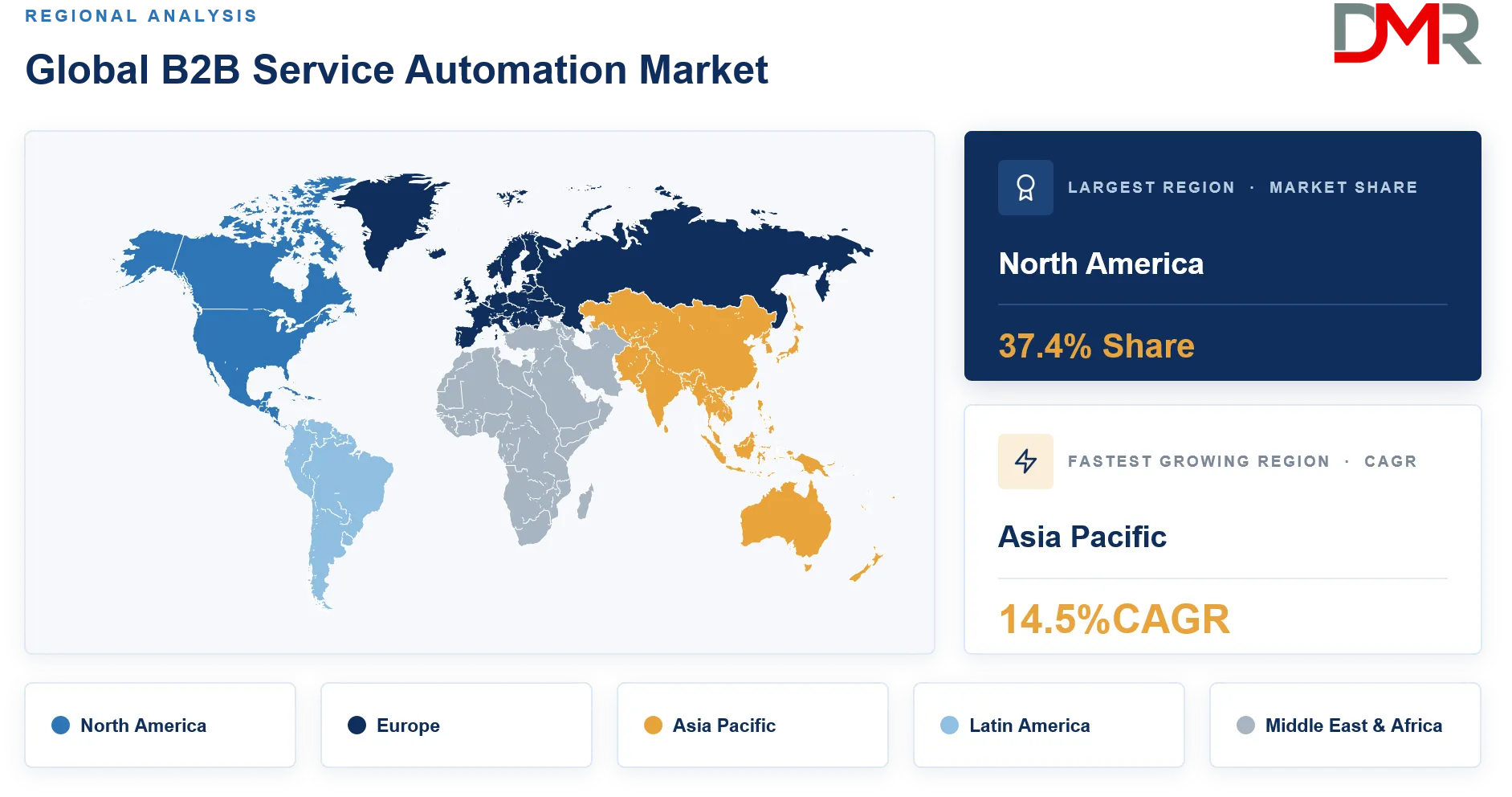
- Regional Analysis: North America led B2B Service Automation Market with 37.4% revenue share in 2026.
- US Market Size: The United States size is expected to reach USD 19.6 billion by 2035 from USD 6.8 billion in 2026, at a CAGR of 12.5%.
- India Market Size: The India size is expected to reach USD 5.9 billion by 2035 from USD 1.7 billion in 2026, at a CAGR of 15.1%.
- UAE Market Size: The UAE size is expected to reach USD 1.4 billion by 2035 from USD 0.42 billion in 2026, at a CAGR of 14.3%.
- Major Players: ServiceNow, Salesforce, Workday, Oracle, and Others.
What is the B2B Service Automation Market and its Market Size?
The Global B2B Service Automation Market size is projected to be valued at USD 18.42 billion in 2026 and reach USD 52.78 billion by 2035, expanding at a CAGR of 12.4% during the forecast period. B2B service automation covers software, platforms, integration services, and managed services that automate recurring business service activities across customer support, finance, sales, human resources, IT operations, field service, and supply chains. The market is shifting from isolated task automation toward connected workflows that combine robotic process automation, machine learning, natural language processing, enterprise data, and autonomous software agents.
ℹ
To learn more about this report –
Download Your Free Sample Report Here
Demand is increasingly linked to measurable service outcomes rather than simple headcount reduction. Enterprises want to shorten response times, improve first contact resolution, automate document and invoice handling, reduce manual data entry, coordinate complex cases, and provide continuous digital service. Salesforce reported in its 2026 service research that 79% of service leaders regard investment in AI agents as critical for addressing current business challenges. Service organizations in the same research expect AI agents to reduce service costs and case resolution time by about 20%, showing why automation budgets are moving closer to core customer experience and operating strategy.
Use Cases
- Customer Support Automation: Enterprises use automated case classification, knowledge retrieval, routing, response generation, self service, and escalation to process high volumes of B2B support requests while preserving human involvement for contractual, technical, or high value cases.
- Finance Process Automation: Robotic process automation and intelligent document processing automate invoice capture, validation, reconciliation, approvals, payment workflows, expense processing, and financial data entry, reducing repetitive work and improving processing consistency.
- Professional Services Automation: Consulting, technology, engineering, and managed service firms automate project planning, resource allocation, time tracking, billing, utilization monitoring, and revenue forecasting through integrated professional services automation platforms.
- IT Operations Automation: Enterprises automate ticket creation, incident categorization, password resets, software requests, event response, knowledge recommendations, and infrastructure workflows, allowing IT teams to focus on complex service reliability and security issues.
- Employee Service Automation: HR and shared service teams use workflow automation for onboarding, employee requests, policy questions, approvals, document collection, access provisioning, and case management across increasingly distributed workforces.
How AI and Generative AI are Transforming the Global B2B Service Automation Market?
Artificial intelligence is changing B2B service automation from rule based execution into context aware service orchestration. Traditional robotic process automation works effectively when inputs, steps, and outputs are predictable. Newer systems combine language models, machine learning, business rules, knowledge bases, and workflow engines to interpret unstructured requests and decide which action should occur next. Salesforce Agentforce, ServiceNow automation capabilities, SAP Joule Agents, Oracle Fusion Cloud Service, Microsoft enterprise agents, and similar platforms are moving service automation toward systems that can classify a request, retrieve customer or account context, initiate a workflow, draft a response, update records, and escalate exceptions. This expands addressable automation opportunities beyond repetitive back office tasks into complex customer, employee, and professional service interactions.
Generative and agentic systems are also increasing demand for governance, integration, observability, permission controls, and reliable enterprise data. SAP states that its context aware Joule agents can reduce time spent on selected multi step workflows by up to 75%. Salesforce reports that its own Agentforce environment resolves a large share of customer service requests without human handling. These outcomes illustrate the commercial potential, but B2B environments require tighter controls because service actions may affect contracts, payments, customer entitlements, regulated data, or operational assets. As a result, buyers are increasingly evaluating automation platforms according to accuracy, integration depth, audit trails, human approval options, security, process context, and measurable business outcomes rather than the presence of generative features alone.
Key Drivers in the B2B Service Automation Market
Rising Pressure to Improve Service Productivity
Service organizations are being asked to process higher case volumes while customers expect faster and more personalized responses. This creates a direct business case for customer service automation, workflow automation, and intelligent case routing. ServiceNow's 2026 India customer experience research found that service representatives use an average of four systems to resolve a customer query, illustrating the productivity loss caused by fragmented workflows. Automation platforms that connect customer data, knowledge, approvals, and service actions can reduce system switching and shorten resolution cycles.
Enterprise Shift Toward Connected Digital Workflows
Large organizations are replacing isolated automation scripts with enterprise platforms that coordinate workflows across CRM, ERP, IT service management, finance, HR, and supply chain systems. This change supports stronger B2B service automation demand because many service processes cross departmental boundaries. A customer issue may require contract validation, inventory checks, billing adjustments, field service activity, and account updates. Platforms that orchestrate these steps through common data, APIs, rules, and AI can provide greater operating value than standalone task automation.
Restraints in the B2B Service Automation Market
Complex Legacy System Integration
Integration remains a major barrier for enterprises that operate fragmented ERP, CRM, service management, finance, and industry specific systems. Automation delivers limited value when customer records, contracts, service histories, and workflow data remain trapped in incompatible applications. Legacy interfaces can also increase implementation cost and require custom connectors. This challenge is especially important in large enterprises where service processes have developed over many years and frequently include manual exceptions, undocumented rules, and dependencies on older infrastructure.
Governance, Security, and Automation Risk
Automated service systems increasingly make or recommend decisions that affect customers, employees, payments, access rights, and business records. This raises concerns around data privacy, inaccurate outputs, access control, accountability, and auditability. Businesses in banking, healthcare, telecommunications, and public services face particularly strict requirements. Buyers therefore require permission controls, human approval stages, monitoring, secure data access, and clear audit trails. These safeguards can lengthen deployment cycles and limit the immediate automation of sensitive processes.
Growth Opportunities in the Global B2B Service Automation Market
Agentic Service Automation Across Business Functions
Agentic automation creates a major opportunity by extending automation from predefined task sequences into goal driven workflows. An enterprise service agent can interpret a request, retrieve relevant business information, coordinate specialized tools, complete approved actions, and return an outcome to the user. This model can support sales operations, finance, procurement, IT service, customer support, and employee services. Vendors able to combine enterprise data, workflow orchestration, business rules, security, and specialized agents have an opportunity to capture a larger share of automation budgets.
Automation Expansion Among Small and Medium Enterprises
Cloud delivery is lowering the infrastructure and implementation requirements for smaller companies that previously depended on manual service operations. Subscription based workflow tools, low code automation, packaged connectors, and preconfigured industry templates allow small and medium enterprises to automate invoicing, customer support, project management, onboarding, and sales processes without building large internal automation teams. This creates a broad growth opportunity for vendors offering fast deployment, transparent pricing, integration with popular business applications, and measurable return on investment.
Trends in the Global B2B Service Automation Market
Convergence of RPA, Workflow Automation, and AI Agents
The technology landscape is moving away from separate automation categories. Robotic process automation remains important for deterministic tasks, but vendors increasingly combine it with workflow engines, language models, document intelligence, machine learning, and autonomous agents. This convergence enables one platform to handle structured transactions and less predictable service interactions. For buyers, the trend shifts platform evaluation toward orchestration capabilities, business context, integration coverage, model governance, process analytics, and the ability to coordinate human and digital work.
Outcome Based Service Automation
Enterprises are placing greater emphasis on automation outcomes such as faster resolution, lower cost per case, reduced backlog, improved utilization, higher first contact resolution, and better customer retention. This is changing automation procurement because management teams want business level performance measures rather than counts of automated tasks. Software vendors are responding with analytics, process intelligence, monitoring, service level tracking, and outcome oriented automation features. The trend is likely to strengthen as autonomous systems gain responsibility for larger portions of end to end service delivery.
Research Scope and Analysis
The Global B2B Service Automation Market is segmented based on component, automation technology, deployment, business function, service type, organization size, industry vertical, application, and region. The study examines the adoption of automation software, platforms, integration services, intelligent technologies, and managed automation models across business service environments. It also evaluates market demand, enterprise adoption patterns, competitive positioning, technology development, regional opportunities, and factors influencing purchasing decisions through 2035.
ℹ
To learn more about this report –
Download Your Free Sample Report Here
By Component
Automation Software dominated the component segment with a 38.2% share in 2026. Its leadership reflects enterprise demand for workflow engines, robotic process automation, service management applications, intelligent document processing, process analytics, and embedded AI capabilities that can be deployed across multiple functions. Automation software increasingly acts as the execution layer connecting customer requests, enterprise data, business rules, and downstream applications. Demand is also supported by the expansion of low code configuration and reusable workflow components. Automation services, integration services, and support services remain important because enterprises require process redesign, system integration, governance, customization, and ongoing optimization as automation programs expand from departmental projects to enterprise wide operations.
By Automation Technology
Robotic Process Automation held a 29.4% share in 2026, making it the leading automation technology segment. RPA remains widely used because it can automate structured, repetitive tasks across existing interfaces without requiring complete replacement of legacy systems. Common applications include data entry, invoice processing, account updates, report preparation, record reconciliation, and service ticket handling. The segment is evolving as RPA platforms integrate machine learning, natural language processing, process mining, and generative capabilities. This combination allows organizations to retain deterministic automation for controlled transactions while using intelligent technologies to interpret documents, conversations, and exceptions, supporting a gradual transition toward intelligent process automation.
By Business Function
Customer Service Automation accounted for 26.3% of the market in 2026. The segment benefits from large service volumes, clearly measurable performance indicators, and strong pressure to reduce resolution times without weakening customer experience. Automated routing, self service, knowledge retrieval, response generation, case summarization, workflow triggering, and service agent assistance are increasingly integrated into CRM and service management platforms. ServiceNow's 2026 research in India found that 44% of surveyed consumers were prepared to switch brands following poor service experiences, highlighting the revenue risk associated with inefficient support. B2B companies are therefore treating service automation as both an operating efficiency tool and a customer retention capability.
The B2B Service Automation Market Report is segmented on the basis of the following:
By Component
- Automation Software
- Automation Services
- Automation Platforms
- Integration Services
- Support Services
By Automation Technology
- Robotic Process Automation
- Artificial Intelligence
- Machine Learning
- Natural Language Processing
- Workflow Automation
- Intelligent Process Automation
By Deployment
- Cloud Based Automation
- On Premises Automation
- Hybrid Automation
By Business Function
- Customer Service Automation
- Sales Marketing Automation
- Finance Accounting Automation
- Human Resource Automation
- Supply Chain Automation
- IT Operations Automation
By Service Type
- Customer Support Services
- Field Service Management
- Professional Services Automation
- Managed Service Automation
- Business Process Services
By Organization Size
- Small Medium Enterprises
- Large Enterprises
By Industry Vertical
- Banking Financial Services
- Healthcare Life Sciences
- Information Technology
- Telecommunications
- Manufacturing
- Retail E Commerce
- Transportation Logistics
By Application
- Workflow Process Automation
- Customer Query Automation
- Document Processing Automation
- Data Entry Automation
- Invoice Processing Automation
- Employee Onboarding Automation
Regional Analysis
North America is the Leading Region in the Global B2B Service Automation Market
North America accounted for 37.4% of Global B2B Service Automation Market revenue in 2026. The region benefits from a large enterprise software ecosystem, high cloud adoption, mature CRM and IT service management deployments, and significant investment in AI enabled workflow technologies. ServiceNow, Salesforce, Microsoft, Oracle, Workday, BMC Software, and several professional services automation vendors have substantial commercial activity in the region. Demand is moving toward integrated platforms that automate service across customer operations, IT, finance, employee workflows, and field service while supporting governance and enterprise security requirements.
Asia Pacific is the Fastest Growing Region in the Global B2B Service Automation Market
Asia Pacific is expected to record the fastest growth as enterprises across India, China, Southeast Asia, Australia, Japan, and South Korea modernize service operations. Expansion of cloud infrastructure, digital payments, shared service centers, global capability centers, and enterprise AI programs is widening the automation opportunity. India is particularly important as organizations move from AI experimentation toward production deployment. Rising service volumes and growing requirements for multilingual customer engagement also increase demand for natural language processing, intelligent workflow automation, and automated customer support.
By Region
North America
Europe
- Germany
- France
- The UK
- Italy
- Spain
- Rest of Europe
Asia-Pacific
- China
- Japan
- India
- Australia
- South Korea
- Rest of APAC
Latin America
- Mexico
- Brazil
- Colombia
- Argentina
- Rest of LATAM
Middle East & Africa
- Saudi Arabia
- The UAE
- South Africa
- Rest of MEA
ℹ
To learn more about this report –
Download Your Free Sample Report Here
Major Countries Analysis
United States B2B Service Automation Market
The United States B2B Service Automation Market is projected to increase from USD 6.8 billion in 2026 to USD 19.6 billion by 2035, expanding at a CAGR of 12.5%. Growth is supported by mature cloud infrastructure, large enterprise technology spending, strong software vendor presence, and rapid adoption of AI enabled service platforms. US companies are deploying automation across customer support, IT operations, finance, field service, professional services, and employee workflows. Competition among ServiceNow, Salesforce, Microsoft, Oracle, Workday, SAP, BMC Software, and specialist automation providers is accelerating product development and enterprise adoption.
India B2B Service Automation Market
The India B2B Service Automation Market is expected to rise from USD 1.7 billion in 2026 to USD 5.9 billion by 2035 at a CAGR of 15.1%. India's large IT services sector, global capability center ecosystem, digital payments infrastructure, expanding cloud adoption, and growing enterprise AI investment provide strong foundations for automation demand. Enterprises are increasingly moving AI projects into production and applying automation to customer service, finance, IT operations, healthcare administration, banking, and shared services. Data governance requirements and the Digital Personal Data Protection framework are also increasing demand for controlled, auditable automation architectures.
UAE B2B Service Automation Market
The UAE B2B Service Automation Market is projected to grow from USD 0.42 billion in 2026 to USD 1.4 billion by 2035, at a CAGR of 14.3%. Growth is supported by national digital transformation programs, expanding cloud infrastructure, AI investment, smart government initiatives, and modernization across banking, aviation, logistics, telecommunications, energy, healthcare, and professional services. Enterprises are adopting automation to support multilingual service, digital onboarding, customer request processing, employee services, and back office workflows. Strong investment capacity and demand for efficient digital service delivery provide additional opportunities for global and regional automation vendors.
Competitive Landscape
The B2B Service Automation Market is highly competitive and increasingly shaped by platform convergence. ServiceNow competes through enterprise workflow, IT service management, customer service management, and AI enabled automation. Salesforce is expanding its position through Agentforce Service, combining CRM data, customer service workflows, self service, and autonomous agents. Microsoft connects automation with its cloud, productivity, Copilot, Dynamics, and Power Platform ecosystem, while SAP is embedding Joule agents into enterprise business processes.
Oracle combines service automation with Fusion applications, AI assisted case management, and field service capabilities. Workday, IFS, BMC Software, Unit4, Deltek, Kantata, BigTime, ConnectWise, and other specialists compete through industry depth or function specific automation. Competitive differentiation is shifting toward secure enterprise data access, workflow orchestration, agent governance, integrations, analytics, industry specific process knowledge, implementation speed, and demonstrated operating outcomes. Vendors that can automate complete business processes while maintaining human oversight are positioned to capture a greater share of enterprise transformation budgets.
Some of the prominent players in the B2B Service Automation Industry are:
- ServiceNow
- Salesforce
- Workday
- Oracle
- SAP
- Microsoft
- Unit4
- Deltek
- IFS
- Acumatica
- Kantata
- Scoro
- BigTime
- Accelo
- Rocketlane
- Productive
- Teamwork
- ConnectWise
- Autotask, Datto and Kaseya
- BMC Software
- Others
Technology Analysis
The B2B Service Automation Market is increasingly shaped by the convergence of workflow automation, robotic process automation, machine learning, natural language processing, cloud platforms, integration APIs, and intelligent process orchestration. Enterprises are moving away from isolated bots toward connected automation architectures that can manage end-to-end service workflows across CRM, ERP, finance, HR, IT, customer support, and project management systems. Cloud-native platforms are gaining importance because they allow faster deployment, centralized governance, scalable processing, and easier integration with distributed business applications.
Natural language capabilities are also expanding automation into email, service tickets, documents, contracts, and conversational interfaces. The next competitive phase will center on secure orchestration, real-time process intelligence, low-code development, reusable automation components, system interoperability, and governed autonomous actions that improve service speed, productivity, accuracy, and operating visibility.
Investment and White Space Analysis
Investment opportunities in the B2B Service Automation Market are strongest where enterprises still depend on fragmented workflows, manual coordination, email-based approvals, spreadsheets, and disconnected service applications. White space is particularly attractive in industry-specific automation for financial services, healthcare, manufacturing, logistics, professional services, telecommunications, and mid-market enterprises that require faster implementation and lower integration complexity.
Investors and vendors can also target gaps in document-heavy automation, multilingual customer support, managed service operations, resource planning, billing automation, compliance workflows, and cross-platform orchestration. Asia Pacific, India, the UAE, and other digitally expanding markets offer additional room for cloud-based and localized solutions. Strategic capital is likely to favor providers that combine automation software with integration depth, vertical templates, recurring subscription revenue, measurable customer ROI, strong retention, and scalable partner ecosystems.
Recent Developments
- May 2026: ServiceNow launched its Autonomous Workforce at Knowledge 2026, introducing AI specialists for IT service desk, CRM, employee service, and security functions to autonomously resolve cases and manage incidents end-to-end.
- December 2025: ServiceNow completed its $2.85 billion acquisition of Moveworks, combining agentic AI workflows with Moveworks' front-end AI assistant and enterprise search to create an AI-native employee engagement platform.
- October 2025: Salesforce made Agentforce IT Service generally available, deploying specialized AI agents for 24/7 conversational IT resolutions across Slack and employee portals with 100+ pre-built connectors.
Report Details
| Report Characteristics |
| Market Size (2026) |
USD 18.42 Bn |
| Forecast Value (2035) |
USD 52.78 Bn |
| CAGR (2026–2035) |
12.4% |
| The Country Market Size (2026) |
United States: USD 6.8 Bn; India: USD 1.7 Bn; UAE: USD 0.42 Bn |
| Historical Data |
2021 – 2025 |
| Forecast Data |
2026 – 2035 |
| Base Year |
2025 |
| Segments Covered |
By Component, By Automation Technology, By Deployment, By Business Function, By Service Type, By Organization Size, By Industry Vertical, and By Application |
| Regional Coverage |
North America – The US and Canada; Europe – Germany, France, The UK, Italy, Spain, Rest of Europe; Asia-Pacific – China, Japan, India, Australia, South Korea, Rest of APAC; Latin America – Mexico, Brazil, Colombia, Argentina, Rest of LATAM; Middle East & Africa – Saudi Arabia, The UAE, South Africa, Rest of MEA |
Frequently Asked Questions
What is the current size of the B2B Service Automation Market?
▾ B2B Service Automation Market size is valued at USD 18.42 billion in 2026 and forecast to reach USD 52.78 billion by 2035.
What is the growth rate of the B2B Service Automation Market during?
▾ The B2B Service Automation Market is expected to grow at a CAGR of 12.4% during the forecast period from 2026 to 2035.
Which region dominates the global B2B Service Automation Market?
▾ Asia Pacific leads the global B2B Service Automation Market with a 34.5% revenue share of the global market in 2026.
What factors are driving the growth of the B2B Service Automation Market?
▾ Cloud adoption, faster workflows, lower service costs, and process efficiency drive B2B Service Automation Market growth.
What are the major challenges restraining the B2B Service Automation Market?
▾ Legacy integration, data security, governance needs, and deployment costs restrain B2B Service Automation Market growth.
Which segment holds the largest share of the B2B Service Automation Market?
▾ No valid leading segment share is available for the B2B Service Automation Market from the supplied automation segment data.
Who are the leading companies in the global B2B Service Automation Market?
▾ ServiceNow, Salesforce, Workday, Oracle, SAP, Microsoft, Unit4, Deltek, IFS, Acumatica, Kantata, Scoro, BigTime, Accelo, Rocketlane, Productive, Teamwork, ConnectWise, Autotask (Datto/Kaseya), and BMC Software are leading companies in the B2B Service Automation Market.
How is AI influencing the B2B Service Automation Market?
▾ AI expands the B2B Service Automation Market through intelligent workflows, NLP, predictive routing, and service actions.
What are the future opportunities and trends in the B2B Service Automation Market?
▾ Cloud adoption, vertical solutions, agent workflows, and SME demand create B2B Service Automation Market opportunities.