Brazil Machine Learning Market Snapshot
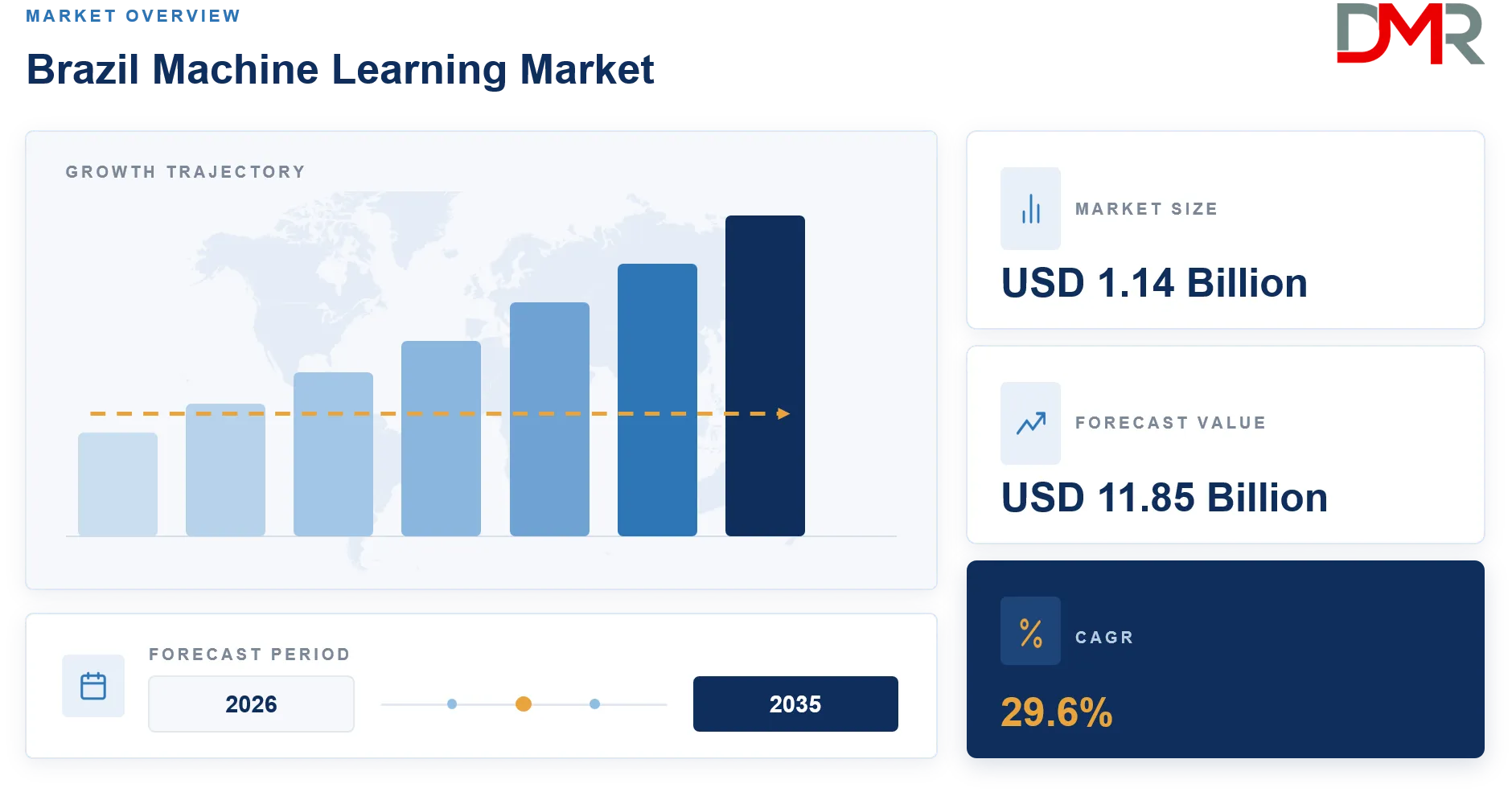
- Market Value: Brazil machine learning market is valued at USD 1,142.5 million in 2026 and is expected to reach USD 11,850.3 million by 2035.
- CAGR: Brazil machine learning market is expected to grow at a CAGR of 29.6% from 2026 to 2035.
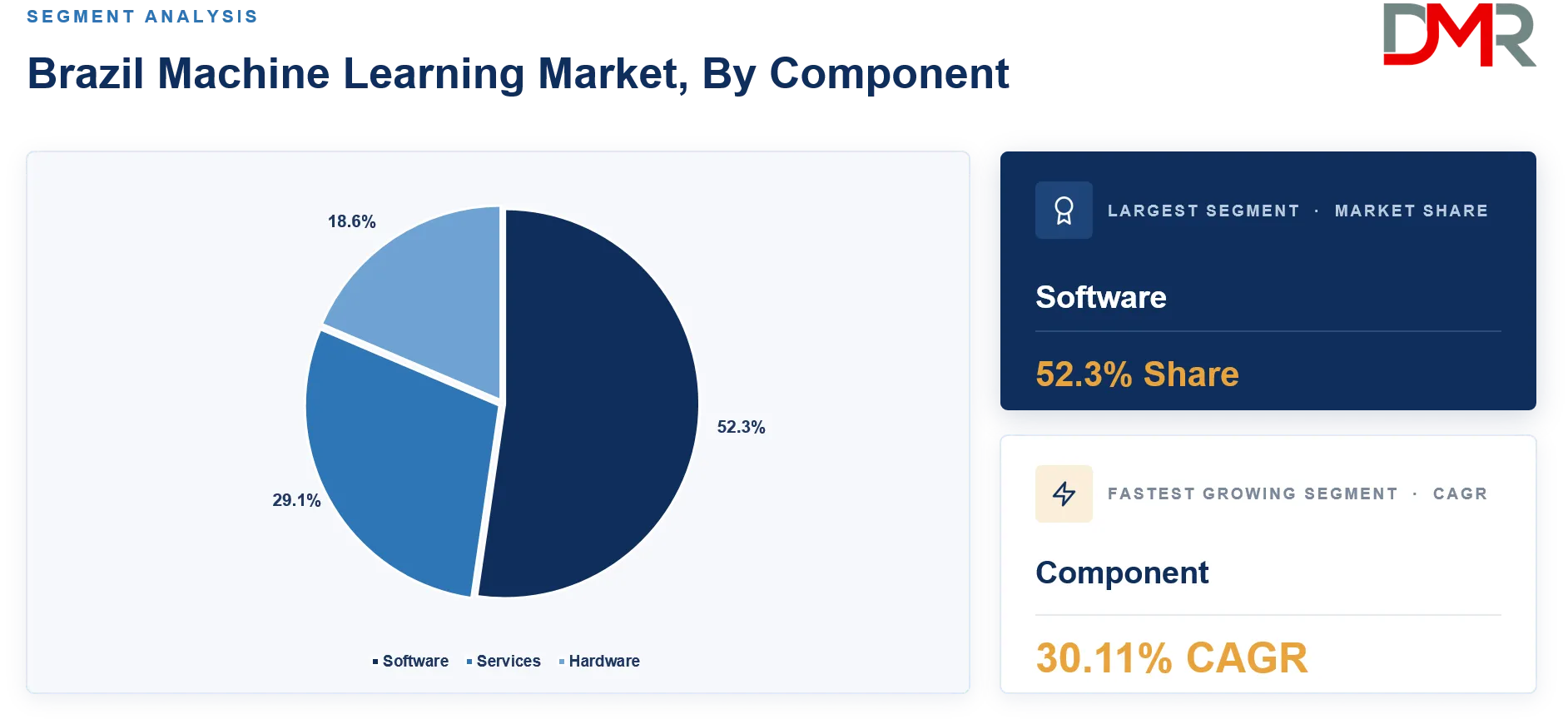
- By Component Segment Analysis: Software segment dominated the market with a 52.3% share in 2026.
- By Deployment Segment Analysis: Cloud-based deployment led the market with a 64.7% share in 2026.
- By End Use Segment Analysis: BFSI sector led end-use verticals with a 22.4% share in 2026.
- Major Players: IBM, Microsoft, Google Cloud, Amazon Web Services (AWS), and SAS.
What is the Brazil Machine Learning Market and its Market Size?
The Brazil Machine Learning Market size is projected to be valued at USD 1,142.5 million in 2026 and is projected to reach USD 11,850.3 million by 2035, expanding at a CAGR of 29.6% during the forecast period. Machine learning adoption in Brazil is moving from isolated analytics projects toward production systems that support banking, retail, industrial operations, fraud prevention, customer service, logistics, agriculture, healthcare, and enterprise automation. Demand is also benefiting from greater access to cloud computing, scalable data infrastructure, application programming interfaces, and pre-trained models that allow Brazilian businesses to deploy advanced analytics without building every capability internally.
ℹ
To learn more about this report –
Download Your Free Sample Report Here
The machine learning market growth in Brazil is driven by the country's broader digital economy and its position as Latin America's largest economy. Brazil's instant-payment infrastructure illustrates the scale of digital activity available for data-driven applications. Banco Central do Brasil reported that Pix had reached nearly 170 million users by late 2025, while transactions totaled BRL 11 trillion during 2024. Such transaction volumes create substantial demand for fraud detection, risk scoring, personalization, anti-money laundering analytics, customer intelligence, and real-time decision systems across banks, fintech companies, retailers, and payment providers.
Use Cases
- Fraud Detection and Financial Risk: Brazilian banks, fintech firms, insurers, and payment processors use machine learning to identify abnormal transaction patterns, evaluate credit risk, detect account takeover attempts, and prioritize suspicious activity. The scale of Pix and digital banking makes real-time scoring particularly important for financial institutions handling millions of transactions.
- Predictive Maintenance: Manufacturers, mining operators, energy companies, transport businesses, and industrial groups use sensor data and machine learning models to predict equipment failure. The technology helps maintenance teams identify abnormal vibration, temperature, pressure, or performance patterns before breakdowns create costly production interruptions.
- Retail Personalization: Retailers and e-commerce platforms apply machine learning to product recommendations, demand forecasting, pricing, inventory allocation, customer segmentation, and churn prediction. Brazil's large consumer base creates opportunities for retailers to combine purchase histories, digital behavior, store activity, and logistics information to improve conversion and inventory efficiency.
- Precision Agriculture: Agriculture businesses can combine satellite imagery, weather information, soil data, machinery telemetry, and crop records with machine learning to improve yield forecasts and field-level decisions. Applications include pest detection, crop classification, irrigation optimization, disease recognition, and predictive planning across Brazil's large agricultural economy.
- Customer Service Automation: Enterprises are using machine learning and language models to classify requests, recommend responses, summarize conversations, route cases, monitor service quality, and power virtual assistants. Portuguese-language capabilities are increasingly important for banks, telecom operators, retailers, government services, and business-to-consumer platforms serving the Brazilian market.
How AI/Gen AI is Transforming the Brazil Machine Learning Market?
Generative AI is expanding the addressable Brazil machine learning market by moving adoption beyond traditional forecasting and classification into enterprise knowledge, software development, document processing, customer interaction, and workflow automation. Organizations can now combine foundation models with proprietary data, retrieval systems, machine learning pipelines, and business rules to build assistants for employees, customers, analysts, engineers, and service teams. Microsoft, Google Cloud, AWS, IBM, Databricks, and other providers are integrating generative capabilities with cloud data platforms, model development tools, security controls, and MLOps services. This reduces the technical gap between experimentation and deployment and increases demand for data engineering, model monitoring, governance, integration, and professional services.
Brazil is also developing public infrastructure and policy support for wider AI adoption. The Brazilian Artificial Intelligence Plan, or PBIA, provides for up to BRL 23 billion in investment through 2028 and includes computing infrastructure, innovation, training, public-service applications, and domestic AI development. Microsoft separately announced a USD 2.7 billion investment over three years to expand cloud and AI infrastructure in Brazil and support AI skills development for millions of people. These initiatives strengthen the computing and talent base required for machine learning workloads, while organizations must still manage LGPD requirements, model explainability, cybersecurity, data quality, intellectual property, and emerging AI governance expectations.
Key Drivers in the Brazil Machine Learning Market
Rapid Digitalization of Financial Services and Payments
Brazil's highly digital financial ecosystem is a major driver of machine learning demand. Pix is used by a large share of the population and has created a high-frequency payments environment where banks and fintech firms must evaluate transactions in near real time. Banco Central do Brasil reported that Pix was used by 76.4% of the population in its payment-method study and that transaction volume increased 52% in 2024. This environment supports investment in fraud analytics, credit models, customer segmentation, cybersecurity, anti-money laundering systems, and personalized financial services.
Expansion of Cloud and Data Center Infrastructure
Machine learning workloads require scalable computing, storage, networking, and specialized infrastructure. Brazil is attracting major data center investment as cloud and AI demand increases. Investments from hyperscale providers and data center operators are expanding local capacity, while Microsoft's USD 2.7 billion cloud and AI commitment strengthens the country's enterprise technology ecosystem. More local infrastructure can improve workload availability and support organizations that require lower latency, stronger data controls, or regional processing for analytics and AI applications.
Restraints in the Brazil Machine Learning Market
Shortage of Advanced Data and Machine Learning Skills
Organizations require more than data scientists to deploy machine learning at scale. Successful programs depend on data engineering, cloud architecture, cybersecurity, MLOps, product management, model governance, domain expertise, and business process redesign. Competition for experienced professionals can raise implementation costs and slow projects, particularly for small and medium-sized enterprises. Skills development is therefore becoming part of public and private investment strategies, including training initiatives associated with Brazil's national AI plan and major cloud providers.
Data Governance, Privacy, and Regulatory Complexity
Machine learning models used for credit, employment, healthcare, fraud prevention, marketing, and customer profiling can process sensitive or personally identifiable data. Brazil's LGPD establishes requirements relevant to data processing and automated decisions, including rights related to information about criteria and procedures used in automated decision-making. At the same time, Brazil continues to debate a broader risk-based AI framework. Companies therefore face growing pressure to document data sources, monitor models, establish human oversight, protect sensitive information, and create auditable governance processes.
Growth Opportunities in the Brazil Machine Learning Market
Industrial Machine Learning and Predictive Operations
Brazil's manufacturing, mining, energy, logistics, automotive, and agricultural industries create a strong opportunity for operational machine learning. Industrial companies can use equipment telemetry, maintenance records, computer vision, production data, and environmental information to forecast failures, improve quality, reduce downtime, optimize energy consumption, and automate inspections. Brazilian technology company TRACTIAN demonstrates growing regional demand for condition monitoring and industrial intelligence, while global platforms provide scalable tools for model development and deployment.
Machine Learning Adoption Among SMEs
Small and medium-sized enterprises represent an expanding opportunity as cloud platforms, packaged analytics, application programming interfaces, and software-as-a-service products reduce the need for large internal data science teams. Brazilian software providers such as TOTVS, Sankhya, Stefanini, and CI&T can integrate intelligent functions into workflows already used by local companies. Customer forecasting, document extraction, lead scoring, inventory planning, pricing, virtual assistance, and financial analytics can therefore become accessible to a wider base of businesses during the forecast period.
Trends in the Brazil Machine Learning Market
Shift Toward Cloud-based Machine Learning Platforms
Cloud-based deployment accounted for 64.7% of the Brazil machine learning market in 2026, reflecting enterprise demand for flexible computing and managed services. Organizations increasingly use cloud data warehouses, notebooks, model registries, automated training, vector databases, APIs, and monitoring services instead of maintaining the full machine learning stack internally. AWS, Microsoft Azure, Google Cloud, IBM, Databricks, SAS, DataRobot, and H2O.ai compete across different layers of this technology environment.
Growing Focus on Responsible and Governed Machine Learning
Model performance is no longer the only purchasing criterion for large Brazilian organizations. Financial institutions, healthcare providers, government bodies, and consumer-facing companies increasingly evaluate explainability, security, data lineage, access controls, bias testing, monitoring, and human review. LGPD obligations and the continuing debate around Brazil's proposed AI legislation are pushing governance earlier into the model lifecycle. This trend favors platforms that combine model development with monitoring, auditability, risk management, and enterprise security capabilities.
Research Scope and Analysis
The Brazil Machine Learning Market is segmented based on Component, Deployment, Enterprise Size, End Use, and other relevant categories. The study provides an in-depth analysis of key segments and sub-segments, covering their applications, industry adoption, demand patterns, competitive position, technology requirements, and contribution to overall market growth.
By Component
The software segment dominated the Brazil machine learning market with a 52.3% share in 2026. Its leadership is supported by demand for model development platforms, analytics applications, data preparation tools, MLOps software, fraud detection systems, predictive analytics, computer vision, and natural language processing. Cloud vendors and independent software suppliers are making machine learning capabilities available through managed services and APIs, allowing enterprises to build models without maintaining extensive infrastructure. Software demand is also expanding as Brazilian banks, retailers, manufacturers, and service providers embed predictions and automation directly into operational systems.
ℹ
To learn more about this report –
Download Your Free Sample Report Here
By Deployment
Cloud-based deployment led the Brazil machine learning market with a 64.7% share in 2026. Machine learning projects often require computing capacity that changes sharply between data preparation, training, testing, and production inference, making elastic cloud resources attractive. Access to managed databases, GPU infrastructure, model endpoints, monitoring, and integrated security also reduces deployment complexity. Growing investment in Brazilian data centers and cloud regions supports adoption by organizations that want locally available infrastructure. On-premises deployment remains relevant for organizations with legacy environments, strict internal controls, specialized latency requirements, or sensitive workloads.
By End Use
BFSI led Brazil's machine learning market with a 22.4% share in 2026. Brazil's banking and fintech ecosystem generates large volumes of transaction, payment, credit, identity, behavioral, and customer-service data that can support machine learning applications. Banks use models for fraud detection, credit underwriting, anti-money laundering, customer retention, personalization, collections, and cybersecurity. The scale of Pix further increases the need for rapid transaction monitoring. Manufacturing, retail, healthcare, agriculture, automotive and transportation, advertising and media, and legal services are also expanding machine learning investment as sector-specific data becomes easier to capture and process.
The Brazil Machine Learning Market Report is segmented on the basis of the following:
By Component
- Software
- Services
- Hardware
By Deployment
By Enterprise Size
- Large Enterprises
- Small and Medium-sized Enterprises
By End Use
- BFSI
- Manufacturing
- Retail
- Healthcare
- Agriculture
- Automotive & Transportation
- Advertising & Media
- Law
- Others
Competitive Landscape
The Brazil machine learning market has a mixed competitive structure that includes global cloud providers, enterprise software companies, specialist data and AI platforms, Brazilian IT service firms, enterprise software vendors, and vertical technology companies. Microsoft, Google Cloud, AWS, and IBM compete through cloud infrastructure, managed machine learning services, generative AI capabilities, data platforms, security, and enterprise relationships. SAS remains relevant in advanced analytics and regulated industries, while Databricks competes around unified data, analytics, lakehouse architecture, and machine learning workflows. Palantir, DataRobot, and H2O.ai target enterprise analytics, automated machine learning, operational decision systems, and model lifecycle management. Brazilian companies such as Stefanini and CI&T contribute implementation, consulting, software engineering, and digital transformation expertise. TOTVS and Sankhya provide access to established enterprise customer bases, while TRACTIAN targets industrial intelligence and predictive maintenance. Competition is increasingly shaped by cloud integration, Portuguese-language capabilities, data governance, industry expertise, implementation speed, model monitoring, cybersecurity, and the ability to connect machine learning with measurable business outcomes.
Some of the prominent players in the Brazil Machine Learning Industry are:
- IBM
- Microsoft
- Google Cloud
- Amazon Web Services (AWS)
- SAS
- Databricks
- Palantir
- DataRobot
- H2O.ai
- Stefanini
- CI&T
- TOTVS
- Sankhya
- TRACTIAN
- Konduto
- Others
Regulatory Landscape
Brazil's machine learning regulatory landscape is increasingly shaped by data protection, cybersecurity, consumer rights, and emerging AI governance requirements. The General Data Protection Law, or LGPD, administered by the National Data Protection Authority (ANPD), is particularly relevant when machine learning systems process personal data for credit scoring, fraud detection, customer profiling, healthcare, employment, or marketing. Organizations must consider lawful data processing, security, transparency, data-subject rights, and governance throughout the model lifecycle. Brazil has also advanced legislation for a risk-based AI framework, increasing management attention on accountability, human oversight, documentation, and high-risk applications. For banks and fintech firms, Banco Central do Brasil requirements add sector-specific controls around security, operational resilience, and data management. These developments are increasing demand for explainable models, audit trails, privacy controls, model monitoring, and responsible machine learning platforms.
Investment and White Space Analysis
Investment opportunities in the Brazil machine learning market are expanding beyond general-purpose model development into infrastructure, industry-specific software, MLOps, cybersecurity, and localized enterprise applications. Brazil's national AI strategy provides a significant policy catalyst, with the Brazilian Artificial Intelligence Plan outlining investments of up to BRL 23 billion through 2028 across infrastructure, innovation, skills, public services, and business adoption. Microsoft has separately announced USD 2.7 billion for cloud and AI infrastructure and skills development in Brazil, while data center investment is strengthening local computing capacity. White space remains attractive in Portuguese-first enterprise applications, SME-focused machine learning tools, agricultural intelligence, industrial predictive maintenance, financial fraud prevention, healthcare analytics, and governed AI deployment. Vendors that combine local industry knowledge with cloud integration, data governance, measurable ROI, and lower implementation complexity can address demand that broad global platforms do not fully serve.
Recent Developments
Report Details
| Report Characteristics |
| Market Size (2026) |
USD 1,142.5 Million |
| Forecast Value (2035) |
USD 11,850.3 Million |
| CAGR (2026–2035) |
29.6% |
| Historical Data |
2021 – 2025 |
| Forecast Data |
2027 – 2035 |
| Base Year |
2025 |
| Estimate Year |
2026 |
| Segments Covered |
By Component (Software, Services, and Hardware), By Deployment (Cloud-based and On-premises), By Enterprise Size (Large Enterprises and Small and Medium-sized Enterprises), and By End Use (BFSI, Manufacturing, Retail, Healthcare, Agriculture, Automotive & Transportation, Advertising & Media, Law, and Others) |
| Regional Coverage |
Brazil |
Frequently Asked Questions
What is the current size of the Brazil Machine Learning Market?
▾ The Brazil Machine Learning Market is valued at USD 1,142.5 million in 2026 and may reach USD 11,850.3 million by 2035.
What is the growth rate of the Brazil Machine Learning Market during?
▾ The Brazil Machine Learning Market is projected to grow at a CAGR of 29.6% during the forecast period from 2026 to 2035.
What factors are driving the growth of the Brazil Machine Learning Market?
▾ Brazil Machine Learning Market growth is driven by cloud adoption, digital banking, automation, and advanced analytics.
What are the major challenges restraining the Brazil Machine Learning Market?
▾ Brazil Machine Learning Market growth is restrained by skill shortages, data privacy requirements, and governance costs.
Which segment holds the largest share of the Brazil Machine Learning Market?
▾ Software holds the largest component share of the Brazil Machine Learning Market, accounting for 52.3% in 2026.
Who are the leading companies in the global Brazil Machine Learning Market?
▾ IBM, Microsoft, Google Cloud, Amazon Web Services (AWS), SAS, Databricks, Palantir, DataRobot, H2O.ai, Stefanini, CI&T, TOTVS, Sankhya, TRACTIAN, and Konduto are leading companies in the Brazil Machine Learning Market.
How is AI influencing the Brazil Machine Learning Market?
▾ AI expands the Brazil Machine Learning Market through automation, predictive analytics, GenAI, and smarter workflows.
What are the future opportunities and trends in the Brazil Machine Learning Market?
▾ Brazil Machine Learning Market opportunities include cloud ML, MLOps, predictive maintenance, and sector solutions.