What is the Business Process Automation Market Size?
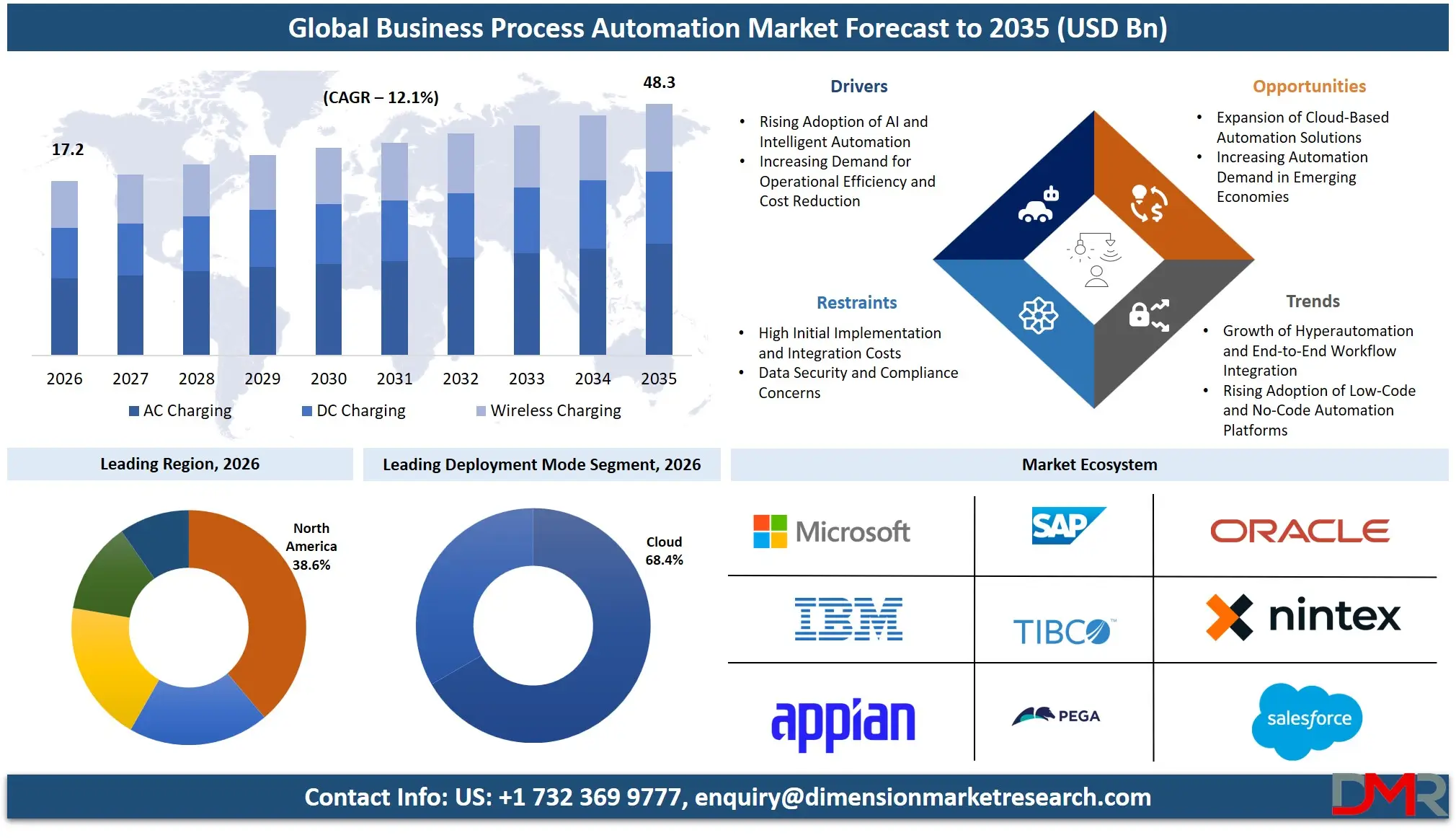
The Business Process Automation Market size is expected to be USD 17.2 billion in 2026 and increase at a compound annual growth rate of 12.1% to USD 48.3 billion in 2035 due to adaption of artificial intelligence, machine learning, and predictive analytics in automation technologies.
ℹ
To learn more about this report –
Download Your Free Sample Report Here
The Business Process Automation Market includes software solutions and technologies that help automate business processes using approaches such as robotic process automation, business process management, artificial intelligence-based systems, and digital process automation platforms. These enable organizations to make improvements by making their processes more efficient, reducing costs, and ensuring accuracy. The rapid advancements in digitalization, cloud computing, and artificial intelligence are driving the Business Process Automation Market.
ℹ
To learn more about this report –
Download Your Free Sample Report Here
The US Business Process Automation Market
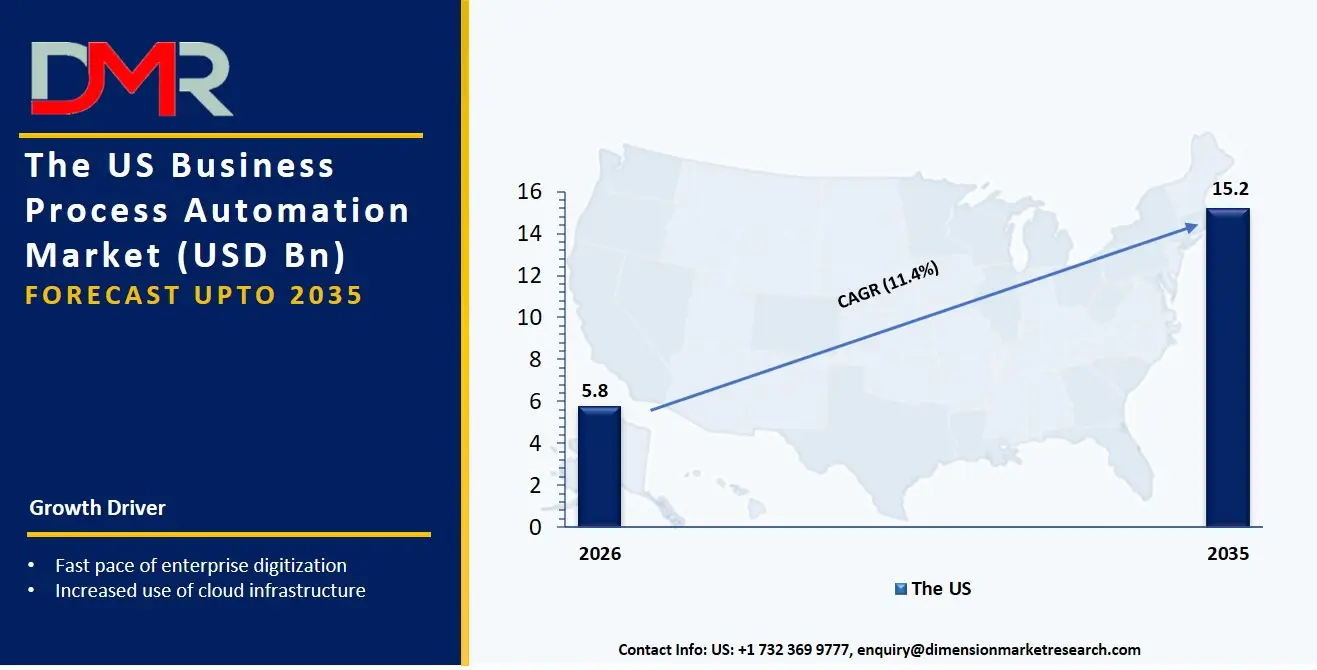
The US Business Process Automation Market size is estimated to be USD 5.8 billion in 2026 and is expected to increase at a CAGR of 11.4% over the forecast period.
The US Business Process Automation Market is fueled by the fast pace of enterprise digitization, increased use of cloud infrastructure, and higher investment in AI-based automation software. Intelligent automation is being adopted by large enterprises in BFSI, healthcare, and retail industries to lower operational costs and ensure compliance management. Support from the government in digital innovations and cybersecurity advancements boosts the growth of the market. Advanced technology vendors, high expenditure on research & development activities, and increased use of robotic process automation software positively impact the competitive scenario.
ℹ
To learn more about this report –
Download Your Free Sample Report Here
Europe Business Process Automation Market
The Europe Business Process Automation Market size is estimated to be USD 4.3 billion in 2026 and is expected to increase at a CAGR of 11.2% over the forecast period.
The Europe Business Process Automation Market is affected by factors such as the need for compliance, sustainability efforts, and digital transformation within businesses. The policies related to the European Green Deal have encouraged organizations to leverage automation tools to enhance efficiency and minimize the consumption of resources. Process automation tools are widely adopted by manufacturers, banks, and public sector organizations. The use of cloud-based workflows and AI analytics solutions has been on the rise in Germany, France, and the Nordic nations.
Japan Business Process Automation Market
The market size of Japan Business Process Automation will be USD 688 million in 2026 and at a CAGR of 11.5% in the forecast period.
Japan's Business Process Automation Technology Market is set to expand due to labor shortage problems, aging population problems, and advanced skills in industrial automation. Companies are becoming more dependent on automation technologies that make use of artificial intelligence technology to increase their efficiency and bring digitalization into their workplaces. The fastest adopters of automation technologies in Japan include the manufacturing sector, electronics industry, and the finance sector. The development of digital transformation projects by the government and the development of intelligent manufacturing systems will help the market grow.
Key Takeaways
- Market Size & Forecast: The Business Process Automation Market size is projected to reach USD 17.2 billion in 2026 and is anticipated to have a value of USD 48.3 billion in 2035.
- Growth Rate & Outlook: The Business Process Automation Market size is set to grow at a compound annual growth rate of 12.1% during the forecast period of 2026 to 2035.
- Primary Growth Drivers: Some of the major growth drivers in the market Higher Adaption of Artificial Intelligence and Intelligent Automation Technologies, and more.
- Key Market Trends: Some of the major trends in the market are Emergence of Hyperautomation and End-to-End Workflow Processes, and more.
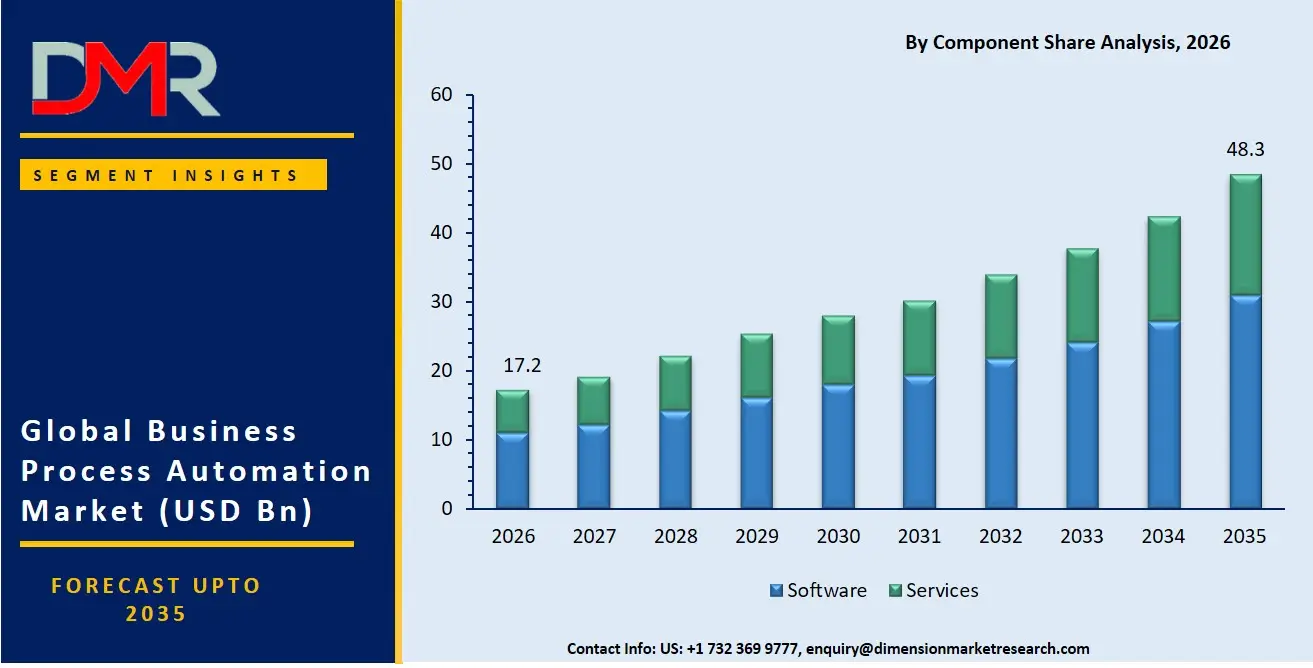
- By Component: Software segment is anticipated to get the majority share of the Business Process Automation Market in 2026.
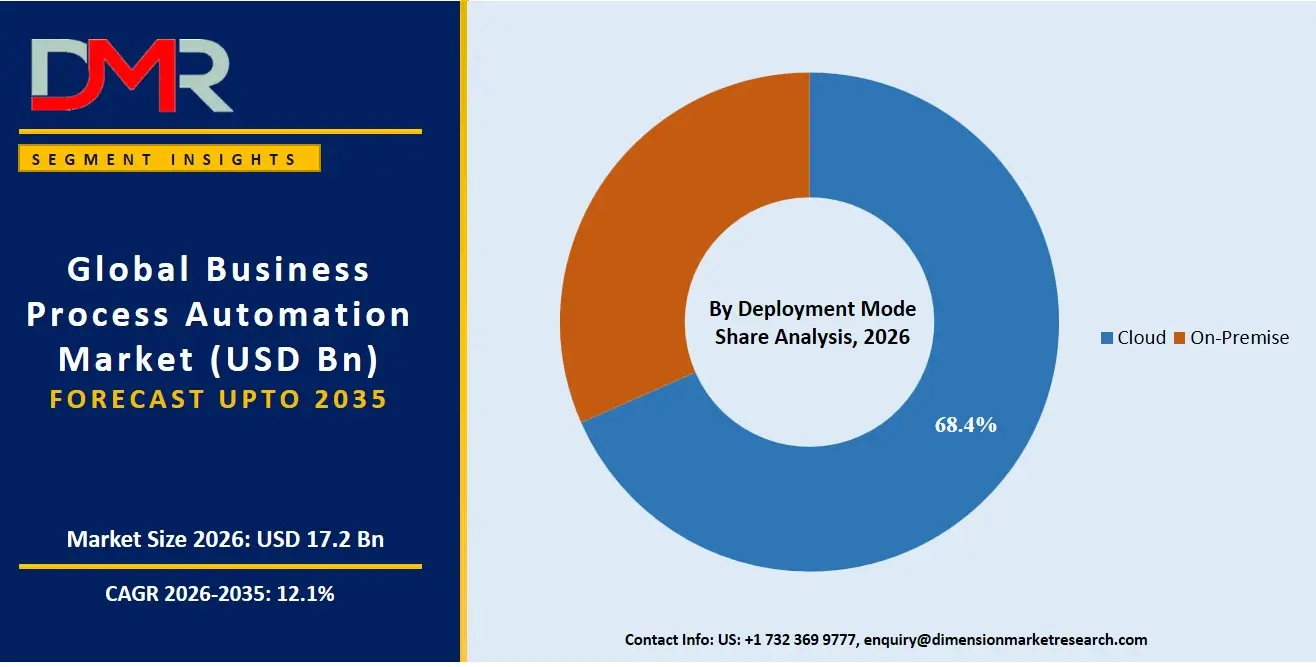
- By Deployment Mode: Cloud is expected to get the largest revenue share in 2026 in the Business Process Automation Market.
- By Organization Size: Large Enterprise segment is expected to get the largest revenue share in 2026 in the Business Process Automation Market.
- Regional Leadership: North America is set to lead the Business Process Automation Market with an estimated 38.6% share in 2026.
What is the Business Process Automation?
Business Process Automation is the deployment of technological solutions, intelligent workflow processes, and software that can help automate business processes. Some of the examples of business process automation include robotic process automation, intelligent workflow processes based on AI, process mining, and low-code automation. Dynamics of the market have a very important role in implementing digital transformation strategies across sectors like BFSI, healthcare, manufacturing, retail, and telecommunication. Adoption of technologies such as cloud computing, artificial intelligence, and hyperautomation has led to an increasing need for business process automation.
Use Cases
- Customer Service Automation: Companies use automation techniques to handle routing of tickets, integrating chatbots, and responding to customer queries. It results in quicker responses, customer satisfaction, and lower operating costs. Virtual assistants powered by artificial intelligence provide personalized support along with round-the-clock availability using different communication channels.
- Finance & Accounting Automation: Companies make use of automated systems for managing invoices, expense management, and financial reporting to reduce error rates and compliance. Financial operations become transparent and transactions can be approved instantly in addition to real-time financial analysis. Companies gain efficiency and faster transactions via automation.
- HR Process Automation: Human resource departments automate processes for hiring new employees, payroll management, recruiting management, and scheduling of workers. It helps in completing repetitive tasks more efficiently, improves the employee experience, and reduces processing time. AI-based analytics assist in hiring and managing the workforce.
- Procurement & Supply Chain Management Automation: Companies automate processes for inventory management, supplier coordination, logistics, and purchase order processing. These help in increasing operational transparency, reducing procurement time, and building resilience in the supply chain. Data analytics also assist companies in maintaining efficient inventory management and deliveries.
How AI Is Transforming the Business Process Automation Market
There is no denying the fact that Artificial Intelligence has had a significant impact on the Business Process Automation Market by helping businesses automate complicated processes, make more accurate predictions, and increase their efficiency. The AI-driven business automation systems can handle enormous amounts of structured and unstructured data, thus increasing speed and accuracy while minimizing manual intervention. AI-based intelligent chatbots, virtual assistants, and machine learning algorithms are being utilized for automating customer service, finance, and logistics operations.
Moreover, there are various other applications of AI technology like advanced process analytics, anomaly detection, and predictive maintenance that can assist organizations in becoming more productive and risk-free. There are some other applications of Artificial Intelligence like natural language processing and cognitive automation that are making the tasks of document processing, compliance management, and customer engagement easier for businesses. With the help of hyperautomation solutions driven by AI technology, organizations will become much more adaptive and autonomous.
Market Dynamic
Driving Factors in the Business Process Automation Market
Higher Adaption of Artificial Intelligence and Intelligent Automation Technologies
There are many factors that have played a part in the growth of the business process automation market, but one of the most important factors is the adaption of artificial intelligence, machine learning, and predictive analytics in automation technologies. Companies are trying their best to incorporate intelligent automation to reduce costs and automate processes with better precision. With automation technologies backed by AI, companies can make decisions and perform instant analysis of data along with adaptive workflows. The digital transformation of companies is helping them provide a better customer experience and increase employee productivity.
Restraints in the Business Process Automation Market
Expensive to Implement and Integrate
There is a need for considerable expenditure in implementing automation systems that cover all departments within an organization since it involves buying software, integrating the new system, training employees, and enhancing cybersecurity. Financial constraints could affect small and medium-sized firms that would wish to implement automation technologies. The integration process could also be challenging and lead to delays. Maintenance expenses could further hinder the adoption of automation technology.
Opportunities in the Business Process Automation Market
Expanding Opportunities for Cloud-Based Automation Systems
As more companies turn towards cloud computing, there are great opportunities for highly scalable and efficient automation systems. The use of cloud-based automation in businesses allows organizations to easily implement workflows, provide real-time analysis and accommodate remote working environments. Subscription-based automation services are becoming increasingly popular among SMEs due to their scalability and low initial costs. With improvements in cloud security, hybrid infrastructure and API integration, there are more opportunities for automation in various sectors.
Trends in the Business Process Automation Market
Emergence of Hyperautomation and End-to-End Workflow Processes
Hyperautomation is making its way into the market as one of the revolutionary technologies. Hyperautomation entails combining several technologies including robotic process automation, artificial intelligence, machine learning, and process mining to form an integrated enterprise environment. Businesses are adopting the concept of end-to-end automation in order to overcome organizational silos and enhance process transparency. Organizations are using automation tools capable of making complex decisions and even conducting predictive analytics.
Research Scope and Analysis
Business Process Automation Research Scope and Analysis is centered on exploring the various automation technologies including RPA, BPM, artificial intelligence-enabled solutions, and hyperautomation techniques in multiple sectors and geographical locations. It entails an assessment of the technology's segmentations according to deployment, enterprise size, and applications alongside growth factors, barriers, and future prospects.
ℹ
To learn more about this report –
Download Your Free Sample Report Here
By Component Analysis
The software category is predicted to dominate the Business Process Automation Market, holding a share of about 63.8% by 2026 due to increasing demands from enterprises for intelligent process automation, robotic process automation, and AI-based automation solutions. Process mining software, low-code automation software, and digital process automation technology are being increasingly adopted by enterprises. Machine learning and predictive analytics are also being incorporated into automation software, thus propelling market demand. Meanwhile, the services category is projected to register the highest growth rate, as enterprises today are looking for consulting, integration, deployment, and managed services for efficient automation processes.
By Deployment Model Analysis
The cloud deployment method is estimated to hold about 68.4% market share by 2026 due to its scalability, reduced cost of implementation, remote access, and fast deployment capabilities. Businesses are quickly adopting cloud-native automation tools to cater to their hybrid working environment and real-time management needs. Cloud computing helps businesses incorporate automation processes in a more efficient way across distributed business units. The on-premise deployment segment is still relevant for industries that operate under strict regulations such as the banking industry and the health care sector. However, the cloud deployment segment is projected to be the fastest growing segment due to its popularity in SMEs and multinational companies.
By Organization Size Analysis
Large enterprises are predicted to capture around 71.2% of the market share by 2026 owing to the high level of automation investments made for enterprise-level automation infrastructure and digital transformations. Large companies need scalable automation systems that can cater to complicated workflows, compliance requirements, and extensive data sets in various departments. Large companies have larger budgets for automation technologies and better integration capabilities as compared to other market segments. On the other hand, SMEs are likely to witness high growth in the coming years owing to the decreasing costs of cloud-based automation technologies.
By Business Function Analysis
Automation in finance and accounting processes is predicted to be the dominant factor in the market, holding a market share of 27.6% in 2026, owing to the rising demand for automated invoicing, reporting, monitoring, and transaction management. The reason why enterprises seek to automate finance processes lies in the potential for significant cost savings and fewer errors, among other benefits. Accounting processes powered by artificial intelligence facilitate quick decisions and real-time financial analysis. Automation of customer service processes is forecasted to be the fastest-growing category owing to the deployment of AI chatbots and automated ticketing systems.
By Technology Type Analysis
Robotic Process Automation (RPA) is expected to have around 34.9% market share in 2026 due to its extensive use in automating repetitive processes, optimizing workflows, and increasing productivity. RPA tools are extremely efficient at automating rule-based administrative processes like data entry, invoicing, and claims management. The reason why enterprises prefer using RPA technology is its scalability and quick ROI. On the other hand, the fastest growth rate is forecasted by the segments of hyperautomation and automation with the use of AI & machine learning due to the demand for intelligent end-to-end automation solutions.
By Industry Vertical Analysis
The BFSI sector will have nearly 24.7% market share by 2026 due to the growing application of automation technology in fraud detection, compliance with regulations, customer onboarding, and transactions processing. Large amounts of money are invested in automation systems that utilize artificial intelligence (AI) to improve efficiency, reduce errors, and boost cybersecurity within financial institutions. It is estimated that the healthcare and life sciences sector will witness exponential growth due to the growing application of automation technology in patient scheduling, billing, claims processing, and clinical data management.
The Business Process Automation Market Report is segmented on the basis of the following:
By Component
- Software
- Business Process Management (BPM) Software
- Robotic Process Automation (RPA) Software
- Digital Process Automation (DPA) Platforms
- Low-Code/No-Code Automation Platforms
- Process Mining Software
- AI-Driven Automation Platforms
- Services
- Consulting Services
- System Integration & Deployment Services
- Managed Services
- Support & Maintenance Services
By Deployment Model
By Organization Size
- Large Enterprises
- Small & Medium Enterprises (SMEs)
By Business Function
- Human Resource Process Automation
- Recruitment & Applicant Tracking
- Employee Onboarding
- Payroll Processing
- Workforce Scheduling & Management
- Finance & Accounting Process Automation
- Accounts Payable Processing
- Accounts Receivable Processing
- Invoice & Billing Automation
- Financial Reporting & Compliance
- Sales & Marketing Process Automation
- Lead Management Automation
- Campaign Management Automation
- CRM Workflow Automation
- Customer Journey Automation
- Procurement & Supply Chain Process Automation
- Purchase Order Automation
- Supplier Management Automation
- Inventory Management Automation
- Logistics & Fulfillment Automation
- Customer Service Process Automation
- Contact Center Automation
- Ticket Management Automation
- Virtual Assistants & Chatbots
- Service Request Automation
- IT Process Automation
- IT Helpdesk Automation
- Infrastructure Automation
- IT Service Management (ITSM) Automation
- Network Operations Automation
By Technology Type
- Rule-Based Automation
- Robotic Process Automation (RPA)
- Intelligent Process Automation (IPA)
- Hyperautomation
- AI & Machine Learning-Based Automation
By Industry Vertical
- Banking, Financial Services & Insurance (BFSI)
- Healthcare & Life Sciences
- Retail & E-Commerce
- Manufacturing
- IT & Telecommunications
- Government & Public Sector
- Transportation & Logistics
- Energy & Utilities
- Education
- Others
Regional Analysis
Leading Region in the Business Process Automation Market
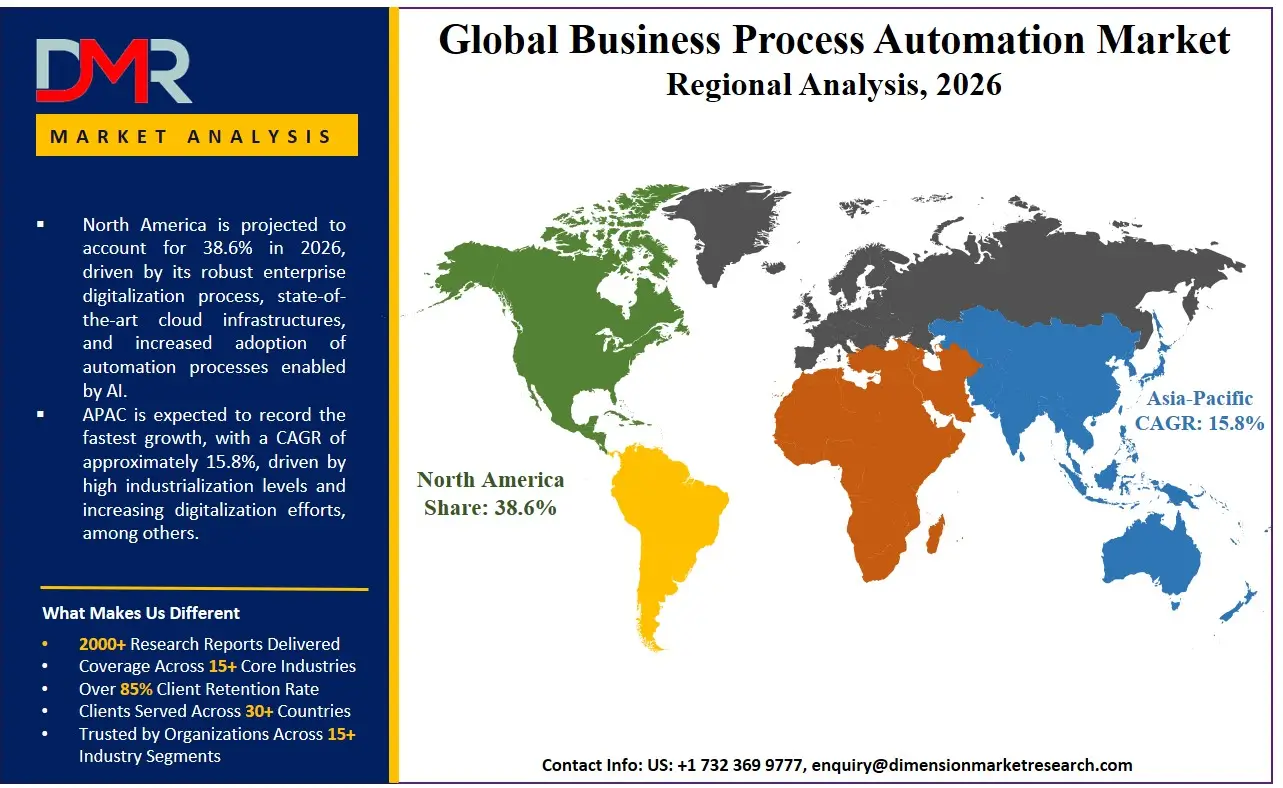
The North American region will capture the highest market share of around 38.6% by 2026 due to its robust enterprise digitalization process, state-of-the-art cloud infrastructures, and increased adoption of automation processes enabled by AI. North America enjoys a lot of investment in modernizing enterprise software systems, building cybersecurity infrastructures, and intelligent workflow management systems. The BFSI, healthcare, retail, and telecommunications sectors have adopted many advanced automation systems that enhance productivity and flexibility in operations. Moreover, the government's support of digitalization and innovations, presence of IT vendors, and substantial research and development spending make North America a leader in the business process automation market.
ℹ
To learn more about this report –
Download Your Free Sample Report Here
Fastest Growing Region in the Business Process Automation Market
Asia-Pacific is anticipated to emerge as the most dynamic region in terms of Business Process Automation Market owing to high industrialization levels and increasing digitalization efforts, among others. Countries like China, India, Japan, and South Korea are recording increased investments in smart manufacturing processes, digital banking, and enterprise automation projects. Increased focus on digitization and efficiency of operations by governments as well as enterprises is propelling the adoption rate in the market. Adoption of cheaper automation tools by small and medium-sized businesses in the region, along with high internet usage rates, will boost market dynamics further in the coming years.
By Region
North America
Europe
- Germany
- The U.K.
- France
- Italy
- Russia
- Spain
- Benelux
- Nordic
- Rest of Europe
Asia-Pacific
- China
- Japan
- South Korea
- India
- ANZ
- ASEAN
- Rest of Asia-Pacific
Latin America
- Brazil
- Mexico
- Argentina
- Colombia
- Rest of Latin America
Middle East & Africa
- Saudi Arabia
- UAE
- South Africa
- Israel
- Egypt
- Rest of MEA
Competitive Landscape
The Business Process Automation Market is very competitive with regard to innovation, collaboration, more growth opportunities in cloud platforms, and moves toward using AI-driven automation solutions. Companies active in the market strive to differentiate themselves by means of developing advanced analytics, low-code development solutions, and other forms of hyperautomation. The acquisition and merger activity in the business process automation market is not uncommon for players in this market sector, enabling them to grow their technology and geographic footprint. The entry barriers into the Business Process Automation Market are quite significant since enterprise-level integrations, cybersecurity, and scale are essential.
Some of the prominent players in the global Business Process Automation are:
- Microsoft
- IBM
- SAP
- Oracle
- Salesforce
- ServiceNow
- UiPath
- Automation Anywhere
- Pegasystems
- Appian
- SS&C Blue Prism
- Nintex
- Kissflow
- Bizagi
- Software AG
- OpenText
- Newgen Software
- TIBCO Software
- Workato
- Celonis
- Other Key Players
Recent Developments
- In May 2026, ProcessOS has been introduced by Camunda at their annual event called CamundaCon with more than 1,200 executives and technologists from 25 countries in attendance. As per the company's claim, the next step in adopting AI by enterprises requires going beyond just being assistants to focusing on transforming processes with AI. ProcessOS aims to provide businesses with a framework that can assist in reconsidering workflow by figuring out the role played by AI and humans.
- In May 2026, BPX is marketing its services by showing how robotic process automation is not only a cost-saving mechanism but can also help companies grow and scale. They point out that robotics process automation can enable companies to automate tasks in fields like finance, human resources, and customer care. Through automation, companies can become more efficient by eliminating the risk of errors.
- In May 2025, ABB partnered with Red Hat to enhance their joint efforts for next-generation industrial IT automation technologies that allow for the safe and modular implementation of control apps within process industries. The alliance is based on bringing together the knowledge of both organizations where ABB has vast experience in industrial automation while Red Hat has expertise in enterprise open-source platforms and artificial intelligence for autonomous operations.
Report Details
| Report Characteristics |
| Market Size (2026) |
USD 17.2 Bn |
| Forecast Value (2035) |
USD 48.3 Bn |
| CAGR (2026–2035) |
12.1% |
| Historical Period |
2021 – 2025 |
| Forecast Period |
2027 – 2035 |
| Base Year |
2025 |
| Estimate Year |
2026 |
| Segments Covered |
By Component (Software, Services), By Deployment Model, By Organization Size, By Business Function, By Technology Type, By Industry Vertical |
| Regional Coverage |
North America – The US and Canada; Europe – Germany, The UK, France, Russia, Spain, Italy, Benelux, Nordic, & Rest of Europe; Asia-Pacific – China, Japan, South Korea, India, ANZ, ASEAN, Rest of APAC; Latin America – Brazil, Mexico, Argentina, Colombia, Rest of Latin America; Middle East & Africa – Saudi Arabia, UAE, South Africa, Turkey, Egypt, Israel, & Rest of MEA |
Frequently Asked Questions
How big is the Business Process Automation Market?
▾ The Business Process Automation Market size is expected to reach USD 17.2 billion by 2026 and is projected to reach USD 48.3 billion by the end of 2035.
What is the CAGR of the Business Process Automation Market from 2026 to 2035?
▾ The market is growing at a CAGR of 12.1 percent over the forecasted period.
What factors are driving the growth of the Business Process Automation Market?
▾ Higher Adaption of Artificial Intelligence and Intelligent Automation Technologies, and more are the factors driving the growth of the Business Process Automation Market.
What are the major trends in the Business Process Automation Market?
▾ Emergence of Hyperautomation and End-to-End Workflow Processes, and more are some of the major trends in the market.
Who are the key players in the Business Process Automation Market?
▾ Some of the key players in the Business Process Automation Market include IBM, SAP, Microsoft, and more.
How is the Business Process Automation Market segmented?
▾ The Business Process Automation Market is segmented by component, deployment model, organization size, business function, technology type, industry vertical.
Which region held the largest share of the Business Process Automation Market in 2026?
▾ North America is set to lead the Business Process Automation Market with an estimated 38.6% share in 2026.
Which region is expected to grow the fastest in the Business Process Automation Market?
▾ Asia Pacific is the fastest-growing region in the Business Process Automation Market during the forecast period.