Market Snapshot
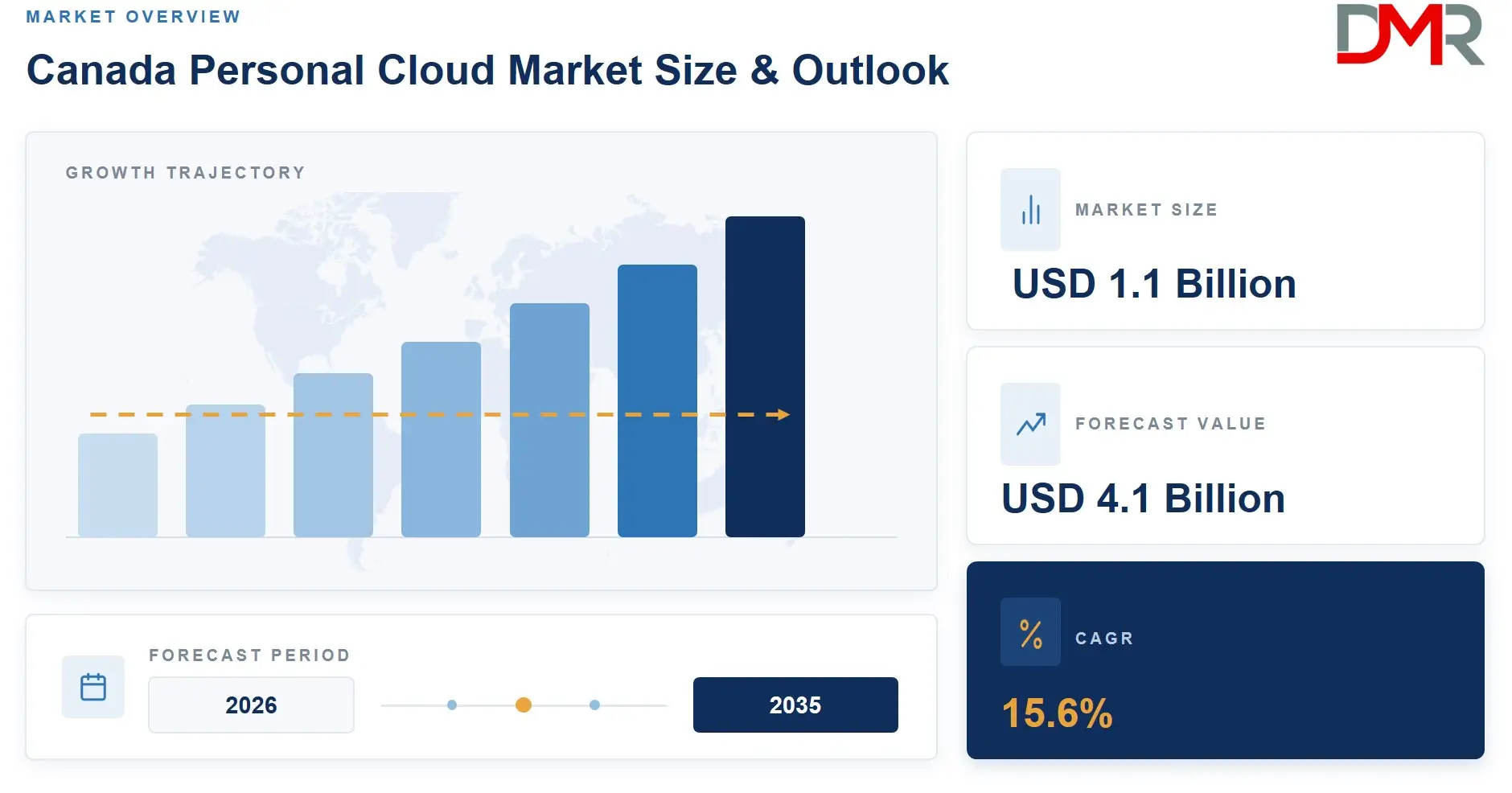
- Market Size (2026): USD 1.1 Bn
- Forecast Value (2035): USD 4.1 Bn
- CAGR (2026-2035): 15.6%
- Leading Offering (2026): Cloud Storage Software & Platforms, around 42%
- Leading Application (2026): Photo & Video Backup, close to 34%
- Key Players: Apple, Google, Sync.com and others
What is Canada Personal Cloud Market and its Market Size?
The Canada Personal Cloud Market size is estimated to reach USD 1.1 Bn in 2026 and is further anticipated to reach USD 4.1 Bn by 2035, at a CAGR of 15.6%. These figures cover consumer and household demand for personal cloud storage, backup and synchronization services delivered to users located inside Canada; they exclude the worldwide revenue that Canadian-headquartered vendors such as Sync.com or national telecom operators earn from customers outside the country, and exclude enterprise or government cloud infrastructure spending, which sits in a separate category.
ℹ
To learn more about this report –
Download Your Free Sample Report Here
Personal cloud describes consumer-facing storage that mirrors, backs up and synchronizes files, photos and device data across a user's phones, laptops and connected devices, accessed through an app or browser rather than a corporate network. In Canada the category spans three delivery forms: subscription storage sold directly by software platforms, storage bundled into a device or operating system at no separate charge until a capacity threshold is crossed, and physical network-attached storage that a household or freelancer runs at home and pairs with cloud sync for offsite copies.
Buyers fall into three broad groups. Individual consumers upgrade storage tiers once phone photo and video libraries outgrow the free allowance, family plan subscribers split one paid tier across a household to cover multiple devices at a lower per-user cost, and home office or freelance professionals use personal cloud as an informal alternative to enterprise file servers when running a one or two person operation. Each group buys on a different trigger: capacity pressure, cost sharing, or workflow continuity.
What is structurally changing is the boundary between "free enough" and "worth paying for." Camera resolution and video length keep pushing average file sizes up, telecom carriers are folding storage tiers into broadband and mobile contracts as a retention tool, and growing attention to where personal data physically sits under Canadian privacy law is nudging a portion of buyers toward domestically hosted alternatives rather than the default platform headquartered abroad.
Use Cases
- Household Photo and Video Archiving: Families with multiple smartphones consolidate years of photos and home videos into one paid tier once on-device storage repeatedly hits its limit, replacing a patchwork of manual transfers to laptops and external drives with automatic background backup that keeps every device in sync.
- Freelance and Home Office File Continuity: Independent contractors and small home-based businesses use personal cloud folders as a lightweight stand-in for a corporate file server, keeping client files, invoices and project drafts accessible across a work laptop and a personal phone without the cost or setup of a dedicated business plan.
- Multi-Device Family Sharing: Households on a single family subscription tier, which accounts for close to 24% of end-user demand in 2026, centralize shared calendars, documents and media libraries so that each family member's device draws from one pooled allowance rather than separate paid accounts.
- Home Network-Attached Storage Backed by Cloud Sync: Privacy-conscious households and hobbyist users run a personal NAS device for primary storage and pair it with a lighter cloud subscription purely for offsite disaster recovery, keeping the bulk of sensitive data on hardware they physically control while still holding a remote copy.
Key Takeaways
- Market Size & Share: The Canada Personal Cloud Market is estimated at USD 1.1 Bn in 2026, expanding at a CAGR of 15.6% through 2035.
- Offering Analysis: Cloud Storage Software & Platforms is expected to account for approximately 42% of 2026 revenue, the largest share of any offering.
- Demand Concentration: Uptake is concentrated among broadband-connected urban households in Ontario, British Columbia and Quebec, where the highest device-per-household counts sit alongside near-universal home internet access.
- Application Shift: Smart Home & Connected Device Data Management is projected to grow fastest among applications, at a CAGR of 26.1% between 2026 and 2035.
- Distribution Shift: Telecom & ISP Bundled Plans is set to expand fastest among distribution channels, at a CAGR of 23.4% over the same period.
- Data Sovereignty Pressure: Federal and Quebec privacy rules are steering a rising share of privacy-sensitive buyers toward domestically hosted storage options.
How AI/Gen AI is Transforming the Canada Personal Cloud Market?
Artificial intelligence has moved from an experimental add-on to a baseline expectation in Canadian personal cloud services, primarily through features that reduce the manual effort of organizing a growing personal data archive. Computer vision models now scan uploaded photo and video libraries to auto-tag faces, locations and objects, letting a user search "beach trip 2023" instead of scrolling folders, while large-language-model-based assistants summarize shared documents and surface the right file from a natural-language query rather than a filename.
The more commercially significant shift is operational rather than conversational: anomaly-detection models trained on account activity flag ransomware-style mass file changes and unusual sign-ins before a backup is overwritten, and predictive storage-tiering engines forecast when a user will exceed their plan and prompt an upgrade at the moment of genuine need instead of after the account is already full.
- Smart Photo and Video Organization: automatic tagging, duplicate detection and face grouping across a user's full library.
- Natural-Language File Search: LLM-based assistants that retrieve documents from a description rather than an exact filename.
- Ransomware and Anomaly Detection: behavioral models that flag mass file changes before they propagate into backups.
- Predictive Storage Tiering: usage forecasting that times upgrade prompts to when a household is about to run out of space.
Key Drivers in the Canada Personal Cloud Market
Two forces are pulling Canadian households and small offices toward paid personal cloud tiers faster than the broader digital services category is growing.
- Rising File Sizes from Smartphone Photography and Video: successive generations of smartphone cameras have increased average photo resolution and introduced longer, higher-frame-rate video capture as a default setting, so a typical device now generates several times more data per year than it did five years earlier. Free storage allowances bundled with operating systems have not kept pace with this growth, so users repeatedly hit capacity warnings and convert to a paid tier, a dynamic that keeps Photo & Video Backup the leading application at close to 34% of 2026 demand.
- Telecom Bundling of Storage into Broadband and Mobile Contracts: national and regional carriers increasingly fold a personal cloud storage allowance into fibre internet and mobile plans as a low-cost way to raise switching costs and differentiate otherwise similar packages. Because the storage arrives pre-activated on the customer's existing bill rather than requiring a separate signup, conversion from free to paid use is close to frictionless, which is why Telecom & ISP Bundled Plans is the fastest-growing distribution channel at a CAGR of 23.4%.
Restraints in the Canada Personal Cloud Market
- Free-Tier Sufficiency for Light Users: most Canadian consumers already receive several gigabytes of storage bundled at no cost with their phone, laptop or email account, and single-device users with modest photo libraries can operate for years without exceeding that allowance. This keeps upgrade urgency low for a meaningful share of the addressable population and caps how quickly average revenue per paying user can rise industry-wide.
- Cross-Border Data Storage Concerns Under Dominant Foreign-Headquartered Platforms: a portion of privacy-conscious buyers, particularly small businesses and professionals handling client information, hesitate to commit to platforms headquartered outside Canada because of exposure to foreign data-access laws and the compliance friction this creates alongside federal and Quebec privacy rules. Domestically hosted alternatives remain comparatively small in scale, so this hesitation slows near-term conversion rather than redirecting it fully toward local providers.
Growth Opportunities in the Canada Personal Cloud Market
- Deeper Telecom Bundling Beyond Major Metros: regional and secondary-market carriers extending fibre and 5G coverage outside the largest metro areas have a clear opening to attach storage tiers to new broadband sign-ups the way larger urban carriers already do, capturing households that have not yet formed a personal cloud habit at all.
- Combined Personal and Professional Plans for the Home Office Segment: the Home Office & Freelance Professionals end-user group is expanding at a CAGR of 22.8%, and providers that package personal and light business-grade features, such as client-folder sharing and simple access controls, into one consumer-priced plan can capture buyers who currently sit awkwardly between a personal account and an enterprise contract.
Trends in the Canada Personal Cloud Market
- AI Features Becoming a Standard Inclusion Rather Than a Paid Add-On: smart search, auto-organization and security scanning are shifting from premium upsells to baseline expectations across most subscription tiers, which is pulling Value-Added Services to a CAGR of 24.3% as providers repackage these capabilities into new pricing bands rather than a single flat fee.
- Hybrid Local-Plus-Cloud Architectures Gaining Ground: a growing number of households are pairing a personal NAS device with a lighter cloud subscription used only for offsite backup, a pattern that keeps primary data on hardware they control while still meeting the need for a remote copy, and it is the reason Hybrid Personal Cloud is expanding at a CAGR of 21.7%.
Research Scope and Analysis
Segment performance is assessed across five axes: offering, deployment mode, application, end user and distribution channel. Each axis identifies the sub-segment carrying the largest share of 2026 revenue and the one expanding fastest through 2035, together with the commercial reason behind each position.
ℹ
To learn more about this report –
Download Your Free Sample Report Here
By Offering
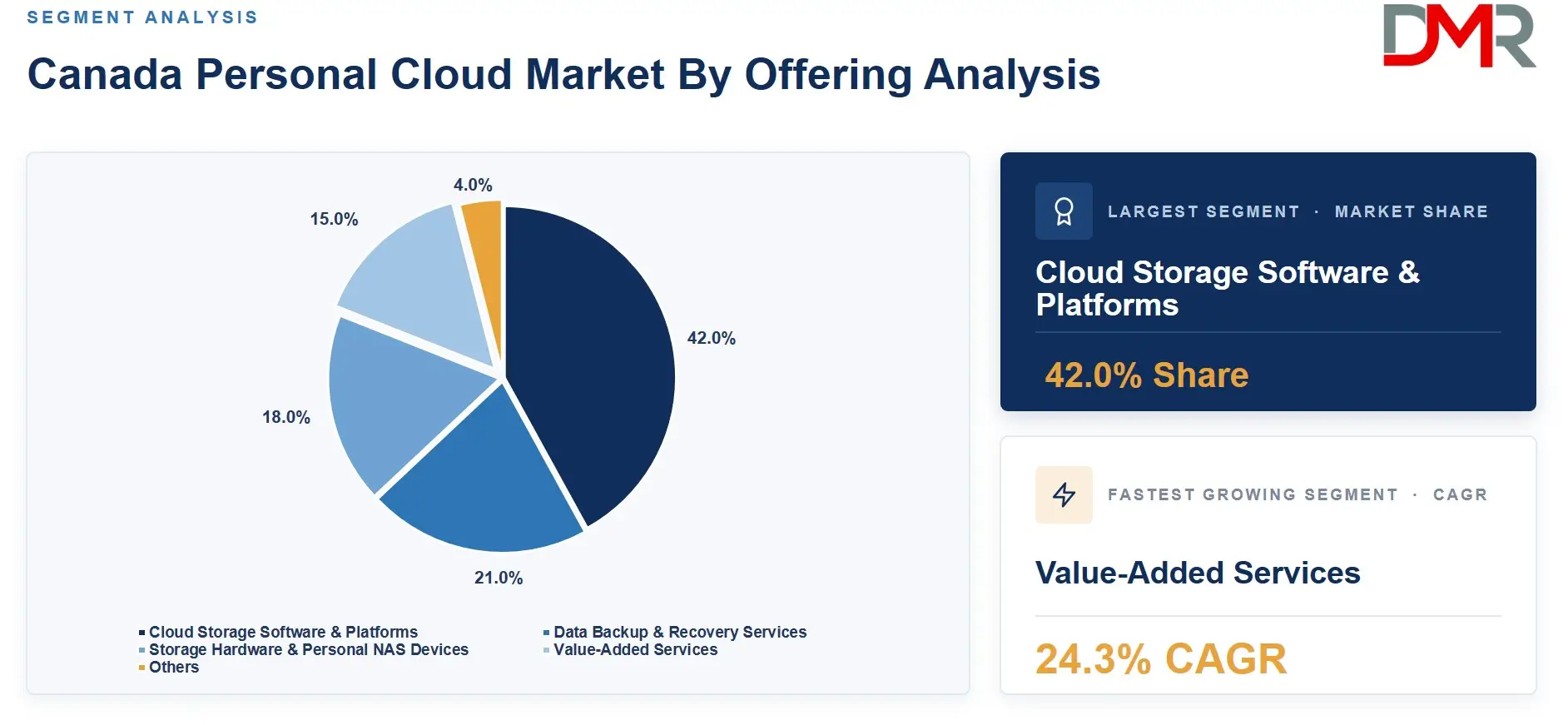
Cloud Storage Software & Platforms is projected to hold the largest share by offering in 2026, accounting for close to 42% of revenue, since it is the default paid upgrade path presented directly inside operating systems and apps that nearly every device owner already uses, giving it the widest addressable base and the lowest switching friction of any offering. Growth, however, is concentrated in Value-Added Services such as AI-driven organization, ransomware protection and advanced sharing controls, expanding at a CAGR of 24.3% between 2026 and 2035 as providers unbundle these features into a distinct premium tier that sits on top of base storage rather than folding them in for free.
By Deployment Mode
Public Personal Cloud is expected to remain the largest deployment mode in 2026, holding approximately 58% of revenue, because it requires no hardware purchase or setup and arrives pre-configured as the default option on most consumer devices. The steeper trajectory sits with Hybrid Personal Cloud, forecast to grow at a CAGR of 21.7% through 2035, pulled by households pairing local NAS hardware with a cloud sync layer to balance data control against the convenience of an offsite copy.
By Application
Photo & Video Backup leads by application, accounting for around 34% of 2026 revenue, a position built on the steady rise in smartphone camera resolution and video length that keeps outpacing free storage allowances and forcing retrofit demand from users with years of accumulated media. Growth, however, is concentrated in Smart Home & Connected Device Data Management, expanding at a CAGR of 26.1% between 2026 and 2035 as connected cameras, thermostats and other home devices generate continuous data that needs cloud retention rather than one-off backup.
By End User
Individual Consumers hold the largest share by end user in 2026, at approximately 64%, reflecting the near-universal personal ownership of smartphones and laptops across the Canadian population. The fastest-growing group is Home Office & Freelance Professionals, forecast at a CAGR of 22.8% through 2035, as hybrid and remote work normalize the practice of storing client and project files on the same personal-grade infrastructure used for family photos, without the cost of an enterprise contract.
By Distribution Channel
OEM & Device-Bundled distribution is the leading channel in 2026, accounting for close to 39% of revenue, since storage upgrades are offered at the exact moment a consumer sets up a new phone, laptop or tablet, when the purchase decision is already in motion. Growth, however, is concentrated in Telecom & ISP Bundled Plans, projected at a CAGR of 23.4% between 2026 and 2035, as carriers extend fibre and mobile coverage and use bundled storage as a low-cost retention lever on existing bills.
The Canada Personal Cloud Market Report is Segmented Based on the Following
By Offering
- Cloud Storage Software & Platforms
- Data Backup & Recovery Services
- Storage Hardware & Personal NAS Devices
- Value-Added Services
- Others
By Deployment Mode
- Public Personal Cloud
- Hybrid Personal Cloud
- Private/NAS-based Personal Cloud
- Others
By Application
- Photo & Video Backup
- File Sync & Sharing
- Document & Data Backup
- Smart Home & Connected Device Data Management
- Personal Media Streaming & Content Libraries
- Others
By End User
- Individual Consumers
- Family/Household Plan Subscribers
- Home Office & Freelance Professionals
- Others
By Distribution Channel
- OEM & Device-Bundled
- Direct-to-Consumer Subscription
- Telecom & ISP Bundled Plans
- Retail & Electronics Stores
- Others
Geopolitical Analysis
Most personal data uploaded by Canadian users today still flows to storage infrastructure operated by platforms headquartered outside the country, a legacy of those platforms being the default option pre-installed on devices sold in Canada. That default is now being tested: Quebec's Law 25 and ongoing federal modernization of private-sector privacy rules are pushing both consumers and small-business buyers to ask where their data physically resides, not just how it is encrypted in transit. This is opening real commercial space for domestically hosted providers and Canadian data centre operators to compete on residency and jurisdiction rather than price alone, particularly among freelancers and home-office users handling client information. The brake is scale: domestic providers remain small relative to the Canadian user bases held by large multinational incumbents, so the shift changes purchase consideration more than it changes market share in the near term, and it is nonetheless starting to shape how providers position and price their offerings to Canadian buyers.
Technology Analysis
Personal cloud platforms serving Canadian users are converging on the same core technology stack: client-side encryption applied before a file leaves the device, AI-based indexing that runs on uploaded photo and video libraries, and sync engines that reconcile changes across several devices in near real time. What is shifting now is where that AI processing happens, with more providers moving lightweight tagging and search models onto the device itself to cut cloud compute cost and address privacy objections simultaneously. The commercial opening sits in packaging these technical capabilities as a distinct premium layer rather than a hidden cost of doing business, letting providers charge separately for organization and security features. The risk is margin pressure on entry-level tiers, since running AI features at scale carries real compute cost that a low free or introductory price point does not always cover, pushing providers toward tighter caps on free-tier processing.
Competitive Landscape
The Canada Personal Cloud Market is moderately concentrated at the top, with a handful of multinational device and software ecosystems capturing the majority of paid subscriptions through pre-installed defaults, while a longer tail of specialist backup providers, domestic cloud operators and telecom-bundled offerings compete for the remainder. Competition centers on three levers: storage price per gigabyte, depth of ecosystem lock-in across a buyer's devices, and, increasingly, where data is physically hosted. Multinational platforms lean on device defaults and free-tier funnels to convert users with minimal marketing spend, while Canadian-headquartered providers and national telecom operators compete on data residency, bundled distribution through existing broadband and mobile bills, and pricing tuned to the domestic market rather than worldwide scale.
Some of the Prominent Players in the Canada Personal Cloud Market Are
- Apple Inc.
- Google LLC
- Microsoft Corporation
- Amazon.com Inc.
- Dropbox Inc.
- Box Inc.
- IDrive Inc.
- Backblaze Inc.
- pCloud AG
- Western Digital Corporation
- Internxt
- Icedrive Limited
- Koofr d.o.o.
- MEGA Limited
- Tresorit
- SpiderOak Inc.
- Egnyte Inc.
- Ziff Davis Inc. (Livedrive)
- Code42 Software Inc. (CrashPlan)
- Nord Security (NordLocker)
- Proton AG
- Filen
- Degoo Backup AB
- Genie9 (Zoolz)
- Synology Inc.
- QNAP Systems Inc.
- Sync.com Inc.
- ThinkOn Inc.
- eStruxture Data Centers Inc.
- OpenText Corporation
- Rogers Communications Inc.
- BCE Inc. (Bell Canada)
- TELUS Corporation
- Cogeco Communications Inc.
- Bragg Communications Inc. (Eastlink)
- Videotron Ltd.
- SaskTel
- Ecobee Inc.
- 01 Communique Laboratory Inc.
- London Drugs Limited
- Other Key Players
Recent Developments
- In April 2026, Sync.com expanded its Toronto data centre capacity to support growing demand from Canadian small businesses seeking domestically hosted file storage under provincial privacy requirements.
- In February 2026, TELUS extended a bundled cloud storage allowance to a wider range of its mobile and home internet plans as part of a broader push to reduce subscriber churn.
- In September 2025, Rogers Communications integrated an upgraded photo and video backup tool into its home internet app, aimed at households consolidating storage across multiple family devices.
- In June 2025, eStruxture Data Centers announced additional Quebec facility capacity partly earmarked for consumer and small-business cloud storage partners seeking in-country hosting.
- In March 2025, Ecobee added expanded cloud data retention options for its smart home device line, responding to customer requests for longer historical logs of connected
Report Details
| Report Characteristics |
| Market Size (2026) |
USD 1.1 Bn |
| Forecast Value (2035) |
USD 4.1 Bn |
| CAGR (2026-2035) |
15.6% |
| Historical Data |
2021 - 2025 |
| Forecast Data |
2026 - 2035 |
| Base Year |
2025 |
| Segments Covered |
By Offering, By Deployment Mode, By Application, By End User, By Distribution Channel |
| Regional Coverage |
Canada |
Frequently Asked Questions
How big is the Canada Personal Cloud Market?
▾ The Canada Personal Cloud Market is estimated at USD 1.1 Bn in 2026 and is projected to reach USD 4.1 Bn by 2035, reflecting sustained growth in household and small-office demand for cloud storage, backup and synchronization services across the country.
What is the growth rate of the Canada Personal Cloud Market?
▾ The market is forecast to grow at a CAGR of 15.6% between 2026 and 2035, driven by rising smartphone photo and video volumes, expanding telecom bundling of storage allowances, and growing adoption of AI-assisted organization and security features.
What is driving demand in the Canada Personal Cloud Market?
▾ Demand is primarily driven by data volume growth from smartphone photography and video, which keeps pushing users past free storage allowances, and by telecom carriers bundling storage into broadband and mobile contracts, which converts free users to paid tiers with minimal friction and no separate signup step.
Who are the key players in the Canada Personal Cloud Market?
▾ Key players include Apple, Google, Microsoft, Dropbox, Sync.com, TELUS and Rogers Communications, alongside a broader group of specialist backup providers, domestic cloud operators and telecom-bundled storage offerings competing across the country.
Which offering segment leads the Canada Personal Cloud Market?
▾ Cloud Storage Software & Platforms leads by offering, accounting for approximately 42% of 2026 revenue, ahead of data backup services, storage hardware and value-added services such as AI organization and security tools.
How is AI transforming personal cloud services in Canada?
▾ AI now powers automatic photo and video organization, natural-language file search, ransomware and anomaly detection, and predictive storage-tiering prompts, shifting these capabilities from optional extras to standard features across most Canadian personal cloud subscriptions.
What is the forecast outlook for the Canada Personal Cloud Market through 2035?
▾ The Canada Personal Cloud Market is expected to nearly quadruple in size between 2026 and 2035, expanding from an estimated USD 1.1 Bn to USD 4.1 Bn as data volumes, telecom bundling and AI-driven feature adoption continue to broaden the paying user base across the country.