China Autonomous Factory Market Snapshot
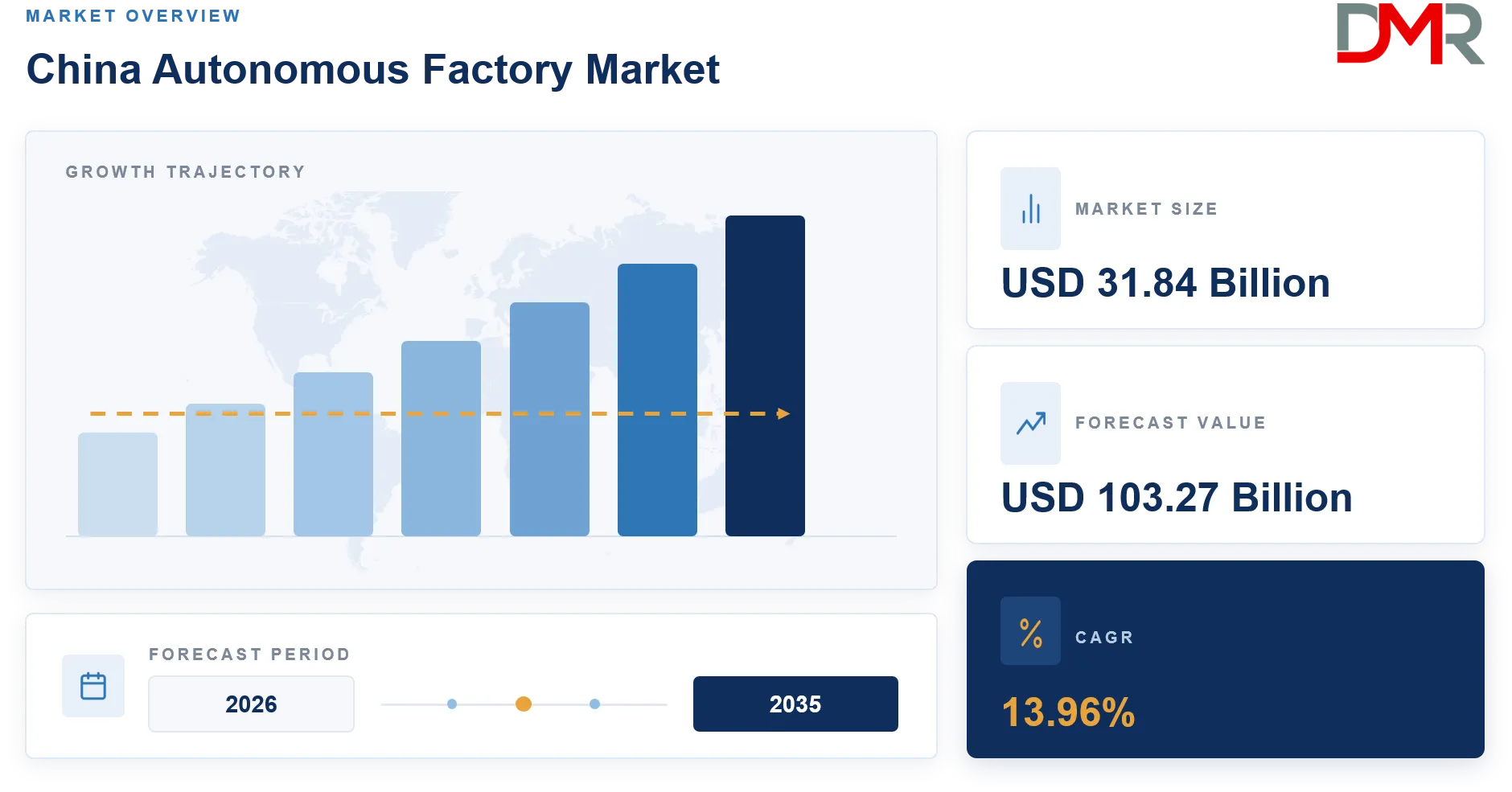
- Market Value: China autonomous factory market is valued at USD 31.84 billion in 2026 and is expected to reach USD 103.27 billion by 2035.
- CAGR: China autonomous factory market is expected to grow at a CAGR of 13.96% from 2026 to 2035.
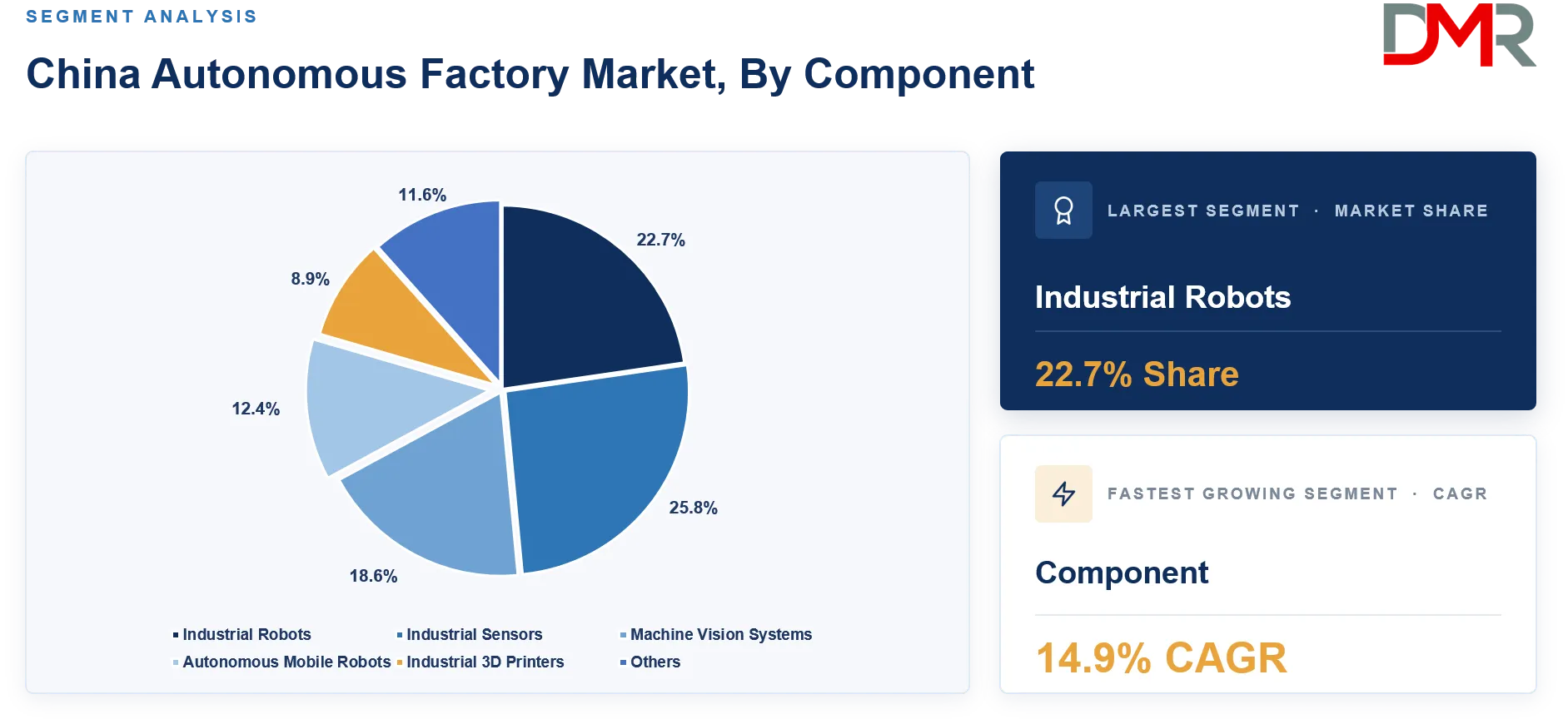
- By Component Segment Analysis: Industrial robots led the component segment with a 22.7% share in 2026.
- By Software Segment Analysis: Industrial artificial intelligence led the software segment with a 22.4% share in 2026.
- By End-User Industry Segment Analysis: Electronics and semiconductor manufacturing held a 24.6% share in 2026.
- Major Players: Hikrobot, Geek+, Siasun Robot & Automation, ESTUN Automation, and Otheras.
What is the China Autonomous Factory Market and its Market Size?
The China Autonomous Factory Market size is projected to be valued at USD 31.84 billion in 2026 and is expected to reach USD 103.27 billion by 2035, expanding at a CAGR of 13.96% during the forecast period. An autonomous factory combines industrial robots, machine vision, autonomous mobile robots, industrial sensors, digital twins, manufacturing execution systems, industrial artificial intelligence, control platforms, and connected production assets to automate manufacturing decisions and physical operations with limited human intervention.
ℹ
To learn more about this report –
Download Your Free Sample Report Here
China offers a strong commercial base for autonomous manufacturing because it combines very large manufacturing output with deep domestic robotics, electronics, automotive, battery, machinery, and industrial automation supply chains. According to the International Federation of Robotics, 295,000 industrial robots were installed in China during 2024, representing 54% of worldwide installations. China also had more than 2 million industrial robots in operation, while Chinese suppliers captured 57% of domestic robot installations. These conditions are lowering equipment availability barriers and supporting broader factory automation adoption.
Use Cases
- Autonomous Production Lines: Manufacturers connect industrial robots, PLCs, machine vision and AI-based process controls to run assembly, welding, machining, packaging and testing operations with fewer manual interventions. The model is particularly relevant to electronics, EV, battery and precision equipment plants where production speed and repeatability influence margins.
- Automated Quality Inspection: Machine vision systems and industrial AI inspect components, solder joints, surfaces, dimensions and packaging in real time. Automated inspection allows manufacturers to identify defects at production speed, trace recurring quality issues and reduce dependence on manual sampling, which is important in semiconductor, electronics and automotive supply chains.
- Autonomous Material Handling: Autonomous mobile robots, automated forklifts and warehouse robots transport raw materials, work-in-progress components and finished products between storage zones and production lines. Chinese robotics suppliers are expanding these systems across factories that require high-throughput intralogistics and flexible production layouts.
- Predictive Equipment Maintenance: Connected sensors monitor vibration, temperature, current, pressure and machine cycles. Industrial software detects abnormal operating patterns before a critical asset fails, allowing factories to schedule maintenance around production requirements and reduce unplanned downtime across continuous and discrete manufacturing facilities.
- Production and Energy Optimization: Digital twins, MES platforms and industrial AI combine equipment, quality, inventory and energy data to optimize scheduling and resource use. Manufacturers can adjust production parameters, balance workloads, reduce idle equipment and improve energy efficiency while maintaining output and delivery commitments.
How AI/Gen AI is Transforming the China Autonomous Factory Market?
Industrial artificial intelligence is shifting factory automation from predefined machine sequences toward systems that can interpret production conditions and recommend or execute operational changes. AI-enabled machine vision identifies subtle defects that fixed inspection rules can miss, while predictive models analyze sensor data to detect equipment degradation. Production planning systems can combine machine availability, work orders, quality records and material constraints to improve scheduling. This capability is particularly valuable in Chinese electronics, semiconductor, EV and machinery plants where manufacturers handle high product volumes, shorter product cycles and demanding quality specifications.
Generative AI is extending this transformation into engineering, maintenance and factory knowledge management. Manufacturers can use industrial copilots to query equipment documentation, interpret alarm histories, assist technicians with troubleshooting and generate maintenance instructions from operational records. Digital twin environments can pair these interfaces with real production data to accelerate root-cause analysis and process improvement. The strongest commercial value is likely to come from systems connected securely to MES, ERP, SCADA, machine vision and plant asset management platforms, since operational context allows AI applications to support measurable manufacturing decisions rather than isolated office tasks.
Key Drivers in the China Autonomous Factory Market
Large-Scale Deployment of Industrial Robotics
China's industrial robot ecosystem provides a strong hardware base for autonomous factory growth. The country installed 295,000 industrial robots in 2024, the highest annual deployment recorded by the International Federation of Robotics and 54% of worldwide installations. Local manufacturers supplied 57% of China's domestic installations. Rising domestic supply improves access to robots, controllers, servo systems and integration expertise, helping manufacturers automate assembly, handling, inspection and processing at larger scale.
National Push for Intelligent Manufacturing
Government support is accelerating the transition from isolated automation toward connected smart factories. In July 2026, China's Ministry of Industry and Information Technology and five other departments launched the 2026 intelligent factory cultivation initiative. The program covers progressively more capable smart factories and encourages manufacturers to strengthen digital, networked and intelligent production capabilities. This policy direction supports investment in industrial software, robotics, digital twins, machine vision and data-driven production systems.
Restraints in the China Autonomous Factory Market
Integration Complexity Across Legacy Production Assets
Many Chinese factories operate mixed equipment environments containing newer connected systems alongside legacy PLCs, machines and proprietary production platforms. Building an autonomous factory requires reliable communication between these assets and MES, ERP, SCADA, AI and digital twin layers. Data structures, protocols and machine generations can vary widely. Integration therefore requires engineering work, production testing and system validation, raising implementation costs and making brownfield transformation more complicated than automation in newly built facilities.
Industrial Cybersecurity and Data Governance Risks
Greater factory connectivity increases the number of systems that can affect physical production. Autonomous factories connect robots, sensors, industrial networks, cloud platforms, enterprise systems and remote maintenance tools, so cyber incidents can create production as well as information risks. Manufacturers need segmented operational networks, access controls, secure device management and reliable recovery procedures. Companies operating sensitive electronics, semiconductor, pharmaceutical or strategic manufacturing facilities also need tighter governance around production data and industrial AI models.
Growth Opportunities in the China Autonomous Factory Market
Expansion from Large Plants into Mid-Sized Manufacturing
China's next automation opportunity extends beyond large automotive and electronics plants. Lower-cost domestic robots, machine vision, autonomous mobile robots and modular industrial software can make advanced automation more accessible to medium-sized machinery, food, medical-device and component manufacturers. Suppliers that offer standardized cells, rapid deployment, subscription software and easier integration can reduce initial engineering requirements. This creates an opportunity to expand autonomous manufacturing into China's broad network of specialized industrial suppliers.
Autonomous Logistics Integrated with Production
Factories are increasingly linking production automation with internal logistics. Autonomous mobile robots, vision-guided forklifts, warehouse systems and MES software can coordinate material movement directly with line demand. Companies such as Geek+, Hai Robotics, Quicktron Robotics, ForwardX Robotics and VisionNav Robotics give China a substantial domestic ecosystem in intelligent logistics. Integrating these technologies with production scheduling can reduce material waiting time and support factories designed around flexible rather than fixed conveyor infrastructure.
Trends in the China Autonomous Factory Market
Convergence of Robotics, Machine Vision and Industrial AI
Automation suppliers are increasingly combining robot motion, visual perception and AI-based decision systems rather than selling each layer independently. A robot equipped with machine vision can recognize part location, inspect quality and adapt its movement when production conditions change. Industrial AI adds process optimization and predictive capabilities to this environment. This convergence supports more flexible automation in electronics assembly, machine tending, warehouse operations and high-mix manufacturing where rigid systems have historically been difficult to justify.
Movement Toward Higher Levels of Factory Autonomy
China's market is moving from automated equipment toward coordinated production systems that require less manual supervision. Semi-autonomous factories currently provide a practical transition because manufacturers can retain human control over exceptions while automating repetitive workflows. Over the forecast period, improved machine perception, edge computing, industrial AI, digital twins and autonomous logistics are expected to expand the number of production stages that can operate continuously, supporting the longer-term development of fully autonomous and lights-out manufacturing environments.
Research Scope and Analysis
The China Autonomous Factory Market is segmented based on component, software, control system, automation level, automation type, application, end-user industry and factory scale. The study analyzes the role of physical automation equipment, industrial software and factory control infrastructure while assessing adoption patterns across major manufacturing industries. It also considers autonomous material movement, quality control, equipment maintenance, production optimization and energy management as connected parts of the autonomous manufacturing architecture.
ℹ
To learn more about this report –
Download Your Free Sample Report Here
By Component;
Industrial robots dominated the component segment with a 22.7% share in 2026. China provides an unusually large addressable environment for robot deployment because electronics, automotive, batteries, appliances, machinery and metal fabrication all require scalable physical automation. Robots perform welding, assembly, material transfer, machine tending, dispensing, packaging and inspection, giving the category applications across several factory processes. China's domestic supplier share of industrial robot installations reached 57% in 2024, indicating stronger localization of the robotics supply chain. Industrial sensors, machine vision and autonomous mobile robots increasingly complement robotic arms by giving automated cells greater perception, traceability and mobility.
By Software;
Industrial artificial intelligence led the software segment with a 22.4% share in 2026. Its position reflects the increasing need to convert factory data into operational decisions. Industrial AI can analyze visual inspection feeds, equipment signals, cycle data, production records and maintenance histories to identify defects, predict failures and optimize machine settings. Its value rises when integrated with MES, SCADA, ERP, digital twins and plant asset management systems. China has a large installed base of robots and connected manufacturing equipment, creating substantial data volumes that can support AI applications. Future growth will increasingly depend on secure deployment, domain-specific models and measurable improvements in yield, uptime and throughput.
By End-User Industry;
Electronics and semiconductor manufacturing held a 24.6% share of the China autonomous factory market in 2026. The sector benefits from automation because manufacturing processes require high precision, rapid inspection, traceability and consistent handling of small components. China also has exceptional robotics exposure within electronics manufacturing. IFR data indicate that 64% of industrial robots used by the global electronics industry are installed in China. Automated inspection, wafer and component handling, electronics assembly, packaging and intralogistics therefore create strong demand for robots, machine vision, autonomous mobile systems and intelligent production software.
The China Autonomous Factory Market Report is segmented on the basis of the following:
By Component
- Industrial Robots
- Industrial Sensors
- Machine Vision Systems
- Autonomous Mobile Robots
- Industrial 3D Printers
- Control Devices
- Communication Technologies
By Software
- Manufacturing Execution Systems
- Supervisory Control Systems
- Enterprise Resource Planning
- Product Lifecycle Management
- Digital Twin Platforms
- Industrial Artificial Intelligence
- Plant Asset Management
By Control System
- Programmable Logic Controllers
- Distributed Control Systems
- Supervisory Control and Data Acquisition
- Human Machine Interfaces
- Motion Controllers
- Industrial Drives
By Automation Level
- Fully Autonomous Factories
- Semi-Autonomous Factories
- Partially Automated Factories
By Automation Type
- Discrete Automation
- Process Automation
- Hybrid Automation
- Programmable Automation
By Application
- Autonomous Material Handling
- Automated Quality Inspection
- Predictive Equipment Maintenance
- Production Process Optimization
- Warehouse Logistics Automation
- Energy Management Systems
- Worker Safety Monitoring
By End-User Industry
- Automotive Manufacturing
- Electronics Semiconductor Manufacturing
- Machinery Equipment Manufacturing
- Chemicals Petrochemicals Manufacturing
- Food Beverage Manufacturing
- Pharmaceuticals Medical Devices
- Metals Mining Manufacturing
By Factory Scale
- Large Manufacturing Facilities
- Medium Manufacturing Facilities
- Small Manufacturing Facilities
Competitive Landscape
The China autonomous factory market has a diverse competitive landscape spanning industrial robots, autonomous logistics, machine vision, motion control, manufacturing software and industrial digitalization. Hikrobot participates through machine vision and mobile robotics, while Geek+, Hai Robotics, Quicktron Robotics, ForwardX Robotics and VisionNav Robotics address autonomous intralogistics and warehouse movement. Siasun Robot & Automation, ESTUN Automation, Efort Robot, Rokae Robotics, STEP and GSK compete across industrial robot and automation applications.
Inovance Technology has a strong position in industrial drives, motion control and factory automation, while Siemens China contributes control, industrial software and digital manufacturing technology. RootCloud participates through industrial internet and connected manufacturing platforms. Competition is increasingly based on the ability to integrate robots, perception, control software and operational data into complete factory workflows rather than supplying a standalone machine. Localization is also shaping competition. Chinese robot manufacturers captured 57% of domestic installations in 2024, showing that local vendors are gaining scale alongside established multinational automation suppliers.
Some of the prominent players in the China Autonomous Factory Industry are:
- Hikrobot
- Geek+
- Siasun Robot & Automation
- ESTUN Automation
- Inovance Technology
- Hai Robotics
- Quicktron Robotics
- ForwardX Robotics
- UBTech Robotics
- Rokae Robotics
- Efort Robot
- STEP
- GSK
- Standard Robots
- SEER Robotics
- Aivison
- Robotphoenix
- Boshi Automation
- VisionNav Robotics
- Siemens China
- RootCloud
- Others
Technology Analysis
China's autonomous factory technology stack is moving from isolated automation toward integrated, data-driven production systems. Industrial robots remain the core execution layer, supported by machine vision, autonomous mobile robots, industrial sensors, PLCs, motion controllers and high-speed industrial networks. China installed about 295,000 industrial robots in 2024, equal to 54% of global deployments, while the operational stock exceeded 2 million units. Industrial AI is becoming the decision layer for predictive maintenance, defect detection, process optimization and adaptive scheduling, while digital twins connect engineering models with live factory data. MES, SCADA, ERP and plant asset management platforms provide production context and traceability. Edge computing and 5G-enabled connectivity reduce latency for real-time control, and domestic robotics suppliers are gaining scale, with Chinese vendors reaching 57% of local robot installations in 2024. Together, these technologies are enabling flexible electronics, automotive, battery and machinery plants to progress toward semi-autonomous and fully autonomous operations.
Regulatory Landscape
China's autonomous factory market is shaped by industrial policy, cybersecurity obligations, data governance and manufacturing compliance requirements. The Ministry of Industry and Information Technology is promoting intelligent factory development under the country's new industrialization agenda, encouraging manufacturers to upgrade digital, networked and intelligent production capabilities. Connected factories must also comply with China's Cybersecurity Law, Data Security Law and industrial internet security rules. MIIT's Industrial Internet Security Classification and Grading Management Measures require enterprises to apply safeguards according to risk level and strengthen protection across equipment, control systems, networks, platforms and data. Higher-tier industrial internet enterprises face periodic conformity assessments. For autonomous factory operators, cybersecurity architecture, data classification, access management, incident response and secure system integration are therefore important design requirements, especially in electronics, semiconductor, pharmaceutical and other sensitive manufacturing environments.
Recent Developments
- July 2026: Rockwell Automation launched a strategic software-defined manufacturing collaboration with Cisco in India, inaugurating a Gurugram demo pod and digital skills initiative to advance AI-enabled automation for manufacturers.
- June 2026: LMW accelerated AI and enterprise-wide digital transformation investments, restructuring business processes to navigate textile machinery slowdown and position for next-phase growth in automation.
- May 2025: Trützschler India inaugurated its ₹400 crore state-of-the-art manufacturing plant in Sanand, Gujarat, consolidating operations and doubling capacity to support automation and digital transformation.
Report Details
| Report Characteristics |
| Market Size (2026) |
USD 31.84 Bn |
| Forecast Value (2035) |
USD 103.27 Bn |
| CAGR (2026-2035) |
13.96% |
| Historical Data |
2021 - 2025 |
| Forecast Data |
2027 - 2035 |
| Base Year |
2025 |
| Estimate Year |
2026 |
| Segments Covered |
By Component (Industrial Robots, Industrial Sensors, Machine Vision Systems, Autonomous Mobile Robots, Industrial 3D Printers, Control Devices, and Communication Technologies), By Software (Manufacturing Execution Systems, Supervisory Control Systems, Enterprise Resource Planning, Product Lifecycle Management, Digital Twin Platforms, Industrial Artificial Intelligence, and Plant Asset Management), By Control System (Programmable Logic Controllers, Distributed Control Systems, Supervisory Control Acquisition, Human Machine Interfaces, Motion Controllers, and Industrial Drives), By Automation Level (Fully Autonomous Factories, Semi-Autonomous Factories, and Partially Automated Factories), By Automation Type (Discrete Automation, Process Automation, Hybrid Automation, and Programmable Automation), By Application (Autonomous Material Handling, Automated Quality Inspection, Predictive Equipment Maintenance, Production Process Optimization, Warehouse Logistics Automation, Energy Management Systems, and Worker Safety Monitoring), By End-User Industry (Automotive Manufacturing, Electronics Semiconductor Manufacturing, Machinery Equipment Manufacturing, Chemicals Petrochemicals Manufacturing, Food Beverage Manufacturing, Pharmaceuticals Medical Devices, and Metals Mining Manufacturing), By Factory Scale (Large Manufacturing Facilities, Medium Manufacturing Facilities, and Small Manufacturing Facilities) |
| Regional Coverage |
China |
Frequently Asked Questions
What is the current size of the China Autonomous Factory Market?
▾ China Autonomous Factory Market size is USD 31.84 billion in 2026 and forecast to reach USD 103.27 billion by 2035.
What is the growth rate of the China Autonomous Factory Market during?
▾ China Autonomous Factory Market is expected to grow at a CAGR of 13.96% during the forecast period 2026-2035.
What factors are driving the growth of the China Autonomous Factory Market?
▾ China Autonomous Factory Market growth is driven by robotics, industrial AI, smart factories, and automation demand.
What are the major challenges restraining the China Autonomous Factory Market?
▾ China Autonomous Factory Market growth is restrained by high integration costs, cybersecurity risks, and legacy systems.
Which segment holds the largest share of the China Autonomous Factory Market?
▾ Industrial robots hold the largest component share of the China Autonomous Factory Market at 22.7% in 2026.
Who are the leading companies in the global China Autonomous Factory Market?
▾ Hikrobot, Geek+, Siasun Robot & Automation, ESTUN Automation, Inovance Technology, Hai Robotics, Quicktron Robotics, ForwardX Robotics, UBTech Robotics, Rokae Robotics, Efort Robot, STEP, GSK, Standard Robots, SEER Robotics, Aivison, Robotphoenix, Boshi Automation, VisionNav Robotics, Siemens China, and RootCloud are leading companies in the China Autonomous Factory Market.
How is AI influencing the China Autonomous Factory Market?
▾ AI is advancing the China Autonomous Factory Market through predictive maintenance, vision inspection, and optimization.
What are the future opportunities and trends in the China Autonomous Factory Market?
▾ China Autonomous Factory Market opportunities include digital twins, AMRs, industrial AI, and lights-out manufacturing.