India Electronics Manufacturing Automation Market Snapshot
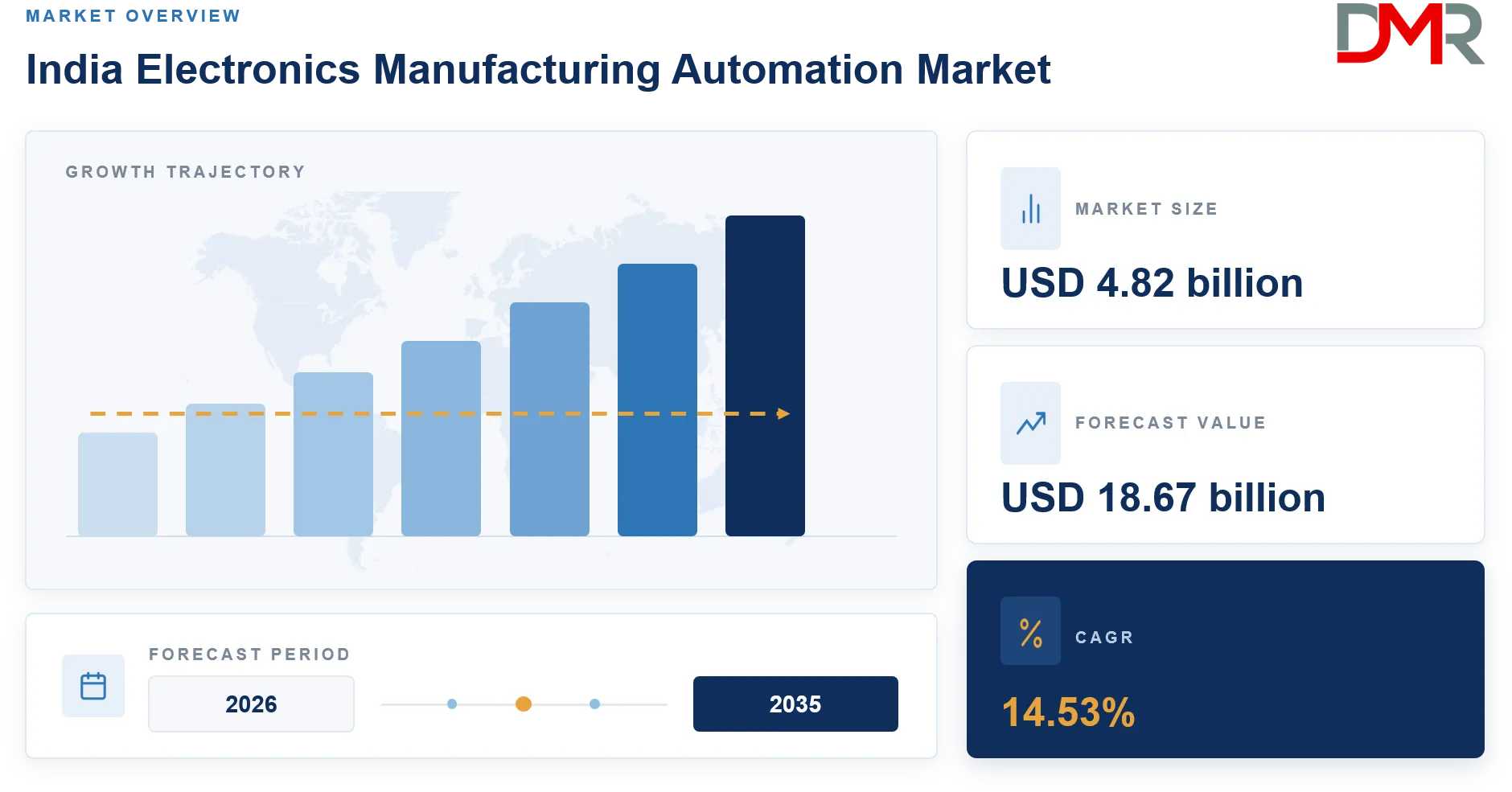
- Market Value: India Electronics Manufacturing Automation Market size is expected to reach USD 18.67 billion by 2035 from USD 4.82 billion in 2026, expanding at a CAGR of 14.53%.
- By Automation Type Segment Analysis: Process Automation dominated the market with a 48.4% share in 2026.
- By Component Segment Analysis: Hardware led the market with a 58.2% share in 2026.
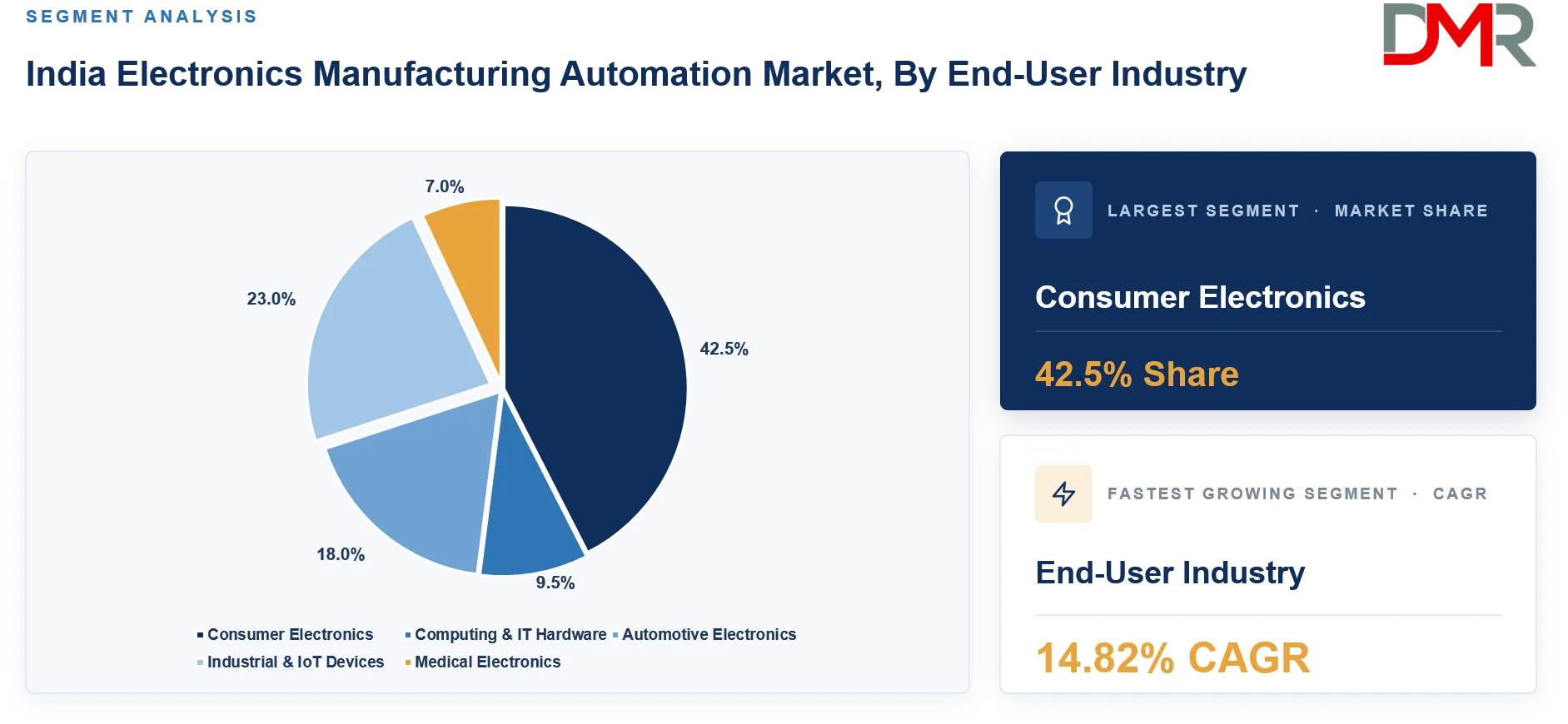
- By End-User Industry Segment Analysis: Consumer Electronics held a 42.5% market share in 2026.
- By Manufacturing Process Segment Analysis: Surface Mount Technology (SMT) led with a 52.3% share in 2026.
- Major Players: Siemens India, ABB India, Rockwell Automation India, Mitsubishi Electric India, and Others.
What is the India Electronics Manufacturing Automation Market and its Market Size?
The India Electronics Manufacturing Automation Market size is projected to be valued at USD 4.82 billion in 2026 and is expected to reach USD 18.67 billion by 2035, expanding at a CAGR of 14.53% during the forecast period. The market covers automation hardware, industrial robots, control systems, machine vision, manufacturing software, system integration, automated assembly, testing, inspection, material handling, and production control technologies deployed across electronics factories.
ℹ
To learn more about this report –
Download Your Free Sample Report Here
Demand is connected to India's transition from electronics assembly toward a deeper domestic manufacturing ecosystem covering components, subassemblies, semiconductor packaging, IT hardware, consumer electronics, automotive electronics, and connected devices. According to the Ministry of Electronics and Information Technology, electronics production increased from about INR 1.9 lakh crore in FY 2014-15 to approximately INR 13.11 lakh crore in FY 2025-26. Electronics exports reached about INR 4.24 lakh crore in FY 2025-26, increasing the need for scalable production lines, traceability, machine vision, automated inspection, and high-throughput manufacturing systems.
Use Cases
- High-Speed Electronics Assembly: Electronics manufacturers use robotic cells, PLC-controlled equipment, automated component feeders, conveyors, and precision motion systems to increase production throughput. These systems are particularly relevant to smartphones, computing devices, wearables, power electronics, and other products requiring repeatable placement and assembly at large volumes.
- SMT Production and Inspection: Automated SMT lines integrate solder paste printing, component placement, reflow processing, automated optical inspection, 3D inspection, and production tracking. Greater PCB complexity and smaller electronic components are encouraging Indian manufacturers to adopt closed-loop inspection and process control to reduce defects and improve first-pass yield.
- Automated Testing and Quality Control: Machine vision, sensors, automated test equipment, inspection cameras, and analytics platforms help manufacturers identify solder defects, component misalignment, dimensional errors, missing parts, and electrical failures. Automation enables manufacturers serving export markets to maintain consistent quality while handling higher production volumes.
- Material Handling and Intralogistics: Automated storage, conveyors, autonomous mobile robots, robotic picking systems, and digital inventory platforms support movement of components between warehouses, SMT lines, assembly stations, testing areas, and finished-goods zones. Electronics plants can use these technologies to reduce manual movement and improve material traceability.
- Production Monitoring and Traceability: MES, SCADA, industrial PCs, sensors, barcode systems, and connected equipment provide real-time visibility into machine status, work-in-progress, downtime, yield, cycle times, and component genealogy. Traceability is increasingly important for automotive electronics, medical electronics, export manufacturing, and high-value electronics production.
How AI/Gen AI is Transforming the India Electronics Manufacturing Automation Market?
AI is expanding the role of automation from fixed machine control toward adaptive production and data-based quality management. Machine vision systems can analyze printed circuit boards, solder joints, component orientation, surface defects, labels, connectors, and assembly conditions at production speed. Predictive algorithms can also use vibration, temperature, motor current, cycle-time, and error data to identify equipment deterioration before unplanned failure. For electronics manufacturers operating high-volume SMT and assembly lines, this can improve equipment utilization, reduce inspection dependency, and limit the cost associated with defective batches.
Generative AI is beginning to support engineering and manufacturing teams through equipment troubleshooting, maintenance knowledge retrieval, process documentation, production reporting, and operator assistance. When connected with MES, SCADA, digital twins, industrial data platforms, and plant documentation, Gen AI interfaces can help engineers identify abnormal process conditions and locate relevant maintenance procedures more quickly. Adoption will depend on cybersecurity, data quality, intellectual property protection, plant-level validation, and integration with existing operational technology. Human supervision remains particularly important in safety, quality, and process-control decisions.
Key Drivers in the India Electronics Manufacturing Automation Market
Rapid Expansion of Domestic Electronics Production
India's expanding electronics manufacturing base is creating direct demand for assembly automation, inspection equipment, industrial robots, control systems, MES platforms, and automated material handling. Electronics production reached about INR 13.11 lakh crore in FY 2025-26, compared with approximately INR 11.32 lakh crore in FY 2024-25. As factories scale output for domestic and export markets, manufacturers require higher throughput, repeatable processes, lower defect rates, and stronger production traceability, supporting automation investment across new and existing plants.
Government Support for Electronics and Semiconductor Manufacturing
Production-linked incentives, electronics manufacturing clusters, semiconductor programs, component manufacturing initiatives, and infrastructure development are expanding India's manufacturing capacity. The PLI scheme for Large Scale Electronics Manufacturing recorded cumulative production exceeding INR 11 lakh crore by February 2026. New investments in components, semiconductor assembly, IT hardware, and electronics manufacturing create demand for automated placement, testing, machine vision, robotics, process control, clean production, and precision material handling systems.
Restraints in the India Electronics Manufacturing Automation Market
High Initial Automation and Integration Costs
Advanced SMT equipment, industrial robots, vision systems, automated inspection platforms, MES deployments, drives, sensors, and integrated production cells can require substantial capital expenditure. Smaller contract manufacturers and electronics suppliers may find the investment difficult when order volumes fluctuate or product lifecycles are short. Additional spending on engineering, software configuration, tooling, maintenance, cybersecurity, and operator training can lengthen the payback period, particularly for factories with high product variety and lower production volumes.
Integration and Skilled Workforce Challenges
Electronics factories commonly operate equipment from multiple vendors, with different machine interfaces, control architectures, communication protocols, and software generations. Connecting legacy machines with MES, SCADA, vision platforms, robots, and industrial data systems can therefore become technically complex. Manufacturers also require specialists in PLC programming, robotics, machine vision, industrial networking, motion control, data engineering, and operational technology security. Shortages in these skills can delay implementation and raise integration costs.
Growth Opportunities in the India Electronics Manufacturing Automation Market
Localization of Components and Semiconductor Manufacturing
India is moving beyond final-product assembly toward components, semiconductor packaging, substrates, power electronics, and higher-value manufacturing. India Semiconductor Mission provides fiscal support for semiconductor and display ecosystem development, while electronics component programs encourage deeper local value addition. These facilities require precise process equipment, inspection, automated handling, clean manufacturing, digital traceability, and production analytics, creating opportunities for automation vendors, machine builders, software suppliers, vision companies, and system integrators.
Automation for Mid-Sized EMS and Electronics Suppliers
A large growth opportunity exists in modular automation suited to mid-sized electronics manufacturing services providers and component suppliers. Cobots, compact SCARA robots, modular inspection cells, flexible feeders, cloud-connected monitoring, and standardized control platforms can reduce the complexity of automation adoption. Vendors offering scalable systems with local engineering, commissioning, training, financing, and maintenance can address manufacturers seeking productivity gains without rebuilding an entire production line.
Trends in the India Electronics Manufacturing Automation Market
Shift Toward Connected and Data-Driven Electronics Factories
Manufacturers are increasingly connecting PLCs, robots, SMT equipment, inspection systems, sensors, MES platforms, and production databases to improve factory visibility. The objective is moving from isolated machine automation toward line-level and plant-level optimization. Real-time dashboards can track throughput, downtime, yield, work-in-progress, energy consumption, and quality events. This trend strengthens demand for industrial networking, edge computing, SCADA, MES, digital twins, cybersecurity, and interoperable automation architectures.
Rising Adoption of Machine Vision and Flexible Robotics
Electronics products are becoming smaller, more customized, and more component-dense, which increases the need for precise inspection and handling. Machine vision, 3D cameras, robotic guidance, SCARA systems, cobots, and intelligent component-feeding technologies are gaining importance in PCB assembly, connector insertion, testing, packaging, and final assembly. Flexible automation is particularly valuable for manufacturers managing frequent product changes because equipment can be reconfigured for different models without creating a fully dedicated production line.
Research Scope and Analysis
The India Electronics Manufacturing Automation Market is segmented based on Automation Type, Component / Solution, End-User Industry, Deployment Mode, Manufacturing Process, and other relevant categories. The study evaluates applications, industry adoption, demand patterns, technology requirements, investment priorities, production environments, and the contribution of individual segments to overall market growth.
ℹ
To learn more about this report –
Download Your Free Sample Report Here
By Automation Type
Process Automation held the leading position with a 48.4% market share in 2026. Its dominance is connected to the process-intensive nature of modern electronics manufacturing, where SMT placement, soldering, inspection, testing, PCB handling, and through-hole operations require precision and repeatability. Electronics plants producing smartphones, computing hardware, automotive electronics, and connected devices depend on automated process control to maintain cycle times and quality. Growing PCB complexity, component miniaturization, higher production volumes, and export-quality requirements are expected to support investment in automated inspection, testing, SMT control, and production monitoring.
By Component
Hardware accounted for 58.2% of the India Electronics Manufacturing Automation Market in 2026. Industrial robots, SCARA systems, cobots, PLCs, industrial PCs, machine vision equipment, sensors, drives, motors, cameras, inspection systems, and HMI devices form the physical foundation of automated electronics production. Hardware demand is supported by greenfield electronics plants and the modernization of existing assembly lines. As factories introduce higher-speed machines and greater traceability, hardware is increasingly deployed with MES, SCADA, digital twins, and industrial analytics. Opportunities are also expanding for locally supported automation components that offer faster service and integration.
By End-User Industry
Consumer Electronics held a 42.5% share in 2026, supported by India's large mobile phone and consumer device manufacturing base. Mobile phone production reached approximately INR 6.27 lakh crore in FY 2025-26, while mobile phone exports reached about INR 2.59 lakh crore. Large volumes and short product cycles make consumer electronics particularly suitable for automated SMT placement, robotic assembly, optical inspection, functional testing, labeling, packaging, and material handling. Growth in wearables, connected appliances, accessories, and smart devices is widening the automation opportunity beyond smartphones.
By Manufacturing Process
Surface Mount Technology led with a 52.3% share in 2026. SMT is central to high-volume PCB production used across smartphones, computers, automotive electronics, IoT equipment, industrial devices, and medical electronics. Modern lines integrate solder paste printers, pick-and-place machines, reflow ovens, conveyors, automated optical inspection, solder paste inspection, and traceability systems. Continued miniaturization and increasing board density make precision placement and automated inspection critical. Investments in domestic electronics and component manufacturing should therefore continue to support advanced SMT automation demand.
The India Electronics Manufacturing Automation Market Report is segmented on the basis of the following:
By Automation Type
-
Factory Automation
- Assembly Line Automation
- Material Handling & Logistics
- Packaging Automation
- Process Automation
- Surface Mount Technology (SMT) Automation
- Through-Hole Technology (THT) Automation
- Testing & Quality Inspection Automation
- Machine Automation
- Robotic Assembly Cells
- CNC & Precision Machining Control
- Bin Picking & Component Feeding Systems
By Component / Solution
-
Hardware
- Industrial Robots
- Articulated
- SCARA,
- Cartesian
- Cobots
- Control Systems
- Sensors & Vision Systems
- Machine Vision
- 3D Cameras
- Inspection Systems
- Drives & Motors
- Human Machine Interface (HMI)
- Software & Platforms
- Manufacturing Execution Systems (MES)
- Supervisory Control & Data Acquisition (SCADA)
- Product Lifecycle Management (PLM)
- Digital Twin & Simulation Software
- Services
- System Integration & Consulting
- Maintenance & Support
- Training & Managed Services
By End-User Industry
-
Consumer Electronics
- Computing & IT Hardware
- Automotive Electronics
- Industrial & IoT Devices
- Medical Electronics
By Deployment Mode
-
On-Premise
- Cloud-Based
- Hybrid
By Manufacturing Process
Competitive Landscape
The India Electronics Manufacturing Automation Market combines global industrial automation companies, Indian engineering groups, robotics specialists, system integrators, SMT equipment providers, and emerging automation companies. Siemens India, ABB India, Rockwell Automation India, Mitsubishi Electric India, Delta Electronics India, Omron India, Schneider Electric India, and Honeywell Automation India compete across industrial controls, PLCs, drives, robotics, machine vision, software, process control, and factory digitalization.
ABB maintains multiple manufacturing locations and a broad automation ecosystem in India, while established multinational suppliers use local engineering and partner networks to address large manufacturers. Indian companies and specialized integrators compete through customized robotic cells, intralogistics, machine vision, component feeding, line integration, and local service. Competition is increasingly influenced by interoperability, lifecycle support, cybersecurity, implementation speed, energy efficiency, analytics capabilities, and the ability to integrate automation with existing production assets.
Some of the prominent players in the India Electronics Manufacturing Automation Industry are:
- Siemens India
- ABB India
- Rockwell Automation India
- Mitsubishi Electric India
- Delta Electronics India
- Omron India
- Schneider Electric India
- Honeywell Automation India
- Tata Elxsi
- Larsen & Toubro Electrical & Automation
- Systemantics (GreyOrange)
- Addverb Technologies
- Hachidori Robotics
- SlightGen Solutions
- Parshwanath Robotics
- Leaptech Corporation
- Unique Circle Automation
- Oro Robotics and Automation
- NMTronics India
- IMTronics Technology
- Others
Regulatory Landscape
India's Electronics Manufacturing Automation Market is shaped by industrial, electronics, semiconductor, safety, quality, and data regulations that influence factory investment and technology deployment. The Ministry of Electronics and Information Technology supports domestic capacity through programs such as the Production Linked Incentive Scheme for Large Scale Electronics Manufacturing, the Electronics Components Manufacturing Scheme, the Scheme for Promotion of Manufacturing of Electronic Components and Semiconductors, and India Semiconductor Mission. Manufacturers deploying automated lines must also consider applicable Bureau of Indian Standards requirements, electrical and machinery safety practices, environmental rules for electronic waste, and state-level factory compliance. As MES, SCADA, industrial IoT, cloud platforms, and connected equipment expand, cybersecurity and data governance are becoming more important in plant architecture. This policy environment supports localization while increasing demand for compliant automation, traceability, quality inspection, secure industrial networks, and documented production control.
Investment and White Space Analysis
Investment opportunities in the India Electronics Manufacturing Automation Market are widening as the country moves from final assembly toward components, semiconductor manufacturing, advanced packaging, PCB production, IT hardware, automotive electronics, and high-value contract manufacturing. The strongest white spaces exist in automation solutions adapted to Indian mid-sized manufacturers, including modular robotic cells, affordable machine vision, flexible component feeding, automated testing, intralogistics, MES integration, predictive maintenance, and retrofit solutions for legacy equipment. Semiconductor and electronics clusters in Tamil Nadu, Karnataka, Telangana, Gujarat, Uttar Pradesh, and other manufacturing states create opportunities for automation vendors to establish local engineering and service capacity. Another underserved area is integrated automation that combines hardware, software, traceability, quality control, and lifecycle support under one implementation model. Vendors that reduce deployment cost and provide local integration, training, maintenance, and scalable automation can address a large customer base transitioning from manual and semi-automated production.
Recent Developments
- August 2026: Rockwell Automation inaugurated integrated capability campus in Bengaluru's Electronics City, consolidating GCCs for Digital and MOM to advance connected-industry engineering and AI solutions for India's electronics manufacturing automation sector.
- July 2026: Schneider Electric partnered with Horizon Industrial Parks to develop 500K sq ft state-of-the-art Hosur facility for manufacturing and sales of Battery Management Products including UPS, PDUs and electronic accessories under Make in India initiative.
- May 2026: Honeywell Automation India signed partnership agreement with MIC Electronics to explore collaboration opportunities in industrial technology, electronics manufacturing, automation and smart solutions for future-focused initiatives.
Report Details
| Report Characteristics |
| Market Size (2026) |
USD 4.82 Bn |
| Forecast Value (2035) |
USD 18.67 Bn |
| CAGR (2026-2035) |
14.53% |
| Historical Data |
2021 - 2025 |
| Forecast Data |
2027 - 2035 |
| Base Year |
2025 |
| Estimate Year |
2026 |
| Segments Covered |
By Automation Type (Factory Automation {Assembly Line Automation, Material Handling & Logistics, Packaging Automation}, Process Automation {Surface Mount Technology (SMT) Automation, Through-Hole Technology (THT) Automation, Testing & Quality Inspection Automation}, Machine Automation {Robotic Assembly Cells, CNC & Precision Machining Control, Bin Picking & Component Feeding Systems}), By Component / Solution (Hardware {Industrial Robots (Articulated, SCARA, Cartesian, Cobots), Control Systems (PLCs, DCS, Industrial PCs), Sensors & Vision Systems (Machine Vision, 3D Cameras, Inspection Systems), Drives & Motors, Human Machine Interface (HMI)}, Software & Platforms {Manufacturing Execution Systems (MES), Supervisory Control & Data Acquisition (SCADA), Product Lifecycle Management (PLM), Digital Twin & Simulation Software}, Services {System Integration & Consulting, Maintenance & Support, Training & Managed Services}), By End-User Industry (Consumer Electronics, Computing & IT Hardware, Automotive Electronics, Industrial & IoT Devices, Medical Electronics), By Deployment Mode (On-Premise, Cloud-Based, Hybrid), By Manufacturing Process (Surface Mount Technology (SMT), Through-Hole Technology (THT), Advanced Packaging / Hybrid Processes, Final Box Build / EMS) |
| Regional Coverage |
India |
Frequently Asked Questions
What is the current size of the India Electronics Manufacturing Automation Market?
▾ The India Electronics Manufacturing Automation Market size is USD 4.82 billion in 2026 and may reach USD 18.67 billion by 2035.
What is the growth rate of the India Electronics Manufacturing Automation Market during?
▾ The India Electronics Manufacturing Automation Market is expected to grow at a CAGR of 14.53% during the 2026-2035 period.
What factors are driving the growth of the India Electronics Manufacturing Automation Market?
▾ Electronics production, factory expansion and rising robotics adoption drive the India Electronics Manufacturing Automation Market.
What are the major challenges restraining the India Electronics Manufacturing Automation Market?
▾ High investment, integration costs and skilled labor gaps restrain the India Electronics Manufacturing Automation Market.
Which segment holds the largest share of the India Electronics Manufacturing Automation Market?
▾ Process Automation leads the India Electronics Manufacturing Automation Market by automation type with a 48.4% share in 2026.
Who are the leading companies in the global India Electronics Manufacturing Automation Market?
▾ Siemens India, ABB India, Rockwell Automation India, Mitsubishi Electric India, Delta Electronics India, Omron India, Schneider Electric India, Honeywell Automation India, Tata Elxsi, Larsen & Toubro Electrical & Automation, Systemantics (GreyOrange), Addverb Technologies, Hachidori Robotics, SlightGen Solutions, Parshwanath Robotics, Leaptech Corporation, Unique Circle Automation, Oro Robotics and Automation, NMTronics India, and IMTronics Technology are leading companies in the India Electronics Manufacturing Automation Market.
How is AI influencing the India Electronics Manufacturing Automation Market?
▾ AI improves machine vision, predictive maintenance and quality control in the India Electronics Manufacturing Automation Market.
What are the future opportunities and trends in the India Electronics Manufacturing Automation Market?
▾ Smart factories, robotics, machine vision and semiconductor expansion offer opportunities in the India Electronics Manufacturing Automation Market.