China Contact Intraocular Lenses Market Snapshot
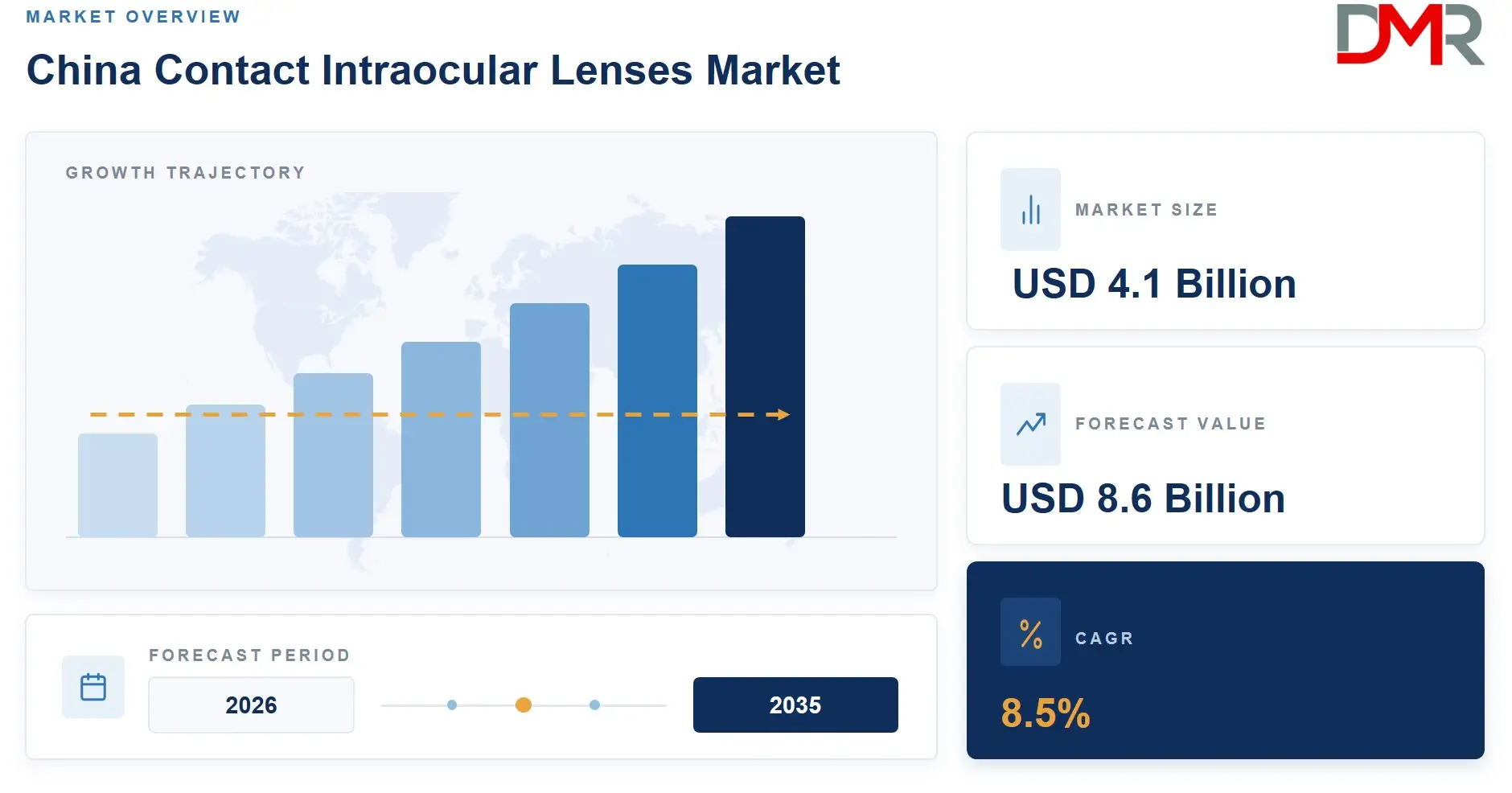
- China Contact Intraocular Lenses Market Size in 2026: USD 4.1 Billion
- China Contact Intraocular Lenses Market Size in 2035: USD 8.6 Billion
- China CAGR from 2026 to 2035: 8.5%
- Monofocal IOLs is the leading product type segment in 2026: 57.4%
- Silicone Hydrogel is the leading material segment in 2026: 41.2%
- Myopia & Refractive Correction is the leading application segment in 2026: 38.6%
- Hospitals & Eye Clinics is the leading distribution channel segment in 2026: 44.3%
What is the China Contact Intraocular Lenses and its Market Size?
The China Contact Intraocular Lenses Market is projected to be valued at an estimated USD 4.1 billion in 2026 and is projected to reach USD 8.6 billion by 2035, expanding at a CAGR of 8.5% during the forecast period a pace notably faster than mature Western European and North American vision-care markets, reflecting both China's enormous unmet refractive-correction need and its rapidly aging population. China carries the largest absolute burden of myopia in the world, with national health surveys repeatedly showing that a majority of school-age children and the overwhelming majority of university students are myopic, a trend regulators have identified as a public health priority. At the same time, an aging population and rising cataract surgical volumes are driving sustained double-digit growth in premium intraocular lens categories. The market is shaped by the National Medical Products Administration (NMPA), which classifies both contact lenses and intraocular lenses as regulated medical devices (Class II and Class III respectively) subject to registration, clinical evaluation, and post-market surveillance requirements, alongside a fast-maturing domestic manufacturing base increasingly competing with established multinational suppliers.
ℹ
To learn more about this report –
Download Your Free Sample Report Here
Use Cases
- School-Based and Community Myopia Screening Programs: Provincial health commissions, in coordination with the Ministry of Education, conduct large-scale vision screening among primary and secondary school students, feeding directly into demand for corrective soft contact lenses and orthokeratology fittings.
- Orthokeratology (Ortho-K) for Myopia Control in Children and Adolescents: Ophthalmology clinics in major cities such as Beijing, Shanghai, Guangzhou, and Shenzhen increasingly prescribe overnight ortho-K lenses to slow myopia progression in children, supported by growing parental willingness to pay for premium refractive-management solutions.
- Cataract Surgery Volume Growth in an Aging Population: Public tertiary hospitals and expanding private ophthalmology chains perform rising volumes of phacoemulsification cataract surgery with IOL implantation, particularly across China's rapidly growing population of adults aged 60 and above.
- Premium Presbyopia-Correcting IOLs Among Urban, Higher-Income Patients: Multifocal, extended depth of focus (EDOF), and toric IOLs are gaining traction among urban patients seeking spectacle independence after cataract surgery, particularly in higher-income coastal provinces.
Key Takeaways
- Market Size: The China Contact Intraocular Lenses Market is estimated at USD 4.1 billion in 2026 and forecast to reach USD 8.6 billion by 2035, expanding at a CAGR of 8.5%.
- Growth Outlook: Growth is sustained by China's exceptionally high and rising myopia prevalence among children and young adults, an aging population driving cataract surgical volumes, expanding health insurance and private-pay coverage for premium lens categories, and rapid e-commerce-driven retail expansion for daily-wear and cosmetic contact lenses.
- Primary Growth Drivers: Explained in expanded detail below covering myopia prevalence, an aging population and cataract surgery growth, domestic manufacturing scale-up, and rising consumer willingness to pay for premium and cosmetic eyewear alternatives.
- By Material Analysis: Silicone Hydrogel is projected to lead the contact lens material segment with a 41.2% share in 2026 due to superior oxygen permeability and comfort for extended wear, while Hydrophobic Acrylic leads IOL materials due to reduced posterior capsule opacification rates.
- By Application Analysis: Myopia & Refractive Correction is forecast to lead with a 38.6% share in 2026, while Cataract Surgery is expected to see the fastest growth at roughly 10.4% CAGR as surgical capacity expands across tier-2 and tier-3 cities.
- By Distribution Channel Analysis: Hospitals & Eye Clinics is projected to lead with a 44.3% share in 2026, while E-commerce/Online Channels is expected to be the fastest-growing distribution channel at 13.2% CAGR, driven by daily and cosmetic lens sales to younger consumers.
- By End-User Analysis: Hospitals are projected to lead with a 46.1% share in 2026, while Ophthalmology & Eye Care Clinics and retail optical chains continue to gain share as private eye care networks expand into lower-tier cities.
How AI/Gen AI is Transforming the Contact Intraocular Lenses Market?
Artificial intelligence is increasingly embedded in Chinese ophthalmic care pathways, from AI-assisted fundus and corneal topography screening used in school-based myopia surveillance programs to AI-supported biometry and IOL power calculation tools used ahead of cataract surgery to improve refractive outcome accuracy. Domestic technology companies and hospital networks are piloting AI-enabled teleophthalmology platforms to extend specialist screening capacity into lower-tier cities and rural counties, where the ratio of ophthalmologists to population remains comparatively low. Generative AI tools are also beginning to support patient education content, lens-fitting simulation, and synthetic training data for rare corneal and retinal pathology recognition models used in specialist training programs.
Key Drivers in the China Contact Intraocular Lenses Market
World's Largest Population of Myopic Children, Adolescents, and Young Adults
China carries an outsized share of the global myopia burden, with repeated national health surveys showing that well over half of primary and secondary school students, and an even higher share of university students, are myopic a trend that has accelerated over the past two decades alongside rising near-work screen time, reduced outdoor activity, and intensive academic schedules. This has elevated myopia prevention and control to a formally stated national public health priority, with provincial education and health authorities mandating regular vision screening, classroom lighting standards, and outdoor-time requirements in schools.
Rapidly Aging Population and Expanding Cataract Surgical Capacity
China's population is aging at one of the fastest rates of any major economy, with the share of citizens aged 60 and above rising steadily and expected to continue climbing sharply through the forecast period. Because cataract prevalence rises sharply with age, this demographic shift is driving substantial and durable growth in cataract surgical volumes nationwide, a trend reinforced by expanding national and provincial health insurance coverage for cataract procedures, government-backed rural and county-level "bright action" cataract surgery outreach campaigns, and rapid buildout of both public tertiary ophthalmology departments and private specialty eye hospital chains. As surgical access expands beyond established tier-1 city hospitals into tier-2 and tier-3 cities and county-level facilities, the sheer volume of IOL implantations is set to rise considerably.
Domestic Manufacturing Scale-Up and Import Substitution
China's contact lens and IOL manufacturing base has matured substantially over the past decade, with a growing number of domestic producers achieving NMPA registration for silicone hydrogel contact lenses, foldable acrylic IOLs, and, increasingly, premium toric and multifocal IOL designs that were previously the near-exclusive domain of multinational suppliers. This domestic scale-up is supported by government industrial policy favoring local high-value medical device manufacturing, lower production costs relative to imported alternatives, and improving quality perception among clinicians and consumers as local players invest in clinical trial data and manufacturing certifications aligned with international standards.
Rising Consumer Willingness to Pay for Premium and Cosmetic Eyewear Alternatives
Beyond pure medical necessity, a distinct and fast-growing consumer trend is reshaping demand at the retail end of the contact lens market: young, urban, and increasingly female consumers are adopting colored and cosmetic contact lenses as a fashion and beauty category, purchased heavily through domestic e-commerce and livestreaming social-commerce channels alongside skincare and cosmetics. This has expanded the addressable market well beyond patients with a clinical refractive need, while also prompting regulatory attention from the NMPA around proper fitting, hygiene education, and marketing claims for cosmetic lenses sold outside traditional clinical channels.
Restraints in the China Contact Intraocular Lenses Market
Regulatory Oversight and Registration Complexity Under the NMPA
Both contact lenses and intraocular lenses are regulated as medical devices in China, with IOLs typically classified as higher-risk Class III devices requiring more extensive clinical evaluation, registration testing, and post-market surveillance than many other ophthalmic products. This creates meaningful barriers to entry and extended time-to-market for both domestic innovators and multinational entrants seeking to launch new lens designs, particularly premium multifocal and myopia-control lens categories where regulators are applying increased scrutiny given rising direct-to-consumer marketing activity.
Price Sensitivity and Insurance Reimbursement Limitations
While basic monofocal IOLs and standard corrective contact lenses benefit from varying degrees of insurance coverage depending on province and hospital tier, premium categories such as multifocal IOLs, toric IOLs, and myopia-control ortho-K lenses are typically paid out-of-pocket, limiting adoption among lower- and middle-income patients, particularly outside major coastal cities. Regional disparities in insurance generosity and hospital-tier reimbursement rules add further complexity to national market access planning for premium product categories.
Growth Opportunities in the China Contact Intraocular Lenses Market
Expansion of Eye Care Access into Lower-Tier Cities and Rural Counties
Substantial white-space opportunity exists in extending both surgical cataract care and modern contact lens fitting services into tier-3 and tier-4 cities and rural counties, where ophthalmologist density remains comparatively low relative to major metropolitan centers. Government-backed rural outreach programs, expanding private eye hospital chain footprints, and growing teleophthalmology adoption are expected to unlock significant incremental demand over the forecast period.
Myopia-Control Product Innovation
Continued clinical evidence generation supporting ortho-K lenses, soft multifocal myopia-control contact lenses, and pharmacological adjuncts creates opportunity for manufacturers able to demonstrate efficacy in slowing axial length progression in children, a category with strong parental willingness to pay and continued regulatory and clinical community support given China's public health prioritization of myopia control.
Trends in the China Contact Intraocular Lenses Market
Expansion of Eye Care Access into Lower-Tier Cities and Rural Counties
Significant growth opportunities lie in expanding cataract surgery and modern contact lens fitting beyond China’s leading metropolitan areas into tier-3 and tier-4 cities and rural counties. These markets remain underserved because ophthalmologist density, specialist facilities, and access to advanced diagnostic equipment are comparatively limited. Government-supported screening and rural outreach programs, combined with the geographic expansion of private eye hospital chains, could improve diagnosis, referrals, and treatment availability. Teleophthalmology and remote follow-up platforms can further reduce access barriers, enabling providers and manufacturers to reach previously untapped patient groups and generate sustained incremental demand throughout the forecast period across these underserved regions.
Myopia-Control Product Innovation
Growing clinical evidence supporting orthokeratology lenses, soft multifocal myopia-control contact lenses, and complementary pharmacological treatments is creating attractive opportunities for product innovation in China. Manufacturers that can demonstrate clinically meaningful reductions in axial length progression, particularly among children and adolescents, will be well positioned to capture demand. Strong parental awareness and willingness to pay for effective preventive solutions support premium product adoption. Meanwhile, China’s public health focus on childhood myopia is encouraging clinical research, professional education, and regulatory attention.
Research Scope and Segment Analysis
The China Contact Intraocular Lenses Market is segmented by product type, material, application, distribution channel, and end user, reflecting the distinct clinical and consumer dynamics of the two underlying product categories that make up this combined market.
By Product Type Analysis
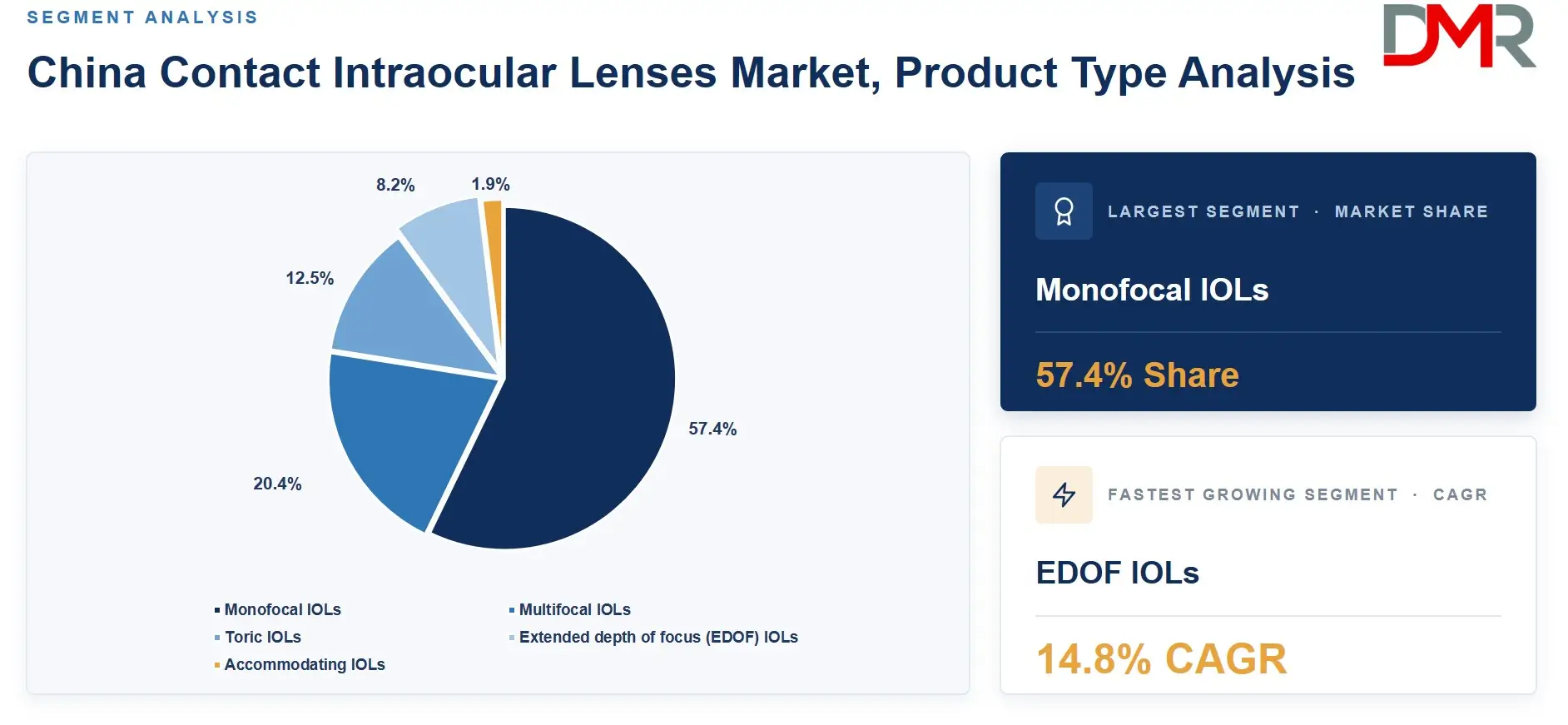
Monofocal IOLs is projected to dominate the product segment, holding an estimated 57.4% share of IOL revenue in 2026. They remain the standard, insurance-reimbursed option for routine cataract surgery across China's public hospital system, especially outside tier-1 cities, which keeps their volume and therefore revenue share well ahead of every premium category combined. Extended Depth of Focus (EDOF) IOLs post the highest CAGR, at an estimated 14.8% through 2035. It's the newest premium category with the smallest base (8.2% share in 2026), and it's gaining fast among urban cataract patients who want a middle ground better range of vision than a monofocal lens without the halo/glare trade-offs some patients experience with older multifocal designs.
ℹ
To learn more about this report –
Download Your Free Sample Report Here
By Material Analysis
Silicone Hydrogel is projected to lead the contact lens material segment with an estimated 41.2% share in 2026, reflecting its superior oxygen permeability relative to conventional hydrogel materials, which supports greater wearer comfort during extended and overnight wear a particularly important property for the orthokeratology sub-segment, where lenses are worn overnight. Conventional Hydrogel materials continue to hold meaningful share in lower-price-point daily disposable lenses, particularly in price-sensitive lower-tier city and rural markets, while Rigid Gas Permeable (RGP) materials retain a smaller but clinically important niche in specialty fitting for irregular corneas and certain myopia-control applications.
By Application Analysis
Myopia & Refractive Correction is expected to lead the combined market with an estimated 38.6% share of application-based revenue in 2026, driven directly by the scale of China's myopic population and encompassing both standard soft contact lens correction and the fast-growing orthokeratology myopia-control sub-application. Cataract Surgery is projected to be the fastest-growing application at 10.4% CAGR during the forecast period, propelled by the country's aging demographic profile, expanding surgical capacity across hospital tiers, and continued government investment in rural and county-level surgical outreach.
By Distribution Channel Analysis
Hospitals & Eye Clinics are projected to remain the leading distribution channel with an estimated 44.3% share in 2026, reflecting the fact that intraocular lenses are surgically implanted exclusively within hospital and ambulatory surgical center settings, and that a substantial share of prescription and myopia-control contact lens fittings, particularly orthokeratology, require in-clinic professional fitting and follow-up care. E-commerce and Online Channels, however, are projected to be the fastest-growing distribution channel at 13.2% CAGR during 2026–2035, driven overwhelmingly by daily disposable and cosmetic contact lens sales to younger, digitally native consumers through major domestic e-commerce platforms and livestreaming social-commerce formats, a distribution dynamic considerably more pronounced in China than in most other major global contact lens markets.
By End User Analysis
Hospitals are projected to lead the end-user segmentation with an estimated 46.1% share in 2026, reflecting their central role in both cataract surgery and complex contact lens fitting for medically indicated cases. Ophthalmology & Eye Care Clinics, including the rapidly expanding footprint of private specialty eye hospital chains, represent a growing share of both surgical IOL procedures and premium contact lens fitting services, particularly in tier-1 and tier-2 cities. Ambulatory Surgical Centers are expanding as a lower-cost, higher-throughput setting for routine cataract surgery, supported by government efforts to expand surgical capacity efficiently.
The China Contact Intraocular Lenses Market Report is segmented based on the following:
By Product Type
- Monofocal IOLs
- Multifocal IOLs
- Toric IOLs
- Extended depth of focus (EDOF) IOLs
- Accommodating IOLs
By Material
- Hydrogel
- Silicone hydrogel
- Rigid gas permeable materials
- Hydrophobic acrylic
- Hydrophilic acrylic
- Polymethyl methacrylate (PMMA)
- Silicone
By Application
- Myopia and refractive correction
- Astigmatism correction
- Presbyopia correction
- Cataract surgery
- Cosmetic and aesthetic use
By Distribution Channel
- Hospitals and eye clinics
- Optical retail stores
- E-commerce/online channels
- Others
By End User
- Hospitals
- Ophthalmology and eye care clinics
- Ambulatory surgical centers
- Retail optical chains
- Others
Technology Analysis
Innovation is reshaping the contact and intraocular lenses market through silicone hydrogel materials, advanced lens coatings, myopia-control designs, toric and multifocal optics, and extended-depth-of-focus IOLs. Digital fitting platforms, corneal topography, AI-assisted measurements, and precision biometry are improving customization and clinical outcomes. Opportunities are strongest in pediatric myopia management, premium cataract surgery, and products offering greater comfort and visual independence. However, high development costs, complex manufacturing, clinician training needs, and uncertain reimbursement may slow adoption. Companies delivering demonstrable safety, durability, and superior vision outcomes can command premium pricing, strengthen brand differentiation, and expand market share across clinical and retail channels while raising competitive pressure on conventional product manufacturers worldwide.
Epidemiology Analysis
Rising prevalence of myopia, astigmatism, presbyopia, and age-related cataracts is the fundamental demand driver for contact and intraocular lenses. Longer screen exposure, reduced outdoor activity, urbanization, and ageing populations are enlarging the addressable patient base, particularly among children requiring myopia control and older adults needing cataract surgery. This creates opportunities for orthokeratology lenses, multifocal contacts, toric products, and premium IOLs. Key risks include low diagnosis rates, unequal access to eye care, affordability constraints, and inconsistent treatment adherence. Markets with strong screening programs, expanding ophthalmology capacity, and insurance coverage should experience faster procedure volumes, higher product penetration, and sustained revenue growth for manufacturers, distributors, and specialized eye-care providers worldwide.
Competitive Landscape
The China Contact Intraocular Lenses Market features an increasingly competitive mix of established multinational suppliers and fast-growing domestic manufacturers. Multinational players including Johnson & Johnson Vision, Alcon, CooperVision, Bausch + Lomb, EssilorLuxottica, Carl Zeiss Meditec, and Menicon maintain significant commercial presence, particularly in premium contact lens and IOL categories. Domestic Chinese manufacturers, including Eyebright Medical Technology, Aisi Vision, Weikang Medical, and a growing number of NMPA-registered regional producers, have expanded meaningfully in both standard soft contact lenses and, increasingly, foldable acrylic IOLs, supported by favorable domestic industrial policy and improving clinical trial and manufacturing capabilities.
Some of the prominent players in the China Contact Intraocular Lenses Market are:
- Alcon
- Johnson & Johnson Vision
- Bausch + Lomb
- CooperVision
- Carl Zeiss Meditec
- HOYA Surgical Optics
- Menicon
- SEED
- STAAR Surgical
- Rayner
- OPHTEC
- HumanOptics
- SIFI
- Teleon Surgical
- Lenstec
- Hanita Lenses
- Medicontur Medical Engineering
- VSY Biotechnology
- Cristalens Industrie
- Biotech Vision Care
- Aurolab
- Appasamy Associates
- Eyebright Medical Technology
- Shanghai Haohai Biological Technology
- Wuxi Vision Pro
- Xi’an Eyedeal Medical Technology
- Shanghai Maxus Medical
- Henan Universe Intraocular Lens Research and Manufacture
- Ginko International
- PEGAVISION
- BenQ Materials
- FreshLady Contact Lens
- Clearlab
- Interojo
- Neo Vision
- T-Garden
- DreamCon
- Art Optical Contact Lens
- SynergEyes
- BostonSight
- Other Key Players
Recent Developments
- August 2026: China’s NMPA approved Shanghai Haohai Biological Technology Co., Ltd.’s innovative trifocal toric intraocular lens (IOL). This milestone marks the approval of the first domestic trifocal toric implant, expanding domestic options for simultaneous cataract, presbyopia, and astigmatism correction.
- July 2026: PEGAVISION Corporation confirmed Chinese regulatory clearance for its soft hydrophilic contact lenses. While strengthening its presence in China’s expanding corrective and cosmetic lens market, the manufacturer indicated that these newly approved products will not significantly impact immediate short-term revenue.
- June 2026: NMPA registration records continue to track domestic astigmatism solutions, including hydrophobic acrylic toric intraocular lenses manufactured by Wuxi Vision Pro, supporting the ongoing domestic availability of implants designed to correct cataracts and corneal astigmatism.
- April 2026: The NMPA maintained active commercial registries covering Johnson & Johnson Vision Care’s soft corneal contact lenses (ACUVUE) and Paragon Vision Sciences’ orthokeratology (CRT) lenses, reinforcing established, branded options across conventional vision correction and myopia management.
Report Details
| Report Characteristics |
| Market Size (2026) |
USD 4.1 Billion |
| Forecast Value (2035) |
USD 8.6 Billion |
| CAGR (2026–2035) |
8.5% |
| Historical Data |
2021 – 2025 |
| Forecast Data |
2026 – 2035 |
| Base Year |
2025 |
| Segments Covered |
By Product Type, By Material, By Application, By Distribution Channel, and By End User |
| Country Coverage |
China |
Frequently Asked Questions
How big is the China Contact Intraocular Lenses Market?
▾ The China Contact Intraocular Lenses Market is estimated at USD 4.1 billion in 2026 and is projected to reach USD 8.6 billion by 2035, reflecting strong underlying demand from the world's largest myopic population and rapidly rising cataract surgical volumes tied to China's aging demographic profile.
What is the CAGR of the China Contact Intraocular Lenses Market from 2026 to 2035?
▾ The market is projected to expand at a CAGR of 8.5% between 2026 and 2035, notably faster than mature Western markets, supported by expanding surgical capacity, rising insurance and out-of-pocket spending on premium lens categories, and rapid e-commerce-driven retail growth in contact lenses.
What factors are driving the growth of the China Contact Intraocular Lenses Market?
▾ Growth is driven by China's exceptionally high myopia prevalence among children and young adults, an aging population fueling cataract surgery volume growth, maturing domestic manufacturing capacity supporting import substitution, and rising consumer willingness to pay for premium and cosmetic contact lens and IOL categories.
What are the major trends in the China Contact Intraocular Lenses Market?
▾ Major trends include premiumization of cataract surgery outcomes through multifocal and toric IOL adoption, rapid growth of orthokeratology for pediatric myopia control, and the rise of social-commerce and livestreaming as a dominant retail channel for daily-wear and cosmetic contact lenses.
Who are the key players in the China Contact Intraocular Lenses Market?
▾ Key participants include multinational suppliers such as Johnson & Johnson Vision, Alcon, CooperVision, and Bausch + Lomb, alongside fast-growing domestic manufacturers including Eyebright Medical Technology, Aisi Vision, and Weikang Medical.
How is the China Contact Intraocular Lenses Market segmented?
▾ The market is segmented by product type, material, application, distribution channel, and end user, with performance shaped by the distinct dynamics of China's large refractive-correction consumer base and its rapidly growing cataract surgical patient population.