Market Snapshot
- Market Size (2026): USD 7.6 Bn
- Forecast Value (2035): USD 26.5 Bn
- CAGR (2026-2035): 14.9%
- Leading Offering (2026): Cloud Storage & File Hosting, around 40%
- Leading Deployment Mode (2026): Public Cloud, close to 68%
- Key Players: Baidu, Tencent, Huawei and others
What is China Personal Cloud Market and its Market Size?
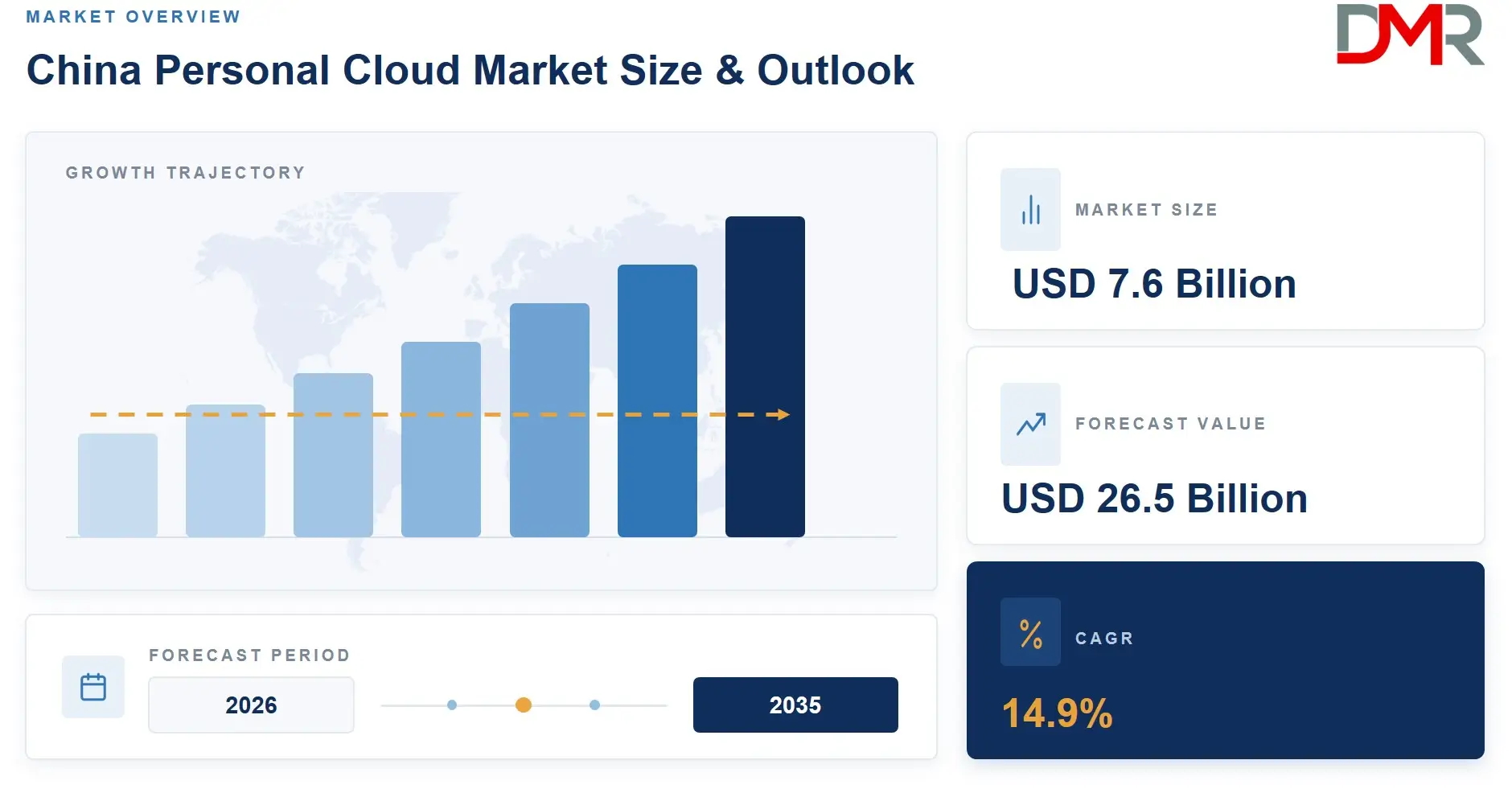
The China Personal Cloud Market size is estimated to reach USD 7.6 Bn in 2026 and is further anticipated to reach USD 26.5 Bn by 2035, at a CAGR of 14.9%.
ℹ
To learn more about this report –
Download Your Free Sample Report Here
The market covers consumer facing storage, sync, backup and device integrated cloud services that individuals and households purchase or use across mainland China. It spans software subscriptions, bundled device storage allowances and personal network attached storage hardware, but excludes enterprise file sharing, government cloud and other business infrastructure spend, which sit in separate categories. Because scope is national, every figure here reflects demand generated inside China rather than the worldwide revenue of Chinese headquartered platforms such as Baidu, Tencent or Alibaba, several of which also serve customers abroad.
In practical terms, a personal cloud product keeps a household's photos, videos, documents and device backups synchronized and retrievable across phones, laptops, tablets and smart televisions. Most providers bundle a modest free allowance with the underlying device or app, then meter additional gigabytes through subscriptions once daily photography pushes a user past that limit. A growing share of demand also runs through personal network attached storage boxes, small drives that sit on a home network and mirror cloud folders locally, letting a household keep sensitive files on hardware it owns while syncing a lighter working set for remote access.
The core buyer is the individual smartphone owner, but the purchase decision increasingly happens at the household level. Parents managing a shared family photo library, students syncing coursework across devices, and short video creators archiving raw footage all draw on the same infrastructure, though usage patterns differ sharply. Pricing sits well below equivalent Western subscriptions, so providers compensate with scale, cross selling value added services, and steering users from free tiers toward paid family plans.
What is changing structurally is the shift away from the storage giveaways that defined the market's first decade. Providers are consolidating around tiered subscriptions, using artificial intelligence to organize and compress content rather than simply expanding free capacity, and increasingly treating personal cloud as one entry point into a broader smart device ecosystem that spans phones, wearables, smart home hubs and vehicles.
Use Cases
- Urban Family Photo Archiving: Parents in higher income coastal households consolidate a family's phone photos and videos into a single shared album, using automatic backup so no single device becomes a point of failure, which around 40% of subscribers now access as a paid Cloud Storage & File Hosting plan rather than a free tier.
- Short Video Creator Footage Archiving: Independent creators on short video platforms offload raw, uncompressed clips from phone storage to the cloud between shoots, freeing device capacity for the next recording session while keeping a searchable backlog for future edits.
- Multi-Device Student Sync: University students working across a phone, a laptop and a tablet rely on continuous file sync to move lecture notes, scanned documents and coursework between devices without manual transfers or campus network restrictions.
- Privacy-Conscious Home NAS Setup: Households wary of third-party data access buy a personal NAS box to hold sensitive files locally, pairing it with a lighter cloud tier for offsite backup and remote access, a hybrid pattern that is spreading beyond early adopter tech enthusiasts.
Key Takeaways
- Market Size & Share: The market is valued at approximately USD 7.6 Bn in 2026, on course for USD 26.5 Bn by 2035.
- Offering Analysis: Cloud Storage & File Hosting is estimated to hold close to 40% of 2026 revenue, the largest of the five offering categories.
- Demand Concentration: Tier 1 and New Tier 1 cities are expected to generate around 55% of 2026 paid subscription revenue, reflecting higher device ownership and disposable income in those metros.
- AI Adoption: AI based photo and video organization is now embedded in the leading apps from at least 6 of the market's largest providers, up from a handful three years earlier.
- Distribution Concentration: OEM bundled channels, where storage ships pre-integrated with a new phone or NAS device, account for approximately 58% of 2026 distribution.
- Competitive Structure: More than 40 companies, from national platforms to specialist NAS hardware makers, compete across software, hardware and channel layers of the market.
How AI/Gen AI is Transforming the China Personal Cloud Market?
Artificial intelligence has moved from an optional add-on to a core differentiator in China's personal cloud apps over the past two years. Rather than positioning around raw gigabytes, providers now market their ability to make an unmanageable pile of phone photos and videos searchable, deduplicated and lighter to store, since capacity stopped being a meaningful point of difference once free tiers converged around similar limits.
The shift is operational as much as promotional: providers cut their own storage costs while giving subscribers a reason to upgrade. Four techniques account for most of what is currently deployed.
- Computer Vision Photo Organization: Automated face grouping, scene tagging and duplicate or near duplicate detection let a user find a specific photo or clean up a cluttered library without manual sorting.
- Adaptive Compression: Learning based codecs shrink video and image files during upload with minimal visible quality loss, reducing the storage footprint a subscriber actually consumes.
- Semantic Search: Natural language queries such as a request to find pictures from a specific trip or event now return relevant results without folder navigation, mirroring the way people already search on their phones.
- Predictive Storage Alerts: Usage pattern models flag when a device or account is about to hit its quota and recommend the smallest sufficient upgrade, timing upsell prompts around genuine need rather than blanket promotion.
Key Drivers in the China Personal Cloud Market
Two forces, distinct in kind, are pushing paid personal cloud adoption higher across China.
- Smartphone Photo and Video Volume Growth: Camera resolution, frame rate and slow motion capture have all climbed on mainstream Chinese phones over the past several device cycles, and the resulting file sizes routinely exceed on-device storage within a year or two of purchase. Free allowances that felt generous when a photo averaged a few megabytes now fill within months once four thousand pixel video becomes a household default. That mismatch between capture volume and built-in device capacity is the single largest reason a free user eventually becomes a paying subscriber, since the alternative, manually deleting old memories to make room for new ones, is unattractive to most households. Camera makers and cloud providers reinforce each other here, since better cameras generate more data that then needs somewhere to live.
- OEM Device Bundling and Ecosystem Lock-In: Smartphone makers increasingly treat personal cloud as part of the device purchase rather than a standalone product, pre-installing a storage app and offering a free introductory allowance that expires or shrinks after a set period. This converts a portion of every new device sale into a cloud trial, and because switching providers means re-uploading years of photos, most users renew rather than migrate once the free period ends. The largest handset makers, several of which sell tens of millions of units domestically each year, can therefore acquire personal cloud subscribers at close to zero marginal cost, a structural advantage independent storage specialists cannot easily replicate through paid marketing alone.
Restraints in the China Personal Cloud Market
Two brakes weigh against otherwise strong underlying demand.
- Intense Price Competition and Free Tier Saturation: Years of storage giveaways trained consumers to expect meaningful free capacity, and providers now compete on price for the entry tiers that remain. Subscription prices for comparable storage bands have compressed as national platforms, telecom operators and device makers all chase the same upgrade moment, squeezing margins for smaller apps that cannot subsidize storage with revenue from elsewhere in their business.
- Data Security and Cross-Border Compliance Costs: China's data protection and cybersecurity rules require personal data to be stored domestically and impose approval processes for cross-border transfer, raising fixed compliance costs for every provider at scale. Smaller platforms struggle to fund the audits and local data center commitments that larger, better capitalized competitors treat as routine. International providers face an added layer of complexity, since compliant service typically requires operating through a licensed local partner rather than a direct international offering.
Growth Opportunities in the China Personal Cloud Market
Two areas of white space stand out for providers willing to invest beyond the core storage product.
- Smart Home and IoT Data Sync: As households add connected cameras, smart speakers and appliance sensors, providers with an existing device ecosystem are extending storage and sync to cover this new stream of continuous data rather than just phone photos. A provider that already anchors a household's phone and television storage is well positioned to become the default archive for a security camera's motion clips, turning a single-purpose subscription into a broader home data platform.
- Telecom-Bundled Expansion into Lower-Tier Cities: Reaching cost sensitive households in lower-tier cities is difficult through app store marketing alone, but telecom operators already bill these households monthly and can bundle a modest allowance into an existing mobile or broadband plan at negligible incremental cost. This sidesteps the price sensitivity limiting direct subscription sales and gives cloud providers access to a segment that has so far under-indexed on paid storage.
Trends in the China Personal Cloud Market
Two shifts are reshaping how the product is packaged and sold, distinct from the drivers pulling demand or the restraints holding it back.
- Shift from Free Storage to Tiered Family Plans: Providers are steadily retiring the large permanent free allowances that once defined the market, replacing them with smaller free tiers designed to demonstrate value rather than satisfy long-term needs, alongside family and multi-device plans priced to cover an entire household under one subscription. This mirrors a broader move across Chinese consumer software toward recurring revenue over one-time acquisition tactics, and it changes how providers measure success, from user counts toward paid conversion and household level retention.
- AI-Curated Albums as a Competitive Differentiator: Automatically generated highlight reels, memory anniversaries and curated albums, once a novelty feature, are now a standard expectation that influences which app a household chooses to trust with years of family photos. Providers are racing to make these curation features feel personal rather than generic, since a well-timed anniversary reminder or an accurately assembled trip album does more to keep a subscriber renewing than any storage capacity increase would.
Research Scope and Analysis
Segment performance is assessed across five axes: offering, deployment mode, application, subscription tier and distribution channel. Each axis identifies the sub-segment carrying the largest share of 2026 revenue and the one expanding fastest through 2035, along with the commercial reason behind each position.
ℹ
To learn more about this report –
Download Your Free Sample Report Here
By Offering
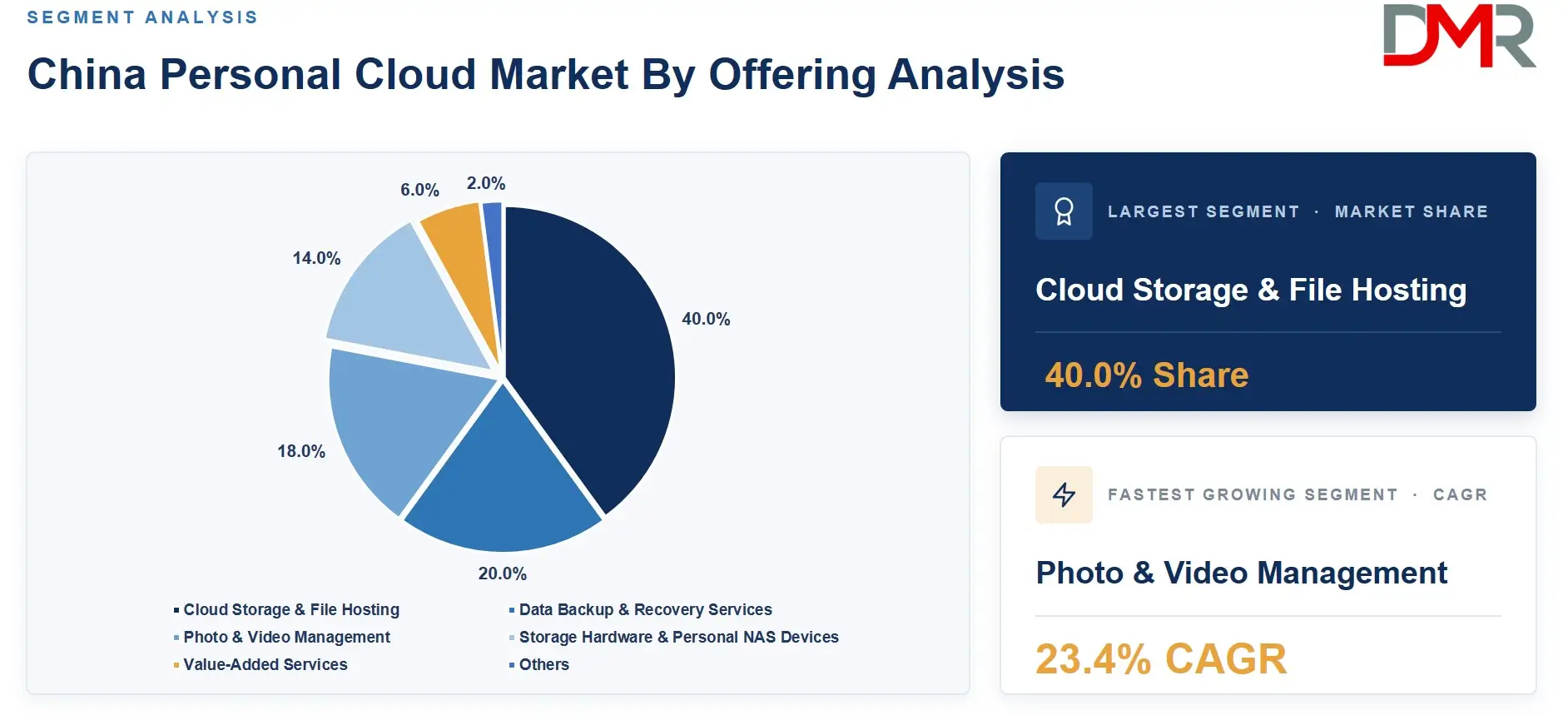
Cloud Storage & File Hosting is estimated to hold the largest share of 2026 revenue, at around 40%, because it forms the base subscription that nearly every other offering, from backup to value added services, is sold alongside or bundled into. Its installed base advantage compounds over time, since a household with years of files stored on one platform faces a real switching cost that keeps renewal rates high even when a cheaper alternative appears. Growth, however, is concentrated in Photo & Video Management, projected to expand at a CAGR of 23.4% between 2026 and 2035 as rising video resolution and AI curation features turn what was once a passive storage line item into an actively used, higher-value product that commands its own upgrade path independent of raw storage capacity.
By Deployment Mode
Public Cloud deployment is projected to account for close to 68% of 2026 revenue, since it requires no upfront hardware purchase and matches how most Chinese consumers already access storage through an app tied to their phone or device account. The steeper trajectory sits with Hybrid Personal Cloud, expanding at a CAGR of 22.1% through 2035 as privacy-conscious households pair a home NAS box with a lighter public cloud tier, a combination that data localization concerns and falling NAS hardware prices are both making more attainable for mainstream buyers rather than only technical enthusiasts.
By Application
Photo & Video Backup leads 2026 demand at an estimated 34% share, reflecting how camera-driven data growth remains the single largest source of storage consumption in a smartphone-first market. The fastest growth belongs to Smart Home & IoT Data Sync, forecast at a CAGR of 24.8% through 2035, pulled by rising ownership of connected cameras and smart appliances that generate continuous data streams needing a home for the first time, a category that barely existed as a distinct storage draw a decade ago.
By Subscription Tier
The Standard Paid Tier carries the largest share of 2026 revenue at close to 46%, the natural landing point for a subscriber who has outgrown the free allowance but does not yet need premium capacity or multi-user features. Premium and Family Bundle Tiers show the fastest trajectory, at a CAGR of 21.6% through 2035, as providers push households toward a single plan covering every family member's device rather than several separate individual subscriptions, a packaging shift that lifts average revenue per household even as per-gigabyte pricing keeps falling.
By Distribution Channel
OEM Bundled distribution, where storage ships pre-integrated with a new smartphone or NAS device, is estimated to account for approximately 58% of 2026 revenue, underscoring how deeply personal cloud acquisition is tied to hardware purchase cycles in China. Independent App Platforms are growing fastest, at a CAGR of 20.3% through 2035, as specialist storage and NAS software brands build direct relationships with privacy-conscious and power users who deliberately choose a provider independent of their phone maker, a smaller but increasingly vocal segment of the buyer base.
The China Personal Cloud Market Report is Segmented Based on the Following
By Offering
- Cloud Storage & File Hosting
- Data Backup & Recovery Services
- Photo & Video Management
- Storage Hardware & Personal NAS Devices
- Value-Added Services
- Others
By Deployment Mode
- Public Cloud
- Private/On-Device NAS
- Hybrid Personal Cloud
- Others
By Application
- Photo & Video Backup
- Document & File Sync
- Device Backup (OS-Level)
- Smart Home & IoT Data Sync
- Others
By Subscription Tier
- Standard Paid Tier
- Premium/Family Bundle Tier
- Enterprise-Individual Crossover Tier
- Freemium Ad-Supported
- Others
By Distribution Channel
- OEM Bundled (Device Pre-Installed)
- Independent App Platforms
- Telecom Operator Bundled
- Others
Regulatory Landscape
China's data protection regime, anchored by the Cybersecurity Law, the Data Security Law and the Personal Information Protection Law, requires personal data collected domestically to be stored inside the country and subjects any cross-border transfer to security assessment or filing. For providers, this has settled into a stable but demanding baseline, with domestic data center commitments now a routine cost of entry. What is shifting is enforcement intensity around consent mechanics and account security following a string of breach incidents across consumer internet more broadly. The opening lies with platforms that turn compliance into a trust signal, marketing verified local storage as a reason to choose their app. The risk is that compliance costs rise faster than entry-tier prices, squeezing smaller providers and accelerating consolidation toward platforms already at national scale.
Technology Analysis
The technology layer beneath China's personal cloud apps has shifted from raw storage infrastructure toward AI-driven content intelligence as the primary axis of competition. Object storage has become largely commoditized, so providers differentiate through models that organize, compress and search a user's files, alongside consumer NAS hardware embedding local AI for privacy-preserving photo curation. What is shifting now is the move of some AI workloads from centralized servers onto the device or the home NAS box itself, driven by privacy demand and falling edge processor costs. The opening favors providers that bundle software intelligence with affordable hardware, since a NAS box that organizes photos as well as a cloud app removes a practical objection to local storage. The risk is that AI feature parity arrives quickly, compressing the current premium pricing window and shifting competition back toward price and ecosystem lock-in.
Competitive Landscape
The China Personal Cloud Market is moderately concentrated at the software layer, where a small number of platforms tied to search, social and device ecosystems account for the bulk of paid subscribers, while the hardware layer supporting personal NAS adoption is more fragmented. Competition centers on storage-to-price ratio, AI curation quality and ecosystem integration across a buyer's other devices, with device makers using bundled storage as a retention tool rather than a standalone profit line. Domestic platforms hold a structural advantage over international entrants, which must operate through licensed local partners to meet data localization rules.
Some of the Prominent Players in the China Personal Cloud Market Are
- Apple
- Google
- Microsoft
- Huawei
- Xiaomi
- Samsung
- Seagate Technology
- Western Digital
- Synology
- Lenovo
- Baidu
- Tencent
- Alibaba Cloud
- Xunlei
- 115 Netdisk
- Quark
- Kingsoft
- Meitu
- pCloud
- MEGA
- Degoo
- IDrive
- Backblaze
- Box
- Dropbox
- Sync.com
- China Telecom
- China Mobile
- China Unicom
- OPPO
- vivo
- ZTE
- TerraMaster
- UGREEN
- Zhitai
- Honor
- QNAP
- ASUSTOR
- Netgear
- Icedrive
- Other Key Players
Recent Developments
- In July 2026, Xiaomi opened crowdfunding for its first NAS device, Xiaomi Smart Storage, through its Youpin platform, pairing AI powered photo albums with deep integration into its phone and smart home ecosystem, and drew more than thirty thousand orders within the first hour.
- In April 2026, Baidu Netdisk and Baidu Wenku jointly released an upgraded intelligent agent that lets individual users and teams automate document and file workflows directly from the storage app, extending the platform beyond passive backup toward active file processing.
- In January 2026, UGREEN unveiled its NASync iDX AI NAS lineup at CES, positioning the devices as an on-device private cloud and partnering with Western Digital to support up to 196TB of local storage capacity for households and small creators.
- In September 2025, UGREEN launched its NASync DH Series, a lower-cost two and four bay NAS lineup aimed at home users and NAS beginners rather than IT professionals, widening the price points at which Chinese households can adopt personal network storage.
Report Details
| Report Characteristics |
| Market Size (2026) |
USD 7.6 Bn |
| Forecast Value (2035) |
USD 26.5 Bn |
| CAGR (2026-2035) |
14.9% |
| Historical Data |
2021 - 2025 |
| Forecast Data |
2026 - 2035 |
| Base Year |
2025 |
| Segments Covered |
By Offering, By Deployment Mode, By Application, By Subscription Tier, and By Distribution Channel |
| Regional Coverage |
China |
Frequently Asked Questions
How big is the China Personal Cloud Market?
▾ The market is estimated at USD 7.6 Bn in 2026 and is projected to reach USD 26.5 Bn by 2035, expanding at a CAGR of 14.9% over the forecast period. Growth is led by rising smartphone photo and video volumes, OEM device bundling and a steady shift from free storage toward paid subscription tiers.
What is the growth rate of the China Personal Cloud Market?
▾ The market is expected to grow at a CAGR of 14.9% between 2026 and 2035. Growth is fastest in Photo & Video Management within the offering axis and in Hybrid Personal Cloud within the deployment axis, both outpacing the market's headline rate.
What is driving demand in the China Personal Cloud Market?
▾ Demand is driven primarily by rising photo and video data volumes from increasingly capable smartphone cameras, which push households past free storage allowances faster than in prior device generations. OEM bundling of storage with new phone and NAS purchases reinforces this, converting device sales into cloud subscription trials that convert into paying users once introductory allowances expire.
Who are the key players in the China Personal Cloud Market?
▾ Leading participants include Baidu, Tencent, Alibaba Cloud, Huawei, Xiaomi, China Telecom and UGREEN, spanning national software platforms, device makers and NAS hardware specialists. Competitive intensity is highest around AI curation quality, storage-to-price ratio and integration with a buyer's broader device ecosystem.
Which offering leads the China Personal Cloud Market?
▾ Cloud Storage & File Hosting leads with an estimated 40% share of 2026 revenue, since it forms the base subscription most other offerings are bundled around. Photo & Video Management is the fastest growing offering, forecast at a CAGR of 23.4% through 2035 on the back of rising video resolution and AI curation demand.
How is AI changing the China Personal Cloud Market?
▾ AI now underpins photo and video organization, adaptive compression, semantic search and predictive storage alerts across the leading apps, shifting competition away from raw storage capacity toward content intelligence. Providers use these capabilities both to control their own storage costs and to justify subscribers upgrading to paid tiers.
Which distribution channel dominates the China Personal Cloud Market?
▾ OEM Bundled distribution, where storage ships pre-integrated with a new smartphone or NAS device, accounts for approximately 58% of 2026 revenue in the China Personal Cloud Market, reflecting how closely personal cloud acquisition is tied to China's hardware purchase cycles. Independent App Platforms are the fastest growing channel as privacy-conscious buyers increasingly choose a provider deliberately rather than by default.