China Polyamino Acid Polymers Market Snapshot
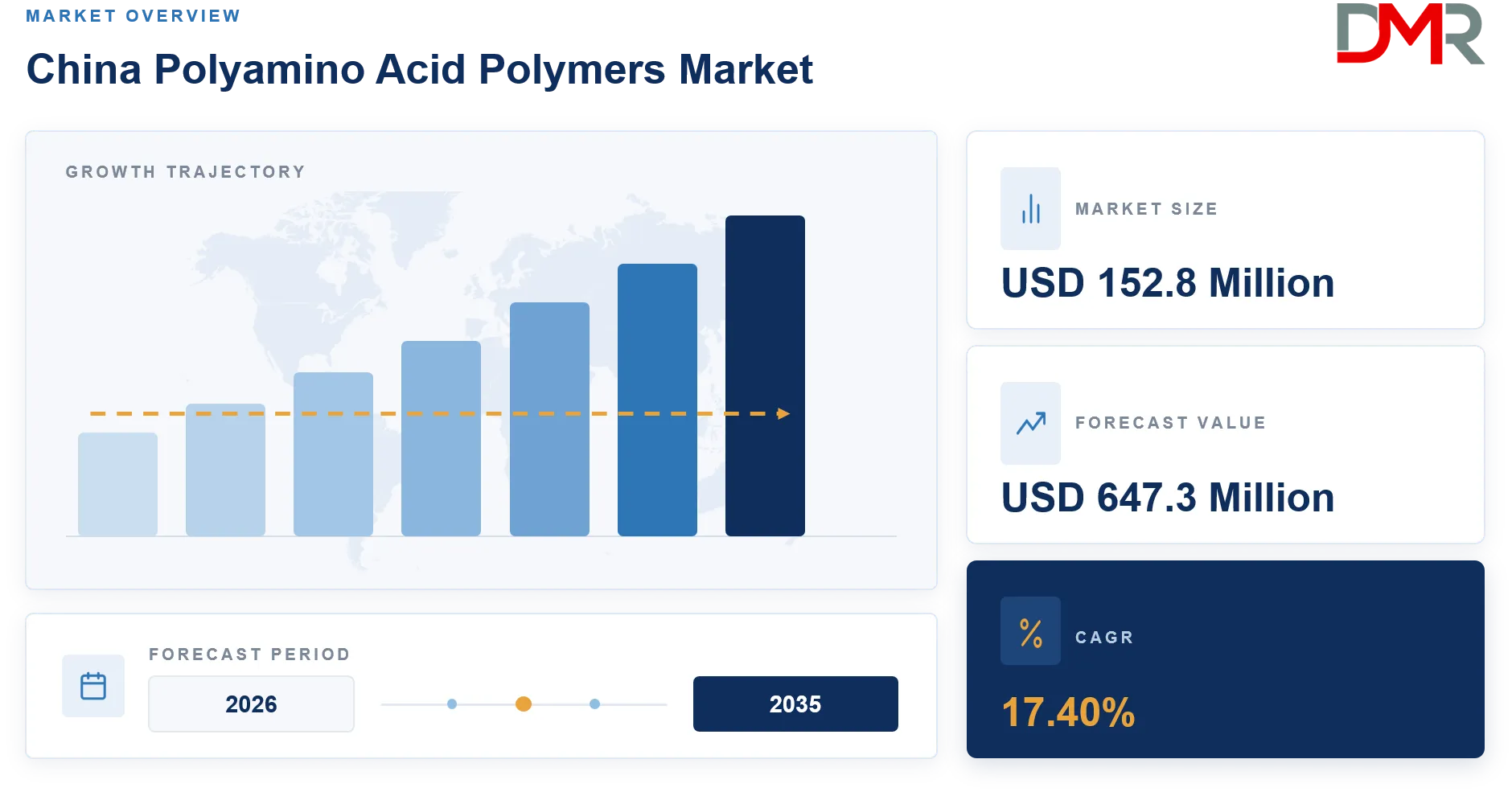
- Market Value: China polyamino acid polymers market size is valued at USD 152.8 million in 2026 and is expected to reach USD 647.3 million by 2035.
- CAGR: China polyamino acid polymers market is expected to grow at a CAGR of 17.4% from 2026 to 2035.
- By Application Segment Analysis: Biomedical & drug delivery led the application segment with a 38.5% share in 2026.
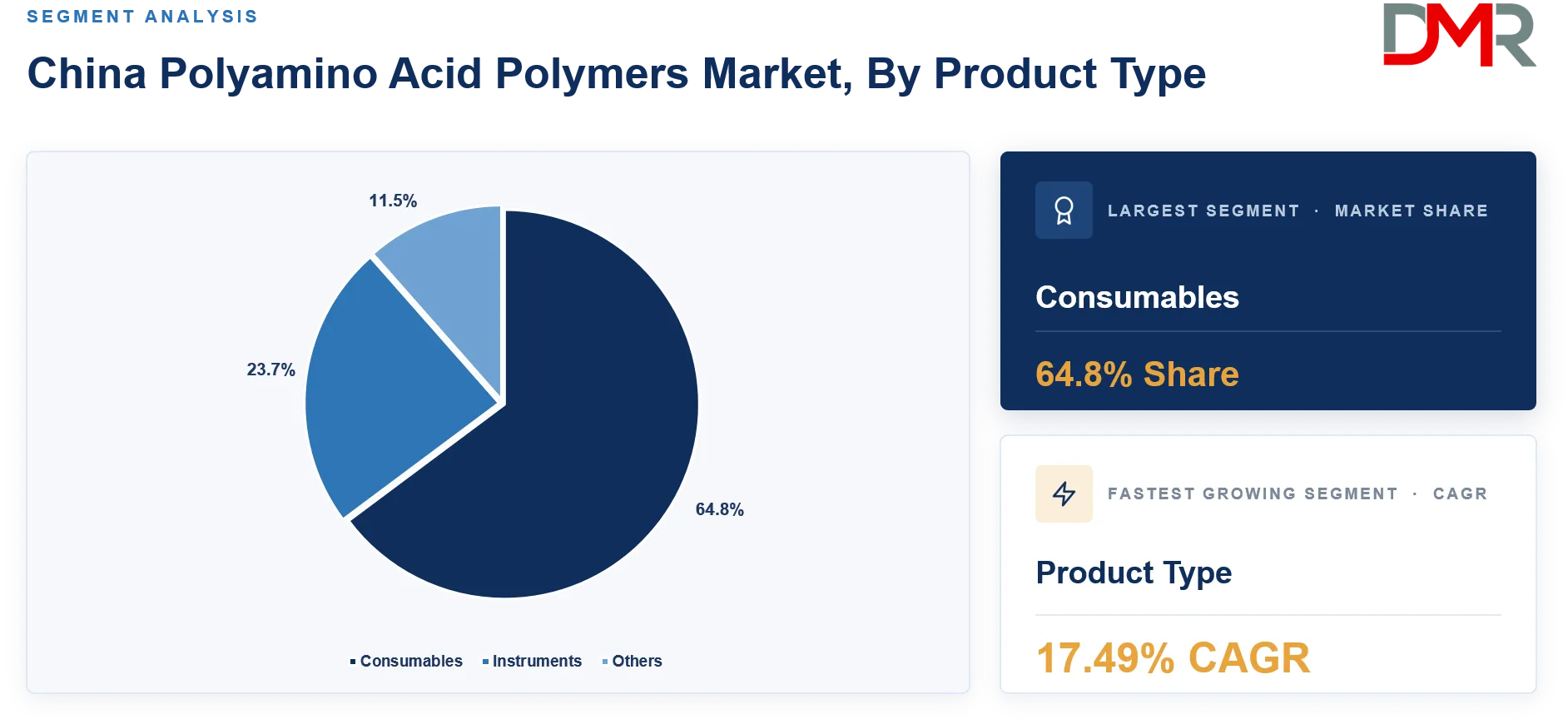
- By Product Type Segment Analysis: Consumables, including resins, powders, and solutions, led product types with a 64.8% share in 2026.
- By End-Use Segment Analysis: Pharmaceutical & biotech companies held a 41.2% share in 2026.
- Major Players: Hebei Chuanghai Biotechnology Co., Ltd., Shenzhen Feiyang Protech Corp., Ltd., and Others.
What is the China Polyamino Acid Polymers Market and its Market Size?
The China Polyamino Acid Polymers Market size is projected to be valued at USD 152.8 million in 2026 and is projected to reach USD 647.3 million by 2035, expanding at a CAGR of 17.4% during the forecast period. Polyamino acid polymers are polymeric materials constructed from amino-acid-based units and are valued for properties such as tunable molecular structure, water compatibility, functional groups, and potential biodegradability.
ℹ
To learn more about this report –
Download Your Free Sample Report Here
Commercial demand in China spans pharmaceutical formulation, controlled drug delivery, agricultural inputs, industrial water treatment, personal care, and specialty cleaning products. Based on the 2026 market structure, biomedical & drug delivery applications account for approximately USD 58.8 million, while consumables represent about USD 99.0 million of product-type revenue. The combination of biotechnology development, specialty chemical manufacturing, fermentation capability, and demand for functional materials is supporting the China polyamino acid polymers market growth outlook.
Use Cases
- Drug Delivery Systems: Polyamino acid polymers can serve as functional carriers, coatings, hydrogels, and polymer matrices for controlled or targeted delivery. Their adjustable molecular structure allows pharmaceutical developers to tune solubility, interaction with active ingredients, degradation behavior, and release performance for specialized formulations.
- Agricultural Inputs: Polyglutamic acid and related amino-acid-based polymers are incorporated into fertilizer and soil-management formulations to support nutrient retention, moisture management, and controlled interaction between nutrients and the root environment. This creates demand from Chinese fertilizer formulators and agricultural input manufacturers.
- Water Treatment: Polyaspartic acid and related functional polymers can be used in scale-control, dispersing, and chelating formulations for industrial water systems. Their use is relevant to cooling-water treatment, industrial cleaning, mineral-scale management, and processes seeking alternatives to more persistent treatment chemistries.
- Cosmetics & Personal Care: Polyamino acid polymers are used as functional ingredients where moisture retention, film formation, conditioning, texture modification, or formulation stability are required. Premium skincare and functional personal-care formulations provide opportunities for suppliers capable of delivering controlled purity and consistent molecular specifications.
- Industrial Cleaning: Amino-acid-based polymers can function within detergent and industrial-cleaning formulations as dispersants, scale-control agents, and formulation aids. Their compatibility with performance-focused and environmentally oriented product development creates opportunities across institutional cleaners, process chemicals, and specialty detergent systems.
How AI/Gen AI is Transforming the China Polyamino Acid Polymers Market?
Artificial intelligence is beginning to influence polyamino acid polymer development through molecular-property prediction, formulation screening, process optimization, and data-driven materials design. For Chinese pharmaceutical and biotechnology companies, computational models can evaluate relationships between polymer architecture, molecular weight, charge density, drug loading, stability, and release behavior before extensive laboratory screening. This is particularly relevant to biomedical & drug delivery, the market's largest application segment. AI-assisted workflows can narrow candidate formulations, identify promising polymer-drug combinations, and help research teams prioritize experiments. Manufacturers can also use predictive systems to monitor fermentation conditions, raw-material variability, viscosity, purity, and batch consistency, improving commercial scalability for products such as polyglutamic and polyaspartic acid derivatives.
Generative models broaden this opportunity by proposing molecular structures or formulation combinations around predefined performance targets. In the China polyamino acid polymers industry, such tools can support the design of biodegradable carriers, functional coatings, agricultural polymer additives, or water-treatment formulations with selected solubility and interaction profiles. The strongest near-term business impact is likely to come from combining computational screening with laboratory validation rather than replacing physical testing. Companies that link formulation databases, experimental results, process data, and customer performance requirements can shorten development cycles and improve product customization. This may strengthen competition among specialty polymer producers as buyers increasingly request application-specific grades instead of standardized polymer materials.
Key Drivers in the China Polyamino Acid Polymers Market
Expansion of Biomedical and Drug Delivery Applications
Biomedical & drug delivery accounted for 38.5% of the China polyamino acid polymers market in 2026, making it the largest application and representing approximately USD 58.8 million in market value. Polyamino acid structures can be engineered for use in carriers, hydrogels, coatings, and controlled-release systems, creating commercial relevance for formulation developers. Growth in advanced pharmaceuticals and biotechnology research is raising demand for materials that offer tunable chemistry, compatibility with aqueous systems, and controllable molecular characteristics.
Growing Demand for Functional and Biodegradable Specialty Polymers
Chinese manufacturers across agriculture, water treatment, cosmetics, and cleaning applications are increasingly evaluating polymers on both performance and environmental characteristics. Polyaspartic acid and polyglutamic acid derivatives provide functionality in areas such as dispersing, scale management, moisture retention, and formulation modification. This broad application base reduces dependence on a single end market. It also supports development of specialized grades for customers seeking differentiated performance rather than commodity polymer solutions.
Restraints in the China Polyamino Acid Polymers Market
Production Cost and Grade-Specific Purification Requirements
Commercial economics remain a barrier for several high-value polyamino acid polymer applications. Fermentation, polymerization, molecular-weight control, purification, drying, and quality testing can add substantial processing complexity, particularly for pharmaceutical and biomedical grades. Buyers in industrial applications are also highly cost sensitive because competing synthetic polymers may already have established supply chains. Producers therefore need to balance biodegradability and functional advantages against price, process consistency, and customer switching costs.
Complex Qualification for Biomedical Applications
Biomedical adoption requires more than polymer functionality. Pharmaceutical and biotech customers typically need tightly defined purity, molecular-weight distribution, residual content, stability, reproducibility, and documentation. A polymer suitable for agriculture or industrial treatment cannot automatically move into a drug-delivery application without additional testing and qualification. These requirements lengthen commercialization cycles and increase development expenditure, limiting rapid entry by smaller suppliers that lack pharmaceutical-grade production controls or application-development capabilities.
Growth Opportunities in the China Polyamino Acid Polymers Market
Application-Specific Pharmaceutical Grades
Pharmaceutical & biotech companies represented 41.2% of market revenue in 2026, equivalent to approximately USD 63.0 million. This creates an opportunity for suppliers to move beyond standard powders and solutions into grades tailored for drug carriers, hydrogels, surface modification, or formulation research. Greater value can be created through controlled molecular weight, higher purity, narrower specifications, and technical support. Suppliers that collaborate directly with formulation developers can position their polymers earlier in product-development cycles and improve customer retention.
Expansion into Agriculture and Water Treatment
Agricultural input manufacturers and water-treatment service providers offer a large addressable application base outside healthcare. Polyglutamic acid can support fertilizer and soil-input formulations, while polyaspartic acid is relevant to scale control, dispersion, and treatment chemistry. These applications can absorb larger material volumes than specialized biomedical uses. Producers capable of lowering manufacturing cost while maintaining consistent technical performance can develop differentiated product families for fertilizers, irrigation systems, industrial cooling water, detergents, and process-treatment formulations.
Trends in the China Polyamino Acid Polymers Market
Shift Toward Customized Polymer Specifications
The market is moving from basic material supply toward specification-driven products. Customers increasingly evaluate molecular weight, concentration, viscosity, purity, salt form, particle form, and application performance when selecting polyamino acid polymers. This is particularly important in pharmaceuticals, cosmetics, agriculture, and specialty chemicals, where the same polymer family may require different characteristics for each formulation. Manufacturers are responding by developing multiple grades, solutions, powders, and application-specific variants rather than relying on a single standard product.
Integration of Fermentation, Polymer Chemistry, and Formulation Expertise
Competition is increasingly shaped by technical capability across the full development chain. Suppliers of polyglutamic acid and related biomaterials require control over fermentation or synthesis, downstream purification, polymer characterization, and final formulation. Polyaspartic acid producers compete through polymerization efficiency, molecular control, scale inhibition, and chelation performance. Companies that combine manufacturing with application laboratories can respond more effectively to customer requirements and capture higher-value opportunities in pharmaceutical, agricultural, and environmental applications.
Research Scope and Analysis
The China polyamino acid polymers market is assessed across major commercial, technological, and demand variables influencing industry development between 2026 and 2035. The analysis evaluates market size, growth, application demand, product formats, end-user adoption, domestic regional concentration, competitive positioning, manufacturing requirements, emerging technologies, and opportunities across high-growth downstream industries.
By Application;
Biomedical & drug delivery led the application category with a 38.5% market share in 2026, equal to approximately USD 58.8 million based on the total China market value. The segment benefits from the ability of polyamino acid polymers to function as drug carriers, hydrogels, coatings, delivery matrices, and functional biomaterial components. Molecular structure and side-chain chemistry can be adjusted to influence solubility, interaction with therapeutic molecules, degradation characteristics, and release profiles. This makes the polymer class relevant to advanced pharmaceutical formulation and biotechnology research. Agriculture represents another attractive application through fertilizer enhancement and soil-related formulations, while water treatment benefits from polyaspartic-acid-based scale and dispersion chemistry. Cosmetics and industrial cleaning further broaden revenue opportunities and reduce supplier dependence on biomedical demand.
ℹ
To learn more about this report –
Download Your Free Sample Report Here
By Product Type;
Consumables, including resins, powders, and solutions, held 64.8% of the China polyamino acid polymers market in 2026, equivalent to approximately USD 99.0 million. Their dominance reflects the recurring nature of polymer consumption across formulation, laboratory, pilot-scale, and commercial production processes. Powders can support transportation and long-term handling requirements, while prepared solutions can simplify dosing and integration in water treatment, agricultural formulations, cosmetics, and industrial processes. Product differentiation increasingly depends on concentration, molecular weight, purity, viscosity, chemical form, and application-specific performance. Instruments occupy a smaller market position because they are durable capital products, while polymer consumables require repeated purchasing as customers increase manufacturing output and research activity.
By End-Use;
Pharmaceutical & biotech companies captured 41.2% of the market in 2026, translating to approximately USD 63.0 million. These organizations purchase polyamino acid polymers for formulation research, carrier development, biomaterial studies, controlled-release systems, and other advanced applications requiring tighter specifications. Agricultural input manufacturers represent a separate volume-oriented customer base where functional polymers can be incorporated into fertilizer and plant-input formulations. Water-treatment companies require scale-control and dispersing performance, while cosmetics producers focus on moisture retention, film formation, texture, and formulation compatibility. Research institutes and academia remain important for early-stage polymer development and the creation of new downstream applications that can later move into commercial production.
The China Polyamino Acid Polymers Market Report is segmented on the basis of the following:
By Application
- Biomedical & Drug Delivery
- Agriculture
- Water Treatment & Environmental
- Cosmetics & Personal Care
- Detergents & Industrial Cleaners
By Product Type
- Consumables
- Instruments
- Others
By End-Use
- Pharmaceutical & Biotech Companies
- Agricultural Input Manufacturers
- Water Treatment & Environmental Services
- Cosmetics & Personal Care Producers
- Research Institutes & Academia
Competitive Landscape
The China polyamino acid polymers market includes biotechnology specialists, peptide and fine-chemical suppliers, polyaspartic acid manufacturers, specialty material producers, and diversified chemical companies. Competition is shaped by polymer type, production technology, purity, molecular-weight control, formulation format, technical support, production scale, and ability to serve regulated or specialized end uses. Biomedical customers place greater emphasis on purity, reproducibility, documentation, and customized molecular specifications, while agriculture and water-treatment buyers focus more strongly on application performance, cost, concentration, and supply reliability.
Companies including Hebei Think-Do Chemicals and Nanjing Shineking Biotech operate in application areas connected with polyaspartic acid and polyglutamic acid, respectively. Other suppliers compete through peptide chemistry, specialty polymer development, distribution networks, and export capabilities. As market value rises from USD 152.8 million in 2026 to USD 647.3 million by 2035, competitive advantage is expected to shift further toward companies that combine scalable manufacturing with application development, quality consistency, customized grades, and direct technical engagement with pharmaceutical, agricultural, environmental, and personal-care customers.
Some of the prominent players in the China Polyamino Acid Polymers Industry are:
- Hebei Chuanghai Biotechnology Co., Ltd.
- Shenzhen Feiyang Protech Corp., Ltd.
- Shandong Yuanlian Chemical Co., Ltd.
- GIHI Chemicals Co., Limited
- Guilin Peptide Technology Limited
- Henan Tianfu Chemical Co., Ltd.
- Hubei Highwin New Material Technology Co., Ltd.
- Hebei Think-Do Chemicals Co., Ltd.
- Zhengzhou Jiuyi Time New Materials Co., Ltd.
- Guangdong Maydos Building Materials Co., Ltd.
- Xi’an Waycoo Industrial & Trading Co., Ltd.
- Shandong Luyue Chemical Co., Ltd.
- Nanjing Shineking Biotech Co., Ltd.
- Shenzhen Feiyang New Materials Co., Ltd.
- Hebei Shengsuan Chemical Industry Co., Ltd.
- Others
Technology Analysis
Technology development in the China polyamino acid polymers market is centered on fermentation optimization, controlled polymerization, molecular-weight engineering, purification, functional modification, and application-specific formulation. For poly-γ-glutamic acid, microbial fermentation is commercially important because strains such as Bacillus can produce the polymer through bioprocessing, followed by separation, purification, concentration, and drying. Manufacturers are improving strain selection, nutrient utilization, fermentation control, and downstream recovery to raise yield and achieve consistent viscosity and molecular specifications.
Polyaspartic acid production relies more heavily on controlled chemical synthesis and process conditions that influence molecular weight and functional performance. In biomedical & drug delivery, which held 38.5% of market revenue in 2026, technology development is moving toward engineered polymer carriers, hydrogels, surface modification, and controlled-release systems. Better analytical characterization and process control are also helping suppliers develop distinct grades for pharmaceuticals, agriculture, water treatment, cosmetics, and industrial cleaning.
Investment and White Space Analysis
Investment opportunities in the China polyamino acid polymers market are shifting toward specialized grades and downstream applications rather than capacity expansion alone. With the market projected to increase from USD 152.8 million in 2026 to USD 647.3 million by 2035, attractive white spaces include pharmaceutical-grade polymers, customized molecular-weight products, drug-delivery materials, high-purity poly-γ-glutamic acid, biodegradable water-treatment additives, and polymer-enhanced agricultural formulations. Pharmaceutical & biotech companies already account for 41.2% of 2026 demand, indicating room for suppliers that can provide tighter specifications, documentation, reproducibility, and application support. Another opportunity exists in converting basic powders and solutions into higher-value formulations tailored to customer processes.
East China's 42.3% revenue share makes it a logical location for application laboratories and partnerships with pharmaceutical and biotechnology customers, while chemical manufacturing clusters elsewhere can support cost-efficient production. Investment in purification, quality control, fermentation productivity, and customer-specific formulation can help producers move from price competition toward higher-margin specialty materials.
Recent Developments
- August 2026: Shandong Yuanlian Chemical Co., Ltd. Expanded PASP applications into industrial water treatment, promoting phosphate-free, biodegradable scale-inhibitor solutions for cooling towers and boilers.
- July 2026: Shandong Yuanlian Chemical Co., Ltd. Developed additional PASP-focused solutions for water treatment, agriculture and detergents, broadening its amino-acid polymer portfolio and targeting overseas demand.
- January 2025: Hebei Think-Do Chemicals Co., Ltd. Reported annual polyaspartic-acid capacity of up to 20,000 tons, reinforcing its position as a major Asian supplier of biodegradable polyamino-acid chelating polymers.
Report Details
| Report Characteristics |
| Market Size (2026) |
USD 152.8 Million |
| Forecast Value (2035) |
USD 647.3 Million |
| CAGR (2026–2035) |
17.4% |
| Historical Data |
2021 – 2025 |
| Forecast Data |
2027 – 2035 |
| Base Year |
2025 |
| Estimate Year |
2026 |
| Segments Covered |
By Application (Biomedical & Drug Delivery, Agriculture, Water Treatment & Environmental, Cosmetics & Personal Care, and Detergents & Industrial Cleaners), By Product Type (Consumables {Resins, Powders, and Solutions}, Instruments, and Others), and By End-Use (Pharmaceutical & Biotech Companies, Agricultural Input Manufacturers, Water Treatment & Environmental Services, Cosmetics & Personal Care Producers, and Research Institutes & Academia) |
| Regional Coverage |
China |
Frequently Asked Questions
What is the current size of the China Polyamino Acid Polymers Market?
▾ The China Polyamino Acid Polymers Market is valued at USD 152.8 million in 2026 and may reach USD 647.3 million by 2035.
What is the growth rate of the China Polyamino Acid Polymers Market during?
▾ The China Polyamino Acid Polymers Market is expected to expand at a CAGR of 17.4% during the 2026-2035 forecast period.
What factors are driving the growth of the China Polyamino Acid Polymers Market?
▾ Biomedical drug delivery and biodegradable materials drive demand across the China Polyamino Acid Polymers Market.
What are the major challenges restraining the China Polyamino Acid Polymers Market?
▾ Production costs, purification needs, and biomedical qualification restrain the China Polyamino Acid Polymers Market.
Which segment holds the largest share of the China Polyamino Acid Polymers Market?
▾ Biomedical & Drug Delivery holds the largest China Polyamino Acid Polymers Market application share at 38.5% in 2026.
Who are the leading companies in the China Polyamino Acid Polymers Market?
▾ Hebei Chuanghai Biotechnology Co., Ltd., Shenzhen Feiyang Protech Corp., Ltd., Shandong Yuanlian Chemical Co., Ltd., GIHI Chemicals Co., Limited, Guilin Peptide Technology Limited, Henan Tianfu Chemical Co., Ltd., Hubei Highwin New Material Technology Co., Ltd., Hebei Think-Do Chemicals Co., Ltd., Zhengzhou Jiuyi Time New Materials Co., Ltd., Guangdong Maydos Building Materials Co., Ltd., Xi’an Waycoo Industrial & Trading Co., Ltd., Shandong Luyue Chemical Co., Ltd., Nanjing Shineking Biotech Co., Ltd., Shenzhen Feiyang New Materials Co., Ltd., and Hebei Shengsuan Chemical Industry Co., Ltd. are prominent market participants.
How is AI influencing the China Polyamino Acid Polymers Market?
▾ AI supports China Polyamino Acid Polymers Market growth through molecular design, formulation screening, and control.
What are the future opportunities and trends in the China Polyamino Acid Polymers Market?
▾ Pharma-grade polymers, agriculture, and water treatment offer opportunities in the China Polyamino Acid Polymers Market.