Market Snapshot
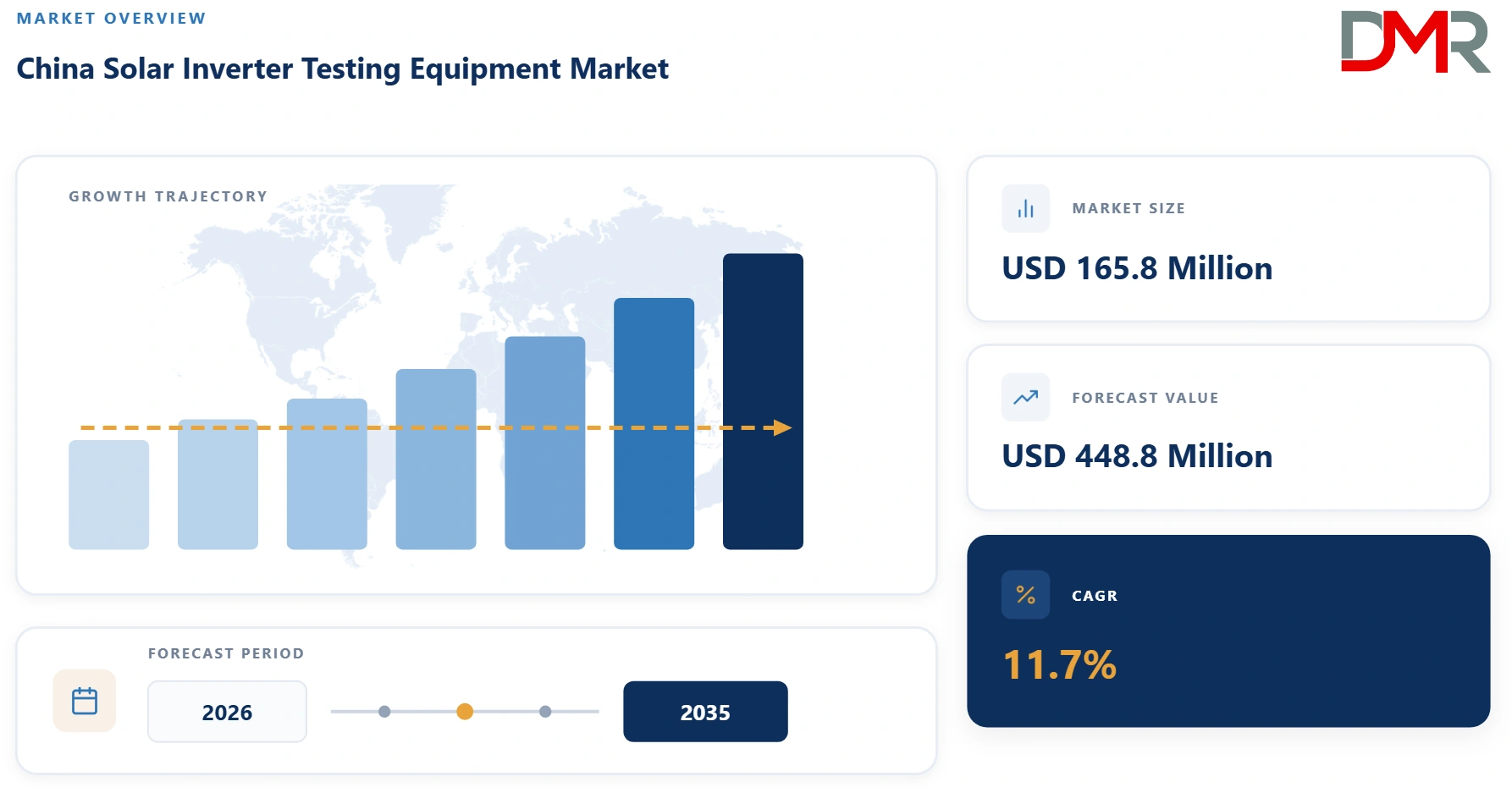
- Market Size (2026): USD 165.8 Mn
- Forecast Value (2035): USD 448.8 Mn
- CAGR (2026-2035): 11.7%
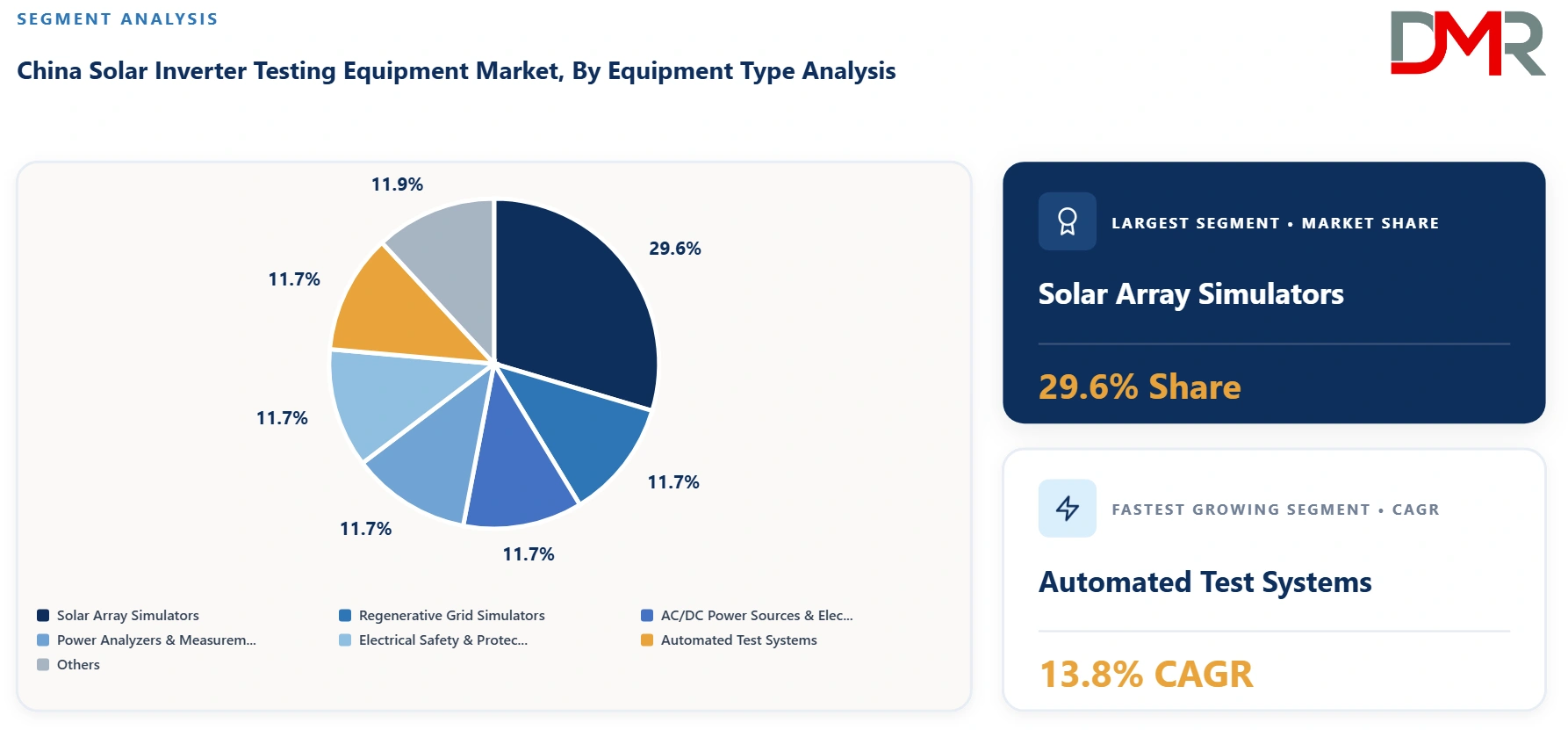
- Leading Equipment Type (2026): Solar Array Simulators, around 29.6%
- Leading Test Type (2026): Performance & Efficiency Testing, close to 26.9%
- Key Players: Kewell Technology Co., Ltd., ITECH Electronic Co., Ltd., Chroma ATE Inc., and Others
What is China Solar Inverter Testing Equipment Market and its Market Size?
The China Solar Inverter Testing Equipment Market size is estimated to reach USD 165.8 Mn in 2026 and is further anticipated to reach USD 448.8 Mn by 2035, at a CAGR of 11.7%.
ℹ
To learn more about this report –
Download Your Free Sample Report Here
Solar inverter testing equipment includes programmable power sources, solar array simulators, regenerative grid simulators, electronic loads, power analyzers, safety testers, automated test platforms, environmental test systems, and associated software used to validate photovoltaic inverter performance. The equipment supports laboratory development, product qualification, production-line quality control, certification, grid-code compliance, and reliability assessment across residential, commercial, industrial, and utility-scale inverter products.
China represents one of the world's largest solar inverter manufacturing and export bases, which creates sustained demand for high-power, high-voltage, and automated testing infrastructure. Domestic manufacturers increasingly validate products against Chinese standards as well as IEC, EN, IEEE, UL, and destination-market requirements. Testing platforms must therefore simulate complex irradiance profiles, dynamic I-V curves, grid disturbances, anti-islanding conditions, low- and high-voltage ride-through events, harmonics, reactive power behavior, and rapid load transitions with high repeatability.
Procurement decisions are influenced by power range, regenerative efficiency, channel density, measurement accuracy, test automation, report generation, standards libraries, system scalability, and compatibility with fast-changing inverter architectures. As string inverter ratings rise and hybrid solar-storage products become more common, test benches require higher DC voltage, bidirectional power flow, multi-MPPT capability, and increasingly sophisticated grid emulation.
The market is also moving toward integrated, energy-regenerative test systems that reduce facility power consumption and heat generation while supporting continuous high-power testing. Local suppliers are competing aggressively in programmable power and automated test systems, while international vendors retain strong positions in precision measurement, certification-grade instrumentation, advanced grid simulation, and specialized compliance testing.
Use Cases
- R&D Validation: Inverter manufacturers use solar array simulators, grid simulators, analyzers, and automated software to reproduce operating conditions before product release, validate control algorithms, measure conversion efficiency, and verify dynamic MPPT behavior across changing irradiance and temperature conditions.
- Grid Compliance Testing: Laboratories and manufacturers reproduce voltage sags, frequency deviations, harmonics, phase imbalance, reactive power conditions, and ride-through events to verify that grid-connected inverters meet Chinese interconnection requirements and export-market certification standards.
- Production-Line End-of-Line Testing: High-throughput automated test systems perform functional, protection, calibration, communications, and electrical safety checks before shipment. Parallel test channels and scripted sequences reduce operator intervention and improve traceability across high-volume inverter manufacturing lines.
- Certification & Reliability Testing: Third-party laboratories combine power-electronic test equipment with environmental chambers, safety analyzers, and data acquisition systems to evaluate long-duration operation, anti-islanding response, protection functions, thermal behavior, and compliance evidence required for formal certification.
Key Takeaways
- Market Size & Share: The market is estimated at USD 165.8 Mn in 2026 and is projected to reach USD 448.8 Mn by 2035.
- Equipment Type Analysis: Automated Test Systems are expected to be the fastest-growing major equipment category, with an estimated CAGR of 13.8%.
- Test Type Analysis: Performance & Efficiency Testing leads with approximately 26.9% of 2026 revenue due to mandatory efficiency, MPPT, and operating-performance validation.
- Inverter Type Analysis: String Inverters account for about 48.7% of testing-equipment demand, reflecting China's large string inverter manufacturing base.
- Commercial Catalyst: Higher-power inverter platforms and hybrid solar-storage products are increasing demand for regenerative systems above 1 MW and DC test voltages above 1,500 V.
- Competitive Dynamics: Domestic programmable-power suppliers are gaining share, while international vendors remain important in precision measurement, certification-grade testing, and advanced instrumentation.
How AI/Gen AI is Transforming the China Solar Inverter Testing Equipment Market?
AI is being incorporated into automated test software to identify abnormal waveforms, classify failure modes, optimize test sequences, and compare measured inverter behavior against expected performance envelopes. Machine-learning models can flag drift in efficiency, switching behavior, thermal response, and protection timing across large production datasets. This is particularly useful in high-volume manufacturing, where test equipment generates substantial amounts of voltage, current, power-quality, waveform, and communications data that can be analyzed for early defect detection and process control.
Generative AI is beginning to support test engineering documentation, test-plan creation, troubleshooting, and standards interpretation. Engineering teams can use controlled Gen AI tools to summarize test logs, generate draft scripts from validated requirements, and retrieve relevant procedures from large internal knowledge bases. Adoption remains constrained by the need for deterministic test execution, calibration traceability, cybersecurity, and formal certification evidence. As a result, AI is more likely to augment test engineers and data analysis than replace validated test-control logic.
- Automated Anomaly Detection: AI models identify unusual voltage, current, harmonic, efficiency, and thermal signatures during repeated inverter test cycles.
- Adaptive Test Sequencing: Software prioritizes additional tests when early measurements indicate borderline performance or protection behavior.
- Predictive Calibration & Maintenance: Usage patterns and drift data help laboratories schedule equipment verification before measurement accuracy deteriorates.
- Engineering Knowledge Assistance: Gen AI tools summarize test reports, standards requirements, and historical failure cases for design and quality teams.
Key Drivers in the China Solar Inverter Testing Equipment Market
Large Domestic Solar Inverter Manufacturing Base
China's extensive solar inverter manufacturing ecosystem creates direct demand for R&D, validation, production-line, and certification test equipment. Major inverter suppliers operate high-volume factories and frequent product-refresh cycles across residential, commercial, utility-scale, and storage-integrated platforms. Each new generation requires verification of efficiency, MPPT, grid support, protection, communications, and thermal behavior. Export-oriented manufacturers must also validate against standards used in Europe, North America, Asia-Pacific, Latin America, and the Middle East. This multiplies the number of test conditions and encourages investment in programmable, automated, and reconfigurable platforms that can support multiple product families without rebuilding the laboratory for every design.
Stricter Grid-Connection and Product Quality Requirements
Chinese regulators, grid operators, certification bodies, and project owners are placing greater emphasis on inverter quality, grid-support capability, and safe operation. Testing now extends beyond basic conversion efficiency to voltage and frequency adaptability, fault ride-through, reactive power control, harmonics, anti-islanding, communications, and protection behavior. Distributed solar growth also increases the importance of verifying how inverters behave on weaker distribution networks and under abnormal grid conditions. These requirements support demand for regenerative grid simulators, power analyzers, high-speed data acquisition, automated compliance software, and test systems capable of reproducing complex grid events with high repeatability.
Restraints in the China Solar Inverter Testing Equipment Market
High Capital Cost of Megawatt-Class Test Platforms
High-power inverter testing requires substantial investment in regenerative grid simulators, solar array emulators, transformers, switchgear, cooling, safety infrastructure, analyzers, and automation software. Systems rated in the hundreds of kilowatts or megawatts can require major facility upgrades and dedicated engineering resources. Smaller inverter companies, component suppliers, and regional laboratories may therefore postpone purchases or rely on shared third-party facilities. Although regenerative equipment can reduce energy consumption over time, the initial capital requirement remains significant. Buyers also face calibration, maintenance, software licensing, and operator-training costs, which can slow replacement cycles for otherwise functional test equipment.
Rapid Standards and Product Architecture Changes
Inverter products are evolving quickly as manufacturers increase DC voltage, add storage interfaces, deploy silicon carbide power devices, expand grid-forming functionality, and enter more export markets. Test systems can become constrained if they lack sufficient voltage, bandwidth, communications interfaces, or software flexibility. At the same time, standards and certification requirements continue to change across target countries. Laboratories must update test scripts, fixtures, safety procedures, and sometimes hardware configurations. This creates technology-obsolescence risk and makes purchasers cautious about highly specialized platforms that cannot be expanded. Vendors must therefore provide modular architectures and continuing software support to protect customer investment.
Growth Opportunities in the China Solar Inverter Testing Equipment Market
Hybrid Inverter and Solar-Storage Test Platforms
The growth of residential, commercial, and utility-scale storage is expanding the need to test hybrid inverters that manage PV input, batteries, loads, and grid interaction in one product. These systems require bidirectional DC sources, battery simulators, solar array simulators, regenerative AC sources, load emulation, communications testing, and more complex automation. Suppliers that combine PV and energy-storage test functions into a common platform can address both inverter and power-conversion-system development. Demand is especially attractive for systems that support multi-MPPT channels, high-voltage batteries, grid-forming operation, backup mode, transfer switching, and interoperability testing across different energy-management configurations.
High-Power Regenerative and Automated Production Testing
As utility-scale and commercial string inverter ratings increase, manufacturers need test systems that can deliver higher power while minimizing energy waste. Regenerative sources and loads return energy to the facility grid instead of dissipating it as heat, reducing cooling demand and operating cost during continuous production testing. Parallelized automated systems can also shorten takt time and improve traceability. This creates opportunities for modular megawatt-scale platforms, high-density channel systems, automated report generation, remote monitoring, and software capable of coordinating multiple instruments. Domestic equipment makers can gain share by combining competitive pricing with local service and standards-specific automation.
Trends in the China Solar Inverter Testing Equipment Market
Shift Toward 1,500 V Plus and Megawatt-Class Test Capability
Utility-scale inverter design is moving toward higher DC voltages, larger power blocks, and more integrated power-conversion architectures. Test equipment is responding with wider voltage ranges, higher power density, modular parallel operation, and improved regenerative efficiency. Solar array simulators are increasingly required to reproduce multiple strings and independent MPPT channels, while grid simulators must emulate high-power three-phase networks and rapid voltage disturbances. Suppliers are also adopting silicon carbide-based power stages to improve switching speed and system efficiency. This trend favors equipment platforms that can scale from engineering development to full-power validation without changing the underlying control and automation environment.
Software-Centric Automation and Multi-Standard Test Libraries
Hardware performance remains essential, but differentiation is increasingly shifting toward automation software, reusable test libraries, data management, and standards coverage. Manufacturers want systems that can execute scripted sequences, automatically configure instruments, collect synchronized data, calculate pass-fail results, and export reports with minimal operator input. Multi-standard libraries reduce the time required to adapt products for different export markets. Open APIs and support for common industrial communications protocols are also becoming more important because inverter test benches must integrate with manufacturing execution systems, laboratory databases, barcode tracking, and internal analytics platforms.
Research Scope and Analysis
The study evaluates the China solar inverter testing equipment market by equipment type, test type, inverter type, power rating, and end user, with segment leadership and growth assessed across the 2026-2035 forecast period.
ℹ
To learn more about this report –
Download Your Free Sample Report Here
By Equipment Type
Solar Array Simulators is estimated to lead the equipment type segment with around 29.6% of 2026 revenue. Its position reflects established usage across inverter R&D, compliance, production, and certification workflows, supported by mature supplier portfolios and broad standards coverage. Buyers prioritize systems that combine measurement accuracy, repeatability, automation, and scalable power capability. Growth, however, is concentrated in Automated Test Systems, which is projected to expand at a CAGR of 13.8% between 2026 and 2035. Expansion is supported by higher inverter power ratings, hybrid solar-storage architectures, stricter grid-code testing, export certification requirements, and increasing demand for automated, energy-regenerative test platforms.
By Test Type
Performance & Efficiency Testing is estimated to lead the test type segment with around 26.9% of 2026 revenue. Its position reflects established usage across inverter R&D, compliance, production, and certification workflows, supported by mature supplier portfolios and broad standards coverage. Buyers prioritize systems that combine measurement accuracy, repeatability, automation, and scalable power capability. Growth, however, is concentrated in Grid Compliance & Ride-Through Testing, which is projected to expand at a CAGR of 14.5% between 2026 and 2035. Expansion is supported by higher inverter power ratings, hybrid solar-storage architectures, stricter grid-code testing, export certification requirements, and increasing demand for automated, energy-regenerative test platforms.
By Inverter Type
String Inverters is estimated to lead the inverter type segment with around 48.7% of 2026 revenue. Its position reflects established usage across inverter R&D, compliance, production, and certification workflows, supported by mature supplier portfolios and broad standards coverage. Buyers prioritize systems that combine measurement accuracy, repeatability, automation, and scalable power capability. Growth, however, is concentrated in Hybrid Solar-Storage Inverters, which is projected to expand at a CAGR of 16.9% between 2026 and 2035. Expansion is supported by higher inverter power ratings, hybrid solar-storage architectures, stricter grid-code testing, export certification requirements, and increasing demand for automated, energy-regenerative test platforms.
By Power Rating
10-100 kW is estimated to lead the power rating segment with around 34.2% of 2026 revenue. Its position reflects established usage across inverter R&D, compliance, production, and certification workflows, supported by mature supplier portfolios and broad standards coverage. Buyers prioritize systems that combine measurement accuracy, repeatability, automation, and scalable power capability. Growth, however, is concentrated in Above 1 MW, which is projected to expand at a CAGR of 15.6% between 2026 and 2035. Expansion is supported by higher inverter power ratings, hybrid solar-storage architectures, stricter grid-code testing, export certification requirements, and increasing demand for automated, energy-regenerative test platforms.
By End User
Solar Inverter Manufacturers is estimated to lead the end user segment with around 57.4% of 2026 revenue. Its position reflects established usage across inverter R&D, compliance, production, and certification workflows, supported by mature supplier portfolios and broad standards coverage. Buyers prioritize systems that combine measurement accuracy, repeatability, automation, and scalable power capability. Growth, however, is concentrated in Third-Party Testing Laboratories, which is projected to expand at a CAGR of 13.2% between 2026 and 2035. Expansion is supported by higher inverter power ratings, hybrid solar-storage architectures, stricter grid-code testing, export certification requirements, and increasing demand for automated, energy-regenerative test platforms.
The China Solar Inverter Testing Equipment Market Report is Segmented Based on the Following
By Equipment Type
- Solar Array Simulators
- Regenerative Grid Simulators
- AC/DC Power Sources & Electronic Loads
- Power Analyzers & Measurement Instruments
- Electrical Safety & Protection Testers
- Automated Test Systems
- Others
By Test Type
- Performance & Efficiency Testing
- MPPT Testing
- Grid Compliance & Ride-Through Testing
- Anti-Islanding Testing
- Electrical Safety Testing
- Reliability & Environmental Testing
- Others
By Inverter Type
- String Inverters
- Central Inverters
- Microinverters
- Hybrid Solar-Storage Inverters
- Off-Grid Inverters
- Others
By Power Rating
- Below 10 kW
- 10-100 kW
- 101-500 kW
- 501 kW-1 MW
- Above 1 MW
- Others
By End User
- Solar Inverter Manufacturers
- Third-Party Testing Laboratories
- Certification & Inspection Bodies
- Research Institutes & Universities
- Utilities & Grid Technology Centers
- Others
Regulatory Landscape
China's solar inverter testing environment is shaped by national product standards, grid-connection requirements, certification programs, market-supervision activities, and internationally recognized standards used by export manufacturers. Relevant testing areas include inverter efficiency, power quality, protection, anti-islanding, voltage and frequency adaptability, ride-through performance, electrical safety, and electromagnetic compatibility. National authorities have strengthened oversight of distributed photovoltaic equipment quality and continue to use testing and certification results in market supervision, procurement, and project acceptance. Testing laboratories therefore require traceable measurement systems, regularly updated standards libraries, documented calibration, and flexible platforms that can support both Chinese requirements and destination-market certification programs.
Technology Analysis
The technology base is shifting toward regenerative, modular, high-voltage, and software-defined test systems. Solar array simulators increasingly support dynamic I-V curves, shading profiles, multi-peak conditions, multiple MPPT channels, and voltages above 1,500 V. Regenerative grid simulators reproduce harmonics, phase imbalance, transient voltage events, anti-islanding conditions, and ride-through scenarios while returning test energy to the facility network. Precision power analyzers provide synchronized efficiency, harmonic, and waveform measurement, while automated test software coordinates instrument control and report generation. Silicon carbide power stages, high-speed digital control, open communications interfaces, and modular parallel operation are improving system density and scalability for megawatt-class inverter testing.
Competitive Landscape
The China solar inverter testing equipment market combines domestic programmable-power specialists, Taiwanese and Japanese test-equipment vendors, international precision-instrument companies, and certification organizations with substantial laboratory infrastructure. Domestic vendors compete strongly on price, localization, high-power customization, service response, and Chinese standards integration. International suppliers differentiate through measurement accuracy, established certification acceptance, advanced grid simulation, software ecosystems, and global support. Competition is increasingly based on total test-platform capability rather than individual instruments. Vendors that combine solar array simulation, regenerative grid emulation, power analysis, safety testing, automation software, and data management can capture a larger portion of laboratory and production-line spending. Partnerships with certification laboratories and inverter manufacturers remain important routes to technology validation and market visibility.
Some of the Prominent Players in the China Solar Inverter Testing Equipment Market Are:
- Kewell Technology Co., Ltd.
- ITECH Electronic Co., Ltd.
- Chroma ATE Inc.
- Keysight Technologies
- AMETEK Programmable Power
- EA Elektro-Automatik
- Regatron AG
- Kikusui Electronics Corporation
- Pacific Power Source, Inc.
- Cinergia Power Solutions
- Intepro Systems
- Magna-Power Electronics
- Delta Elektronika B.V.
- ET System electronic GmbH
- NH Research, Inc.
- Yokogawa Electric Corporation
- Hioki E.E. Corporation
- Rohde & Schwarz
- Tektronix, Inc.
- Fluke Corporation
- GW Instek
- Rigol Technologies
- Siglent Technologies
- ZLG Zhiyuan Electronics
- Ainuo Instrument Co., Ltd.
- Hefei Yuanzhi High-Tech Co., Ltd.
- TÜV Rheinland
- TÜV SÜD
- UL Solutions
- SGS
- Intertek
- DEKRA
- China Quality Certification Centre
- China General Certification Center
- China Electric Power Research Institute
- National Institute of Metrology, China
- Suzhou Electrical Apparatus Science Research Institute
- Shanghai Electrical Apparatus Research Institute
- Guangdong Testing Institute of Product Quality Supervision
- China Testing & Certification International Group
- Other Key Players
Recent Developments
- In June 2026, China's National Energy Administration highlighted distributed photovoltaic grid-safety concerns and the need to strengthen grid-connected performance management, reinforcing demand for inverter compliance and ride-through testing.
- In December 2025, ITECH released SAS1100 solar cell matrix simulation software supporting centralized control of up to 100 channels for photovoltaic R&D and production-line testing, including real-time I-V/P-V curve and MPPT monitoring.
- In 2025, Chinese market-supervision authorities continued national quality inspections of grid-connected photovoltaic inverters and maintained testing and certification as a key mechanism for equipment quality oversight.
- In 2025, TÜV Rheinland's China accreditation scope continued to include photovoltaic inverter and converter testing against IEC and EN safety requirements as well as low-voltage ride-through measurement procedures.
- In 2025, ITECH expanded promotion of regenerative grid-simulation platforms for photovoltaic inverter, grid-adaptability, anti-islanding, and high-power bidirectional testing applications.
- In 2025, Kewell continued expanding high-voltage photovoltaic and energy-storage testing solutions, including platforms supporting up to 2,400 V-class test power for advanced inverter and power-conversion applications.
Report Details
| Report Characteristics |
| Market Size (2026) |
USD 165.8 Mn |
| Forecast Value (2035) |
USD 448.8 Mn |
| CAGR (2026–2035) |
11.7% |
| Historical Data |
2021 – 2025 |
| Forecast Data |
2026 – 2035 |
| Base Year |
2025 |
| Segments Covered |
By Equipment Type, By Test Type, By Inverter Type, By Power Rating, By End User |
| Geographic Coverage |
China |
Frequently Asked Questions
How big is the China Solar Inverter Testing Equipment Market?
▾ The China Solar Inverter Testing Equipment Market size is estimated to reach USD 165.8 Mn in 2026 and is projected to reach USD 448.8 Mn by 2035, growing at a CAGR of 11.7%.
What is the growth rate of the China Solar Inverter Testing Equipment Market?
▾ The market is expanding at an estimated CAGR of 11.7% from 2026 to 2035, supported by inverter manufacturing growth, stricter grid-code testing, export certification, and greater use of automated regenerative test platforms.
Which equipment type holds the largest share in the China Solar Inverter Testing Equipment Market?
▾ The Solar Array Simulators segment leads the market, holding approximately 29.6% of 2026 revenue due to its central role in MPPT, efficiency, dynamic irradiance, and inverter input-performance testing.
Who are the key players in the China Solar Inverter Testing Equipment Market?
▾ Prominent operating companies include Kewell Technology Co., Ltd., ITECH Electronic Co., Ltd., Chroma ATE Inc., Keysight Technologies, AMETEK Programmable Power, and other test-equipment and certification providers.
Which inverter type is leading the China Solar Inverter Testing Equipment Market?
▾ The String Inverters segment commands the highest share, accounting for roughly 48.7% in 2026 because China has a large manufacturing base for commercial, industrial, residential, and increasingly high-power string inverter products.
Which segment is expanding fastest in the China Solar Inverter Testing Equipment Market?
▾ The Hybrid Solar-Storage Inverters segment is projected to record the highest inverter-type growth, registering an estimated CAGR of 16.9% through 2035 as PV and battery functions converge within shared power-conversion platforms.
What are the major growth drivers in the China Solar Inverter Testing Equipment Market?
▾ Market expansion is primarily propelled by China's large inverter manufacturing base, export certification requirements, stricter grid-connected performance standards, rising inverter power ratings, hybrid solar-storage products, and growing demand for automated, high-voltage, regenerative test systems.