Market Overview
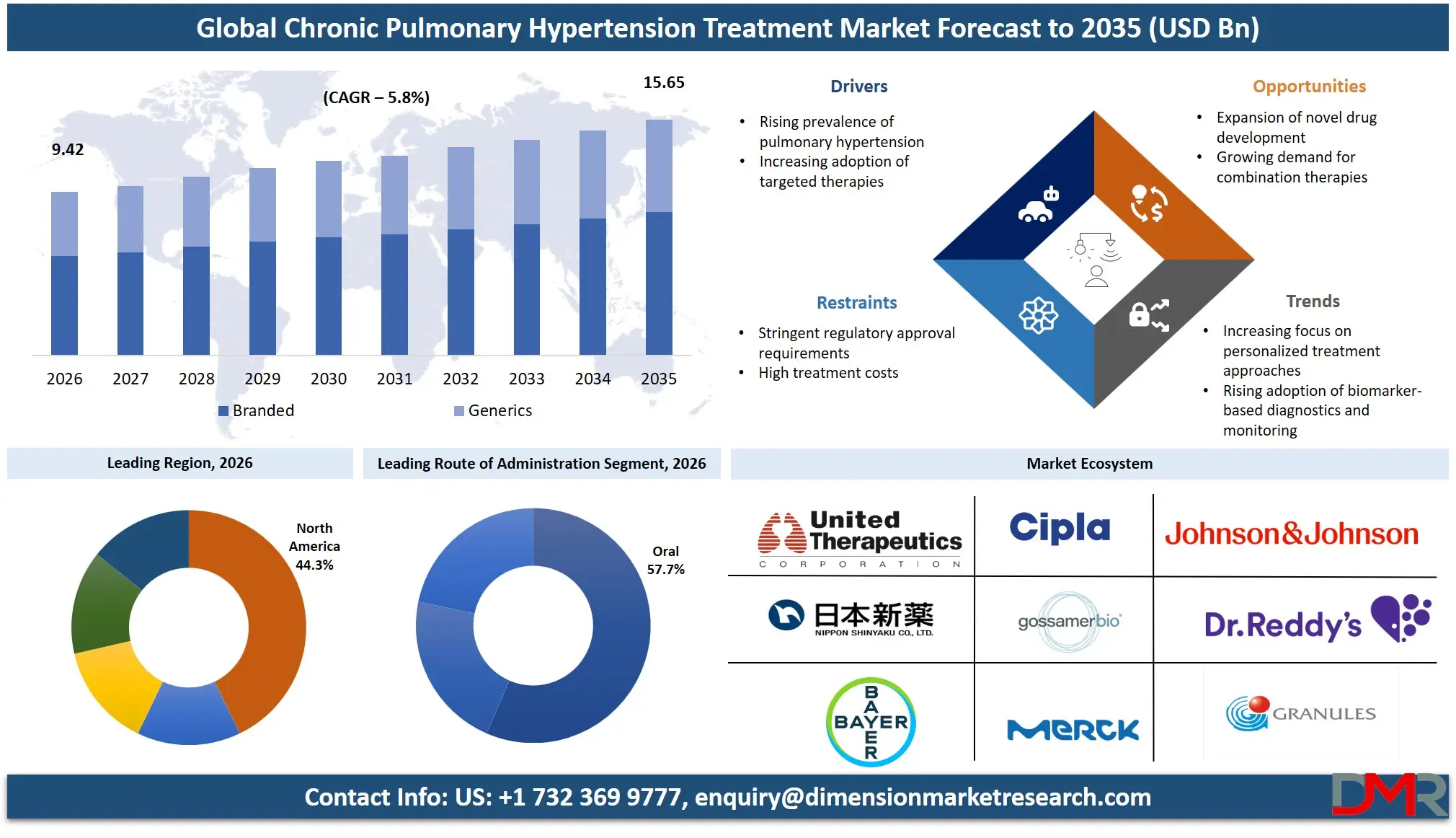
The Global Chronic Pulmonary Hypertension Treatment Market covers pharmaceutical therapies and interventional approaches used to manage elevated pulmonary arterial pressure across multiple etiologies. Drug classes in scope include Prostacyclin and Prostacyclin Analogs, Endothelin Receptor Antagonists, PDE-5 Inhibitors, SGC Stimulators, and Smad-signaling modulators. Administration routes span oral, intravenous or subcutaneous, and inhalational formats. The market was valued at USD 8.9 Billion in 2025 and carries structural characteristics that separate it from mainstream pharmaceutical markets.
ℹ
To learn more about this report –
Download Your Free Sample Report Here
Chronic pulmonary hypertension is progressive and incurable, which means diagnosed patients remain on therapy indefinitely. That treatment permanence, combined with specialist gatekeeping and titrated dosing requirements, sustains a premium pricing environment. Branded drugs commanding an 88.72% share despite decades of approved therapies reflects exactly this dynamic: physicians managing a rare, life-threatening disease do not switch to generics without strong bioequivalence confidence, and payers in most markets have historically accommodated branded pricing for ultra-orphan conditions.
The treatment paradigm is shifting from hemodynamic symptom control to vascular disease modification. University of Maryland School of Medicine data shows hospitalization affected 50% of placebo patients compared with 9% under sotatercept, a 41 percentage point absolute reduction. That outcome gap signals that a new clinical performance benchmark is now established, and older drug classes face long-term commercial pressure from agents that can demonstrate this level of disease modification rather than symptom management alone.
Key Takeaways
- The Chronic Pulmonary Hypertension Treatment Market size is USD 8.9 Billion in 2025, reached USD 9.42 Billion in 2026, and is projected to hit USD 15.65 Billion by 2035 at a CAGR of 5.8%.
- By Drug Class, Prostacyclin and Prostacyclin Analogs leads with a 48.27% revenue share in 2026.
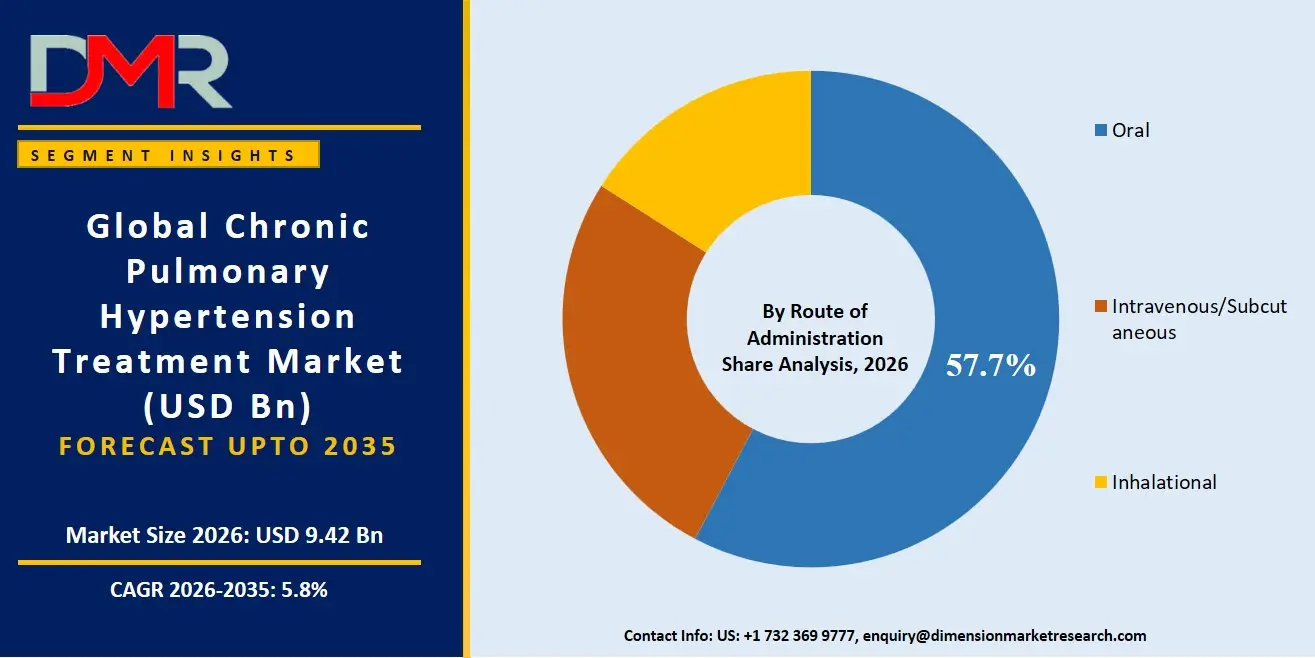
- By Route of Administration, Oral therapies hold a 57.72% share, reflecting the physician preference for patient-friendly long-term dosing.
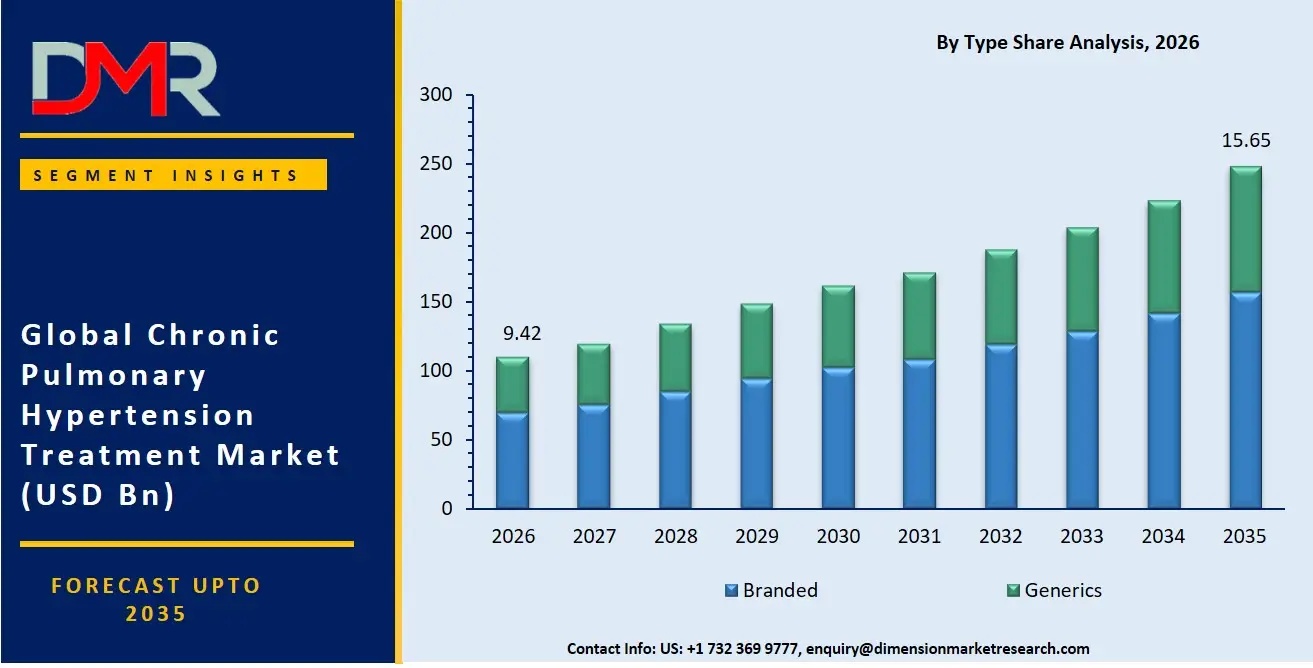
- By Type, Branded drugs account for 88.72% of the market, signaling limited generic penetration to date.
- By Distribution Channel, Hospital Pharmacies hold a 59.31% share, consistent with the specialist-managed nature of PAH therapy initiation.
- By Patient Cohort, Congenital Heart Disease (CHD) Survivor Cohort accounts for 49.27% of the market.
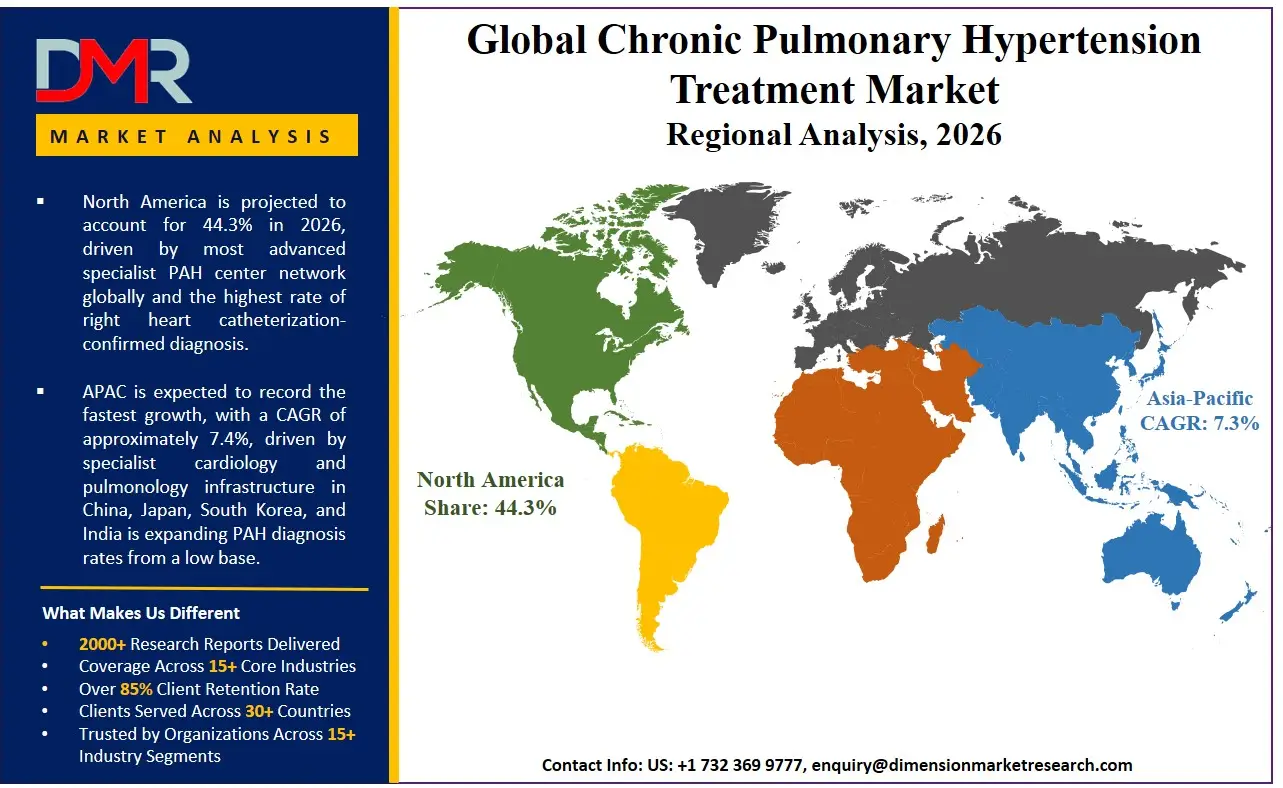
- North America is the dominant region with a 44.30% revenue share in 2026.
Market Size and Forecast
The Global Chronic Pulmonary Hypertension Treatment Market size is estimated at USD 9.42 Billion in 2026 from USD 8.9 Billion in 2025, and is projected to reach USD 15.65 Billion by 2035, exhibiting a CAGR of 5.8% during the forecast period.
The 5.8% CAGR reflects price-mix improvement rather than patient volume expansion alone. Patients shifting from older vasodilator monotherapy to combination regimens anchored by newer agents carry substantially higher per-patient revenue. As reported by Merck, sotatercept improved six-minute walk distance by 40.8 meters from baseline at week 24, with a 95% confidence interval of 27.5 to 54.1 meters. That functional improvement is a commercially actionable endpoint: it supports payer justification, reinforces prescriber confidence, and provides the clinical narrative that sustains premium pricing across the forecast window.
The primary downside risk to the forecast is reimbursement restriction. Annual combination PAH regimen costs exceed six figures in most developed markets. Health technology assessment bodies in Europe and select Asia-Pacific countries are pushing back on coverage without robust real-world outcomes data, which could delay uptake of premium agents and compress near-term revenue growth below the 5.8% baseline. Aging demographics provide a modest upside offset, as CHD survivors and connective tissue disorder patients reach ages where pulmonary hypertension complications emerge, expanding the diagnosed patient base organically through the forecast period.
Drug Class Analysis
Prostacyclin and Prostacyclin Analogs led the Drug Class segment with a 48.27% share in 2026.
Prostacyclins are the only drug class with demonstrated survival benefit across all PAH functional classes, making them the non-negotiable backbone of combination regimens in high-risk patients. Inhaled and intravenous delivery formats command premium pricing. The FDA approval of YUTREPIA in May 2025 expands the addressable patient pool further by offering a more tolerable inhalation powder alternative that removes the barrier of continuous intravenous infusion.
Endothelin Receptor Antagonists function as oral anchor agents in combination regimens, pairing with prostacyclins to block the endothelin pathway. A 2025 post-marketing pharmacovigilance analysis reported by PMC/NCBI found an adverse event incidence of 52.22% for ambrisentan in real-world PAH management in South Korea, a data point that reinforces why physician-monitored initiation within specialist centers remains the standard for this class. PDE-5 Inhibitors are the most cost-accessible oral option, positioning them as the dominant entry point in price-sensitive markets and as the credible generic threat over the forecast period. SGC Stimulators represent the fastest-moving pipeline category, with riociguat already approved and next-generation molecules advancing in trials. Smad-signaling modulators are the most consequential emerging class: their vascular remodeling mechanism places them in a premium therapeutic tier above existing combination therapy, which means they compete on a different clinical axis rather than displacing established agents directly.
Route of Administration Analysis
With a 57.72% share in 2026, Oral administration outpaced all other Route of Administration categories.
ℹ
To learn more about this report –
Download Your Free Sample Report Here
Oral agents reduce infection risk, care burden, and quality-of-life disruption associated with continuous parenteral therapy. Physicians and patients managing a chronic, lifelong condition default to oral formats for stable patients across functional classes II and III. Convenience translates directly into adherence, which in this disease area translates into measurable clinical outcomes and sustained commercial revenue.
Intravenous and subcutaneous administration retains a critical role in high-risk and advanced-disease patients where oral bioavailability and speed of action are insufficient. Inhalational delivery is the format gaining the most clinical interest. YUTREPIA's 2025 approval confirms that regulators and physicians accept inhaled prostacyclins as a viable route with a manageable safety profile. As next-generation inhaled formulations reach approval, this sub-segment will take share from intravenous delivery in moderate-risk patients and from oral delivery in those requiring prostacyclin-class efficacy without infusion burden.
Type Analysis
Branded drugs accounted for 88.72% of Type segment demand in 2026, the highest of any category.
ℹ
To learn more about this report –
Download Your Free Sample Report Here
Physicians treating a rare, life-threatening disease with heterogeneous subtypes are slow to switch to generics without robust bioequivalence confidence. That clinical caution preserves branded pricing power well beyond what is typical in larger therapeutic areas. Newer agents entering the market on patent protection, including sotatercept and YUTREPIA, face no credible generic competition before 2035, insulating the premium tier through the full forecast window.
Generics hold the remaining 11.28% and are concentrated in older PDE-5 inhibitors such as sildenafil and tadalafil. Generic penetration will expand modestly as ERA patents expire, but the structural shift toward combination regimens anchored by patented agents limits the ceiling for substitution. Generic manufacturers exert pricing pressure only in the most cost-sensitive markets and distribution channels, leaving the commercial center of gravity firmly with branded players.
Distribution Channel Analysis
A 59.31% share made Hospital Pharmacies the clear leader across Distribution Channel categories in 2026.
PAH diagnosis requires right heart catheterization and specialist confirmation. The first prescription almost always originates within a hospital or specialist center, making hospital pharmacies the natural dispensing point for high-cost branded agents that require patient education and monitoring protocols. Retail Pharmacies serve stable patients on established oral regimens who no longer require frequent specialist visits. Online Pharmacies are a growing channel for oral agents in markets where specialty pharmacy networks are expanding, though regulatory restrictions on dispensing high-risk PAH drugs through unspecialized channels constrain this segment's near-term growth rate.
Patient Cohort Indication Analysis
Congenital Heart Disease (CHD) Survivor Cohort captured 49.27% of the Patient Cohort Indication segment in 2026, ahead of all rivals.
Advances in pediatric cardiac surgery have created a large and growing population of CHD survivors who develop pulmonary hypertension as a long-term complication, often decades after their initial procedure. This cohort is younger on average than idiopathic PAH patients, which means longer treatment duration per patient and a higher lifetime revenue value per diagnosed case. Manufacturers targeting this cohort benefit from a structurally longer commercial relationship per patient than any other PAH subgroup.
Connective Tissue Disorders Associated PH and Scleroderma-Associated Systemic PH patients carry the most complex and refractory disease profiles. Poor prognosis under standard vasodilator therapy makes these groups the primary target population for disease-modifying agents like sotatercept. The Idiopathic/Hereditary PAH cohort, while historically the most studied, is the smallest by current revenue share. Diagnostic reclassification through genetic testing has shifted some cases into the hereditary subcategory, fragmenting what was once a single commercial segment and spreading revenue across a more granular patient taxonomy.
Key Market Segments
By Drug Class
- Prostacyclin and Prostacyclin Analogs
- Endothelin Receptor Antagonists (ERAs)
- PDE-5 Inhibitors
- SGC Stimulators
- Smad-signaling modulators
By Route of Administration
- Oral
- Intravenous/Subcutaneous
- Inhalational
By Type
By Distribution Channel
- Hospital Pharmacies
- Retail Pharmacies
- Online Pharmacies
By Patient Cohort Indication
- Congenital Heart Disease (CHD) Survivor Cohort
- Connective Tissue Disorders Associated PH
- Scleroderma-Associated Systemic PH
- Idiopathic/Hereditary PAH
Regional Analysis
North America held a dominant position with a 44.30% revenue share in 2026, generating the largest absolute revenue of any region in the Global Chronic Pulmonary Hypertension Treatment Market.
ℹ
To learn more about this report –
Download Your Free Sample Report Here
The United States has the most advanced specialist PAH center network globally and the highest rate of right heart catheterization-confirmed diagnosis. FDA approval timelines for novel agents like sotatercept and YUTREPIA translate into commercial revenue quarters before European or Asian market entry. Payer systems in North America, despite access barriers, reimburse branded therapies at a scale no other region matches, which locks in the region's revenue leadership through the forecast period.
Europe holds the second-largest revenue position, though health technology assessment processes in Germany, France, and the UK create meaningful price compression on branded agents after launch. Asia Pacific is the fastest-growing regional market over the forecast period. Specialist cardiology and pulmonology infrastructure in China, Japan, South Korea, and India is expanding PAH diagnosis rates from a low base. Japan is particularly notable: findings from the 2025 RACE trial, as reported by SOLACI, showed that balloon pulmonary angioplasty produced greater reduction in right ventricular afterload than riociguat and was the only strategy delivering statistically significant improvements in right ventricular function, confirming Japan's procedural-led model supports adjacent pharmacological therapy volumes. Latin America and Middle East and Africa remain underpenetrated relative to their PAH disease burden, constrained by absent or highly restricted reimbursement frameworks for ultra-orphan drugs. These regions represent a long-term volume opportunity, but near-term revenue contribution will remain modest within the forecast window.
Key Regions and Countries
North America
Europe
- Germany
- France
- The UK
- Spain
- Italy
- Rest of Europe
Asia Pacific
- China
- Japan
- South Korea
- India
- Australia
- Rest of APAC
Latin America
- Brazil
- Mexico
- Rest of Latin America
Middle East & Africa
- GCC
- South Africa
- Rest of MEA
Market Dynamics
Disease-Modifying Agents Reset the Clinical Standard of Care
Sotatercept targets the underlying vascular remodeling process rather than managing hemodynamics symptomatically. Based on data from the New England Journal of Medicine 2025, death occurred in 15% of PAH patients on placebo versus 8% on sotatercept, a 7 percentage point absolute mortality reduction. A drug that moves the mortality needle by that margin in a rare disease does not compete incrementally. It resets what physicians, payers, and patients expect from any PAH regimen.
Upfront combination therapy is reshaping prescribing at diagnosis. Newly diagnosed patients now receive two or three mechanistically distinct agents simultaneously rather than stepping up through monotherapy. As reported by the American College of Cardiology, riociguat increased resting cardiac output by 0.37 L/min versus a decrease of 0.11 L/min on placebo in the DYNAMIC trial, a net treatment effect of 0.54 L/min. Multi-pathway targeting reduces time to clinical deterioration and lifts per-patient revenue from day one of treatment.
Cost Barriers and Drug Safety Profiles Limit Market Penetration
Annual treatment costs for combination PAH regimens exceed USD 100,000 per patient in the United States. Reimbursement coverage outside North America remains inconsistent. Patients who qualify clinically may never access branded therapy because of payer restrictions, which means the commercial market captures only a fraction of the epidemiological opportunity in price-sensitive regions.
Safety profiles of newer agents add a second constraint. Adverse events occurred in 32.8% of riociguat patients versus 21.4% on placebo in the DYNAMIC trial, as reported by the American College of Cardiology. Separate data from the American College of Cardiology October 2025 ZENITH trial shows epistaxis in 31.9% and telangiectasia in 26.2% of sotatercept-treated patients. These event rates create pharmacovigilance requirements that raise post-market monitoring costs for manufacturers and create hesitancy among prescribers in markets with less robust adverse event management infrastructure.
Precision Subgroups and Digital Monitoring Open New Revenue Channels
PAH is not a single disease. Idiopathic, heritable, connective tissue-associated, and CHD-related subtypes each carry different hemodynamic profiles and treatment responses. Biomarker-driven patient stratification allows manufacturers to design narrower but better-powered trials, achieve faster approvals in defined populations, and justify premium pricing through demonstrated subgroup efficacy. Orphan designation incentives make this approach economically attractive even at small patient volumes.
Remote monitoring platforms, including Apple Watch-based six-minute walk test applications evaluated in 2024 and 2025 PAH studies, allow clinicians to track functional capacity between specialist visits. For device and software companies, recurring monitoring revenue runs alongside drug therapy. For established pharma players, these tools extend commercial reach by improving adherence to high-cost therapies that require consistent use to deliver clinical benefit in real-world practice.
Market Trends
Inhaled Prostacyclins and SGC Stimulators Define the Near-Term Pipeline Race
The near-term pipeline concentrates on two mechanistic categories: soluble guanylate cyclase stimulators with improved safety profiles and inhaled prostacyclin analogs with better tolerability than intravenous formulations. YUTREPIA's 2025 FDA approval confirms that inhaled delivery can expand the prostacyclin-eligible patient pool by removing the infusion barrier. Growing trial investment in pediatric and rare-etiology PAH subgroups signals that manufacturers are building orphan-designated indication franchises that carry pricing power and exclusivity windows structurally harder for generic manufacturers to challenge. Early movers securing pediatric-specific approvals gain exclusivity extensions and access to patient cohorts with longer treatment horizons than adult idiopathic PAH populations.
Market Competition Overview
The Chronic Pulmonary Hypertension Treatment Market is moderately consolidated at the top. A small number of large-cap pharmaceutical companies hold the majority of branded revenue through patented agents across multiple drug classes. The competitive strategy at the top tier centers on owning the full treatment algorithm rather than a single molecule. Companies build portfolios spanning prostacyclins, ERAs, and Smad-signaling modulators to capture the per-patient combination regimen, making it structurally difficult for single-asset entrants to displace incumbents at the prescribing level.
The mid-tier is fragmented and pipeline-dependent. Several smaller biotech companies have advanced single assets into late-stage development in niche PAH subgroups, including inhaled on-demand therapies and gene-based approaches targeting vascular remodeling. These players carry binary outcome risk: approval creates high-value niche revenue, while trial failure removes them from commercial competition entirely. The generic segment remains peripheral, constrained to older PDE-5 inhibitors and exerting price pressure only in cost-sensitive markets. No generic player has a credible pathway to the premium disease-modifying tier before 2035.
Company Profiles
United Therapeutics holds a foundational position through its prostacyclin franchise, spanning intravenous, subcutaneous, oral, and inhaled delivery formats. Its strategy centers on formulation innovation rather than new molecular discovery: the company extends the commercial life of treprostinil by creating delivery systems that address tolerability barriers across patient segments. Formulation and device patents extend exclusivity beyond the core molecule, preserving pricing power after the primary patent expires. The competitive risk is direct: an inhaled prostacyclin with a superior tolerability profile, such as YUTREPIA from Liquidia Corporation, can challenge the market share of United Therapeutics' existing inhalation products without requiring a new drug class or therapeutic mechanism.
Merck entered a new competitive tier when the U.S. FDA granted WINREVAIR (sotatercept-csrk) an updated indication in October 2025, covering reduction of clinical worsening events including hospitalization, lung transplantation, and death. Sotatercept's activin-signaling mechanism places Merck in a category of one within the current approved PAH landscape. No current competitor can match its head-to-head efficacy data on a disease-modification basis. The strategic challenge is sustaining premium pricing outside the United States: health technology assessors in Europe and Asia Pacific will require real-world outcomes data before granting broad access, and Merck's ability to navigate those processes will define the long-term revenue ceiling for this asset globally.
Key Players
- United Therapeutics
- Johnson & Johnson
- Bayer
- Merck
- Nippon Shinyaku
- Liquidia Technologies
- Gossamer Bio
- Respira Therapeutics
- Pharmosa Biopharm
- DelveInsight
- Insmed Incorporated
- Cereno Scientific
- AllRock Bio
- Inhibikase Therapeutics
- Tenax Therapeutics
- Lupin
- Dr. Reddy's Laboratories
- Cipla
- Granules India
Supply Chain and Value Chain Analysis
The value chain spans from active pharmaceutical ingredient synthesis through specialist dispensing, with value creation concentrated at the branded drug and specialty pharmacy layers. API manufacturing for prostacyclin analogs requires complex multi-step synthesis under tightly controlled conditions, limiting the supplier base and creating upstream concentration risk. Inhalation device components add a secondary supply dependency for inhaled formulations, where device manufacturer relationships carry strategic importance equal to the drug molecule itself.
The highest margin capture occurs at the branded manufacturer level, where proprietary formulation patents and regulatory exclusivity insulate pricing. Hospital pharmacies, holding a 59.31% distribution share, function as controlled access points that reinforce specialist oversight of high-cost therapies. They also create reimbursement bottlenecks when payer authorization processes delay dispensing. Prior authorization requirements for branded PAH agents in the United States routinely delay therapy initiation by weeks, creating a gap between clinical diagnosis and commercial revenue recognition that manufacturers cannot fully control.
Regulatory Landscape
The U.S. FDA remains the most commercially consequential regulatory authority in Chronic Pulmonary Hypertension Treatment Market. Two approvals in 2025 confirm the agency's willingness to move decisively on well-powered PAH data. WINREVAIR received an updated indication in October 2025 covering reduction of clinical worsening events, and YUTREPIA received full approval in May 2025 for PAH and pulmonary hypertension associated with interstitial lung disease. The FDA's orphan drug designation pathway applies to most PAH subtypes, shortening review timelines and granting seven-year post-approval market exclusivity. For manufacturers, this structure rewards first-in-class assets with a protected commercial window that justifies the high cost of late-stage PAH trials.
Outside the United States, the European Medicines Agency and national health technology assessment bodies including NICE in the UK and G-BA in Germany apply value-based scrutiny after marketing authorization. Price negotiation processes following EMA approval can take 12 to 24 months and result in reimbursed prices significantly below U.S. levels. Asia Pacific adds a further layer of country-specific registration requirements: Japan's PMDA and China's NMPA each run independent review processes that add 18 to 36 months to ex-U.S. launch timelines. Manufacturers with strong phase 3 data, as sotatercept demonstrates, hold a better health economics argument in these processes but still face structural delays that defer non-U.S. revenue recognition well into the forecast period.
Investment and White Space Analysis
Current investment concentrates in two areas: disease-modifying biologics targeting vascular remodeling and next-generation inhaled delivery systems for prostacyclin-class agents. GSK's April 2026 acquisition of 35Pharma, adding HS235, an investigational activin-signaling inhibitor, to its cardiopulmonary pipeline confirms that large-cap players are willing to pay acquisition premiums to enter the Smad-signaling modulator space alongside Merck. The activin pathway is now viewed as a validated commercial target, which will attract further deal activity around mechanistically similar assets in late-stage development.
The clearest white space sits in pediatric PAH and Asia Pacific. Pediatric PAH has historically been treated off-label with adult-labeled drugs, creating a regulatory and commercial gap that orphan designation incentives are beginning to close. Companies securing pediatric-specific approvals gain exclusivity extensions and access to a patient cohort with a longer treatment horizon than adult idiopathic PAH populations. India and Southeast Asia represent a regional white space where PAH diagnosis rates are rising as echocardiography infrastructure improves, but branded therapy penetration remains constrained by reimbursement gaps. Generic manufacturers already present in these markets are positioned to capture volume at price points that large-cap Western manufacturers will not compete at directly.
Recent Developments
- June 2025: Liquidia Corporation commenced the commercial launch of YUTREPIA following FDA approval, marking its entry into the pulmonary hypertension treatment market as a direct competitor to established inhaled prostacyclin products.
- May 2025: Liquidia Corporation received U.S. FDA approval for YUTREPIA (treprostinil) inhalation powder for patients with PAH and pulmonary hypertension associated with interstitial lung disease, expanding the approved inhaled prostacyclin option set available to prescribers.
- September 2025: Gossamer Bio entered an option agreement to acquire Respira Therapeutics and its lead candidate RT234, an inhaled on-demand therapy for pulmonary hypertension including PAH and PH-ILD, signaling continued mid-tier consolidation around inhaled delivery mechanisms.
Report Details
| Report Characteristics |
| Market Value (2025) |
USD 8.9 Billion |
| Market Value (2026) |
USD 9.42 Billion |
| Forecast Revenue (2035) |
USD 15.65 Billion |
| CAGR (2026–2035) |
5.8% |
| Base Year for Estimation |
2025 |
| Historic Period |
2020 – 2024 |
| Forecast Period |
2026 – 2035 |
| Report Coverage |
Revenue Forecast, Market Dynamics, Competitive Landscape, Recent Developments |
| Segments Covered |
By Drug Class (Prostacyclin and Prostacyclin Analogs, Endothelin Receptor Antagonists, PDE-5 Inhibitors, SGC Stimulators, Smad-signaling Modulators), By Route of Administration (Oral, Intravenous/Subcutaneous, Inhalational), By Type (Branded, Generics), By Distribution Channel (Hospital Pharmacies, Retail Pharmacies, Online Pharmacies), By Patient Cohort Indication (Congenital Heart Disease Survivor Cohort, Connective Tissue Disorders Associated PH, Scleroderma-Associated Systemic PH, Idiopathic/Hereditary PAH) |
| Regional Analysis |
North America – US and Canada; Europe – Germany, France, The UK, Spain, Italy, and Rest of Europe; Asia-Pacific – China, Japan, South Korea, India, Australia, and Rest of APAC; Latin America – Brazil, Mexico, and Rest of Latin America; Middle East & Africa – GCC, South Africa, and Rest of MEA |
| Competitive Landscape |
United Therapeutics, Johnson & Johnson, Bayer, Merck, Nippon Shinyaku, Liquidia Technologies, Gossamer Bio, Respira Therapeutics, Pharmosa Biopharm, DelveInsight, Insmed Incorporated, Cereno Scientific, AllRock Bio, Inhibikase Therapeutics, Tenax Therapeutics, Lupin, Dr. Reddy's Laboratories, Cipla, Granules India |
| Customization Scope |
Customization for segments and region or country level will be provided. Additional customization can be done based on requirements. |
| Purchase Options |
Three license options: Single User License, Multi-User License (Up to 5 Users), Corporate Use License (Unlimited Users and Printable PDF). |
Frequently Asked Questions
What is the biggest investment opportunity in Chronic Pulmonary Hypertension Treatment Market?
▾ The activin-signaling modulator class represents the highest-value investment target. Sotatercept's phase 3 data showed an 84% reduction in composite clinical worsening versus placebo, a benchmark that draws capital toward assets in this mechanistic category. GSK's April 2026 acquisition of 35Pharma for its investigational activin inhibitor HS235 confirms that strategic acquirers have already reached the same conclusion.
Who are the top companies in Chronic Pulmonary Hypertension Treatment Market?
▾ United Therapeutics and Merck hold the strongest current commercial positions. United Therapeutics owns the broadest prostacyclin franchise across multiple delivery formats. Merck holds a category-defining advantage with sotatercept, the only approved disease-modifying agent targeting vascular remodeling in PAH.
Which segment is growing fastest in Chronic Pulmonary Hypertension Treatment Market and why?
▾ Smad-signaling modulators are the fastest-moving drug class segment. Sotatercept's approval establishes a new efficacy ceiling with an 84% risk reduction in composite clinical worsening events, positioning this class to capture an expanding share of combination regimens. No other approved class competes on the same disease-modifying axis.
Which region is growing fastest in Chronic Pulmonary Hypertension Treatment Market and why?
▾ Asia Pacific is the fastest-growing region over the 2026 to 2035 forecast period. Expanding specialist cardiology and pulmonology infrastructure in China, Japan, South Korea, and India is increasing confirmed PAH diagnosis rates from a low base. Japan's established balloon pulmonary angioplasty program for CTEPH further supports procedural and pharmacological therapy volume growth across the region.
What is the biggest challenge holding Chronic Pulmonary Hypertension Treatment Market back?
▾ Reimbursement access is the primary constraint on market growth. Annual costs for combination PAH regimens exceed six figures in most developed markets, and payers outside North America apply health technology assessment processes that delay or restrict coverage of premium agents. This gap between clinical eligibility and commercial access limits the revenue manufacturers can extract from the full diagnosed patient population.