What is the Cloud Professional Services Market ?
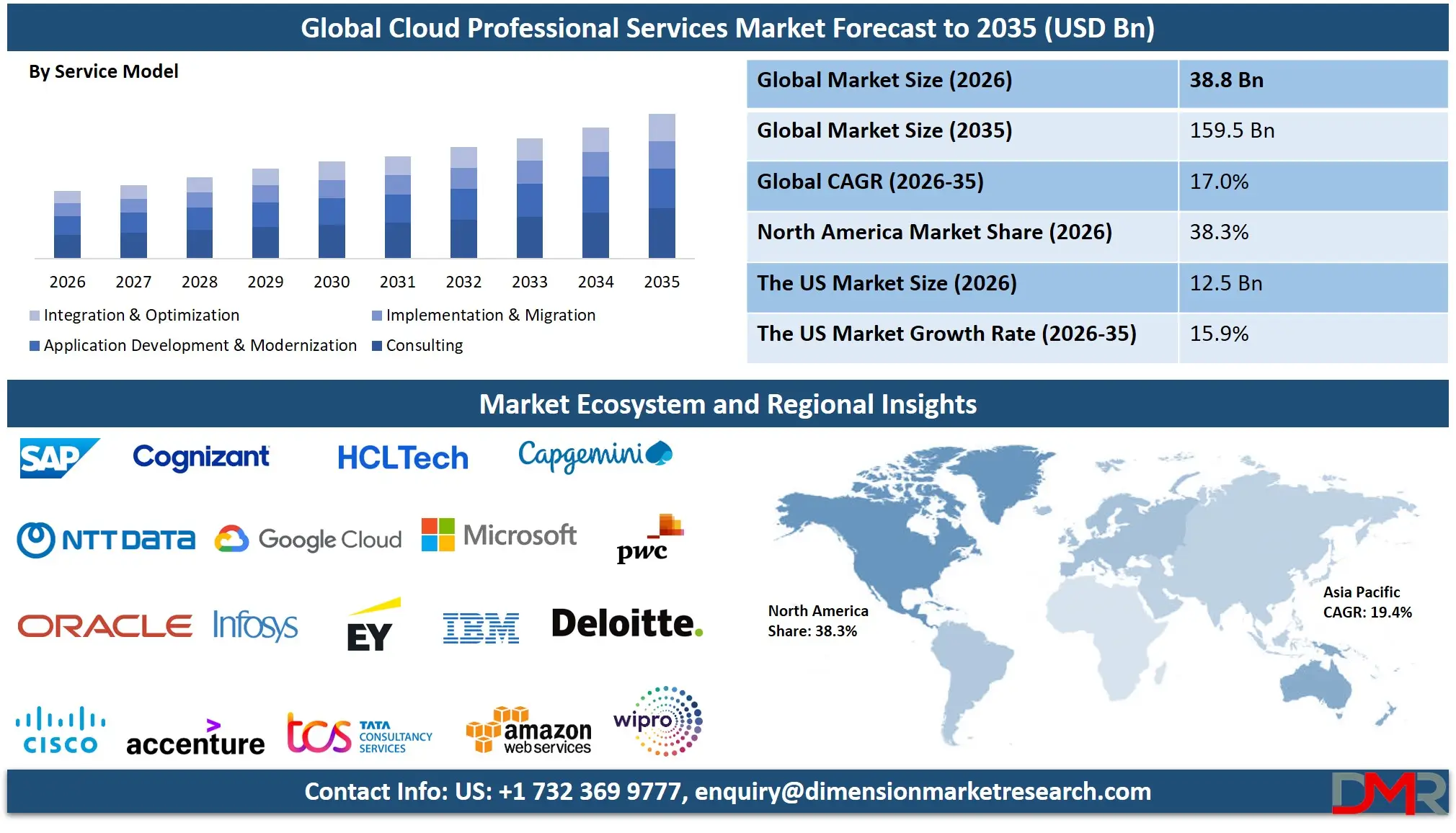
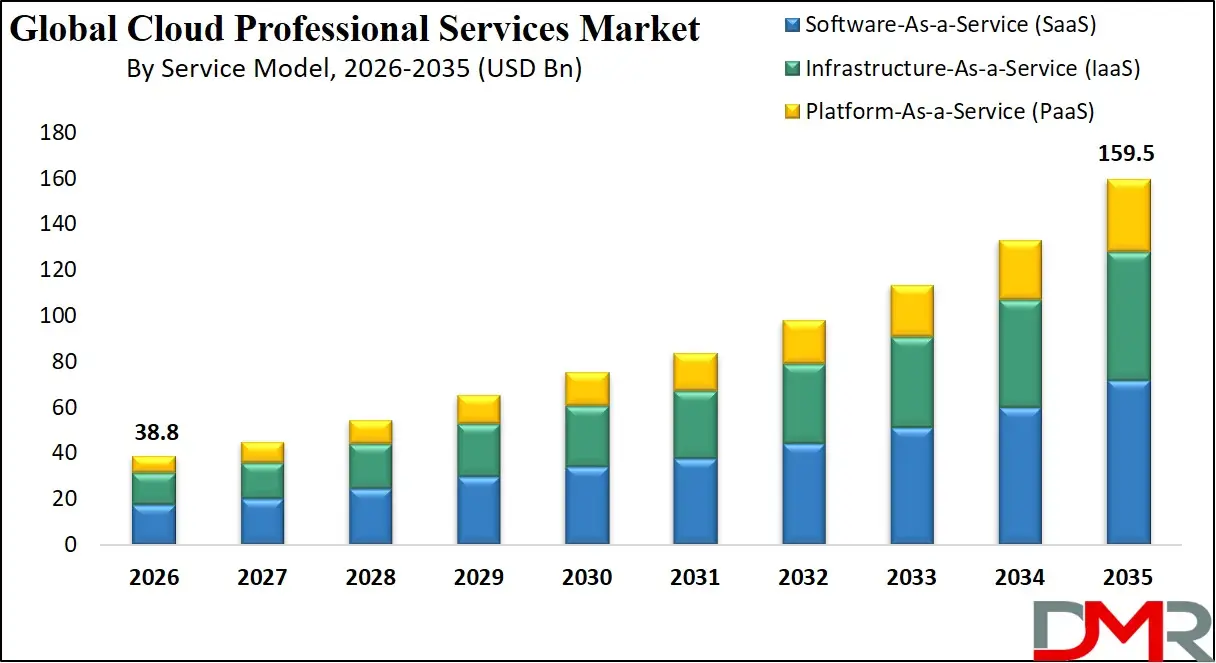
The Global Cloud Professional Services Market is expected to reach a value of USD 38.8 billion in 2026, and it is further anticipated to reach USD 159.5 billion by 2035, growing at a CAGR of 17.0% during the forecast period. The cloud professional services market has been growing at a high rate with enterprises increasing the pace of digital transformation and transitioning out of legacy infrastructure to cloud-based infrastructure.
ℹ
To learn more about this report –
Download Your Free Sample Report Here
The market consists of consulting, migration, integration, modernization, and managed services which assist organizations to migrate to public, private, and hybrid clouds. The increasing demand to implement multi-cloud architecture, cloud-native applications, cybersecurity and AI-driven workloads is driving the necessity of specialized professional services.
Enterprises are the most frequent adopters, with SaaS and public cloud remaining to be the most popular because of their scalability and affordability. The BFSI, healthcare, telecom and manufacturing industries are key players as they need secure, compliant and highly available cloud ecosystems.
ℹ
To learn more about this report –
Download Your Free Sample Report Here
The US Cloud Professional Services Market
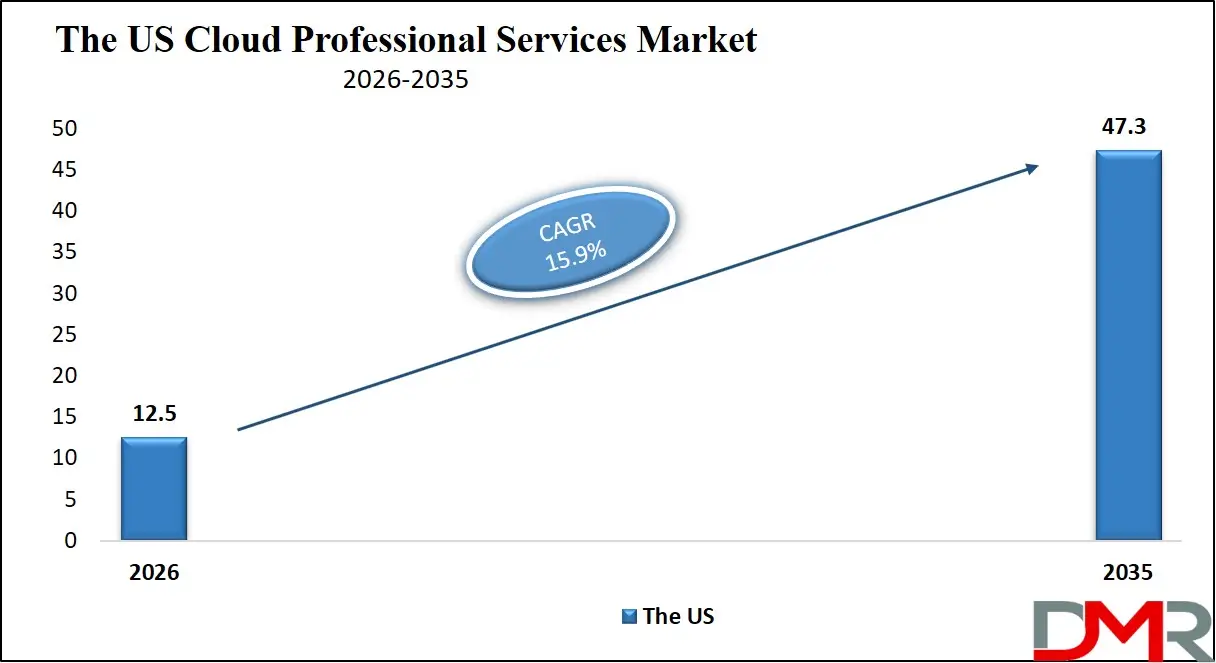
The US Cloud Professional Services Market is projected to reach USD 12.5 billion in 2026 at a compound annual growth rate of 15.9% over its forecast period, culminating in a value of USD 47.3 billion by 2035.
ℹ
To learn more about this report –
Download Your Free Sample Report Here
The US continues to be the largest and most developed market in cloud professional services due to the active modernization efforts of Fortune 500 companies and the growing distribution of hyperscale data centers. The market has been typified by high demand on Application modernization services whereby organizations are aimed at refactoring monolithic legacy applications into cloud native microservices. Besides, the implementation of Generative AI tools in cloud workflows is producing a similar need in Risk & Compliance Consulting services to regulate data governance and AI ethics frameworks on the cloud.
The Europe Cloud Professional Services Market
The Europe Cloud Professional Services Market is estimated to be valued at USD 11.2 billion in 2026 and is further anticipated to reach USD 44.8 billion by 2035 at a CAGR of 16.6%. The regulatory frameworks including GDPR and the upcoming EU AI Act have a significant impact on the European market and drive the need to employ Risk & Compliance Consulting and sovereign clouds. Accelerated growth of Hybrid Cloud deployment services is also being experienced in the region as manufacturing and automotive industries in Germany and France are trying to strike a balance in operational technology (OT) security with cloud-based analytics. In addition, efforts such as GAIA-X are challenging service providers to create dedicated Data Migration Services to provide data residency and interoperability across European cloud ecosystems.
The Japan Cloud Professional Services Market
The Japan Cloud Professional Services Market is projected to be valued at USD 4.1 billion in 2026. It is further expected to witness robust growth, holding USD 14.8 billion in 2035 at a CAGR of 15.3%. The Japanese market is unique, with a corporate drive to Digital Transformation (DX) in response to declining workforce and outdated IT infrastructure. Business Transformation Consulting and Implementation & Migration services make up a large part of the spending as large conglomerates migrate mission-critical workloads off on-premise mainframes to the cloud. There is also a strong need to integrate deeply in the local market to bridge the gaps between the old Electronic Medical Record (EMR) systems and industrial control systems to the new SaaS systems, which forms a niche in API Integration and Workflow Automation.
Key Takeaways
- Market Size & Forecast: The Global Cloud Professional Services market is projected to reach USD 38.8 billion in 2026, expanding dramatically to USD 159.5 billion by 2035, fueled by the dual drivers of enterprise AI adoption and the mandatory modernization of aging IT infrastructure.
- Growth Rate & Outlook: Global market growth is expected at a CAGR of 17.0%, driven by a critical shortage of in-house cloud architects and the escalating complexity of managing Kubernetes environments and FinOps (Cloud Financial Management).
- Primary Growth Drivers: Key forces include the widespread migration from capital expenditure (CapEx) data centers to operational expenditure (OpEx) cloud models, the need for Cloud Strategy Consulting to avoid costly misconfigurations, and the integration of DevOps pipelines requiring specialized Application Development & Modernization skills.
- Key Market Trends: Major trends include the rise of industry-specific cloud solutions (e.g., Healthcare Cloud, Finance Cloud), the use of AI-powered tools within Integration & Optimization services to auto-remediate performance issues, and the shift toward Risk & Compliance Consulting as boards prioritize cloud data sovereignty.
- By Deployment Model Analysis: Public Cloud models are expected to dominate enterprise discussions due to data gravity and regulatory constraints. Professional services are increasingly required to build seamless API Integration layers that connect on-premise private clouds with public cloud innovation engines.
- By Industry Vertical Analysis: BFSI (Banking, Financial Services, and Insurance) and Healthcare & Life Sciences are the most lucrative verticals due to stringent compliance needs. Manufacturing is the fastest-growing sector as industrial IoT data requires robust Data Migration Services and edge-to-cloud architecture.
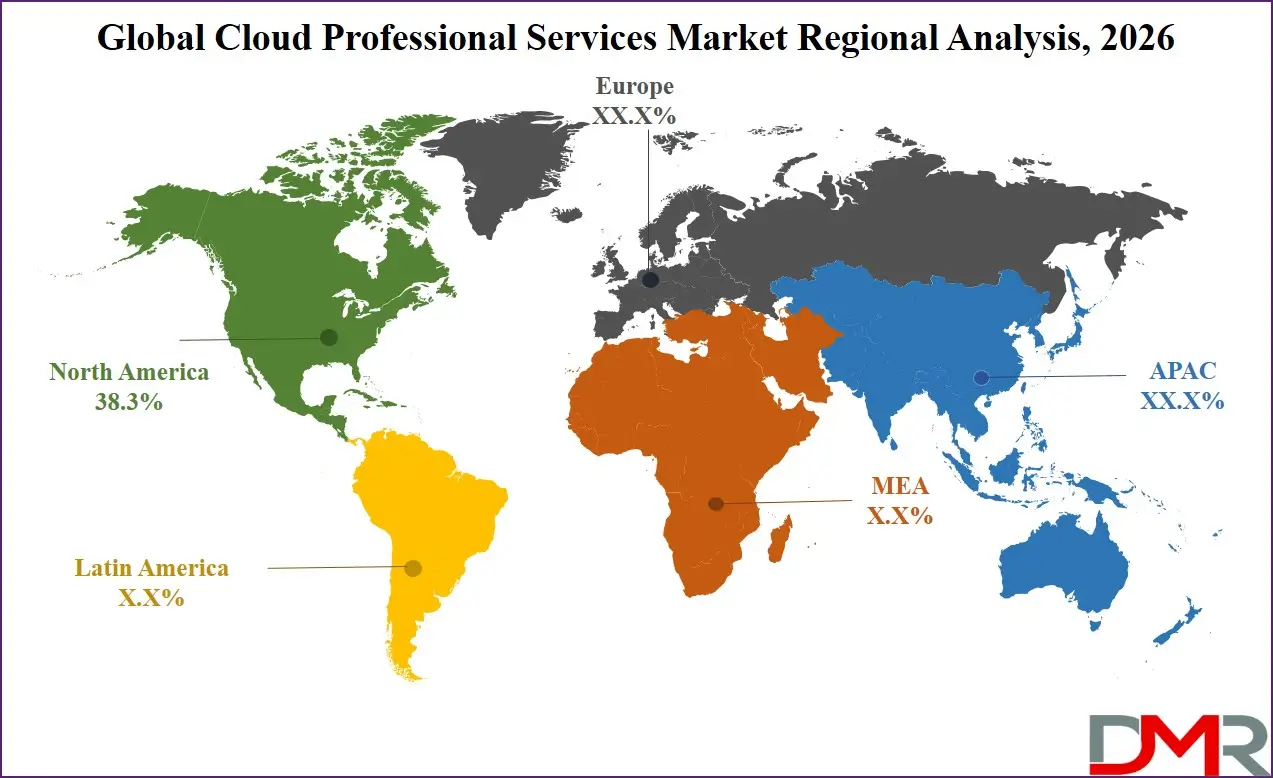
- Regional Leadership: North America is poised to dominate this market with 38.3% of the market share in 2026 due to its well-developed technological ecosystem that utilizes this infrasture to its fullest and makes it a leader in this market.
What is the Cloud Professional Services Market?
Cloud Professional Services are the specialized advisory and technical implementation services that are offered by the third-party experts, systems integrators and consultancy to assist organizations to go through the whole cloud lifecycle. These services, unlike cloud consumption (the software or infrastructure itself) are related to the how of cloud adoption. This involves Consulting to establish a strategic roadmap and business case to adopt the cloud, Implementation and Migration to relocate data and applications physically without disrupting business, and Integration and Optimization to make sure that cloud systems can effectively communicate with the existing on-premise tools. With 90% of organizations running multi-cloud environments, professional services are needed to achieve cost governance, security posture, and performance tuning, making cloud investments translate into a tangible business agility, as opposed to technical complexity.
Use Cases
- Legacy Mainframe Modernization in Banking: Banking institutions hire the Application Development and Modernization services to re-write COBOL-based core banking applications into microservices based on Java or Python that can be run on the cloud, providing real-time transaction processing and open banking APIs.
- GenAI Data Readiness in Healthcare: Hospital networks use Data Migration Services and Risk and Compliance Consulting to migrate petabytes of imaging data to a HIPAA compliant cloud storage, and prepare the data estate to be trained on AI-driven diagnostic models.
- Sovereign Cloud Navigation in Government: Government agencies use Cloud Strategy Consulting to deploy architectures that comply with stringent data residency legislation, so that citizen data does not leave the country, but uses the scalable cloud resources.
- Hybrid Manufacturing Edge Integration: Global manufacturers use API Integration and Workflow Automation services to integrate factory floor PLCs (Programmable Logic Controllers) with cloud-based ERP systems and then provide predictive maintenance and real-time visibility of the supply chain.
How AI is Transforming the Cloud Professional Services Market
AI is changing the cloud professional services by accelerating the process of modernizing applications, as well as enhancing operational efficiency. In Application Development & Modernization, AI-based refactoring tools have the potential to automatically transform legacy code into cloud-native architectures, greatly minimizing the amount of manual work and migration timelines, and project risk. Meanwhile, AI-powered features in Integration & Optimization allow businesses to better control cloud expenditures by detecting suspicious costs, predicting and determining future usage, and suggesting measures like reserved instance purchases to reinforce FinOps methods.
Governance and business transformation projects are also revolving around AI. In the area of consulting services, intelligent compliance-monitoring agents are used to continuously check multi-cloud environments and identify security deficiencies, configuration flaws, and policy breaches to keep organizations in line with frameworks like SOC 2 and ISO 27001. Moreover, generative AI assistants are complementing business transformation consulting by simulating process changes and modelling future business processes to give stakeholders a visualization of the change in business before committing technical resources.
Market Dynamics
Key Drivers in the Global Cloud Professional Services Market
The Global IT Skills Gap
Global organizations are grappling to acquire skilled professionals who have the knowledge of cloud-native solutions like Kubernetes, Terraform, cloud security, and infrastructure automation. The skills are in demand at a faster pace than the number of trained talents which has led to structural shortage in the labour market. This is leading to a trend of enterprises outsourcing professional service providers of clouds rather than depending on in-house employment. These companies assist in essential processes like cloud implementation, migration, configuration, and managed services that are continuously provided. Outsourcing such functions allows organizations to speed up digital transformation initiatives and minimize the chances of delays due to insufficient in-house capacities.
Complexity of Multi-Cloud Architecture
Enterprises of considerable size also tend to have several cloud systems, primarily AWS, Microsoft Azure, and Google Cloud, to ensure that they are not reliant on a single provider but instead provide flexibility. Nonetheless, controlling a multi-cloud environment is very complicated. Organizations need to align identity management, networking, security, compliance and cost optimization on multiple platforms using various tools and standards. This complexity may cause inefficiencies, security gaps and unnecessary expenditure without the guidance of experts. Thus, there is a growing need in the integration and optimization services that can assist enterprises to operate in such environments.
Restraints in the Global Cloud Professional Services Market
Inertia of Legacy Technical Debt
Most businesses still run on old systems that were developed over a long history, and have become highly tailored to their own operations. These outdated systems are a significant obstacle to change, despite cloud adoption potentially delivering more agility and efficiency. It can be costly and risky to migrate large proprietary databases, complex applications, and highly integrated workflows to the cloud. Information migrations that span petabytes of data necessitate a lot of planning, testing, and security. The organizations are afraid of business disruption, loss of data and unforeseen expenses in the transition. Consequently, technical debt decelerates the adoption of the cloud and tends to delay or even block larger-scale digital transformation efforts.
Economic Uncertainty and Budget Scrutiny
Unstable economies and unpredictable business environments have caused organizations to be more hesitant to spend on consulting and technology initiatives. Even though cloud transformation is still a strategic priority, executives are being pressurized to explain every investment and provide measurable business value. The fees and long-term engagement models of professional service providers providing business transformation consulting are more likely to come under increased scrutiny. Businesses have shifted to short, implementation-driven projects that generate quick operational benefits or cost reductions. Long-term strategy and transformation initiatives are more likely to be delayed until the providers can demonstrate a near term payoff. This change is compelling the consulting firms to be more performance-driven and results-oriented.
Growth Opportunities in the Global Cloud Professional Services Market
Cloud-Native AI/ML Platform Building
One of the significant growth opportunities in the cloud professional services market is assisting organizations to create secure, cloud-native artificial intelligence and machine learning environments. A lot of companies have tried using tools such as ChatGPT, but now they desire their own custom platforms that meet their own data, compliance requirements, and workflows. The development of these sophisticated settings involves the specialized skills of application modernization, vector databases, large language models, and AI orchestration frameworks. Cloud service providers are able to assist enterprises to build scalable, personal AI ecosystems that assist automation, analytics, and decision-making. The area has the potential to create high demand of highly specialized consulting and implementation services.
Vertical SaaS Implementation and Integration
The need to integrate both technical skills and understanding of particular industries is driving the growth of professional services as cloud vendors create solutions specific to a particular industry. They are medical-centric cloud solutions, financial solutions clouds, and manufacturing-centric SaaS solutions. Companies within the health care, life sciences and banking sectors are required to adhere to stringent rules and special operation needs. Thus, they require for implementation partners that comprehend the cloud technology and industry compliance framework. To add value, professional service providers may consider integrating vertical SaaS applications with existing systems, aligning with regulations, and tailoring workflows.
Trends in the Global Cloud Professional Services Market
The Rise of Platform Engineering Services
Platform engineering is becoming increasingly adopted in organizations as an alternative to traditional and siloed IT operations. Enterprises are constructing Internal Developer Platforms that deliver self-service tools to developers, rather than having infrastructure, development, and operations run by separate teams, with infrastructure, development, and operations running independently. These platforms enable the ease of deployment of applications, provisioning of infrastructure, and workflow automation. To counter this, cloud professional service vendors are providing knowledge in platform design, DevOps, automation, and performance optimization.
Sustainability Consulting as a Service
Sustainability in the environment is also emerging as a key aspect in cloud decisions as companies are under pressure to achieve ESG objectives and minimize carbon emissions. Businesses are now interested in cloud strategies that help enhance performance and lower costs as well as lessen the environmental impact. This has brought about the need to have GreenOps consulting services. Professional service providers assist organizations in selecting energy efficient cloud regions, resource optimization, workload right-sizing, and waste reduction by underutilized infrastructure.
Research Scope and Analysis
By Service Type Analysis
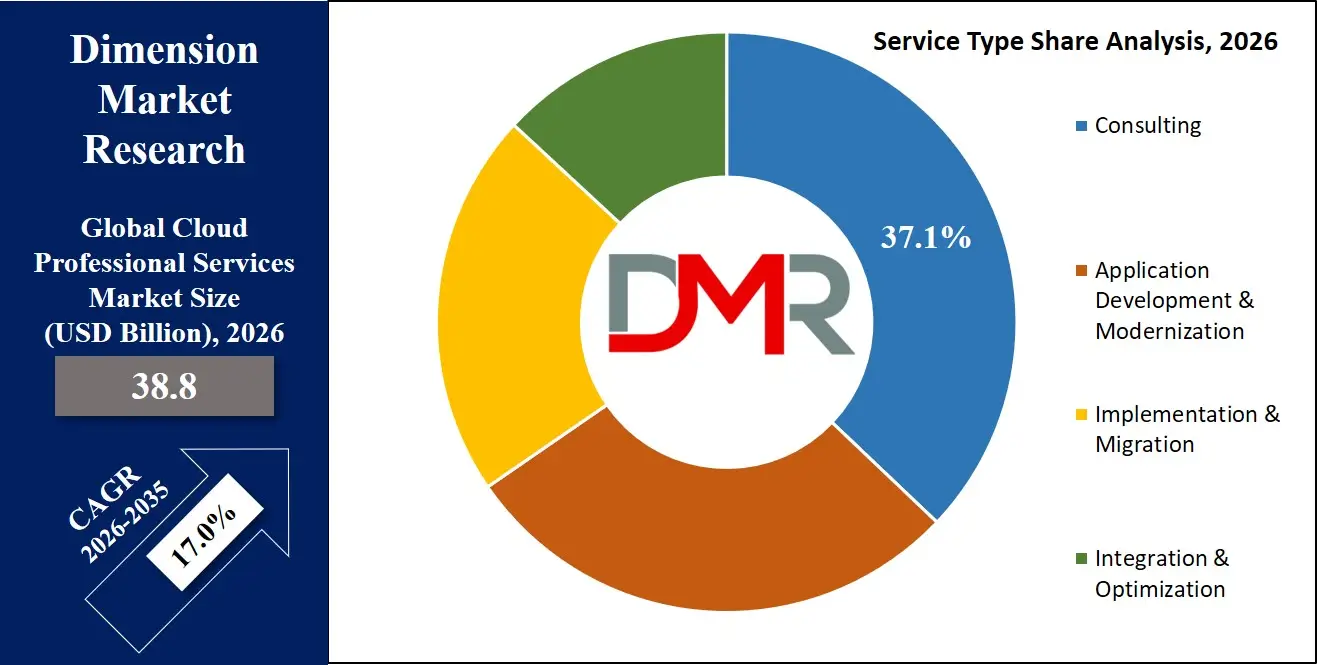
Consulting is poised to lead the service type segment of the global cloud professional services market due to the fact that enterprises need strategic advice prior to making extensive investments in the cloud. In many cases, companies do not have the internal knowledge to identify the cloud platform, deployment model, and migration strategy that best fits their business objectives.
ℹ
To learn more about this report –
Download Your Free Sample Report Here
Consulting services can assist businesses in developing cloud roadmaps, assessing infrastructure preparedness, cost estimates, and overcoming regulatory or cybersecurity obstacles. Cloud strategy consulting, business transformation consulting and risk and compliance advisory are particularly in demand. With the rise in the use of multi-cloud and hybrid cloud environments by enterprises, the demand to use specialized consulting services increases. Such services minimize project risks, enhance decision making, speed up implementation times, and enhance long term returns of cloud investments.
By Service Model Analysis
SaaS remains the dominant service model due to its inherent financial accessibility and operational simplicity. Organizations favor SaaS for its low upfront capital expenditure and predictable subscription-based pricing, which eliminates costly hardware refreshes and license management overhead. The model enables rapid deployment timelines, allowing business units to activate critical applications such as CRM, ERP, and collaboration suites within days rather than months. Consequently, the professional services ecosystem thrives around SaaS, focusing on critical adjacent tasks including complex data migration from legacy systems, user training and change management, and custom API integration to ensure SaaS applications exchange data seamlessly with existing on-premise or legacy enterprise software systems.
By Organization Size Analysis
Large enterprises is expected to dominate cloud professional services based on organization side due to the scale and intricacy of their IT estates. These organizations operate with substantial global IT budgets and maintain vast portfolios of legacy applications, often running on outdated mainframes or client-server architectures that require meticulous modernization strategies. Unlike smaller firms that can adopt off-the-shelf cloud tools rapidly, large enterprises face complex organizational silos and strict regulatory governance. Their cloud journeys require comprehensive professional services spanning multi-year business transformation consulting, complex data migration services for petabyte-scale databases, and managed integration services to orchestrate workloads across hybrid environments spanning private data centers and multiple public cloud providers simultaneously.
By Deployment Model Analysis
Public cloud is expected to dominate this market based on deployment model as it essentially redefines the IT economics by providing unparalleled scalability, worldwide coverage, and a reduced total cost of possessing infrastructure than the cost of constructing and running its own data centers. Public cloud elasticity is used by enterprises to manage fluctuating workloads without over-provisioned hardware. But the dynamic and consumption-based public cloud develops a similar demand on specialized professional services. Companies need skilled advice in FinOps to manage spiraling costs, security posture management to avoid data breaches throughout shared responsibility models, and performance optimization to make sure that applications use cloud-native services efficiently instead of being inefficient virtual machines in another location.
By Industry Vertical Analysis
BFSI is poised to command this market with highest market share in this segment as it is experiencing a radical digital transformation caused by customer demands and competitive forces. Banks are moving workloads to the cloud at an aggressive pace to ensure real-time digital banking experiences, highly sophisticated AI-based fraud detection algorithms that can scan transactions in milliseconds, and more resilient cybersecurity postures that can protect against advanced threats. In addition, the industry is subject to a highly dynamic regulatory compliance regime in the world. BFSI firms require cloud professional services to design solutions that strike a balance between innovation and compliance with data residency legislation, privacy, and audit requirements imposed on financial oversight agencies across the globe.
The Global Cloud Professional Services Market Report is segmented on the basis of the following:
By Service Type
- Consulting
- Cloud Strategy Consulting
- Business Transformation Consulting
- Risk & Compliance Consulting
- Application Development & Modernization
- Implementation & Migration
- Cloud Migration Services
- Data Migration Services
- Integration & Optimization
- API Integration
- Workflow Automation
- Performance Optimization
By Service Model
- Software-As-a-Service (SaaS)
- Infrastructure-As-a-Service (IaaS)
- Platform-As-a-Service (PaaS)
By Organization Size
- Small & Medium Enterprises (SMEs)
- Large Enterprises
By Deployment Model
- Public Cloud
- Private Cloud
- Hybrid Cloud
By Industry Vertical
- BFSI
- IT & Telecom
- Healthcare & Life Sciences
- Government
- Manufacturing
- Retail & Consumer Goods
- Energy & Utilities
- Education
- Telecommunications
- Others
Regional Analysis
Leading Region by Market Share
North America is poised to dominate the global cloud professional services market as it is projected to holds 38.3% of the market share by the end of 2026. The United States, which dominates North America, has the highest share in cloud professional services market because of the unmatched concentration of hyperscale cloud data centres and the aggresive digital transformation agendas of the Fortune 500 companies. The area has an established ecosystem of integrators of global systems, boutique consultancy firms and rich pool of talent cloud architects and engineers.
ℹ
To learn more about this report –
Download Your Free Sample Report Here
Enterprise investment in artificial intelligence, sophisticated analytics, and the overall retirement of legacy mainframe systems contribute to the continued demand of application modernization and migration services along with continuous optimization. Moreover, an optimistic venture capital climate persistently finances upcoming cloud-native enterprises that need expert professional services to achieve expeditious development and protection compliance.
Fastest-Growing Regional Market
Asia-Pacific is expected to be the most rapidly expanding cloud professional services market, driven by the government-led sweeping digital transformation initiatives in India, China, Japan, and Southeast Asia. The fast paced economic growth, the rise of a middle-income population and the dynamic expansion of the digital economy is compelling established conglomerates and state agencies to discard unproductive legacy infrastructure. Business transformation consulting is in high demand to help these large organizations head in the direction of cloud native operating models. There is also a severe lack of qualified cloud talent in the region, and it is necessary to outsource professional services to implement, migrate, and managed security to cover the skills gap and enable faster investments in cloud projects.
By Region
North America
Europe
- Germany
- The U.K.
- France
- Italy
- Russia
- Spain
- Benelux
- Nordic
- Rest of Europe
Asia-Pacific
- China
- Japan
- South Korea
- India
- ANZ
- ASEAN
- Rest of Asia-Pacific
Latin America
- Brazil
- Mexico
- Argentina
- Colombia
- Rest of Latin America
Middle East & Africa
- Saudi Arabia
- UAE
- South Africa
- Israel
- Egypt
- Rest of MEA
Competitive Landscape
The competitive environment of global cloud professional services has become highly dynamic with a heterogeneous array of multinational global system integrators (GSIs), professional service divisions of the large hyperscalers, and niche cloud-native consultancies. The key to success will be the profound strategic alliances with AWS, Microsoft Azure, or Google Cloud because they will open the necessary co-selling opportunities and early access to the new capabilities of the platforms. The movement towards market consolidation is rapidly progressing with the traditional IT outsourcing companies acquiring application modernization and AI engineering specialized Boutiques to stay afloat. Proprietary intellectual property, including automated migration frameworks and industry-specific solution accelerators, is becoming a more important basis of competitive differentiation than just labor arbitrage or generic project management approaches.
Some of the prominent players in the Global Cloud Professional Services Market are:
- Accenture
- Deloitte
- PwC
- IBM
- EY
- Amazon Web Services
- Microsoft
- Google Cloud
- Oracle
- Capgemini
- Tata Consultancy Services
- Infosys
- Wipro
- HCLTech
- Cognizant
- NTT DATA
- Cisco
- SAP
- Rackspace Technology
- Alibaba Cloud
- Other Key Players
Recent Developments
- January 2026: AWS declared it will make a major expansion of its Generative AI Innovation Center, a professional services initiative to assist clients in Healthcare and Life Sciences and Manufacturing to create proprietary AI models through Amazon Bedrock and expertise in Application Development and Modernization.
- November 2025: IBM Consulting strengthened its collaboration with Microsoft and introduced a specific practice called Risk & Compliance Consulting and API Integration aimed to support BFSI clients in moving core banking workloads to Azure and keeping in compliance with international financial regulations.
- October 2025: Accenture purchased a European cloud security enterprise to further its Cloud Strategy Consulting and Workflow Automation solutions to sovereign cloud facilities, to support the complicated requirements of Government and public sector customers in data residency.
Report Details
| Report Characteristics |
| Market Size (2026) |
USD 38.8 Bn |
| Forecast Value (2035) |
USD 159.5 Bn |
| CAGR (2026–2035) |
17.0% |
| The US Market Size (2026) |
USD 12.5 Bn |
| Historical Data |
2021 – 2025 |
| Forecast Data |
2027 – 2035 |
| Base Year |
2025 |
| Estimate Year |
2026 |
| Segments Covered |
By Service Type (Consulting, Application Development & Modernization, Implementation & Migration, and Integration & Optimization), By Service Model (Software-as-a-Service (SaaS), Infrastructure-as-a-Service (IaaS), and Platform-as-a-Service (PaaS)), By Organization Size (Small & Medium Enterprises (SMEs), and Large Enterprises), By Deployment Model (Public Cloud, Private Cloud, and Hybrid Cloud), By Industry Vertical (BFSI, IT & Telecom, Healthcare & Life Sciences, Government, Manufacturing, Retail & Consumer Goods, Energy & Utilities, Education, Telecommunications, and Others) |
| Regional Coverage |
North America – The US and Canada; Europe – Germany, The UK, France, Russia, Spain, Italy, Benelux, Nordic, & Rest of Europe; Asia-Pacific – China, Japan, South Korea, India, ANZ, ASEAN, Rest of APAC; Latin America – Brazil, Mexico, Argentina, Colombia, Rest of Latin America; Middle East & Africa – Saudi Arabia, UAE, South Africa, Turkey, Egypt, Israel, & Rest of MEA |
Frequently Asked Questions
How big is the Global Cloud Professional Services Market?
▾ The Global Cloud Professional Services market is poised to be valued at USD 38.8 billion in 2026 and is projected to reach USD 159.5 billion by 2035, driven by the universal need for specialized skills in cloud migration, application modernization, and AI integration.
What is the CAGR of the Global Cloud Professional Services Market from 2026 to 2035?
▾ The market is expected to grow at a CAGR of 17.0% from 2026 to 2035, reflecting the accelerating complexity of enterprise cloud environments and the persistent shortage of internal cloud engineering talent.
What factors are driving the growth of the Global Cloud Professional Services Market?
▾ Key drivers include the global IT skills gap, the imperative to modernize legacy applications, the management complexity of multi-cloud and hybrid deployments, and the surge in demand for Risk & Compliance Consulting amid evolving data sovereignty laws.
Which region held the largest share of the Cloud Professional Services Market in 2026?
▾ North America, specifically the United States, held the 38.3% of market share in 2026, driven by a mature hyperscaler ecosystem and aggressive enterprise investment in Application Development & Modernization and AI-driven cloud capabilities.
Which region is expected to grow the fastest in the Cloud Professional Services Market?
▾ The Asia-Pacific region is expected to grow the fastest, fueled by rapid digital transformation in India, China, and Japan, where Business Transformation Consulting is critical for transitioning large conglomerates to cloud-native operations.
What are the major trends in the Global Cloud Professional Services Market?
▾ Major trends include the integration of Generative AI into development workflows, the rise of FinOps and GreenOps consulting, the demand for industry-specific cloud solutions, and the focus on Performance Optimization within complex Kubernetes environments.
Who are the key players in the Global Cloud Professional Services Market?
▾ Key players include Global System Integrators like Accenture, Deloitte, IBM Consulting, and TCS, as well as the professional services divisions of hyperscalers like AWS, Microsoft, and Google Cloud, alongside specialized pure-play cloud consultancies.
How is the Global Cloud Professional Services Market segmented?
▾ The market is segmented by Service Type (Consulting, Application Modernization, Implementation, Integration), Service Model (SaaS, IaaS, PaaS), Organization Size, Deployment Model (Public, Private, Hybrid), and Industry Vertical (BFSI, Healthcare, Manufacturing, and others).