What is the Cloud Security Market Size?
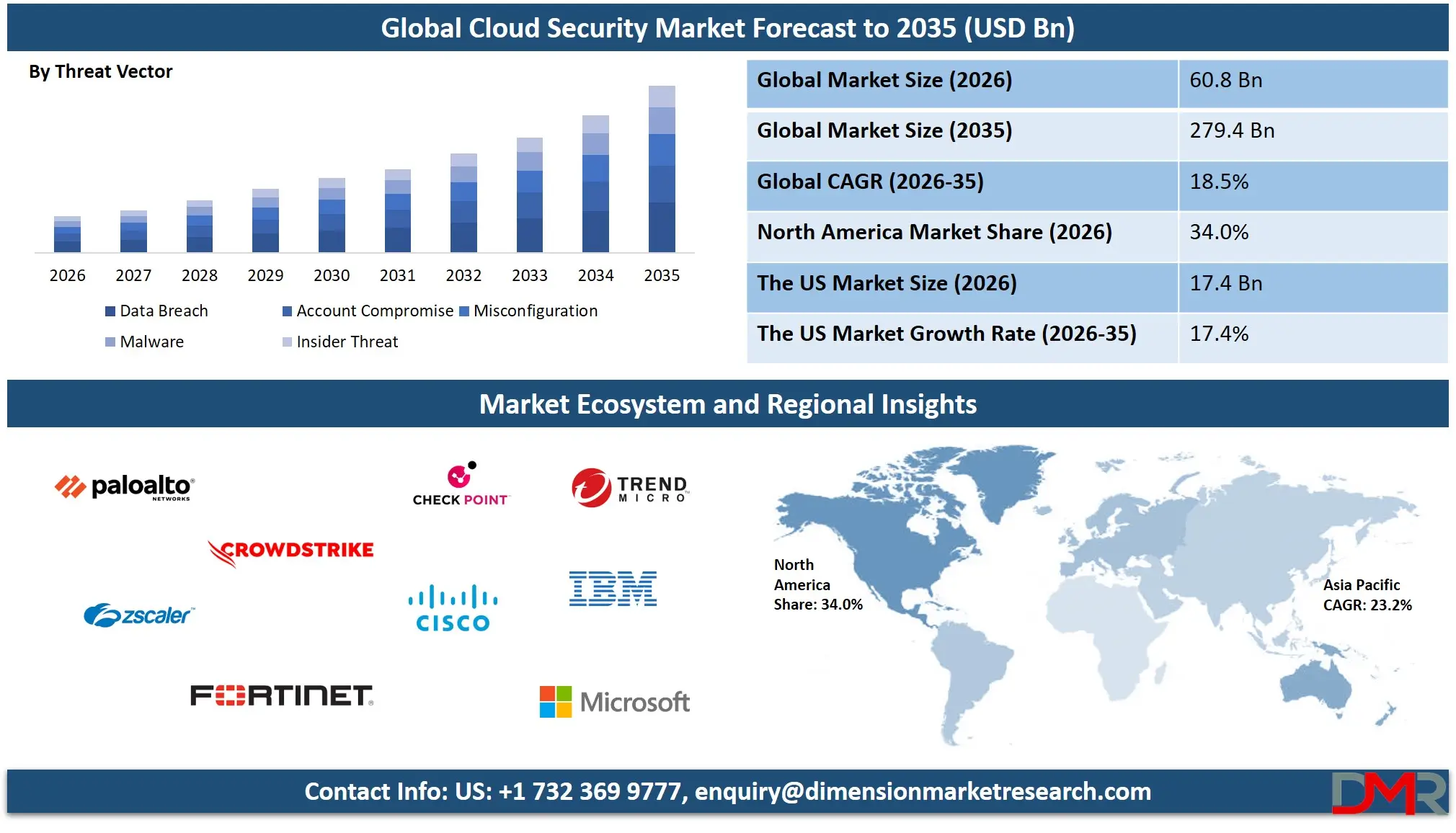
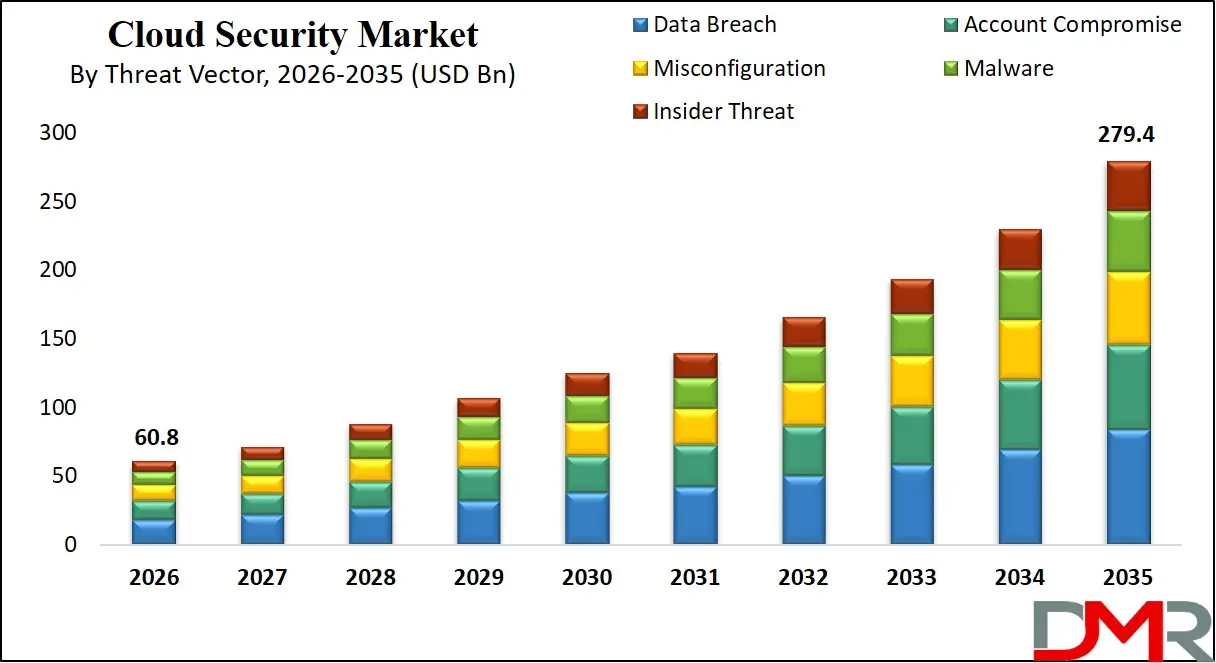
The Global Cloud Security Market size is expected to reach USD 60.8 billion in 2026 and grow at a CAGR of 18.5% to USD 279.4 billion by 2035, driven by demand for data protection, IAM, zero trust, and hybrid cloud security solutions.
ℹ
To learn more about this report –
Download Your Free Sample Report Here
The Cloud Security Market comprises cloud infrastructure, application, and data protection solutions and services against cyber threats, as well as compliance. The market is expanding at a high rate because of the rising adoption of the cloud with Eurostat indicating that more than 66 percent of EU medium enterprises are using cloud services which is leading to increased security demand. Increasing cyberattacks, as brought to attention by Australian Cyber Security Centre, are also driving adoption.
Governments are imposing more stringent data protection laws, compelling organizations to higher levels of protection systems. Also supporting growth are hybrid cloud expansion and critical workload migration. AI-based security and zero-trust models will influence the future demand. The market as a whole is projected to experience a high and sustained growth in the world.
ℹ
To learn more about this report –
Download Your Free Sample Report Here
US Cloud Security Market
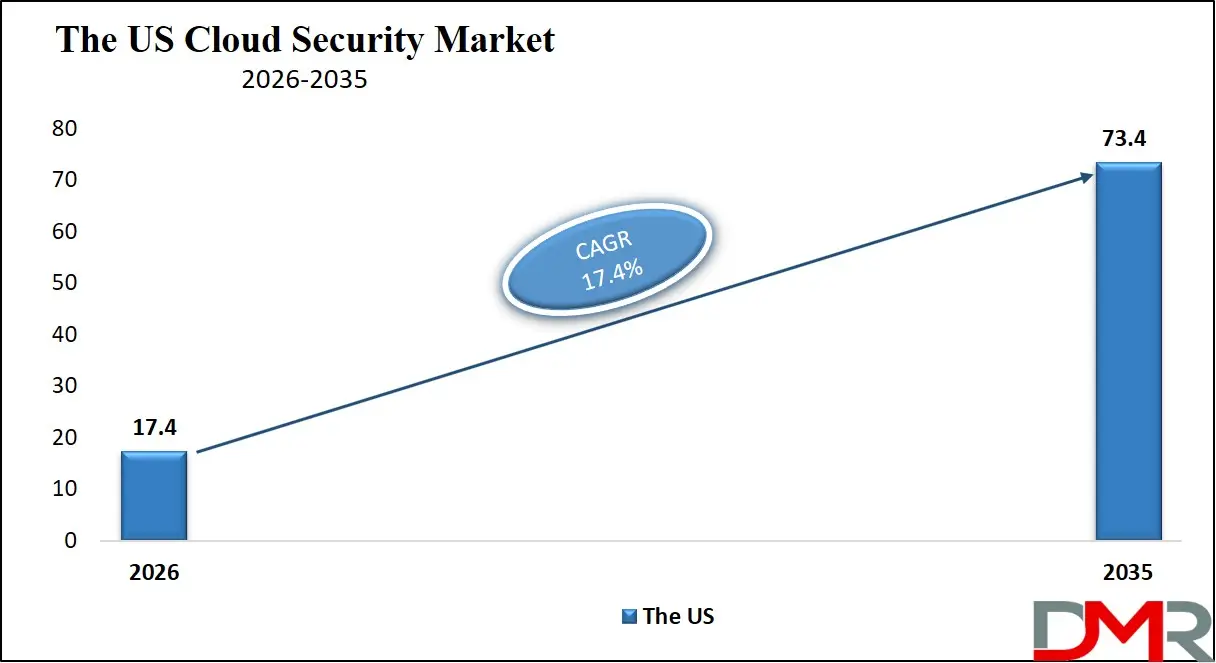
The US Cloud Security Market is projected to reach USD 17.4 billion in 2026 and grow at a compound annual growth rate of 17.4%, reaching USD 73.4 billion by 2035.
ℹ
To learn more about this report –
Download Your Free Sample Report Here
The US Cloud Security Market is the most active in the world with the aggressive adoption of the cloud and advanced cybersecurity guidelines by such agencies as National Institute of Standards and Technology and Cybersecurity and Infrastructure Security Agency. The increasing cyber threats, adoption of zero trust, and growing demand of IAM, data protection, and multi-cloud security solutions drive growth.
Europe Cloud Security Market
The Europe Cloud Security Market is expected to grow to USD 15.2 billion in the year 2026 with a CAGR of 17.2%. The stringent data protection laws like the GDPR and the growing adoption of clouds in enterprises are driving growth. Investments are accelerating due to increased cyber threats and the need to comply with security solutions. High levels of technology vendors and government-sponsored cybersecurity programs also help to facilitate the growth of the market.
Japan Cloud Security Market
The Japan Cloud Security Market is expected to grow to USD 3.6 billion in 2026 with a CAGR of 18.5%. The rapid adoption of clouds by enterprises and the growing number of digital transformation projects drive growth. An increase in cyber-attacks and close attention to data security is driving the demand towards sophisticated security solutions. Market growth is further promoted by government activities and investments in cybersecurity infrastructure.
Key Takeaways
- Market Size: The Cloud Security Market is projected to reach USD 60.8 billion by 2026 and expand significantly to USD 279.4 billion by 2035, reflecting strong long-term demand.
- Growth Rate and Outlook: The market is expected to grow at a CAGR of 18.5%, driven by continuous cloud adoption and evolving cybersecurity requirements across industries.
- Primary Growth Drivers: Key drivers include rising cyber threats, increasing adoption of hybrid and multi-cloud environments, strict regulatory compliance, and growing demand for data protection and identity security.
- By Component Analysis: Solutions lead the segment with approximately 66.0% share, driven by high demand for IAM, CSPM, and workload protection technologies, while services support deployment and management.
- By Deployment Analysis: Private cloud dominates with around 47.0% share due to higher control, security, and compliance requirements among enterprises handling sensitive data.
- By Enterprise Size Analysis: Large enterprises account for nearly 73.0% share, supported by higher budgets, complex infrastructures, and greater focus on advanced cloud security frameworks.
- Regional Leadership: North America leads the market with about 34.0% share, driven by strong cloud adoption, advanced cybersecurity infrastructure, and presence of major technology providers.
What is Cloud Security?
Cloud security is the technologies and controls that protect cloud infrastructure, applications, and data against cyber threats. It follows models specified by the National Institute of Standards and Technology, with a shared responsibility model between the provider and the user. It has major functions which include identity management, encryption, and monitoring and threat detection. Cloud environments are risky because they are distributed and multi-tenant. Governmental organizations, such as the Cybersecurity and Infrastructure Security Agency, note the importance of constant monitoring and risk management. Security: The security issue is essential since organizations are transferring the workloads that are crucial to cloud systems. In sum, cloud security guarantees protection, compliance and resilience.
Use Cases
- Secure Remote Workforce: Cloud security enables safe access to enterprise systems for remote employees through identity controls and secure gateways, ensures data protection across distributed endpoints and unmanaged networks, and is critical for hybrid work environments and global teams.
- Application Protection: Cloud security safeguards cloud-native and web applications from threats such as malware and unauthorized access, provides runtime protection, vulnerability management, and secure configurations, and ensures continuous availability and integrity of business-critical applications.
- Data Protection and Compliance: Cloud security ensures sensitive data is encrypted, monitored, and protected against breaches, helps organizations meet regulatory requirements and data governance standards, and is essential for industries handling confidential and regulated data.
- Multi-cloud Risk Management: Cloud security provides centralized visibility and control across multiple cloud environments, helps detect misconfigurations, enforce policies, and manage access risks, and enables secure scaling and seamless operations across hybrid and multi-cloud setups.
How AI is Transforming the Cloud Security Market?
AI is also changing the cloud security market by being able to detect threats in real-time, predictive analytics and automated responses to incidents in complex cloud environments, enhancing accuracy and minimizing response time. It improves identity and access control by analyzing behavior and identifying anomalies, reducing the possibility of compromising accounts.
AI-based solutions also enhance data security by detecting errors and misconfigurations before they occur. On the whole, AI can help with scalable, adaptive, and intelligent security systems that are consistent with the changing cyber threats.
Market Dynamics
Key Drivers in the Global Cloud Security Market
Rising Cloud Adoption
Main factor driving cloud security demand are increased migration of enterprises to public, private, and hybrid cloud environments. Organizations are moving essential workloads and sensitive data to the cloud increasing the attack surface. Such a transition needs high security controls to guard distribution systems and users. The regulatory pressures also urge business organizations to adhere to cloud infrastructure. Cloud security is an investment to make as the world is rapidly becoming digital.
Escalating Cyber Threats
The frequency and complexity of cybercrime (like ransomware, data breaches, and account hijacking) is rapidly growing. Cloud environments are also the most appealing because of a centralized data storage and remote accessibility. Companies are spending on proactive security systems to identify and address threats on the fly. Adoption is being fueled by the need to constantly monitor and gather threat intelligence. Such a trend directly increases the need to have advanced cloud security platforms.
Restraints in the Global Cloud Security Market
Complex Security Architecture
Cloud environments are characterized by various layers, providers, and configurations, making the security management extremely complicated. One of the most prevalent causes of cloud breaches is misconfigurations. Multi-cloud environments usually become difficult to sustain a coherent set of policies by the organization. There are also integration difficulties with the legacy systems that make it even more difficult to deploy. This ordo can be a drag on adoption, particularly by smaller businesses.
High Implementation Costs
Implementing end-to-end cloud security solutions is very expensive in both start-up and operational costs. Among the costs are sophisticated instruments, qualified staff, and monitoring systems. Limiting adoption may be due to budget constraints among small and medium enterprises. Constant upgrades and compliance also contribute to the financial challenge. This serves as an obstacle as there is an increasing realization of security threats.
Growth Opportunities in the Global Cloud Security Market
AI-driven Security Solutions
Artificial intelligence and machine learning are creating new opportunities in cloud security. These technologies enable automated threat detection, predictive analytics, and faster incident response. AI helps reduce human intervention and improves accuracy in identifying anomalies. Vendors are increasingly integrating AI into security platforms. This is expected to drive innovation and market expansion.
Zero Trust Adoption
The shift toward zero-trust architecture is opening new growth avenues. Organizations are moving away from perimeter-based security to identity-centric models. This approach ensures continuous verification of users and devices. Increasing remote work and cloud usage support this transition. Zero trust frameworks are becoming a standard in modern cloud security strategies.
Trends in the Global Cloud Security Market
Platform Consolidation
Businesses are shifting off of a multi-point solution to single cloud security solutions. This tendency simplifies the work and enhances visibility in any environment. Centralization allows centralized policy management and detection of threats. Combination of various security functions is being sold by vendors. This transformation boosts efficiency and cost optimization.
Multi-cloud Security Expansion
Organizations are moving towards multi-cloud solutions to prevent vendor lock-in and enhance flexibility. This brings about the need to have a consistent security among various cloud providers. Security solutions are also changing in such a way that they are offering cross platform visibility and control. The control of identities, data, and workloads across clouds is taking a critical turn. This is a trend that is driving the future of cloud security market.
Research Scope and Analysis
By Component Analysis
In the component segment, solutions are expected to dominate with around 66.0% market share in 2026, driven by strong demand for technologies such as IAM, CSPM, CWPP, and data protection tools that secure cloud environments. Increasing cyber threats, compliance needs, and multi-cloud adoption further support this dominance. Meanwhile, services play a key role in deployment, integration, and ongoing management. Managed services are growing due to skill gaps and need for continuous monitoring, while professional services support implementation and optimization.
By Cloud Layer Secured Analysis
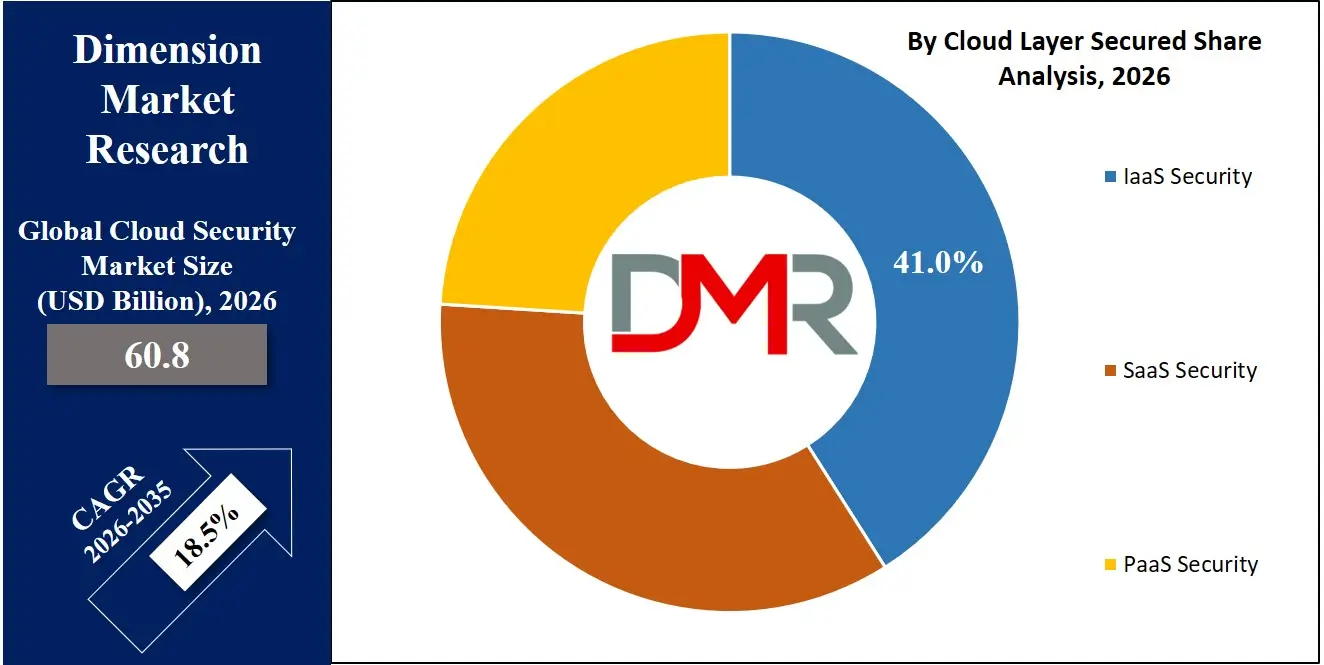
In the cloud layer secured segment, IaaS security is expected to dominate with around 41.0% market share in 2026, driven by the need to secure virtual infrastructure, storage, and networks as enterprises move critical workloads to the cloud.
ℹ
To learn more about this report –
Download Your Free Sample Report Here
High risk of misconfigurations and demand for infrastructure-level visibility further support its dominance. Meanwhile, SaaS security is growing with increased use of cloud applications, focusing on securing user access and data across platforms. Rising risks of data leakage and account compromise are driving its adoption.
By Workload Focus Analysis
In the workload focus segment, data security is expected to dominate with around 34.0% market share in 2026, driven by the need to protect sensitive data through encryption, access control, and monitoring. Rising breaches and compliance requirements support its growth. Meanwhile, application security is gaining importance as cloud applications become key attack targets, focusing on securing code, APIs, and runtime environments.
By Threat Vector Analysis
In the threat vector section, data breach will be the largest with approximately 30.0% market share in 2026 as a result of the accumulating quantity of sensitive information kept in cloud setups and rising cases of unauthorized access and data breach. Companies are focusing on data-centric security controls to avert the loss of financial and reputational damage. The compliance requirements also drive investments in breach prevention and monitoring. In the meantime, account compromise is also a critical vulnerability, as hackers use weak credentials or phishing to access cloud systems. This is leading to embracing of strong authentication and identity security. Access protection is being hastened by the increasing credential-based attacks.
By Security Architecture Analysis
Platform-based security will dominate the security architecture segment with a market share of approximately 54.0% in 2026 with the demand to have a single visibility, a single point of control and integrated threat detection capabilities that span complex cloud environments. Companies are inclined towards consolidated platforms to achieve complexity of operations and efficiency. Such a implementation allows the implementation of the policy without issues and scaling over a multi-cloud architecture. In the meantime, point solutions still play certain functions of high specialization and flexibility in security. They are usually incorporated to support niche needs or as an addition to platforms. Their disunity, however, may add complexity to management over and above integrated solutions.
By Delivery Model Analysis
Managed security will take the lead in the delivery model segment with about 60.0% market share in 2026 due to the complexity of clouds and lack of expertise. Managed services are preferred by organizations as it provides 24/7 monitoring and threat response. In the meantime, the in-house security is also significant when the company requires more control and customization. Nevertheless, it demands increased investment in equipment and skills.
By Deployment Analysis
Under the deployment segment, the market share of private cloud is projected to surpass the highest by 47.0% in 2026 due to the increased control, data privacy, and compliance needs of enterprises with sensitive workloads. Organizations would like to have private environments to have better governance and security customization. This is particularly essential in controlled businesses. In the meantime, hybrid cloud is taking off because it can integrate the advantages of both the private and the public cloud and is flexible and scalable. It enables organizations to strike the balance between performance and security requirements. The adoption of hybrid clouds is also being fueled by increasing multi-cloud strategies.
By Enterprise Size Analysis
Large enterprises are supposed to lead the enterprise size market with an estimated market share of approximately 73.0% in 2026 due to increased IT budgets, heavy cloud deployments, and high compliance needs. They spend huge amounts on high-tech security tools to safeguard extensive amounts of sensitive information and multi-clouds. In the meantime, SMEs are slowly moving towards adoption with cloud usage on the rise with an eye on cost effective and scalable security measures. Nevertheless, small budgets and inadequate resource expertise continue to be major constraints of smaller organizations.
By End-use Industry Analysis
IT and telecom will dominate the end-use industry segment with approximately 17.0% market share in 2026, due to high levels of cloud adoption, massive data traffic, and ongoing demand of network and infrastructure security. These organizations need enhanced security of distributed systems and real-time operations. In the meantime, one of the major developing segments is BFSI because of the stringent regulatory standards and sensitivity of financial information. Banks and other financial institutions spend a lot of money on data protection, identity security and fraud prevention solutions. The growing demand of cloud security in this industry is also being pushed by increasing digital banking and online transactions.
The Global Cloud Security Market Report is segmented on the basis of the following:
By Component
- Solutions
- IAM
- CSPM
- CWPP
- CASB
- DLP
- CIEM
- Encryption
- Services
- Managed Services
- Professional Services
By Cloud Layer Secured
- IaaS Security
- SaaS Security
- PaaS Security
By Workload Focus
- Data Security
- Application Security
- Infrastructure Security
- Identity Security
By Threat Vector
- Data Breach
- Account Compromise
- Misconfiguration
- Malware
- Insider Threat
By Security Architecture
- Platform-based Security
- Point Solutions
By Delivery Model
- Managed Security
- In-house Security
By Deployment
- Private Cloud
- Hybrid Cloud
- Public Cloud
By Enterprise Size
By End-use Industry
- IT & Telecom
- BFSI
- Healthcare
- Retail
- Government
- Manufacturing
- Energy
- Logistics
- Others
Regional Analysis
Leading Region by Market Share
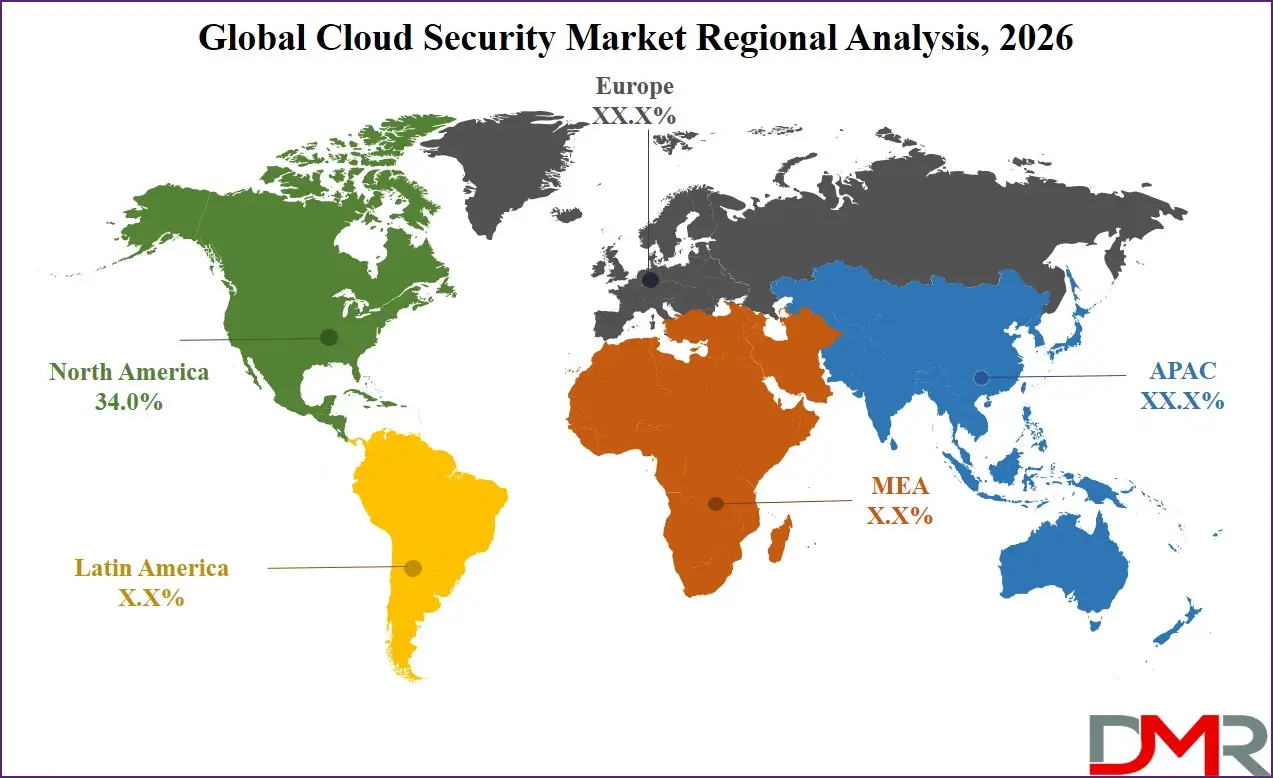
North America is expected to lead the market with around 34.0% share in 2026, driven by high cloud adoption and strong presence of major technology providers. The region benefits from advanced cybersecurity frameworks and strict regulatory standards supporting security investments. Rising cyber threats and early adoption of advanced security solutions further strengthen its dominance.
ℹ
To learn more about this report –
Download Your Free Sample Report Here
Fastest-Growing Regional Market
Asia Pacific is the fastest-growing regional market, driven by rapid cloud adoption and digital transformation across emerging economies. Increasing cyber threats and expanding enterprise IT infrastructure are accelerating demand for advanced security solutions. Government initiatives and rising investments in cybersecurity further support strong growth in the region.
By Region
North America
Europe
- Germany
- The U.K.
- France
- Italy
- Russia
- Spain
- Benelux
- Nordic
- Rest of Europe
Asia-Pacific
- China
- Japan
- South Korea
- India
- ANZ
- ASEAN
- Rest of Asia-Pacific
Latin America
- Brazil
- Mexico
- Argentina
- Colombia
- Rest of Latin America
Middle East & Africa
- Saudi Arabia
- UAE
- South Africa
- Israel
- Egypt
- Rest of MEA
Competitive Landscape
The market is fragmented with global providers and niche vendors competing on innovation and integration. Players focus on AI-driven security and zero trust models to stay competitive. Partnerships and product development are key growth strategies. Rising demand for unified solutions is intensifying competition.
Some of the prominent players in the Global Cloud Security Market are:
- Palo Alto Networks
- CrowdStrike
- Zscaler
- Fortinet
- Check Point Software Technologies
- Trend Micro
- Cisco
- IBM
- Microsoft
- Google
- Amazon Web Services
- VMware
- Sophos
- Qualys
- Aqua Security
- Orca Security
- Wiz
- Lacework
- Sysdig
- Rubrik
- Other Key Players
Recent Developments
- March 2026: Cylake secured USD 45 million in funding to build AI-powered security systems for highly regulated sectors.
- February 2026: Zscaler acquired browser security firm SquareX to strengthen its cloud and zero trust security portfolio.
- November 2025: Clover Security raised USD 36 million to develop AI-driven product security solutions backed by major industry leaders.
Report Details
| Report Characteristics |
| Market Size (2026) |
USD 60.8 Bn |
| Forecast Value (2035) |
USD 279.4 Bn |
| CAGR (2026–2035) |
18.5% |
| Historical Data |
2021 – 2025 |
| Forecast Data |
2027 – 2035 |
| Base Year |
2025 |
| Estimate Year |
2026 |
| Segments Covered |
By Component (Solutions, Services),
By Cloud Layer Secured (IaaS Security, SaaS Security, PaaS Security),
By Workload Focus (Data Security, Application Security, Infrastructure Security, Identity Security),
By Threat Vector (Data Breach, Account Compromise, Misconfiguration, Malware, Insider Threat),
By Security Architecture (Platform-based Security, Point Solutions),
By Delivery Model (Managed Security, In-house Security),
By Deployment (Private Cloud, Hybrid Cloud, Public Cloud),
By Enterprise Size (Large Enterprises, SMEs),
By End-use Industry (IT & Telecom, BFSI, Healthcare, Retail, Government, Manufacturing, Energy, Logistics, Others) |
| Regional Coverage |
North America – The US and Canada;
Europe – Germany, The UK, France, Russia, Spain, Italy, Benelux, Nordic, & Rest of Europe;
Asia-Pacific – China, Japan, South Korea, India, ANZ, ASEAN, Rest of APAC;
Latin America – Brazil, Mexico, Argentina, Colombia, Rest of Latin America;
Middle East & Africa – Saudi Arabia, UAE, South Africa, Turkey, Egypt, Israel, & Rest of MEA |
Frequently Asked Questions
How big is the Cloud Security Market?
▾ The Cloud Security Market is projected to be valued at USD 60.8 billion in 2026 and is expected to reach USD 279.4 billion by 2035.
What is the CAGR of the Cloud Security Market from 2026 to 2035?
▾ The market is projected to grow at a CAGR of 18.5% during the forecast period.
What factors are driving the growth of the Cloud Security Market?
▾ The market growth is driven by increasing cloud adoption, rising cyber threats, strict regulatory compliance requirements, and growing demand for data protection and identity security solutions.
What are the major trends in the Cloud Security Market?
▾ Major trends include adoption of AI-driven security, zero trust architecture, platform-based security models, and expansion of multi-cloud security strategies.
Which region held the largest share of the Cloud Security Market in 2026?
▾ North America is projected to hold the largest market share of 34.0% in 2026.
Which region is expected to grow the fastest in the Cloud Security Market?
▾ Asia Pacific is expected to be the fastest-growing region during the forecast period.
Who are the key players in the Cloud Security Market?
▾ Key players include Palo Alto Networks, CrowdStrike, Zscaler, Fortinet, Check Point Software Technologies, Trend Micro, Cisco, IBM, Microsoft, Google, Amazon Web Services, VMware, Sophos, Qualys, Aqua Security, Orca Security, Wiz, Lacework, Sysdig, Rubrik, and other key players.
How is the Cloud Security Market segmented?
▾ The market is segmented by Component, Cloud Layer Secured, Workload Focus, Threat Vector, Security Architecture, Delivery Model, Deployment, Enterprise Size, and End-use Industry.