What is the Global Cloud Security Posture Management Market Size?
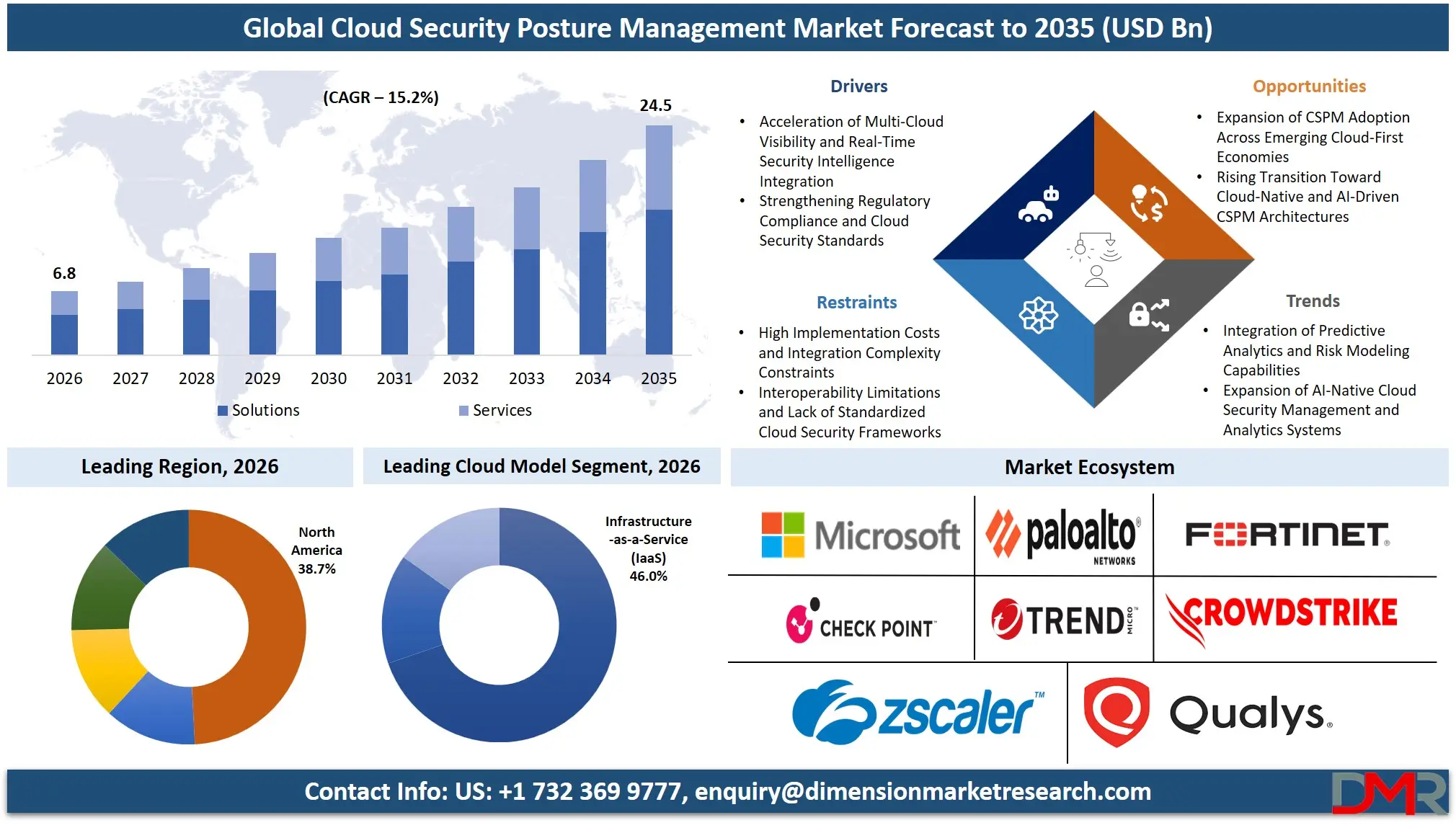
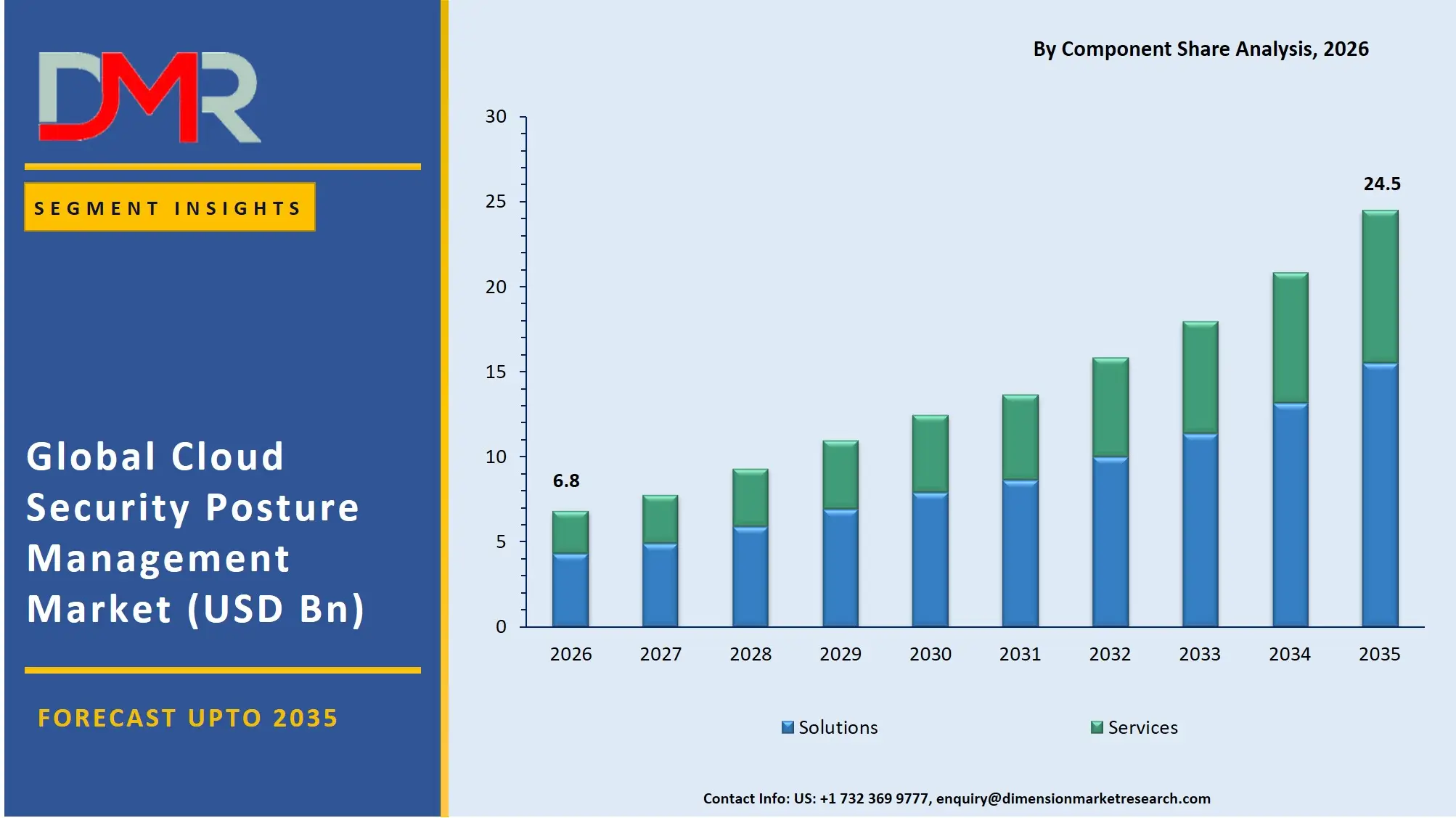
The Global Cloud Security Posture Management Market size is estimated at USD 6.8 billion in 2026 and is projected to reach USD 24.5 billion by 2035, exhibiting a CAGR of 15.2% during the forecast period, driven by the rising use of automated security tools in cloud misconfiguration detection, continuous compliance monitoring across multi-cloud environments, and connected risk management systems.
ℹ
To learn more about this report –
Download Your Free Sample Report Here
The global Cloud Security Posture Management (CSPM) market is expanding because of increasing use of smart software in detecting and analyzing cloud infrastructure drift and security effectiveness; increasing regulatory approvals, which reduce the chance of rule-breaking during cloud deployment and speed up the review process for new cloud workloads; and more funding in automating the use of cloud security-related data.
Some other reasons for expansion in this market include new technologies in real-time posture assurance, threat risk prediction through automated remediation, multi-cloud supply chain handling, and high-volume security analytics platforms, as well as better data-sharing rules. The digital shift in enterprise IT and cloud-first companies has been helpful in speeding up product development and making cloud security management easier. This includes continuous compliance tracking research. In addition, government plans focusing on preventing data leakage and the secure cloud economy have ensured steady research in cloud-native security systems.
ℹ
To learn more about this report –
Download Your Free Sample Report Here
The US Cloud Security Posture Management Market
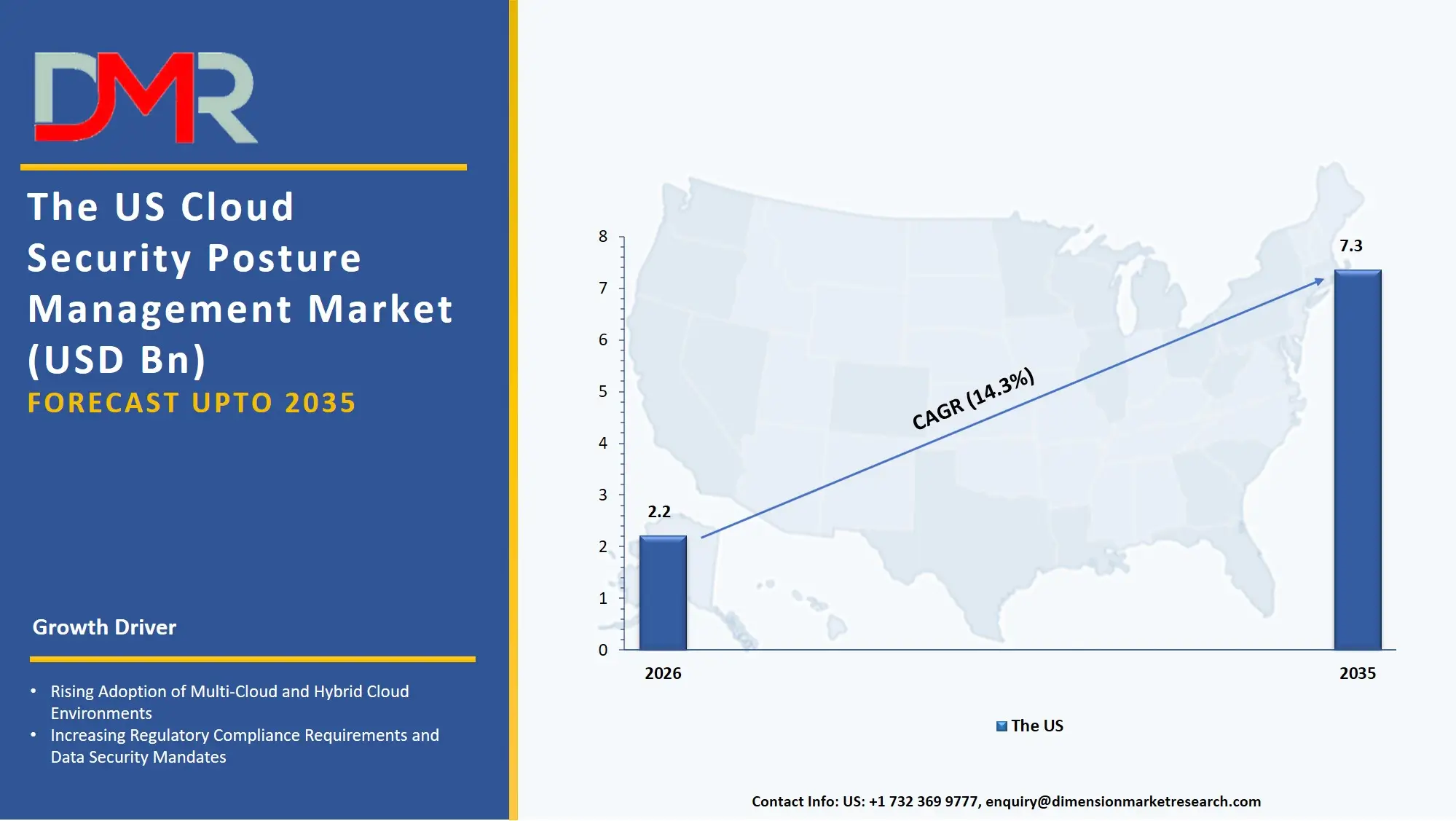
The US Cloud Security Posture Management Market is estimated to grow to USD 2.2 billion in 2026 with a compound annual growth rate of 14.3% during the forecast period.
ℹ
To learn more about this report –
Download Your Free Sample Report Here
The US market is shaped by major federal and state-level programs promoting zero-trust architecture, cloud security modernization initiatives supported by CISA and NIST, and FedRAMP-led cloud authorization initiatives. These programs encourage the use of smart misconfiguration testing, real-time enterprise cloud data analysis, and predictive risk forecasting software. Automated compliance platforms are being rapidly adopted, and the US continues to invest in better data sharing between research labs, cloud asset records, and reliable smart tools for CSPM platforms. Service providers are also influenced by laws like the Federal Information Security Modernization Act (FISMA) and national digital cloud strategies to offer services that ensure data safety, rule-following, and smooth integration across cloud service providers and on-premise systems.
Europe Cloud Security Posture Management Market
The European Cloud Security Posture Management Market is estimated to be valued at USD 1.9 billion in 2026, witnessing growth at a CAGR of 14.4%, during the forecast period.
Europe's CSPM market is well-established, shaped by EU-wide policies such as the NIS2 Directive, the Digital Operational Resilience Act (DORA), and national policies to support digital cloud security markets (e.g., Germany's cloud computing strategies and France's national cybersecurity plans). Countries are also making cloud compliance processes more flexible to align producer and buyer demands and enable the sharing of security posture data across borders. The market grows due to new tools like software for real-time posture validation and scoring systems for cloud projects. Use is made easier by teamwork between public and private groups and shared data rules. Manufacturers have access to technologies such as AI-driven security analytics and secure record-keeping, and Europe is at the forefront of the digitisation of safe and efficient CSPM operations.
Japan Cloud Security Posture Management Market
The Japan Cloud Security Posture Management Market is projected to be valued at USD 323.4 million in 2026, progressing at a CAGR of 15.8%, during the period spanning from 2026 to 2035.
Japan's CSPM market is well developed, with high-quality digital forecasting platforms, connected posture management systems, and a wide array of smart cloud risk analysis software tools. National focus on automation, efficiency, and process integrity is delivered via predictive risk models and smart asset management. Growth opportunities are helped by government measures under the Digital Agency's cloud-first policy and Japan's Ministry of Economy, Trade and Industry (METI) security guidelines, and continued investment in digital cloud market modernization. Cloud workload analysis, industry-specific cloud security development, and virtual cloud environments all need effective smart software to keep pace with data analysis. Higher costs for validating new automation systems and connecting them with older security registries are significant, but there are opportunities for the export of Japanese CSPM technologies to the Asian and Pacific markets.
Key Takeaways
- Market Size & Forecast: The Global CSPM Market is estimated to be valued at USD 6.8 billion in 2026 and is expected to grow to USD 24.5 billion by 2035.
- Growth Rate & Outlook: The market is expected to witness growth at a compound annual growth rate of 15.2% in the forecast period.
- Primary Growth Drivers: The availability of new cloud security processing technologies that use smart software, the need to speed up cloud compliance results and improve success rates of multi-cloud integration, and more government investment in national digital cloud security infrastructure are key growth drivers.
- Key Market Trends: The predictive profiling of individual cloud risks, real-time posture data handling, and the shift to AI-driven security analytics platforms and asset management platforms are key market trends.
- By Component: The solutions segment is expected to take the largest revenue share in 2026 in the global CSPM market, owing to the need for automated misconfiguration detection.
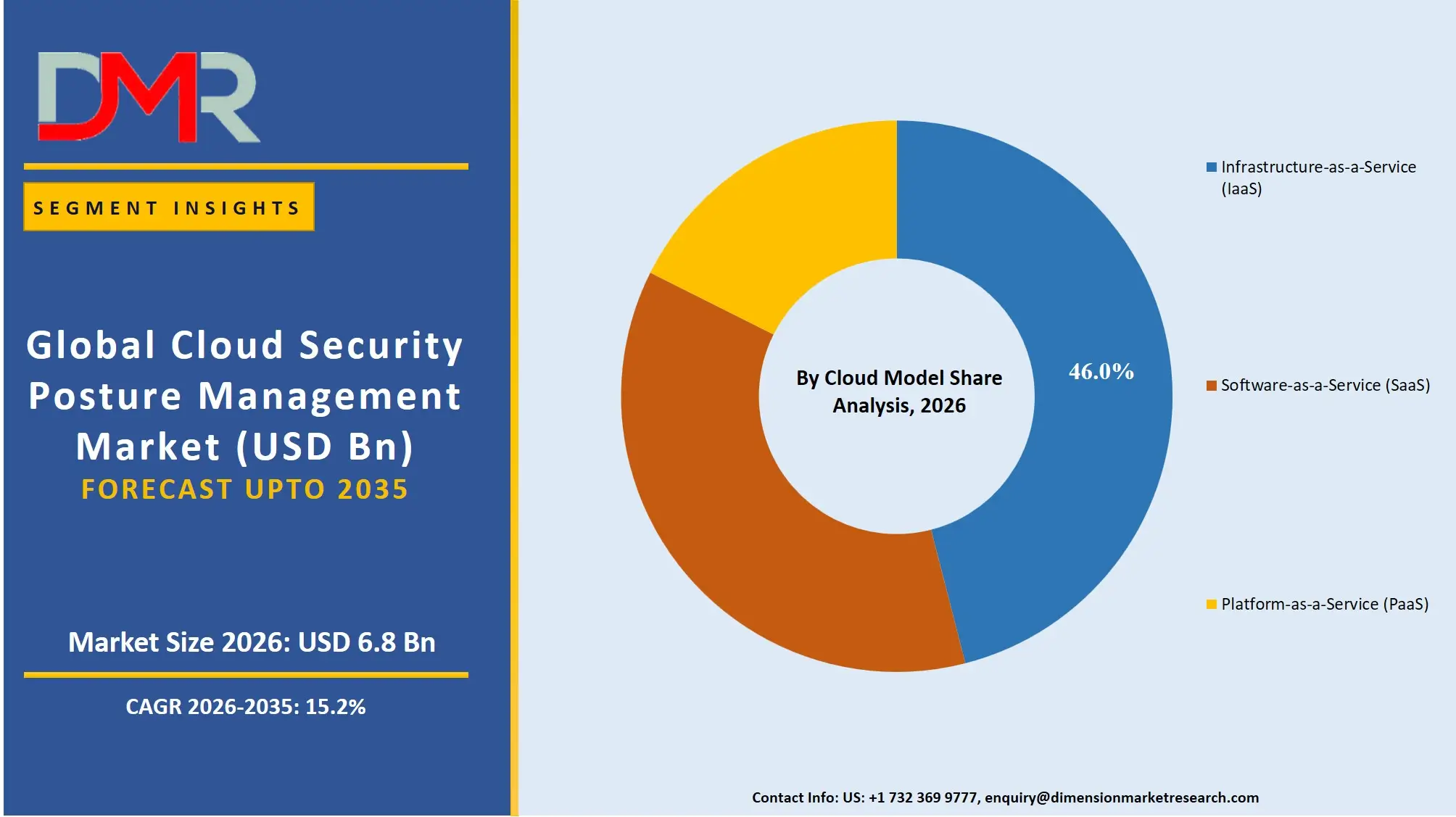
- By Cloud Model: The Infrastructure-as-a-Service (IaaS) segment is expected to take the largest revenue share in 2026 in the CSPM market.
- By Industry Vertical: BFSI is estimated to take the lead in 2026 with the largest share in the CSPM market.
- Regional Leadership: North America is estimated to take the lead in 2026 with 38.7% share in the CSPM market, owing to significant investment in cloud security modernization and stringent data protection regulations like GDPR.
What is Cloud Security Posture Management?
Cloud Security Posture Management (CSPM) platforms are automated security systems that provide cloud engineers, security teams, and compliance officers with enhanced capabilities beyond basic threat detection, including helping to identify, remediate, and prevent misconfigurations, compliance violations, and security risks across cloud environments like IaaS, PaaS, and SaaS. They include posture assessment platforms, compliance monitoring systems, and risk analytics tools. These platforms use modern systems such as real-time configuration verification, asset management software, and remote cloud advisory to manage, verify, and track cloud security events and outcomes. To improve cloud security outcomes, manage risk variability and condition-specific cloud compliance programs, and expand security coverage into personalized cloud protection to support individual customer care and promote the development of secure cloud-native products.
Use Cases
- Market Stability for Daily Operations: CSPM platforms can provide market-balancing benefits through software (assessment, analytics) and control systems to reduce misconfiguration risk and support remediation in minutes, compared to days that it would take with only manual review.
- Long-Term Cloud Asset Management: Long-term data on ongoing cloud issues, including workload intermittency, security score spikes, or policy buffer degradation, are studied to better understand security performance and to help plan long-term software-based care.
- Security Load Balancing: Cloud security posture management is handled through digital platforms and smart software in enterprise IT and multi-cloud settings to support security capacity balance.
- Community & Government Programs: Faster CSPM software development helps cloud innovation and development of targeted compliance programs; government programs through smart monitoring of national cloud security data advance national cybersecurity strategies and help the adoption of operational standards.
How AI Is Transforming the Global Cloud Security Posture Management Market?
Artificial intelligence (AI) is being used progressively more often in CSPM platforms to improve risk demand forecasting, find compliance quality trends, and automatically spot unusual patterns in cloud configuration data. It also allows faster policy verification because it can handle digital submissions on a large scale. Cloud asset records and electronic audit logs are easier to study and help security registries find integration issues, reduce mistakes, and improve the overall accuracy of compliance issuance. This has resulted in operations being cost-effective, quicker, and more efficient than the old manual review method.
AI is also strengthening research and development by improving risk assessment and enabling more accurate capacity planning. It helps security teams predict how many compliance checks will be needed, find possible processing delays, and monitor the performance of cloud networks more effectively. In addition, automation of routine checks and performance tracking is reducing operational workload, lowering administrative costs, and improving overall efficiency. This is leading to better financial results and more stable operations across the cloud security production chain.
Market Dynamics
Key Drivers of the Global Cloud Security Posture Management Market
Acceleration of Multi-Cloud Visibility and Real-Time Security Intelligence Integration
The market is growing with the rise of digital tools to monitor and manage cloud security integration, better handling of compliance data, and a closer connection of cloud environments and posture management platforms. CSPM platforms provide real-time visibility that allows monitoring of cloud workflows, helping to spot misconfigurations early and enforce policies much faster. This has improved efficiency in operations and reduced human mistakes as well as administrative costs. At the same time, demand for more automated research and development is being supported by increased activity in predictive analytics for the assessment of individual cloud risks, as cloud security continues to digitize core IT and operational tasks.
Strengthening Regulatory Compliance and Cloud Security Standards
There is increasing emphasis on transparency, data accuracy, and regulatory compliance within cloud security posture management systems. Regulations and frameworks such as GDPR, HIPAA, PCI DSS, and cloud security modernization efforts in key markets are encouraging better data handling practices and more structured compliance processes. These advances are supporting the need for systems that can offer continuous monitoring of cloud assets and standardized reporting. At the same time, ongoing efforts to improve interoperability of cloud security data and reduce configuration risks are strengthening the demand for more effective management systems among both government and private sector organizations.
Restraints in the Global Cloud Security Posture Management Market
High Implementation Costs and Integration Complexity Constraints
The rollout of CSPM platforms remains costly, requiring significant investment in system integration, testing, and alignment with cloud workflows. In addition, following data privacy rules such as GDPR and other regional laws adds to setup complexity. These factors increase upfront costs and can limit adoption, especially among smaller cloud developers and new companies entering the market.
Interoperability Limitations and Lack of Standardized Cloud Security Frameworks
There is still fragmentation in the market in terms of data formats and quality handling procedures. Although some areas have put in place organized cloud security management systems, many cloud registries continue to work with both digital and manual systems. Lack of standard rules limits the ability to share data between cloud operators and CSPM platform companies and results in inefficiencies in software deployment and system integration.
Growth Opportunities in the Global Cloud Security Posture Management Market
Expansion of CSPM Adoption Across Emerging Cloud-First Economies
Newly developing economies such as Brazil, Indonesia, Nigeria, the UAE, and Vietnam are gradually strengthening their cloud security and posture management capabilities. These regions present long-term growth opportunities, with increasing adoption of cloud-first strategies, growing awareness of cloud compliance requirements, and gradual digitization of security operations. These markets have limited legacy security infrastructure and can adopt modern, technology-driven CSPM platforms that can scale over time.
Rising Transition Toward Cloud-Native and AI-Driven CSPM Architectures
The shift toward remote cloud security management, decentralized cloud environments, and real-time posture assessment is driving the adoption of cloud-native CSPM systems. These systems enable centralized visibility, better coordination across cloud environments, and faster asset management. Cloud-native deployment is increasingly becoming a key trend among modern CSPM platform providers, as operational efficiency and scalability emerge as critical competitive factors.
Global Cloud Security Posture Management Market Trends
Integration of Predictive Analytics and Risk Modeling Capabilities
CSPM platforms are gradually adding data-driven technology to find risk trends and improve accuracy in security posture management. These systems allow security teams to study their customers' cloud behavior better, simplify the management of their compliance portfolios, and improve their overall performance. This move is slowly turning the industry more proactive and data-driven in cloud security management instead of being purely reactive in market operations.
Expansion of AI-Native Cloud Security Management and Analytics Systems
The use of AI-native systems is currently becoming a basic part of today's CSPM operations. These systems allow real-time posture monitoring, centralized asset administration, and better network coordination among market participants. AI-native platforms are improving the efficiency and responsiveness of CSPM providers that operate in different regions by removing the need to rely on physical infrastructure and allowing operations to grow more easily.
Research Scope and Analysis
The CSPM market is witnessing strong growth driven by rising cloud adoption, regulatory compliance requirements, and increasing demand for automated security monitoring. Hybrid cloud deployments, large enterprises, AWS environments, and BFSI applications continue to dominate, while SMEs, healthcare, and public cloud adoption emerge as high-growth segments globally.
ℹ
To learn more about this report –
Download Your Free Sample Report Here
By Component Analysis
The Solutions segment is likely to continue dominating the market in 2026, accounting for approximately 68.2% of the global CSPM market share. This is due to its key role in automated misconfiguration detection, compliance-driven security posture management, and strong regulatory enforcement under frameworks such as GDPR and PCI DSS. These systems support continuous security monitoring and standardized cloud compliance across industries. Within solutions, the CSPM Platforms/Software sub-segment holds the largest share, driven by high adoption volumes, automated demand for posture visibility, and cloud security requirements. Among services, Managed & Continuous Monitoring Services is the fastest-growing sub-segment, as enterprises seek 24/7 security oversight without expanding internal teams. The Services segment is growing steadily due to its key role in covering consulting, implementation, and audit services, and its usefulness in various industry settings where customized security expertise is needed.
By Cloud Model Analysis
The Infrastructure-as-a-Service (IaaS) segment is expected to account for 45.0% share in 2026, due to established cloud adoption (AWS, Azure, GCP), lower perceived migration risk, and faster compliance cycles compared to other models. The segment is also driven by growing adoption of complete cloud security management plans and combined software options to increase value for enterprises in commercial and industrial settings. It is also the fastest-growing segment in the CSPM platform market, due to the fast uptake of fully connected cloud workflows and security infrastructure. The Platform-as-a-Service (PaaS) segment is the second-largest, offering flexibility for application development and cloud-native deployments, making it attractive for DevOps teams and compliance buyers. The Software-as-a-Service (SaaS) segment follows, particularly significant for cloud-based applications and data workloads, with increasing demand for CSPM across Microsoft 365, Salesforce, and other SaaS environments.
By Deployment Mode Analysis
The Hybrid Cloud segment is expected to dominate in 2026, accounting for approximately 47.5% market share, driven by enterprise strategies that combine public cloud agility with private cloud control for sensitive data. Organizations are adopting hybrid deployments to maintain legacy on-premise systems while gradually migrating to public clouds, creating complex security postures that require CSPM solutions capable of unified visibility across both environments. The Public Cloud segment is the second-largest and fastest-growing, fueled by digital transformation initiatives, startup adoption, and cloud-first policies. Public cloud CSPM adoption is particularly high among organizations using multiple cloud providers (multi-cloud), where configuration consistency and cross-platform compliance become critical challenges. The Private Cloud segment, while smaller, remains significant for regulated industries like BFSI and government, where data sovereignty and complete control over security infrastructure are non-negotiable requirements.
By Organization Size Analysis
The Large Enterprises segment is the largest end user in 2026, accounting for 70.0% share, driven by the need for compliance with multiple regulatory mandates (GDPR, HIPAA, SOX, PCI DSS), multi-cloud security posture standardization across hundreds or thousands of cloud accounts, and large-scale cloud integration. Large enterprises are adopting CSPM platforms for visibility and control over their cloud security profiles, often deploying dedicated security operations centers (SOCs) integrated with CSPM tools. The Small and Medium Enterprises (SMEs) segment is the fastest-growing, supported by increasing cloud adoption, managed security service provider (MSSP) offerings that bundle CSPM capabilities, and cost-conscious security needs. The fastest-growing sub-segments within SMEs are tech-forward startups and digital-native businesses that operate entirely in the cloud and require automated security without large security teams.
By Cloud Service Provider Analysis
The Amazon Web Services (AWS) segment is projected to lead in 2026 with approximately 34.0% share of the CSPM market related to specific cloud provider environments, driven by largest global IaaS presence, mature security tooling ecosystem, and widespread adoption among startups and enterprises. Microsoft Azure is the second-largest segment, benefiting from strong enterprise penetration, hybrid cloud adoption, and integration with Microsoft 365 and Active Directory, particularly in regulated industries. Google Cloud Platform (GCP) is the fastest-growing segment, with strength in data analytics and AI-driven security insights, followed by IBM Cloud, which maintains a strong presence in regulated industries and government contracts requiring high-assurance cloud offerings. Oracle Cloud and other providers like Alibaba Cloud are also significant, particularly in enterprise ERP, financial services workloads, and Asia-Pacific markets.
By Industry Vertical Analysis
The BFSI (Banking, Financial Services, and Insurance) segment is expected to dominate with around 30.0% market share in 2026, driven by stringent regulatory compliance requirements (e.g., SOX, PCI DSS, Basel III, FFIEC), faster software adoption for risk management, and broader cloud transformation initiatives. BFSI cloud security supports customized management plans because it can offer multiple levels of daily risk forecasting, asset monitoring, and compliance enforcement, delivering fast results while maintaining strict governance requirements. The Healthcare segment is the second-largest and fastest-growing, driven by HIPAA compliance needs, patient data protection mandates, and rapid migration of electronic health records (EHRs) to the cloud. The Government & Public Sector segment is seeing strong growth with FedRAMP, stateRAMP, NIST 800-53, and national cybersecurity directives requiring continuous cloud compliance monitoring.
The Global Cloud Security Posture Management Market Report is segmented based on the following:
By Component
- Solutions
- CSPM Platforms / Software
- Compliance Management Solutions
- Risk Assessment Tools
- Configuration Management Tools
- Services
- Consulting Services
- Implementation & Integration Services
- Training & Support Services
- Managed & Continuous Monitoring Services
- Audit & Compliance Services
By Cloud Model
- Infrastructure-as-a-Service (IaaS)
- Platform-as-a-Service (PaaS)
- Software-as-a-Service (SaaS)
By Deployment Mode
- Public Cloud
- Private Cloud
- Hybrid Cloud
By Organization Size
- Large Enterprises
- Small and Medium Enterprises (SMEs)
By Cloud Service Provider
- Amazon Web Services (AWS)
- Microsoft Azure
- Google Cloud Platform (GCP)
- IBM Cloud
- Oracle Cloud
By Industry Vertical
- BFSI (Banking, Financial Services, and Insurance)
- Healthcare
- IT & Telecommunications
- Retail & E-commerce
- Government & Public Sector
- Manufacturing
- Energy & Utilities
- Others
Regional Analysis
Leading Region in the Cloud Security Posture Management Market
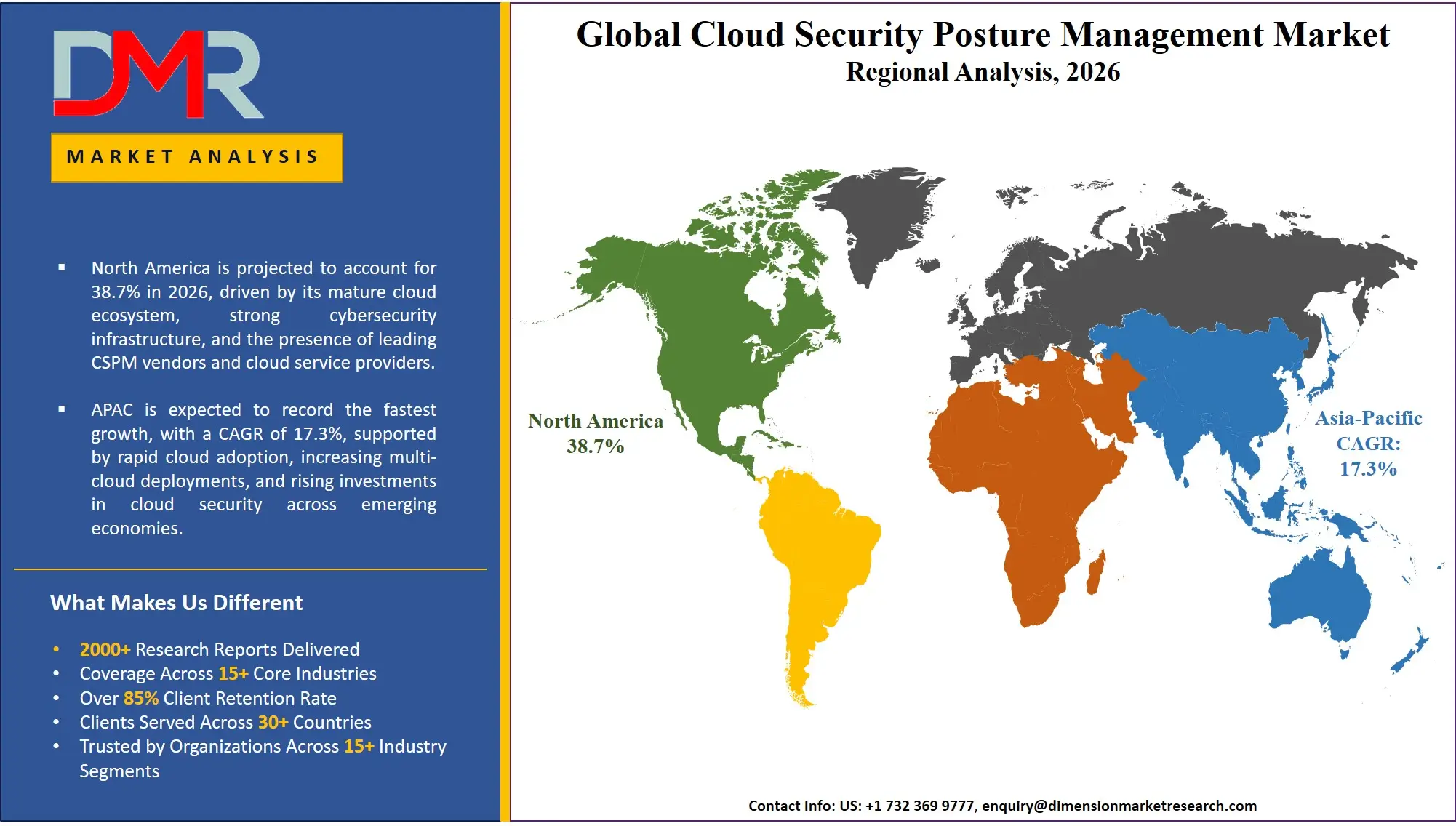
It is projected that North America will take the lead in the global CSPM market, covering a market share of about 38.7% in the year 2026. The region's dominance is driven by the early and widespread adoption of cloud infrastructure across enterprises, the presence of major CSPM vendors and cloud service providers, stringent regulatory frameworks such as HIPAA, SOX, and CCPA, and significant government mandates like FedRAMP and the national zero-trust strategy. The widespread adoption of advanced cloud security processing and automation for multi-cloud environments, workload protection, and long-term compliance management further strengthens North America's leading position. Additionally, ongoing investments in AI-driven cloud security monitoring and cross-platform system interoperability further reinforce the region's technology leadership.
ℹ
To learn more about this report –
Download Your Free Sample Report Here
Fastest-Growing Region in the Cloud Security Posture Management Market
Asia-Pacific is the fastest-growing region, supported by strong digital cloud security infrastructure goals in China, India, and Japan, increasing cloud security awareness efforts, rising investments in local CSPM capabilities, and growing adoption of automated cloud compliance analysis systems. The region benefits from well-established digital payment systems for cloud services, increasing business activity, and alignment with national cloud-first roadmaps. Countries across the region are actively setting up CSPM platforms to improve cloud security efficiency and strengthen cybersecurity infrastructure. Growing focus on cloud security research and structured data development further speeds up market expansion. Moreover, increasing government support and corporate cloud security commitments are expected to keep growth momentum high.
By Region
North America
Europe
- Germany
- The U.K.
- France
- Italy
- Russia
- Spain
- Benelux
- Nordic
- Rest of Europe
Asia-Pacific
- China
- Japan
- South Korea
- India
- ANZ
- ASEAN
- Rest of Asia-Pacific
Latin America
- Brazil
- Mexico
- Argentina
- Colombia
- Rest of Latin America
Middle East & Africa
- Saudi Arabia
- UAE
- South Africa
- Israel
- Egypt
- Rest of MEA
Competitive Landscape
The global cloud security posture management market is highly competitive, with new ideas and strategic partnerships shaping the competitive environment. To gain an advantage, companies and providers are focused on developing better digital platforms (such as AI-driven posture engines, automated compliance verification systems, and mobile apps for risk management), smart data analysis, and cloud-native security monitoring. There are high barriers to entering the market due to the large amount of money needed for regulatory approval, specialized cloud security market knowledge, and the need for mature software systems and rule-following.
Strategic approaches to increase market presence include partnerships with cloud security research groups and compliance registries, mergers between software providers and security operators, and long-term support contracts with customers and government institutions. Additionally, research and development in data-sharing rules and flexible software designs are important for staying competitive and meeting the changing needs of the cloud security community.
Some of the prominent players in the Global Cloud Security Posture Management Market are:
- Microsoft Corporation
- Palo Alto Networks, Inc.
- Check Point Software Technologies Ltd.
- CrowdStrike Holdings, Inc.
- Trend Micro Incorporated
- Fortinet, Inc.
- Zscaler, Inc.
- Qualys, Inc.
- International Business Machines Corporation
- Cisco Systems, Inc.
- Netskope, Inc.
- Sophos Ltd.
- Wiz, Inc.
- Orca Security Ltd.
- Aqua Security Software Ltd.
- Sysdig, Inc.
- Tenable Holdings, Inc.
- Rapid7, Inc.
- Lacework, Inc.
- Snyk Ltd.
- Other Key Players
Recent Developments
- March 2026: Wiz, Inc. was acquired by Google for USD 32 billion, marking the largest cybersecurity acquisition to date. The deal aims to build a unified, AI-driven cloud security platform within Google Cloud while maintaining Wiz's multi-cloud capabilities.
- September 2025: Check Point Software Technologies Ltd. expanded its strategic partnership with Wiz, Inc., launching a fully integrated CNAPP and cloud network security solution with real-time visibility and AI-powered threat prevention.
- October 2025: Palo Alto Networks, Inc. introduced Cortex Cloud 2.0 along with AI-driven security platforms, enhancing its Prisma Cloud capabilities with autonomous AI agents, a unified cloud command center, and improved cloud detection and response.
Report Details
| Report Characteristics |
| Market Size (2026) |
USD 6.8 Bn |
| Forecast Value (2035) |
USD 24.5 Bn |
| CAGR (2026-2035) |
15.2% |
| The US Market Size (2026) |
USD 2.2 Bn |
| Historical Period |
2021 – 2025 |
| Forecast Period |
2027 – 2035 |
| Base Year |
2025 |
| Estimated Year |
2026 |
| Segments Covered |
By Component, By Cloud Model, By Deployment Mode, By Organization Size, By Cloud Service Provider, By Industry Vertical |
| Regional Coverage |
North America – The US and Canada; Europe – Germany, The UK, France, Russia, Spain, Italy, Benelux, Nordic, & Rest of Europe; Asia-Pacific – China, Japan, South Korea, India, ANZ, ASEAN, Rest of APAC; Latin America – Brazil, Mexico, Argentina, Colombia, Rest of Latin America; Middle East & Africa – Saudi Arabia, UAE, South Africa, Turkey, Egypt, Israel, & Rest of MEA |
Frequently Asked Questions
How big is the Global Cloud Security Posture Management Market?
▾ The Global Cloud Security Posture Management Market size is estimated to have a value of USD 6.8 billion in 2026 and is expected to reach USD 24.5 billion by the end of 2035.
What is the CAGR of the Global Cloud Security Posture Management Market from 2026 to 2035?
▾ The market is growing at a CAGR of 15.2% over the forecasted period.
What factors are driving the growth of the Global Cloud Security Posture Management Market?
▾ The market is driven by advances in smart software-based cloud security processing, regulatory pressure to speed up cloud compliance results and reduce misconfiguration mistakes, and increased government investment in national digital cloud security infrastructure.
What are the major trends in the Global Cloud Security Posture Management Market?
▾ The key market trends include the adoption of predictive cloud risk tracking and real-time posture data analysis, along with a growing shift toward AI-native cloud security platforms and data-enabled asset management systems.
Which region held the largest share of the Global Cloud Security Posture Management Market in 2026?
▾ North America is expected to account for the largest market share in 2026, with a share of about 38.7%.
Which region is expected to grow the fastest in the Global Cloud Security Posture Management Market?
▾ Asia Pacific is the fastest-growing region in the market during the forecast period.
Who are the key players in the Global Cloud Security Posture Management Market?
▾ Some of the major key players in the Global CSPM Market are Palo Alto Networks, Wiz, Inc., Orca Security Ltd., CrowdStrike Holdings Inc., Microsoft Corporation, Cisco Systems, Inc., and many others.
How is the Global Cloud Security Posture Management Market segmented?
▾ The market is segmented by component, cloud model, deployment mode, organization size, cloud service provider, and industry vertical.