Global Commercial Insurance Market Snapshot
- Global Commercial Insurance Market Size in 2026: USD 1,096.8 Billion
- Global Commercial Insurance Market Size in 2035: USD 2,248.5 Billion
- Global CAGR from 2026 to 2035: 8.3%
- Commercial Property Insurance is the leading insurance product segment in 2026: 29.8%
- Large Enterprises is the leading business size segment in 2026: 67.1%
- Manufacturing is the leading industry vertical segment in 2026: 22.3%
- Insurance Agents & Brokers is the leading distribution channel segment in 2026: 56.8%
- North America is the leading region in 2026: 38.1%
What is the Global Commercial Insurance and its Market Size?
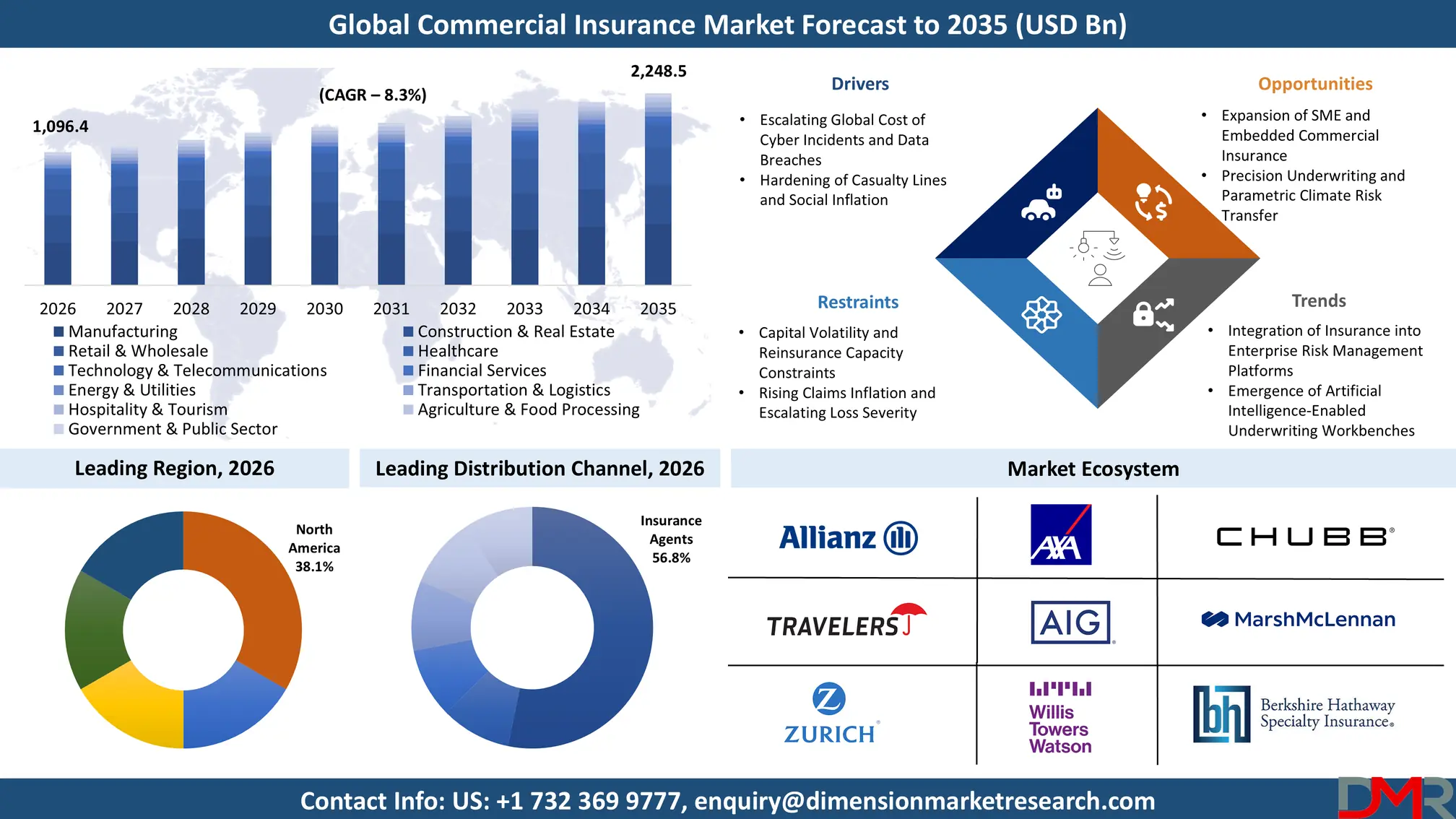
The Global Commercial Insurance Market is projected to be valued at USD 1,096.8 billion in 2026 and is projected to reach USD 2,248.5 billion by 2035, expanding at a CAGR of 8.3% during the forecast period.
ℹ
To learn more about this report –
Download Your Free Sample Report Here
Growth is being propelled by the increasing complexity of global business operations, the escalating frequency and severity of cyber-attacks and ransomware incidents, and the expansion of intangible asset exposures that demand sophisticated professional indemnity and directors & officers (D&O) protection. The hardening of the global reinsurance market, coupled with evolving climate risk disclosures mandating robust physical and transition risk coverage, is reshaping underwriting and pricing paradigms. Investment is accelerating as brokers, carriers, and insurtechs pivot from reactive claims settlement toward predictive risk mitigation, utilizing AI-powered exposure modeling and parametric solutions to manage the escalating cost of business interruption and supply chain disruption across interconnected enterprises.
Use Cases
- Supply Chain Resilience and Business Interruption Risk Transfer: Multinational manufacturing and retail corporations deploy a layered program of commercial property insurance with contingent business interruption extensions to indemnify against income losses stemming from physical damage to tier-1 and tier-2 suppliers.
- Cyber Extortion and Ransomware Incident Response: Mid-market and large enterprises across all industry verticals rely on standalone cyber insurance policies that cover not only data breach notification costs and forensic investigation but also ransom payments negotiated by specialist incident response firms.
- Executive Liability Protection in Securities Class Actions: Publicly traded corporations and high-growth startups purchase D&O liability insurance within financial & professional lines to shield personal assets of directors and officers from allegations of mismanagement, misleading disclosures, or breaches of fiduciary duty.
- Integrated Contractor Risk Management on Construction Sites: Project owners and general contractors mandate a comprehensive suite of specialty insurance, including construction all-risk, professional indemnity for design-build, and surety bonds, to secure project completion.
Key Takeaways
- Market Size: The Global Commercial Insurance Market is anticipated to be valued at USD 1,096.8 billion in 2026 and is forecast to reach USD 2,248.5 billion by 2035, expanding at a CAGR of 8.3%.
- Growth Outlook: Market expansion is sustained by the inexorable rise in cyber risk, the tightening of D&O and professional indemnity underwriting, the shift toward alternative capital and insurance-linked securities (ILS), and the integration of insurtech APIs that embed commercial insurance products directly into enterprise resource planning and procurement platforms.
- Primary Growth Drivers: A mounting frequency of social inflation-driven liability claims, breakthrough regulatory mandates for climate-related financial disclosures, increasing third-party litigation funding, and shifting payment models toward usage-based and on-demand commercial lines are accelerating investment across the risk transfer continuum.
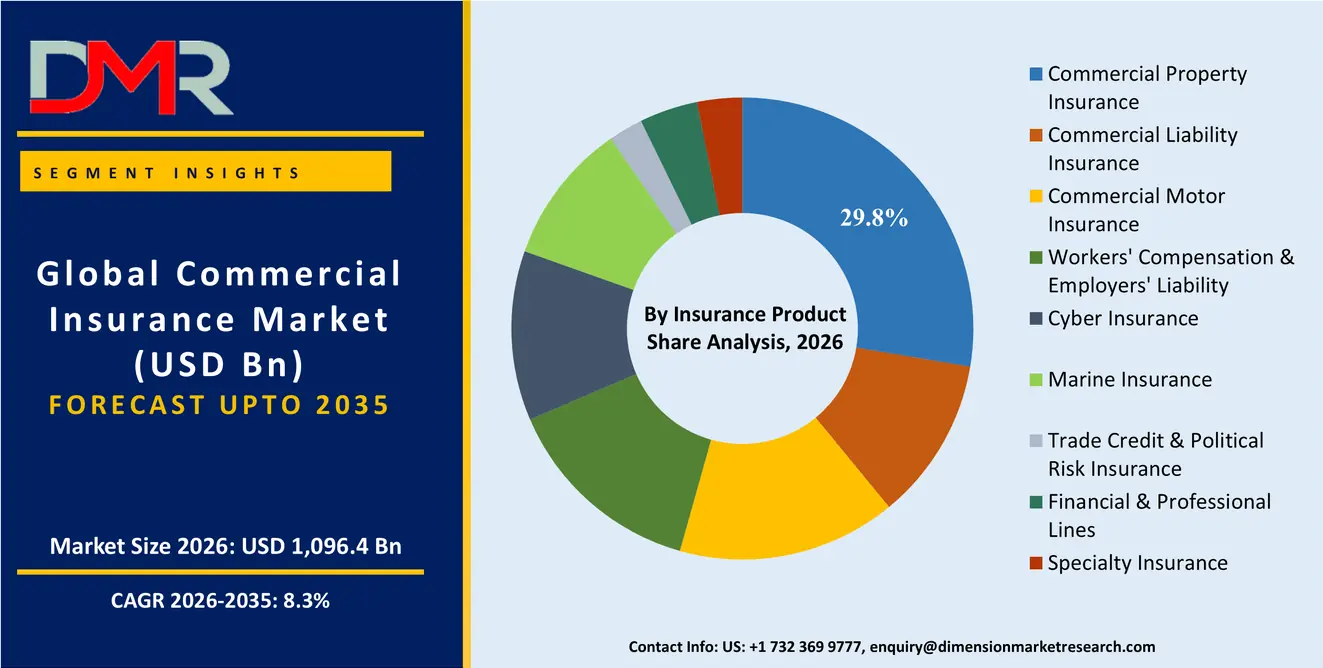
- By Insurance Product Analysis: Commercial Property Insurance is projected to lead the product segment with a dominant 29.8% share in 2026, driven by the universal mandate for protecting physical assets buildings, equipment, and inventory against fire, natural catastrophe, and business interruption, reflecting the rising insured values of globally integrated corporate balance sheets.
- By Business Size Analysis: Large Enterprises is expected to dominate with a 67.1% share in 2026, supported by their complex risk profiles, multifaceted multi-line insurance programs, global placement structures, and the significant premium volumes generated by industrial all-risks and excess liability towers.
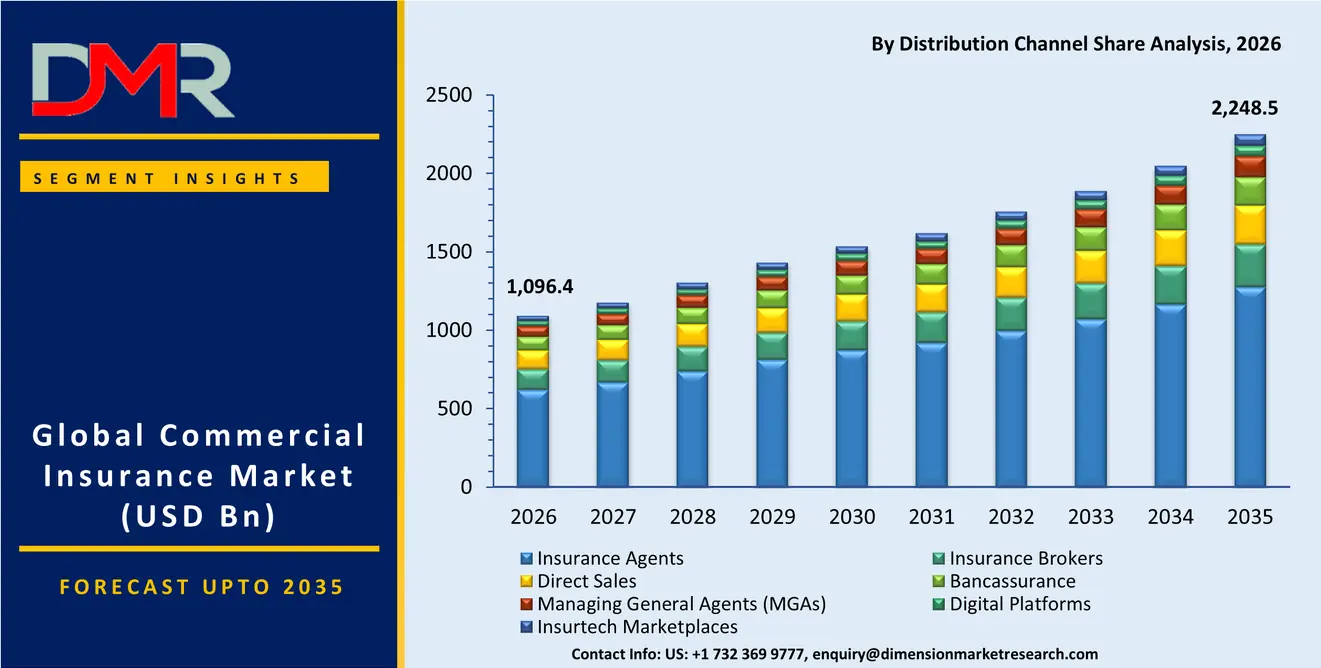
- By Distribution Channel Analysis: Insurance Agents & Brokers is anticipated to hold a 56.8% share in 2026, reflecting their entrenched role in advisory-led, complex risk placement and the deep relationships held by wholesale and retail brokers with large corporate buyers. Digital Platforms are projected to exhibit the highest CAGR at 10.2% due to the digitization of small commercial lines and the rise of embedded insurance marketplaces.
- By Industry Vertical Analysis: Manufacturing is poised to lead with a 22.3% share in 2026, representing the largest insured sector due to its extensive exposure to property damage, heavy machinery, product recall, and global supply chain disruption. Technology & Telecommunications is the fastest-expanding vertical at a 9.2% CAGR, driven by surging cyber liability, errors & omissions, and intellectual property infringement insurance demand.
- Growth Analysis: Financial & Professional Lines is projected to record the highest CAGR of 8.8% from 2026 to 2035, fueled by a boom in M&A-related representations and warranties insurance, heightened D&O litigation, and the tightening of professional indemnity markets for consultants and financial advisors.
How AI/Gen AI is Transforming the Commercial Insurance Market ?
Artificial intelligence and insurtech innovations are fundamentally reshaping commercial insurance by enabling superior risk selection, automated underwriting, and proactive loss control. Machine learning algorithms trained on vast corpora of loss run triangles, financial statements, and cyber hygiene telemetry dynamically generate predictive risk scores for individual businesses, enabling underwriters to move beyond historical burning cost models. These predictive models are being embedded into submission intake portals that automatically ingest broker PDFs, extract unstructured data, and pre-fill applications, slashing time-to-quote for small and medium enterprise (SME) packages. Generative AI further assists brokers by synthesizing complex policy wordings into plain language summaries and comparing coverage differences across competing market quotations in real-time, elevating the advisory conversation.
Key Drivers in the Global Commercial Insurance Market
Escalating Global Cost of Cyber Incidents and Data Breaches
Ransomware-as-a-service, state-sponsored cyber warfare, and systemic cloud outage aggregation remain the dominant forces behind cyber insurance demand, with extortion events and third-party data breaches accounting for the majority of large-loss notifications worldwide. The unabated rise in remote work, digital supply chain interconnections, and stringent privacy regulations is expanding the pool of enterprises requiring standalone cyber liability, breach response, and business interruption coverage. As the global average cost of a data breach surpasses multi-million dollar thresholds, the downstream demand for incident response vendors, forensic accounting, and legal breach coach services intensifies commensurately.
Hardening of Casualty Lines and Social Inflation
Landmark jury verdicts and the proliferation of third-party litigation funding over the past decade have repositioned commercial liability insurance, umbrella policies, and excess casualty towers as critical board-level concerns independent of economic cycles. The robust nuclear verdict trends demonstrated in commercial auto and product liability claims have triggered major retrenchment and rate hardening across the London Market and domestic surplus lines carriers, expanding the premium base and demand for structured reinsurance solutions. This evidence-driven underwriting discipline and capacity scarcity is generating sustained, high-volume demand for general liability and D&O coverage, elevating the specialty lines segment’s market dominance and propelling double-digit growth for reinsurers and managing general agents (MGAs) focused on non-correlated risk.
Restraints in the Global Commercial Insurance Market
Capital Volatility and Reinsurance Capacity Constraints
Despite being life-sustaining for corporate risk transfer, peak natural catastrophe perils and systemic cyber aggregation impose catastrophic underwriting losses on carriers, particularly in retrocession and catastrophe bond markets where trapped capital drives families of ILS funds into negative returns. Large-scale property cat events require substantial balance sheet resilience, advanced exposure management, and disciplined underwriting, limiting capacity availability in coastal and wildfire-prone regions. Even in diversified global carriers, the cost of property catastrophe excess-of-loss reinsurance frequently exceeds risk-adjusted technical premiums, creating unsustainable pressure on ceding commissions and policyholder surplus
Growth Opportunities in the Global Commercial Insurance Market
Expansion of SME and Embedded Commercial Insurance
The global shift toward digital platforms and API-driven distribution represents a high-growth opportunity for insurtech MGAs, incumbent carriers, and software-as-a-service (SaaS) providers. Insurtech marketplaces are incentivizing embedded product penetration through usage-based and micro-duration commercial policies that reward reduced idle time and improved driver telematics with dynamic pricing. This creates a fertile market for user-friendly online quote-and-bind portals, connected risk management dashboards, and instant certificate issuance services.
Precision Underwriting and Parametric Climate Risk Transfer
Emerging alternative data sources including satellite-based flood mapping, IoT sensor data for water leakage, and supply chain shipment tracking are enabling precise risk segmentation beyond traditional industry classification codes. This paves the way for a precision underwriting market where parametric insurance products are triggered by objective indices (e.g., wind speed, earthquake magnitude) rather than generic loss adjustment. Brokers and carriers that develop and syndicate validated, reinsurer-backed parametric facilities capable of providing immediate claims liquidity post-catastrophe will unlock a premium-priced protection gap market.
Trends in the Global Commercial Insurance Market
Integration of Insurance into Enterprise Risk Management Platforms
A defining trend is the dissolution of silos between insurance procurement, corporate treasury, and operational risk management, driven by the shared objective of total cost of risk reduction. Corporate practice is consolidating around holistic captive utilization that simultaneously finances property, liability, and cyber exposures. This convergence is expanding the use of structured programs with multi-year commitments and fostering the development of integrated insurtech platforms that track claims, exposures, and coverage gaps on a single analytics dashboard. The market implications include broader multi-line underwriting, increased reinsurance utilization, and the rise of holistic risk advisory consultancies.
Emergence of Artificial Intelligence-Enabled Underwriting Workbenches
Digital underwriting augmented by large language models is transforming the interpretation of broker submissions and loss control reports. AI models trained on historical quote data and loss triangles can now triage incoming new business, flagging those matching the carrier’s ideal risk appetite with underwriter-level accuracy. This trend is commercializing as cloud-based AI triage services that insurance companies adopt to standardize risk selection, reduce quote turnaround times, and enrich portfolio management with real-time accumulation control.
Research Scope and Analysis
The Global Commercial Insurance Market is segmented by insurance product, business size, distribution channel, and industry vertical. Products cover property, liability, motor, workers' compensation, cyber, marine, trade credit, financial lines, and specialty insurance. Distribution channels include agents, brokers, direct sales, bancassurance, MGAs, digital platforms, and insurtech marketplaces. Industry verticals span manufacturing, construction, healthcare, technology, and financial services.
ℹ
To learn more about this report –
Download Your Free Sample Report Here
By Insurance Product Analysis
Commercial Property Insurance is projected to dominate the insurance product segment, accounting for 29.8% of the Commercial Insurance Market in 2026. Its leadership is supported by substantial insured values associated with commercial buildings, manufacturing facilities, equipment, inventories, and business interruption exposures. Demand is further strengthened by rising replacement costs, climate-related losses, infrastructure expansion, and increasing requirements for comprehensive property protection among enterprises. Meanwhile, Financial and Professional Lines are projected to record the highest CAGR of 8.8% through 2035, supported by increasing demand for directors and officers liability, professional indemnity, errors and omissions, and specialized financial risk protection.
By Business Size Analysis
Large Enterprises is expected to dominate the business-size segment, holding 67.1% of the Commercial Insurance Market in 2026. Large organizations typically maintain extensive physical assets, large workforces, complex supply chains, fleets, multinational operations, and higher liability exposures, resulting in substantial demand for multi-line and high-limit insurance programs. Their requirements often encompass property, liability, cyber, marine, professional, and specialty insurance under integrated risk-management arrangements. Meanwhile, Small and Medium-sized Enterprises (SMEs) are expected to register the highest CAGR of 7.5% through 2035, driven by business formalization, increasing risk awareness, digital insurance accessibility, and adoption of standardized commercial insurance packages.
By Industry Vertical Analysis
Manufacturing is poised to dominate the industry vertical segment, accounting for 22.3% of the Commercial Insurance Market in 2026. Manufacturers face diverse operational exposures involving factories, machinery, employees, inventory, product liability, transportation, business interruption, and supply-chain disruptions, creating demand for multiple commercial insurance products. High capital intensity and significant potential losses further support higher insurance spending within this industry. Meanwhile, Technology and Telecommunications is projected to experience the highest CAGR of 9.2% through 2035, primarily due to rapidly increasing cyber threats, data privacy exposures, technology errors, intellectual property risks, cloud infrastructure dependence, and growing demand for professional liability and cyber insurance.
By Distribution Channel Analysis
Insurance Agents and Brokers is projected to dominate the distribution channel segment, collectively accounting for 56.8% of the Commercial Insurance Market in 2026. Their leadership is supported by the complex nature of commercial risks, which often requires specialized risk assessment, policy customization, insurer negotiations, placement expertise, and claims support.
ℹ
To learn more about this report –
Download Your Free Sample Report Here
Brokers are particularly important for large enterprises, specialty risks, and multinational insurance programs where multiple insurers may participate. Meanwhile, Digital Platforms are expected to register the highest CAGR of 10.2% through 2035, driven by automated underwriting, AI-enabled quotations, embedded insurance, online policy comparison, and increasing digital adoption among SMEs seeking faster and simplified commercial insurance purchasing.
The Global Commercial Insurance Market Report is segmented based on the following:
By Insurance Product
- Commercial Property Insurance
- Buildings
- Equipment & Machinery
- Inventory
- Business Interruption
- Commercial Liability Insurance
- General Liability
- Product Liability
- Professional Indemnity
- Directors & Officers (D&O)
- Commercial Motor Insurance
- Fleet Insurance
- Commercial Auto Liability
- Workers' Compensation & Employers' Liability
- Cyber Insurance
- Cyber Liability
- Data Breach & Incident Response
- Marine Insurance
- Marine Cargo
- Inland Transit
- Trade Credit & Political Risk Insurance
- Financial & Professional Lines
- Specialty Insurance
- Aviation
- Energy
- Construction
- Agriculture
- Environmental
- Surety
By Business Size
- Micro Enterprises
- Small Enterprises
- Medium Enterprises
- Large Enterprises
- Multinational Corporations
By Distribution Channel
- Insurance Agents
- Insurance Brokers
- Direct Sales
- Bancassurance
- Managing General Agents (MGAs)
- Digital Platforms
- Insurtech Marketplaces
By Industry Vertical
- Manufacturing
- Construction & Real Estate
- Retail & Wholesale
- Healthcare
- Technology & Telecommunications
- Financial Services
- Energy & Utilities
- Transportation & Logistics
- Hospitality & Tourism
- Agriculture & Food Processing
- Government & Public Sector
Regional Analysis
North America is the Leading Region in the Global Commercial Insurance Market
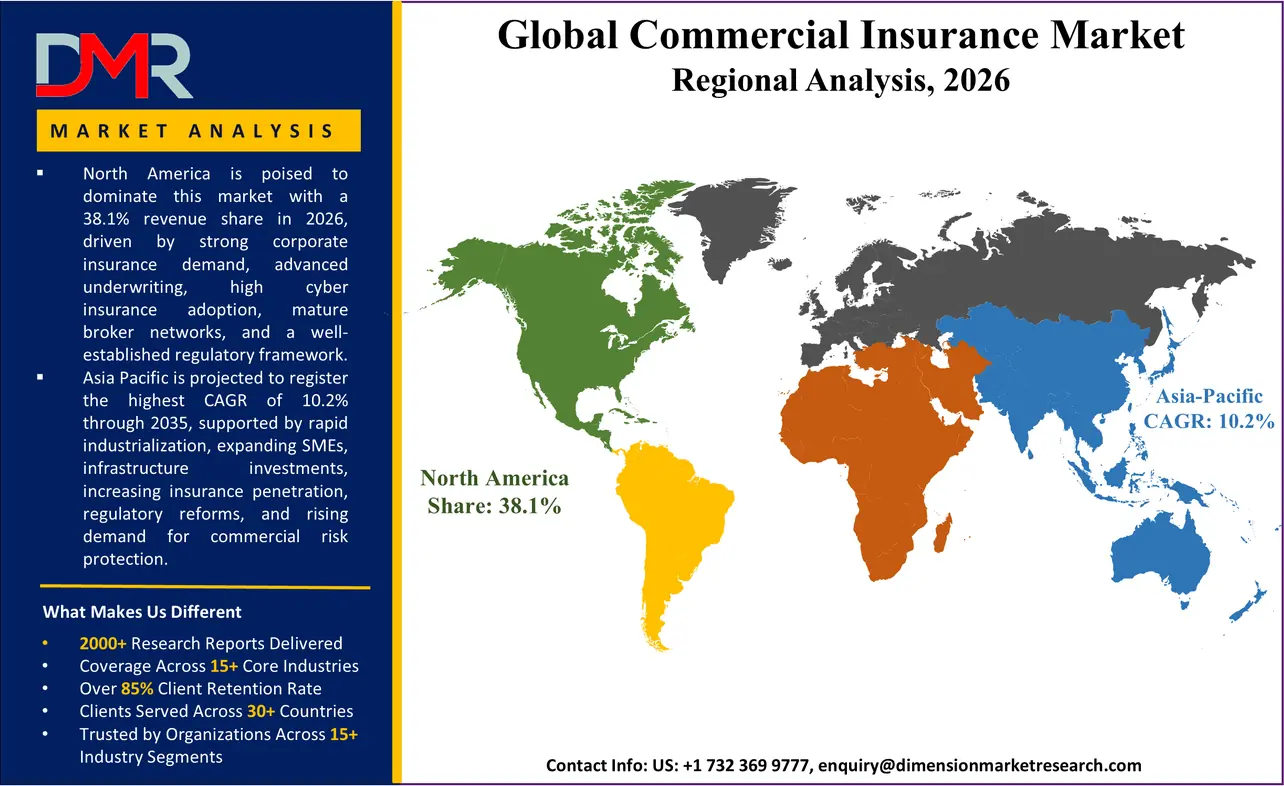
North America is poised to lead the Global Commercial Insurance Market with an estimated 38.1% revenue share in 2026. The region’s dominance is anchored by a highly litigious business environment, the greatest concentration of Fortune 500 global headquarters, and a mature, well-capitalized excess & surplus lines infrastructure dominated by major wholesale brokers. The United States, in particular, is characterized by early and broad adoption of innovative liability protection like standalone cyber and D&O insurance, robust litigation financing influencing severity trends, and a dynamic captive insurance ecosystem supported by federal policy reforms favoring onshore domiciles.
ℹ
To learn more about this report –
Download Your Free Sample Report Here
Asia Pacific is the Fastest-Growing Region in the Global Commercial Insurance Market
Asia Pacific is projected to register the fastest CAGR of 10.2% through 2035, driven by the region’s enormous and rapidly expanding industrial base, massive foreign direct investment in infrastructure development, and the maturation of regulatory frameworks for compulsory lines, particularly in China and India, which together account for a dominant share of the region’s corporate formation. Economic development is enabling massive investments in commercial property covers, with both local and international (re)insurers rapidly expanding capacity to meet previously unmet corporate demand for business interruption and construction all-risk. Additionally, governments are implementing national credit guarantee schemes and trade credit insurance programs that are boosting SME insurance penetration and risk management practices.
The Europe Commercial Insurance Market
Europe represents one of the largest regional markets, characterized by robust Solvency II regulatory oversight that mandates comprehensive capital adequacy, though with significant cross-national variation in corporate insurance buying patterns and broker concentration. Germany holds the largest European market share, driven by its massive industrial manufacturing sector ("Mittelstand"), deep industrial insurer expertise, and broad coverage for innovative green technology performance guarantees. The European Insurance and Occupational Pensions Authority’s (EIOPA) push for cyber resilience stress testing and the growing adoption of climate transition plans are driving demand for environmental liability and renewable energy insurance across the continent.
Latin America Commercial Insurance Market
The Latin America Commercial Insurance Market is expanding as a dual burden of political risk, associated with contract frustration and inconvertibility, and a high frequency of business interruption losses from supply chain fragmentation drives corporate spending upward. Brazil and Mexico are the primary national markets, with Brazil’s large agribusiness and energy sectors funding significant surety and property programs. Mexico’s proximity to U.S. supply chains and the nearshoring trend fuel demand for commercial auto and transit insurance. Growth is constrained by high interest rates and currency volatility impacting reinsurance purchasing capacity.
Middle East and Africa Commercial Insurance Market
The Middle East and Africa Commercial Insurance Market is developing against a backdrop of soaring construction megaprojects in Gulf Cooperation Council (GCC) countries and a substantial infrastructure gap in sub-Saharan Africa driving demand for engineering, construction, and political risk covers. Saudi Arabia and the United Arab Emirates are the most attractive markets, with high government capital expenditure, expansive construction all-risk and delay-in-start-up insurance programs, and active captive formations driven by national Vision 2030 and economic diversification mandates.
Major Countries Analysis
The US Commercial Insurance Market
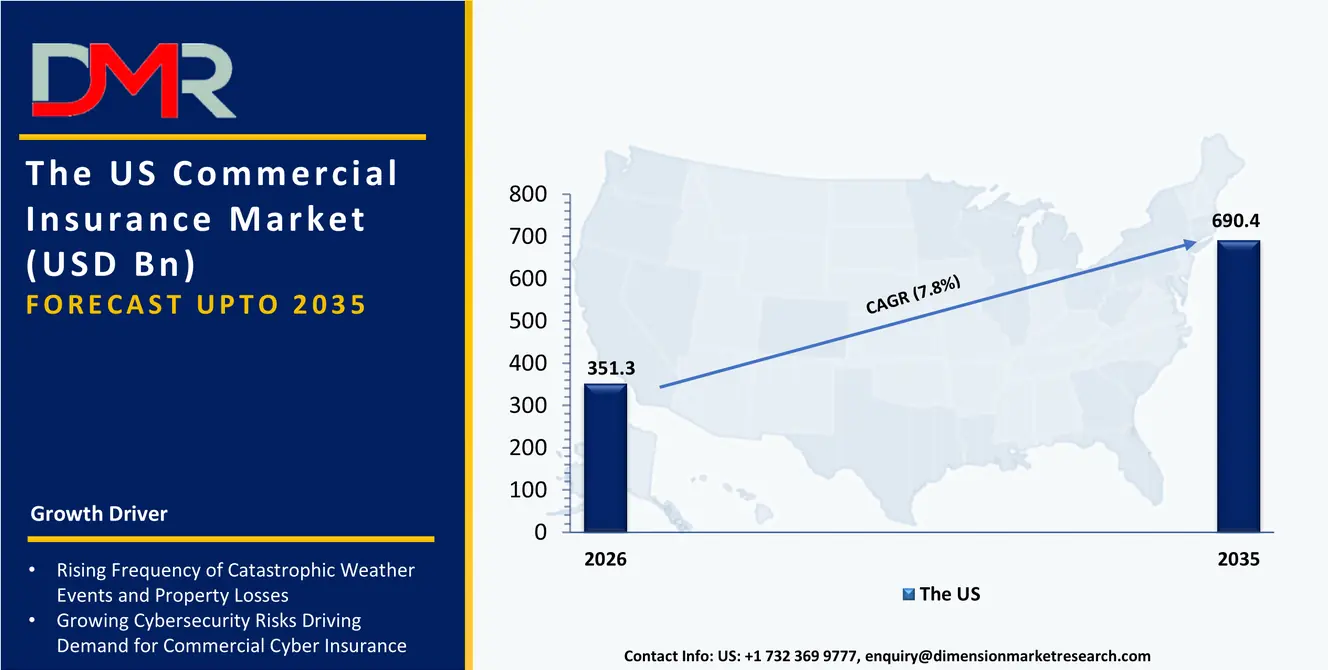
The United States Commercial Insurance Market is projected to be valued at USD 351.3 billion in 2026 and is expected to reach USD 690.4 billion by 2035, registering a CAGR of 7.8% from 2026 to 2035. This robust trajectory reflects the U.S.’s position as the highest-value single-country corporate insurance market globally, underpinned by an estimated unmatched density of commercial litigation and expansive corporate balance sheet values. Growth is fueled by the hard property-catastrophe pricing environment, transformative social inflation trends impacting general and auto liability, and the rapid shift toward admitted cyber carrier solutions as systemic risk aggregation fears moderate standalone market volatility.
ℹ
To learn more about this report –
Download Your Free Sample Report Here
Japan Commercial Insurance Market
Japan possesses a sophisticated corporate insurance market, a consequence of its export-oriented industrial base and high susceptibility to natural catastrophe exposures like earthquakes and typhoons, sustained by a unique mutual-aid corporate culture (Kyosai). The market is distinguished by deep penetration of earthquake business interruption covers, high utilization of alternative capital through Japanese ILS structures, and early corporate adoption of parametric covers for supply chain disruption. The General Insurance Association of Japan’s influential guidelines and the national push for corporate digital transformation under Society 5.0 are driving a spike in cyber and technology E&O purchasing among Japanese multinationals.
Saudi Arabia Commercial Insurance Market
Market expansion is directly tied to the Kingdom’s Vision 2030 and massive Giga-projects, which together drive a rapid increase in demand for construction all-risk, surety bonds, and specialized marine cargo insurance. The Saudi Central Bank (SAMA) oversees a maturing regulatory environment mandating compulsory third-party motor and health insurance for expatriate workforces, while the Public Investment Fund supports a growing industrial base requiring industrial all-risks programs. Economic transformation ambitions, which emphasize public-private partnerships and digital health, are opening significant opportunities for international reinsurers, global brokers, and insurtech platforms offering compliance-focused insurtech marketplaces.
Regulatory Landscape
In the European Union, Solvency II provides the dominant framework, mandating a risk-based capital calculation that influences the capacity that insurers and reinsurers can deploy to volatile lines like commercial property natural catastrophe and directors & officers liability. The ongoing Solvency UK reforms and the EU’s Solvency II Review aim to unlock long-term capital for green infrastructure investment, directly impacting insurers’ ability to underwrite multi-year energy and construction risk. In the United States, the National Association of Insurance Commissioners (NAIC) coordinates state-based solvency regulation, with a specific focus on the growing use of captive insurance entities by large corporations. The NAIC’s accreditation standards and Own Risk and Solvency Assessment (ORSA) requirements compel captive managers to demonstrate robust liquidity stress testing for fronted deductible reimbursements in workers' compensation and general liability programs.
White Space Analysis
A significant white space exists in the underinsurance of micro and small enterprises, which collectively represent the vast majority of global businesses yet account for a disproportionately low share of commercial premium. These entities often rely on personal lines or remain entirely uninsured against business interruption, cyber extortion, and professional indemnity claims, representing a massive latent protection gap. Incumbents and insurtech marketplaces that can crack the code of instant, algorithmic underwriting for these homogeneous risks offering embedded commercial insurance products at the point of sale within accounting, e-commerce, or payment processing platforms will unlock a premium pool that has historically been uneconomical for traditional broker-led distribution.
By Region
North America
Europe
- Germany
- France
- The U.K.
- Italy
- Spain
- Rest of Europe
Asia-Pacific
- China
- Japan
- India
- Australia
- South Korea
- Rest of APAC
Latin America
- Mexico
- Brazil
- Rest of LATAM
Middle East & Africa
- Saudi Arabia
- The UAE
- South Africa
- Rest of MEA
Competitive Landscape
The Global Commercial Insurance Market features a diverse competitive landscape spanning multinational global carriers, specialist London Market syndicates, wholesale surplus lines insurers, and disruptive insurtech MGAs. Aon, Marsh McLennan, and Willis Towers Watson dominate the commercial brokerage and risk advisory services market through extensive networks of global placement hubs and a growing portfolio of proprietary analytics and captives management technologies. Zurich Insurance Group and Chubb Limited are leading carriers in multinational programs, competing on the strength of their global network licenses and in-house risk engineering capabilities.
Some of the prominent players in the Global Commercial Insurance Market are:
- Allianz SE
- AXA SA
- Zurich Insurance Group
- Chubb Limited
- AIG (American International Group)
- The Travelers Companies, Inc.
- Marsh McLennan
- Aon plc
- WTW (Willis Towers Watson)
- Liberty Mutual Insurance
- Berkshire Hathaway Specialty Insurance
- The Hartford Financial Services Group
- CNA Financial Corporation
- Tokio Marine Holdings, Inc.
- Sompo Holdings, Inc.
- MS&AD Insurance Group Holdings
- Munich Re
- Swiss Re
- HDI Global SE
- QBE Insurance Group
- RSA Insurance (Intact Financial Corporation)
- Intact Financial Corporation
- Aviva plc
- Mapfre S.A.
- Generali Group
- Admiral Group plc
- Suncorp Group
- PICC Property and Casualty Company Limited
- Ping An Insurance (Group) Company of China, Ltd.
- China Pacific Insurance (CPIC)
- The Hanover Insurance Group
- Everest Group, Ltd.
- Arch Capital Group Ltd.
- AXIS Capital Holdings Limited
- Fairfax Financial Holdings Limited
- Markel Group Inc.
- FM Global
- Hiscox Ltd.
- RLI Corp.
- Zurich North America
- Other Key Players
Recent Developments
- May 2026: Allianz Commercial announced a strategic partnership with Coalition to transition its commercial cyber insurance business, strengthening its cyber risk protection capabilities for business customers.
- May 2026: Zurich Insurance Group reported that its Commercial Insurance gross written premiums increased by 9% in Q1 2026, driven by strong performance in Global Specialty and Middle Market businesses.
- February 2026: Zurich Insurance Group reached agreement on key terms to acquire Beazley plc for £8 billion, expanding its presence in specialty commercial insurance, including cyber, construction, energy, marine, and aviation insurance.
Report Details
| Report Characteristics |
| Market Size (2026) |
USD 1,096.4 Bn |
| Forecast Value (2035) |
USD 2,248.5 Bn |
| CAGR (2026–2035) |
8.3% |
| The US Market Size (2026) |
USD 351.3 Bn |
| Historical Data |
2021 – 2025 |
| Forecast Data |
2027 – 2035 |
| Base Year |
2025 |
| Estimate Year |
2026 |
| Segments Covered |
By Insurance Product, By Business Size, By Distribution Channel, and By Industry Vertical |
| Regional Coverage |
North America – The US and Canada; Europe – Germany, France, The UK, Italy, Spain, Rest of Europe; Asia-Pacific – China, Japan, India, Australia, South Korea, Rest of APAC; Latin America – Mexico, Brazil, Colombia, Argentina, Rest of LATAM; Middle East & Africa – Saudi Arabia, The UAE, South Africa, Rest of MEA |
Frequently Asked Questions
How big is the Global Commercial Insurance Market?
▾ The Global Commercial Insurance Market is valued at USD 1,096.8 billion in 2026 and is projected to reach USD 2,248.5 billion by 2035, reflecting strong global demand for corporate property, liability, cyber, and specialty risk transfer solutions across all industry verticals.
What is the CAGR of the Global Commercial Insurance Market from 2026 to 2035?
▾ The market is projected to expand at a compound annual growth rate (CAGR) of 8.3% between 2026 and 2035, supported by sustained rate hardening in casualty lines, explosive cyber insurance adoption, and the digital transformation of SME insurance distribution.
What factors are driving the growth of the Global Commercial Insurance Market?
▾ Growth is driven by the escalating frequency and severity of ransomware attacks, social inflation and nuclear jury verdicts expanding liability exposures, tightening regulatory mandates for climate and cyber risk disclosure, and the rise of embedded insurtech platforms that are closing the micro and small enterprise protection gap.
What are the major trends in the Global Commercial Insurance Market?
▾ Major trends include the shift toward parametric and index-based specialty covers for climate and supply chain risks, the convergence of insurance with enterprise risk management dashboards, AI-powered underwriting workbenches for mid-market property and management liability, the rapid expansion of MGAs offering digital-first financial & professional lines, and the integration of satellite imagery and IoT telemetry into loss control engineering.
Which region held the largest share of the Global Commercial Insurance Market in 2026?
▾ North America is expected to lead the global market with a 38.1% share in 2026, translating to a market size of USD 418.0 billion. This dominance is supported by the high litigation environment, a mature surplus lines and reinsurance infrastructure, and the greatest concentration of large enterprise corporate headquarters.
Which region is expected to grow the fastest in the Global Commercial Insurance Market?
▾ Asia Pacific is expected to record the fastest growth at a 10.2% CAGR through 2035, driven by massive infrastructure investment, rapid corporate formation in China and India, and the maturation of compulsory commercial lines and trade credit insurance frameworks across the region.
Which insurance product segment holds the largest market share?
▾ Commercial Property Insurance is the leading product segment, holding a 29.8% share in 2026. Its dominance is anchored by universal corporate mandates to cover buildings, equipment, machinery, and business interruption exposures, reflecting the escalating replacement costs of physical assets.
Who are the key players in the Global Commercial Insurance Market?
▾ Key market participants include global carriers and brokers such as Allianz SE, Aon plc, Marsh McLennan, Chubb Limited, Zurich Insurance Group, AIG, Munich Re, Swiss Re, and AXA S.A., alongside specialist London Market syndicates, digital-native MGAs like Coalition, Next Insurance, and Vouch, and technology giants embedding insurance into enterprise cloud marketplaces.