Market Overview
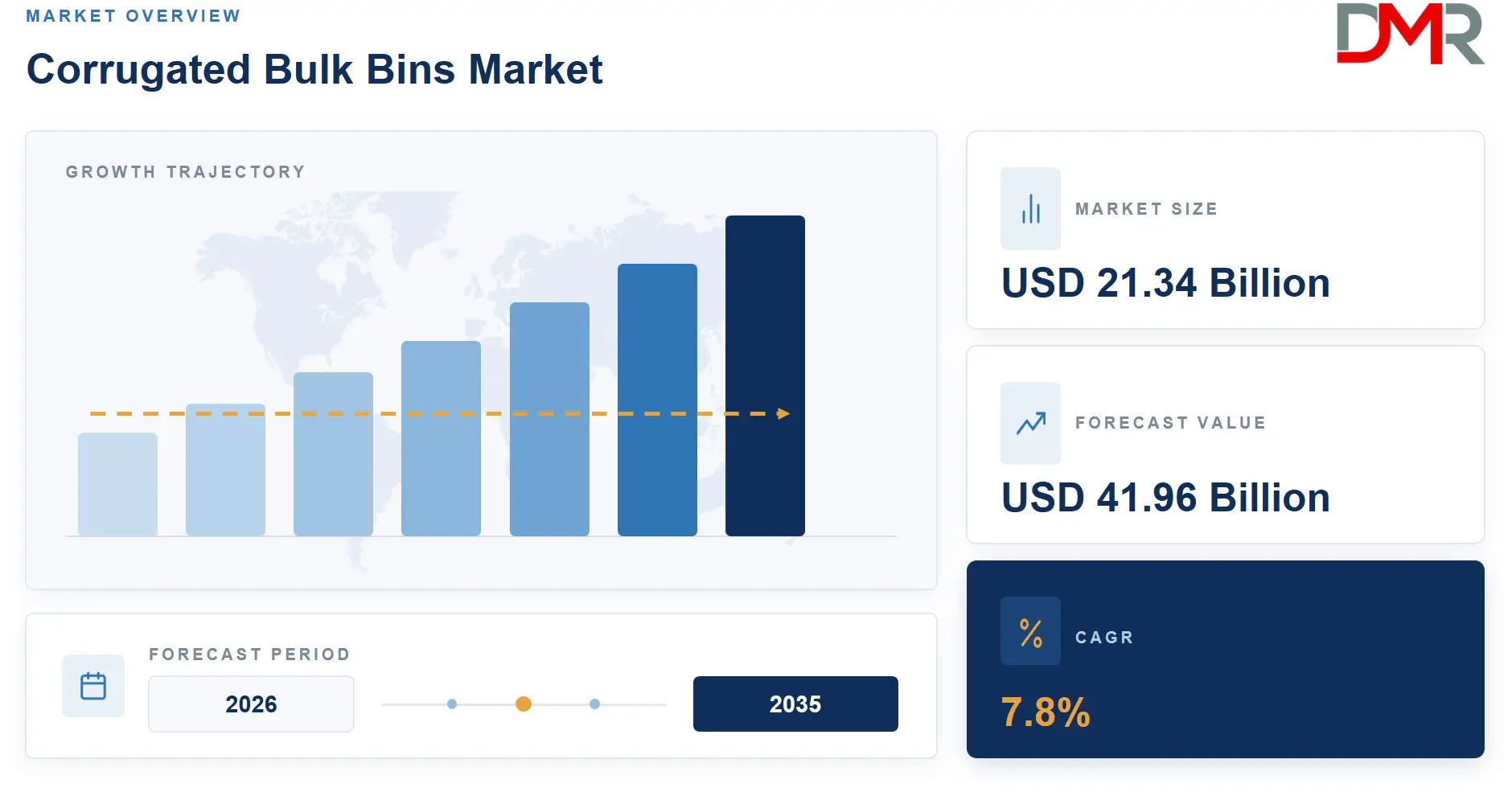
The Global Corrugated Bulk Bins Market size is estimated at USD 21.34 Billion in 2026, and is projected to reach USD 41.96 Billion by 2035, exhibiting a CAGR of 7.8% during the forecast period. Growers and food processors pushed steady volume gains through 2025 as wooden crate replacement programs matured across export corridors. Buyers in agricultural and industrial supply chains locked in multi-year contracts once phytosanitary compliance rules made corrugated the default containment choice. International Paper Company closed a USD 7.2 billion acquisition of DS Smith Plc in March 2025, consolidating heavy-duty converting capacity across Europe just as demand accelerated. Manufacturer specifications from 2025 rated double and triple-wall bulk bins to hold 1,500 to 3,000 lb per tote and stack three bins high, a capability that lets exporters cut freight trips without upgrading to plastic intermediate bulk containers.
This market covers corrugated fiberboard bulk bins used in agricultural, food, pharmaceutical, and industrial bulk transport. It excludes rigid plastic containers, wooden crates, and standard retail cartons. Corrugated bulk bins sit inside the broader Food Packaging and industrial containment ecosystem, competing directly against reusable plastic totes on cost rather than durability. Fulfillment operators now specify high-cube formats that match automated sortation lines, a shift that rewards converters who can engineer board strength without adding weight.
ℹ
To learn more about this report –
Download Your Free Sample Report Here
Key Takeaways
- The market size is USD 21.34 Billion in 2026, and is projected to hit USD 41.96 Billion by 2035 at a CAGR of 7.8%.
- By Load Capacity: More than 1,500 kg led with a 45.8% share in 2026.
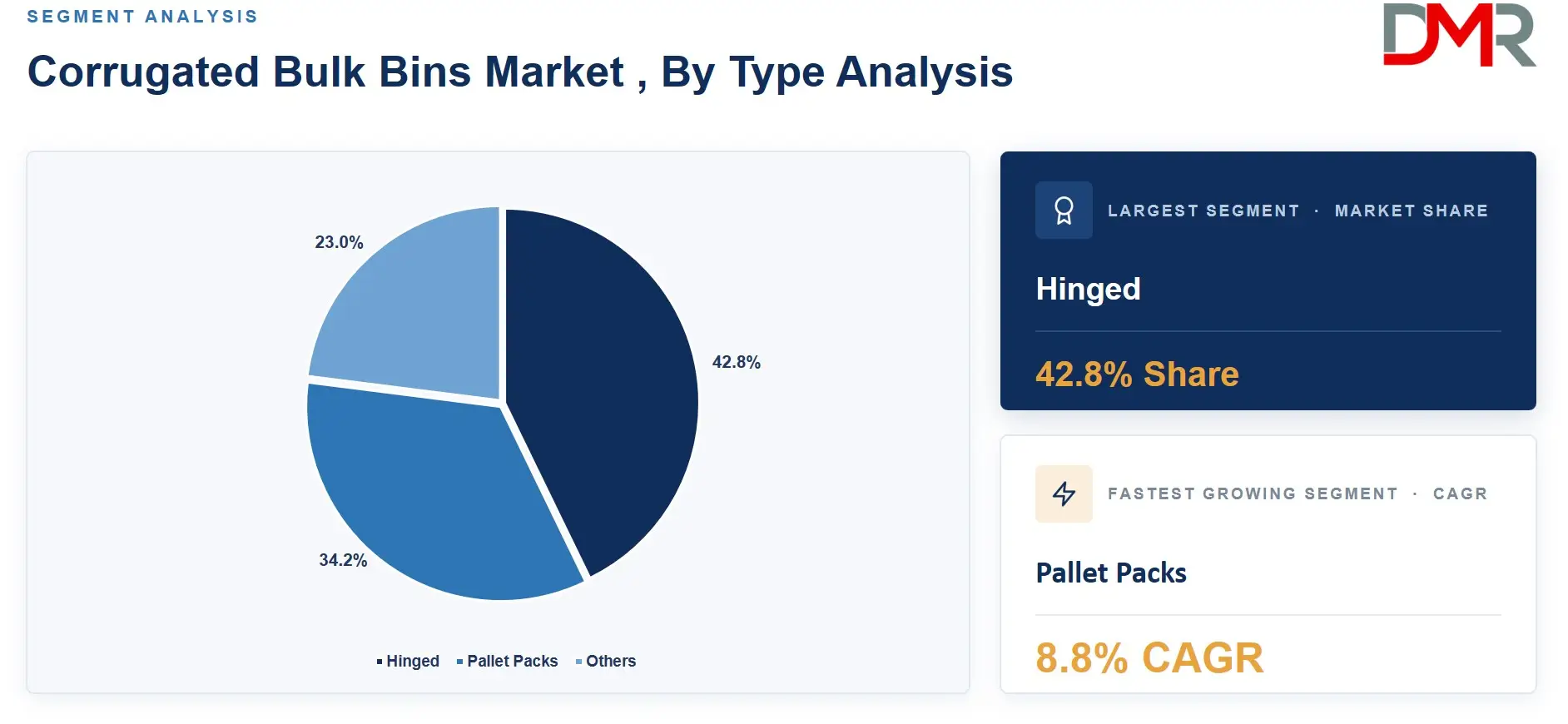
- By Type: Hinged led with a 42.8% share in 2026.
- By Format: Triple Wall led with a 56.8% share in 2026.
- By End Use: Food & Beverages led with a 39.8% share in 2026.
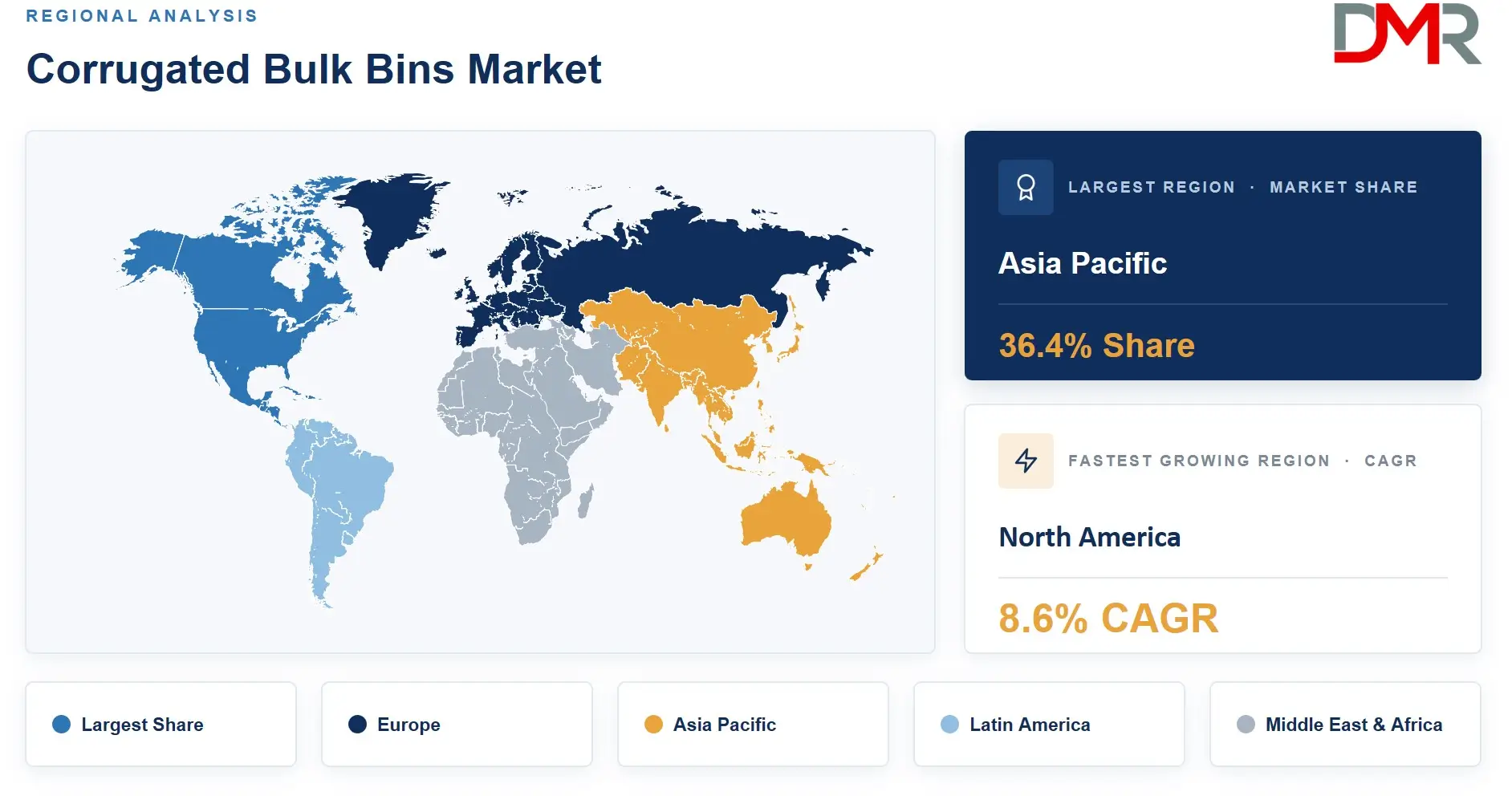
- By Region: Asia Pacific led with a 36.4% share, valued at USD 7.2 Billion, in 2026.
- Top 5 key players: International Paper Company, Smurfit Westrock, DS Smith Plc, Mondi Group, and Packaging Corporation of America.
Load Capacity Analysis
More than 1,500 kg accounted for 45.8% of Load Capacity demand in 2026, the highest of any category. Five-wall Gaylord specifications from 2026 rated bins for a 3,000 lb static load with 32 or higher ECT and roughly 600 psi Mullen burst on a standard pallet footprint. Automotive parts shippers and chemical intermediate handlers favor this bracket because a single bin replaces two mid-capacity units on the same trailer, cutting handling steps at the dock. The 1,000 to 1,500 kg tier serves food processors moving palletized produce, while bins below 1,000 kg remain the entry point for pharmaceutical and light industrial packers. Vendors selling into the top bracket now bundle stacking certification with delivery, since buyers rarely test burst strength themselves before committing to an annual contract.
Type Analysis
Hinged led the Type segment with a 42.8% share in 2026. Hinged bins dominate because they collapse flat for return freight, a feature that matters most to distributors running closed-loop logistics between packers and retailers. Food and beverage buyers specify hinged designs to speed line-side assembly, cutting labor minutes per unit compared to fully manual erection. Pallet Packs post the fastest growth of any Type category as fulfillment centers standardize footprints across automated storage systems. Buyers moving away from custom-built crates toward pallet packs gain faster receiving times, and this shift pressures smaller converters who lack tooling for high-volume pallet pack runs. Other formats, including octagonal and telescoping styles, hold a residual base among specialty industrial shippers.
ℹ
To learn more about this report –
Download Your Free Sample Report Here
Format Analysis
With a 56.8% share in 2026, Triple Wall outpaced all other Format categories. A 2026 technical guide found standard bulk bins typically hold 500 to 1,000 lb, while heavy-duty triple-wall construction handles 1,500 to 2,500 lb, a gap that explains why heavier industrial shippers default to triple wall despite the higher unit cost. Reported stacking strength for triple-wall board reaches 5,000 to 10,000 or more pounds, giving warehouse operators confidence to run four-high storage without collapse risk. Double Wall bins serve mid-weight food and pharmaceutical loads where cost sensitivity outweighs maximum durability. Single Wall and Others categories persist mainly in short-haul, single-trip agricultural moves where buyers prioritize price over stacking performance. Converters investing in triple-wall capacity now compete less on price and more on certified burst ratings.
End Use Analysis
Food & Beverages accounted for 39.8% of End Use demand in 2026, the highest of any category. Produce exporters and packaged food manufacturers drive this share because import certification rules increasingly bar wooden pallets on phytosanitary grounds, forcing a permanent switch to corrugated. Pharmaceuticals and automotive follow as niche but high-margin categories, since both demand tighter dimensional tolerance and moisture control than bulk produce. Chemical and oil and lubricants buyers need reinforced liners rather than structural changes, keeping their share modest but stable. Building and construction, along with other categories, absorb bins mainly for palletized hardware and fastener transport. Vendors serving Fresh Food Packaging buyers now design bins with ventilation slots to extend produce shelf life during transit.
Key Market Segments
By Load Capacity
- More than 1,500 kg
- 1,000 to 1,500 kg
- Below 1,000 kg
By Type
- Hinged
- Pallet Packs
- Others
By Format
- Triple Wall
- Double Wall
- Single Wall
- Others
By End Use
- Food & Beverages
- Pharmaceuticals
- Automotive
- Chemical
- Oil & Lubricants
- Building & Construction
- Others
Regional Analysis
Asia Pacific led the market with a 36.4% share, valued at USD 7.2 Billion, in 2026. China, Japan, and India anchor regional demand through large-scale agricultural export programs and expanding food processing capacity. A 2026 industry guide reported octabin capacities near 1,000 to 1,250 or more kg on standard pallet formats, a specification that fits the region's high-volume grain and produce export flows. Rising containerboard mill investment across Southeast Asia keeps input costs lower here than in import-dependent markets. North America ranks as the fastest-growing region as fulfillment center construction in the US and Canada pulls forward demand for high-cube bulk bin formats. Automated sortation facilities specify corrugated over plastic due to lower per-trip cost, and this trend compounds as e-commerce operators expand distribution square footage. Germany, France, and the UK drive a mature but consolidating market following International Paper Company's acquisition of DS Smith Plc, which concentrated heavy-duty converting capacity under fewer operators. Regulatory pressure on wood packaging in cross-border food shipments keeps replacement demand steady across the region. Brazil and Mexico supply corrugated bulk bins mainly to agricultural exporters shipping into North American and European retail chains. Currency volatility in the region makes buyers cautious about long-term fixed-price contracts with converters. GCC and South African buyers remain a smaller base, concentrated in food import repackaging and industrial component transport tied to construction projects.
ℹ
To learn more about this report –
Download Your Free Sample Report Here
Key Regions and Countries
North America
Europe
- Germany
- France
- The UK
- Spain
- Italy
- Rest of Europe
Asia Pacific
- China
- Japan
- South Korea
- India
- Australia
- Rest of APAC
Latin America
- Brazil
- Mexico
- Rest of Latin America
Middle East & Africa
- GCC
- South Africa
- Rest of MEA
Macroeconomic Impact
Global agricultural export volumes respond directly to currency swings, and a weaker exporter currency typically lifts shipment volumes that need standardized containment. Interest rate pressure on converters raises the cost of capacity expansion, slowing new mill investment even as order books grow. Trade policy shapes demand unevenly across regions. Phytosanitary transit rules in major import markets keep pushing exporters away from wooden packaging regardless of freight rate cycles, giving corrugated bulk bin demand a floor that pure GDP growth does not fully explain.
Market Dynamics
Driver: Wood Packaging Replacement Under Import Rules
Phytosanitary transit standards now bar untreated Wooden Crates from many import corridors, forcing food manufacturers to switch to corrugated bulk bins to keep shipments clearing customs on schedule. This regulatory push compounds with a cost advantage. A 2026 industry guide found triple-wall corrugated containers cost 20 to 40% less than equivalent wood crates once material, labor, freight, and disposal are counted for single-use shipments. Agricultural exporters shipping into strict import markets no longer treat this as optional. Buyers who delay conversion risk shipment rejection at the border, a cost far higher than the packaging switch itself.
Restraint: Moisture Exposure Limits Humid-Route Adoption
Corrugated substrates lose structural integrity in refrigerated and tropical transit lanes, capping bulk bin adoption on cold chain and high-humidity produce routes. Buyers on these routes still default to plastic intermediate bulk containers despite the higher upfront cost, since a compromised bin mid-transit costs more than the packaging premium. Recycled fiber input costs add a second pressure point. OCC market swings compress converter margins on fixed-price, multi-year supply contracts, discouraging some manufacturers from bidding aggressively on long-term agricultural accounts.
Opportunity: Reinforced Formats Open Cold Chain and Industrial Niches
Wax-coated and water-resistant corrugated formats now target cold chain produce export lanes still dominated by plastic alternatives, giving converters a path into a segment they historically could not serve. Engineering advances matter here. A 2026 guide found that adding corrugated or solid-fiber corner posts can raise heavy-duty box stacking strength by 30 to 50%, letting lighter-weight designs match legacy heavy-duty performance. Heavy-duty formats engineered for automotive parts and chemical intermediates open a second track, since these buyers pay a premium for certified load ratings rather than shopping purely on price.
Porter's Five Forces
New entrants face high capital barriers tied to converting equipment and containerboard sourcing, keeping the threat of entry moderate at best. Suppliers of recycled fiber hold meaningful bargaining power given OCC price volatility, squeezing converters locked into fixed-price contracts. Buyers, particularly large food processors and e-commerce fulfillment operators, negotiate aggressively given their order volume, shifting leverage toward the demand side. Substitutes in the form of Intermediate Bulk Container plastic totes remain a persistent threat on humid or cold chain routes where corrugated underperforms. Rivalry among converters intensifies as consolidation, including International Paper Company's acquisition of DS Smith Plc, concentrates capacity among fewer large players competing on certified strength ratings and price per ton.
Market Trends
Lightweight Engineering and Traceability Reshape Bulk Bins
Converters push high-burst-strength profiles that cut bulk bin weight without sacrificing stacking performance, a shift reflected in reports that triple-wall containers now weigh 25 to 40% less than equivalent wood crates. Embedded QR codes and RFID tags give logistics operators asset visibility across multi-handoff routes, a capability that rivals traditional Fiber Drums struggle to match. Retail buyers increasingly require FSC or PEFC chain-of-custody documentation before signing supply agreements.
Market Competition Overview
The market remains moderately consolidated following a wave of acquisitions among the largest containerboard producers. A supplier tracking corrugated bulk container orders reported more than 8,000 sold orders through mid-2026, excluding archived and dead-deal transactions, a volume that signals demand concentrating among a handful of scaled vendors rather than dispersing across small regional shops. Large integrated producers gain share by controlling containerboard supply end to end, insulating them from OCC price swings that squeeze smaller converters. Regional sheet feeders lose ground as consolidation reshapes pricing power across the manufacturing tier, and buyers increasingly favor vendors who can guarantee both volume and certified strength ratings.
Pricing Analysis
Pallet-size triple-wall corrugated bulk bins carry an approximate unit cost of $30 to $100 per bin, with price scaling to wall count and burst rating. Buyers ordering used units instead of new stock can secure meaningful savings, since one 2026 supplier listed used five-wall Gaylord bins at $6 to $18 per box against $18 to $45 for new equivalents in equivalent volumes. Bulk buyers matter here. A supplier's 2026 operating minimums ran 25 to 100 used containers per pallet, meaning smaller buyers pay a per-unit premium that scaled fulfillment operators avoid. Market leaders bundle pricing with delivery and certification, while challengers compete mainly on raw per-unit cost.
Company Profiles
International Paper Company built its position through scale acquisitions rather than organic capacity growth, closing its DS Smith Plc deal and later adding Delmarva Corrugated Packaging and North Pacific Paper Company within a 15 month span. This acquisition pace gives it vertically integrated containerboard supply that smaller converters cannot match, though it also raises integration risk across newly combined plants. Smurfit Westrock took a manufacturing modernization path instead, starting production at its automated Pleasant Prairie, Wisconsin facility in May 2025 with capacity to make up to 3 billion square feet of corrugated boxes annually. Heavy automation lowers its per-unit labor cost, positioning it to compete on price even as OCC input costs swing. Its Protective Packaging lines benefit directly from this automated capacity.
Key Players
- International Paper Company
- Smurfit Westrock
- DS Smith Plc
- Mondi Group
- Packaging Corporation of America
- Georgia-Pacific LLC
- Saica Group
- VPK Group
- Klabin S.A.
- Rengo Co., Ltd.
- Great Northern Corporation
- Ernest Packaging Solutions
- Atlantic Packaging
- Durham Box
- GWP Group
- Oji Holdings Corporation
- WestRock Company
- Nine Dragons Paper Holdings Limited
- Cascades Inc.
Supply Chain and Value Chain Analysis
Containerboard mills feed sheet plants, which convert board into finished bulk bins before shipment to agricultural, food, and industrial end users. Maximum value concentrates at the converting stage, where wall configuration and strength certification determine price. Lead times mark the clearest bottleneck. A 2026 technical guide reported supplier lead times of 2 to 4 weeks for double-wall heavy-duty construction and 3 to 6 weeks for triple-wall builds, a gap that forces buyers to plan procurement well ahead of peak agricultural export seasons.
Regulatory Landscape
Phytosanitary transit standards govern most cross-border demand, requiring exporters to use treated or non-wood packaging to clear customs in major import markets. Retail and foodservice buyers layer on FSC or PEFC chain-of-custody requirements, adding a second compliance track that favors large converters with certified fiber sourcing over smaller regional producers lacking documentation systems.
Investment and White Space Analysis
Capital continues flowing into containerboard consolidation and automated converting capacity, evident in Smurfit Westrock's €600 million French modernization program announced in June 2026. White space remains open in cold chain produce packaging, a segment still dominated by plastic alternatives despite corrugated's cost edge on single-trip routes. Returnable bin programs under lease-and-recover models offer an underexplored entry point for new players willing to build reverse logistics networks rather than compete purely on unit price.
Recent Developments
- April 2025 International Paper Company entered exclusive negotiations with Germany's PALM Group to divest five European corrugated box plants to meet antitrust commitments tied to its regional expansion.
- May 2026 International Paper Company expanded its North American footprint by acquiring Delmarva Corrugated Packaging, adding a strategically located facility in Dover, Delaware.
- June 2026 International Paper Company completed a $360 million acquisition of North Pacific Paper Company in Longview, Washington, securing high-performance packaging grade supply for West Coast customers.
- June 2026 Smurfit Westrock announced a €600 million investment program across its French manufacturing network to modernize capacity and reduce the carbon footprint of its packaging operations.
- August 2026 Packaging Corporation of America, Smurfit Westrock, and International Paper Company implemented consecutive containerboard price increases of up to $140 per ton amid rising industrial and agricultural demand.
Report Details
| Report Characteristics |
| Market Value (2026) |
USD 21.34 Billion |
| Forecast Revenue (2035) |
USD 41.96 Billion |
| CAGR (2026–2035) |
7.8% |
| Base Year for Estimation |
2025 |
| Historic Period |
2020 – 2024 |
| Forecast Period |
2026 – 2035 |
| Report Coverage |
Revenue Forecast, Market Dynamics, Segment Analysis, Regional Analysis, Competitive Landscape, Pricing Analysis, Supply Chain & Value Chain Analysis, Regulatory Landscape, Investment & White Space Analysis, Recent Developments |
| Segments Covered |
By Load Capacity (More than 1,500 kg, 1,000 to 1,500 kg, Below 1,000 kg), By Type (Hinged, Pallet Packs, Others), By Format (Triple Wall, Double Wall, Single Wall, Others), By End Use (Food & Beverages, Pharmaceuticals, Automotive, Chemical, Oil & Lubricants, Building & Construction, Others) |
| Regional Analysis |
North America – US, Canada; Europe – Germany, France, The UK, Spain, Italy, Rest of Europe; Asia Pacific – China, Japan, South Korea, India, Australia, Rest of APAC; Latin America – Brazil, Mexico, Rest of Latin America; Middle East & Africa – GCC, South Africa, Rest of MEA |
| Competitive Landscape |
International Paper Company, Smurfit Westrock, DS Smith Plc, Mondi Group, Packaging Corporation of America, Georgia-Pacific LLC, Saica Group, VPK Group, Klabin S.A., Rengo Co., Ltd., Great Northern Corporation, Ernest Packaging Solutions, Atlantic Packaging, Durham Box, GWP Group, Oji Holdings Corporation, WestRock Company, Nine Dragons Paper Holdings Limited, Cascades Inc. |
| Customization Scope |
Customization for segments and region or country level will be provided. Additional customization can be done based on requirements. |
| Purchase Options |
Three license options: Single User License, Multi-User License (Up to 5 Users), and Corporate Use License (Unlimited Users and Printable PDF) |
Frequently Asked Questions
What is the biggest investment opportunity in the Corrugated Bulk Bins market?
▾ Cold chain produce packaging offers the clearest opening, since wax-coated and water-resistant corrugated formats can now compete against plastic alternatives that have long dominated this segment. Returnable bin programs under lease-and-recover models add a second path for investors willing to build reverse logistics infrastructure.
Who are the top companies in the Corrugated Bulk Bins market?
▾ International Paper Company and Smurfit Westrock lead through scale acquisitions and automated manufacturing capacity. DS Smith Plc, Mondi Group, and Packaging Corporation of America round out the top tier by revenue and production footprint.
Which segment is growing fastest in the Corrugated Bulk Bins marketand why?
▾ Pallet Packs grow fastest within the Type segment as fulfillment centers standardize footprints for automated storage and sortation systems. Buyers switching from custom crates to pallet packs cut receiving time, driving faster adoption than any other Type category.
Which region is growing fastest in the Corrugated Bulk Bins marketand why?
▾ North America grows fastest as e-commerce fulfillment center construction expands demand for high-cube corrugated formats built for automated sortation. Asia Pacific still leads by absolute share at 36.4%, but North America's growth rate now outpaces it.
What is the biggest challenge holding in the Corrugated Bulk Bins market back?
▾ Moisture sensitivity limits corrugated bulk bins on refrigerated and tropical transit routes, where plastic intermediate bulk containers remain the safer choice. Recycled fiber cost volatility adds a second constraint, compressing converter margins on fixed-price supply contracts.