What is the Deepfake Technology Market Size in 2026?
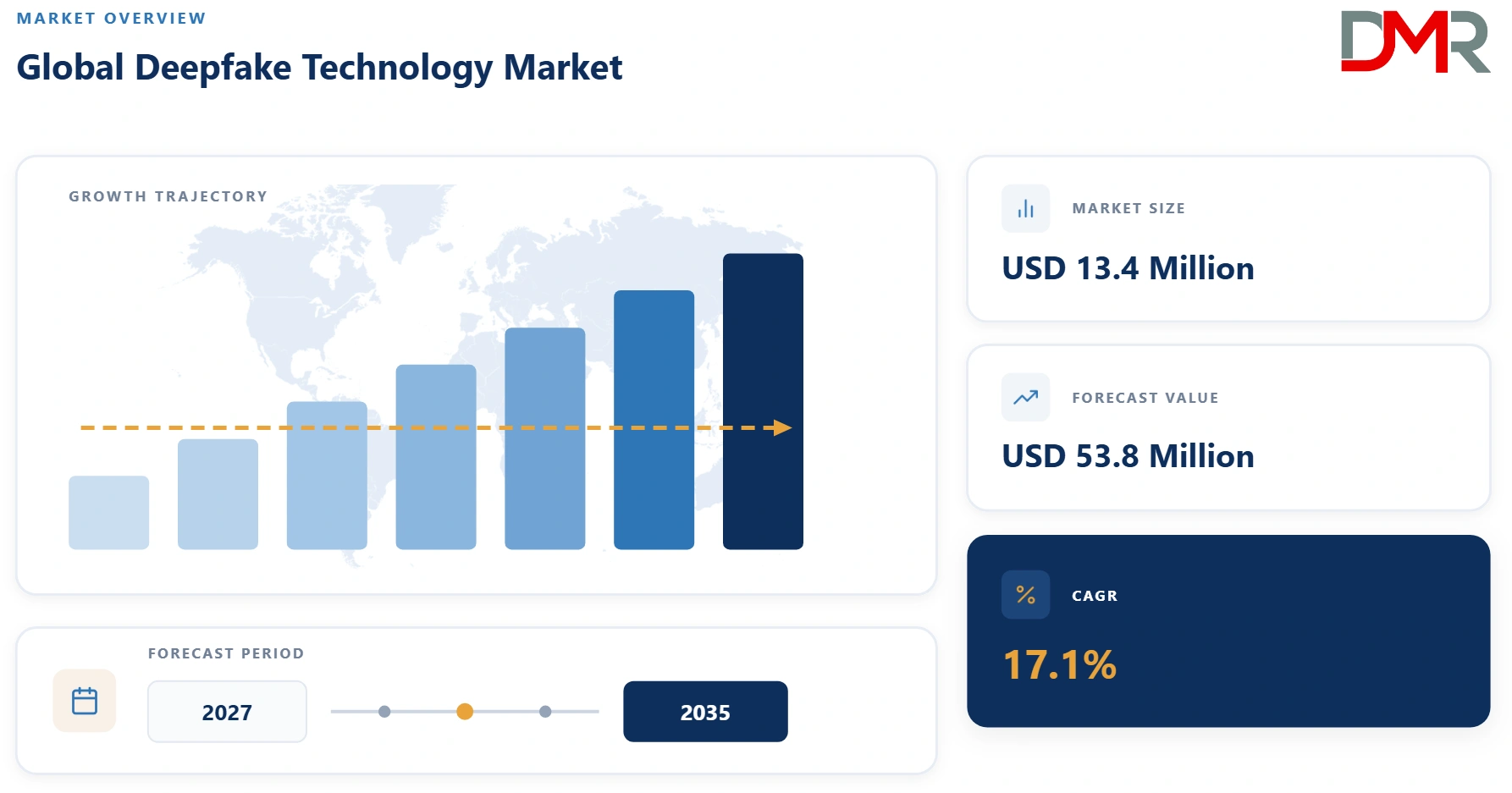
The Global Deepfake Technology Market is valued at USD 13.4 billion in 2026 and is projected to reach USD 53.8 billion by 2035, growing at a CAGR of 17.1% from 2027 to 2035. Growth is driven by advancements in generative artificial intelligence, increasing synthetic media adoption, rising digital impersonation threats, expanding demand for identity verification, and growing investments in automated content authentication solutions.
ℹ
To learn more about this report –
Download Your Free Sample Report Here
Deepfake technology is a type of artificial intelligence that can create, alter, or identify synthetic digital media that mimics human facial features, voices, expressions, and movements. These technologies use deep learning algorithms, generative adversarial networks, diffusion models, and neural networks to generate realistic video, audio, and image content. These technologies enable creative innovation and cybersecurity needs across various industry contexts for commercial applications such as entertainment production, virtual avatars, personalized communication, identity verification, fraud prevention, and digital forensics.
The Global Deepfake Technology Market is defined as software and services that are used to create, alter, identify, and verify synthetic digital media. Market coverage includes video, audio, and image content from commercial, institutional, and government applications. Content generation, fraud prevention, identity verification, digital forensics and virtual avatar solutions are all included. Revenue recognition includes software subscriptions, software licenses, software use via API, implementation and professional services. Other general AI platforms that offer no deepfake-specific features and typical media editing tools are not in the scope of the market.
Deepfake Technology Market Snapshot
Deepfake Technology Market Snapshot, 2026-2035
| Metric |
Value |
| Market Size (2026) |
USD 13.4 Billion |
| Market Size (2027) |
USD 15.2 Billion |
| Forecast Value (2035) |
USD 53.8 Billion |
| CAGR (2027–2035) |
17.1% |
| Largest Region (2026) |
North America, 45.1% share |
| Fastest-Growing Region (2027–2035) |
Asia Pacific, 18.3% CAGR |
| Leading Offering (2026) |
Software, 74.3% share |
| Key Players |
Synthesia Limited, HeyGen, Inc., ElevenLabs, Reality Defender, Inc., Pindrop Security, Inc., GetReal Security, iProov Limited, and Resemble AI, Inc. |
Deepfake Technology Market: Key Takeaways
- Market Growth: The market is valued at USD 13.4 billion in 2026 and is projected to reach USD 53.8 billion by 2035, registering a CAGR of 17.1%.
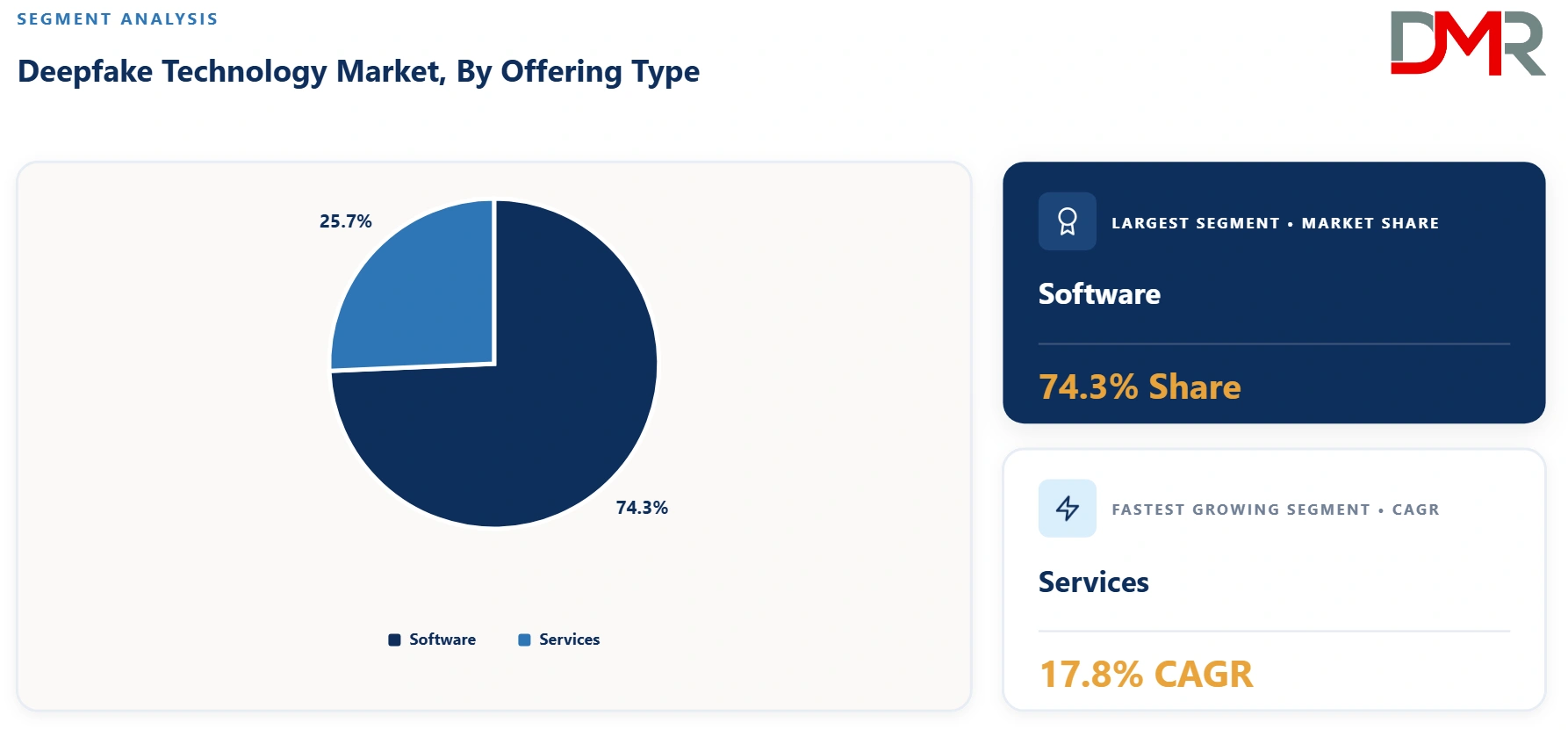
- Offering Leader: Software accounts for 74.3% of market revenue in 2026, supported by increasing adoption of synthetic media generation and detection platforms.
- Fastest-Growing Offering: Services are projected to grow at a CAGR of 17.8%, driven by increasing demand for implementation, customization, and technical support.
- Content Type Leader: Video accounts for 53.6% of market revenue in 2026, supported by extensive entertainment and digital communication applications.
- Fastest-Growing Content Type: Audio is projected to register a CAGR of 18.2%, driven by advancements in voice synthesis and audio deepfake detection.
- Regional Picture: North America leads with a 45.1% market share in 2026, while Asia Pacific is projected to grow at a CAGR of 18.3%.
What are the Key Use Cases of Deepfake Technology?
- Synthetic Content Production: Generates realistic digital media, authorized virtual performers, and localized audiovisual content for entertainment, advertising, and commercial communication applications.
- Financial Fraud Prevention: Detects manipulated voices, fabricated facial imagery, and synthetic identities to strengthen transaction security and prevent digital impersonation.
- Identity Authentication: Identifies synthetic media and manipulated biometric information during remote customer onboarding, employee verification, and digital authentication processes.
- Digital Forensic Investigation: Analyzes manipulated audiovisual evidence, identifies synthetic content characteristics, and supports authenticity assessment during cybersecurity and legal investigations.
How are Foundation Models and Generative AI Transforming the Deepfake Technology Market
Foundation models and generative AI are transforming the deepfake technology market through advancements in realistic media synthesis, voice replication, facial animation, and multimodal content generation. Large-scale neural networks enable increasingly sophisticated audiovisual outputs, supporting authorized digital avatars, multilingual communication, and personalized media production. These capabilities improve production efficiency, reduce content localization costs, and expand accessibility across commercial and educational applications.
Generative AI advancements simultaneously increase requirements for sophisticated detection and authentication technologies. AI-enabled detection platforms analyze facial inconsistencies, acoustic characteristics, temporal irregularities, and synthetic media patterns to identify manipulated content. Multimodal foundation models improve analytical capabilities across video, audio, and image formats. Increasing adoption of generative AI encourages investment in real-time detection, biometric verification, content provenance, and responsible synthetic media development across enterprise environments.
Deepfake Technology Market Dynamics at a Glance
Drivers, Restraints, Opportunities and Trends in the Deepfake Technology Market
| Type |
Factor |
Impact |
| Driver |
Increasing Adoption of AI-Generated Multimedia Content |
High |
| Driver |
Rising Incidence of Deepfake-Enabled Fraud and Cybercrime |
High |
| Restraint |
Growing Ethical, Privacy, and Legal Concerns |
High |
| Restraint |
High Computational and Implementation Costs |
Medium |
| Opportunity |
Expansion of Personalized Digital Communication |
Medium |
| Opportunity |
Growing Demand for Deepfake Detection in Financial Services |
High |
| Trend |
Increasing Adoption of Real-Time Deepfake Detection |
High |
| Trend |
Integration of Digital Watermarking and Content Provenance |
High |
What is Driving the Growth of the Deepfake Technology Market?
Increasing Adoption of AI-Generated Multimedia Content
The increasing adoption of AI-generated multimedia content is driving demand for deepfake technologies across entertainment, advertising, education, and enterprise communication applications. Organizations increasingly utilize synthetic media solutions to generate authorized digital characters, localized audiovisual content, and realistic virtual presentations. These technologies reduce dependence on conventional production infrastructure while improving content scalability and operational efficiency. Growing demand for multilingual communication encourages the adoption of automated dubbing and facial synchronization capabilities. Increasing investments in digital marketing and immersive entertainment experiences further strengthen demand for advanced synthetic media generation solutions across commercial and institutional environments.
Rising Incidence of Deepfake-Enabled Fraud and Cybercrime
The rising incidence of deepfake-enabled fraud and cybercrime is accelerating demand for advanced detection and authentication technologies. Manipulated audiovisual content creates significant security risks involving identity impersonation, fraudulent communications, unauthorized financial transactions, and misinformation. Organizations increasingly implement deepfake detection solutions to identify synthetic media and strengthen digital communication security. Financial institutions, government agencies, and enterprises prioritize advanced analytical capabilities to protect sensitive operations against emerging impersonation threats. Increasing cybersecurity investments and growing awareness of AI-generated fraud encourage the deployment of specialized detection platforms, strengthening demand for reliable authentication and digital forensic solutions.
What are the Key Restraints in the Deepfake Technology Market?
Growing Ethical, Privacy, and Legal Concerns
Growing ethical, privacy, and legal concerns restrict the adoption of deepfake technologies across commercial and institutional environments. Unauthorized replication of human appearances and voices creates risks involving privacy violations, intellectual property infringement, reputational damage, and misleading digital content. Organizations face increasing scrutiny regarding consent management, responsible technology utilization, and synthetic media disclosure. Evolving regulatory requirements introduce additional compliance obligations for developers and commercial users of deepfake solutions. Uncertainty surrounding legal liability and ownership rights complicates technology deployment decisions. These concerns encourage organizations to establish comprehensive governance frameworks, potentially increasing operational complexity and delaying implementation across sensitive applications.
High Computational and Implementation Costs
High computational and implementation costs present significant barriers to adopting advanced deepfake technologies. Developing and operating sophisticated synthetic media generation and detection platforms requires substantial computing resources, specialized processors, extensive training datasets, and skilled artificial intelligence professionals. Organizations implementing real-time detection systems face additional expenditure associated with infrastructure integration, continuous model updates, and technical maintenance. Smaller enterprises frequently encounter budget constraints when deploying advanced solutions across existing digital environments. Increasing requirements for high-resolution content processing and accurate multimodal analysis further contribute to operational expenses, restricting accessibility among organizations with limited technological and financial resources.
What are the Key Opportunities in the Deepfake Technology Market?
Expansion of Personalized Digital Communication
The expansion of personalized digital communication creates opportunities for deepfake technology providers developing authorized virtual avatars, multilingual presentations, and customized audiovisual experiences. Enterprises increasingly seek scalable communication solutions capable of delivering consistent messages across diverse customer groups and geographic markets. Synthetic media platforms enable organizations to personalize training materials, product demonstrations, customer engagement campaigns, and corporate announcements. Advancements in voice synthesis and facial animation improve the accessibility of localized digital content. Growing demand for interactive communication and personalized marketing creates opportunities for technology providers offering consent-based synthetic media solutions with flexible customization and enterprise integration capabilities.
Growing Demand for Deepfake Detection in Financial Services
Growing demand for deepfake detection in financial services creates commercial opportunities for specialized fraud prevention and authentication providers. Financial institutions increasingly rely on remote onboarding, digital banking, automated customer support, and electronic transaction authorization. These activities create requirements for reliable detection of manipulated biometric information and synthetic voice communications. Advanced deepfake detection systems support financial organizations through real-time risk assessment, identity validation, and automated monitoring. Integration with existing fraud management infrastructure improves operational effectiveness and security coverage. Expanding digital financial services and increasing regulatory attention toward identity-related risks encourage investments in specialized deepfake detection and prevention technologies.
What are the Latest Trends in the Deepfake Technology Market?
Increasing Adoption of Real-Time Deepfake Detection
The increasing adoption of real-time deepfake detection reflects growing enterprise requirements for immediate identification of manipulated audiovisual communications. Traditional forensic analysis frequently occurs after suspicious content has circulated or fraudulent activities have occurred. Advanced detection platforms increasingly analyze live video conferences, customer service interactions, and digital authentication processes to identify potential manipulation during communication. Multimodal analytical capabilities support detection across audio, video, and image formats. Integration with enterprise communication and security platforms improves operational responsiveness. Growing demand for proactive fraud prevention encourages technology providers to develop scalable detection solutions supporting continuous monitoring and rapid risk assessment.
Integration of Digital Watermarking and Content Provenance
The integration of digital watermarking and content provenance technologies is emerging as an important trend in the deepfake technology market. Synthetic media developers increasingly incorporate content identification mechanisms to support transparency and responsible distribution. Digital watermarks, cryptographically signed metadata, and provenance records assist organizations in assessing the origin and modification history of multimedia content. Such capabilities complement deepfake detection tools by providing additional authenticity indicators. Growing regulatory attention toward AI-generated content disclosure encourages the adoption of standardized transparency mechanisms. Technology providers increasingly prioritize interoperability, traceability, and verifiable content identification to strengthen confidence across digital media ecosystems.
Research Scope and Analysis
The research covers the Global Deepfake Technology Market across offering, content type, application, end-use industry, and region. The analysis evaluates revenue generated through synthetic media generation software, detection platforms, authentication technologies, and associated services. Market assessment incorporates technological advancements, adoption patterns, regulatory developments, competitive positioning, and commercial growth opportunities across diverse industry environments and geographic markets.
ℹ
To learn more about this report –
Download Your Free Sample Report Here
By Offering Analysis
Software is projected to dominate the offering segment in the Global Deepfake Technology Market, accounting for 74.3% of the total market share in 2026. Dominance is supported by extensive adoption of AI-powered synthetic media generation, detection, and authentication platforms. Services are projected to be the fastest-growing segment, registering a CAGR of 17.8% from 2027 to 2035, driven by increasing demand for technology implementation, platform customization, system integration, and specialized technical support.
By Content Type Analysis
Video is projected to dominate the content type segment in the Global Deepfake Technology Market, accounting for 53.6% of the total market share in 2026. Dominance is supported by extensive applications across entertainment production, digital advertising, and virtual communication. Audio is projected to be the fastest-growing segment, registering a CAGR of 18.2% from 2027 to 2035, driven by advancements in authorized voice synthesis, automated dubbing, and increasing requirements for audio deepfake detection.
By Application Analysis
Content Generation is projected to dominate the application segment in the Global Deepfake Technology Market, accounting for 32.7% of the total market share in 2026. Dominance is supported by increasing adoption of synthetic multimedia across commercial and creative applications. Fraud Detection & Prevention is projected to be the fastest-growing segment, registering a CAGR of 18.4% from 2027 to 2035, driven by rising digital impersonation threats and increasing investments in advanced cybersecurity solutions.
By End-Use Industry Analysis
Media & Entertainment is projected to dominate the end-use industry segment in the Global Deepfake Technology Market, accounting for 29.4% of the total market share in 2026. Dominance is supported by growing demand for synthetic audiovisual content, digital characters, and automated localization. BFSI is projected to be the fastest-growing segment, registering a CAGR of 17.9% from 2027 to 2035, driven by increasing requirements for fraud prevention, biometric authentication, and secure digital financial transactions.
How is the Deepfake Technology Market Segmented?
By Offering
By Content Type
By Application
- Content Generation
- Fraud Detection & Prevention
- Identity Verification
- Digital Forensics
- Virtual Avatars & Personalization
- Others
By End-Use Industry
- Media & Entertainment
- BFSI
- IT & Telecom
- Government & Defense
- Retail & E-Commerce
- Education
- Others
Which Region Leads the Deepfake Technology Market?
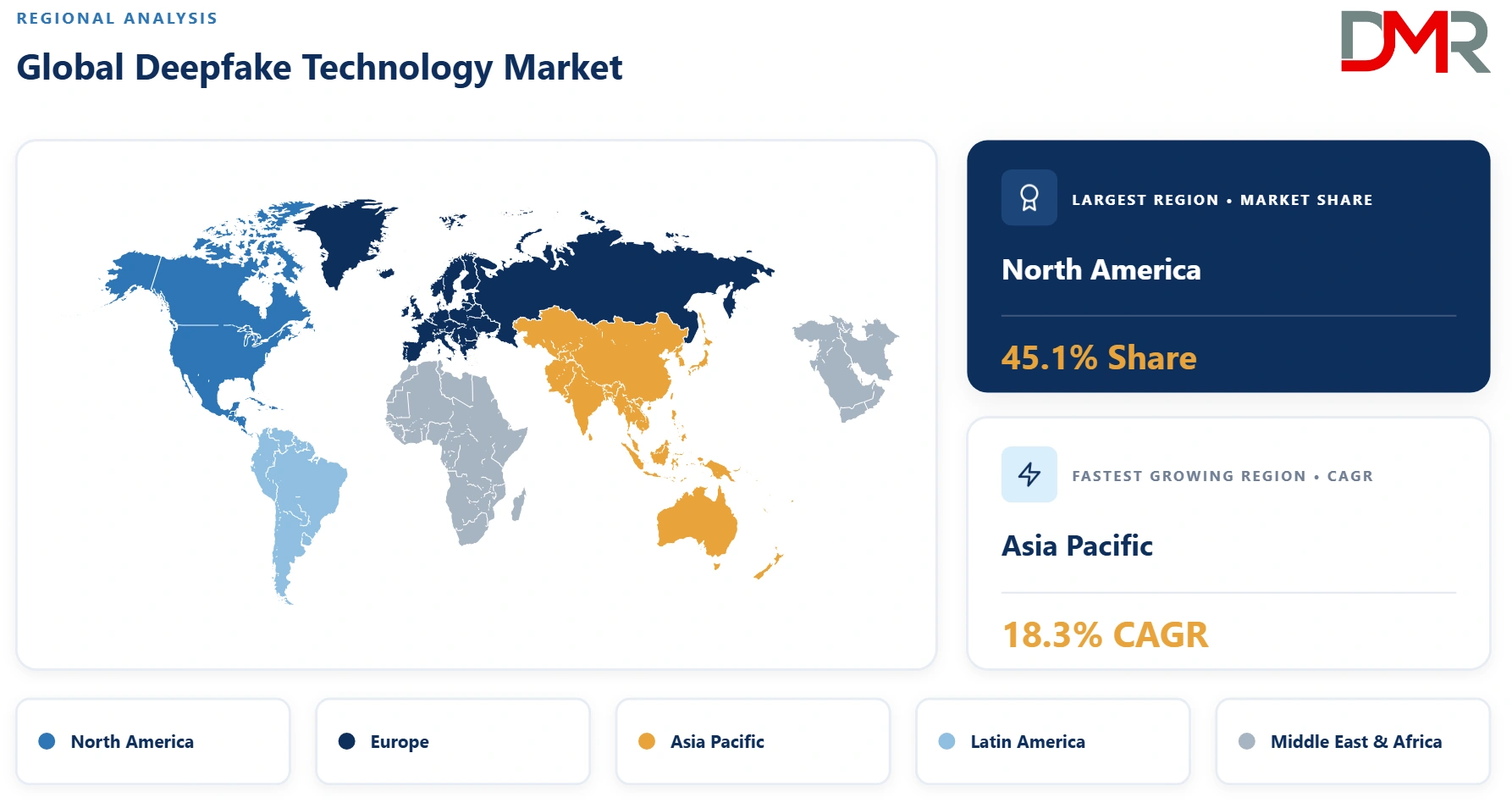
North America leads the Global Deepfake Technology Market with a 45.1% share in 2026, while Asia Pacific is projected to register the highest CAGR of 18.3% from 2027 to 2035.
ℹ
To learn more about this report –
Download Your Free Sample Report Here
Region with the Largest Revenue Share
North America dominates the Global Deepfake Technology Market, accounting for 45.1% of the total market share in 2026. Regional dominance is supported by advanced artificial intelligence infrastructure, established entertainment industries, and substantial cybersecurity investments. The U.S. and Canada contribute to market demand through synthetic media adoption, digital innovation, and enterprise security modernization. The presence of specialized technology developers and established research ecosystems supports product innovation. Growing requirements for digital authenticity and fraud prevention strengthen regional demand for advanced deepfake technologies.
Region with the Highest CAGR
Asia Pacific is projected to register the highest CAGR of 18.3% in the Global Deepfake Technology Market from 2027 to 2035. Regional growth is supported by expanding digital infrastructure, increasing artificial intelligence investments, and growing adoption of synthetic media technologies. China, Japan, India, Australia, and South Korea contribute through digital entertainment production, financial technology adoption, and cybersecurity modernization. Increasing demand for localized audiovisual content and secure digital authentication encourages the deployment of deepfake generation and detection solutions across regional industries.
Regional Analysis
Europe Deepfake Technology Market
The Europe Deepfake Technology Market is supported by growing artificial intelligence adoption, established media industries, and increasing regulatory attention toward synthetic content transparency. Germany, France, the U.K., Italy, and Spain contribute to regional demand through digital innovation, entertainment production, and cybersecurity investments. Organizations increasingly implement deepfake detection solutions to address impersonation risks and strengthen digital authenticity. Evolving requirements for AI-generated content disclosure encourage investment in responsible synthetic media development, content provenance, and advanced authentication technologies across commercial and institutional applications.
Latin America Deepfake Technology Market
The Latin America Deepfake Technology Market is supported by expanding digital communication platforms, increasing artificial intelligence adoption, and growing demand for localized multimedia content. Mexico and Brazil contribute to regional demand through established entertainment industries, digital banking activities, and commercial advertising. Organizations increasingly explore synthetic media technologies to improve content production efficiency and customer engagement. Growing exposure to digital impersonation and identity-related fraud encourages investment in specialized detection and authentication solutions, creating opportunities across financial services, telecommunications, and digital entertainment industries.
Middle East & Africa Deepfake Technology Market
The Middle East & Africa Deepfake Technology Market is supported by digital transformation initiatives, increasing artificial intelligence investments, and expanding media production activities. Saudi Arabia, the UAE, and South Africa contribute to regional demand through technology modernization, digital financial services, and entertainment development. Organizations increasingly explore synthetic media solutions for multilingual communication and personalized customer engagement. Growing cybersecurity awareness and increasing requirements for reliable identity authentication create opportunities for deepfake detection technologies across government institutions, financial organizations, and commercial digital platforms.
By Region
North America
Europe
- Germany
- France
- The U.K.
- Italy
- Spain
- Rest of Europe
Asia-Pacific
- China
- Japan
- India
- Australia
- South Korea
- Rest of APAC
Latin America
- Mexico
- Brazil
- Rest of LATAM
Middle East & Africa
- Saudi Arabia
- The UAE
- South Africa
- Rest of MEA
Regulatory Landscape
The regulatory landscape of the Global Deepfake Technology Market is evolving through artificial intelligence governance, data protection requirements, intellectual property regulations, and cybersecurity standards. Article 50 of the European Union Artificial Intelligence Act introduces transparency obligations for artificially generated or manipulated multimedia content, applicable from August 2026. Privacy regulations influence the collection and processing of biometric information used in synthetic media development. Increasing regulatory scrutiny of unauthorized impersonation, deceptive advertising, and manipulated digital content encourages responsible technology deployment. These requirements create opportunities for providers offering consent management, content authentication, digital watermarking, and advanced detection capabilities while increasing compliance responsibilities across commercial deepfake technology applications and enterprise environments.
Technology Analysis
Technological advancements in the Global Deepfake Technology Market focus on generative adversarial networks, diffusion models, transformer architectures, and multimodal artificial intelligence. Advanced neural networks improve the realism of synthetic facial expressions, voice characteristics, and audiovisual synchronization. Detection technologies increasingly utilize machine learning algorithms, biometric analysis, and temporal pattern recognition to identify manipulated multimedia content. Integration of application programming interfaces facilitates deployment across enterprise communication platforms, financial systems, and digital media applications. Emerging content provenance and watermarking technologies support digital authenticity assessment. Increasing demand for real-time processing, multilingual capabilities, and reliable detection encourages continued investment in scalable computational infrastructure and advanced artificial intelligence models across commercial applications.
Who are the Leading Companies in the Deepfake Technology Market?
The Global Deepfake Technology Market is characterized by competition among synthetic media developers, artificial intelligence companies, cybersecurity specialists, and biometric authentication providers. Major participants include Synthesia Limited, HeyGen, Inc., ElevenLabs, Reality Defender, Inc., and Pindrop Security, Inc. Competitive differentiation focuses on content realism, detection accuracy, processing efficiency, multilingual capabilities, and enterprise integration. Companies strengthen market positioning through technological innovation, product development, strategic partnerships, and expanded commercial applications.
- Synthesia Limited (London, U.K.): Provides AI-powered video generation, authorized digital avatars, multilingual video localization, and synthetic media solutions supporting enterprise communication, education, and commercial content production
- HeyGen, Inc. (Los Angeles, California, U.S.): Offers AI-generated video, personalized digital avatars, voice synthesis, and automated video translation solutions supporting marketing, corporate communication, and multilingual content creation.
- ElevenLabs (New York, New York, U.S.): Provides AI-powered voice synthesis, authorized voice cloning, automated dubbing, and synthetic audio generation technologies supporting entertainment, education, localization, and digital communication.
- Reality Defender, Inc. (New York, New York, U.S.): Provides multimodal deepfake detection platforms supporting synthetic audio, video, and image identification across enterprise communication, fraud prevention, cybersecurity, and digital forensic applications.
Pindrop Security, Inc. (Atlanta, Georgia, U.S.): Offers voice authentication, audio deepfake detection, and fraud prevention solutions through Pindrop Pulse and associated security platforms supporting financial institutions and enterprise contact centers.
Some of the prominent players in the Global Deepfake Technology are:
- Synthesia Limited
- HeyGen, Inc.
- ElevenLabs
- Reality Defender, Inc.
- Pindrop Security, Inc.
- GetReal Security
- iProov Limited
- Persona Identities, Inc.
- Socure, Inc.
- Mitek Systems, Inc.
- AU10TIX Ltd.
- HyperVerge Technologies Private Limited
- ValidSoft Limited
- Daon, Inc.
- Attestiv, Inc.
- DeepMedia
- Truepic, Inc.
- Neural Defend
- Netarx
- Modulate, Inc.
- LOVO, Inc.
- WellSaid Labs, Inc.
- Colossyan
- VEED Limited
- Descript, Inc.
- Trend Micro Incorporated
- Microsoft Corporation
- Resemble AI, Inc.
- DeepBrain AI, Inc.
- Sensity AI
- Hive AI
- DuckDuckGoose B.V.
- Deepware A.Ş.
- FaceTec, Inc.
- BioID GmbH
- Paravision, Inc.
- Incode Technologies, Inc.
- Jumio Corporation
- Veriff OÜ
- Sumsub
- Other Key Players
Recent Developments
- In October 2026, Reality Defender, Inc. partnered with Samsung Electronics Singapore to advance on-device deepfake detection capabilities for enterprise customers in Singapore. The collaboration supports enhanced protection against manipulated digital communications and AI-generated impersonation threats across enterprise environments.
- In September 2026, HeyGen, Inc. introduced Avatar V, an advanced artificial intelligence avatar model designed to improve the realism of synthetic video content. The development expands professional content generation capabilities across enterprise communication, digital marketing, and personalized audiovisual production applications.
- In September 2026, Reality Defender, Inc. received a minority equity investment from KPMG LLP to support advancements in enterprise deepfake detection technologies. The investment strengthens opportunities for addressing AI-generated impersonation, synthetic media fraud, and digital authenticity challenges across commercial environments.
- In May 2026, iProov Limited announced iProov Verified Meetings, a solution designed to address deepfake impersonation risks during video conferences. The development supports participant authentication and fraud prevention across remote recruitment, financial authorization, customer onboarding, and enterprise communication applications.
- In May 2026, GetReal Security announced the general availability of continuous identity verification within GetReal Protect. The platform combines ongoing identity assessment with multimodal deepfake detection, strengthening enterprise protection against synthetic media manipulation and AI-enabled impersonation during digital interactions.
Deepfake Technology Market Report Scope and Research Methodology
Market Definition: The Deepfake Technology Market encompasses software and services supporting artificial intelligence powered synthetic media generation, manipulation, detection, and authentication across video, audio, and image formats, enabling commercial content production, identity verification, fraud prevention, and digital authenticity assessment applications globally.
Methodology: Dimension Market Research's proposed market estimation methodology combines bottom-up analysis of deepfake technology provider revenues, software subscriptions, licensing, service expenditure, and application-specific adoption with top-down validation against synthetic media, artificial intelligence, and cybersecurity expenditure. Primary interviews with technology developers, cybersecurity professionals, media organizations, and enterprise end users support validation of pricing and adoption assumptions. Forecasts incorporate segment-level growth expectations for 2027–2035 and periodic assessment of technological advancements, regulatory developments, and market conditions.
Report Details
| Report Characteristics |
Details |
| Market Size (2026) |
USD 13.4 Billion |
| Market Size (2027) |
USD 15.2 Billion |
| Forecast Value (2035) |
USD 53.8 Billion |
| CAGR (2027–2035) |
17.1% |
| Historical Data |
2021–2026 |
| Forecast Data |
2027–2035 |
| Base Year |
2026 |
| Estimate Year |
2027 |
| Regional Coverage |
North America (The US, Canada); Europe (Germany, France, The UK, Italy, Spain, Rest of Europe); Asia Pacific (China, Japan, India, Australia, South Korea, Rest of APAC); Latin America (Mexico, Brazil, Rest of LATAM); Middle East & Africa (Saudi Arabia, The UAE, South Africa, Rest of MEA) |
Frequently Asked Questions
How big is the Deepfake Technology Market in 2026?
▾ The Global Deepfake Technology Market is valued at USD 13.4 billion in 2026 and is projected to reach USD 53.8 billion by 2035.
What is the growth rate of the Deepfake Technology Market?
▾ The Global Deepfake Technology Market is projected to grow at a CAGR of 17.1% from 2027 to 2035.
Which region leads the Deepfake Technology Market?
▾ North America dominates the Global Deepfake Technology Market, accounting for 45.1% of the total market share in 2026.
Which offering segment dominates the Deepfake Technology Market?
▾ Software dominates the offering segment in the Deepfake Technology Market, accounting for 74.3% of the total market share in 2026.
Which end-use industry is growing fastest in the Deepfake Technology Market?
▾ BFSI is projected to be the fastest-growing end-use industry, registering a CAGR of 17.9% from 2027 to 2035.
Who are the key players in the Deepfake Technology Market?
▾ Key players include Synthesia Limited, HeyGen, Inc., Eleven Labs, Reality Defender, Inc., Pindrop Security, Inc., GetReal Security, iProov Limited, and Resemble AI, Inc.
What are the main challenges facing the Deepfake Technology Market?
▾ Growing ethical, privacy, and legal concerns alongside high computational and implementation costs represent significant challenges restricting deepfake technology adoption.