What is the Digital Provenance Market Size?
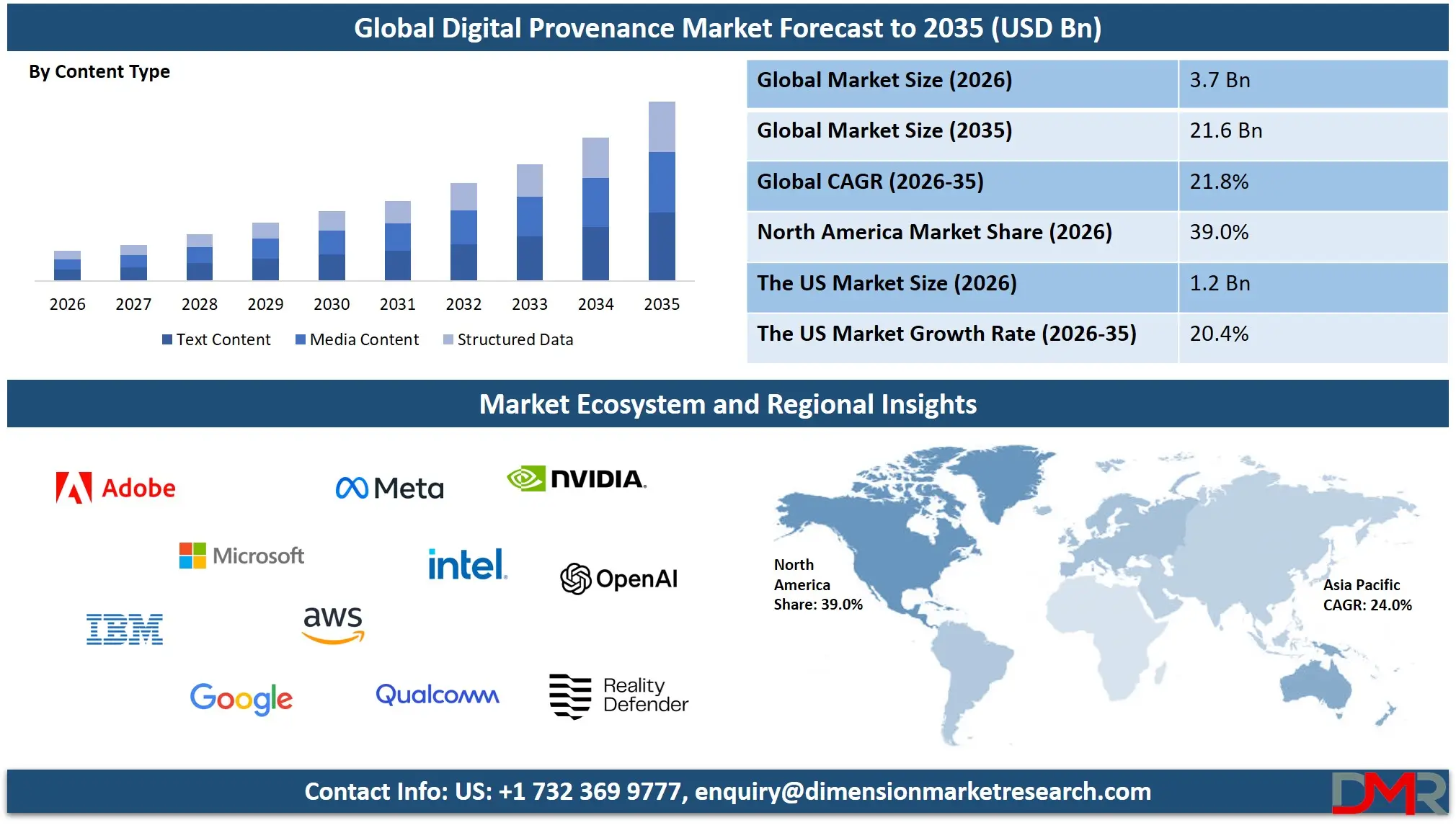
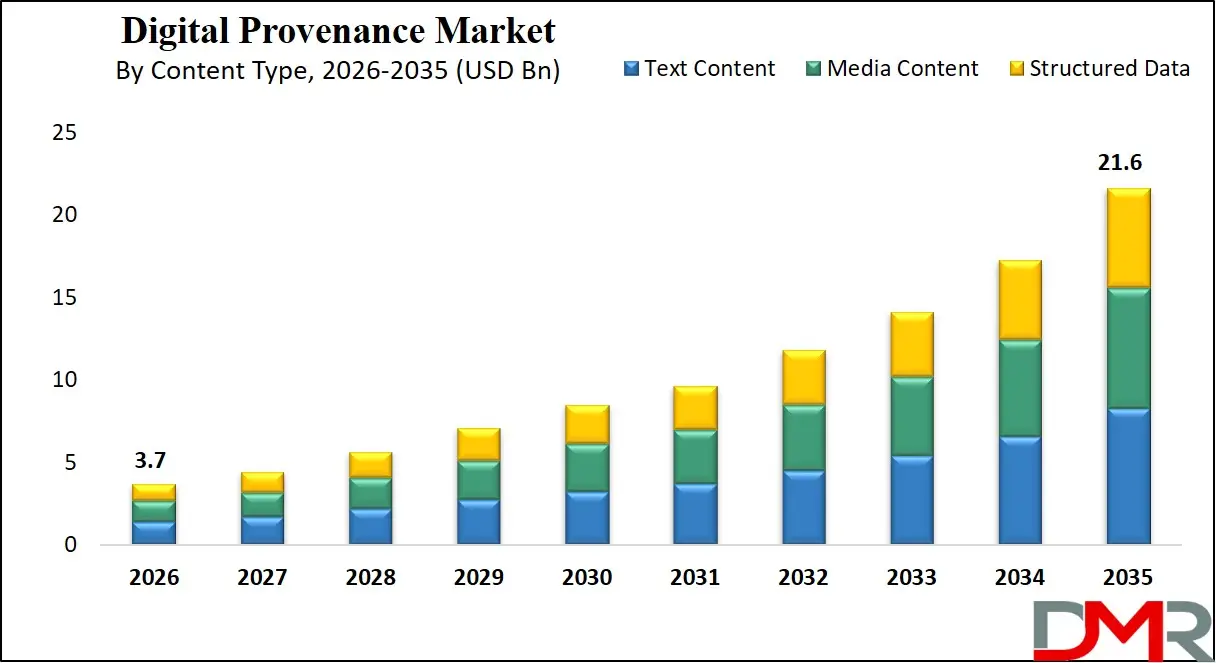
The Global Digital Provenance Market size is expected to reach USD 3.7 billion in 2026 and grow at a CAGR of 21.8%, reaching USD 21.6 billion by 2035, driven by rising demand for content authentication, data integrity, AI-generated content detection, deepfake detection, blockchain-based traceability, and digital trust frameworks across industries.
ℹ
To learn more about this report –
Download Your Free Sample Report Here
Digital Provenance Market refers to the technologies that authenticate and confirm authenticity and integrity of digital text, media, and data. Content authentication solutions are being demanded by the ever-growing market that is driven by increased threats of deepfakes, misinformation, and identity fraud.
The growing threat in finance, media and security sectors as pointed out by government agencies like the Department for Science, Innovation and Technology (DSIT) is driving this faster adoption. Growth is further supported by regulations focused on AI transparency and digital trust. In the future, it is anticipated that digital provenance will be a fundamental layer of digital infrastructure, as increasingly more stringent governance and the demand to have secure, trusted digital ecosystems push it.
ℹ
To learn more about this report –
Download Your Free Sample Report Here
US Digital Provenance Market
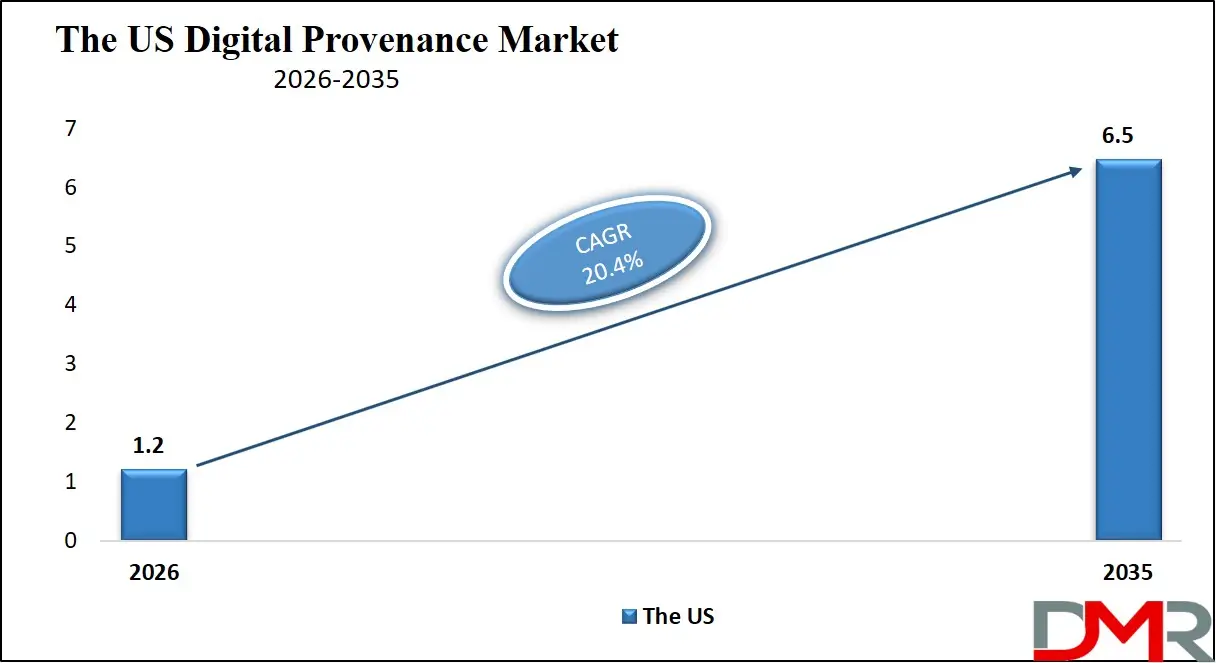
The US Digital Provenance Market size is expected to reach USD 1.2 billion in 2026 and grow at a CAGR of 20.4%, reaching USD 6.5 billion by 2035.
ℹ
To learn more about this report –
Download Your Free Sample Report Here
The U.S. Digital Provenance Market is the biggest in the world, with high usage of AI-based content authentication, deepfake detection, and data integrity solutions in government, BFSI, and media industries. The increasing worries about misinformation, election security, and identity fraud, and the efforts of agencies such as the National Institute of Standards and Technology (NIST) on AI trust and authenticity standards support growth. The market will continue to be dominant because of the developed tech infrastructure and the growing attention to digital trust and AI governance.
Europe Digital Provenance Market
The Europe Digital Provenance Market is anticipated to reach USD 999.0 million in 2026, expanding with a CAGR of 19.5%. The market is driven by stringent regulatory frameworks such as GDPR and the EU AI Act, which emphasize data transparency and content authenticity. Increasing concerns around misinformation, deepfakes, and digital trust are accelerating adoption across media, BFSI, and government sectors. Additionally, growing investments in AI governance and digital infrastructure are supporting long-term market expansion across the region.
Japan Digital Provenance Market
The Japan Digital Provenance Market is anticipated to reach USD 259.0 million in 2026, expanding with a CAGR of 23.6%. The market is driven by high levels of AI technologies adoption, growing worries about deepfake content, and growing attention to digital trust. Cybersecurity and data integrity efforts by the government are also contributing to industry adoption. Also, the increase in digital media and enterprise data systems is driving the need to have sophisticated provenance solutions.
Key Takeaways
- Market Size: The Global Digital Provenance Market is projected to reach USD 3.7 billion in 2026, growing significantly to USD 21.6 billion by 2035.
- Growth Rate and Outlook: The market is expected to expand at a CAGR of 21.8%, driven by increasing adoption of AI-based authentication and digital trust frameworks.
- Primary Growth Drivers: Rising deepfake threats, surge in AI-generated content, need for data integrity, and growing regulatory focus on transparency and content authenticity.
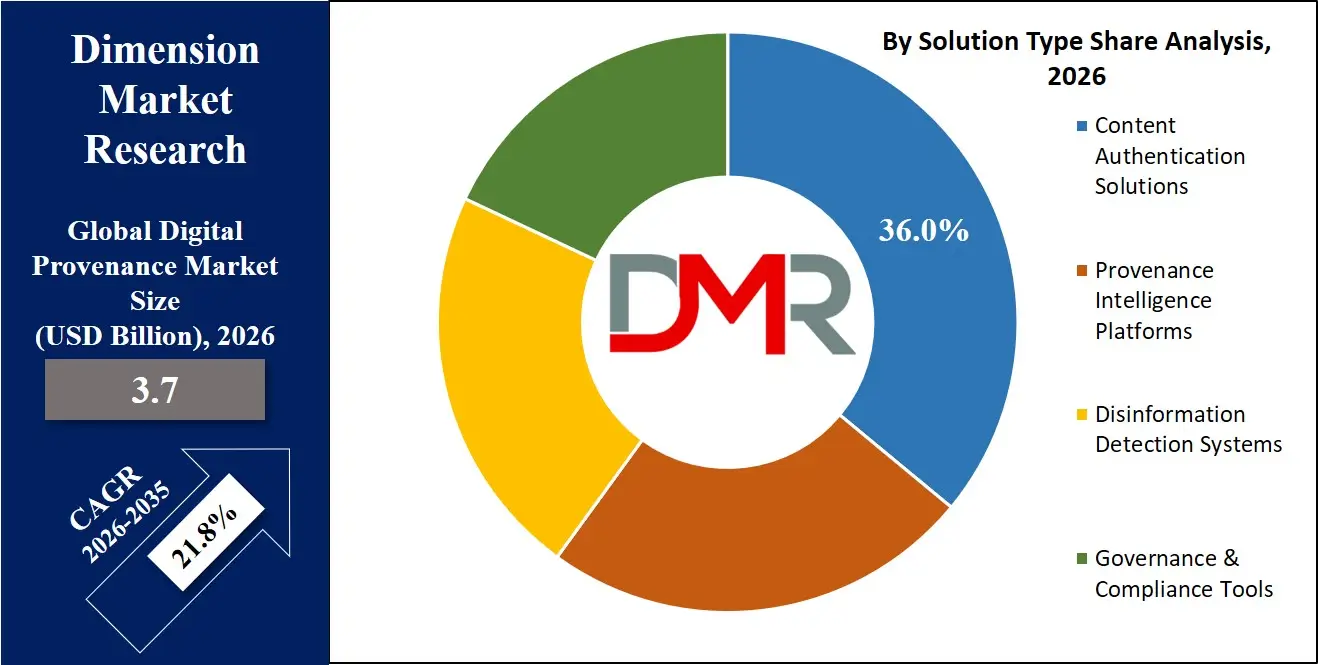
- By Solution Type Analysis: Content Authentication Solutions dominate the segment with 36.0% market share, driven by high demand for deepfake detection and real-time verification systems.
- By Content Type Analysis: Text Content leads with 38.0% market share, supported by the vast volume of digital text and increasing risks of misinformation.
- By Deployment Model Analysis: Cloud deployment holds the largest share at 64.0%, due to scalability, cost-efficiency, and real-time processing capabilities.
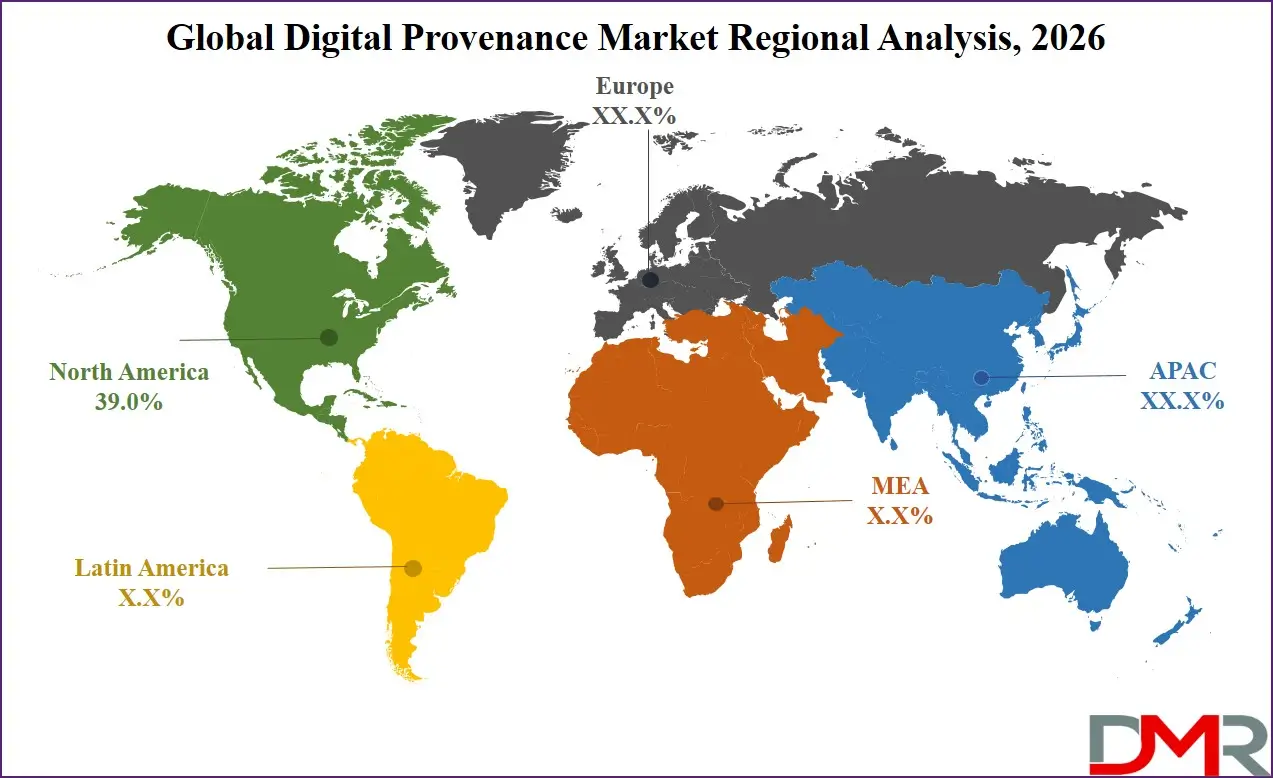
- Regional Leadership: North America leads the market with 39.0% share, supported by advanced AI infrastructure, strong regulatory frameworks, and early adoption of digital provenance technologies.
What is Digital Provenance?
Digital Provenance is the provenance of a digital object, such as its creation, editing, and ownership, forming an auditable record. It aids in maintaining authenticity, data integrity, and trust, particularly with the growing volume of AI-generated and manipulated content, and is becoming backed by government-led standards of secure and transparent digital ecosystems. It is used extensively in industries like finance, media and government to prevent fraud, compliance and content verification.
Use Cases
- Media Content Authentication: Digital provenance is used to verify the authenticity of images, videos, and news content. It helps detect deepfakes and manipulated media using AI-based verification tools. This ensures credibility and trust in journalism and digital publishing.
- Financial Fraud Prevention: Banks and financial institutions use provenance systems to validate transaction data and digital identities. It helps track the origin of data and detect unauthorized alterations to financial records. This reduces fraud risks and strengthens regulatory compliance.
- Government & Public Data Integrity: Governments use digital provenance to maintain transparency and trust in public datasets and official records. It ensures traceability of data sources and prevents manipulation of critical information. This is essential for secure governance and policy enforcement.
How AI is Transforming the Digital Provenance Market
The Digital Provenance Market is also changing as AI will allow authenticating content in real-time and automatically identifying media generated by AI or manipulated by it. State-of-the-art machine learning algorithms can identify patterns, metadata and inconsistencies to check authenticity on a large scale.
Another area in which AI is improving provenance tracking is predictive analytics and anomaly detection in high-complexity data streams. Consequently, it is emerging as the fundamental technology that enables the digital trust, transparency, and secure content ecosystems.
Market Dynamics
Key Drivers in the Global Digital Provenance Market
Rising Deepfake & Misinformation Risks
The proliferation of AI-generated content has greatly contributed to the dissemination of deepfakes and fake news on the Internet. This has posed a pressing need of authentication and verification systems. Governments and businesses are giving content integrity a priority in order to retain trust of the people. Social media are also investing in detection technologies to regulate harmful content. As a result, digital provenance solutions are becoming essential for safeguarding information ecosystems.
Regulatory Push for Digital Trust and Transparency
Governments all over the world are implementing policies aimed at AI transparency, data integrity and digital accountability. Regulatory authorities are focusing on traceability of content and auditability of data sources. Provenance systems are being adopted through the encouragement of frameworks by institutions such as the National Institute of Standards and Technology. The need to comply is compelling businesses to incorporate verification tools in their operations. This regulatory wave is a significant market growth driver.
Restraints in the Global Digital Provenance Market
High Implementation Complexity
Deploying digital provenance solutions requires integration across multiple systems and data environments. Organizations often face challenges in aligning legacy infrastructure with advanced AI and blockchain technologies. The need for skilled expertise further increases implementation difficulty. Interoperability issues between platforms can delay deployment timelines. These factors collectively slow down widespread adoption.
Limited Standardization across Platforms
Limited standardization across digital provenance platforms can make it difficult to exchange and verify origin, ownership, processing, and chain-of-custody records across systems. Providers may use different data formats, identifiers, metadata fields, and verification methods, so information captured on one platform may require conversion or manual reconciliation before another can use it. These integration demands raise implementation costs, slow multi-party adoption, and create gaps in end-to-end visibility.
Growth Opportunities in the Global Digital Provenance Market
AI Governance Frameworks
With the increasing use of AI, organizations are looking at ways to provide transparency and accountability in AI deliverables. Digital provenance can play a key role in tracking AI-generated content and model decisions. Combination with AI governance systems opens up new sources of revenue. Companies are making more investments in reliable AI. This trend makes provenance a key element of future AI ecosystems.
Growth in Emerging Digital Economies
Emerging economies are fast digitalizing financial services, media and government services. This puts a high demand on data integrity and fraud prevention solutions. Secure digital transformation initiatives can be supported by digital provenance. These regions are also investing in cybersecurity infrastructure by governments. This growth creates new growth opportunities to market players.
Trends in the Global Digital Provenance Market
Adoption of Blockchain-Based Provenance Systems
Blockchain technology is increasingly being used to create immutable records of digital content. It ensures tamper-proof tracking of data origin and modifications. Organizations are leveraging decentralized systems for enhanced transparency. This trend is gaining traction in supply chain, finance, and media sectors. It is reshaping how provenance data is stored and verified.
Shift Toward Real-Time Verification Systems
There is a growing demand for real-time content authentication across digital platforms. AI-powered systems are enabling instant verification of media and data streams. This is particularly important for social media and live content environments. Enterprises are focusing on proactive detection rather than reactive analysis. Real-time capabilities are becoming a key competitive differentiator in the market.
Research Scope and Analysis
By Solution Type Analysis
The solution type segment is projected to be dominated by Content Authentication Solutions with a market share of 36.0% in 2026 due to the pressing need to identify deepfakes, verify the integrity of digital content, and provide trust in the media, finance, and government platforms. The emergence of AI-generated content and misinformation is compelling organizations to scale to real-time verification and watermarking technologies. These solutions are broadly incorporated into social media, news outlets, and enterprise systems to avoid manipulation and fraud.
ℹ
To learn more about this report –
Download Your Free Sample Report Here
Meanwhile, Provenance Intelligence Platforms are becoming more popular because they allow tracking the content origin, ownership, and modification history end-to-end. They offer more content lifecycle and source attribution, which is beneficial to compliance, auditability, and transparency. The two segments are collectively the backbone of the digital provenance ecosystem in terms of functionality.
By Content Type Analysis
Text Content will have the largest market share of 38.0% in the content type segment in 2026, mainly because of the sheer amount of textual data produced on news sites, social media, legal systems, and enterprise communications. The fact that text is highly exposed to misinformation, fake news and automated content generation is creating high demand on verification and authenticity solutions. Companies are also implementing NLP-based systems to check credibility and identify manipulation as it happens. In the meantime, Media Content is also experiencing a rapid growth as a result of the influx of deepfake videos, synthetic images, and manipulated audio. The use of advanced forensic and AI-based detection technologies is being implemented to confirm visual and audio authenticity. Collectively, the two segments are essential in enhancing digital trust in various content ecosystems.
By Technology Analysis
In 2026, AI and ML will take over the technology segment with a 34.0% market share, as they will be used to facilitate real-time content authentication, deepfake detection, and automated analysis of large-scale digital data. Pattern recognition, anomaly detection, and predictive verification are supported by these technologies, and they are crucial in detecting manipulated or AI-generated content. Their ability to scale and their ability to learn continuously also enhance their adoption in industries. Meanwhile, blockchain is becoming significant in offering unalterable and non-repudiable content provenance and provenance history. It provides secure traceability and transparency with decentralized ledgers and timestamping. AI and blockchain are the two fundamental technologies of digital provenance systems.
By Deployment Model Analysis
Cloud deployment will take over the deployment model segment with a market share of 64.0% in 2026 due to its scalability, real-time processing and its ease of integration with AI-based content authentication and verification tools. Organizations are more inclined to cloud solutions to manage high amounts of digital content and provide instant provenance tracking of distributed systems. Pay-as-you-go model and quicker deployment cycles further boost adoption within enterprises and government agencies. Meanwhile, hybrid deployment is becoming more popular among the organizations that need to achieve a balance bDigital Provenance Market By Solution Type Share Analysisetween data security and scalability. It enables sensitive data to be on-premises and use cloud capabilities to perform advanced analytics and verification. The model is especially applicable in controlled industries that need flexibility without losing control.
By End-Use Industry Analysis
BFSI is expected to dominate the end-use industry segment with a 27.0% market share in 2026, driven by the critical need for fraud prevention, transaction authentication, and regulatory compliance in highly sensitive financial environments. Digital provenance solutions are becoming popular among financial institutions to ensure the integrity of data, detect identity fraud, and secure digital transactions. The increasing risk of cyberattacks and financial manipulation also contributes to the increased adoption in this sector. Simultaneously, the Media & Entertainment sector is experiencing a robust growth as the issue of deepfakes, content piracy, and misinformation are becoming increasingly worrisome. Provenance technologies are being applied to authenticate the content, safeguard intellectual property, and provide trust in digital media. The two industries contribute to the general growth of the market.
The Global Digital Provenance Market Report is segmented on the basis of the following:
By Solution Type
- Content Authentication Solutions
- Deepfake detection
- Content integrity verification
- Media authenticity validation
- Digital watermarking
- Provenance Intelligence Platforms
- Lineage tracking systems
- Source attribution engines
- Content traceability tools
- Origin mapping systems
- Disinformation Detection Systems
- Influence detection platforms
- Bot network analytics
- Narrative tracking systems
- Misinformation monitoring
- Governance & Compliance Tools
- Audit trail systems
- Policy enforcement tools
- Compliance dashboards
- Data governance platforms
By Content Type
- Text Content
- News content
- Social media text
- Legal documents
- Academic content
- Media Content
- Images
- Video
- Audio
- Synthetic media
- Structured Data
- Financial data
- Healthcare records
- IoT data
- Enterprise data
By Technology
- AI & ML
- Pattern detection
- GAN detection
- Anomaly scoring
- Predictive analytics
- Blockchain
- Distributed ledger
- Smart contracts
- Immutable records
- Timestamping
- Digital Forensics
- Image forensics
- Video forensics
- Audio forensics
- Metadata analysis
- NLP Analytics
- Semantic analysis
- Fake news detection
- Context validation
- Sentiment tracking
By Deployment Model
- Cloud
- SaaS platforms
- API-based systems
- Cloud-native AI
- Hybrid
- Hybrid AI systems
- Federated platforms
- Multi-cloud systems
- On-Premise
- Secure government systems
- Banking internal systems
- Defense deployments
By End-Use Industry
- BFSI
- Media & Entertainment
- Government & Defense
- Healthcare
- IT & Cybersecurity
- Retail & E-commerce
Regional Analysis
Leading Region by Market Share
It is estimated that North America will dominate the Digital Provenance Market, with 39.0% of the total world market share in 2026 due to the large adoption of AI-based content authentication and advanced cybersecurity systems. The presence of large technology suppliers and the early implementation of digital trust models in BFSI, media and government is an advantage to the region. Demand is also being driven by the increasing interest in deepfakes, misinformation, and data integrity. Moreover, the regional supremacy is still being strengthened by facilitative regulatory policies and investments in AI governance.
ℹ
To learn more about this report –
Download Your Free Sample Report Here
Fastest-Growing Regional Market
Asia Pacific is set to become the most rapidly expanding regional market, prompted by the accelerating digitalization, growing social media ecosystems, and the growing exposure to the risks of deepfakes and misinformation. The governments of China, India, Japan, and South Korea are investing in AI governance, and content verification systems. The increase in the use of AI, blockchain, and cybersecurity technologies in businesses further enhances expansion. The high numbers of digital users in the region and the changing regulatory environment in the region makes the region a significant future growth driver in the Digital Provenance Market.
By Region
North America
Europe
- Germany
- The U.K.
- France
- Italy
- Russia
- Spain
- Benelux
- Nordic
- Rest of Europe
Asia-Pacific
- China
- Japan
- South Korea
- India
- ANZ
- ASEAN
- Rest of Asia-Pacific
Latin America
- Brazil
- Mexico
- Argentina
- Colombia
- Rest of Latin America
Middle East & Africa
- Saudi Arabia
- UAE
- South Africa
- Israel
- Egypt
- Rest of MEA
Competitive Landscape
Competitive environment is quite dynamic with a combination of both established technology vendors and new entrants with interest in AI-based content authentication and data integrity solutions. The capabilities that companies are competing on include real-time verification, scalability, and the integration with the existing digital ecosystems. Ongoing research and development efforts are leading to innovation in deepfake detection, blockchain-based traceability, and automated provenance systems. The approaches that influence the market competition include strategic partnerships, product improvement, and regulatory alignment.
Some of the prominent players in the Global Digital Provenance Market are:
- Adobe
- Microsoft
- IBM
- Google
- Meta Platforms
- Amazon Web Services
- NVIDIA
- Intel
- Qualcomm
- OpenAI
- Reality Defender
- Truepic
- Sensity AI
- Digimarc
- Serelay
- Veritone
- Accenture
- Booz Allen Hamilton
- Thales Group
- Pindrop
- Other Key Players
Recent Developments
- April 2026: Winston AI launched a forensic deepfake detection tool capable of tracing manipulated images back to their source systems, strengthening content provenance and authenticity verification capabilities.
- February 2026: Microsoft collaborated with the UK government to develop a standardized deepfake detection framework, marking a strategic partnership to strengthen digital provenance and AI trust infrastructure.
- January 2026: Incode introduced its "Deepsight" AI solution to detect deepfake video calls and enhance identity verification, addressing rising fraud risks in digital ecosystems.
Report Details
| Report Characteristics |
| Market Size (2026) |
USD 3.7 Bn |
| Forecast Value (2035) |
USD 21.6 Bn |
| CAGR (2026–2035) |
21.8% |
| Historical Data |
2021 – 2025 |
| Forecast Data |
2027 – 2035 |
| Base Year |
2025 |
| Estimate Year |
2026 |
| Segments Covered |
By Solution Type (Content Authentication Solutions, Provenance Intelligence Platforms, Disinformation Detection Systems, Governance & Compliance Tools), By Content Type (Text Content, Media Content, Structured Data), By Technology (AI & ML, Blockchain, Digital Forensics, NLP Analytics), By Deployment Model (Cloud, Hybrid, On-Premise), By End-Use Industry (BFSI, Media & Entertainment, Government & Defense, Healthcare, IT & Cybersecurity, Retail & E-commerce) |
| Regional Coverage |
North America – The US and Canada; Europe – Germany, The UK, France, Russia, Spain, Italy, Benelux, Nordic, & Rest of Europe; Asia-Pacific – China, Japan, South Korea, India, ANZ, ASEAN, Rest of APAC; Latin America – Brazil, Mexico, Argentina, Colombia, Rest of Latin America; Middle East & Africa – Saudi Arabia, UAE, South Africa, Turkey, Egypt, Israel, & Rest of MEA |
Frequently Asked Questions
How big is the Digital Provenance Market?
▾ The Global Digital Provenance Market is projected to reach USD 3.7 billion in 2026 and is expected to grow significantly to USD 21.6 billion by 2035.
What is the CAGR of the Digital Provenance Market from 2026 to 2035?
▾ The market is expected to grow at a compound annual growth rate (CAGR) of 21.8% during the forecast period.
What factors are driving the growth of the Digital Provenance Market?
▾ Growth is driven by the increasing rise of AI-generated content, deepfakes, misinformation risks, need for data integrity, regulatory focus on digital trust, and adoption of blockchain-based traceability systems.
What are the major trends in the Digital Provenance Market?
▾ Key trends include AI-driven content authentication, blockchain-based provenance systems, real-time verification, digital watermarking, and integration with AI governance frameworks.
Which region held the largest share of the Digital Provenance Market in 2026?
▾ North America held the largest market share of 39.0% in 2026 due to strong adoption of AI, cybersecurity solutions, and advanced digital trust frameworks.
Which region is expected to grow the fastest in the Digital Provenance Market?
▾ Asia Pacific is expected to be the fastest-growing region, driven by rapid digitalization, rising misinformation risks, and increasing AI adoption.
Who are the key players in the Digital Provenance Market?
▾ Adobe, Microsoft, IBM, Google, Meta Platforms, Amazon Web Services, NVIDIA, Intel, Qualcomm, OpenAI, Reality Defender, Truepic, Sensity AI, Digimarc, Serelay, Veritone, Accenture, Booz Allen Hamilton, Thales Group, Pindrop, Other Key Players.
How is the Digital Provenance Market segmented?
▾ The market is segmented by Solution Type, Content Type, Technology, Deployment Model, and End-Use Industry.