What is the Digital Railway Market Size?
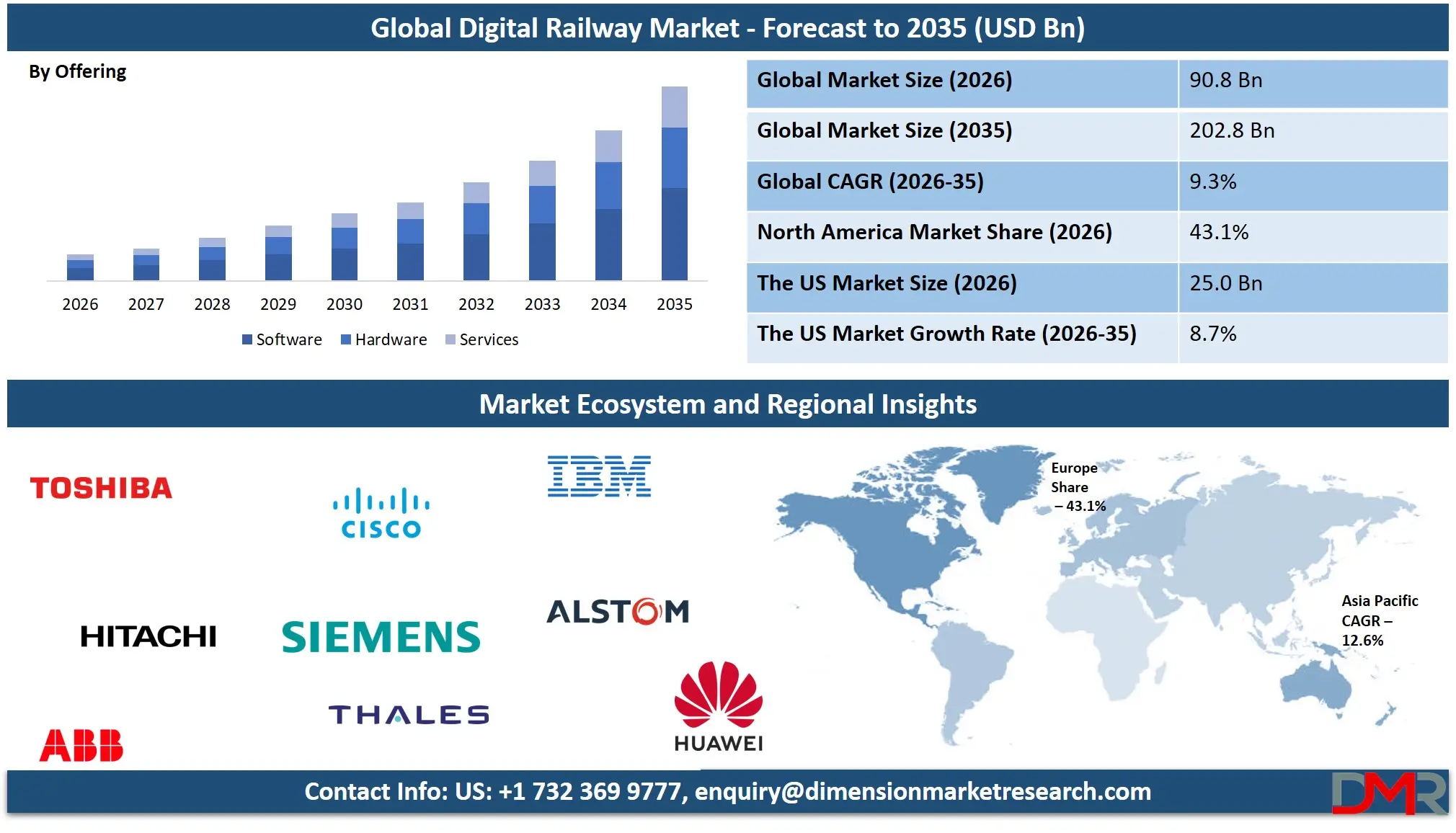
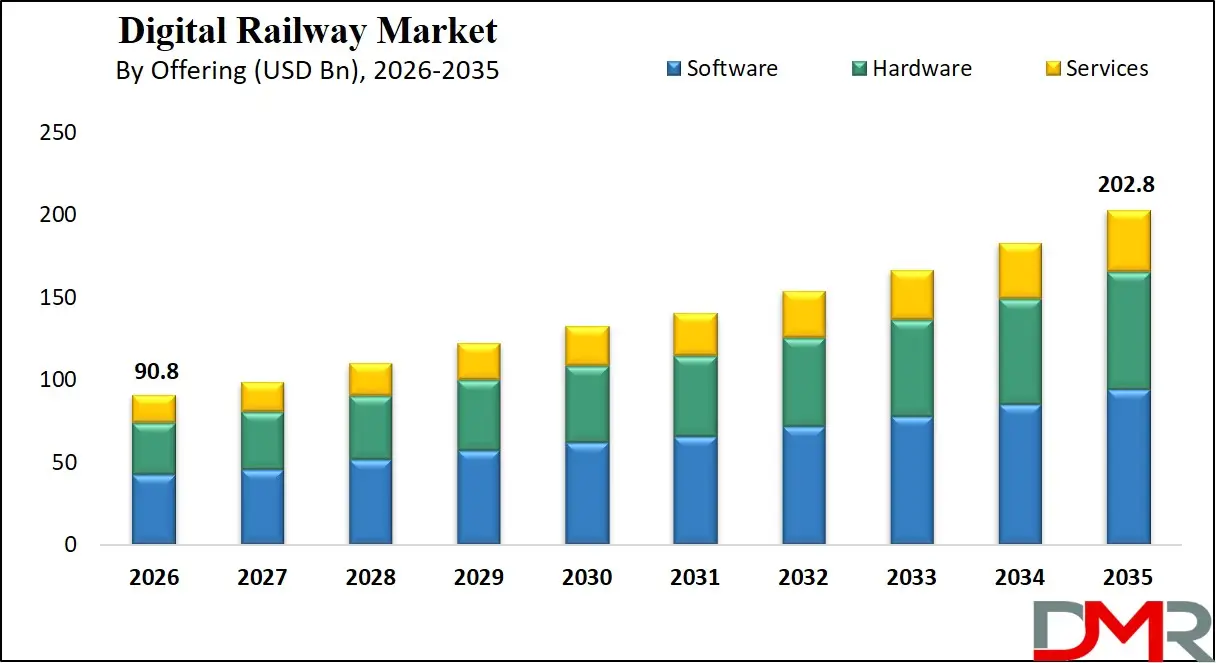
The Digital Railway Market size is projected to reach USD 90.8 billion in 2026 and grow at a compound annual growth rate of 9.3% to reach a value of USD 202.8 billion in 2035, driven by government investing heavily in railway modernization as part of broader smart city and infrastructure development plans.
ℹ
To learn more about this report –
Download Your Free Sample Report Here
Digital Railway Market is experiencing a strong growth due to the growing demand of efficient, safe, and smart rail systems across the globe. It also includes such modern technologies as IoT, AI, cloud computing, and real-time data analytics applied in the work of railways. Modernization is a major investment that governments and other stakeholders in the sector are undertaking to enable efficiency in operations, minimize delays and enhance consumer experience.
The move towards automation, predictive maintenance and smart ticketing solutions is increasing adoption. Moreover, the need to reduce carbon emissions and the importance of sustainability are driving digital changes in rail transport, and digital railway systems have become an essential part of the mobility infrastructure of the future on the global scale.
ℹ
To learn more about this report –
Download Your Free Sample Report Here
The US Digital Railway Market
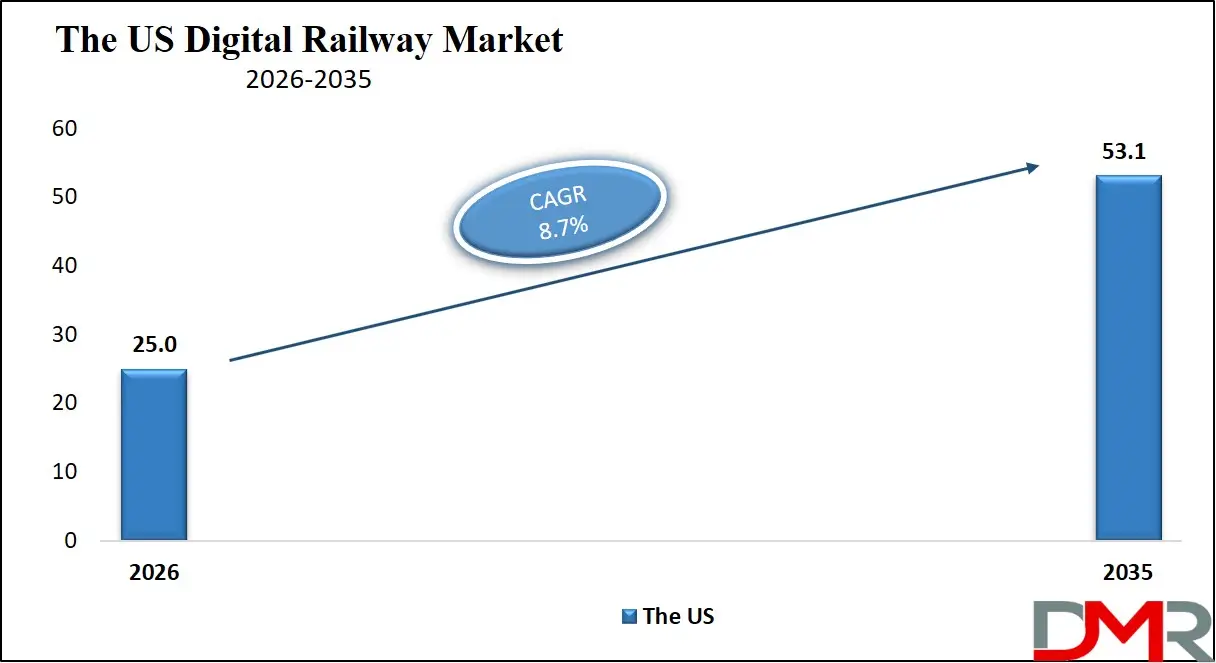
The US Digital Railway Market size is projected to reach USD 25.0 billion in 2026 and grow at a CAGR of 8.7% during the forecast period.
ℹ
To learn more about this report –
Download Your Free Sample Report Here
The US digital railway market is motivated by the modernization processes and the necessity to renovate the old railroads. There is an increasing investment in smart signaling systems, predictive maintenance based on AI, and IoT-enabled monitoring. The adoption is promoted by government subsidies in terms of infrastructure funding programs. The freight rail prevails and digital tools improve the effectiveness of logistics. Major participants are concentrating on innovation and collaborations to increase capacities. The regulatory frameworks that promote safety and efficiency also facilitate the adoption of digital, and the need to have real-time data and automation further determines the growth of markets.
Europe Digital Railway Market
The Europe Digital Railway Market size is estimated to be USD 33.1 billion in 2026 and its CAGR of 8.4% over the forecast period.
Europe is a developed digital railway market, which has a strong impact on sustainability objectives and regional policies, including the European Green Deal. Nations are also working on intelligence rail systems to minimize emissions and enhance cross-border linkages. Innovation is driven by advanced signaling systems, such as ERTMS (European Rail Traffic Management System) and high-speed rails. Adoption is supported by public-private partnerships and harmonization of regulations. Technologies like real-time information and smart ticketing are commonly practiced as passenger-centric services, and Europe is a frontrunner in terms of digital transformation of the railroad.
Japan Digital Railway Market
Japan Digital Railway Market size will be USD 3.6 billion in 2026 and CAGR is 8.8% in the forecast period.
The Japanese have a well-developed digital railway market backed by good technology and an extensive urban rail system. Automation, punctuality, and safety are the priorities in the country and are achieved by AI-driven systems and predictive maintenance solutions. Growth is stimulated by government actions and constant investment in intelligent infrastructure. The high volume of passengers and urbanization require efficient rail systems of management. The difficulties are high implementation costs and system integration, yet the prospects are in exporting the developed digital railway technologies worldwide.
Digital Railway Market: Key Takeaways & Influencing Factors
- Market Size & Forecast: The Digital Railway Market size is projected to reach USD 90.8 billion in 2026 and is anticipated to have a value of USD 202.8 billion in 2035.
- Growth Rate & Outlook: The Digital Railway Market size is set to grow at a compound annual growth rate of 9.3% during the forecast period of 2026 to 2035.
- Primary Growth Drivers: Some of the major growth drivers in the market include technological advancements and automation, government investments and smart infrastructure initiatives, and more.
- Key Market Trends: Some of the major trends in the market are adoption of AI and data-driven decision making, shift toward cloud-based solutions, and more.
- By Offering: The software segment is anticipated to get the majority share of the Digital Railway market in 2026.
- By Technology: The IoT segment is expected to get the largest revenue share in 2026 in the Digital Railway market.
- By Deployment Mode: The cloud segment is expected to get the largest revenue share in 2026 in the Digital Railway market.
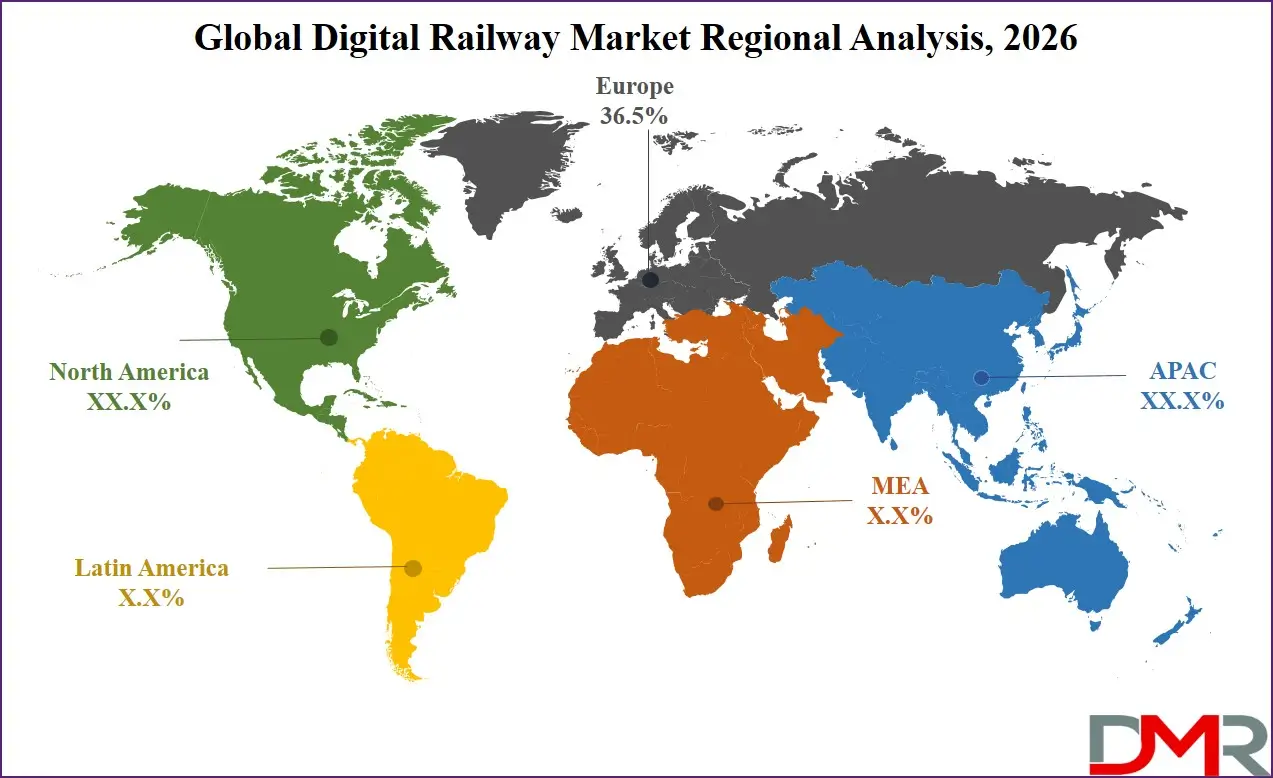
- Regional Leadership: Europe is set to lead the Digital Railway market with an estimated 36.5% share in 2026.
What is the Digital Railway?
Digital railway is a concept of utilizing the latest digital technologies in railway systems to streamline the processes, improve the safety and passenger and freight services. Such components include smart sensors, automated signaling systems, real-time data analytics, and cloud-based platforms that facilitate smooth communication between trains, infrastructure and control centers. Online railways allow predictive maintenance, effective planning and improved maintenance of assets. The concept is essential in converting conventional rail systems into intelligent transportation systems, which assist in increasing capacity utilization, enhancing reliability, and sustainable mobility as well as offering automation and data-driven decisions in rail activities.
Use Cases
- Smart Train Operations: Digital railway systems enable automated scheduling, real-time monitoring, and efficient dispatching, reducing delays and improving operational efficiency across networks.
- Predictive Maintenance: Faults are detected before failures to prevent downtime and minimize maintenance expenses and maximize safety.
- Passenger Experience Enhancement: Passengers can enjoy greater convenience, satisfaction, and engagement with digital ticketing, real-time updates, and personalized services.
- Freight Optimization: Next-generation analytics and tracking technologies optimize freight transit, enhance efficiency in logistics, and cut transit times in rail networks.
How AI Is Transforming the Digital Railway Market
Digital railway systems are also changing with artificial intelligence, which facilitates predictive maintenance, automated scheduling, and real-time decisions. AI algorithms can be used to analyze large body of sensor data and system operation data to identify any anomaly and streamline performance. This saves time, increases safety and efficiency.
Also, AI improves passenger experience by providing customized services, predicting demand, and smart ticketing. It also contributes to minimizing energy consumption and resource distribution, enabling rail operators to lower costs and environmental footprint and enhance reliability of services and their operational efficiency.
Market Dynamic
Driving Factors in the Digital Railway Market
Technological Advancements and Automation
The digital railway market is being greatly propelled by the integration of AI, IoT, and big data analytics. Such technologies allow real-time monitoring and predictive maintenance, as well as automated train operations, enhancing efficiency and safety. Automation minimizes human errors and operational expenses as well as maximizing the use of capacity. Ongoing signaling system and communication technology advances lead to improved system reliability, and digital transformation is a necessary part of modern rail infrastructure development.
Government Investments and Smart Infrastructure Initiatives
The world governments are spending a lot of money in modernizing their railways, which are also a part of the wider smart city and infrastructure development programs. Policy support, subsidies and funding programs are promoting the adoption of digital railway technologies. Implementation of measures to minimise carbon emissions and enhance efficiency of the transport system of the populace is spurring deployment. Such investments provide an attractive atmosphere to the technology providers and infrastructural developers that directly enhances growth of the market.
Restraints in the Digital Railway Market
High Capital Investment Requirements
Digital railway implementation is expensive in terms of initial investment in the infrastructure, technology and system integration. The process of updating the old systems can be complicated and expensive, particularly in developing countries. Such cost constraints can cause delays in adoption, especially with smaller rail operators, as the benefit in the long-term costs is impeded.
Integration and Interoperability Challenges
Digital railway systems entail several technologies, which are supposed to seamlessly interact. The technical challenge of integrating new digital solutions with the existing infrastructure can take place. The absence of standardized procedures and regional compatibility may be a barrier to adoption. Such difficulties make deployments more expensive and time-consuming, affecting the expansion of the market in general.
Opportunities in the Digital Railway Market
Expansion in Emerging Economies
To facilitate urbanization and economic growth, developing countries are investing in rail infrastructure. The areas pose major threats of adopting digital railways, since they do not have to be tied by the legacy of technologies. The growing need of effective transportation and government incentives provides a good growth opportunity to market participants.
Growth of Smart Cities and Sustainable Transport
The trend of smart cities and mobility sustainability in the world is also providing digital railway systems with new opportunities. Digital railways are a crucial part of the transport ecosystems of the future by integrating with urban mobility platforms, energy-efficient operations, and lowering emissions. This is likely to be a long-term demand trend.
Trends in the Digital Railway Market
Adoption of AI and Data-Driven Decision Making
The use of AI and analytics in rail operators is gaining more and more momentum aimed at operations optimization and decision-making. Information-based insights facilitate effective planning, proactive maintenance, and enhanced passenger services. The trend is converting the conventional rail systems into smart, responsive networks.
Shift Toward Cloud-Based Solutions
The trend of cloud computing in digital railway systems is becoming a fundamental aspect of this sector, allowing the storage of data and the availability of information on a larger scale and in real-time. Online solutions facilitate remote monitoring, centralized control, and enhanced collaboration. This change increases flexibility in operations and minimizes the cost of infrastructure.
Research Scope and Analysis
By Offering Analysis
The software component will have a market share of about 46.3 percent in 2026 because of the growing demand of using sophisticated analytics, traffic control, and predictive maintenance systems. Rail operators are interested in software solutions related to real-time decision-making and optimization of operations. The use of AI-based analytics and cloud-based applications is gaining momentum, thus enabling this segment. Meanwhile, the services business is the most expanding with an increasing demand of system integration and managed services. With the increasing pace of digital transformation, software-based solutions will be in the middle of the action to empower the smart railway ecosystem.
By Deployment Mode Analysis
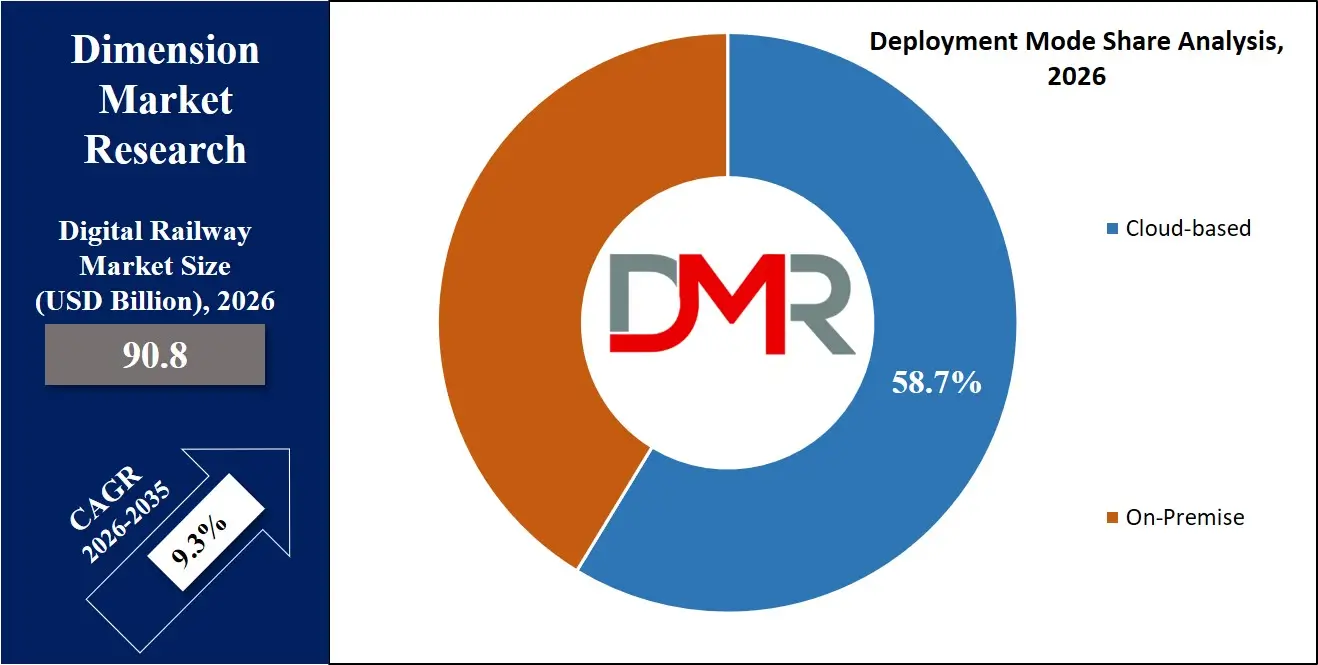
Cloud-based deployment is expected to dominate with a forecast of 58.7% market share in the year 2026 due to the scalability, affordability and real-time access of data. Rail operators are moving towards cloud technologies to gain centralized control and enhance cooperation. Cloud solutions are flexible, which facilitates quick deployment and integration.
ℹ
To learn more about this report –
Download Your Free Sample Report Here
On-premise systems are, however, still applicable in areas where there is a high level of data security demands. The most rapid development is in the hybrid cloud usage, which involves the security and scalability, thus deployment strategies are more flexible to the various ways of operations.
By Technology Analysis
It is expected that the IoT technology will have the highest share at the time of 34.8 percent in 2026, considering its pivotal role in facilitation of real-time monitoring and predictive maintenance. Connected devices and sensors deliver ongoing streams of data, enhancing the efficiency and safety of operation. The most rapidly developing segment is AI and machine learning, which improve the ability to analyze data and automate the process. The IoT and AI convergence are producing smarter railway systems, which lead to innovation and broaden the technological market landscape.
By Application Analysis
Management of rail operations in the future is likely to take the lead with an estimated share of 31.6 in 2026 owing to the demand of efficient scheduling, dispatching and traffic control systems. Digital solutions enhance efficiencies and minimize delays. The fastest-growing area is passenger experience applications driven by the need to have smart ticketing and real-time information systems. With the increasing customer expectations, rail operators have been spending more on digital tools to improve the quality of service and customer engagement.
The Digital Railway Market Report is segmented on the basis of the following:
By Offering
- Hardware
- Sensors & IoT Devices
- Signaling Equipment
- Communication Systems
- Onboard Systems
- Software
- Rail Traffic Management Software
- Asset Management Software
- Predictive Maintenance Software
- Passenger Information Software
- Freight Management Software
- Analytics Platforms
- Services
- Consulting
- System Integration
- Managed Services
- Support & Maintenance
By Deployment Mode
By Technology
- IoT
- Artificial Intelligence & Machine Learning
- Big Data & Analytics
- Cloud Computing
- Cybersecurity
- Communication-Based Train Control (CBTC)
By Application
- Rail Operations Management
- Scheduling & Dispatch
- Traffic Control
- Asset Management
- Lifecycle Management
- Condition Monitoring
- Predictive Maintenance
- Passenger Experience
- Smart Ticketing
- Real-Time Information Systems
- Freight Management
- Safety & Security
- Surveillance Systems
- Access Control Systems
Regional Analysis
Leading Region in the Digital Railway Market
The digital railway market will be dominated by Europe with an estimated 36.5 percent market share by 2026 due to the high level of regulatory support, superior infrastructure, and sustainability. The adoption of ERTMS and investments in high-speed rail networks play a significant role in leading the market.
ℹ
To learn more about this report –
Download Your Free Sample Report Here
The policies by the government that encourage low carbon modes of transportation and connectivity across borders also boost the position of the region. Moreover, the availability of advanced technology suppliers and developed railways favor ongoing innovation and implementation.
Fastest Growing Region in the Digital Railway Market
The fastest-growing region is Asia-Pacific which is being propelled by rapid urbanization, developing railways, and massive government investments in infrastructure. Digital railway technologies are being embraced by countries to enhance efficiency and address the increased transportation needs. Growth is further boosted by smart city projects and rising passenger traffic. The emphasis of the region on modernization and technological development opens up huge market potentials.
By Region
North America
Europe
- Germany
- The U.K.
- France
- Italy
- Russia
- Spain
- Benelux
- Nordic
- Rest of Europe
Asia-Pacific
- China
- Japan
- South Korea
- India
- ANZ
- ASEAN
- Rest of Asia-Pacific
Latin America
- Brazil
- Mexico
- Argentina
- Colombia
- Rest of Latin America
Middle East & Africa
- Saudi Arabia
- UAE
- South Africa
- Israel
- Egypt
- Rest of MEA
Competitive Landscape
The digital railway market is very competitive with innovation and strategic alliances being the order of the day. In order to achieve a competitive advantage, companies are oriented towards the creation of new advanced technologies, including AI-powered analytics and IoT-enabled systems. There are high barriers to entry because of capital-intensive infrastructure and technical know-how. Strategic approaches in the market to increase market presence include partnerships, mergers and long-term contracts with the rail operators. Moreover, research and development is an important factor in staying competitive and meeting the changing needs of the industry.
Some of the prominent players in the global Digital Railway are:
- Siemens AG
- Alstom SA
- Hitachi Ltd.
- Thales Group
- Cisco Systems Inc.
- Huawei Technologies Co., Ltd.
- IBM Corporation
- ABB Ltd.
- Wabtec Corporation
- Bombardier Inc.
- Toshiba Corporation
- Fujitsu Limited
- General Electric Company
- Nokia Corporation
- Indra Sistemas S.A.
- Trimble Inc.
- Konux GmbH
- Tego Inc.
- Oxplus Ltd.
- SAP SE
- Other Key Players
Recent Developments
- In April 2026, Hitachi Rail acquired Clever Devices, a U.S.-based provider of intelligent transit solutions. Known for fleet management and passenger experience technologies, Clever Devices strengthens Hitachi Rail's digital capabilities. The deal supports its strategy to expand into multimodal mobility, boost North American presence, and advance its position as a global digital mobility leader.
- In February 2026, Tata Communications and RailTel Corporation of India announced a strategic partnership to enhance India's digital infrastructure for AI. Combining RailTel's 63,000+ km optical fibre network across 6,000+ stations with Tata's global digital capabilities, the collaboration focuses on modernising networks, strengthening cybersecurity, enabling secure cloud adoption, and advancing AI-driven digital operations nationwide.
- In April 2025, Nokia introduced a new 5G radio solution for railways, delivering high-capacity, reliable real-time communications to support the Future Railway Mobile Communication System (FRMCS). It includes the first commercial 5G radio for the 1900 MHz band and a dedicated core solution. Designed to replace GSM-R, FRMCS will enable advanced automation, stronger security, improved services, and seamless cross-border railway communication.
Report Details
| Report Characteristics |
| Market Size (2026) |
USD 90.8 Bn |
| Forecast Value (2035) |
USD 202.8 Bn |
| CAGR (2026–2035) |
9.3% |
| Historical Period |
2021 – 2025 |
| Forecast Period |
2027 – 2035 |
| Base Year |
2025 |
| Estimate Year |
2026 |
| Segments Covered |
By Offering (Hardware, Software, Services), By Deployment Mode (Cloud-Based, On-Premises), By Technology (IoT, Artificial Intelligence & Machine Learning, Big Data & Analytics, Cloud Computing, Cybersecurity, Communication-Based Train Control (CBTC)), By Application (Rail Operations Management, Asset Management, Predictive Maintenance, Passenger Experience, Freight Management, Safety & Security) |
| Regional Coverage |
North America – The US and Canada; Europe – Germany, The UK, France, Russia, Spain, Italy, Benelux, Nordic, & Rest of Europe; Asia-Pacific – China, Japan, South Korea, India, ANZ, ASEAN, Rest of APAC; Latin America – Brazil, Mexico, Argentina, Colombia, Rest of Latin America; Middle East & Africa – Saudi Arabia, UAE, South Africa, Turkey, Egypt, Israel, & Rest of MEA. |
Frequently Asked Questions
How big is the Digital Railway Market?
▾ The Digital Railway Market size is expected to reach USD 90.8 billion by 2026 and is projected to reach USD 202.8 billion by the end of 2035.
What is the CAGR of the Digital Railway Market from 2026 to 2035?
▾ The market is growing at a CAGR of 9.3 percent over the forecasted period.
What factors are driving the growth of the Digital Railway Market?
▾ Technological advancements and automation, government investments and smart infrastructure initiatives, and more are the factors driving the growth of the Digital Railway Market.
What are the major trends in the Digital Railway Market?
▾ Adoption of AI and data-driven decision making, shift toward cloud-based solutions, and more are some of the major trends in the market.
Who are the key players in the Digital Railway Market?
▾ Some of the key players in the Digital Railway Market include Siemens, Hitachi, ABB, and more.
How is the Digital Railway Market segmented?
▾ The Digital Railway Market is segmented into by offering, deployment mode, technology, and application.
Which region held the largest share of the Digital Railway Market in 2026?
▾ Europe is set to lead the Digital Railway market with an estimated 36.5% share in 2026.
Which region is expected to grow the fastest in the Digital Railway Market?
▾ Asia-Pacific is the fastest-growing region in the Digital Railway market during the forecast period.