What is the Disinformation Security Market Size?
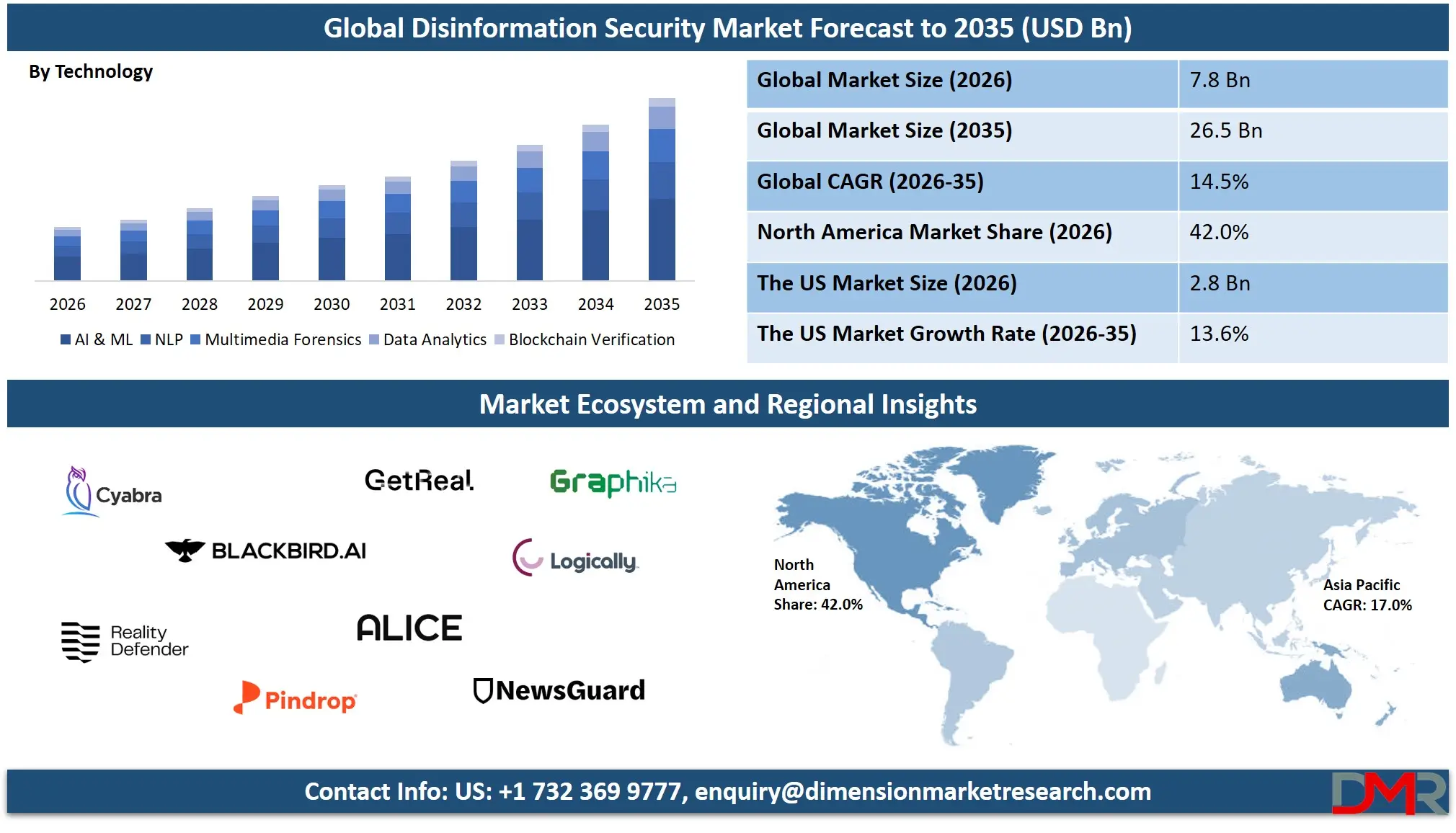
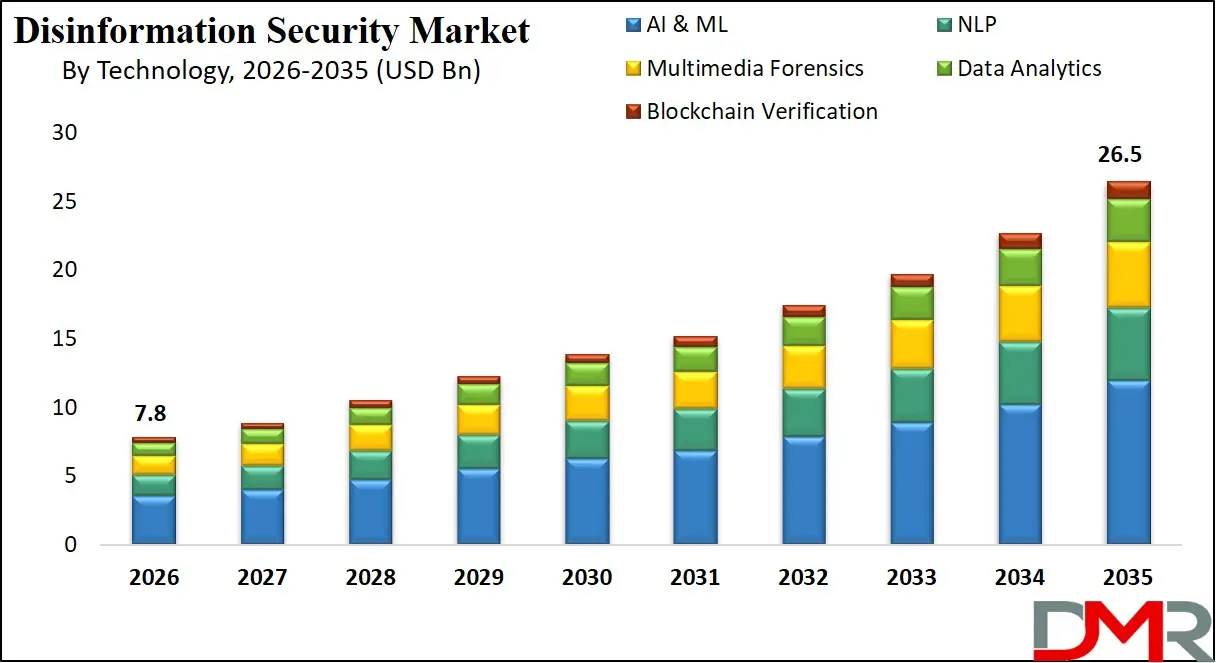
The global Disinformation Security Market size is projected to reach USD 7.8 billion in 2026 and grow at a 14.5% CAGR to USD 26.5 billion by 2035, driven by the rising need for misinformation detection, deepfake detection, and AI-based threat intelligence amid increasing online manipulation and information warfare.
ℹ
To learn more about this report –
Download Your Free Sample Report Here
The Disinformation Security Market is dedicated to identifying and addressing fake, misleading, and organized malicious information on digital platforms and media ecosystems. It is expanding at a fast pace because of the AI-generated deepfakes, influence campaigns by bots, and mass cross-platform misinformation. The extent of the problem is reflected in the fact that in October 2025, the European Commission has estimated that around 70% of EU citizens have been exposed to online disinformation at least once.
Disinformation is now seen by governments around the world as a major challenge to democratic stability, national security, and citizen trust, leading to more stringent regulations, transparency policies, and digital trust models. There is an increasing demand in BFSI, media and enterprises in brand and risk protection.
ℹ
To learn more about this report –
Download Your Free Sample Report Here
US Disinformation Security Market
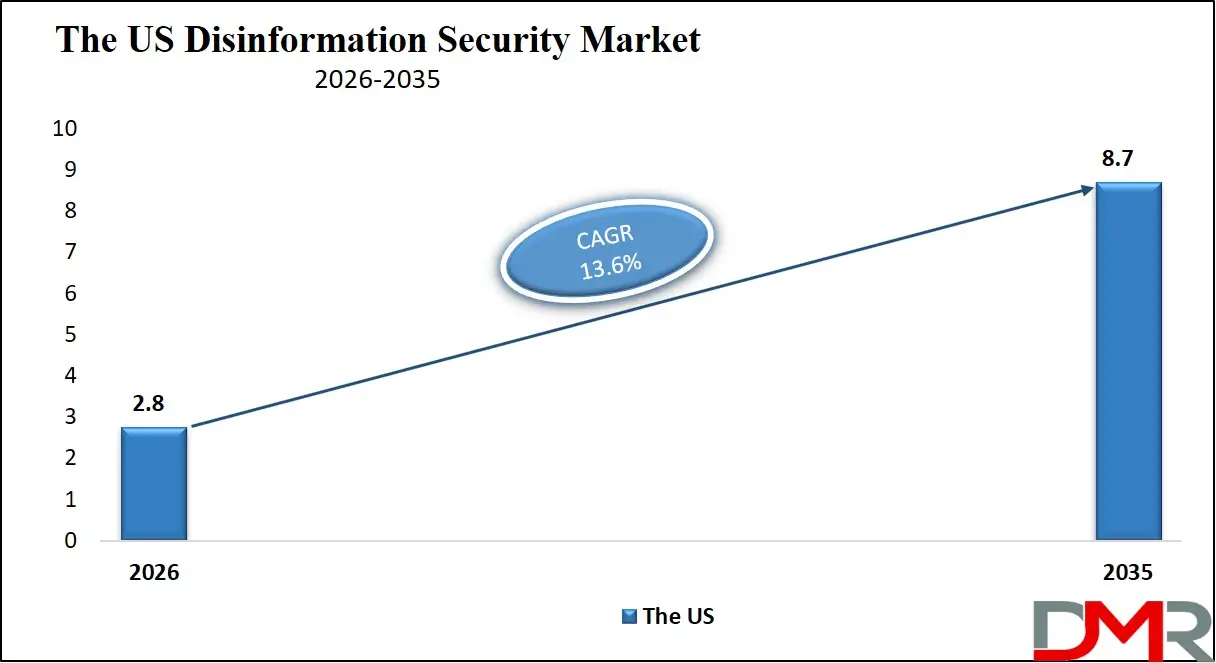
The US Disinformation Security Market is projected to reach USD 2.8 billion in 2026 and grow at a compound annual growth rate of 13.6%, reaching USD 8.7 billion by 2035.
ℹ
To learn more about this report –
Download Your Free Sample Report Here
The US Disinformation Security Market is the largest and most advanced, driven by high risks of political misinformation, election interference, and AI-generated deepfakes. Government agencies and enterprises are increasingly adopting influence monitoring, content authenticity, and threat intelligence solutions to protect information integrity. Strong cybersecurity infrastructure and public–private collaboration further accelerate adoption, making the U.S. a key hub for innovation in disinformation defense technologies.
Europe Disinformation Security Market
Europe Skills-Based Hiring Technology Market is anticipated to reach USD 2.1 Bn in 2026, expanding with a CAGR of 13.2%. The Europe Disinformation Security Market is expanding as governments, enterprises, media organizations, and technology platforms strengthen capabilities to detect, monitor, and mitigate false or manipulated information. Increasing concerns surrounding election interference, foreign influence operations, deepfakes, coordinated inauthentic behavior, and AI-generated content are encouraging investment in advanced detection and threat-intelligence solutions. European regulatory initiatives, including requirements addressing platform accountability and digital integrity, are further supporting market development. Organizations are adopting AI-based content analysis, social listening, fact-checking, identity verification, and threat-monitoring technologies. Demand is particularly strong across government, defense, financial services, media, and critical infrastructure sectors, where information manipulation can create significant operational and reputational risks.
Japan Disinformation Security Market
Japan Skills-Based Hiring Technology Market is anticipated to reach USD 507.0 Mn in 2026, expanding with a CAGR of 15.1%. The Japan Disinformation Security Market is developing as government agencies, businesses, media organizations, and digital platforms increase efforts to identify and counter misleading or manipulated information. Growing use of generative AI, deepfakes, automated social-media campaigns, and fabricated online content is increasing the need for advanced monitoring and verification capabilities. Japan's highly connected digital environment and reliance on online information create opportunities for AI-powered content detection, threat intelligence, fact-checking, and social-media monitoring solutions. Demand is emerging across government, financial services, healthcare, media, telecommunications, and critical infrastructure. Organizations are also emphasizing cybersecurity awareness, information verification, and rapid response mechanisms to protect public trust, corporate reputation, and sensitive operations.
Key Takeaways
- Market Size: The global Disinformation Security Market is anticipated to be valued at USD 7.8 billion in 2026 and is projected to reach USD 26.5 billion by 2035.
- Growth Rate and Outlook: The market is expanding at a CAGR of 14.5% during 2026–2035, driven by increasing digital misinformation risks and AI-based threat detection adoption.
- Primary Growth Drivers: Growth is fueled by rising deepfakes, coordinated influence campaigns, election security concerns, and increasing demand for AI-driven content authenticity and threat intelligence solutions.
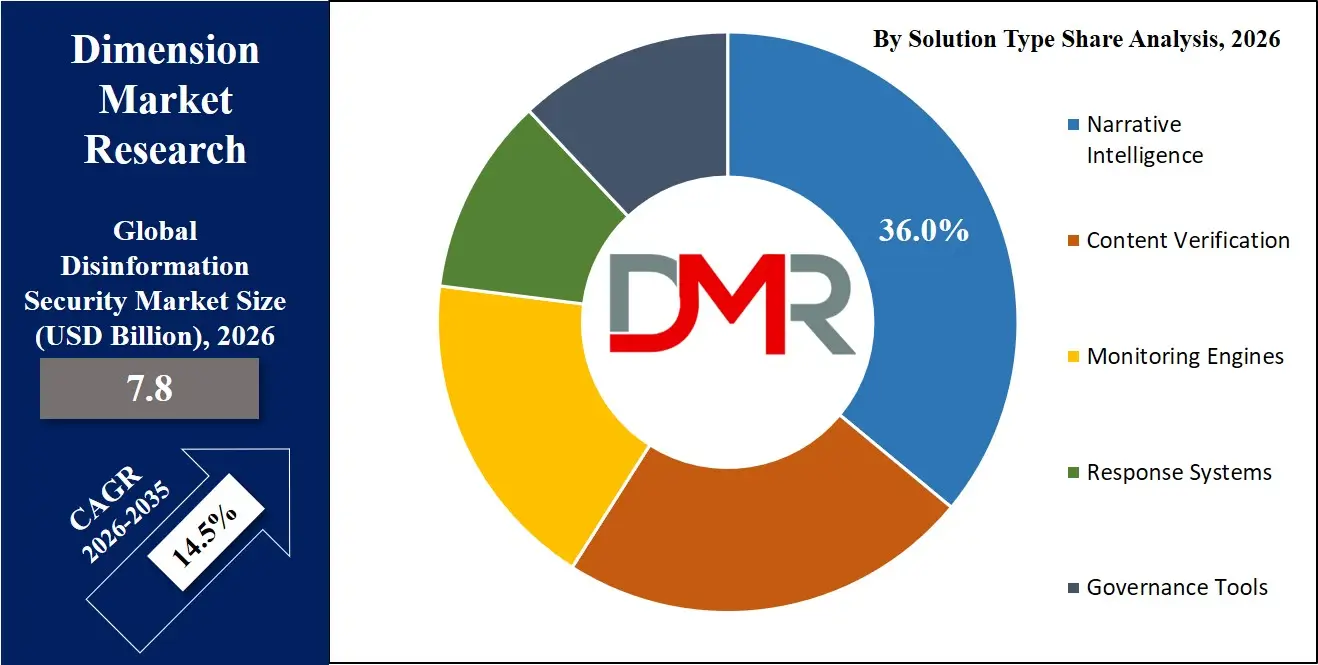
- By Solution Type Analysis: Narrative Intelligence dominates the market with 36.0% share in 2026, driven by real-time influence tracking and cross-platform misinformation monitoring.
- By Technology Analysis: AI & ML leads the market with 45.0% share, enabling predictive detection, pattern recognition, and automated disinformation analysis.
- By End-Use Industry Analysis: Government & Defense holds the largest share at 31.0%, driven by national security, election integrity, and geopolitical information warfare concerns.
- Regional Leadership: North America leads the market with a 42.0% share in 2026, supported by strong cybersecurity infrastructure and high exposure to misinformation threats.
What is Disinformation Security?
Disinformation Security is the term that is applied to systems and technologies that identify and limit the dissemination of false or misleading information that is produced to control the opinion of the population or damage institutions. The European Union defines disinformation as intentionally false content spread for political or economic gain that can impact democratic processes. It is considered by governments and international organizations such as the OECD to be a significant threat to citizen confidence, elections, and information integrity. It is propelled by the increasing fake news, organized influence campaigns, and AI-generated deepfakes on digital platforms. Disinformation security uses AI, NLP, and media forensics to identify and counter manipulated content in real time.
Use Cases
- Election Integrity Monitoring: Election misinformation campaigns are identified through disinformation security when they are organized and conducted across the social media and news outlets. It assists in detecting bot networks, counterfeit narratives, and foreign influence activities in real-time. It is used by governments to safeguard voter confidence and fair elections.
- Brand Reputation Protection: Disinformation security is used by enterprises to monitor fake statements, rumors and manipulated messages about their brand. It assists in identifying viral misinformation at an early stage before it can affect customer confidence or perception in the market. This facilitates quicker reaction and damage control of reputation.
- Financial Market Manipulation Detection: Financial institutions rely on such systems to detect false news or rumors that can affect stock prices or investor sentiment. It tracks social sites and news feeds to organize misinformation campaigns. This assists in minimizing fraud and market instability.
- Public Health Misinformation Control: Disinformation security is the tool used by health agencies to monitor and address false medical claims, vaccine misinformation, and health-related rumors. It allows detecting dangerous stories that are propagated on the Internet quickly. This enhances awareness among the people and aids in making informed healthcare choices.
How AI is Transforming the Disinformation Security Market
The Disinformation Security Market is being transformed by AI, which is able to detect fake news, deepfakes, and coordinated influence campaigns in real-time across the digital platform. State-of-the-art machine learning and NLP models are used to detect misleading stories and behavioral patterns with high precision on large-scale data. Generative AI detection tools and computer vision are used to confirm the authenticity of images, videos, and audio. This is simplifying the process of monitoring disinformation, making it more scalable and proactive among governments and enterprises.
Market Dynamics
Key Drivers in the Global Disinformation Security Market
Rising AI-Generated Disinformation
The swift development of generative AI applications has greatly amplified the amount and authenticity of counterfeit material on the internet. Deepfakes, fake voices, and AI-generated fake news are becoming more difficult to detect with conventional means. To deal with this emerging threat, governments and businesses are investing in sophisticated detection systems. This is fueling the need of AI-based disinformation security platforms. This is leading to increased adoption both in the public and the private sectors.
Increasing Geopolitical Information Warfare
Countries are becoming more active in terms of influence activities and narrative management on digital platforms in times of conflict and elections. This has caused information integrity to be a major national security issue in the world. Governments are also using surveillance mechanisms to monitor cross-border propaganda and organized campaigns. Such activities can be detected and attributed in real time with the help of disinformation security tools. This is a significant growth driver in the market due to this geopolitical pressure.
Restraints in the Global Disinformation Security Market
Expensive Advanced Detection Systems.
High-tech disinformation security systems demand substantial investment in AI infrastructure and expertise in cybersecurity. The cost of deployment and maintenance is a problem that is faced by small and medium enterprises. The constant training of models and data processing also add to the operational costs. This restricts its use in cost-sensitive organizations. This has led to uneven market penetration by regions and industries.
Regulatory and Data Privacy Issues.
The monitoring of disinformation usually implies the mass gathering of data on social media and communication platforms. This brings up issues of user privacy, data protection legislation, and surveillance policies. Tight compliance frameworks such as GDPR may limit the use of data to analysis. Organizations have to strike a balance between detection efficiency and legal restrictions. These regulatory complexities delay implementation in a number of markets.
Growth Opportunities in the Global Disinformation Security Market
Expansion of AI-Powered Trust & Safety Platforms
The increasing demand of secure digital ecosystems is opening up the prospects of combined trust and safety solutions. Content moderation, misinformation detection, and risk intelligence are increasingly being integrated on platforms. Businesses and states are embracing integrated systems to respond quicker. This convergence is expanding market scope beyond standalone tools. It creates a robust expansion opportunity to AI-first security vendors.
Growth in Election Security Solutions
The growing anxiety about election interference is fueling the need to have specialized disinformation monitoring systems. Governments are also investing in real-time narrative tracking and influence detection systems. Such systems assist in protecting electoral integrity and trust. Emerging democracies are particularly increasing adoption. This generates a high long term opportunity segment in the market.
Trends in the Global Disinformation Security Market
Shift toward Real-Time Narrative Intelligence
The market is moving from static monitoring to real-time narrative tracking systems. Organizations now demand instant detection of viral misinformation before it spreads widely. AI models are being trained for continuous data ingestion across multiple platforms. This enables faster response and mitigation strategies. Real-time intelligence is becoming a standard expectation.
Integration of Multimodal AI Detection
Disinformation detection is increasingly expanding beyond text into images, audio, and video formats. Multimodal AI systems analyze combined content types to identify synthetic or manipulated media. This is especially important with rising deepfake usage. It improves detection accuracy across complex misinformation campaigns. The trend is reshaping how security platforms are built.
Research Scope and Analysis
By Solution Type Analysis
Narrative Intelligence will take over the Solution Type segment with approximately 36.0% share in 2026 due to the increasing need to monitor influence campaigns, track cross-platform narratives, and identify coordinated misinformation in real-time. It is popular in government and defense to monitor election security and geopolitical risk.
ℹ
To learn more about this report –
Download Your Free Sample Report Here
Content Verification aims to ensure the authenticity of digital content, such as text, images, audio, and videos, to identify deepfakes and manipulated media. It uses AI and digital forensics to ensure content provenance and accuracy. The two segments combined enhance information integrity within digital ecosystems.
By Disinformation Type Analysis
The Disinformation Type segment is projected to be dominated by Text Content with approximately 38.0% market share in 2026 since fake news articles, misleading posts, and propaganda narratives continue to be the most prevalent type of disinformation on digital platforms. It is predominant due to the simplicity of creation, speedy dissemination, and the impact it has on the masses and political rhetoric. The most rapidly developing segment is Multimedia Content, such as deepfakes, synthetic audio, and manipulated images or videos, as the technologies of generative AI have been developed. It is more difficult to detect and more dangerous to security because it seems more realistic and difficult to check. The two segments are important targets of disinformation security solutions to safeguard the integrity of information.
By Technology Analysis
The Technology segment is projected to be dominated by AI and ML with approximately 45.0% market share in 2026, as they will allow detecting misinformation, deepfakes, and organized influence campaigns more effectively with predictive analytics and pattern recognition. These technologies allow real-time monitoring and automated classification of large-scale digital content. NLP plays a key role in analyzing textual data by detecting semantic manipulation, sentiment distortion, and cross-language misinformation spread. It assists systems to comprehend context and purpose of online stories. Collectively, AI, ML, and NLP contribute to a high level of accuracy and speed of disinformation detection on platforms.
By Deployment Model Analysis
Cloud deployment is expected to dominate the Deployment Model segment with around 66.0% market share in 2026, driven by its scalability, real-time data processing capabilities, and ease of integration with AI-based disinformation detection platforms. It enables continuous monitoring of large volumes of digital content across multiple sources and geographies. Hybrid deployment combines cloud-based analytics with on-premise infrastructure to ensure data security and regulatory compliance, especially for government and critical enterprises. It allows organizations to balance flexibility with control over sensitive information. Together, both models support secure and efficient disinformation monitoring at scale.
By Organization Size Analysis
The Organization Size segment is projected to be dominated by Large Enterprises with an estimated market share of 61.0% in 2026 due to their greater vulnerability to large-scale disinformation threats, global presence, and ability to invest in sophisticated security infrastructure. These companies use full-scale AI-driven monitoring and threat intelligence tools to safeguard brand reputation and information integrity. SMEs, however, are turning to more affordable, cloud-based disinformation security solutions to identify the risks of misinformation without the need to invest heavily in infrastructure. Their usage is mainly focused on brand protection and social media monitoring. Combined, both segments represent an increased awareness of the dangers of disinformation regardless of the size of the organization.
By End-Use Industry Analysis
The End-Use Industry segment is projected to be dominated by Government & Defense with approximately 31.0% market share in 2026 due to the increasing concerns on election interference, geopolitical information warfare, and the threat of national security. These agencies use sophisticated disinformation security systems to monitor in real-time influence campaigns and misinformation dissemination. BFSI, on the other hand, uses these solutions to detect financial rumors, market manipulation attempts, and fraudulent narratives that can impact investor confidence and stock stability. It is based on AI-powered risk mitigation and reputation protection monitoring tools. The two sectors together are major adopters because they are highly sensitive to risks that are information-driven.
The Global Disinformation Security Market Report is segmented on the basis of the following:
By Solution Type
- Narrative Intelligence
- Influence tracking tools
- Narrative mapping systems
- Coordinated behavior detection
- Content Verification
- Deepfake detection tools
- Content provenance systems
- Fact-check automation
- Monitoring Engines
- Social media monitoring
- Misinformation scanning
- Bot detection systems
- Response Systems
- Content takedown tools
- Counter-narrative systems
- Crisis response tools
- Governance Tools
- Compliance monitoring
- Risk reporting systems
- Policy enforcement tools
By Disinformation Type
- Text Content
- Fake news posts
- Propaganda content
- Multimedia Content
- Deepfake videos
- Synthetic audio
- Coordinated Campaigns
- Bot networks
- Influence operations
- Identity Fraud Content
- Fake accounts
- Impersonation attacks
By Technology
- AI & ML
- Prediction models
- Pattern detection
- Threat classifiers
- NLP
- Semantic detection
- Cross-language analysis
- Sentiment distortion
- Multimedia Forensics
- Deepfake detection
- Audio spoofing detection
- Image tampering detection
- Data Analytics
- Network mapping
- Virality tracking
- Behavior analytics
- Blockchain Verification
- Content traceability
- Timestamp ledgers
By Deployment Model
- Cloud
- SaaS platforms
- API systems
- Real-time analytics
- Hybrid
- Cloud + secure on-prem
- Controlled intelligence systems
- On-Premise
- Isolated defense systems
- High-security deployments
By Organization Size
- Large Enterprises
- Global monitoring systems
- Dedicated intelligence teams
- SMEs
By End-Use Industry
- Government & Defense
- BFSI
- Media Platforms
- Enterprises
- Healthcare
- NGOs & Academia
- Others
Regional Analysis
Leading Region by Market Share
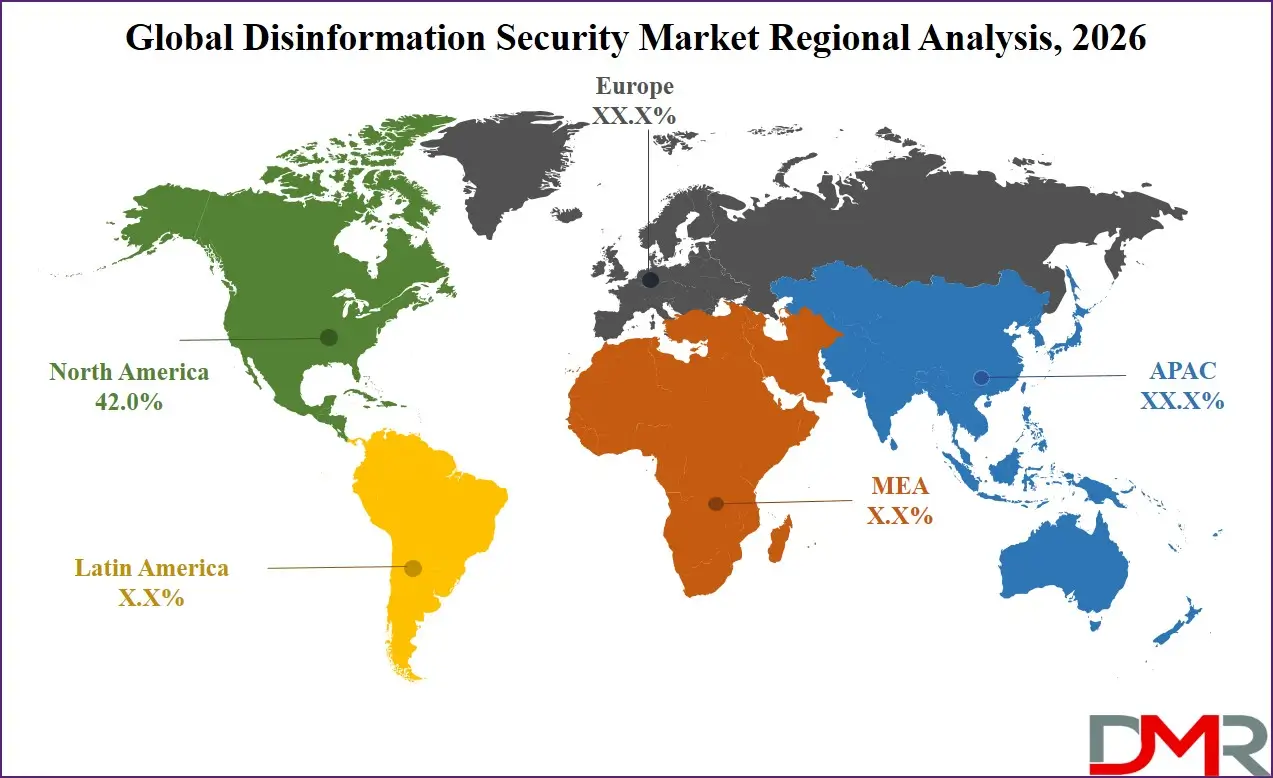
North America is expected to dominate the Disinformation Security Market with a 42.0% share in 2026, driven by strong adoption of advanced AI-based threat intelligence and content verification systems. The region faces high exposure to political misinformation, election interference, and large-scale social media influence operations.
ℹ
To learn more about this report –
Download Your Free Sample Report Here
Strong presence of leading technology providers and robust cybersecurity infrastructure further supports market growth. Continuous government investment in information integrity and digital trust frameworks strengthens its leadership position.
Fastest-Growing Regional Market
Asia Pacific is the fastest-growing regional market in the Disinformation Security Market, driven by rapid digital adoption and increasing social media penetration across emerging economies. Rising concerns over election integrity, geopolitical tensions, and cross-border misinformation are pushing governments to invest in advanced monitoring systems.
By Region
North America
Europe
- Germany
- The U.K.
- France
- Italy
- Russia
- Spain
- Benelux
- Nordic
- Rest of Europe
Asia-Pacific
- China
- Japan
- South Korea
- India
- ANZ
- ASEAN
- Rest of Asia-Pacific
Latin America
- Brazil
- Mexico
- Argentina
- Colombia
- Rest of Latin America
Middle East & Africa
- Saudi Arabia
- UAE
- South Africa
- Israel
- Egypt
- Rest of MEA
Competitive Landscape
The competitive landscape of the Disinformation Security Market is highly dynamic, driven by rapid innovation in AI-based detection and threat intelligence technologies. Companies are focusing on real-time narrative monitoring, deepfake detection, and cross-platform misinformation tracking capabilities. Strategic collaborations with government agencies and social media platforms are increasing to strengthen information integrity frameworks. Continuous advancements in machine learning and multimedia forensics are intensifying competition and accelerating solution development.
Some of the prominent players in the Global Disinformation Security Market are:
- Cyabra
- Blackbird.AI
- Reality Defender
- Pindrop
- GetReal Security
- Alethea Group
- ActiveFence (Alice)
- Graphika
- Logically
- NewsGuard
- Zefr
- Anomali
- Mastercard
- Google
- Palo Alto Networks
- Microsoft
- Semantic Visions
- Oracle
- Other Key Players
Recent Developments
- January 2026: Blackbird.AI secured approximately USD 28 million in funding to expand its narrative intelligence platform and strengthen AI-driven disinformation and influence campaign detection capabilities.
- July 2025: Cyabra launched an AI-powered deepfake detection tool to identify manipulated videos and images using advanced forensic analysis and heatmap-based verification, strengthening real-time disinformation defense for governments and enterprises.
- February 2025: Cyabra introduced its AI-driven "Insights" feature that converts complex social media disinformation data into actionable intelligence, enabling faster detection of fake accounts, narratives, and coordinated influence campaigns.
Report Details
| Report Characteristics |
| Market Size (2026) |
USD 7.8 Bn |
| Forecast Value (2035) |
USD 26.5 Bn |
| CAGR (2026–2035) |
14.5% |
| Historical Data |
2021 – 2025 |
| Forecast Data |
2026 – 2035 |
| Base Year |
2025 |
| Estimate Year |
2026 |
| Segments Covered |
By Solution Type (Narrative Intelligence, Content Verification, Monitoring Engines, Response Systems, Governance Tools), By Disinformation Type (Text Content, Multimedia Content, Coordinated Campaigns, Identity Fraud Content), By Technology (AI & ML, NLP, Multimedia Forensics, Data Analytics, Blockchain Verification), By Deployment Model (Cloud, Hybrid, On-Premise), By Organization Size (Large Enterprises, SMEs), By End-Use Industry (Government & Defense, BFSI, Media Platforms, Enterprises, Healthcare, NGOs & Academia, Others) |
| Regional Coverage |
North America – The US and Canada; Europe – Germany, The UK, France, Russia, Spain, Italy, Benelux, Nordic, & Rest of Europe; Asia-Pacific – China, Japan, South Korea, India, ANZ, ASEAN, Rest of APAC; Latin America – Brazil, Mexico, Argentina, Colombia, Rest of Latin America; Middle East & Africa – Saudi Arabia, UAE, South Africa, Egypt, Israel, & Rest of MEA |
Frequently Asked Questions
How big is the Disinformation Security Market?
▾ The Disinformation Security Market is expected to be valued at USD 7.8 billion in 2026 and is projected to reach USD 26.5 billion by 2035, reflecting strong global expansion driven by rising digital misinformation threats.
What is the CAGR of the Disinformation Security Market from 2026 to 2035?
▾ The market is expected to grow at a CAGR of 14.5% during the forecast period 2026 to 2035.
What factors are driving the growth of the Disinformation Security Market?
▾ Growth is driven by increasing AI-generated deepfakes, rising coordinated misinformation campaigns, election interference risks, and growing demand for digital trust and content authenticity solutions.
What are the major trends in the Disinformation Security Market?
▾ Key trends include real-time narrative intelligence, multimodal deepfake detection, AI-driven misinformation monitoring, and increased integration of blockchain for content provenance.
Which region held the largest share of the Disinformation Security Market in 2026?
▾ North America is expected to hold the largest share in 2026, accounting for 42.0% of the global market, driven by advanced cybersecurity infrastructure and high exposure to political and digital misinformation threats.
Which region is expected to grow the fastest in the Disinformation Security Market?
▾ Asia Pacific is expected to be the fastest-growing region, driven by rapid digital adoption, rising geopolitical tensions, and increasing government investments in AI-based misinformation detection systems.
Who are the key players in the Disinformation Security Market?
▾ Key players include Cyabra, Blackbird.AI, Reality Defender, Pindrop, GetReal Security, Alethea Group, ActiveFence (Alice), Graphika, Logically, NewsGuard, Zefr, Anomali, Recorded Future, Mandiant, Palo Alto Networks, Microsoft, Google, Semantic Visions, Oracle, and other emerging vendors.
How is the Disinformation Security Market segmented?
▾ The market is segmented by Solution Type, Disinformation Type, Technology, Deployment Model, Organization Size, and End-Use Industry.