What is the Distributed Antenna System (DAS) Market Size?
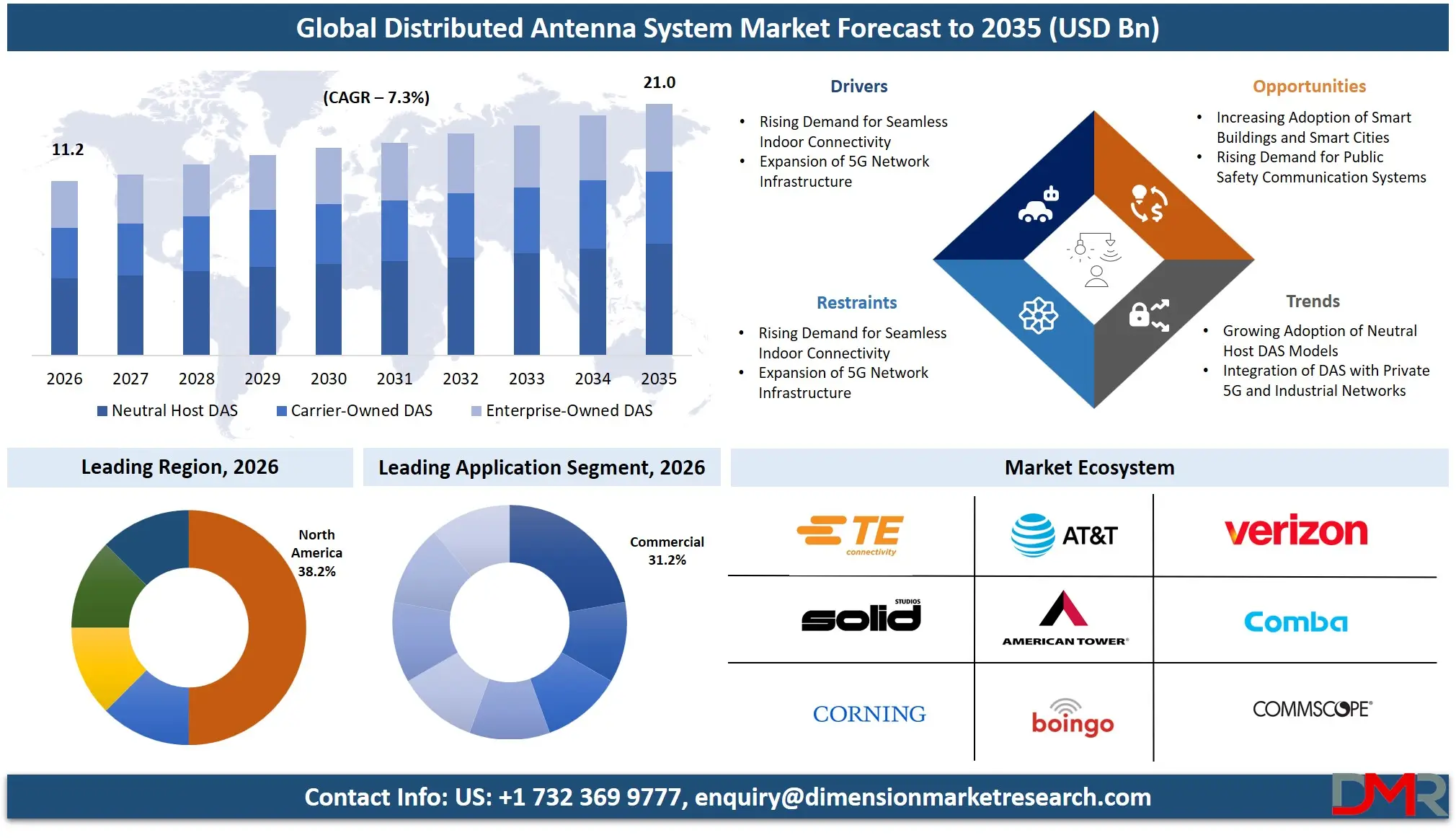
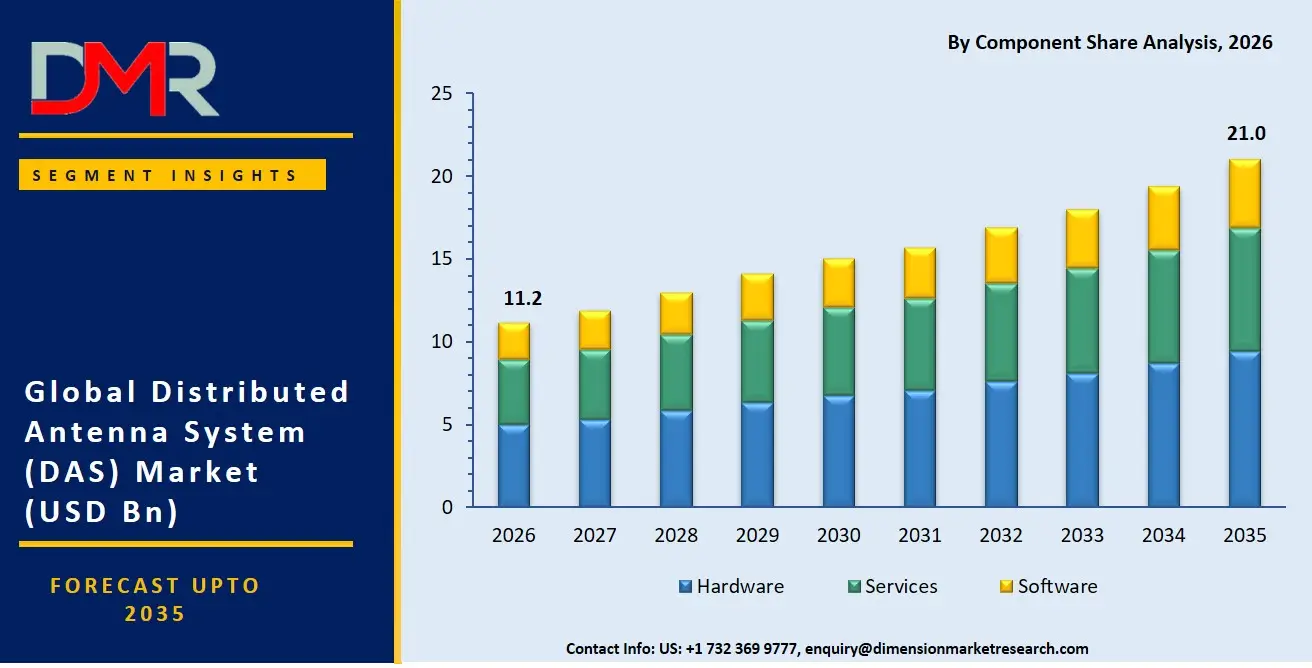
The Global Distributed Antenna System (DAS) Market is expected to reach a value of USD 11.2 billion in 2026, and it is further anticipated to reach USD 21.0 billion by 2035, growing at a CAGR of 7.3% during the forecast period.
ℹ
To learn more about this report –
Download Your Free Sample Report Here
The Distributed Antenna Systems market has seen tremendous growth due to an increase in the adoption rates of enterprises and building management moving towards in-building wireless evolution from traditional dead zones to full-signal coverage. The Distributed Antenna Systems market includes hardware, software, and services that help enterprises and establishments to roll out various forms of DAS, including active, passive, and hybrid types.
The rising adoption of 5G mm Wave architecture, private wireless systems, and multi-carrier signal sources is contributing to the need for dedicated DAS solutions. Large public places are considered the major consumers with active DAS systems and a neutral host ownership model gaining popularity due to their flexibility and multitenancy. Industries such as healthcare, transportation, and commercial real estate form an essential part of this market as they require highly secure, dependable, and accessible wireless infrastructure.
ℹ
To learn more about this report –
Download Your Free Sample Report Here
The US Distributed Antenna System (DAS) Market
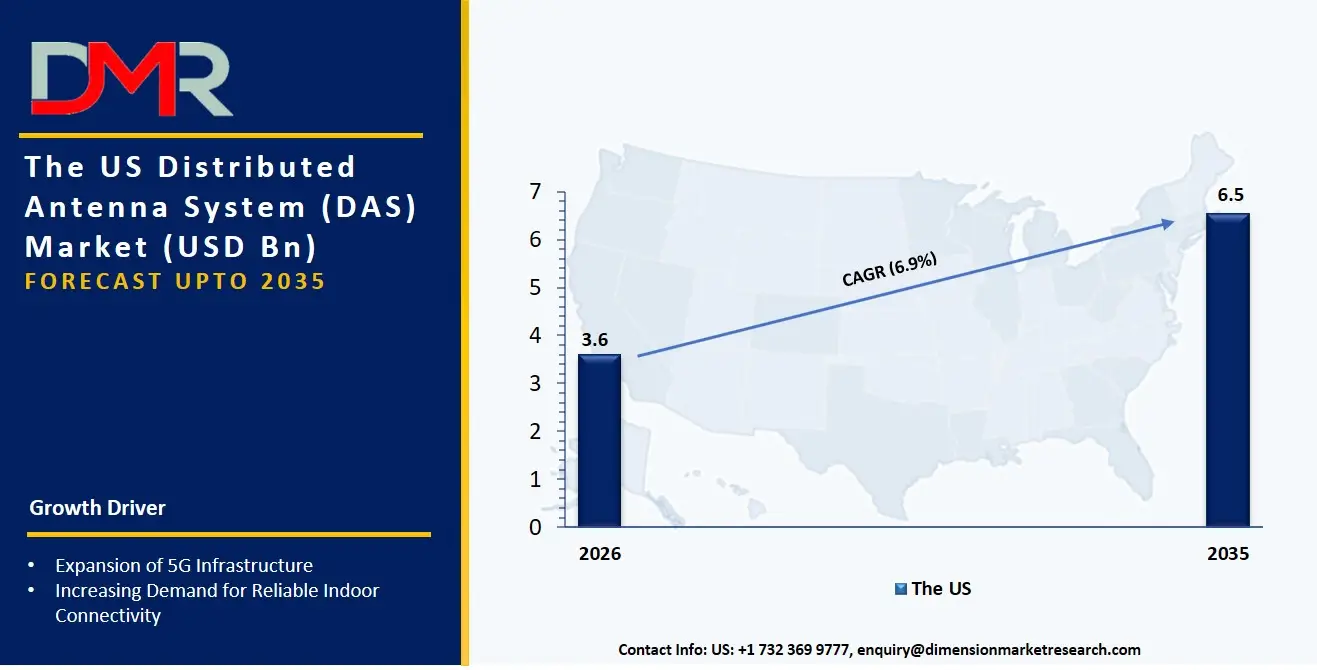
The US Distributed Antenna System Market is projected to reach USD 3.6 billion in 2026 at a compound annual growth rate of 6.9% over its forecast period. The United States is still the biggest and most advanced DAS market because of the ongoing process of modernization of big public venues as well as the spread of small cell/RRU nodes in city centers. The demand for active DAS devices has characterized the market; in that case, companies strive to convert existing passive coax systems to active cloud-native platforms via fiber connection. What is more, the deployment of AI technologies for network management results in the emergence of an analogous demand for network planning and design solutions for controlling data flow and performance analysis on the DAS.
ℹ
To learn more about this report –
Download Your Free Sample Report Here
The Europe Distributed Antenna System (DAS) Market
The Europe Distributed Antenna System Market is estimated to be valued at USD 13.1 billion in 2026 at a CAGR of 24.3% during the forecasted period of 2026 to 2035. The regulatory environment, comprising building safety regulations and EMF emissions standards, plays a key role in influencing the European market and thus creating the necessity for network design and planning services and enterprise-owned DAS approaches. The growth trend of hybrid DAS installation services is equally evident due to the attempt by the manufacturing and transportation industries in Germany and France to balance the reliability of their OT systems with wireless-based analytics. Furthermore, the need for standardization of infrastructure interoperability is putting pressure on service providers to establish separate installation and integration services.
The Japan Distributed Antenna System (DAS) Market
The Japan Distributed Antenna System Market is projected to value at USD 1.8 billion in 2026 at a combined annual growth rate of 26.2% during the forecased period of 2026 to 2035. The market environment of Japan is special due to the DX-oriented approach of both companies and the government in terms of the necessity of providing reliable communications amid natural disasters with increased data needs. Network planning and designing as well as hardware, for example, remote radio units, take up a significant proportion of the spend as big buildings switch their mission-critical public safety networks from legacy VHF/UHF systems to cellular DAS. Another important requirement concerns the integration into the local market, since the transition from legacy analog signals and industrial controls to small cells necessitates optimization and analysis through software applications.
Key Takeaways
- Market Size & Forecast: The Global Distributed Antenna System market is forecasted to be valued at USD 11.2 billion in 2026, which is further anticipated to grow up to USD 21.0 billion by 2035, owing to the combined impact of the rising trend of 5G mmWave deployment and the inevitable upgrade of existing in-building wireless infrastructure.
- Growth Rate & Outlook: Growth rates of global market are anticipated at a CAGR of 7.3% on account of the acute scarcity of in-house radio frequency (RF) engineers and the increasing difficulty in handling multi-spectrum bands and neutral host business models.
- Primary Growth Drivers: Key market drivers include the emergence of more industry-focused DAS systems such as healthcare and stadium systems, the demand for consultancy in network design and planning to prevent expensive coverage losses, and the implementation of public safety systems which require skilled installation.
- Key Market Trends: Key trends include the development of industry-specific DAS systems, the deployment of artificial intelligence technologies in monitoring and analytical software to automatically resolve interference problems, and the movement towards managed services due to the focus on SLAs.
- By Deployment Type Analysis: Active DAS deployments is projected to lead in enterprise discussions because of limitations in performance and scalability. The demand for professional services in designing seamless hybrid DAS layers that link passive coaxial networks on-premise with innovative active fiber will continue to increase.
- By Application Analysis: The two most profitable sectors are transportation and healthcare & government & public safety because of their rigorous life-safety regulatory requirements. Commercial Real Estate will be the fastest-growing category because DAS is needed to support IoT edge-to-core networking in smart buildings.
- Regional Leadership: North America is the region that is predicted to have leadership in the market with 38.2% of the market share in 2026 because it has an advanced technological ecosystem and is making the most of its infrastructure in this market segment.
What is the Distributed Antenna System (DAS)?
The Distributed Antenna System includes the hardware, software, and services used in the implementation of DAS provided by third-party providers to help businesses manage the entire process of RF life cycle. The services differ from those simple installations like pulling of cables or positioning of antennas since they involve a way of designing wireless coverage systems. It entails consultancy that helps develop an iBwave design and business strategy for the signal distribution, as well as installation and integration that entails physical deployment of head-end units and antennas without compromising the appearance of the venue, and management software that allows seamless communication between DAS nodes and various signal sources provided by carriers. Since 90% of data consumption is indoor, DAS requires professional components and services for governance and performance tuning.
Use Cases
- 5G Modernization in Stadiums: The owners of sports venues engage in the services of installation & integration to modernize existing passive coaxial distribution antenna systems to active fiber-optic distribution antenna systems with remote radio heads to deliver real-time low latency experiences and enable cashless concessions.
- Public Safety Readiness in Healthcare: Hospital networks use services for network design & planning along with headend equipment in order to transition critical communications to multi-band DAS compliant with NFPA and IFC standards to prepare the signal estate for artificial intelligence-enabled alarm monitoring.
- Neutral Host Navigation in Airports: Airports utilize consulting services to install carrier-owned infrastructures that follow strict multi-operator legislation to ensure efficient offloading of passenger data traffic from the macro network to the distributed access system without straining macro resources.
- Hybrid Industrial Edge Integration: Manufacturers use monitoring and analytics software, as well as managed services, to integrate factory-floor signal sources with the network management platform in the cloud for predictive maintenance and monitoring of the wireless-enabled supply chain.
How AI is Transforming the Distributed Antenna System (DAS) Market?
This technological trend in AI is revolutionizing the DAS industry in terms of streamlining the process of optimizing network design as well as making operations efficient. With respect to monitoring and analytics software solutions, interference sniffing technology is now able to convert raw signal data into effective remedial actions that reduce drive testing time while significantly cutting down on outages and associated risks. On the other hand, managed services powered by artificial intelligence enable companies to control their DAS expenses through identifying suspicious power consumption, forecasting and determining future capacity use, and proposing actions like dynamic power adjustment to strengthen green network approaches.
Design and Signal Planning are becoming areas in which AI plays a role. When it comes to consulting services, intelligent design agents are employed for checking signal propagation models for multi-band networks to detect gaps in coverage, interference issues, and policies violation to ensure venues comply with public safety policies such as NFPA 72. Besides, generative AI assistants are helping the network design and planning process by simulating changes in radio-frequency environment and modeling future capacity needs in order to provide stakeholders with visualization of the impact on wireless coverage.
Market Dynamics
Key Drivers in the Global Distributed Antenna System (DAS) Market
Rising Demand for Seamless Indoor Connectivity
High penetration rate of smartphones, mobile data usage, and cloud-based business applications has been instrumental in the rising demand for distributed antenna systems all over the world. Modern businesses, airports, hospitals, stadiums, and learning institutions have started demanding uninterrupted coverage in the indoor environment owing to increased numbers of users and high bandwidth application usage. Traditional macrocellular networks lack sufficient coverage inside the building environment, mainly because of the presence of several obstacles and the weak signal coverage of macrocellular technologies. Therefore, enterprises are opting for DAS systems that offer improved network performance and signal coverage in the indoor environment.
Expansion of 5G Network Infrastructure
The implementation of 5G technology around the globe is a crucial driver for the DAS market, as telecom operators look for ways to improve their efficiency in terms of boosting network performance and improving indoor coverage. 5G networks use higher frequency spectrum bands, which have less building penetration capability. The deployment of DAS helps telecom operators provide low latency, high-speed connectivity, and efficient network performance in densely populated urban areas and other large premises. Moreover, governments and businesses are making huge investments in smart cities, industrial automation, and intelligent infrastructures, which require highly capable wireless communication infrastructures.
Restraints in the Global Distributed Antenna System (DAS) Market
High Installation and Infrastructure Costs
The roll-out of DAS entails significant capital expenditure in terms of the physical equipment, fiber optic cabling, planning, installation, and maintenance involved. The roll-out of active DAS, especially, entails the need for an advanced infrastructure and integration services which increases the cost of implementing the same for smaller and medium-sized businesses. Large-scale implementations in places such as airports, stadiums, hospitals, and other transportation facilities are also quite expensive due to the engineering and regulatory compliance involved. Moreover, operating and upgrading DAS to comply with changing wireless standards, such as 5G, also adds to operational costs.
Complexity in Multi-Operator Integration
The integration of different telecom carriers within one DAS solution comes with certain technical difficulties that may hinder the expansion of the market. Each carrier employs its own set of frequencies, network architecture, and standards in terms of the required equipment. The integration of these factors into a DAS setup may become difficult due to the need for compliance with the regulatory standards and the maintenance of high-quality connections. It is also important to note that the involvement of different carriers within one setup can cause problems in terms of contractual relationships between the involved parties.
Growth Opportunities in the Global Distributed Antenna System (DAS) Market
Increasing Adoption of Smart Buildings and Smart Cities
The fast evolution of smart building and city structures has opened up considerable growth prospects for the DAS industry. Commercial complexes, transport systems, hospitals, and infrastructures now depend significantly on the use of connected devices such as IoT sensors, intelligent security systems, automated platforms, and communication networks. All these technologies require efficient indoor communication for smooth functionality. The application of DAS in high capacity and low latency communication environments is essential in making smart infrastructure function effectively. The digitalization process by governments and companies globally is fueling investments in future-proof DAS infrastructure within cities.
Rising Demand for Public Safety Communication Systems
Increasing focus on emergency preparedness and public safety laws is offering numerous opportunities for the development of DAS. Increasingly, there is a requirement to install reliable systems of communication that allow emergency services to communicate when faced with emergencies, whether these be cases of fire outbreaks, natural disasters, or security incidents. DAS systems allow reliable communication between first response agencies like police and other emergency services in large buildings such as hospitals, airports, tunnels, stadiums, and commercial buildings. Combining public safety networks with wireless communication is increasing the application possibilities of DAS systems.
Trends in the Global Distributed Antenna System (DAS) Market
Growing Adoption of Neutral Host DAS Models
The use of neutral host DASs is becoming a growing market trend owing to its low costs and flexibility. In this approach, more than one telecommunications company shares the DAS, thereby minimizing capital expenditure while avoiding duplication of devices at big premises. The neutral host concept is preferred by property owners and organizations since it simplifies network management while guaranteeing access to a good network for all users regardless of their service providers. The neutral host DAS is becoming more popular in areas such as airports, shopping centers, sports stadiums, hospitals, and transport terminals where multiple operators must be supported.
Integration of DAS with Private 5G and Industrial Networks
The integration of DAS systems with private 5G and wireless industrial networks to facilitate digital operations is gaining ground among organizations. Industrial facilities, logistics hubs, mining sites, and smart campuses need a secure and reliable network capacity to facilitate automation, robotics, real-time analytics, and communication between Internet of Things (IoT) devices. Through DAS technology, organizations can leverage extended wireless coverage across complex industrial locations where normal networks will have difficulties. As the deployment of Industry 4.0 and edge computing solutions becomes more popular, the demand for personalized private wireless ecosystems using DAS will grow.
Research Scope and Analysis
The Global Distributed Antenna System (DAS) Market is segmented by component, coverage, signal source, ownership model, deployment type, frequency protocol, frequency band, user facility area, and application. Applications span commercial, healthcare, transportation, industrial, government, education, sports & entertainment, and residential sectors, supporting reliable wireless connectivity, public safety, and private 5G deployments.
ℹ
To learn more about this report –
Download Your Free Sample Report Here
By Component Analysis
Hardware is projected to dominate this segment in the Global Distributed Antenna System (DAS) Market due to antennas, remote radio units, fiber networks, and other devices constituting the very basis of any DAS installation. With continued uptake of 4G and 5G network capabilities at airports, stadiums, hospitals, and shopping centers, there is a rising demand for high-performance hardware systems that support increased bandwidth and low latency. Active DAS solutions rely on highly efficient radio and fiber components, leading to higher investments in hardware products. Hardware investments are also encouraged by telecom operators and neutral host service providers to ensure indoor coverage and robust network performance.
By Coverage Analysis
Indoor DAS is anticipated to hold the highest market share because of growing demand for mobile data indoors in offices, corporate establishments, hospitals, shopping centers, airports, hotels, and other structures where outdoor cell tower signals are weak. Today's modern infrastructure relies heavily on energy-saving construction materials, which block wireless signals, thus the need for DAS in indoor environments. Companies require continuous connectivity within their organizations through cloud-based computing technologies, internet of things devices, video conferencing systems, and 5G services. Public safety and emergency communication systems can also utilize the benefits of indoor DAS.
By Signal Source Analysis
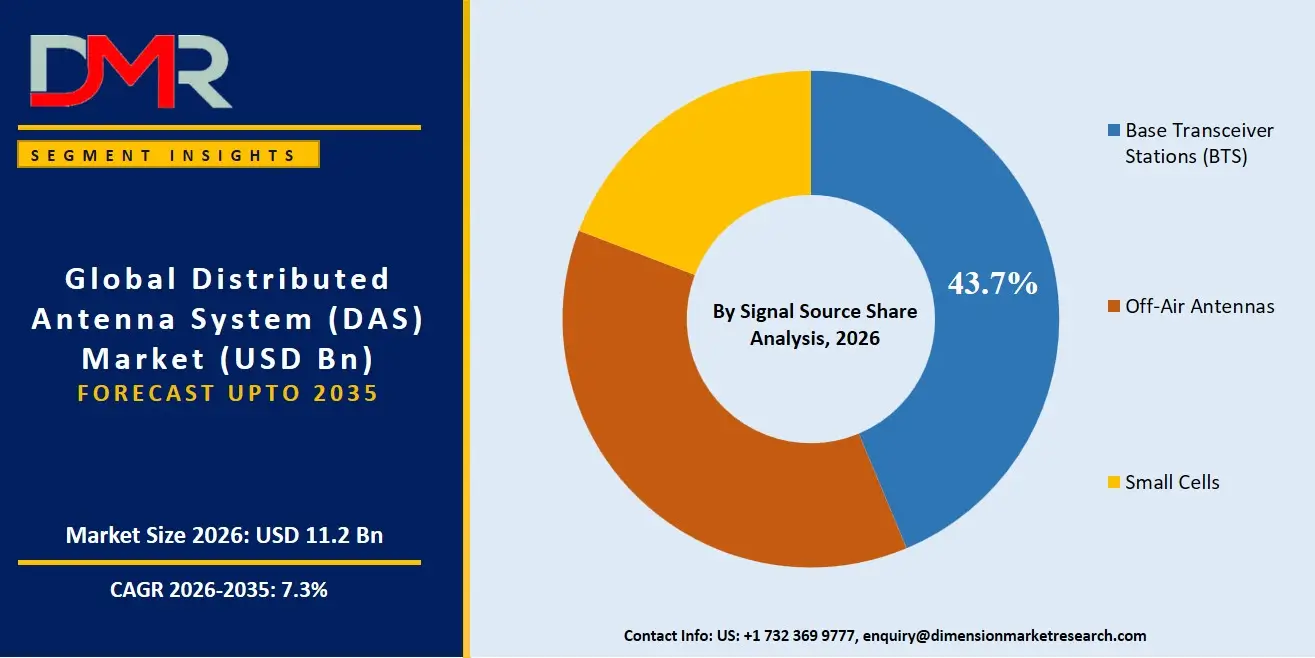
Base Transceiver Stations (BTS) is poised to dominate the signal source segment because they provides dedicated and high capacity cellular coverage necessary for large-scale DAS installations. BTS-based DAS is more reliable, scalable and multi-carrier friendly than off-air antenna systems. Telecommunication service providers are fond of incorporating BTS in dense areas including stadiums, airports, convention centers, and subway systems where there would be heavy usage of the network. The emergence of the new generation 5G networks further enhances the ability of BTS to make efficient use of the available spectrum, reduce latency and effectively manage the network.
By Ownership Model Analysis
Neutral Host DAS is projected to take the lead in the ownership category since it enables several telecom providers to use one common network infrastructure, cutting down on cost savings considerably. Venue owners and enterprises are turning to neutral host DAS more and more because of its ability to reduce expenses that arise when deploying different infrastructures for various providers. Neutral host DAS works very well in places such as airports, stadiums, shopping centers, hospitals, and transport hubs, which require seamless network coverage across different carriers. Telecommunications providers will benefit greatly from quick installation processes and reduced capital expenses while still delivering quality services.
By Deployment Type Analysis
Active DAS is projected to dominate the deployment type segment because of its excellent signal performance and scalability features, along with high capability to serve large premises with dense user capacity. This type of distributed antenna system uses optical fiber cable and other equipment to transmit signals over a vast infrastructure like airports, stadiums, hospitals, and smart campus buildings. Active DAS can deliver many frequency bands and wireless standards including 4G, 5G, and PSBB, making it ideal for enterprise communication applications. Despite high deployment costs compared to other solutions, Active DAS remains the most popular one owing to the increasing complexity of the wireless environment.
By Frequency Protocol Analysis
Cellular frequency protocols is anticipated to dominate the market because DAS deployments as most DAS deployments are meant to provide improved voice and data communications services for telecoms' customers. The widespread use of smartphones and other technological innovations such as video streaming, cloud computing, and enterprise mobility services have contributed to an increase in the need for robust cellular coverage indoors. The launch of 5G networks in many countries around the world has further spurred interest in the deployment of cellular-enabled DAS solutions. Digital transformation efforts by governments and private firms have further solidified the dominance of cellular protocols in the DAS market.
By Frequency Band Analysis
Mid-band spectrum is expected to dominate the DAS market because the demand for mid-band spectrum is prevalent in the DAS industry owing to the balance that this type of spectrum provides in terms of coverage, speed, and capacity requirements for today's communication systems. The use of mid-band spectrum frequencies has been common for applications such as 4G LTE and 5G, providing easy connectivity both indoors and outdoors. Mid-band spectrum is preferred by telecommunication service providers for deployment in DAS networks due to its ability to ensure reliable signal penetration with a high data rate.
By User Facility Area Analysis
Facilities ranging from 200K to 500K square feet make up the majority of this segment in the DAS market since they constitute the most prevalent size for deployment in commercial buildings, hospitals, airports, schools, and factories. These medium-sized venues need reliable indoor connectivity that can cater to high user capacity and communication needs. DAS solutions within such venues present a perfect compromise between coverage needs and installation expenses, making them quite popular among organizations and telecommunications companies. The increasing trend of investing in smart campuses and commercial developments is contributing to the growth of DAS in mid-sized facility deployments.
By Application Analysis
The commercial segment is projected to dominates the DAS market owing to the wide-ranging requirement for continuous wireless connectivity within office complexes, shopping complexes, hotels, and convention centers. With businesses relying on cloud computing, IoT, and video conferencing along with other mobile collaborative applications, there is an increasing necessity for reliable indoor cellular connectivity. Commercial building owners consider superior connectivity as a means of gaining a competitive edge by improving operations and tenants' experiences. With increased deployments of smart building technology and demand for 5G connectivity, the adoption of commercial DAS solutions will only grow stronger.
The Global Distributed Antenna System (DAS) Market Report is segmented on the basis of the following:
By Component
- Hardware
- Antennas
- Repeaters
- Remote Radio Units (RRUs)
- Head-End Units
- Fiber Optic Cables
- Signal Sources
- Power Supplies
- Other Hardware Components
- Services
- Consulting Services
- Installation & Integration
- Network Design & Planning
- Maintenance & Support Services
- Managed Services
- Software
- Network Management Software
- Monitoring & Analytics Software
- Optimization Software
By Coverage
By Signal Source
- Base Transceiver Stations (BTS)
- Off-Air Antennas
- Small Cells
By Ownership Model
- Neutral Host DAS
- Carrier-Owned DAS
- Enterprise-Owned DAS
By Deployment Type
- Active DAS
- Passive DAS
- Hybrid DAS
By Frequency Protocol
By Frequency Band
- Low-Band Spectrum
- Mid-Band Spectrum
- High-Band / mmWave Spectrum
By User Facility Area
- >500 K SQ. FT.
- 200–500 K SQ. FT.
- <200 K SQ. FT.
By Application
- Commercial
- Office Buildings
- Shopping Malls
- Hotels
- Convention Centers
- Healthcare
- Transportation
- Airports
- Railway Stations
- Tunnels
- Metro Systems
- Industrial
- Manufacturing Facilities
- Warehouses
- Oil & Gas Facilities
- Government & Public Safety
- Educational Institutions
- Sports & Entertainment Venues
- Residential
Regional Analysis
Leading Region by Market Share
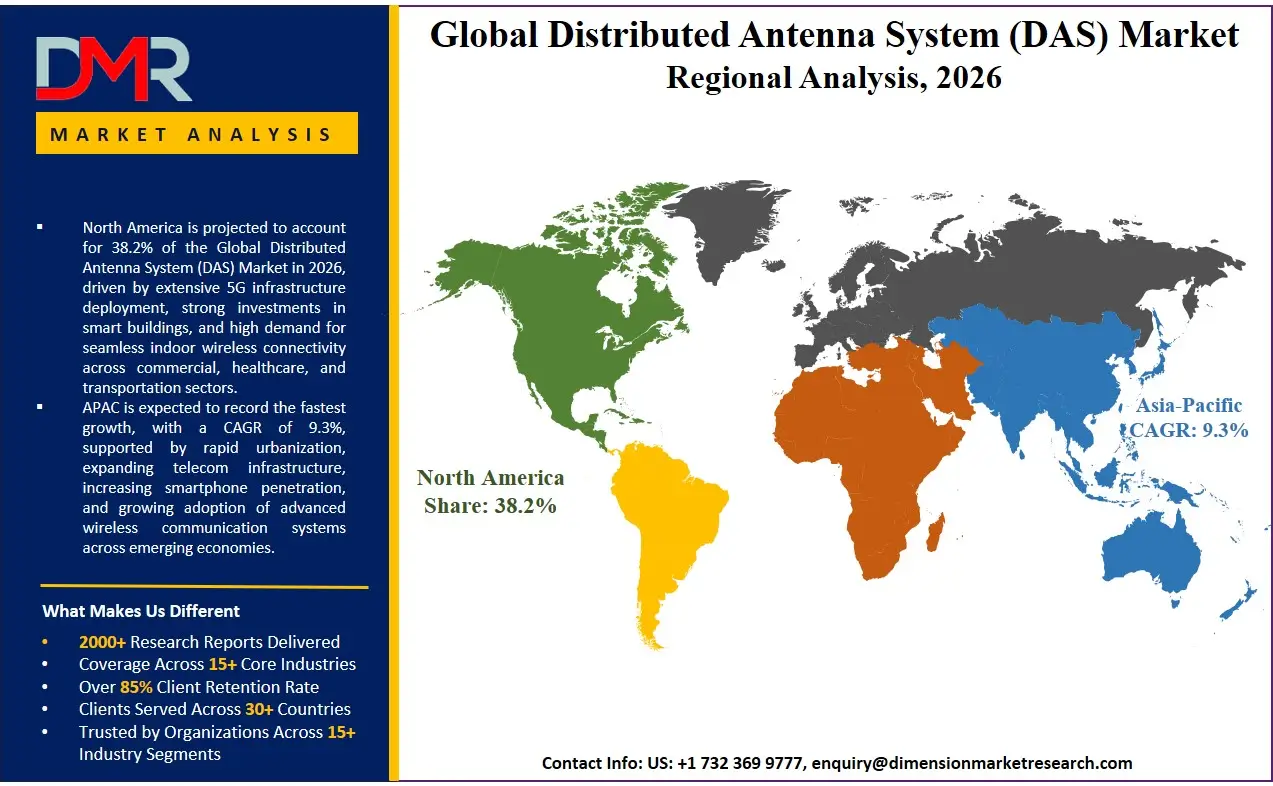
North America is poised to dominate the global Distributed Antenna System (DAS) market, as it is projected to hold 38.2% of the market share by the end of 2026. This is due to the unique availability of venue capacity and highly motivated wireless transformation programs of commercial real estate and public safety authorities. This region also boasts a mature system of global system integrators, niche RF design companies, and a plentiful supply of professionals in the field of DAS engineering. Corporate spending on 5G mmWave, analytics technology, and retiring the old VHF/UHF infrastructure results in sustained requirements for installation services and active DAS equipment in addition to continuous monitoring and analytics tools. Also, the strict regulatory environment around indoor spaces makes it mandatory to have emergency radio coverage for the responders.
ℹ
To learn more about this report –
Download Your Free Sample Report Here
Fastest-Growing Regional Market
The region is anticipated to become one of the fastest growing markets for DAS systems due to the rising digital transformation programs being executed by the governments of India, China, Japan, and Southeast Asia. Rapid economic growth and the emergence of the middle-income population along with the creation of new smart cities have forced the existing conglomerates and public authorities to eliminate outdated signal resources. Consulting services for DAS deployment and network planning are in great demand to guide such enterprises towards multi-carrier and 5G-oriented approaches. Moreover, there is an acute shortage of radio frequency experts in the area, hence it becomes crucial to turn to external managed service providers to address the skills deficit issue.
By Region
North America
Europe
- Germany
- The U.K.
- France
- Italy
- Russia
- Spain
- Benelux
- Nordic
- Rest of Europe
Asia-Pacific
- China
- Japan
- South Korea
- India
- ANZ
- ASEAN
- Rest of Asia-Pacific
Latin America
- Brazil
- Mexico
- Argentina
- Colombia
- Rest of Latin America
Middle East & Africa
- Saudi Arabia
- UAE
- South Africa
- Israel
- Egypt
- Rest of MEA
Competitive Landscape
Market competition within the Distributed Antenna Systems sector across the globe has become extremely volatile due to diverse combinations of multinational neutral host operators, dedicated professional services teams from large equipment vendors, and smaller boutique-style RF engineering consultancies. The crucial factor for success would be the establishment of deep alliances with both carriers and system integrators since these would provide opportunities for collaboration and enable early access to innovative features of active DAS systems. Market consolidation continues at a fast pace, where the traditional structured cabling businesses acquire small boutiques in order to survive through the acquisition of expertise in RF and software. Proprietary IP in terms of automated design solutions and industry-specific signal propagation models becomes much more significant than simply selling components or managing projects.
Some of the prominent players in the Global Distributed Antenna System (DAS) Market are:
- CommScope
- Corning Incorporated
- TE Connectivity
- SOLiD
- Comba Telecom Systems Holdings Ltd.
- Boingo Wireless
- American Tower Corporation
- AT&T
- Verizon Communications
- Cisco Systems
- Huawei Technologies
- Nokia
- Ericsson
- Zinwave
- Dali Wireless
- JMA Wireless
- PBE Group
- Galtronics
- Advanced RF Technologies
- BTI Wireless
- Other Key Players
Recent Developments
- January 2026: CommScope announced a major expansion of its active DAS innovation center and professional services portfolio to help healthcare and transportation clients develop private 5G models using advanced remote radio units and network design & planning expertise.
- November 2025: Boingo Wireless strengthened its collaboration with AT&T and launched a public safety consulting and installation & integration initiative to support government and enterprise clients migrating first responder networks to dedicated multi-band DAS systems while maintaining compliance with national fire protection regulations.
- October 2025: IBM acquired Expeto to enhance its network design & planning and managed service capabilities for hybrid DAS facilities, addressing the complex analytics and user experience monitoring needs of large public venues and enterprise customers.
Report Details
| Report Characteristics |
| Market Size (2026) |
USD 11.2 Bn |
| Forecast Value (2035) |
USD 21.0 Bn |
| CAGR (2026-2035) |
7.3% |
| The US Market Size (2026) |
USD 3.6 Bn |
| Historical Data |
2021 – 2025 |
| Forecast Data |
2027 – 2035 |
| Base Year |
2025 |
| Estimate Year |
2026 |
| Segments Covered |
By Component, By Coverage, By Signal Source, By Ownership Model, By Deployment Type, By Frequency Protocol, By Frequency Band, By User Facility Area, and By Application |
| Regional Coverage |
North America – The US and Canada; Europe – Germany, The UK, France, Russia, Spain, Italy, Benelux, Nordic, & Rest of Europe; Asia-Pacific – China, Japan, South Korea, India, ANZ, ASEAN, Rest of APAC; Latin America – Brazil, Mexico, Argentina, Colombia, Rest of Latin America; Middle East & Africa – Saudi Arabia, UAE, South Africa, Turkey, Egypt, Israel, & Rest of MEA |
Frequently Asked Questions
How big is the Global Distributed Antenna System (DAS) Market?
▾ The market is expected to grow at a CAGR of 7.3% from 2026 to 2035, reflecting the accelerating complexity of enterprise wireless environments and the persistent shortage of internal RF engineering talent.
What is the CAGR of the Global Distributed Antenna System (DAS) Market from 2026 to 2035?
▾ The market is expected to grow at a CAGR of 7.3% from 2026 to 2035, reflecting the accelerating complexity of enterprise wireless environments and the persistent shortage of internal RF engineering talent.
What factors are driving the growth of the Global Distributed Antenna System (DAS) Market?
▾ Key drivers include the global RF engineering skills gap, the imperative to modernize legacy passive systems, the management complexity of multi-band spectrum and neutral host deployments, and the surge in demand for public safety consulting amid evolving life-safety communication laws.
Which region held the largest share of the Distributed Antenna System (DAS) Market in 2026?
▾ North America is projected to dominate this market as it holds 38.2% of market share in 2026, driven by a mature system integrator ecosystem and aggressive enterprise investment in active DAS hardware and 5G-driven wireless capabilities.
Which region is expected to grow the fastest in the Distributed Antenna System (DAS) Market?
▾ The Asia-Pacific region is expected to grow the fastest, fueled by rapid smart city transformation in India, China, and Japan, where network design & planning consulting is critical for transitioning large venues to 5G-native DAS operations.
What are the major trends in the Global Distributed Antenna System (DAS) Market?
▾ Major trends include the integration of AI into network management workflows, the rise of sustainability and green network consulting, the demand for industry-specific DAS solutions, and the focus on performance optimization within complex multi-band spectrum environments.
Who are the key players in the Global Distributed Antenna System (DAS) Market?
▾ Key players include equipment manufacturers like CommScope, Corning, and SOLiD, as well as neutral host operators like American Tower and Boingo Wireless, alongside specialized pure-play DAS integrators and RF consultancies.
How is the Global Distributed Antenna System (DAS) Market segmented?
▾ The market is segmented by Component, Coverage, Signal Source, Ownership Model, Deployment Type, Frequency Protocol, Frequency Band, User Facility Area, and Application.