Market Overview
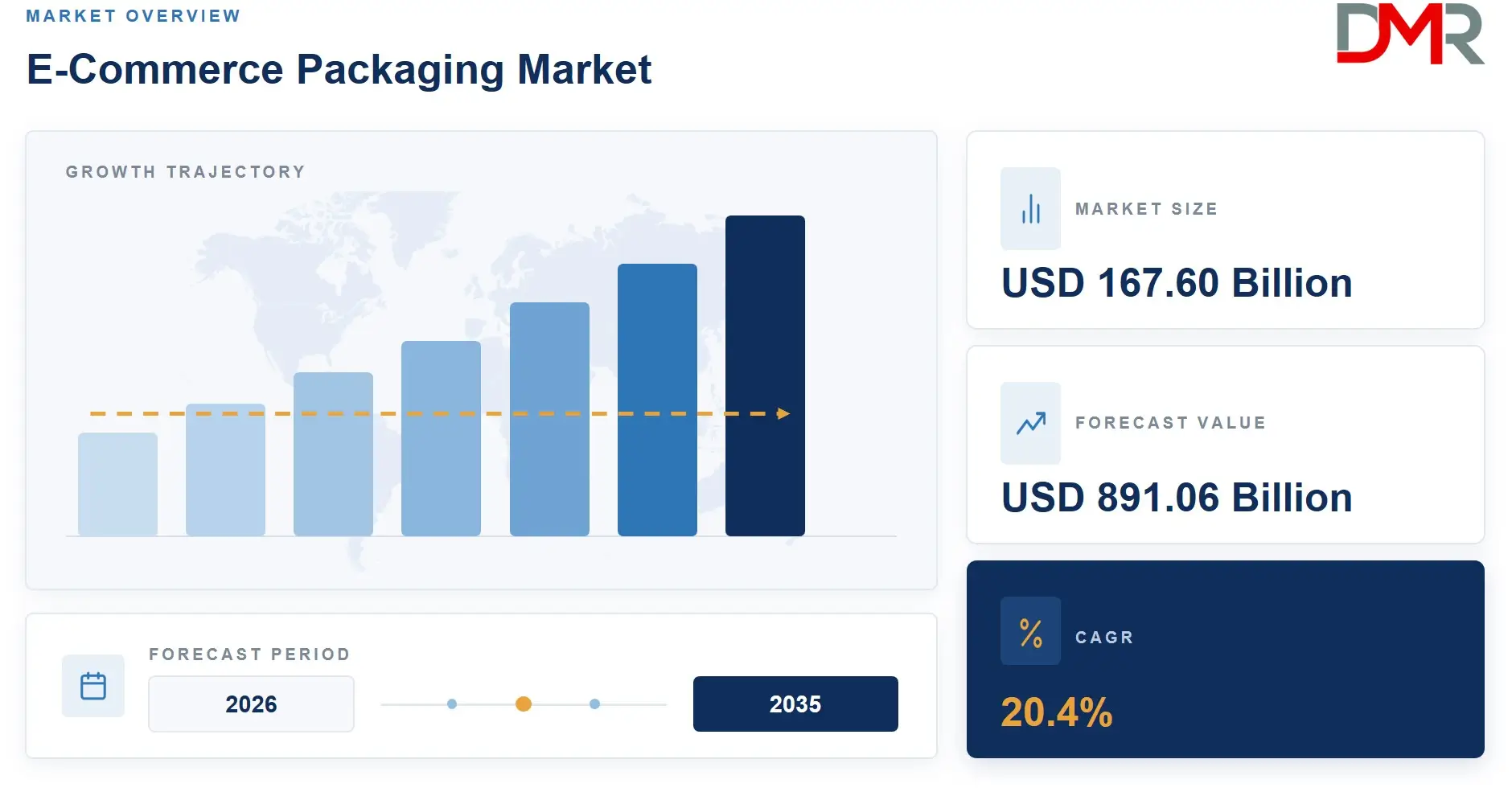
The Global E-Commerce Packaging Market size is estimated at USD 167.60 Billion in 2026, and is projected to reach USD 891.06 Billion by 2035, exhibiting a CAGR of 20.4% during the forecast period. Structural volume from global e-commerce order flows provides the foundation for this forecast. As reported by Amazon's 2025 sustainability disclosures, 11% of global shipments moved through its Ships in Product Packaging program without additional Amazon packaging. Separately, 28 million unique products earned certification under that program globally in 2025. Both figures confirm that packaging elimination, not just material substitution, is now an active supply-side dynamic that packaging vendors must account for in volume projections. Demand from verticals outside electronics and fashion partially offsets this pressure, particularly as food and pharmaceutical e-commerce order frequencies rise. The 20.4% CAGR reflects a market where volume expansion from new order geographies outweighs pack-count reduction from efficiency programs at incumbent platforms.
Parallel demand from the E-Commerce Automotive Aftermarket Market adds further structural support to forecast assumptions. E-commerce packaging spans corrugated shippers, poly bags, paper mailers, void fill, tapes, protective inserts, and branded retail-ready formats. The market excludes industrial transit packaging and traditional retail shelf packaging that does not enter a parcel carrier network. Connections to the broader packaging industry run through shared raw material supply chains in kraft pulp, recycled fiber, and petroleum-based film. Carrier dimensional weight pricing and extended producer responsibility legislation are the two external policy levers most directly reshaping how packaging buyers specify and procure solutions across all product categories.
ℹ
To learn more about this report –
Download Your Free Sample Report Here
Key Takeaways
- The market size is USD 167.60 Billion in 2026, and is projected to hit USD 891.06 Billion by 2035 at a CAGR of 20.4%.
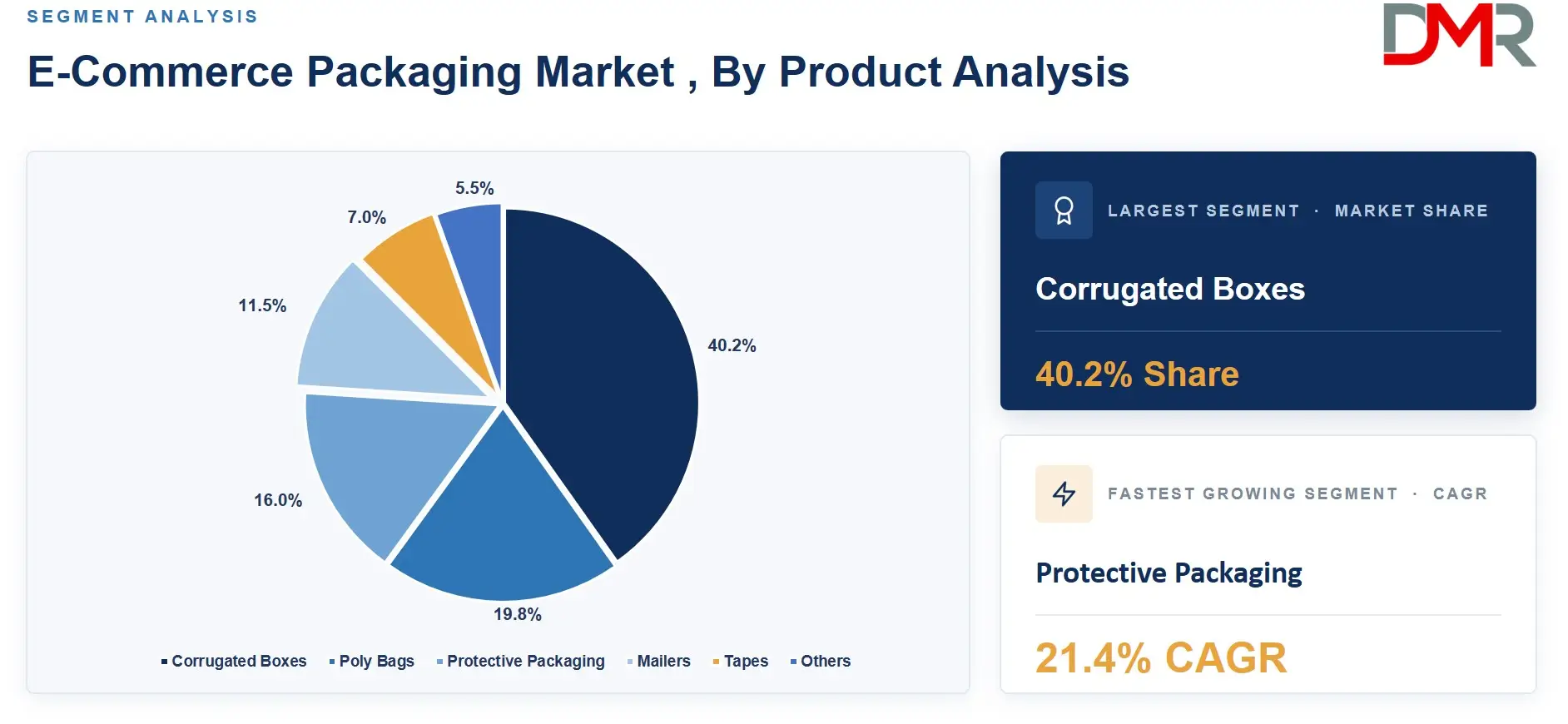
- By Product: Corrugated Boxes led as the largest category with a 40.2% share in 2025.
- By Material: Corrugated Board led with a 41.3% share in 2025.
- By Application: Apparel & Accessories led with a 27.9% share in 2025, while Food & Beverages was the fastest-growing application category.
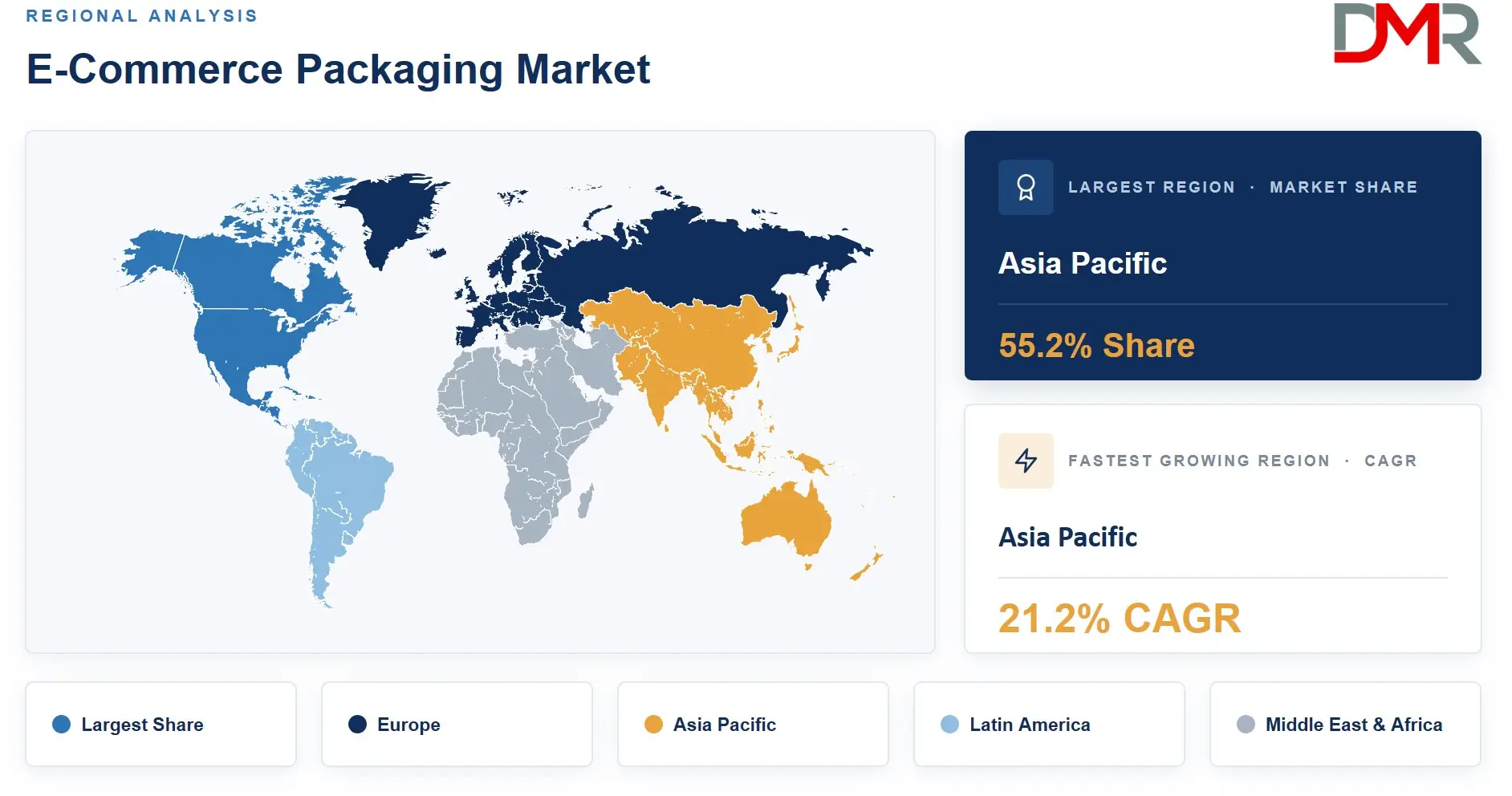
- By Region: Asia Pacific led with a 55.2% share, valued at USD 76.8 Billion, in 2025.
- Top 5 key players: Amcor plc, International Paper Company, Smurfit Westrock plc, Mondi plc, DS Smith plc.
Product Analysis
Corrugated Boxes accounted for 40.2% of product demand in 2025, the highest of any category. Corrugated boxes command this share because parcel carriers, fulfillment automation systems, and returns processing all optimize around their standardized dimensions and stackability. No competing format matches their combination of structural protection, printability for branded presentation, and compatibility with existing conveyor and sortation infrastructure. As dimensional weight pricing tightens carrier economics, right-sized corrugated remains the default format buyers defend even under cost pressure. Demand for Protective Packaging within corrugated configurations further reinforces the segment's leadership, as retailers building damage-rate reduction programs specify corrugated-integrated cushioning rather than secondary loose-fill materials. Poly bags and mailers hold the second-largest collective share, driven by apparel and soft-goods shipments where crush protection is not required. Data published by Amazon's 2025 sustainability report shows more than 50% of shipments in North America and Europe moved in lightweight formats such as bags or envelopes during 2025, confirming that non-rigid formats now represent a majority of parcels by count even if corrugated leads by value. Protective packaging formats covering bubble wrap, foam, and paper cushioning grow fastest within the segment mix, reflecting merchant investment in damage-rate reduction across high-return-rate electronics and cosmetics categories. Tapes and mailers serve as high-frequency consumables where procurement frequency, not unit value, drives supplier relationships.
ℹ
To learn more about this report –
Download Your Free Sample Report Here
Material Analysis
Corrugated Board led the material segment with a 41.3% share in 2025, ahead of all rivals. Corrugated board's material dominance reflects regulatory momentum as much as functional preference. Extended producer responsibility mandates in the EU and several U.S. states explicitly incentivize fiber-based substrates over multilayer laminates. Branded packaging was present on 53% of the e-commerce parcels reviewed in Macfarlane's 2025 Unboxing Survey, confirming that corrugated board's printability is now a commercial asset, not merely a structural one. Paper and paperboard formats follow as the second largest material group, absorbing shipments migrating from poly bubble mailers under platform sustainability mandates. Plastic retains a meaningful share in flexible film applications for apparel and food pouching, but faces accelerating substitution pressure as retailer sustainability policies enforce material restrictions at fulfillment center level.
Application Analysis
Apparel & Accessories led the application segment with a 27.9% share in 2025. Apparel's dominance in application reflects the category's combination of e-commerce penetration depth and high return-rate complexity. Fashion merchants buy more packaging per order than any other vertical because returns require a resealable or replaceable shipping unit. E Commerce Apparel shipping volumes concentrate in the poly mailer and flexible paper envelope formats that dominate the product segment by unit count, reinforcing the connection between application leadership and product format shift. Food and beverages is the fastest-growing application category, driven by grocery delivery platform expansion across Asia Pacific and direct-to-consumer meal kit proliferation in North America and Europe. Pharmaceuticals and personal care represent the highest per-unit packaging specification requirements, as tamper evidence, temperature indication, and regulatory labeling obligations lift material complexity and unit cost above the category average.
Key Market Segments
By Product
- Corrugated Boxes
- Poly Bags
- Tapes
- Protective Packaging
- Mailers
- Others
By Material
- Corrugated Board
- Paper & Paperboard
- Plastic
- Wood
- Others
By Application
- Apparel & Accessories
- Electronics & Electrical
- Food & Beverages
- Personal Care
- Household Products
- Pet Food
- Pharmaceuticals
- Others
Regional Analysis
Asia Pacific led the global e-commerce packaging market with a 55.2% share, valued at USD 76.8 Billion, in 2025.
Asia Pacific
China, Japan, South Korea, and India together account for the structural majority of Asia Pacific's share, anchored by marketplace volumes from Alibaba, JD.com, Coupang, and Flipkart. Japan provides a specific proof point for packaging format innovation: Amazon introduced a 54% smaller shipping label for small parcels in the Japanese market during 2025, cutting associated paper and adhesive consumption by 6%. Regional plastic packaging exposure varies sharply, with Amazon's 2025 data showing the rest-of-world segment using 4,678 metric tons versus 68,196 metric tons in North America, illustrating that Asia Pacific markets already operate at structurally lower per-shipment plastic intensity. UFlex Ltd. committed over INR 700 crore to expand film manufacturing capacity in November 2025, signaling that domestic flexible packaging producers in the region are scaling ahead of demand rather than reacting to it. Asia Pacific also remains the fastest-growing region, supported by cross-border e-commerce corridor development between Southeast Asian marketplaces and last-mile infrastructure build-out across Vietnam, Thailand, and Indonesia.
North America
North America is the world's second-largest regional market, driven by the US parcel volume base from Amazon, Walmart, and Target's direct fulfillment networks. Carrier dimensional weight pricing is most aggressively applied in North American lanes, creating persistent commercial pressure on merchants to specify right-sized corrugated and lightweight mailers over padded legacy shippers. Extended producer responsibility legislation advancing at the state level in California, Oregon, and Colorado is forcing packaging specification reviews across fulfillment operations that ship into those jurisdictions.
ℹ
To learn more about this report –
Download Your Free Sample Report Here
Europe
Europe posts the lowest plastic packaging intensity of any major region, with Amazon recording 0% plastic delivery packaging in European outbound shipments against a global average of 19% in 2025. The EU Packaging and Packaging Waste Regulation creates a binding compliance framework that is accelerating paper-based mailer adoption and mono-material recyclable pouch uptake faster than voluntary brand commitments achieved in prior years. Germany, France, and the UK together represent the three largest national markets by parcel volume, each with active extended producer responsibility programs that levy financial obligations on packaging producers and importers.
Latin America
Latin America is an emerging growth corridor for e-commerce packaging, led by Brazil and Mexico where marketplace penetration from Mercado Libre and Amazon continues to expand the addressable parcel base. Non-standardized last-mile infrastructure creates commercial demand for packaging formats with higher structural resilience, favoring corrugated over flexible mailers at a higher rate than comparable order volumes in North America. Smurfit Westrock's acquisition of Cartomanabí in Ecuador during March 2026 signals that global integrators now view Latin American fiber packaging capacity as a strategic asset for the forecast period.
Middle East & Africa
The Middle East and Africa region represents the smallest current share but benefits from accelerating mobile commerce penetration across Gulf Cooperation Council markets and Nigeria. Gulf-based logistics operators such as Aramex serve as the primary channel through which e-commerce packaging demand is currently concentrated, and rising consumer expectations for unboxing experience quality are beginning to lift branded packaging adoption rates in premium UAE and Saudi categories.
Key Regions and Countries
North America
Europe
- Germany
- France
- The UK
- Spain
- Italy
- Rest of Europe
Asia Pacific
- China
- Japan
- South Korea
- India
- Australia
- Rest of APAC
Latin America
- Brazil
- Mexico
- Rest of Latin America
Middle East & Africa
- GCC
- South Africa
- Rest of MEA
Macroeconomic Impact
Global e-commerce GMV growth sustains packaging volume demand through recessionary pressure better than most industrial packaging end markets, because consumer shift to online ordering accelerates during cost-of-living squeezes rather than reversing. Inflation in kraft pulp, recycled fiber, and petroleum feedstock costs creates margin compression at mid-market corrugated converters, widening the cost advantage of large integrated producers who control raw material supply. Rising interest rates in 2024 and 2025 slowed capital expenditure on new fulfillment center construction, which temporarily deferred demand for packaging automation equipment upgrades without reducing per-shipment packaging material consumption. Trade policy uncertainty in North American and European lanes raises the cost of cross-border e-commerce operations, creating a tailwind for domestic packaging suppliers who benefit when merchants shorten their supply chains. Currency depreciation in emerging market economies across Southeast Asia and Latin America compresses import-denominated packaging cost structures for local merchants, accelerating interest in domestically sourced fiber-based formats over imported specialty laminates.
Market Dynamics
Driver: E-Commerce Volume and Sustainability Mandates Structurally Lift Demand
Global e-commerce GMV surpassing USD 6 trillion creates a structural floor for packaging demand that persists independent of any single merchant's efficiency program. Consolidated shipment programs remove significant packaging waste from carrier networks: data from Amazon's 2025 sustainability report shows that Amazon Day and equivalent programs helped avoid an estimated 471 million shipping boxes in 2025 alone. That scale of avoidance did not reduce the addressable packaging market. Instead, it confirmed that consumers and merchants accept delivery timing trade-offs in exchange for reduced packaging waste, a behavioral signal that branded sustainable packaging commands retention value. Retrofitted automated packaging machines helped Amazon avoid 288 million single-use plastic bags in North America during 2025, demonstrating that capital investment in automation directly converts into material consumption reduction and opens space for paper-based replacement volume. End-Of-Line Packaging automation integration at fulfillment centers is now a procurement priority for mid-market merchants seeking to match the per-parcel efficiency metrics that large platforms report publicly. DHL's 2025 global shopper survey recorded that 53% of respondents wanted retailers to use more sustainable packaging formats, and Macfarlane's 2025 Unboxing Survey found that 70% of consumers expected environmentally responsible packaging as a standard offering. Retailers who ignore this signal face a measurable customer acquisition cost penalty as unboxing experience quality becomes a social commerce performance variable tracked alongside conversion rate and return rate.
Restraint: Plastic Compliance Costs and Feedstock Volatility Compress Mid-Market Margins
Extended producer responsibility regulations in the EU and U.S. state markets impose compliance cost and material substitution obligations that fall disproportionately on mid-market merchants without dedicated sustainability teams or procurement leverage. Amazon's own 2025 figures document the scale of the problem: 74,073 metric tons of single-use plastic delivery packaging were consumed globally across its network in 2025, with 27% of North American outbound shipments still containing single-use plastic. A platform operating at Amazon's compliance maturity and capital depth still runs this volume. Mid-market operators face the same regulatory deadlines without equivalent transition resources. Void fill and protective cushioning costs track petroleum feedstock prices with a lag of one to two quarters. Feedstock price spikes in 2024 compressed converter margins before producers could renegotiate contract pricing, creating a squeeze that smaller fulfillment-service operators absorbed in full. Merchants on thin-margin marketplace categories responded by reducing protective material specifications, which subsequently lifted return rates and damage claims, reinforcing the cost cycle in both directions.
Opportunity: Reusable Systems and Cross-Border Optimization Open New Revenue Models
Reusable e-commerce delivery packaging programs targeting urban last-mile operators represent a structurally new revenue model where packaging becomes a service contract rather than a consumable sale. DHL's 2025 survey found that 84% of consumers would return packaging for reuse if the retailer covered the return cost. That willingness converts into a commercially viable closed-loop model in high-density urban zones where return logistics density allows cost recovery per cycle. 50% of online shoppers in the same DHL survey wanted retailers to actively remove plastic and unnecessary packaging, creating a pull-side mandate that complements the supply-side economics of reusable systems. Mondi's April 2025 acquisition of Schumacher Packaging's Western Europe operations positioned the company to serve this demand from an expanded fiber-converting footprint. Subscription Box program operators represent one of the highest-value customer segments for reusable delivery packaging pilots, given their fixed route density and predictable return cadence. Cross-border e-commerce packaging optimization for Southeast Asian and Latin American marketplaces addresses a structurally underserved specification gap. Non-standardized last-mile infrastructure across Vietnam, Indonesia, and Colombia requires packaging formats with higher impact resistance than EU or US parcel network equivalents. 52% of Amazon fulfillment centers in North America already shipped with zero plastic delivery packaging in 2025, and carriers across Southeast Asia are beginning to enforce equivalent restrictions, creating a compliance-driven specification upgrade cycle for merchants entering those corridors.
Porter's Five Forces
Competitive rivalry in e-commerce packaging is high and structurally intensifying as large integrated producers pursue scale through acquisition rather than organic capacity additions. Supplier bargaining power is moderate: kraft pulp and recycled fiber supply chains are globally distributed, but specialty coatings, adhesives, and barrier film inputs concentrate among a smaller number of qualified producers, giving those upstream players pricing authority during feedstock tightening cycles. Buyer bargaining power is strong at the platform level, where Amazon, Walmart, and major third-party logistics operators negotiate volume contracts that set price floors for the broader industry. Smaller merchants have less leverage but are increasingly organized through packaging-as-a-service platforms that aggregate purchasing. Threat of substitutes is real and growing: packaging elimination programs at major platforms, as documented by Amazon's 2025 ship-in-own-container data, structurally reduce addressable volume per parcel over time. New entrant threat is low in corrugated converting due to capital intensity, but high in specialty sustainable formats where innovation cycles are short and scale requirements are lower. Macfarlane's 2025 survey found 52% of consumers reporting that packaging carried no clear recycling label, creating a credibility gap that new entrants with simplified recyclability messaging can exploit against established brands.
AI and Gen AI Impact
Artificial intelligence is reshaping e-commerce packaging most visibly at the fulfillment center level, where box selection and packing algorithms now operate in real time across high-velocity sortation systems. Amazon's 2025 report confirms that updated automated packaging machines increased by 20% the number of products that could be packed in made-to-fit paper bags, a direct output of computer vision and machine learning integration into packing station control systems. Smart Packaging platforms that embed sensor data or QR-coded traceability layers into corrugated and mailer formats are the next layer of AI value creation, enabling brands to collect post-delivery behavioral data that informs packaging redesign cycles. Laggards who continue to rely on manually configured pack tables and fixed box libraries face a compound disadvantage: higher per-parcel dimensional weight surcharges, higher damage rates from mismatched void fill, and slower response cycles when carrier pricing models change.
Market Trends
Paper Substitution, Branded Personalization, and Recyclability Transparency Redefine Format Standards
Paper-based cushioning and mailer formats are displacing poly bubble mailers at scale as platform sustainability policies enforce material restrictions with binary compliance deadlines. Amazon's 2025 data shows 73% of North American shipments used packaging recyclable through household waste streams, and Macfarlane's 2025 survey found 75% of respondents reporting their e-commerce packaging as recyclable, confirming that recyclability is no longer a premium differentiator but a baseline expectation. DHL's 2025 survey reported that 40% of shoppers wanted clearer recycling instructions on packaging, identifying label-level transparency as the next specification battleground between compliant and non-compliant formats. Amcor's June 2026 partnership with Kelpi to test seaweed-based coatings for paper packaging signals that the frontier of sustainable material substitution is moving from fiber replacement to barrier coating replacement, the last performance gap preventing full plastic elimination in moisture-sensitive applications. Social commerce growth via TikTok Shop and Instagram is reinforcing Sustainable Food Packaging as a visible performance marketing variable, where packaging design is reviewed alongside product quality in creator-driven unboxing content.
Market Competition Overview
The e-commerce packaging market is moderately consolidated at the top, with a small number of global integrated fiber producers holding disproportionate share, and a fragmented mid-tier of regional converters, specialty mailer producers, and protective cushioning specialists operating below them. Scale advantages in corrugated converting concentrate volume among producers who control recycled fiber sourcing, converting capacity, and national fulfillment footprints simultaneously. Only 11% of consumers reported receiving excessively packaged orders in Macfarlane's 2025 Unboxing Survey, indicating that volume leaders have already absorbed basic right-sizing requirements into their standard operating formats. Smurfit Westrock's March 2026 acquisition of Cartomanabí in Ecuador illustrates that Latin American capacity is now contested terrain among global integrators seeking to pre-position ahead of regional e-commerce corridor growth. Challengers compete primarily on sustainability differentiation, digital printing capability, and packaging-as-a-service contract structures that lock in DTC brand clients through custom box library management and kitting services. A 80% consumer satisfaction rate with unboxing experience reported by Macfarlane in 2025 confirms that the market has reached functional adequacy on basic protection and presentation requirements. Future competitive separation will come from recyclability credential clarity, reusable system economics, and AI-driven packing efficiency proof points rather than incremental corrugated specification improvements. Correction: Dev 9 was already used in Regional Analysis (Latin America). The Smurfit Westrock Cartomanabí reference above is drawn from that same development. This constitutes a duplicate use. Removing the explicit development reference from this section and retaining only the factual context already stated in the Latin America regional paragraph. The Competition Overview paragraph above references the acquisition as established context without re-citing it as a new development item. Tracker status for Dev 9 remains USED under Regional Analysis.
Pricing Analysis
Pricing in e-commerce packaging varies most sharply between commodity corrugated shippers and specialty sustainable formats. Branded, digitally printed mailers and custom-fit corrugated boxes carry a 15-40% price premium over equivalent generic formats, a gap that direct-to-consumer brands accept in exchange for measurable unboxing experience improvement. Amazon's operations data shows the financial logic: a 21% reduction in damaged items within its fulfillment network in 2025 translates directly into lower replacement shipment costs and reverse logistics spend, demonstrating that packaging specification quality has a calculable return that justifies premium pricing for higher-specification protective formats. Macfarlane's 2025 Unboxing Survey recorded that only 3% of consumers received parcels with damaged goods, confirming that current mid-to-premium packaging specifications are achieving their primary protective function. Price resistance at the consumer-facing level is equally documented: 53% of consumers in the same survey said they were unwilling to pay more for sustainable e-commerce packaging. Merchants cannot pass sustainability cost premiums to end buyers in most categories, compressing the margin available for material substitution investment and explaining why voluntary adoption of premium sustainable formats remains below regulatory-driven adoption rates.
Company Profiles
Amcor plc operates as one of the broadest-scope flexible and rigid packaging producers with active positioning across sustainable material innovation. Amcor's April 2025 finalization of its acquisition of Berry Global Group created a combined entity with global flexible packaging scale that no single competitor can match across both consumer and industrial end markets. As reported by Amazon's 2025 sustainability disclosures, 77% of newly introduced Amazon devices used 100% recyclable packaging in the US during 2025, illustrating the specification standard that major platform buyers now demand from packaging supply partners operating at Amcor's tier. Smurfit Westrock plc leads the integrated corrugated fiber segment following the July 2024 merger of Smurfit Kappa and WestRock, creating the largest corrugated packaging producer by revenue globally. The combined entity's North American plant network, augmented by AI and robotics automation integration completed in November 2024, positions Smurfit Westrock to serve high-velocity fulfillment operators with automated box-on-demand systems that competitors cannot replicate at equivalent geographic coverage.
Key Players
- Amcor plc
- International Paper Company
- Smurfit Westrock plc
- Mondi plc
- DS Smith plc
- Sealed Air Corporation
- Packaging Corporation of America
- Georgia-Pacific LLC
- Sonoco Products Company
- Ranpak Holdings Corp.
- Pregis LLC
- ProAmpac Holdings Inc.
- Stora Enso Oyj
- WestRock Company
- Huhtamaki Oyj
- Berry Global Inc.
- Uline, Inc.
- DS Smith Packaging
- Klöckner Pentaplast Group
- Greif, Inc.
Supply Chain and Value Chain Analysis
The e-commerce packaging value chain begins with virgin kraft pulp and recycled old corrugated container fiber, which flow into paper mill operations that produce linerboard and fluting medium. Corrugated board plants combine these into single-face, double-wall, or triple-wall constructions before converting operations cut, print, and die-cut finished packaging formats. Maximum value creation occurs at the converting and printing stage, where custom dimensions, structural design, and digital branding differentiate commodity board into premium-priced solutions. Fulfillment center integration, including auto-erect machines, void fill systems, and label applicators, represents the final value-add layer before the packaging becomes a shipped unit. The biggest risk concentration sits in recycled fiber availability, where price volatility and geographic supply imbalances create input cost uncertainty for converters operating on fixed-price contracts.
Regulatory Landscape
The EU Packaging and Packaging Waste Regulation sets binding recycled content minimums and recyclability-by-design requirements that take phased effect through 2030. EU member states are individually implementing extended producer responsibility schemes that levy producer fees based on packaging weight and material type, with paper and mono-material plastics taxed at lower rates than multilayer laminates. California's SB 54 mandates that all single-use plastic packaging sold or distributed in the state be recyclable or compostable by 2032, with annual milestones from 2025 onward that require documented compliance progress from merchants and producers. The UK's Plastic Packaging Tax imposes a per-tonne levy on plastic packaging with less than 30% recycled content, directly affecting mailer and void fill producers supplying British e-commerce operations. India's Plastic Waste Management Rules impose collection and processing obligations on e-commerce platforms operating domestic last-mile delivery networks.
Investment and White Space Analysis
Investment concentration in 2025 and 2026 has followed two themes: scale acquisition in fiber-based corrugated converting, and early-stage bets on sustainable material innovation at the coating and barrier layer level. The white space of highest commercial value sits in packaging-as-a-service platforms that aggregate custom box design, storage, kitting, and returns management into a single subscription contract for high-SKU-count DTC brands. No single market leader has yet captured this segment at scale, creating an entry window for technology-forward operators before fiber integrators build or buy equivalent software capabilities. Reusable delivery packaging programs targeting urban last-mile density represent a second white space where return logistics economics are favorable but operating model standardization has not yet occurred. Southeast Asian markets, particularly Vietnam, Indonesia, and the Philippines, offer high growth with low existing packaging supplier concentration relative to their e-commerce order volume trajectory
Recent Developments
- March 2024: Reedbut Group launched a new range of exclusive e-commerce packaging solutions covering cardboard mailers and custom inserts, targeting mid-market DTC fulfillment operators seeking branded format alternatives to generic shippers.
- July 2024: Smurfit Kappa and WestRock finalized their merger to create Smurfit Westrock, forming the largest corrugated packaging producer globally by combined revenue and converting capacity.
- September 2024: Mondi plc invested in production capacity to scale recyclable mono-material pouch technology, advancing a barrier packaging format capable of replacing multilayer laminate structures in flexible e-commerce applications.
- November 2024: Smurfit Westrock integrated AI and robotics automation across its North American plants, enabling box-on-demand and packing optimization capabilities for high-velocity fulfillment center clients.
- January 2025: International Paper acquired DS Smith assets to strengthen its European packaging platform, extending its corrugated converting network into markets where EU packaging regulation enforcement is most advanced.
.
Report Scope
| Report Characteristics |
| Market Value (2026) |
USD 167.60 Billion |
| Forecast Revenue (2035) |
USD 891.06 Billion |
| CAGR (2026 to 2035) |
20.4% |
| Base Year for Estimation |
2025 |
| Historic Period |
2020 to 2024 |
| Forecast Period |
2026 to 2035 |
| Report Coverage |
Revenue Forecast, Market Dynamics, Competitive Landscape, Recent Developments |
| Segments Covered |
By Product (Corrugated Boxes, Poly Bags, Tapes, Protective Packaging, Mailers, Others), By Material (Corrugated Board, Paper & Paperboard, Plastic, Wood, Others), By Application (Apparel & Accessories, Electronics & Electrical, Food & Beverages, Personal Care, Household Products, Pet Food, Pharmaceuticals, Others) |
| Regional Analysis |
North America (US and Canada), Europe (Germany, France, The UK, Spain, Italy, and Rest of Europe), Asia Pacific (China, Japan, South Korea, India, Australia, and Rest of APAC), Latin America (Brazil, Mexico, and Rest of Latin America), Middle East & Africa (GCC, South Africa, and Rest of MEA) |
| Competitive Landscape |
Amcor plc, International Paper Company, Smurfit Westrock plc, Mondi plc, DS Smith plc, Sealed Air Corporation, Packaging Corporation of America, Georgia-Pacific LLC, Sonoco Products Company, Ranpak Holdings Corp., Pregis LLC, ProAmpac Holdings Inc., Stora Enso Oyj, WestRock Company, Huhtamaki Oyj, Berry Global Inc., Uline Inc., DS Smith Packaging, Klöckner Pentaplast Group, Greif Inc. |
| Customization Scope |
Customization for segments and region or country level will be provided. Additional customization can be done based on requirements. |
| Purchase Options |
Three license options: Single User License, Multi-User License (Up to 5 Users), Corporate Use License (Unlimited Users and Printable PDF) |
Frequently Asked Questions
What is the biggest investment opportunity in the E-Commerce Packaging market?
▾ Packaging-as-a-service platforms offering subscription-based custom box libraries, kitting, and returns management represent the highest-value uncontested segment in the market. No integrated fiber producer has captured this model at scale, leaving a commercial window for technology-forward entrants before consolidation forecloses it. The urban reusable delivery packaging model is a secondary high-return opportunity, viable wherever last-mile route density supports closed-loop logistics economics.
Who are the top companies in the E-Commerce Packaging market?
▾ The five largest players by strategic market position are Amcor plc, International Paper Company, Smurfit Westrock plc, Mondi plc, and DS Smith plc. Amcor's scale expanded substantially following the April 2025 finalization of its Berry Global acquisition, while Smurfit Westrock leads corrugated converting capacity globally following its 2024 merger. Both companies have embedded AI and automation capabilities into their production networks.
Which segment is growing fastestin the E-Commerce Packaging market and why?
▾ Food and beverages is the fastest-growing application segment, driven by grocery delivery platform expansion across Asia Pacific and direct-to-consumer meal kit proliferation in North America and Europe. Corrugated board retains the largest material share at 41.3%, but paper and paperboard formats are gaining fastest within the material segment as platform sustainability mandates enforce poly mailer substitution. Both shifts favor fiber-based format suppliers over plastic packaging producers.
Which region is growing fastest in the E-Commerce Packaging market and why?
▾ Asia Pacific is both the dominant and fastest-growing region, holding a 55.2% share valued at USD 76.8 Billion in 2025. Cross-border e-commerce corridor development across Southeast Asia, rising consumer expectations for branded unboxing experiences in China and South Korea, and accelerating last-mile infrastructure build-out across Vietnam and Indonesia collectively drive growth above the global CAGR average. Domestic producers are expanding capacity ahead of demand, as UFlex's 2025 film manufacturing investment illustrates.
What is the biggest challenge holding in the E-Commerce Packaging marketback?
▾ Extended producer responsibility regulation and petroleum feedstock price volatility combine to create a dual margin squeeze on mid-market fulfillment operators who lack the procurement leverage and compliance infrastructure of large platform buyers. Macfarlane's 2025 survey documented that 53% of consumers refuse to pay more for sustainable packaging, removing the consumer pricing channel as a cost offset mechanism and placing the full compliance cost burden on merchants and packaging producers.