Global Electronic Medical Records Market Snapshot
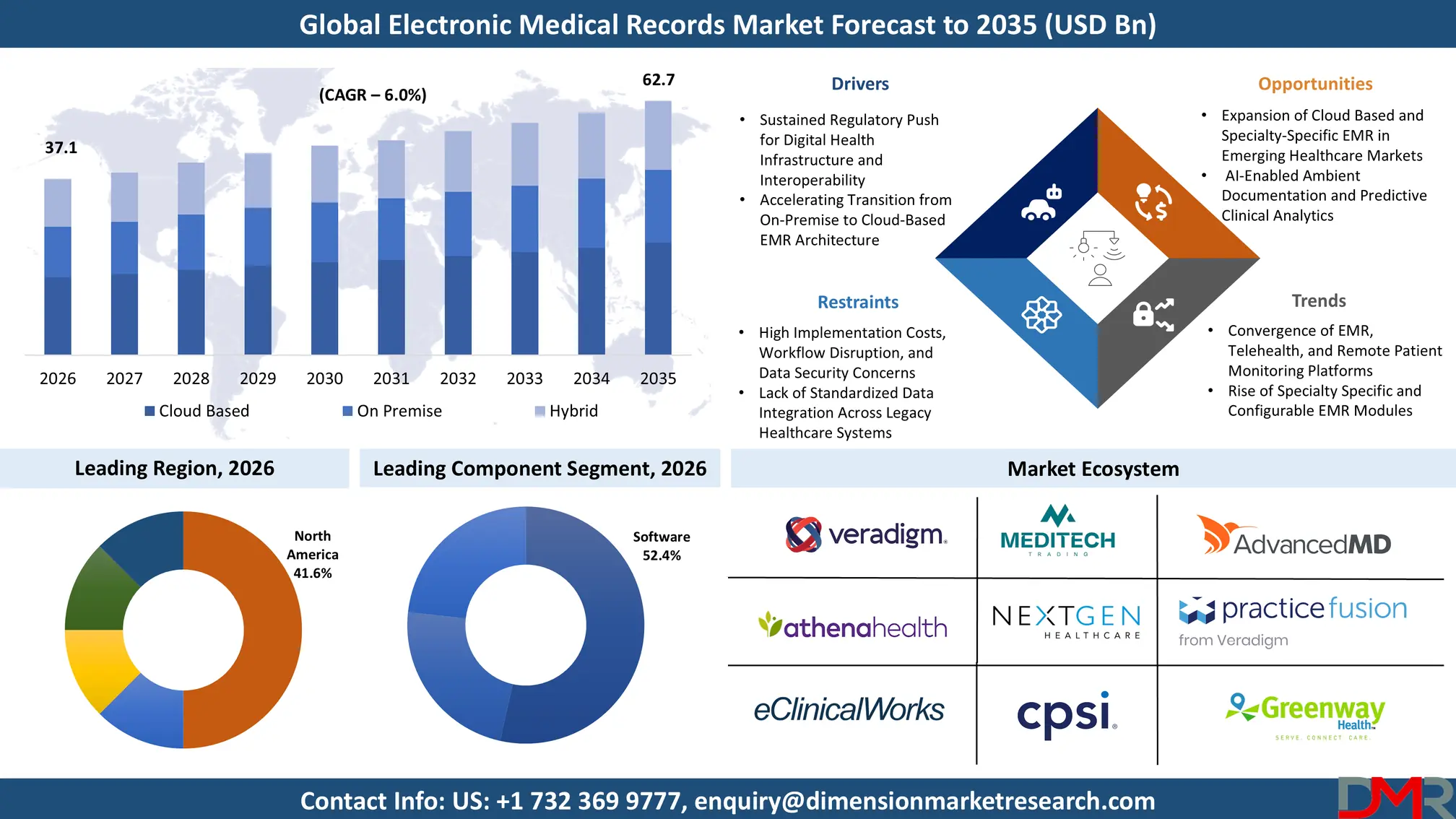
- Global Electronic Medical Records Market Size in 2026: USD 37.1 Billion
- Global Electronic Medical Records Market Size in 2035: USD 62.7 Billion
- Global CAGR from 2026 to 2035: 6.0%
- Software is the leading component segment in 2026: 52.4%
- General EMR is the leading EMR type segment in 2026: 63.7%
- Cloud Based is the leading deployment model segment in 2026: 56.8%
- Hospitals is the leading end user segment in 2026: 46.3%
- North America is the leading region in 2026: 41.6%
What is the Global Electronic Medical Records and its Market Size?
The Global Electronic Medical Records (EMR) Market is projected to be valued at USD 37.1 billion in 2026 and is projected to reach USD 62.7 billion by 2035, expanding at a CAGR of 6.0% during the forecast period. Growth is being propelled by the accelerating global shift from paper-based and legacy clinical documentation toward digitized, interoperable electronic health record (EHR) ecosystems, alongside sustained government mandates for health information technology adoption, meaningful-use style incentive programs, and rising demand for real-time clinical decision support at the point of care.
ℹ
To learn more about this report –
Download Your Free Sample Report Here
The proliferation of cloud-based EMR/EHR platforms, growing adoption of specialty-specific clinical workflows, and increasing integration of artificial intelligence-powered documentation, ambient clinical intelligence, and predictive analytics are reshaping how hospitals, physician offices, and ambulatory care networks capture, store, and exchange patient health information. Investment is accelerating as health systems pivot from siloed, on-premise recordkeeping toward unified, interoperable digital health infrastructure designed to support value-based care, population health management, and cross-continuum data exchange.
Use Cases
- Clinical Documentation and Point-of-Care Decision Support: Hospitals, physician offices, and ambulatory clinics deploy EMR/EHR software with integrated clinical decision support (CDS) engines, e-prescribing modules, and structured templates to streamline charting, reduce documentation burden, and flag drug interactions or care gaps in real time.
- Interoperability and Health Information Exchange (HIE): Health systems leverage EMR platforms built on FHIR-based application programming interfaces to enable secure, standardized clinical data exchange across hospitals, laboratories, diagnostic imaging centers, and payer networks, supporting continuity of care and reducing duplicate testing.
- Population Health Management and Value-Based Care Reporting: Accountable care organizations and integrated delivery networks utilize EMR-embedded analytics dashboards to stratify patient risk, track quality measures, and automate regulatory and value-based reimbursement reporting.
- Remote Patient Monitoring and Telehealth Integration: Ambulatory care centers and specialty practices connect EMR systems with telehealth platforms and remote patient monitoring devices, allowing vitals, symptom logs, and chronic disease data to flow directly into the patient's longitudinal clinical record.
Key Takeaways
- Market Size: The Global Electronic Medical Records Market is anticipated to be valued at USD 37.1 billion in 2026 and is forecast to reach USD 62.7 billion by 2035, expanding at a CAGR of 6.0%.
- Growth Outlook: Market expansion is sustained by continued digitization of clinical workflows, national interoperability mandates, migration toward cloud-native architectures, and the integration of AI-enabled ambient documentation and clinical analytics tools.
- Primary Growth Drivers: Regulatory push for standardized health information exchange, expanding adoption of value-based and accountable care models, rising demand for specialty-specific clinical workflows, and increasing investment in digital health infrastructure across both developed and emerging markets are accelerating vendor and provider investment.
- By Component Analysis: Software is projected to lead the component segment with a dominant 52.4% share in 2026, driven by sustained demand for clinical EMR, practice management, and patient portal modules, while Services is expected to register the highest CAGR at 10.8% as providers increasingly outsource implementation, training, and ongoing support and maintenance.
- By EMR Type Analysis: General EMR is expected to dominate with a 63.7% share in 2026, reflecting its broad applicability across primary care and multi-specialty settings, while Specialty Specific EMR is anticipated to post the highest CAGR at 11.2% as niche disciplines such as oncology, behavioral health, and cardiology demand tailored clinical workflows.
- By Deployment Model Analysis: Cloud Based deployment is projected to lead with a 56.8% share in 2026 and is also expected to record the highest CAGR at 12.5% through 2035, underscoring an accelerating industry-wide migration away from legacy on-premise infrastructure toward scalable, subscription-based SaaS EMR delivery.
- By End User Analysis: Hospitals are expected to lead the end user segment with a 46.3% share in 2026 given their complex, high-volume clinical documentation needs, while Physician Offices and Clinics are projected to be the fastest-growing end-user segment at a 10.6% CAGR, supported by rising outpatient care volumes and affordable cloud-based EMR subscription models.
How AI/Gen AI is Transforming the Electronic Medical Records Market?
Artificial intelligence and generative AI technologies are fundamentally reshaping the EMR landscape by reducing clinician documentation burden, improving data structuring, and enabling predictive, insight-driven care. Ambient AI scribe technology, embedded directly within EMR interfaces, is converting patient-clinician conversations into structured clinical notes in real time, materially reducing after-hours "pajama time" charting and clinician burnout. Natural language processing engines are increasingly used to extract structured data from unstructured clinical notes, discharge summaries, and scanned documents, enriching the EMR with computable data that fuels downstream analytics. Generative AI copilots embedded in clinical EMR modules are assisting providers with differential diagnosis support, automated coding suggestions, prior-authorization drafting, and patient-facing after-visit summaries.
Key Drivers in the Global Electronic Medical Records Market
Sustained Regulatory Push for Digital Health Infrastructure and Interoperability
Governments and health authorities worldwide continue to mandate the adoption of certified electronic health record systems and standardized data-exchange protocols. Regulatory frameworks emphasizing interoperability, patient data access, and information blocking prevention are compelling hospitals, physician offices, and ambulatory networks to upgrade legacy systems to certified, interoperable EMR platforms. As national digital health strategies mature across North America, Europe, and Asia Pacific, the downstream demand for compliant EMR software, implementation services, and health information exchange capability intensifies commensurately, directly fueling growth of the Software and Services components highlighted in this study.
Accelerating Transition from On-Premise to Cloud-Based EMR Architecture
Cloud-native EMR platforms offer lower upfront capital expenditure, faster deployment timelines, automatic regulatory and security updates, and seamless scalability compared with legacy on-premise systems. Health systems of all sizes, from large hospital networks to independent physician offices, are migrating toward subscription-based, cloud-hosted EMR solutions that support remote access, telehealth integration, and simplified multi-site data consolidation. This structural shift is reinforcing Cloud Based deployment's position as both the leading and fastest-growing deployment model segment, as vendors increasingly prioritize SaaS-first product roadmaps over traditional on-premise licensing.
Restraints in the Global Electronic Medical Records Market
High Implementation Costs, Workflow Disruption, and Data Security Concerns
Despite long-term efficiency gains, EMR implementation and system migration require substantial upfront investment in software licensing, hardware upgrades, staff training, and workflow redesign, particularly burdensome for smaller independent physician practices and resource-constrained health systems in emerging markets. Clinician resistance to workflow disruption during go-live periods, along with persistent concerns over cybersecurity vulnerabilities, ransomware attacks, and protected health information breaches, continues to slow adoption in certain segments and geographies, creating sustained pressure on IT budgets and compliance functions.
Growth Opportunities in the Global Electronic Medical Records Market
Expansion of Cloud-Based and Specialty-Specific EMR in Emerging Healthcare Markets
The global shift toward affordable, cloud-hosted EMR subscription models represents a high-growth opportunity for vendors targeting ambulatory care centers, independent physician offices, and diagnostic and imaging centers in emerging economies where legacy digital health infrastructure remains limited. Simultaneously, growing clinical demand for specialty-tailored workflows in disciplines such as oncology, behavioral health, dermatology, and cardiology is creating fertile ground for niche EMR vendors that can embed discipline-specific templates, order sets, and outcome-tracking tools. Vendors that combine low-cost cloud delivery with configurable specialty modules and integrated AI-driven documentation tools are positioned to capture a disproportionate share of the fastest-growing EMR Type and Deployment Model segments identified in this study.
AI-Enabled Ambient Documentation and Predictive Clinical Analytics
Emerging ambient AI scribe tools, natural language processing-driven coding assistance, and predictive risk-stratification analytics embedded directly within EMR platforms are unlocking a premium, higher-margin software and services opportunity. Vendors that successfully integrate validated, clinically safe generative AI copilots into core EMR workflows, supporting documentation, coding accuracy, and proactive population health outreach, stand to differentiate their platforms and accelerate upsell within existing hospital and physician office customer bases.
Trends in the Global Electronic Medical Records Market
Convergence of EMR, Telehealth, and Remote Patient Monitoring Platforms
A defining trend is the dissolution of silos between core clinical documentation systems and adjacent digital health tools such as telehealth video platforms, remote patient monitoring devices, and patient engagement portals. Vendors are increasingly building or acquiring integrated digital front-door capabilities so that virtual visit notes, device-generated vitals, and patient-reported outcomes flow directly into the unified EMR record, reducing data fragmentation and enhancing longitudinal care visibility across hospitals, ambulatory care centers, and physician offices.
Rise of Specialty-Specific and Configurable EMR Modules
Health systems and independent specialty practices are increasingly moving away from generic, one-size-fits-all clinical documentation systems toward configurable, specialty-tailored EMR modules purpose-built for disciplines such as oncology, orthopedics, behavioral health, and nephrology. This trend is commercializing rapidly as EMR vendors expand modular marketplaces and low-code configuration tools, allowing practices to tailor templates, order sets, and quality-reporting workflows without costly custom development, a dynamic reflected in the above-average projected CAGR for the Specialty Specific EMR segment.
Research Scope and Analysis
The Global Electronic Medical Records Market is segmented by component, EMR type, deployment model, and end user. Component coverage spans hardware, software, and services; EMR type covers general and specialty-specific systems; deployment model covers cloud-based, on-premise, and hybrid architectures; and end users include hospitals, physician offices and clinics, ambulatory care centers, diagnostic and imaging centers, and other care settings.
ℹ
To learn more about this report –
Download Your Free Sample Report Here
By Component Analysis
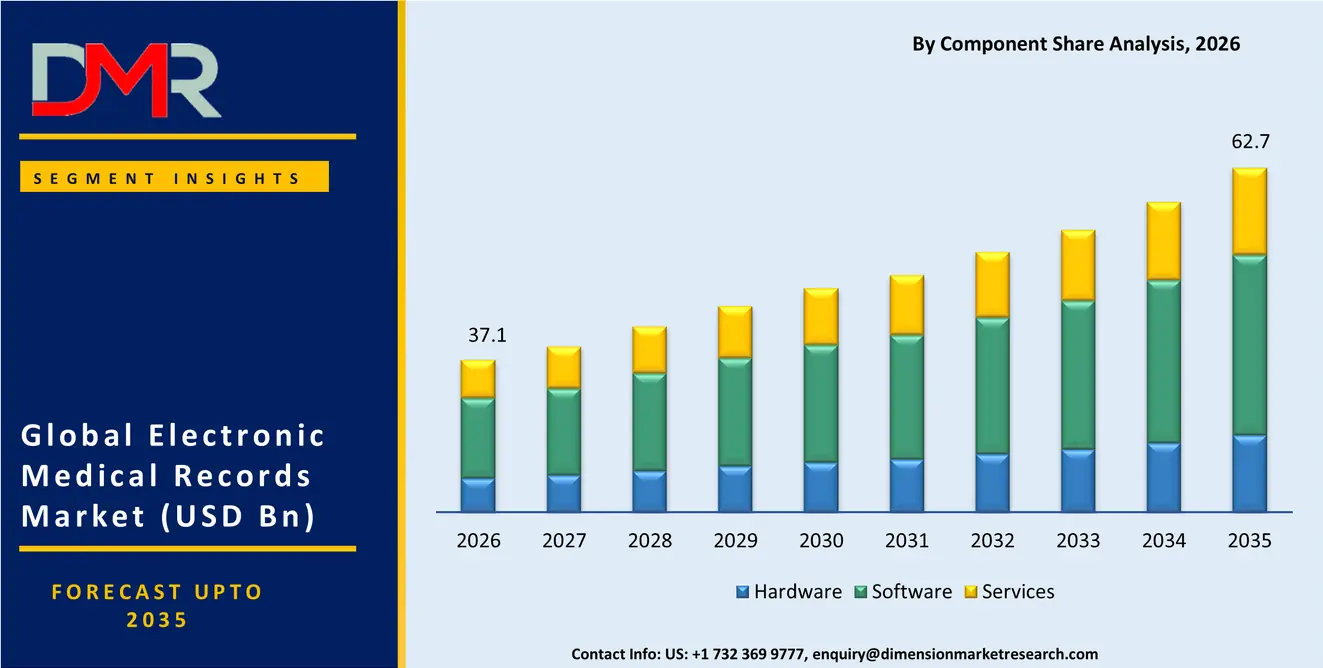
Software is poised to represent the dominant component segment, accounting for an estimated 52.4% share in 2026. Clinical EMR, practice management, and patient portal software modules form the technological core of digital clinical documentation, sustaining high recurring licensing and subscription revenue across hospitals, physician offices, and ambulatory networks.
ℹ
To learn more about this report –
Download Your Free Sample Report Here
Services is projected to register the highest CAGR of 10.8% during 2026-2035, as providers increasingly rely on third-party implementation, staff training, and ongoing technical support and maintenance partners to manage complex system upgrades and interoperability integrations.
By EMR Type Analysis
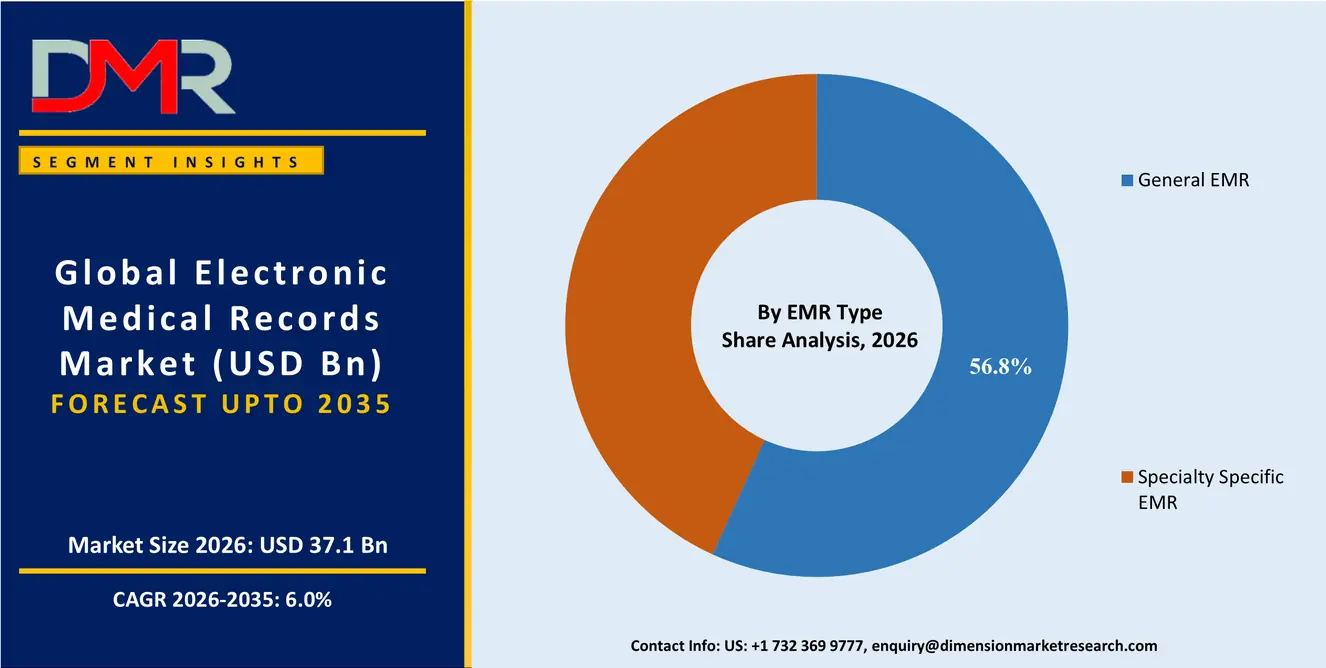
General EMR is expected to dominate the EMR type segment, holding an estimated 63.7% share in 2026, reflecting its broad deployment across primary care, multi-specialty group practices, and general hospital settings where standardized clinical workflows suffice. Specialty Specific EMR is expected to achieve the highest CAGR of 11.2% during 2026-2035, propelled by rising demand from oncology, behavioral health, cardiology, and other discipline-specific practices for tailored documentation templates and specialty order sets.
By Deployment Model Analysis
Cloud Based deployment is anticipated to lead the segment with an estimated 56.8% share in 2026 and is simultaneously projected to post the highest CAGR of 12.5% through 2035. This dual leadership underscores an industry-wide structural migration away from on-premise infrastructure toward scalable, subscription-priced, remotely accessible EMR delivery models that lower total cost of ownership and simplify regulatory compliance and cybersecurity management.
By End User Analysis
Hospitals is expected to dominate the end user segment, accounting for an estimated 46.3% share in 2026, given their high patient volumes, complex multi-department documentation needs, and long-standing investment in enterprise-grade clinical information systems. Physician Offices and Clinics are expected to grow at the highest CAGR of 10.6% during 2026-2035, driven by increasing outpatient care delivery, rising availability of affordable cloud-based EMR subscriptions, and continued regulatory incentives supporting small-practice digitization.
The Global Electronic Medical Records Market Report is segmented based on the following:
By Component
- Hardware
- Servers
- Workstations
- Mobile Devices
- Software
- Clinical EMR
- Practice Management
- Patient Portal
- Services
- Implementation
- Training
- Support and Maintenance
By EMR Type
- General EMR
- Specialty Specific EMR
By Deployment Model
- Cloud Based
- On Premise
- Hybrid
By End User
- Hospitals
- Physician Offices and Clinics
- Ambulatory Care Centers
- Diagnostic and Imaging Centers
- Others
Regional Analysis
North America is the Leading Region in the Global Electronic Medical Records Market
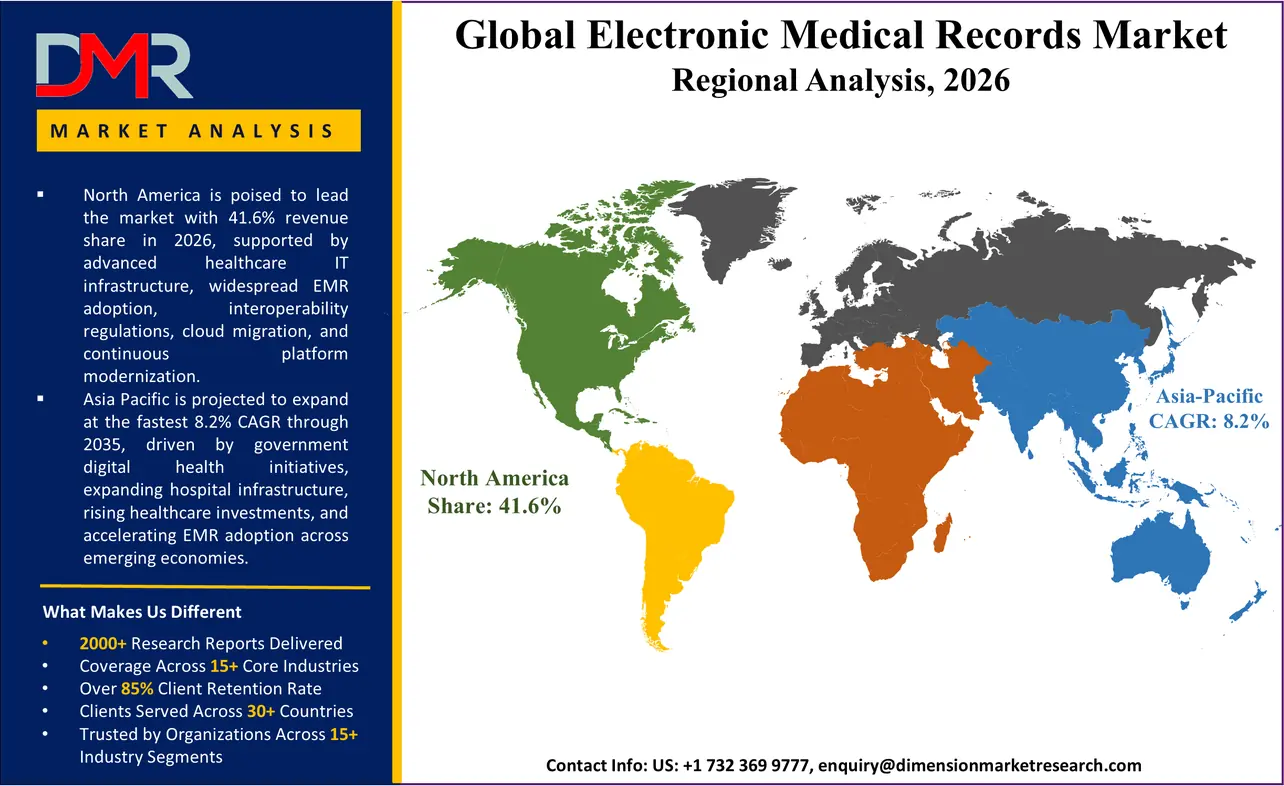
North America is poised to lead the Global EMR Market with an estimated 41.6% revenue share in 2026. The region's dominance is anchored by mature health information technology infrastructure, near-universal EMR penetration among hospitals and large physician groups, and strong regulatory emphasis on interoperability and information-blocking prevention. The United States, in particular, is characterized by continued upgrade cycles among hospital systems replacing legacy platforms, rapid adoption of cloud-based and AI-augmented documentation tools, and a highly consolidated vendor landscape led by a handful of dominant enterprise EMR suppliers.
ℹ
To learn more about this report –
Download Your Free Sample Report Here
Asia Pacific is the Fastest-Growing Region in the Global Electronic Medical Records Market
Asia Pacific is projected to register the fastest CAGR through 2035, driven by large-scale government-led digital health modernization programs across China, India, and Southeast Asia, expanding hospital infrastructure investment, and rising private-sector healthcare delivery capacity. National electronic health record initiatives and digital health identity programs are accelerating EMR adoption among previously underserved rural and secondary-tier hospitals and clinics, creating substantial headroom for both domestic and international vendors.
The Europe Electronic Medical Records Market
Europe represents one of the largest regional markets, characterized by publicly funded healthcare systems that are steadily consolidating fragmented national and regional EMR platforms toward standardized, interoperable digital health records. Germany and the United Kingdom hold significant regional market share, driven by large-scale national digital health transformation programs, strong government funding for hospital IT modernization, and growing emphasis on cross-border health data exchange under evolving European digital health regulations.
Latin America Electronic Medical Records Market
The Latin America EMR Market is expanding as public and private health systems in Brazil and Mexico invest in modernizing clinical documentation infrastructure to improve care coordination and reduce administrative inefficiency. Brazil's expanding public health system digitization initiatives and Mexico's growing private hospital and clinic network investment are key national growth engines within the region.
Middle East and Africa Electronic Medical Records Market
The Middle East and Africa EMR Market is developing against a backdrop of ambitious national digital health transformation agendas in Gulf Cooperation Council (GCC) countries and gradually improving healthcare IT infrastructure across parts of sub-Saharan Africa. Saudi Arabia and the United Arab Emirates are the most attractive markets, supported by substantial government healthcare IT spending, unified national EMR and health information exchange initiatives, and active public-private digital health partnerships.
Major Countries Analysis
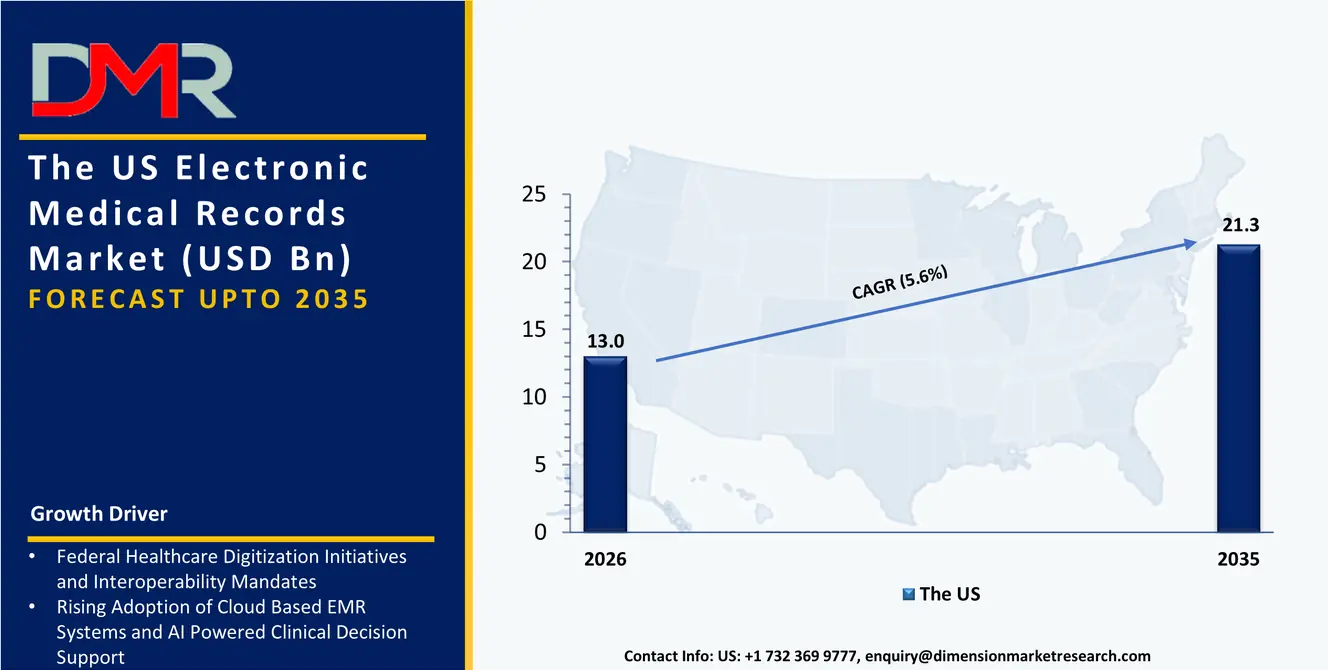
The US Electronic Medical Records Market
The United States EMR Market represents the highest-value single-country market globally, underpinned by near-complete hospital EMR adoption and continued modernization spending among physician offices and ambulatory care networks. Growth is fueled by ongoing regulatory emphasis on interoperability and patient data access, rapid formulary-style adoption of AI-powered ambient documentation tools, and sustained consolidation among enterprise EMR vendors serving large integrated delivery networks.
ℹ
To learn more about this report –
Download Your Free Sample Report Here
Japan Electronic Medical Records Market
Japan is characterized by a highly organized hospital sector with strong government-directed digital health modernization initiatives, sustained by an aging population that places growing administrative demands on clinical documentation systems. The market is distinguished by high utilization of hospital-based EMR systems relative to smaller clinics, alongside gradual national efforts to standardize health information exchange across regional healthcare networks.
Saudi Arabia Electronic Medical Records Market
Market expansion is directly tied to the Kingdom's Vision 2030 healthcare transformation agenda, which emphasizes unified national electronic health record infrastructure, digital hospital modernization, and public-private partnerships. The Ministry of Health's continued investment in nationwide health information exchange platforms and expanding private hospital digitization is opening significant opportunities for international EMR vendors, cloud infrastructure providers, and AI-driven clinical documentation platforms.
Regulatory Landscape
The regulatory landscape for electronic medical records software and services is shaped by agencies that balance interoperability mandates, patient data privacy protection, and certification standards for clinical information systems. In the United States, health IT certification requirements administered under national coordinator frameworks continue to drive standardized data exchange, patient access application programming interfaces, and information-blocking prevention among certified EMR vendors. Across Europe, evolving digital health and data protection regulations are pushing vendors toward standardized, cross-border interoperable health record architectures, while national health authorities across Asia Pacific and the Middle East are increasingly mandating certified EMR adoption as a condition of hospital licensing and public healthcare reimbursement.
EMR Adoption and Utilization Landscape
Hospital-level EMR adoption remains near-saturated across North America and much of Western Europe, with the majority of incremental market growth now driven by system replacement, module expansion, and cloud migration rather than first-time digitization. Physician office and ambulatory clinic EMR adoption continues to lag hospital-level penetration in several emerging markets, representing substantial untapped addressable demand for affordable, cloud-based subscription EMR platforms. Health information exchange activity, measured by volume of standardized clinical data transactions between certified EMR systems, continues to expand as interoperability mandates mature and application programming interface-based data sharing becomes the industry norm. Specialty-specific EMR utilization is rising steadily as oncology, behavioral health, and cardiology practices increasingly move away from generalized documentation templates toward discipline-tailored clinical workflows.
By Region
North America
Europe
- Germany
- France
- The U.K.
- Italy
- Spain
- Rest of Europe
Asia-Pacific
- China
- Japan
- India
- Australia
- South Korea
- Rest of APAC
Latin America
- Mexico
- Brazil
- Rest of LATAM
Middle East & Africa
- Saudi Arabia
- The UAE
- South Africa
- Rest of MEA
Competitive Landscape
The Global EMR Market features a diverse competitive landscape spanning large enterprise health IT vendors, cloud-native EMR challengers, specialty-focused software providers, and health information exchange technology firms. Established enterprise vendors dominate large hospital and integrated delivery network deployments through comprehensive, highly configurable clinical and financial platforms, while cloud-native and specialty-focused vendors are gaining share among independent physician offices, ambulatory care centers, and niche clinical disciplines by offering faster implementation timelines, lower total cost of ownership, and discipline-specific workflow templates.
Some of the prominent players in the Global Electronic Medical Records Market are:
- Oracle Health (Cerner)
- Epic Systems Corporation
- Veradigm (Allscripts Healthcare Solutions)
- MEDITECH
- NextGen Healthcare
- eClinicalWorks
- Athenahealth
- Greenway Health
- CPSI
- AdvancedMD
- Practice Fusion
- CureMD
- DrChrono
- Amazing Charts
- Netsmart Technologies
- Altera Digital Health
- GE HealthCare
- CompuGroup Medical
- Dedalus Group
- InterSystems Corporation
- NXGN Management, LLC
- Tebra
- Azalea Health
- CareCloud
- Kareo
- Evident
- MEDHOST
- Intersystems TrakCare
- WRS Health
- Modernizing Medicine
- TELUS Health
- Oracle Health CommunityWorks
- MicroMD
- MacPractice
- RXNT
- Advanced Data Systems (ADS)
- Harmony Healthcare IT
- WellSky
- ELLKAY
- Fujitsu Limited
- Other Key Players
Recent Developments
- May 2026: MEDITECH strengthened its position in the acute care EMR market as healthcare organizations continued adopting MEDITECH Expanse, while KLAS recognized the company as one of the leading global hospital EHR vendors amid ongoing market consolidation.
- April 2026: Epic Systems announced the return of Open@Epic 2026, expanding its interoperability ecosystem and accelerating secure API-based healthcare data sharing across connected applications.
- August 2025: Oracle Health launched its next-generation AI-powered Electronic Health Record (EHR) platform for U.S. ambulatory providers, featuring voice-first workflows, conversational AI, and cloud-native architecture to improve clinical efficiency.
- March 2025: InterSystems introduced IntelliCare, an AI-enabled EHR platform with ambient listening, natural language documentation, and interoperability capabilities at HIMSS 2025, strengthening its intelligent EMR portfolio.
Report Details
| Report Characteristics |
| Market Size (2026) |
USD 37.1 Bn |
| Forecast Value (2035) |
USD 62.7 Bn |
| CAGR (2026–2035) |
6.0% |
| The US Market Size (2026) |
USD 13.0 Bn |
| Historical Data |
2021 – 2025 |
| Forecast Data |
2027 – 2035 |
| Base Year |
2025 |
| Estimate Year |
2026 |
| Segments Covered |
By Component, By EMR Type, By Deployment Model, and By End User |
| Regional Coverage |
North America – The US and Canada; Europe – Germany, France, The UK, Italy, Spain, Rest of Europe; Asia-Pacific – China, Japan, India, Australia, South Korea, Rest of APAC; Latin America – Mexico, Brazil, Colombia, Argentina, Rest of LATAM; Middle East & Africa – Saudi Arabia, The UAE, South Africa, Rest of MEA |
Frequently Asked Questions
How big is the Global Electronic Medical Records Market?
▾ The Global Electronic Medical Records Market is valued at USD 37.1 billion in 2026 and is projected to reach USD 62.7 billion by 2035, reflecting strong global demand for clinical documentation software, interoperability services, and digital health infrastructure.
What is the CAGR of the Global EMR Market from 2026 to 2035?
▾ The market is projected to expand at a compound annual growth rate (CAGR) of 6.0% between 2026 and 2035, supported by continued digitization of clinical workflows, cloud migration, and AI-enabled documentation adoption.
What factors are driving the growth of the Global EMR Market?
▾ Growth is driven by sustained regulatory emphasis on interoperability, the accelerating shift from on-premise to cloud-based deployment, rising demand for specialty-specific clinical workflows, and growing integration of AI-powered ambient documentation and predictive analytics tools.
What are the major trends in the Global EMR Market?
▾ Major trends include the convergence of EMR, telehealth, and remote patient monitoring platforms, the rise of configurable specialty-specific EMR modules, accelerating cloud migration, and expanding use of generative AI for clinical documentation and coding support.
Which region held the largest share of the Global EMR Market in 2026?
▾ North America is expected to lead the global market with a 41.6% share in 2026, supported by mature health IT infrastructure, near-saturated hospital EMR adoption, and early adoption of AI-augmented documentation tools.
Which region is expected to grow the fastest in the Global EMR Market?
▾ Asia Pacific is expected to record the fastest growth through 2035, driven by large-scale government-led digital health modernization programs and expanding hospital and clinic infrastructure investment.
Who are the key players in the Global EMR Market?
▾ Key market participants include Epic Systems, Oracle Health, Veradigm, athenahealth, MEDITECH, NextGen Healthcare, eClinicalWorks, GE HealthCare, Philips, InterSystems, and Optum, among other health IT, cloud infrastructure, and digital health firms.
How is the Global EMR Market segmented?
▾ The market is segmented by component, EMR type, deployment model, and end user, with regional analysis covering North America, Europe, Asia Pacific, Latin America, and the Middle East and Africa.