Global Employee Surveillance Monitoring Software Market Snapshot
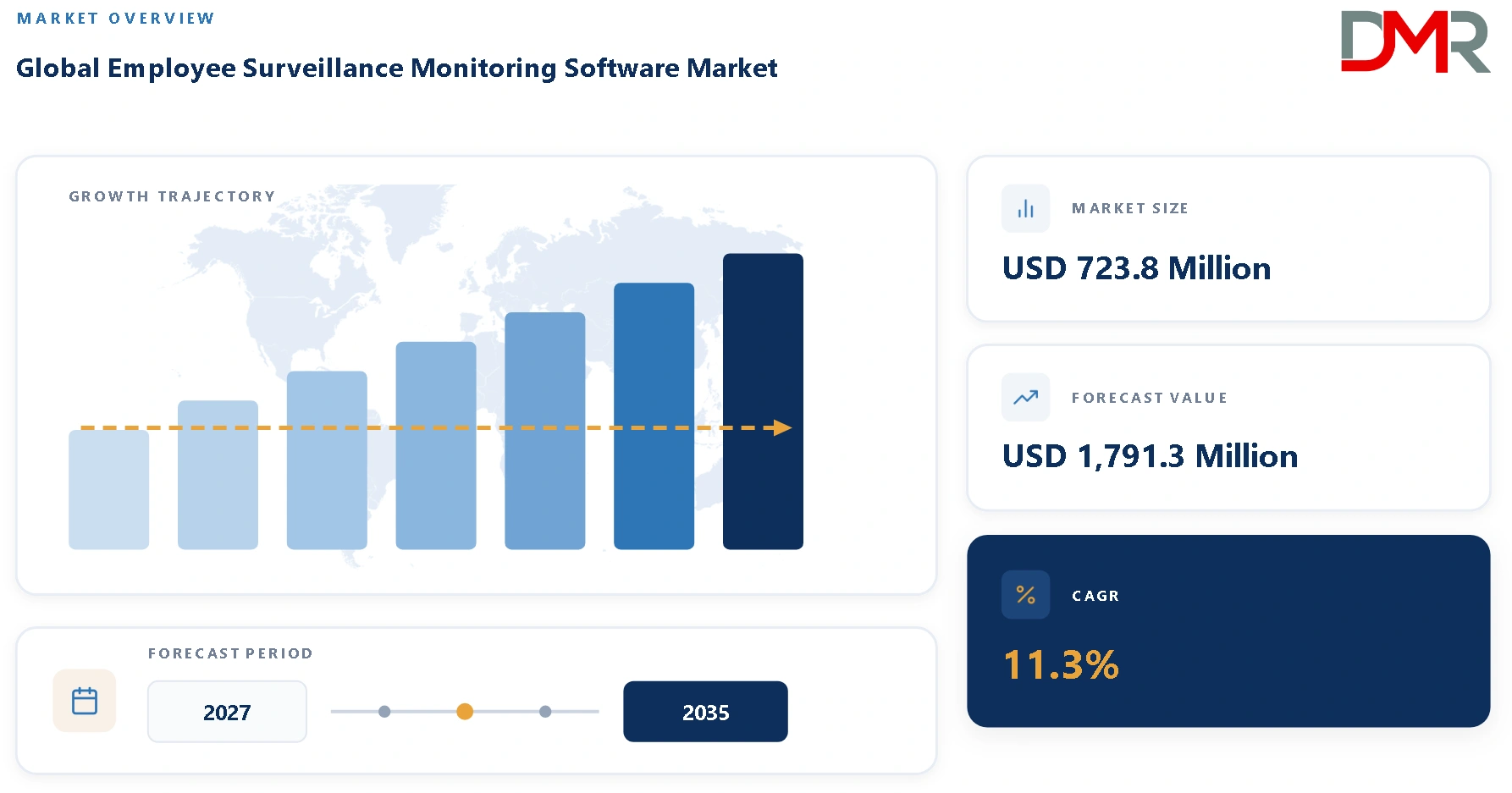
- Global Employee Surveillance Monitoring Software Market Size in 2026: USD 723.8 million
- Global Employee Surveillance Monitoring Software Market Size in 2035: USD 1,791.3 million
- Global CAGR from 2027 to 2035: 11.3%
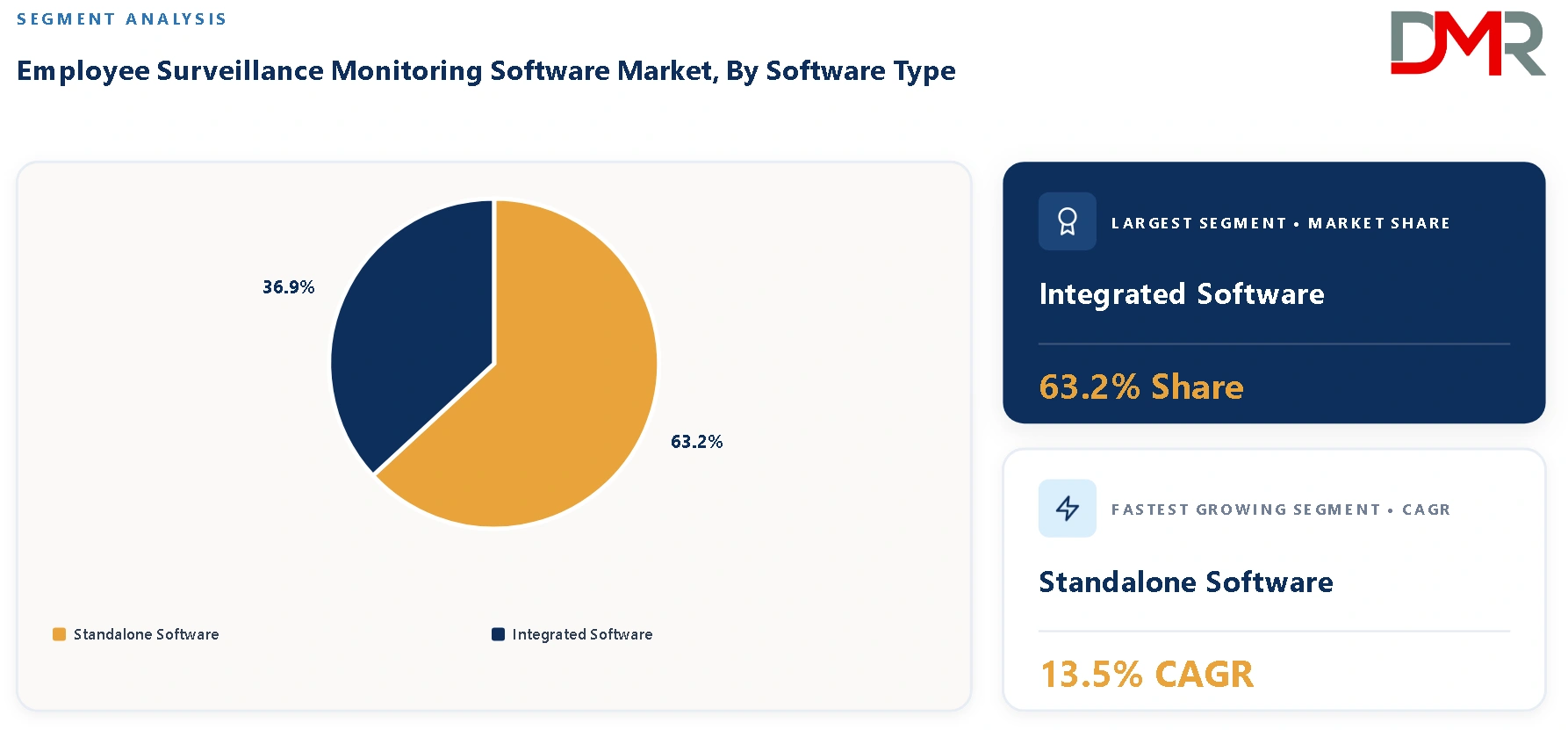
- Integrated Software are the leading Software Type segment in 2026: 63.2%
- Cloud-Based is the leading Deployment Mode segment in 2026: 66.0%
- Standalone Software is the fastest-growing Software Type segment: 13.5% CAGR
- Cloud-Based is the fastest-growing Deployment Mode segment: 13.1% CAGR
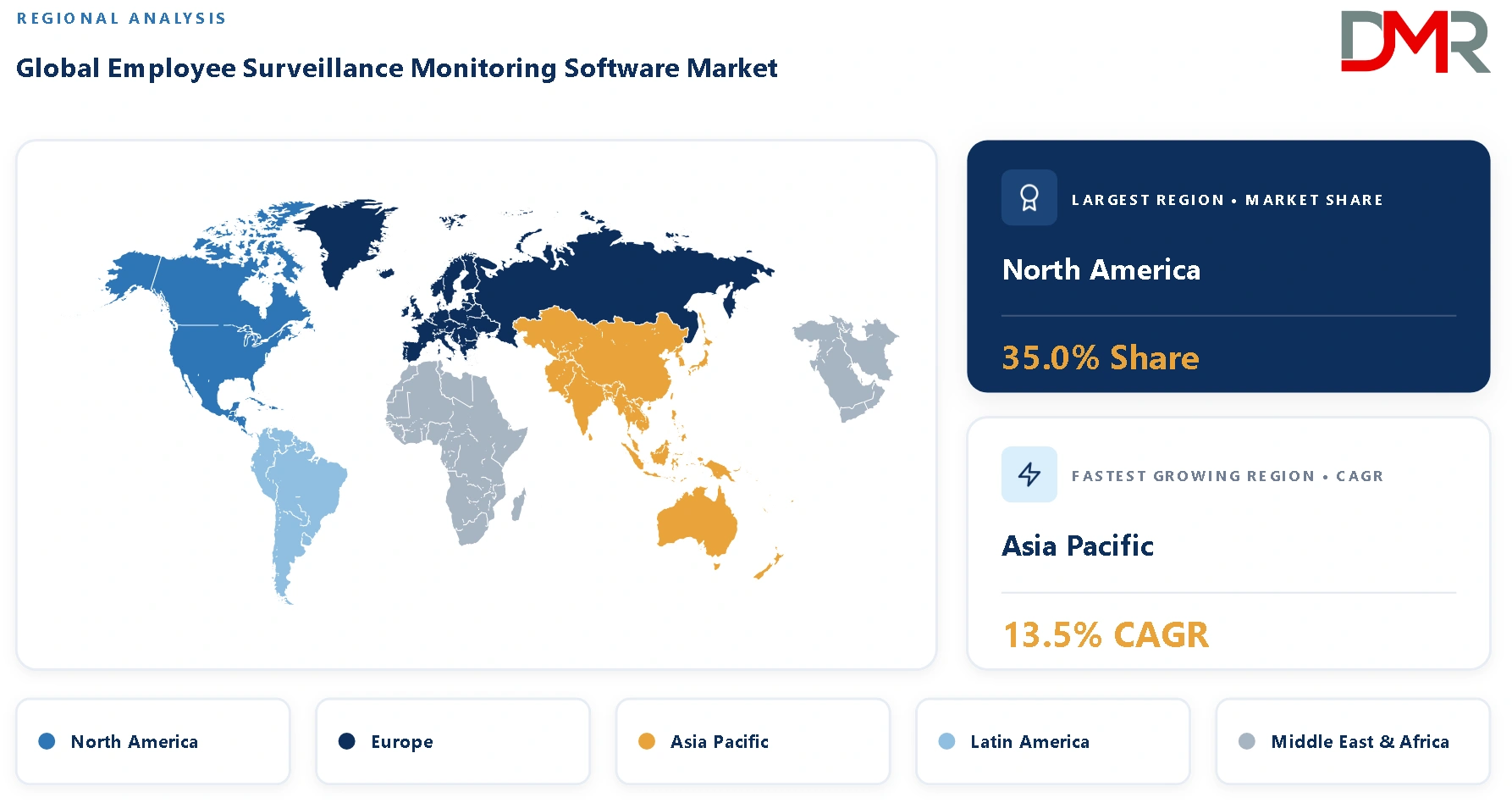
- North America is the leading Region in 2026: 35.0%
- Asia Pacific is the fastest-growing Region: 13.5% CAGR
What is the Global Employee Surveillance Monitoring Software and its Market Size?
The Global Employee Surveillance Monitoring Software Market size is projected to be valued at USD 723.8 million in 2026, and it is further anticipated to reach a market value of USD 1,791.3 million by 2035 at a CAGR of 11.3%.
ℹ
To learn more about this report –
Download Your Free Sample Report Here
The Global Employee Surveillance Monitoring Software Market is based on software designed to monitor the work activities of employees, application usage, working hours and employee’s behavior online while running a business. These solutions are used for obtaining information on worker productivity, the control of working remotely, the detection of abnormalities and company information protection. Software is capable of monitoring application, website consumption, work time and company systems. Used across a number of industries such as IT, financial services, healthcare, manufacturing, retail and beyond, the tools help to improve employee's visibility and aid in the management of operations. Several factors are affecting market demand, such as the rise of remote and hybrid working, cyber security issues, Digital workplace platforms and improved Workforce Management. Solutions need to also comply with data protection regulations and guarantee the confidentiality and transparency of employees.
Use Cases
- Remote Employee Monitoring: Companies use employee monitoring software to know how long remote workers are working, what apps they are using, and what type of activities they are engaging in. These tools facilitate managers to assess work patterns and manage dispersed teams while not asking employees to travel to a physical office.
- Workforce Productivity Management: Companies can use monitoring software to gain insight into how their workforce utilizes time on specific work applications, websites, and tasks. The systems can be used to detect workflow issues, inspect workload distribution and facilitate improved workforce planning.
- Monitoring of employees: Activity on the system identifies suspicious activities, such as unusual access patterns, unauthorized file transfers, or any potential misuse of company information. These tools can help security teams analyze suspicious activity, and keep sensitive business data safe.
- Time and Attendance Tracking: Companies track the working time of employees, attendance, breaks, and the time spent on projects with employee monitoring software. This information is used for workforce scheduling, payroll preparation, project management and service billing.
Key Takeaways
- Global Market Value: The Global Employee Surveillance Monitoring Software Market is generating a revenue of USD 723.8 million in 2026 and which is further anticipated to reach USD 1,791.3 million by 2035.
- Global Growth Rate: The Global Employee Surveillance Monitoring Software Market is expected to have a CAGR of 11.3% during the forecast period from 2027 to 2035.
- Technology Trends: Increasing use of AI-based workforce analytics, automated activity classification, behavior monitoring, and cloud-based reporting is supporting the development of employee monitoring software.
- Market Drivers: Factors supporting market growth include increasing remote and hybrid work arrangements, rising demand for workforce productivity monitoring, growing cybersecurity concerns, and the need for better visibility into digital work activities.
- Software Type Segment Analysis: The Integrated Software segment is anticipated to be the largest product segment, having a market share of 63.2% by the end of 2026. Whereas the Standalone Software segment is expected to be the fastest-growing segment with a CAGR of 13.5% from 2027 to 2035.
- Deployment Mode Segment Analysis: The Cloud-Based is the major deployment mode segment, representing the highest market share of 66.0% in 2026, while the cloud-based segment is projected to have the highest growth rate with a CAGR of 13.1% during the forecast period.
- Regional Analysis: The North America region is poised to hold the largest market share of 35.0% in the global market in 2026. The Asia Pacific region is expected to be the fastest-growing region with a CAGR of 13.5% during the forecast period.
How AI/Gen AI is Transforming the Employee Surveillance Monitoring Software Market?
The artificial intelligence (AI) and generative artificial intelligence (Gen AI) are driving the market for employee surveillance monitoring software. AI-powered tools can sift through employee activity logs, application usage, working times and digital interactions to gain insights into workforce productivity. The tools can detect odd behavior, patterns and potential security threats. AI can also shed light on workload distribution and pinpoint additional support needed by employees. Gen AI can enable users to use conversational interfaces to ask questions about workforce information, and automatically create summaries without having to prepare the detailed reports in advance. Some software companies are adding AI-driven insights to help companies gain a better understanding of productivity, process efficiency, and employee usage of AI applications. The technologies can advance workforce analysis; however organizations must be careful in applying these technologies as there may be sensitive employee data in the monitoring data.
Key Drivers in the Global Employee Surveillance Monitoring Software Market
Market Drivers
Increasing Adoption of Remote and Hybrid Work
As remote and hybrid work becomes more common, demand for employee surveillance monitoring software is growing. It is often important to organisations who have employees located in multiple places to be able to know how much an employee works, their application usage and their activities around a task. Employee monitoring software enables managers to keep an eye on employees work habits and manage teams at a distance without having to be around them all the time. These solutions are also employed by businesses to keep track of the project timeline, identify issues in the workload, and ensure visibility in distributed operations. Digital workforce monitoring solutions are used by companies in various industries, including IT services, consulting, customer support, and business process outsourcing (BPO). Sustainable flexible working arrangements sustain a demand for cloud-based monitoring and workforce analytics solutions.
Growing Need for Data Security and Employee Activity Monitoring
Unauthorized access leakage of sensitive data misuse of business systems is some of the issues that are becoming more and more a cause of concern for organizations. By tracking user activity, employee monitoring software can flag unusual behavior, suspicious file activity, and potential insider threats, assisting security teams. Where an enterprise has sensitive information, such as financial, customer records, IP, and confidential company documents, there needs to be effective controls in place over digital activities. Monitoring systems can generate activity records and notifications to aid in investigations and security audits. The increased adoption of cloud applications, remote access and digital collaboration tools drives the demand for visibility of employee interactions with business systems. These needs drive the need for user behavior analytics and security-related features in monitoring software.
Market Restraints
Employee Privacy and Data Protection Concerns
The monitoring tools can record the application's use, screenshots, working hours and digital activities. Excessive monitoring or lack of clarity about what information is being collected may make employees uncomfortable. Prior to implementing such systems, business must also abide by the relevant privacy and employment laws. The complexity of implementation can be increased due to legal requirements on transparency, monitoring purposes, data retention, and employee rights. These worries could be a barrier to the use of intrusive monitoring tools.
Employee Resistance and Implementation Challenges
Implementing employee monitoring software can be problematic if employees feel it impacts on trust and independence in the workplace. In case of uncommunicative policy implementation, some organizations might encounter opposition to the monitoring policy. It's not only software that needs to be set up properly; it's also the way the software is used by businesses, how managers use it, and what information is interpreted. Activity does not necessarily mean performance, especially in activities that include planning, meetings, research and creative tasks. Technical support may also be needed when incorporating the integration with existing IT systems and workforce management platforms. These could lead to higher implementation costs and impact software adoption.
Market Opportunities
Expansion of Cloud-Based Workforce Monitoring Solutions
Cloud-based business applications are growing in use, which is offering great opportunities for Employee Monitoring Software providers. Cloud deployment enables an organization to view information of its workforce, manage users, and check out reports in multiple offices. They can be helpful for remote and hybrid businesses in that they allow for the monitoring of information to be managed under centralized platforms. Software vendors can create flexible subscription models, integration possibilities, and privacy controls to cater to organizations of various sizes. Additionally, cloud technology that is growing in emerging markets provides opportunities for suppliers with low-cost monitoring solutions that are simple to deploy.
Development of Privacy-Focused Employee Monitoring Software
As employees' privacy becomes a growing concern, software vendors can now create employee monitoring software that offers more robust data protection capabilities. There is a need for systems within organizations that will allow for accountability measures to be transparent, data collection limited and access controls to be appropriate. Businesses can help eliminate the collection of unwanted data by using software to set up monitoring by job function and working hours. Additional features like data anonymization, controlled screenshots, reporting permissions and retention settings can also be useful for responsible workforce management. Businesses looking to monitor their workforce but avoid the issue of over-surveillance can be drawn to providers that provide privacy-focused monitoring and provide strong compliance documentation.
Market Trends
Increasing Use of AI-Based Workforce Analytics
AI-based workforce analytics is becoming an important trend in the employee surveillance monitoring software market. Software vendors rolling out solutions for analyzing patterns, application usage, employee activity and load balancing. These systems can assist businesses in knowing the variations in productivity and the way work is being conducted, across teams. AI-driven reporting can also help to streamline manual analysis by generating workforce data dashboards and summarizing data. These insights are helping organizations with staffing, workload planning and process improvement. But, even monitoring results still need to be reviewed by human beings and otherwise they may draw the wrong inference of employee performance.
Growing Demand for Integrated Monitoring and Security Platforms
There are indications that more organizations are interested in employee monitoring software that can integrate with other business applications, workforce management systems and cybersecurity platforms. Integrated solutions enable businesses to integrate working-hour information, application usage, and activity data, such as security-related activity, into larger business management processes. These systems will help to minimize the use of individual software programs and increase reporting consistency. Monitoring vendors are also working at enhancing integrations with cloud applications and analytics platforms. Providers are being driven to create solutions that offer flexibility in monitoring, reporting and administration, as emphasis on both workforce management and data security is increasing.
Research Scope and Analysis
On the basis of Software Type, the Global Employee Surveillance Monitoring Software Market is segmented into Standalone Software and Integrated Software. The market can be segmented on the basis of Deployment Mode as Cloud-Based and On-Premises. On the basis of Monitoring Type, the market includes Remote Employee Monitoring and On-Premises Employee Monitoring. By Application, the market includes Productivity Monitoring, Application and Website Monitoring, User Behavior Analytics, Insider Threat Detection, and Others. On the basis of Enterprise Size, the market includes Small and Medium Enterprises and Large Enterprises. By Industry Vertical, the market includes BFSI, IT and Telecommunications, Healthcare, Manufacturing, Retail and E-commerce, Government, and Others.
ℹ
To learn more about this report –
Download Your Free Sample Report Here
By Software Type
Integrated Software are projected to dominate the Software Type segment in the Employee Surveillance Monitoring Software Market as they are expected to hold 63.2% of the total market share in 2026. The dominance is caused by the increasing demand for centralized workforce management, growing integration with HR and cybersecurity systems, improved employee activity tracking, automated reporting capabilities, and rising adoption of comprehensive monitoring solutions across large enterprises. While Standalone Software are poised to have the highest CAGR of 13.5% during the forecast period (2027–2035) in the Software Type segment, driven by increasing demand for affordable monitoring solutions, growing adoption among small and medium enterprises, ease of installation, flexible software features, lower implementation costs, and increasing need for independent employee productivity tracking tools.
By Deployment Mode
Cloud-Based are projected to dominate the deployment mode segment in the Employee Surveillance Monitoring Software Market as they are expected to hold 66.0% of the total market share in 2026. The dominance is due to the increasing adoption of remote and hybrid work, growing demand for centralized employee monitoring, easy software deployment, lower infrastructure costs, real-time workforce tracking, and flexible access across multiple business locations. Also, cloud-based are poised to have the highest CAGR of 13.1% during the forecast period (2027–2035) in the deployment mode segment, driven the increasing demand for stronger data security, greater control over employee information, strict regulatory compliance requirements, reduced dependence on external servers, and growing preference for customized monitoring solutions among large enterprises.
By Monitoring Type
Remote Employee Monitoring is projected to dominate the monitoring type segment in the Employee Surveillance Monitoring Software Market as it is expected to hold 61.0% of the total market share in 2026. This dominance is driven by the increasing adoption of remote and hybrid work models, growing demand for workforce productivity tracking, enhanced employee accountability, real-time activity monitoring, and improved operational efficiency. Remote Employee Monitoring is poised to have the highest CAGR of 13.0% during the forecast period (2027–2035) in the Monitoring Type segment, driven by increasing demand for real-time workforce visibility, advanced productivity analytics, cloud-based monitoring solutions, employee performance optimization, and efficient management of geographically dispersed teams.
The Global Employee Surveillance Monitoring Software Market Report is segmented based on the following:
By Software Type
- Standalone Software
- Integrated Software
By Deployment Mode
By Monitoring Type
- Remote Employee Monitoring
- On-Premises Employee Monitoring
By Application
- Productivity Monitoring
- Application and Website Monitoring
- User Behavior Analytics
- Insider Threat Detection
- Others
By Enterprise Size
- Small and Medium Enterprises
- Large Enterprises
By Industry Vertical
- BFSI
- IT and Telecommunications
- Healthcare
- Manufacturing
- Retail and E-commerce
- Government
- Others
Regional Analysis
North America is the Leading Region in the Global Employee Surveillance Monitoring Software Market
The North America is expected to become the dominant force within the Global Employee Surveillance Monitoring Software Market as it will hold a market share of 35.0% in 2026. The dominance of the market is attributed to the widespread adoption of remote and hybrid work, growing demand for employee productivity monitoring, increasing cybersecurity concerns, advanced IT infrastructure, and the strong presence of employee monitoring software providers across the United States and Canada.
ℹ
To learn more about this report –
Download Your Free Sample Report Here
Asia Pacific is the Fastest-Growing Region in the Global Employee Surveillance Monitoring Software Market
Asia Pacific is expected to witness the fastest-growing regional market with a compound annual growth rate of 13.5% during the forecast period from 2027 to 2035, due to adoption of digital workplace technologies, expanding IT and outsourcing industries, rising remote and hybrid work arrangements, growing cybersecurity concerns, and increasing demand for affordable employee monitoring solutions across businesses.
Europe Employee Surveillance Monitoring Software Market
The Europe Employee Surveillance Monitoring Software Market is supported by the use of digital workforce management systems, cybersecurity tools, and remote working arrangements. The use of digital workforce management systems, cyber security control and remote working practices are all providing support to the Europe Employee Surveillance Monitoring Software Market. Companies in Germany, France, the United Kingdom, Italy and Spain are using software to monitor employee activity and safeguard company data. Employees' privacy concerns and data protection laws are also driving responsible monitoring practices. The General Data Protection Regulation (GDPR) Rules lay out the requirements on dealing with personal information and other national employment rules might set other monitoring restrictions. These are being seen as a way to drive organizations to turn to software with monitoring configurations, security access settings and data protection that is both clear and suitable. Accessibility for staff and privacy for workers is a factor that must be taken into account in choosing workforce visibility solutions for businesses.
Latin America Employee Surveillance Monitoring Software Market
The Latin America Employee Surveillance Monitoring Software Market is encouraged by the remote and hybrid working arrangements, digitalization, and growth of IT services. The relevant markets are Brazil, Mexico, Argentina, and Chile, where opportunities exist for the use of digital tools by organizations in workforce management and in the day-to-day functioning of their business. With employee monitoring software, companies can perform working hours tracking, app usage, and task-related activities analysis on a distributed workforce. For companies with limited IT resources and infrastructure, cloud-based solutions might be more appealing for providing cost-effective monitoring capabilities. As businesses become digitalized and the workforce management needs shift, with software pricing, and local data protection laws, the demand for it varies. The policies for monitoring and their implications must be clearly communicated to the members of the business.
Middle East and Africa (MEA) Employee Surveillance Monitoring Software Market
The Middle East and Africa Employee Surveillance Monitoring Software Market is supported by digital transformation initiatives, business technology investments, and the increasing use of cloud-based workplace applications. A growing number of workplace applications supported by the cloud and investments in business technology are bolstering the adoption of employee surveillance monitoring software in the Middle East and Africa (MEA) region. Other nations, including Saudi Arabia, the United Arab Emirates and South Africa, are related markets as various companies are applying digital workforce management solutions in numerous sectors. Employee monitoring software can assist companies in tracking hours of work, tracking their employees if work is conducted remotely, and monitoring digital activities. Financial organizations, companies with technology, and services providers can also employ monitoring tools to comply with their internal security conditions. There must be an investment in enterprise technology, the availability of affordable software applications, and pragmatic approaches to employee work arrangements and privacy laws. The flexibility and data protection capabilities of suppliers can meet specific organizational needs.
Major Countries Analysis
United States Employee Surveillance Monitoring Software Market
The US Employee Surveillance Monitoring Software Market is projected to be valued at USD 190.0 million in 2026. It is expected to witness subsequent growth in the upcoming period, reaching USD 470.2 million in 2035. The market is supported by increasing adoption of remote and hybrid work, growing demand for workforce productivity tracking, rising cybersecurity concerns, and advanced IT infrastructure. The presence of leading software providers, expanding digital workplace solutions, and increasing focus on employee activity monitoring further support market development.
Japan Employee Surveillance Monitoring Software Market
Japan Employee Surveillance Monitoring Software Market is boosted by workplace digitalization, increasing selection of cloud applications, and necessity to optimize the resource management of employees. Digital systems are used in Japanese businesses to track the work hours, employee presence and the tasks engaged in carrying out business activities. Employee monitoring software provides a means for companies to look at application usage and get a better grasp of work patterns and employees working from different locations. IT, financial services, manufacturing and professional services organizations can incorporate these systems and deploy them in addition to their current workforce management systems. Different aspects, such as business efficiency necessities, concerns over cybersecurity, and digital transformation efforts, affect demand. Organizations must, of course, take into account local employment practices and requirements for personal information protection when adopting employee monitoring approaches.
Saudi Arabia Employee Surveillance Monitoring Software Market
The Saudi Arabia Employee Surveillance Monitoring Software Market is supported by digital transformation activities, increasing enterprise technology adoption, and the development of modern workplace systems. Digital transformation initiatives, the rising adoption of new enterprise technology, and modern workplace systems are driving the Saudi Arabia Employee Surveillance Monitoring Software Market. Digital platforms are being exploited by companies from the financial sector, the IT sector, telecoms and healthcare to the same extent to manipulate their business activities and employee operations. Employee monitoring tools can be used to analyze work hours, app usage, and their digital activities, making it easier to meet workforce management needs. Cloud Solutions benefit establishments that have staff working in multiple sites. Cybersecurity needs are also a driver of demand, as are other requirements that must be fulfilled to protect company information. Companies need to take into account the Saudi Personal Data Protection Law and relevant employment regulations as to what information they are gathering relating to employees.
Regulatory Landscape
The Data Protection Regulations, Employee Privacy Laws, Cybersecurity Requirements, and Policies Governing Workplace Monitoring are factors that affect the Global Employee Surveillance Monitoring Software Market. The General Data Protection Regulation (GDPR) of the European Union sets the standards on how personal data of employees are to be processed, among which are its lawfulness, transparency, minimization, and security. The Information Commissioner's Office (ICO) gives guidance about monitoring employees and protecting employee information in the United Kingdom. Federal and state law (in the U.S.) affects workplace monitoring, such as guidance on electronic communication, notification, and privacy. There are also personal data protection regimes that potentially affect employee monitoring in countries like India, Japan, Saudi Arabia and Brazil. Organisations must define the monitoring reasons, minimize the collection of unnecessary data, have strict rules on access to employee data and adhere to relevant legislation. As concern grows among employees about their privacy, it has become more important than ever that software vendors provide flexible monitoring options, security features, and report control.
Investment and White Space Analysis
The AI-powered workforce analysis, cloud monitoring solutions, insider threat identification and privacy-driven software design are investment ventures in the Global Employee Surveillance Monitoring Software Market. Organizations are looking for solutions that deliver value-added job information and uphold data security and the privacy of the employee. Monitoring systems can provide opportunities to gain insight of how applications are used, how work is distributed, the working hours and any unusual digital activity. A software provider can create integrations with other workforce management (WFM) solutions, cybersecurity and enterprise applications. New markets for suppliers of low-cost subscription models and effortless monitoring tools are the SMEs. Growing digital workplace adoption offers opportunities in emerging economies around Asia Pacific, Latin America and the Middle East. Businesses may also prioritize employee-centric reporting, clear monitoring guidelines, flexible data collection and artificial intelligence-driven insights into the workforce. These features can be beneficial for organizations to harness the monitoring software to the best of their advantage while mitigating privacy concerns.
By Region
North America
Europe
- Germany
- France
- The U.K.
- Italy
- Spain
- Rest of Europe
Asia Pacific
- China
- Japan
- India
- Australia
- South Korea
- Rest of APAC
Latin America
- Mexico
- Brazil
- Rest of LATAM
Middle East & Africa
- Saudi Arabia
- The UAE
- South Africa
- Rest of MEA
Competitive Landscape
The key players in the Global Employee Surveillance Monitoring Software Market are specialized employee monitoring software companies, workforce analytics companies, time tracking software companies, and cybersecurity solution companies. Ease of use, data security, reporting capabilities, deployment options are ways companies compete through their monitoring capabilities and software pricing. Some vendors specialize in user behavior analytics, insider threat detection and monitoring, and security-related monitoring tools, while others specialize in monitoring application usage and employee productivity. Businesses with remote workers can get cloud-based solutions and those needing more monitoring visibility can opt for on-premises solutions. The product development is centered around the workforce analytics, automated reporting, flexible setting for monitoring, and incorporating integrations with current enterprise systems using AI technology. Companies are also enhancing the protection and limitations of admin rights around employees' information, to alleviate privacy concerns. The growing demand for workforce visibility and digital security will impact competition further when businesses seek software that is capable of being used in the business without redundant workforce monitoring.
Some of the prominent players in the Global Employee Surveillance Monitoring Software Market are:
- ActivTrak, Inc.
- Teramind, Inc.
- Veriato, Inc.
- Time Doctor
- Hubstaff
- Insightful
- DeskTime
- Monitask
- Controlio
- StaffCop Enterprise
- Kickidler
- InterGuard
- SentryPC
- iMonitorSoft
- WorkTime
- TimeCamp
- CurrentWare
- CleverControl
- Ekran System
- Prodoscore
- EfficientLab
- Awareness Technologies
- NesterSoft
- Spytech Software and Design
- VeriClock
- Toggl Track
- Clockify
- Time Champ
- Work Examiner
- RescueTime
- SoftActivity
- BrowseReporter
- NetVizor
- Screenshot Monitor
- Apploye
- WebWork Time Tracker
- Trackabi
- Traqq
- EmpMonitor
- EmployeeMonitor
Recent Developments
- In November 2026, Insightful launched its Work Intelligence platform, combining Workforce Analytics, People Intelligence, and Process Intelligence into a single system. The platform helps organizations understand employee work patterns, monitor productivity, identify workflow inefficiencies, and improve business processes. It also supports better decision-making through workforce data and AI-based insights.
- In October 2026, ActivTrak introduced ActivTrak MCP, a new capability that connects workforce intelligence with enterprise AI platforms. The solution allows organizations to analyze employee work activities, productivity, and workforce capacity through AI-powered queries. It also integrates workforce information with business systems to support operational decisions and improve employee performance analysis.
- In March 2026, Teramind launched its AI Governance platform to monitor employee interactions with AI tools and autonomous agents. The platform provides visibility into AI usage, user behavior, and potential data security risks. It also supports activity tracking, audit trails, and policy enforcement to help organizations protect sensitive information and manage insider threats.
Report Details
| Report Characteristics |
| Market Size (2026) |
USD 723.8 Mn |
| Forecast Value (2035) |
USD 1791.3 Mn |
| CAGR (2027–2035) |
11.3% |
| The US Market Size (2026) |
USD 190.0 Mn |
| Historical Data |
2021 – 2025 |
| Forecast Data |
2027 – 2035 |
| Base Year |
2026 |
| Segments Covered |
By Software Type, By Deployment Mode, By Monitoring Type, By Application, By Enterprise Size, By Industry Vertical |
| Regional Coverage |
North America – The US and Canada; Europe – Germany, France, The UK, Italy, Spain, Rest of Europe; Asia-Pacific – China, Japan, India, Australia, South Korea, Rest of APAC; Latin America – Mexico, Brazil, Colombia, Argentina, Rest of LATAM; Middle East & Africa – Saudi Arabia, The UAE, South Africa, Rest of MEA |
Frequently Asked Questions
How big is the Employee Surveillance Monitoring Software Market?
▾ The Global Employee Surveillance Monitoring Software Market is projected to be valued at USD 723.8 million in 2026 and is expected to reach USD 1,791.3 million by 2035.
What is the CAGR of the Employee Surveillance Monitoring Software Market from 2027 to 2035?
▾ The Global Employee Surveillance Monitoring Software Market is anticipated to grow at a compound annual growth rate (CAGR) of 11.3% during the forecast period from 2027 to 2035.
What factors are driving the growth of the Employee Surveillance Monitoring Software Market?
▾ The market is supported by increasing remote and hybrid working arrangements, rising demand for workforce productivity management, growing cybersecurity concerns, and the adoption of digital workplace technologies. Organizations use employee monitoring software to understand work patterns, manage distributed teams, and support business security requirements.
What are the major trends in the Employee Surveillance Monitoring Software Market?
▾ Major trends include the increasing use of AI-based workforce analytics, cloud-based monitoring platforms, user behavior analytics, automated reporting, and integration with cybersecurity systems. Software providers are also focusing on employee privacy controls and flexible monitoring settings to support responsible workforce management.
Which region held the largest share of the Employee Surveillance Monitoring Software Market in 2026?
▾ North America is poised to hold the largest share of the Global Employee Surveillance Monitoring Software Market in 2026, accounting for 35.0% of the total market.
Which region is expected to grow the fastest in the Employee Surveillance Monitoring Software Market?
▾ Asia Pacific is projected to be the fastest-growing regional market during the forecast period, registering a CAGR of 13.5%.
Who are the key players in the Employee Surveillance Monitoring Software Market?
▾ Companies relevant to the market include ActivTrak, Teramind, Veriato, Time Doctor, Hubstaff, Insightful, DeskTime, Monitask, Controlio, StaffCop Enterprise, and other employee monitoring software providers. These companies offer employee activity tracking, productivity monitoring, time tracking, application and website monitoring, user behavior analytics, insider threat detection, and related workforce management solutions.
How is the Employee Surveillance Monitoring Software Market segmented?
▾ The market is segmented by Software Type into Standalone Software and Integrated Software. By Deployment Mode, it includes Cloud-Based and On-Premises. By Monitoring Type, it includes Remote Employee Monitoring and On-Premises Employee Monitoring. By Application, it includes Productivity Monitoring, Application and Website Monitoring, User Behavior Analytics, Insider Threat Detection, and Others. By Enterprise Size, it includes Small and Medium Enterprises and Large Enterprises. By Industry Vertical, it covers BFSI, IT and Telecommunications, Healthcare, Manufacturing, Retail and E-commerce, Government, and Others. Geographically, the market covers North America, Europe, Asia Pacific, Latin America, and the Middle East and Africa.