Market Snapshot
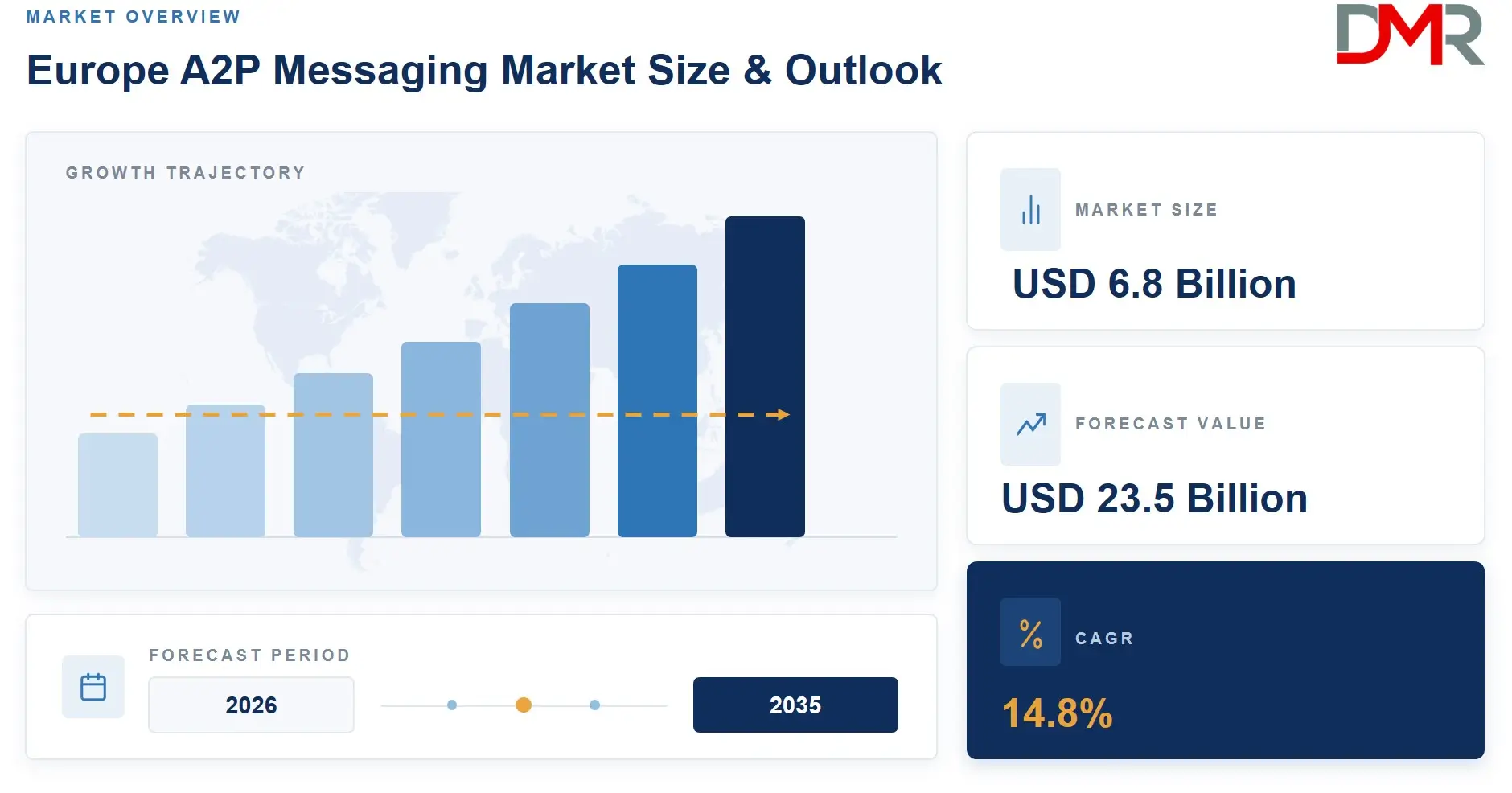
- Market Size (2026): USD 6.8 Bn
- Forecast Value (2035): USD 23.5 Bn
- CAGR (2026-2035): 14.8%
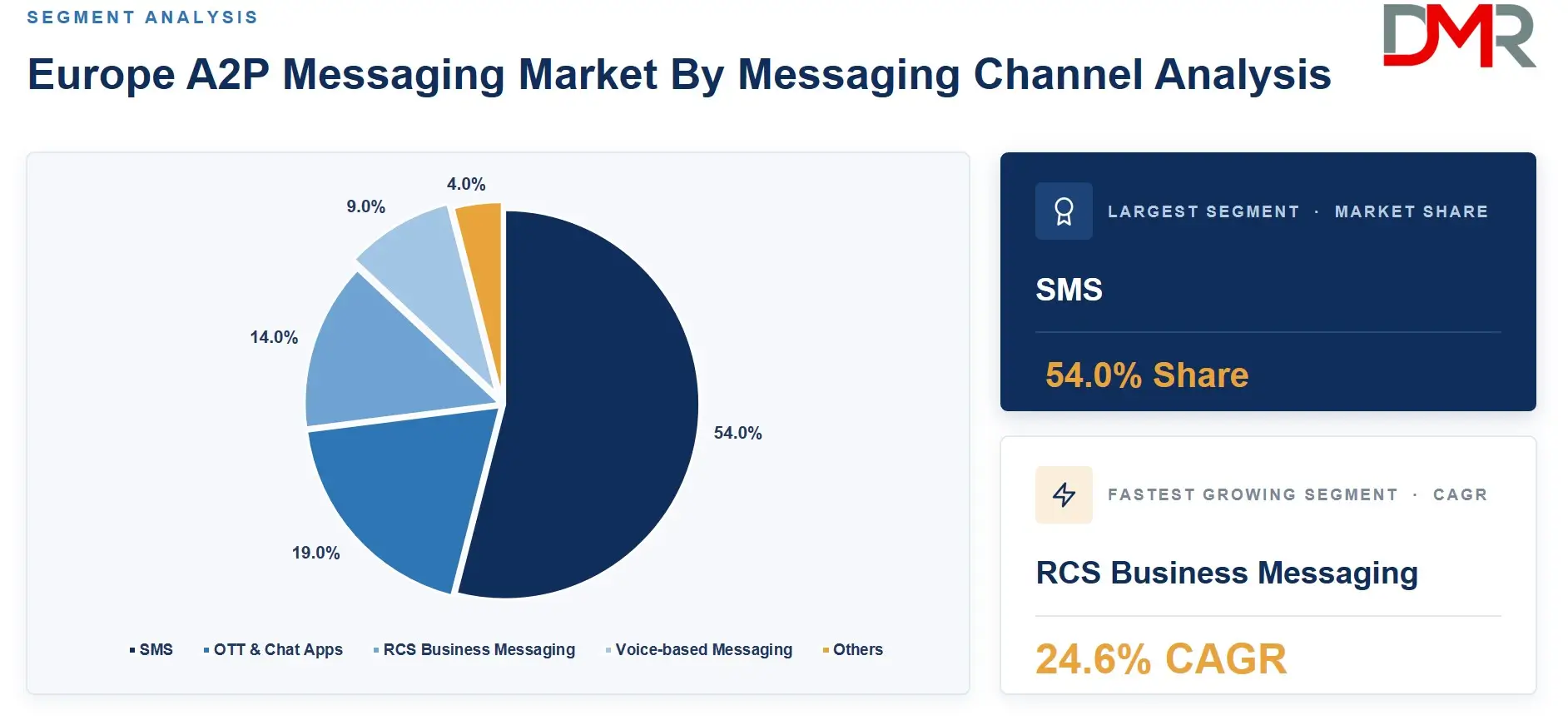
- Leading Messaging Channel (2026): SMS, close to 54%
- Leading Application (2026): Authentication & OTP, around 34%
- Key Players: Sinch, Infobip, Twilio and others
What is Europe A2P Messaging Market and its Market Size?
The Europe A2P Messaging Market size is estimated to reach USD 6.8 Bn in 2026 and is further anticipated to reach USD 23.5 Bn by 2035, at a CAGR of 14.8%.
ℹ
To learn more about this report –
Download Your Free Sample Report Here
Application to person messaging covers bulk and transactional traffic sent from enterprise platforms, banks, retailers, airlines, healthcare providers and public bodies to individual mobile subscribers, spanning SMS, RCS Business Messaging, over the top chat channels and automated voice prompts. The scope covers demand generated inside Europe: messages terminating on European mobile networks and purchased by enterprises operating within the region, not the worldwide billings of vendors that happen to be headquartered in Germany, France or elsewhere on the continent. A separate worldwide A2P messaging market sits outside this boundary, and every figure in this report describes only the regional slice.
Buyers fall into two broad groups. Regulated industries such as banking, insurance and healthcare rely on the channel for one time passwords, appointment confirmations and account alerts, where deliverability and audit trails matter more than creative reach. Retailers, travel operators and media platforms use the same rails for promotional campaigns, delivery updates and loyalty communication, where cost per message and open rates drive channel choice. Both groups route traffic through aggregators or CPaaS platforms rather than negotiating directly with every national carrier, since cross border termination in Europe still runs through dozens of separate mobile network operators.
What is changing structurally is the channel mix rather than the underlying use case. National regulators across the region have tightened sender identity rules and grey route enforcement, pushing volume toward registered, firewall protected paths. At the same time, network operators are rolling out RCS Business Messaging on a country by country basis, giving brands a richer, verified alternative to plain text SMS for the first time since the channel launched three decades ago.
Use Cases
- Banking One Time Password Delivery: Retail banks and card issuers in Germany and France route login and payment authentication codes over SMS and voice fallback, since regulators treat the channel as a baseline strong customer authentication method and outages directly block transactions.
- Retail Delivery Notification at Scale: Pan European e-commerce platforms trigger automated shipping and delivery status messages across millions of daily orders, replacing email alone because open rates on mobile messaging remain materially higher for time sensitive logistics updates.
- Healthcare Appointment Reminders: National and private healthcare providers send appointment confirmations and prescription ready alerts to reduce missed visits, a use case public hospital groups in Italy and Spain have expanded after measuring the drop in no show rates.
- Airline and Travel Operational Alerts: Airlines and rail operators push gate changes, delay notices and boarding reminders directly to passenger handsets, a deployment that scales with the continent's dense cross border travel volumes during peak holiday periods.
Key Takeaways
- Market Size & Share: The market is set to roughly triple between 2026 and 2035, expanding from an estimate year base to USD 23.5 Bn at a 14.8% CAGR.
- Messaging Channel Analysis: SMS is expected to remain the leading channel in 2026, while RCS Business Messaging is projected to expand at a CAGR of 24.6% through 2035.
- Application Analysis: Authentication and one time password traffic is projected to hold close to 34% of 2026 demand, ahead of promotional and marketing use.
- Demand Concentration: Germany, The UK and France together account for the largest share of regional demand, reflecting their scale in retail, banking and telecom subscriber bases.
- Regulatory Momentum: Sender ID registration and anti spoofing mandates are consolidating traffic onto firewall protected, verified routes across most European markets.
- Technology Shift: Carrier rollout of RCS Business Messaging is giving enterprises a rich media, verified alternative to plain text SMS for the first time at national scale.
How AI/Gen AI is Transforming the Europe A2P Messaging Market?
Artificial intelligence is reshaping A2P messaging in Europe mostly through operational gains rather than a consumer facing generative layer. Aggregators and enterprise platforms use machine learning models to score message routes in real time, choosing the carrier path most likely to deliver rather than the cheapest one, which has measurably reduced silent failures on cross border traffic. Fraud detection models trained on traffic patterns also flag grey route and spoofed sender activity before it reaches a subscriber, a capability regulators now expect firewall vendors to demonstrate.
Generative techniques play a narrower but growing role on the customer facing side, mainly inside RCS and chat based conversations rather than plain SMS. Large language model powered assistants draft and personalise conversational replies inside RCS Business Messaging threads, while natural language understanding routes inbound customer replies to the correct backend system without a human agent in the loop for routine queries.
- Intelligent Route Optimisation: Machine learning models continuously reweight carrier routes by real time delivery performance across European mobile networks.
- Fraud and Grey Route Detection: Pattern recognition models flag spoofed sender IDs and unregistered traffic before it reaches subscriber handsets.
- Conversational RCS Assistants: Language model powered bots handle routine customer replies inside rich business messaging threads without agent escalation.
- Automated Compliance Screening: Natural language classifiers scan outbound campaign content against national marketing consent rules before dispatch.
Key Drivers in the Europe A2P Messaging Market
Two forces, one regulatory and one commercial, are pushing enterprise messaging spend higher across the region.
- Strong Customer Authentication Mandates: Payment services regulation across the European Union requires banks and card issuers to apply strong customer authentication on a large share of online transactions, and SMS or voice delivered one time passwords remain the default second factor for most retail banks. Every new digital account, card issuance or high value transaction generates additional authentication traffic, and issuers rarely remove the SMS fallback even as authenticator apps gain adoption, since a meaningful share of customers still lack a smartphone based authenticator. This keeps authentication volume growing roughly in line with digital banking penetration rather than plateauing, and it is the single largest structural driver behind the region's message volume growth.
- E-commerce Delivery Communication Growth: Cross border e-commerce volume within the European single market has continued to expand, and each order now typically triggers three to five automated messages covering confirmation, dispatch, delivery and post purchase feedback. Retailers increasingly treat this messaging thread as part of the customer experience rather than a cost line, layering delivery windows and reschedule options into the same conversation. As parcel volumes rise and same day delivery formats spread beyond the largest cities, the number of automated touchpoints per order is increasing rather than staying flat, compounding the underlying volume driver.
Restraints in the Europe A2P Messaging Market
The same regulatory environment that drives volume also raises the cost and complexity of serving it.
- Rising Termination and Compliance Costs: Mobile network operators across several European markets have raised A2P termination rates in recent years, partly to fund firewall infrastructure and partly as a straightforward revenue lever, and aggregators have passed much of that increase through to enterprise buyers. Sender ID registration, traceability requirements and per country regulatory filings add operational overhead that smaller enterprises often cannot absorb without an aggregator partner, concentrating bargaining power with a handful of large CPaaS providers. Margin pressure is now a recurring theme in vendor earnings commentary across the sector.
- Channel Substitution by OTT Apps: Consumer adoption of WhatsApp, and to a lesser extent other chat applications, has genuinely reduced person to person SMS traffic in most European markets, and some brands now route lower priority promotional content through OTT business messaging instead of paid A2P SMS where the recipient has opted in. While this substitution has not yet materially dented authentication or critical alert volume, it caps the addressable growth of the lowest value promotional segment and forces vendors to diversify revenue across channels rather than relying on SMS volume alone.
Growth Opportunities in the Europe A2P Messaging Market
The clearest white space sits where regulation, channel richness and buyer sophistication intersect.
- RCS Business Messaging Monetisation: As mobile network operators complete national RCS rollouts, enterprises gain a channel that supports branded sender verification, rich cards and in message actions, commanding a materially higher price per message than plain SMS while still landing in the native messaging app rather than a separate download. Aggregators that build early RCS campaign tooling and analytics stand to capture disproportionate share of this premium segment as budgets shift away from flat rate SMS blasts toward measurable, richer campaigns over the next several years.
- Mid Market Managed Service Bundles: Small and mid sized enterprises across Europe have historically under invested in messaging infrastructure relative to large enterprises, often relying on basic email or ad hoc SMS gateways. Managed service providers that package compliance filing, sender ID registration and multi channel routing into a single subscription are opening a segment that large CPaaS platforms have mostly left to resellers, and this mid market bundle represents one of the more accessible entry points for new distribution channel partners.
Trends in the Europe A2P Messaging Market
Buyer behaviour and pricing structures are shifting even where the underlying use cases stay the same.
- Consolidation Among Aggregators: The European CPaaS and messaging aggregation layer has seen a wave of acquisitions as larger platforms absorb regional specialists to secure direct carrier connections in additional countries rather than routing through intermediate hubs. This consolidation is shortening the aggregator list that large enterprise buyers negotiate with, and it is shifting pricing power toward platforms that can offer single contract coverage across most of the region instead of a patchwork of national vendors.
- Shift From Per Message to Outcome Based Pricing: Enterprise buyers, particularly in retail and travel, are increasingly negotiating pricing tied to delivered and read messages rather than flat per message rates, pushing vendors to invest in delivery receipt and read confirmation infrastructure that plain SMS has historically lacked. This trend is most visible in RCS and OTT channel contracts, where richer delivery telemetry makes outcome based pricing straightforward to measure and audit.
Research Scope and Analysis
Segment performance is assessed across five axes: messaging channel, application, end use industry, enterprise size and distribution channel. Each axis identifies the sub-segment carrying the largest share of 2026 demand and the one expanding fastest through 2035.
ℹ
To learn more about this report –
Download Your Free Sample Report Here
By Messaging Channel
SMS is projected to hold the largest share by messaging channel in 2026, accounting for close to 54% of regional demand, since it remains the only channel guaranteed to reach every handset regardless of operating system or app installation, and regulators still recognise it as a valid strong authentication factor. Its installed base advantage and near universal carrier support keep enterprises defaulting to it for critical, time sensitive communication even as richer alternatives emerge. Growth, however, is concentrated in RCS Business Messaging, expanding at a CAGR of 24.6% between 2026 and 2035 as national carrier rollouts complete and brands gain access to verified sender badges, rich cards and in message actions that plain text cannot support, pulling promotional and conversational commerce budgets toward the new channel.
By Application
Authentication and one time password traffic is projected to lead application demand in 2026, holding around 34% of the total, a position anchored by strong customer authentication rules that make SMS or voice delivered codes a near mandatory part of digital banking and payment flows. Promotional and marketing traffic sits close behind, but expands more slowly as brands diversify budget across channels. The steeper trajectory sits with conversational commerce and customer support messaging, projected to grow at a CAGR of 23.1% through 2035 as retailers and travel brands shift post purchase support and order tracking into two way messaging threads rather than static one way alerts.
By End Use Industry
BFSI is expected to remain the largest end use industry in 2026, accounting for approximately 31% of demand, reflecting the sheer volume of authentication, fraud alert and transaction confirmation traffic generated by retail banking and card issuance across the region. Retail and e-commerce follows closely given order and delivery notification volume. The fastest growth, though, sits with healthcare and pharmaceuticals, projected to expand at a CAGR of 22.4% between 2026 and 2035 as public and private providers digitise appointment scheduling, prescription reminders and post discharge follow up communication that was previously handled by phone or post.
By Enterprise Size
Large enterprises are projected to account for the majority of 2026 demand, close to 61% of the total, since banks, national retailers and telecom operators generate the highest per account message volumes and negotiate direct or near direct carrier terms. Mid sized enterprises, however, are forecast to grow fastest, at a CAGR of 19.6% through 2035, as managed service bundles lower the compliance and integration burden that previously kept smaller organisations reliant on basic email or manual SMS gateways, opening up a segment that has been comparatively under served to date.
By Distribution Channel
CPaaS providers and aggregators are expected to remain the dominant distribution channel in 2026, handling nearly 47% of regional traffic, since most enterprises prefer a single platform that abstracts away the fragmented, multi country carrier landscape rather than negotiating national connections individually. Direct carrier connect retains a meaningful share among the very largest senders. The fastest growth sits with managed service providers, projected to expand at a CAGR of 21.3% between 2026 and 2035 as mid market enterprises outsource compliance filing and multi channel routing rather than building the capability internally.
The Europe A2P Messaging Market Report is Segmented Based on the Following
By Messaging Channel
- SMS
- RCS Business Messaging
- OTT & Chat Apps
- Voice based Messaging
- Others
By Application
- Authentication & OTP
- Promotional & Marketing
- Transactional Alerts & Notifications
- Conversational Commerce & Customer Support
- Others
By End Use Industry
- BFSI
- Retail & E-commerce
- IT & Telecom
- Healthcare & Pharmaceuticals
- Travel & Hospitality
- Media & Entertainment
- Others
By Enterprise Size
- Large Enterprises
- Mid sized Enterprises
- Small Enterprises
- Others
By Distribution Channel
- CPaaS Providers & Aggregators
- Direct Carrier Connect
- Managed Service Providers
- Others
Regulatory Landscape
Sender identity and anti spoofing rules have moved from guidance to enforcement across most European markets, with national telecom regulators requiring registered sender IDs and empowering carriers to block unregistered A2P traffic at the network edge. This is shifting further, as more countries move toward mandatory pre registration modelled on schemes already running in parts of the region, alongside continued tightening of strong customer authentication requirements under European payment services rules. The compliance burden opens a commercial opening for aggregators that can offer registration and filing as a managed service across multiple jurisdictions in one contract, turning a cost center for enterprise buyers into a differentiator for vendors. The risk sits with smaller aggregators unable to keep pace with per country filing requirements, which is accelerating consolidation and raising the cost of serving fragmented, multi country campaigns for anyone lacking scale.
Technology Analysis
Rich Communication Services infrastructure is the defining technology shift underway, with mobile network operators completing national interconnect and Google managed hub agreements that finally make RCS Business Messaging deliverable at national scale rather than as a pilot. Firewall and route optimisation platforms are simultaneously moving from static rule sets to real time, model driven scoring of delivery quality and fraud risk. The commercial opening lies in analytics and campaign tooling built specifically for RCS rich cards and suggested replies, a layer that barely exists yet outside the largest CPaaS platforms. The technical risk is interoperability: RCS profiles and feature support still vary by carrier and handset manufacturer, and any enterprise building rich campaigns today must design for graceful fallback to SMS, which continues to shape vendor product roadmaps and slows the pace at which the richer channel can fully displace plain text messaging.
Competitive Landscape
The European A2P messaging market is moderately concentrated at the aggregator layer, where a small number of scaled CPaaS platforms hold direct carrier connections across most of the region, while a longer tail of national specialists and managed service providers compete on price, compliance handling and vertical specific integrations. Competition centers on breadth of direct carrier routes, delivery reliability, RCS readiness and the ability to bundle compliance filing with messaging capacity. Consolidation is the dominant strategy among mid sized players seeking additional country coverage, while larger platforms increasingly compete on analytics, fraud protection and outcome based pricing rather than on raw per message rates alone.
Some of the Prominent Players in the Europe A2P Messaging Market are:
- Sinch AB
- Twilio Inc.
- Vonage
- Infobip
- Bird
- Ericsson
- Nokia
- Deutsche Telekom Global Carrier
- Orange Business
- Telefonica Tech
- Mitto AG
- LINK Mobility Group
- CM.com
- Esendex
- Kaleyra S.p.A.
- BICS (Belgacom International Carrier Services)
- 46elks AB
- Global Message Services (GMS)
- Textlocal (Impart Media Group)
- Openmind Networks
- Anam Technologies
- Evolved Intelligence
- iBasis
- Commify
- IMImobile (Cisco Webex Connect)
- Clickatell
- Plivo Inc.
- Vibes Media
- Comviva Technologies
- Route Mobile Limited
- Tata Communications
- Tanla Platforms
- Netcore Cloud
- MessageMedia
- SMSGlobal
- Syniverse
- Mavenir
- Digital Turbine Inc.
- P1 Security
- Genesys
- Other Key Players
Recent Developments
- In February 2026, Sinch expanded its RCS Business Messaging coverage to additional European carriers, giving enterprise customers verified sender access across a wider share of the region's mobile subscriber base.
- In April 2026, Infobip opened a new compliance and filing service covering sender ID registration across several European markets, aimed at mid sized enterprises without in house regulatory teams.
- In June 2025, Vonage integrated generative reply drafting into its RCS Business Messaging conversation tools for European enterprise customers running customer support threads.
- In September 2025, BICS extended its direct carrier interconnect footprint in Central and Eastern Europe, reducing hop count and improving delivery latency for cross border A2P traffic.
- In November 2025, Mitto AG launched a fraud and grey route detection module built on real time traffic pattern models for enterprise customers sending high volume authentication messages.
- In March 2024, LINK Mobility completed the acquisition of a regional SMS aggregator to add direct carrier routes in Southern Europe, consolidating its national coverage footprint.
Report Details
| Report Characteristics |
| Market Size (2026) |
USD 6.8 Bn |
| Forecast Value (2035) |
USD 23.5 Bn |
| CAGR (2026-2035) |
14.8% |
| Historical Data |
2021 - 2025 |
| Forecast Data |
2026 - 2035 |
| Base Year |
2025 |
| Segments Covered |
By Messaging Channel, By Application, By End Use Industry, By Enterprise Size, By Distribution Channel |
| Regional Coverage |
Europe - Germany, France, The UK, Italy, Spain, Rest of Europe |
Frequently Asked Questions
How big is the Europe A2P Messaging Market?
▾ The Europe A2P Messaging Market is estimated at USD 6.8 Bn in 2026 and is projected to reach USD 23.5 Bn by 2035, driven by authentication traffic, e-commerce delivery communication and carrier rollout of RCS Business Messaging across the region.
What is the growth rate of the Europe A2P Messaging Market?
▾ The market is projected to expand at a CAGR of 14.8% between 2026 and 2035, supported by strong customer authentication mandates, rising e-commerce order volumes and the shift toward richer, verified RCS Business Messaging in place of plain text SMS.
Which country holds the largest share in the Europe A2P Messaging Market?
▾ Germany, The UK and France together represent the largest share of regional demand, reflecting their scale in digital banking, retail e-commerce and mobile subscriber bases. Germany leads on the strength of its banking sector's authentication traffic and dense e-commerce delivery volumes.
Who are the key players in the Europe A2P Messaging Market?
▾ Key players include Sinch, Infobip, Twilio, Vonage, Bird, Mitto and CM.com, alongside carrier owned platforms such as Deutsche Telekom Global Carrier, Orange Business and Telefonica Tech that offer direct interconnect and managed messaging services across the region.
What role does RCS Business Messaging play in the Europe A2P Messaging Market?
▾ RCS Business Messaging is the fastest growing channel, projected to expand at a CAGR of 24.6% through 2035 as national carrier rollouts complete, giving brands verified sender badges and rich, interactive message formats that plain SMS cannot support.
Which application segment leads demand in the Europe A2P Messaging Market?
▾ Authentication and one time password delivery leads application demand, holding close to 34% of the 2026 total, driven by strong customer authentication requirements that make SMS and voice delivered codes a near mandatory part of digital banking and payments.