Market Overview
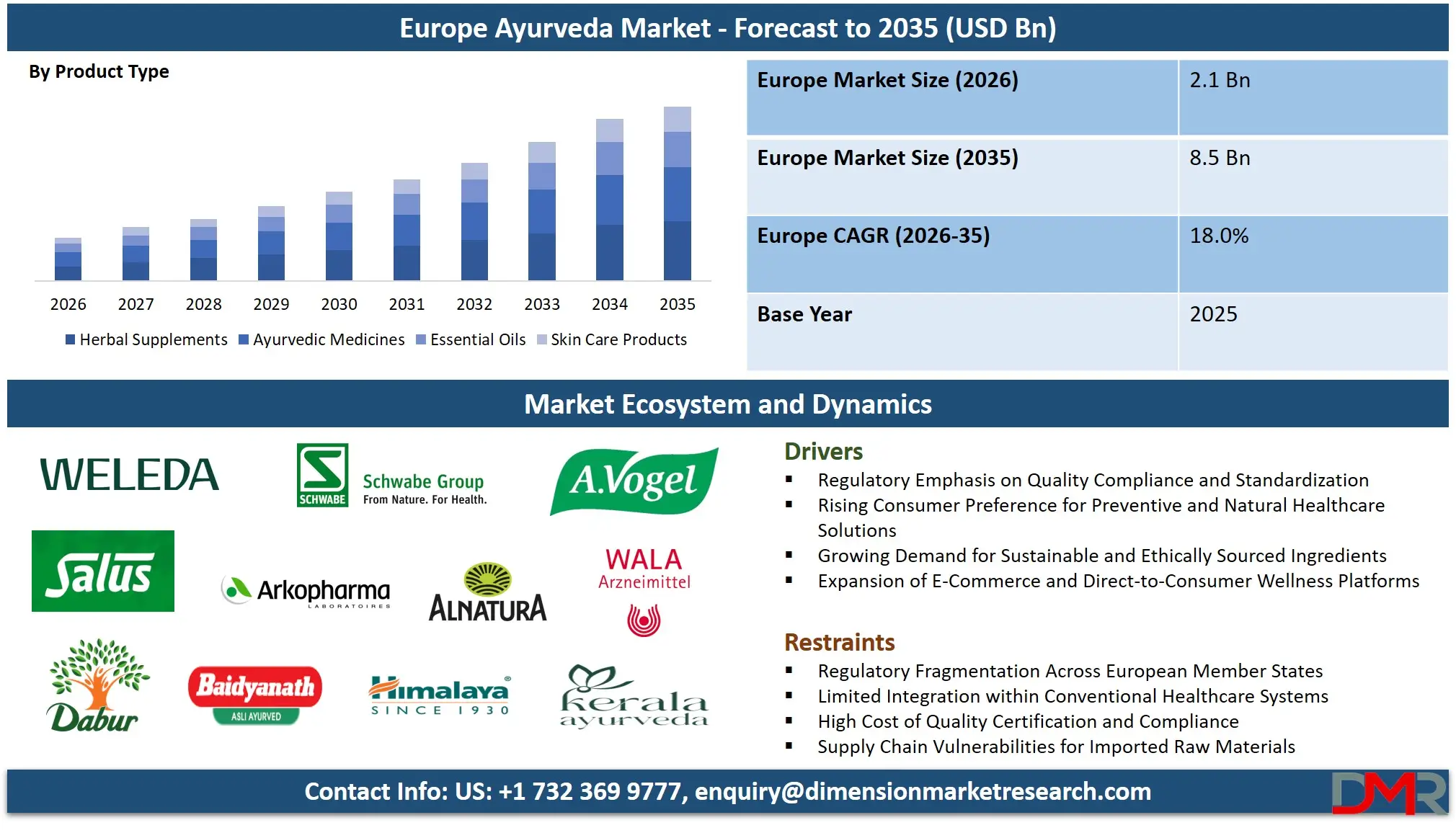
The Europe Ayurveda Market size is estimated to reach USD 2.1 billion in 2026 and grow at a compound annual growth rate of 18.0% to reach a value of USD 8.5 billion in 2035.
ℹ
To learn more about this report –
Download Your Free Sample Report Here
The Europe Ayurveda Market is primarily focused on identifying, analyzing, and healing health and wellness issues through traditional Indian medicine, such as lifestyle health issues, chronic health issues, and the need for natural and alternative therapy.
The Ayurveda Market revolves around the alternative medicine trend which is gaining strength and the rising need for preventive healthcare with herbal, herbomineral, mineral based products along and personalized wellness therapies. Its key categories are ayurvedic supplements, therapy oils, skincare, haircare products and digital health solutions. The key companies primarily focus on nutraceuticals, personal care and medical therapy as well as food sectors.
ℹ
To learn more about this report –
Download Your Free Sample Report Here
Europe Ayurveda Market: Key Takeaways and Other Influencing Factors
- Market Growth Insights: The Europe Ayurveda Market size is estimated to be worth USD 2.1 billion in 2026 and is projected to reach up to USD 8.5 billion in 2035 at a CAGR of 18.0%.
- By Form Insights: Herbal formulations occupy a majority of the market share, and consumers are aware and accept them. Herbomineral formulations are growing rapidly, and this is due to the efficacy of traditional medicine combined with new dosage forms and therapeutic benefits.
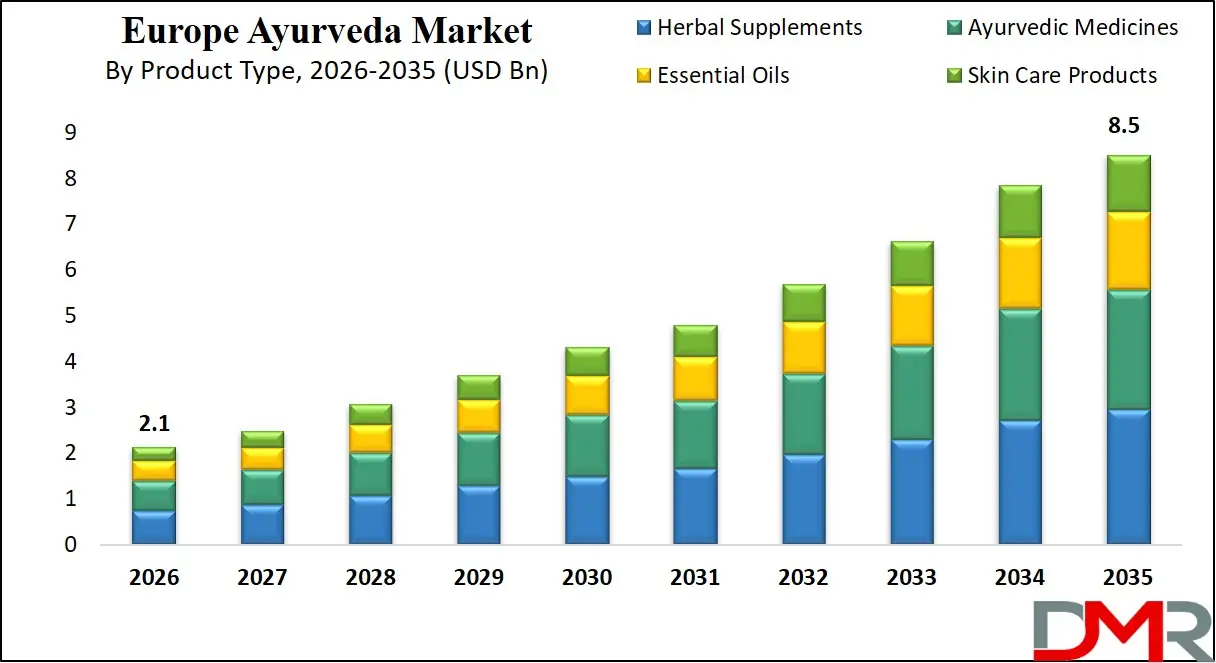
- By Product Type Insights: The herbal supplements segment holds the largest market share owing to its wider acceptance among consumers, ease of use, and a shift towards preventive health trends throughout Europe.
- Key Players Insights: Some of the key players in the market include Himalaya Wellness Company, Dabur International, Maharishi Ayurveda, Emami Europe, and international firms such as A.Vogel Bioforce AG, Schwabe Group and Weleda AG.
- European Medicines Agency (EMA): The "Committee on Herbal Medicinal Products (HMPC)" has produced 50+ herbal monographs, facilitating the approval process for Ayurveda products and resulting in a 40% reduction in time-to-market for Ayurveda products in all EU countries.
- European Federation for Complementary and Alternative Medicine (EFCAM): As a major entity for alternative medicine practitioners and organizations, EFCAM is working towards the inclusion of Ayurveda into the healthcare system, with a measure of insurance coverage already available in Switzerland, Germany, and the Netherlands.
- European Commission (EC): The "Farm to Fork" strategy has provided significant investment for organic and sustainable farming, resulting in a substantial increase in Ayurveda raw material farming since 2020.
Impact of the Iran conflict on the Europe Ayurveda Market
Geopolitical tensions and supply chain disruptions have impacted the availability of some of the raw materials in Europe, and this has impacted the development and growth of the ayurveda industry directly. Supply chain disruptions have impacted the availability of some of the herbs required in the ayurveda industry, and this has exposed the structural weakness of the supply chain. This is a significant factor impacting the ayurveda industry, and this is the reason why diversification and local production are a strategic necessity for the ayurveda industry to ensure business continuity. This is a significant factor impacting the ayurveda industry and the need to consider vertical integration and supply chain management, and this is a fundamental necessity for the ayurveda industry.
Europe Ayurveda Market: Use Cases
- Lifestyle Disease Management: The European populace, especially the Europeans residing in urban areas, is suffering from lifestyle diseases, and the need of the hour is to provide them with ayurvedic solutions, especially ayurvedic diets, stress-relieving medicines, and detoxification therapy.
- Corporate Wellness and Employee Health Programs: European corporations are now using ayurvedic wellness programs as part of employee health and wellness programs, and the need of the hour is to promote ayurvedic stress management, ayurvedic health consultations, and immunity boosters as part of employee wellness programs.
- Immunity Enhancement and Seasonal Health: Due to the increased health and wellness awareness among Europeans, the need of the hour is to promote ayurvedic immunity boosters, especially ayurvedic immunity boosters like 'Chywanaprash,' 'Tulsi,' and 'Herbal Adaptogens,' and the ayurvedic solution is being adopted by the Europeans and the populace residing in Europe.
- Skin and Hair Care in Personal Care Segment: Ayurvedic skin and hair care is gaining popularity among the Europeans, and the need of the hour is to promote ayurvedic skin and hair care, especially ayurvedic solutions for skin and hair conditions like eczema, acne, premature aging, and hair fall.
Europe Ayurveda Market: Market Dynamic
Driving Factors in the Europe Ayurveda Market
Regulatory Emphasis on Quality Compliance and Standardization
The European Medicines Agency (EMA) and other national authorities have established strict guidelines for the registration, quality assurance, and traditional validation of Ayurveda products. The compliance regulations are prompting Ayurveda product manufacturers to invest heavily in clinical validation, documentation, and product formulation, thus increasing the authenticity and acceptability of these products.
Rising Consumer Preference for Preventive and Natural Healthcare Solutions
Consumers in Europe are increasingly seeking preventive healthcare, natural therapies, and holistic wellness options. This has been brought about by a combination of higher healthcare costs, a growing awareness of the potential risks associated with synthetic medicine, and a growing desire among consumers to be healthier. All these trends are contributing to a growing demand for Ayurvedic and plant-based wellness products.
Restraints in the Europe Ayurveda Market
Regulatory Fragmentation Across European Member States
While overarching guidelines exist for EMA, each of the individual member states of the European Union has different regulatory classification systems, approval mechanisms, and advertising guidelines for Ayurvedic products. This diversity is an added complexity for the industry.
Limited Integration within Conventional Healthcare Systems
However, Ayurveda currently remains out of the scope of public health care systems of reimbursement and is not a part of the mainstream medical practices of the majority of the countries of Europe. Ayurveda has received little recognition and support from the conventional medical and health care systems of the region and is still not included in the majority of the health care insurance plans of the region. Moreover, the absence of clinical trials and evidence of Ayurveda further delays its acceptance in evidence-based medical practices of Europe.
Opportunities in the Europe Ayurveda Market
Expansion of Digital Health and Tele-Ayurveda Platforms
The rapidly developing digital health infrastructure in Europe has immense growth opportunities for Ayurvedic service providers. The use of AI technology in consultation tools, personal wellness tracking tools, and digital prescription tools will help Ayurvedic service providers reach more consumers. Additionally, there will be opportunities from wearable devices and real-time biometric data, which will help personalize treatment plans and patient engagement outcomes.
Sustainable Sourcing and Localized Cultivation Models
The sustainability strategy of the European Union, with the inclusion of the Green Deal, is promoting ethical sourcing, biodiversity, and organic farming. Strategic partnership with local organic farms and traceability solutions can help reduce dependency on imports while increasing brand credibility among consumers.
Trends in the Europe Ayurveda Market
Integration of Ayurveda into Mainstream Integrative Healthcare
Ayurveda is being increasingly incorporated into the model of integrative medicine in Europe, where the concept of conventional and alternative medicine practitioners working together is gaining momentum. There is an increased need for evidence-based Ayurvedic formulations, studies, and education programs.
Growth of Ayurvedic-Inspired Clean Beauty and Personal Care Segment
The European clean beauty movement is significantly influencing demand for Ayurvedic skincare and haircare products. Consumers are increasingly favoring formulations that are free from synthetic additives, environmentally sustainable, and ethically sourced, positioning Ayurveda-based cosmetic products as premium alternatives in the personal care market.
Europe Ayurveda Market: Research Scope and Analysis
By Form Analysis
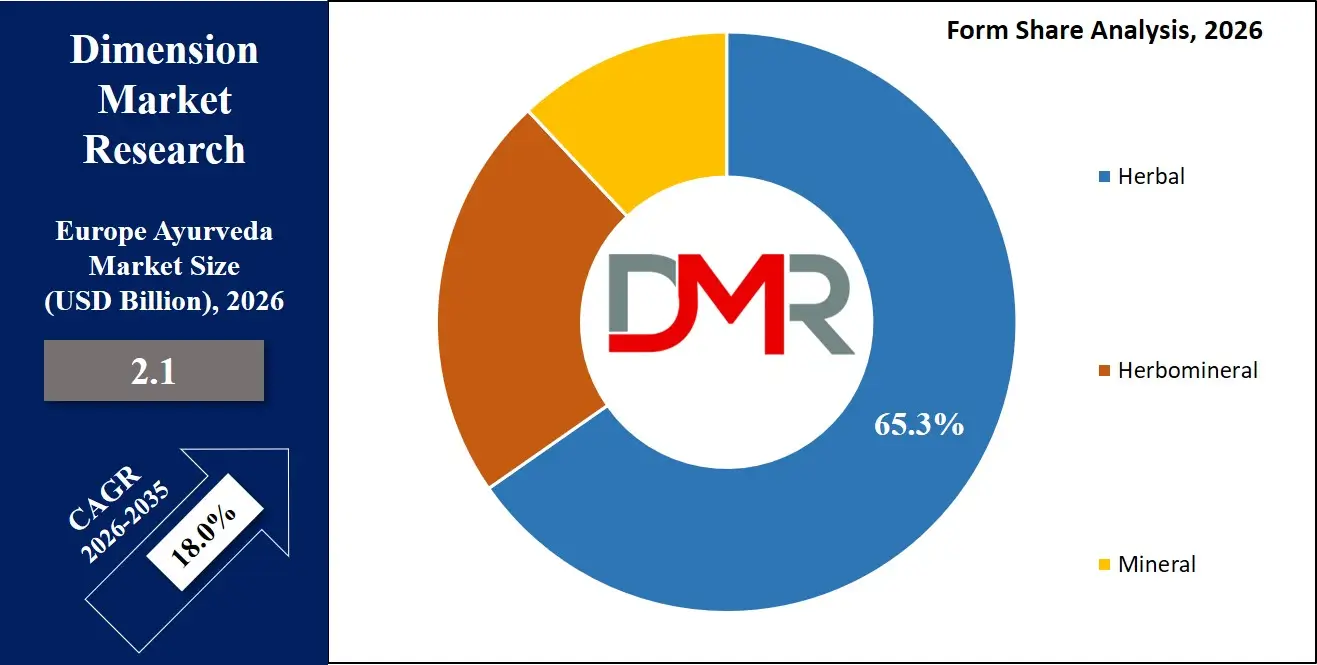
Herbal is expected to be at the forefront of representing the largest market segment in Europe, where it will cover an approximate market share of 65.3%. There is a strong preference for plant-based, natural ingredients considered safe and historically used. There is much attention given to formulations and standardizations for purity and potency.
ℹ
To learn more about this report –
Download Your Free Sample Report Here
Herbomineral formulations are expected to have the highest CAGR during the forecast period, considering the requirement for bioavailability, therapeutic activity, and longer shelf life. Formulations fall under this category, where herbs are formulated with minerals like Shilajit, Guggul, and Bhasmas. Mineral-based supplements fall under a new developing segment, where rasa shastra products have gained more attention, though they have to face more scrutiny regarding heavy metals and safety issues.
By Product Type Analysis
Herbal Supplements have the highest market share in this segment, amounting to 44.6%, owing to the high rate of adoption of preventive health care products among consumers. This includes the use of immune system boosters, stress relievers, and digestive aids. Skin Care Products are expected to have the highest CAGR, owing to the increased demand among consumers for ayurvedic medicines to cure eczema, aging, and sensitive skin. Ayurvedic Medicines have the advantage of traditional registration, while Essential Oils are considered important in aromatherapy and topical application, especially in spas and wellness centers.
By Indication Analysis
Nervous System conditions form the largest segment, contributing 21.5% to the market, as ayurvedic medicine for stress, anxiety, and sleep disorders is becoming extremely popular, considering the high prevalence of work-related stress among European nations. The segment of Digestive Health is likely to record the highest CAGR, considering the growing prevalence of irritable bowel syndrome and consumer interest in gut health remedies. The segment related to Cardiovascular System is gaining momentum, considering the growing demand for natural cholesterol management and blood pressure control agents. The Reproductive System and Infectious Diseases segments also contribute to the overall market share, along with other indications such as respiratory and musculoskeletal disorders.
By Consumer type Analysis
The Adults segment is the largest consumer segment, holding 64.7% of the market share, where working professionals and health-conscious people invest in ayurvedic supplements and products to reduce stress, improve immunity, and stay healthy. The Elderly segment is predicted to have the highest CAGR, owing to the aging population in Europe, who are increasingly turning to ayurvedic products for joint, cognitive, and geriatric care. Children and Pregnant Women are specialized segments that require products with high safety requirements and are advised to be used with the guidance of a practitioner.
By Application Analysis
Medical/Therapy, specifically Lifestyle Disease Management, is seen to be the leading application area, capturing a market share of around 34.7%, given the high incidence rate of metabolic and stress-related disorders in Europe. Food & Nutraceuticals is seen to have the highest CAGR, with functional foods, ayurvedic teas, and nutrient-dense supplements becoming more accepted in the market. Immunity Enhancement and Digestive Health have large market shares under the Medical/Therapy category. Personal Care, specifically Skin Care, holds a large market share, where people prefer natural products to manage various health conditions.
By Distribution Channel Analysis
Retail & Institutional Sales is the largest market, contributing to 54.8% of the total market, with health food stores, pharmacies, and wellness retailers offering high accessibility to the European market. E-sales/Online Retail is expected to have the highest CAGR, as direct-to-consumer brands and digital marketing reach the health-conscious European consumer. Direct/Distance Sales are important for brands that are dispensed through practitioners and offer consultation services.
By End Use Analysis
Home Settings currently account for the dominant share, representing approximately 69.5% of the market, as consumers self-manage wellness through over-the-counter products and online guidance. Hospitals & Clinics are expected to register the highest CAGR, with integrative medical centers, ayurvedic hospitals, and wellness retreats offering supervised therapies, detox programs, and combination treatments.
The Europe Ayurveda Market Report is segmented on the basis of the following:
By Form
- Herbal
- Herbomineral
- Mineral
By Product Type
- Herbal Supplements
- Ayurvedic Medicines
- Essential Oils
- Skin Care Products
By Indication
- Nervous System
- Cardiovascular System
- Reproductive System
- Infectious Diseases
- Others
By Consumer Type
- Adults
- Elderly
- Children
- Pregnant Women
By Application
- Medical/Therapy
- Lifestyle Disease Management
- Immunity Enhancement
- Digestive Health
- Respiratory Conditions
- Personal Care
- Skin Care
- Hair Care
- Oral Care
- Food & Nutraceuticals
By Distribution Channel
- Retail & Institutional Sales
- E-sales / Online Retail
- Direct/Distance Sales
By End Use
- Hospitals & Clinics
- Home Settings
Impact of Artificial Intelligence on the Europe Ayurveda Market
Health and wellness data from Europe's health and wellness sector is being incorporated into AI and ML technologies to personalize ayurvedic consultations, making more accurate dosha assessments and lifestyle recommendations possible. AI technologies use personal health profiles to offer customized herbal formulations, thus merging traditional ayurvedic concepts with contemporary consumer demands.
Europe's manufacturing sector uses AI technologies to map out complicated supply chains, making assessments of sustainable and authentic sources of materials possible, thus allowing for timely warnings against possible disruptions. AI technologies are being utilized to evaluate consumer feedback and results, thus allowing predictive optimization and prioritization of R&D activities.
By Region
Europe
- Germany
- The U.K.
- France
- Italy
- Russia
- Spain
- Benelux
- Nordic
- Rest of Europe
Europe Ayurveda Market: Competitive Landscape
The Europe ayurveda market is an energetic and highly competitive market where the knowledge of European wellness and pharmaceutical companies blends with the heritage and authenticity of traditional ayurvedic brands. The market is dominated by traditional European herbal companies like Pukka Herbs and Bioforce AG, who have been leaders in herbal supplements and tinctures for quite some time.
ℹ
To learn more about this report –
Download Your Free Sample Report Here
The major Indian ayurvedic brands like Himalaya Wellness and Dabur International have been leaders in offering standardized ayurvedic medicine and personal care products based on their vast research and distribution infrastructure.
Some of the prominent players in the Europe Ayurveda Market are:
- Weleda AG
- A.Vogel Bioforce AG
- Schwabe Group
- Salus Haus Dr. med. Otto Greither Nachf. GmbH & Co. KG
- Arkopharma Laboratoires Pharmaceutiques
- L'Erborario S.r.l.
- Herbalgem S.A.
- Yogi Tea GmbH
- WALA Heilmittel GmbH
- Alnatura Produktions- und Handels GmbH
- Dabur India Limited
- Himalaya Wellness Company
- Patanjali Ayurved Limited
- Organic India Private Limited
- Kerala Ayurveda Limited
- Shree Baidyanath Ayurved Bhawan Private Limited
- Charak Pharma Private Limited
- Sandu Pharmaceuticals Limited
- Vicco Laboratories Private Limited
- Emami Limited
- Other Key Players
Recent Developments in the Europe Ayurveda Market
- December 2025: Alnatura Produktions- und Handels GmbH expanded its organic wellness retail infrastructure with more herbal and natural health products in line with the Ayurveda-driven consumption pattern
- March 2025: Schwabe Group (Dr. Willmar Schwabe GmbH & Co. KG) strengthened its position as a global phytomedicine player with a strong presence in the European herbal pharmaceuticals industry with a focus on evidence-based phytomedicines.
- September 2024: Weleda AG enhanced its facial care portfolio with the launch of its new range of Smoothing Face Care and Face Cleansers products, strengthening its position in the European natural cosmetics and Ayurveda-driven facial care segment with the increasing demand for herbal personal care products.
Report Details
| Report Characteristics |
| Market Size (2026) |
USD 2.1 Bn |
| Forecast Value (2035) |
USD 8.5 Bn |
| CAGR (2026–2035) |
28.1% |
| Historical Data |
2021 – 2025 |
| Forecast Data |
2027 – 2035 |
| Base Year |
2025 |
| Estimate Year |
2026 |
| Report Coverage |
Market Revenue Estimation, Market Dynamics, Competitive Landscape, Growth Factors and etc. |
| Segments Covered |
By Form (Herbal, Herbomineral, Mineral), By Product Type (Herbal Supplements, Ayurvedic Medicines, Essential Oils, Skin Care Products), By Indication (Nervous System, Cardiovascular System, Reproductive System, Infectious Diseases, Others), By Consumer Type (Adults, Elderly, Children, Pregnant Women), By Application (Medical/Therapy, Personal Care, Food & Nutraceuticals), By Distribution Channel (Retail & Institutional Sales, E-sales / Online Retail, Direct/Distance Sales), By End Use (Hospitals & Clinics, Home Settings) |
| Regional Coverage |
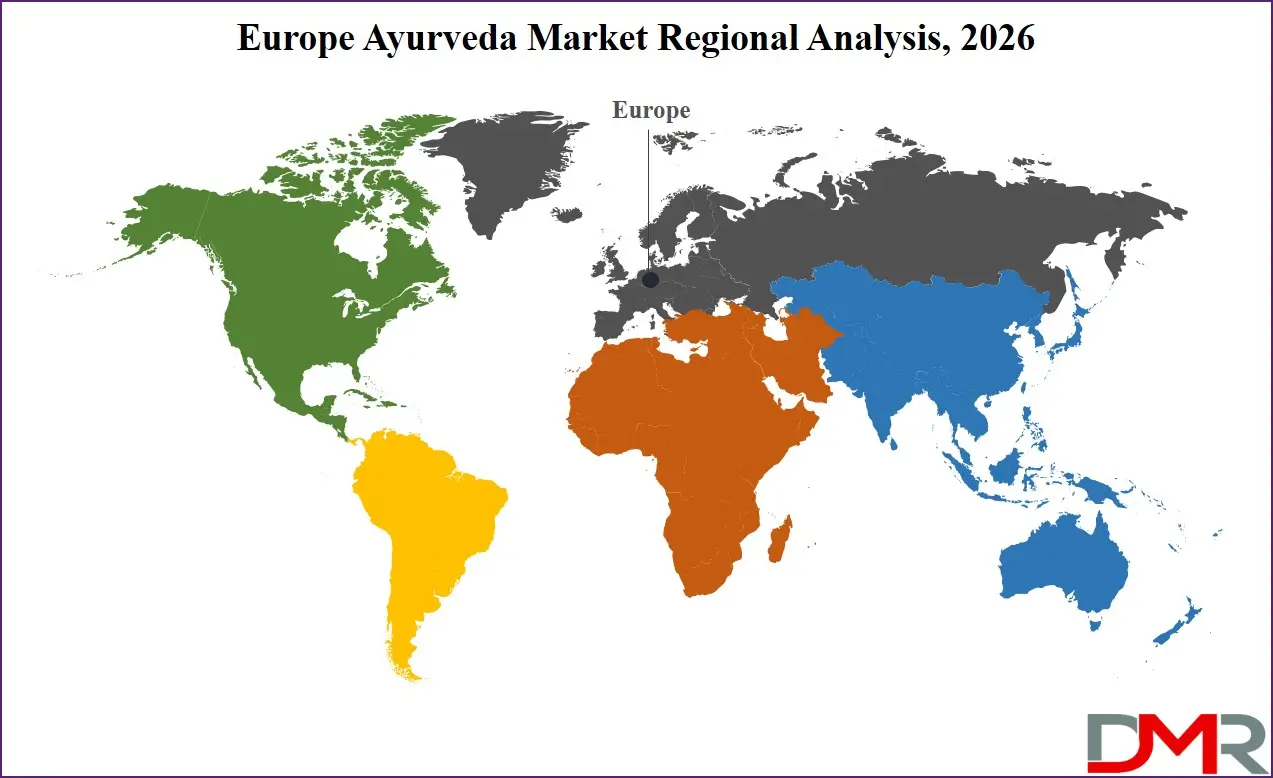
Europe – Germany, The UK, France, Russia, Spain, Italy, Benelux, Nordic, & Rest of Europe |
| Prominent Players |
Weleda AG, A.Vogel Bioforce AG, Dr. Willmar Schwabe Group, Salus Haus Dr. med. Otto Greither Nachf. GmbH & Co. KG, Arkopharma Laboratoires Pharmaceutiques, L’Erborario S.r.l., Herbalgem S.A., Yogi Tea GmbH, WALA Heilmittel GmbH, Alnatura Produktions- und Handels GmbH, Dabur India Limited, Himalaya Wellness Company (formerly The Himalaya Drug Company), Patanjali Ayurved Limited, Organic India Private Limited, Kerala Ayurveda Limited, Shree Baidyanath Ayurved Bhawan Private Limited, Charak Pharma Private Limited, Sandu Pharmaceuticals Limited, Vicco Laboratories Private Limited, Emami Limited and Other Key Players. |
| Purchase Options |
We have three licenses to opt for: Single User License (Limited to 1 user), Multi-User License (Up to 5 Users) and Corporate Use License (Unlimited User) along with free report customization equivalent to 0 analyst working days, 3 analysts working days and 5 analysts working days respectively. |
Frequently Asked Questions
How big is the Europe Ayurveda Market?
▾ The Europe Ayurveda Market size is estimated to have a value of USD 2.1 billion in 2026 and is expected to reach USD 8.5 billion by the end of 2035.
Who are the key players in the Europe Ayurveda Market?
▾ Some of the major key players in the Europe Ayurveda Market are Weleda AG, A.Vogel Bioforce AG, Schwabe Group, Dabur International, Maharishi Ayurveda, Arkopharma Laboratoires Pharmaceutiques, and many others.
What is the growth rate in the Europe Ayurveda Market?
▾ The market is growing at a CAGR of 18.0% over the forecasted period.