Europe Hypochlorous Acid Market Snapshot
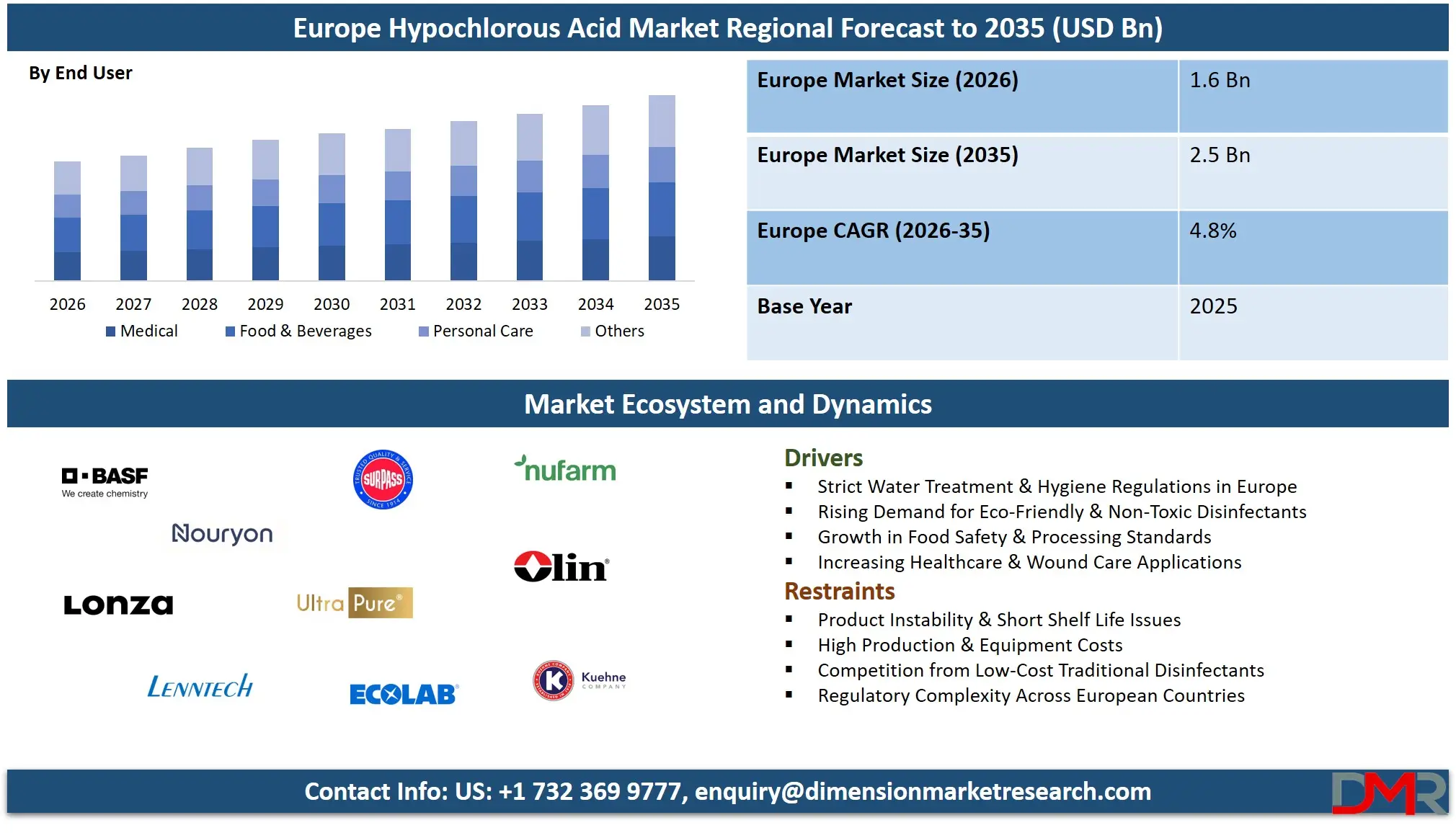
- Market Value: The Europe hypochlorous acid market size is expected to reach USD 2.5 billion by 2035 from USD 1.6 billion in 2026, at a CAGR of 4.8%.
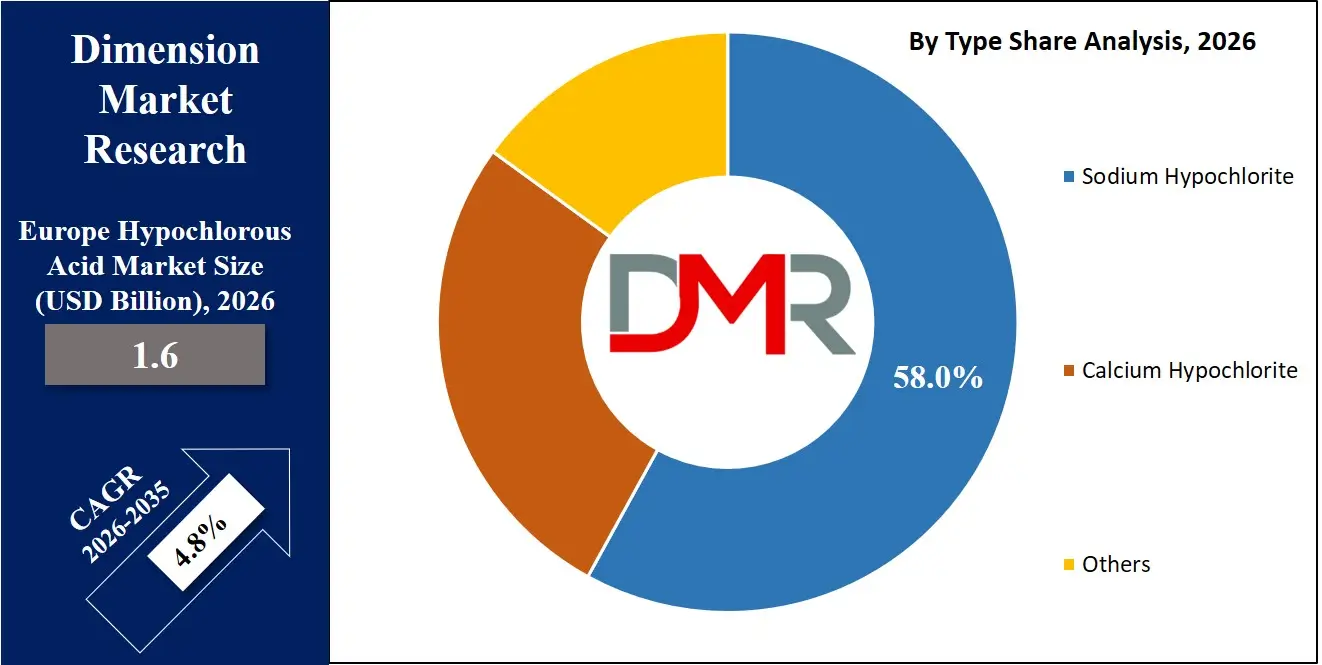
- By Type Segment Analysis: Sodium hypochlorite segment dominated with 58.0% share in 2026.
- By Application Segment Analysis: Water treatment segment led applications with 32.0% share in 2026.
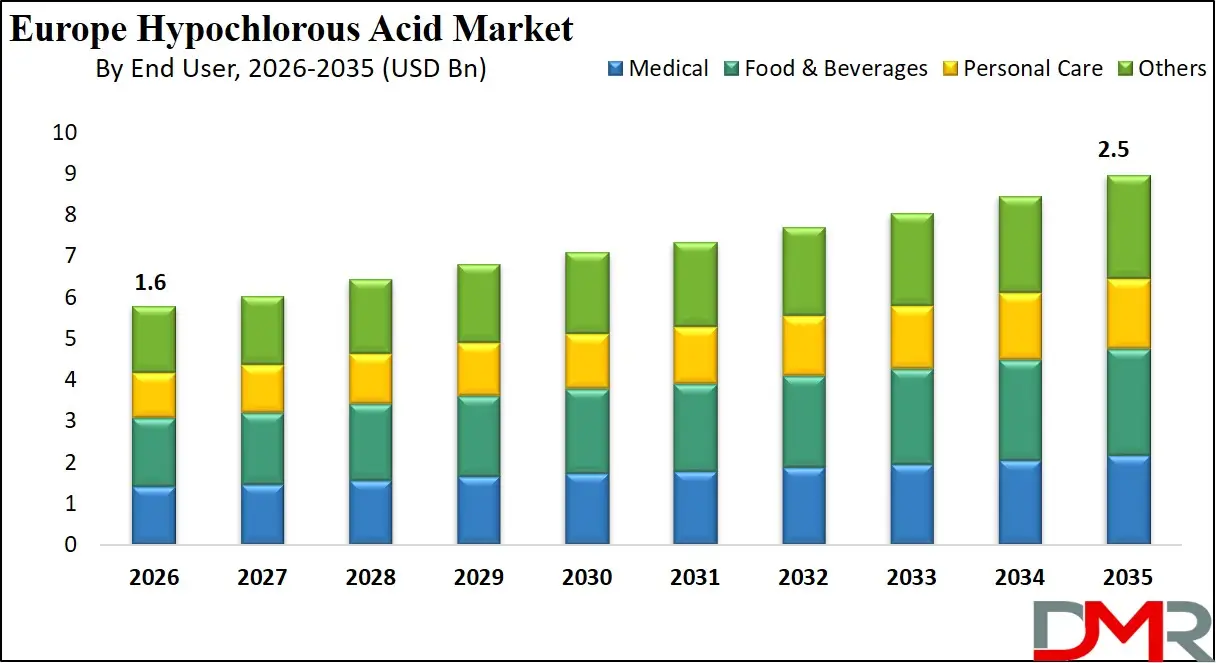
- By End Use Segment Analysis: Food & beverages segment held 29.0% share in 2026.
- Major Players: BASF SE, Lenntech B.V., Nouryon, Lonza Group, AGC Chemicals Europe, and others
What is the Europe Hypochlorous Acid Market Size?
The Europe Hypochlorous Acid Market size is projected to be valued at USD 1.6 billion in 2026 and is projected to reach USD 2.5 billion by 2035, expanding at a CAGR of 4.8% during the forecast period. Market growth is supported by demand for effective disinfectants, water treatment chemicals, sanitation products, food processing hygiene solutions, and applications requiring active chlorine chemistry. Hypochlorous acid based systems are increasingly evaluated for controlled disinfection because they can support microbial control across water, surfaces, food environments, institutional facilities, and selected healthcare settings.
ℹ
To learn more about this report –
Download Your Free Sample Report Here
The growth of the market further driven by the region's regulated biocides environment. Under the EU Biocidal Products Regulation, products generally require approved active substances and appropriate authorization before being placed on the market. Active chlorine released from hypochlorous acid has received EU approval for several relevant biocidal product types, creating a defined regulatory pathway for qualifying products. ECHA records approval for applications including general disinfection and drinking-water related product categories, subject to specified conditions.
Use Cases
- Water Treatment: Hypochlorous acid and related active chlorine systems are used for microbial control in drinking water, process water, storage systems, sanitation lines, and selected wastewater applications. Their strong oxidation capability supports disinfection programs where operators need consistent microbial management and integration with established dosing and monitoring infrastructure.
- Food Processing Sanitation: Food and beverage manufacturers use chlorine-based sanitation solutions for equipment, processing environments, contact surfaces, pipelines, and hygiene programs. Growing attention to contamination prevention, plant hygiene, traceability, and production uptime is sustaining demand for controlled disinfection technologies across European food facilities.
- Healthcare and Institutional Hygiene: Hypochlorous acid based formulations can support disinfection in healthcare, care facilities, laboratories, hospitality sites, schools, and other institutional environments. EU regulation recognizes active chlorine released from hypochlorous acid within relevant biocidal categories, although each commercial product must meet applicable authorization requirements for its intended use.
- Industrial Cleaning: Manufacturing plants, commercial facilities, utilities, and process industries use oxidizing chemicals to control microbial contamination, biofilms, odors, and hygiene risks. Demand is particularly relevant where cleaning systems require scalable chemical treatment, predictable dosing, and compatibility with established sanitation procedures.
- Agriculture and Animal Hygiene: Active chlorine technologies are used across agricultural sanitation, equipment cleaning, water systems, animal production environments, and biosecurity programs. The ability to generate or apply disinfecting solutions at controlled concentrations creates opportunities in farms, horticulture, livestock facilities, and associated supply chains.
How AI/Gen AI is Transforming the Europe Hypochlorous Acid Market?
Artificial intelligence is beginning to influence the Europe hypochlorous acid market through smarter chemical dosing, predictive water-quality management, production optimization, and automated monitoring. In water treatment and food processing plants, sensor data can be combined with analytical software to track oxidation conditions, flow, microbial risk, chemical consumption, and equipment performance. This allows operators to adjust disinfectant dosing more precisely instead of relying only on fixed schedules. Better process control can reduce excess chemical use, stabilize treatment performance, and improve operating visibility across large facilities.
Generative AI can also support commercial and regulatory workflows by organizing technical documents, comparing product specifications, assisting knowledge retrieval, and identifying patterns across quality or maintenance records. Manufacturers and distributors can use advanced analytics to improve demand forecasting, inventory planning, customer segmentation, and supply chain decisions. Adoption remains dependent on reliable sensor inputs, validated procedures, cybersecurity, and human oversight, especially in regulated water, food, and healthcare environments. The near-term value therefore lies in decision support and process efficiency rather than autonomous control of safety-critical treatment operations.
Impact of Iran Conflict on the Market
The Iran conflict is increasing energy and petrochemical prices across Europe, raising production costs for hypochlorous acid manufacturers due to higher dependence on chlorine and chemical feedstocks. Supply chain disruptions and restricted flows through key trade routes are tightening raw material availability and increasing logistics costs. Rising energy prices are further impacting industrial operations and compressing profit margins for chemical producers in the region. However, steady demand from water treatment and healthcare sectors continues to support overall market stability despite these challenges.
Key Drivers in the Europe Hypochlorous Acid Market
Increasing Demand for Reliable Water Disinfection
Rising requirements for safe municipal, industrial, commercial, and process water are strengthening Europe hypochlorous acid market demand. Water treatment accounts for 32.0% of application demand in 2026, making it the leading application segment in this report. Active chlorine chemistry fits established disinfection infrastructure and can support microbial control across water networks, industrial systems, storage facilities, and treatment plants. Regulatory attention to water quality and the need to control contamination are encouraging utilities and industrial users to maintain dependable disinfection programs.
Higher Hygiene Standards Across Food and Beverage Operations
Food and beverages hold 29.0% of the Europe hypochlorous acid market by end use in 2026. Processing companies must maintain hygienic equipment, surfaces, pipelines, storage areas, and production environments while controlling contamination and operational downtime. This creates recurring demand for effective sanitation products. European food producers are also investing in automation and standardized cleaning procedures, supporting chemical solutions that can be incorporated into controlled dosing and cleaning systems. These requirements reinforce long-term consumption across dairies, beverages, meat processing, fresh produce, and packaged food operations.
Restraints in the Europe Hypochlorous Acid Market
Complex Biocidal Authorization and Compliance Requirements
Regulatory compliance can lengthen commercialization timelines and raise costs for suppliers operating in Europe. The EU Biocidal Products Regulation requires active substance approval and product authorization before applicable biocidal products can be marketed, while authorization can involve national, mutual-recognition, or Union-level procedures. Companies must address efficacy, safety, labeling, intended use, formulation, and supporting documentation. These requirements favor well-resourced suppliers but may create barriers for smaller entrants seeking rapid expansion across multiple European countries.
Stability, Storage, and Process Control Challenges
Hypochlorous acid performance is influenced by formulation conditions, concentration, pH, storage environment, packaging, and exposure conditions. Commercial users therefore require controlled manufacturing, appropriate containers, monitoring, and defined handling procedures to maintain product effectiveness. These operating requirements can increase costs compared with simpler cleaning approaches. Industrial customers may also hesitate to change established sanitation systems when alternative disinfectants already have validated procedures, procurement contracts, dosing equipment, and workforce familiarity, slowing adoption in price-sensitive facilities.
Growth Opportunities in the Europe Hypochlorous Acid Market
Expansion of On-Site Generation Systems
On-site generation presents an important Europe hypochlorous acid market opportunity because it can help high-volume users reduce dependence on transporting and storing finished disinfectant solutions. Water facilities, food plants, farms, hospitality sites, and industrial operators can integrate controlled generation with dosing and monitoring equipment. Suppliers that combine generators, sensors, maintenance, consumables, compliance support, and digital monitoring can build recurring service revenue. The opportunity is strongest where customers value supply continuity, automation, traceability, and predictable operating costs.
Broader Adoption in Specialized Hygiene Applications
Healthcare, institutional sanitation, animal hygiene, food environments, and specialty surface disinfection offer additional growth opportunities. ECHA and EU regulations recognize active chlorine released from hypochlorous acid across several biocidal product types, including relevant disinfection and drinking-water categories. New formulations and application systems can therefore address defined professional-use requirements when authorization conditions are satisfied. Suppliers that document efficacy, improve product stability, simplify application, and provide clear regulatory support can differentiate themselves in higher-value market niches.
Trends in the Europe Hypochlorous Acid Market
Shift Toward Automated Dosing and Monitoring
Automation is becoming an important Europe hypochlorous acid market trend as industrial users seek better control over chemical consumption and treatment performance. Connected dosing pumps, oxidation-reduction potential monitoring, flow sensors, remote dashboards, and predictive maintenance tools help operators maintain defined treatment conditions. Water utilities and food manufacturers are especially suited to this transition because they already operate process-control environments. Integration of chemical treatment with digital monitoring can improve traceability, identify abnormal consumption, reduce manual intervention, and support consistent sanitation practices.
Growing Focus on Application-Specific Formulations
The market is moving away from a one-solution-fits-all approach toward formulations and systems developed for specific end uses. Healthcare, food processing, water treatment, agriculture, and commercial sanitation have different concentration, contact-time, packaging, material compatibility, and regulatory requirements. Suppliers are therefore competing through formulation stability, delivery format, dosing technology, technical support, and compliance documentation. EU authorization rules reinforce this trend because biocidal products are assessed according to formulation, intended use, and user category, encouraging more targeted commercial portfolios.
Europe Hypochlorous Acid Market: Research Scope and Analysis
By Type Analysis
Sodium hypochlorite is anticipated to dominate the Europe hypochlorous acid market by type, capturing around 58.0% share in 2026, primarily due to its widespread use in water treatment, surface disinfection, and sanitation processes across municipal and industrial sectors. Its cost effectiveness, strong oxidizing properties, and easy availability make it a preferred chlorine based disinfectant for large scale applications, especially in maintaining drinking water quality and hygiene standards.
ℹ
To learn more about this report –
Download Your Free Sample Report Here
Additionally, its compatibility with existing water treatment infrastructure further strengthens its market position. Calcium hypochlorite, while holding a smaller share, remains significant due to its higher stability and longer shelf life, making it suitable for storage, transportation, and use in remote or decentralized water purification systems, particularly in emergency sanitation and industrial cleaning applications.
By Application Analysis
Water treatment is anticipated to dominate the application segment of the Europe hypochlorous acid market, capturing around 32.0% share in 2026, driven by stringent regulations on drinking water quality, wastewater treatment, and public health sanitation. Its strong antimicrobial properties and effectiveness in eliminating pathogens make it widely used in municipal water systems, industrial water purification, and recycling processes. Increasing investments in sustainable water management and advanced disinfection technologies are further supporting demand. Commercial cleaning also holds a notable share, as hypochlorous acid is increasingly used for surface sanitization, infection control, and eco-friendly cleaning solutions across offices, hospitality, healthcare facilities, and public spaces, supported by rising hygiene awareness and preference for non-toxic disinfectants.
By End User Analysis
Food and beverages are anticipated to dominate the end user segment of the Europe hypochlorous acid market, capturing around 29.0% share in 2026, driven by strict food safety regulations and the need for effective surface sanitization, equipment cleaning, and pathogen control across processing and packaging operations. Its non-toxic and residue free nature makes it highly suitable for maintaining hygiene standards without compromising food quality. Growing demand for contamination prevention and compliance with European food safety norms further supports its adoption. The others segment also contributes significantly, including applications in municipal sanitation, agriculture, hospitality, and industrial hygiene, where hypochlorous acid is used for odor control, surface disinfection, and environmental cleaning across diverse operational settings.
ℹ
To learn more about this report –
Download Your Free Sample Report Here
The Europe Hypochlorous Acid Market Report is segmented on the basis of the following:
By Type
- Sodium Hypochlorite
- Calcium Hypochlorite
- Others
By Application
- Water Treatment
- Food Processing
- Commercial Cleaning
- Wound Management
- Others
By End User
- Medical
- Personal Care
- Food & Beverages
- Others
Europe Hypochlorous Acid Market: Regional Analysis
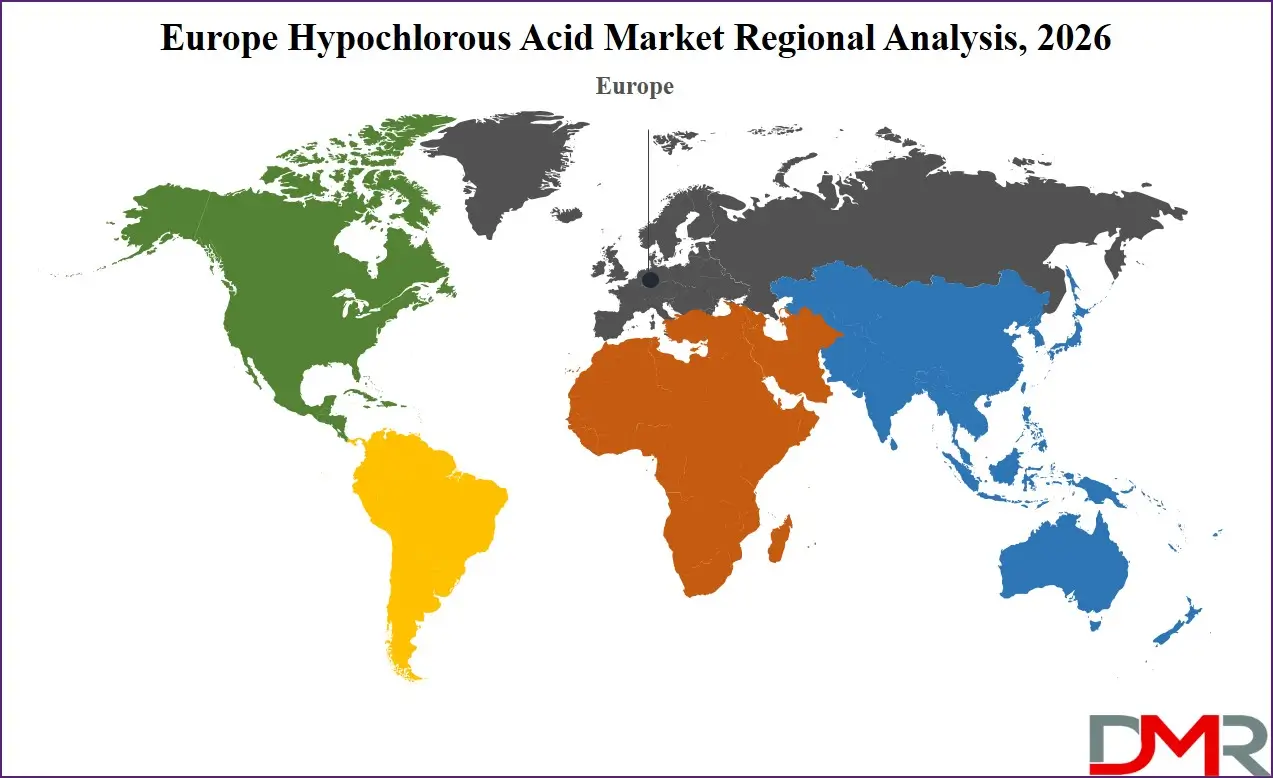
Western Europe leads the hypochlorous acid market, driven by advanced water treatment infrastructure, strict hygiene regulations, and strong adoption in healthcare and food processing sectors, with countries such as Germany, France, and the UK dominating demand due to their industrial base and focus on sustainable disinfection solutions, while Northern Europe shows steady growth supported by environmental awareness and investments in eco-friendly sanitation technologies, and Eastern Europe is emerging as a growth region with improving water treatment facilities, expanding industrial activities, and rising hygiene standards.
By Region
Europe
- Germany
- The U.K.
- France
- Italy
- Russia
- Spain
- Benelux
- Nordic
- Rest of Europe
ℹ
To learn more about this report –
Download Your Free Sample Report Here
Major Countries Analysis
Germany Hypochlorous Acid Market
Germany represents one of Europe's most important commercial markets because of its large chemical industry, advanced municipal infrastructure, food and beverage manufacturing base, healthcare system, and extensive industrial water requirements. Demand is supported by sanitation needs across factories, utilities, institutional facilities, and processing plants. Germany's rigorous regulatory environment favors suppliers capable of providing technical documentation, reliable quality, application expertise, and compliant products. Major chemical industry participants and sophisticated distribution networks further support adoption and market development.
UK Hypochlorous Acid Market
The United Kingdom market is supported by water utilities, food manufacturing, healthcare, hospitality, agriculture, and professional cleaning applications. Increasing use of monitored dosing equipment and greater focus on infection control create opportunities for specialized hypochlorous acid solutions and on-site generation technologies. Domestic companies such as Aqualution Systems also contribute to market development. Suppliers must address the UK's applicable regulatory framework while demonstrating product efficacy, operational value, stability, and compatibility with existing sanitation procedures.
Competitive Landscape
The Europe hypochlorous acid market is moderately fragmented, with a mix of established chemical manufacturers and specialized disinfection solution providers competing on product quality and innovation. Companies are focusing on advanced electrolyzed water technologies, on site generation systems, and ecofriendly formulations to strengthen their market position. Strategic initiatives such as partnerships, capacity expansions, and technology integration are being adopted to enhance distribution networks and operational efficiency. Competitive intensity is further driven by regulatory compliance requirements, pricing strategies, and increasing demand for sustainable and high performance antimicrobial solutions across end use industries.
Some of the prominent players in the Europe Hypochlorous Acid Market are:
- BASF SE
- Lenntech B.V.
- Nouryon
- Lonza Group
- AGC Chemicals Europe
- Arkema S.A.
- INOVYN
- Aqualution Systems Ltd
- Olin Corporation
- Westlake Corporation
- Tosoh Corporation
- Shin-Etsu Chemical Co., Ltd.
- Kuehne Company
- Surpass Chemical Company
- Ultrapure HOCL
- Nufarm Ltd
- Sonoma Pharmaceuticals, Inc.
- Ecolab Inc.
- Sanosil International AG
- BioSafe Systems LLC
- Other Key Players
Regulatory Landscape
The Europe hypochlorous acid market operates under a strict regulatory framework led by the EU Biocidal Products Regulation, which requires active substances to be approved at EU level and individual biocidal products to be authorized for their formulation, intended use, and user category. Active chlorine released from hypochlorous acid has been approved for relevant product types, including personal hygiene, general disinfection, veterinary hygiene, food and feed areas, and drinking water applications, subject to defined conditions. This framework raises the importance of efficacy data, toxicology, labeling, product stability, manufacturing consistency, and environmental compliance. Suppliers entering multiple European countries must also manage authorization routes, documentation, and national implementation requirements. As a result, regulatory capability is becoming a competitive advantage, favoring companies that combine compliant formulations with strong technical support, quality systems, and application-specific evidence.
Investment and White Space Analysis
Investment and white space opportunities in the Europe hypochlorous acid market are expanding around water resilience, on-site generation, automated dosing, food sanitation, and specialized healthcare or institutional hygiene. The European Commission estimates that Europe already invests about EUR 55 billion annually in water, while the annual investment gap is around EUR 23 billion, indicating substantial room for infrastructure and treatment upgrades. The EIB's Water Resilience Programme is expected to mobilize EUR 40 billion of global water investment over three years, strengthening opportunities for suppliers linked to disinfection, monitoring, and digital water management. White space is particularly attractive in compact on-site HOCl generation systems, sensor-integrated dosing, low-logistics sanitation models, and solutions tailored to small and mid-sized food processors. Companies that bundle equipment, consumables, maintenance, compliance support, and remote monitoring can create recurring revenue while addressing customer demand for safer, more efficient, and traceable sanitation.
Recent Developments
- March 2026: Ecolab Inc. launched an advanced hypochlorous acid based surface sanitization system integrated with smart electrolysis technology, targeting healthcare and food processing sectors in Europe.
- February 2026: Arkema S.A. acquired a regional electrolyzed water technology firm to expand its hypochlorous acid production capabilities and strengthen its European market presence.
- January 2026: Sonoma Pharmaceuticals, Inc. introduced a next generation hypochlorous acid formulation for wound care and personal hygiene with improved stability and extended shelf life.
Report Details
| Report Characteristics |
| Market Size (2026) |
USD 1.6 Bn |
| Forecast Value (2035) |
USD 2.5 Bn |
| CAGR (2026–2035) |
4.8% |
| Historical Data |
2021 – 2025 |
| Forecast Data |
2027 – 2035 |
| Base Year |
2025 |
| Estimate Year |
2026 |
| Report Coverage |
Market Revenue Estimation, Market Dynamics, Competitive Landscape, Growth Factors and etc. |
| Segments Covered |
By Type (Sodium Hypochlorite, Calcium Hypochlorite, and Others), By Application (Water Treatment, Food Processing, Commercial Cleaning, Wound Management, Others), By End User (Medical, Personal Care, Food & Beverages, and Others) |
| Regional Coverage |
Europe – Germany, The UK, France, Russia, Spain, Italy, Benelux, Nordic, & Rest of Europe |
| Prominent Players |
BASF SE, Lenntech B.V., Nouryon, Lonza Group, AGC Chemicals Europe, Arkema S.A., INOVYN, Aqualution Systems Ltd, Olin Corporation, Westlake Corporation, Tosoh Corporation, Shin-Etsu Chemical Co., Ltd., Kuehne Company, Surpass Chemical Company, Ultrapure HOCL, Nufarm Ltd, Sonoma Pharmaceuticals, Inc., Ecolab Inc., Sanosil International AG, BioSafe Systems LLC, and Other Key Players |
| Purchase Options |
We have three licenses to opt for: Single User License (Limited to 1 user), Multi-User License (Up to 5 Users) and Corporate Use License (Unlimited User) along with free report customization equivalent to 0 analyst working days, 3 analysts working days and 5 analysts working days respectively. |
Frequently Asked Questions
What is the current size of the Europe Hypochlorous Acid Market?
▾ The Europe Hypochlorous Acid Market is valued at USD 1.6 billion in 2026 and is forecast to reach USD 2.5 billion by 2035.
What is the growth rate of the Europe Hypochlorous Acid Market?
▾ The Europe Hypochlorous Acid Market is expected to grow at a CAGR of 4.8% during the forecast period from 2026 to 2035.
Which segment dominates the Europe Hypochlorous Acid Market?
▾ Sodium hypochlorite leads the Europe Hypochlorous Acid Market by type, accounting for a dominant 58.0% share in 2026.
What factors are driving the growth of the Europe Hypochlorous Acid Market?
▾ Europe Hypochlorous Acid Market growth is driven by rising water treatment, food sanitation, hygiene, and disinfection demand.
What are the major challenges restraining the Europe Hypochlorous Acid Market?
▾ Strict biocide regulations, authorization costs, product stability, storage, and handling requirements restrain market growth.
Which application holds the largest share of the Europe Hypochlorous Acid Market?
▾ Water treatment leads the Europe Hypochlorous Acid Market applications, accounting for a significant 32.0% share in 2026.
Who are the leading companies in the Europe Hypochlorous Acid Market?
▾ BASF SE, Lenntech B.V., Nouryon, Lonza Group, AGC Chemicals Europe, Arkema S.A., INOVYN, Aqualution Systems Ltd, Olin Corporation, Westlake Corporation, Tosoh Corporation, Shin-Etsu Chemical Co., Ltd., Kuehne Company, Surpass Chemical Company, Ultrapure HOCL, Nufarm Ltd, Sonoma Pharmaceuticals, Inc., Ecolab Inc., Sanosil International AG, BioSafe Systems LLC, and other key players are prominent companies in the Europe Hypochlorous Acid Market.
How is AI influencing the Europe Hypochlorous Acid Market?
▾ AI supports the Europe Hypochlorous Acid Market through smart dosing, water monitoring, predictive maintenance, and demand planning.
What are the future opportunities and trends in the Europe Hypochlorous Acid Market?
▾ Europe Hypochlorous Acid Market opportunities include on-site generation, automated dosing, water treatment, and food sanitation.