Europe Online Grocery Market Snapshot
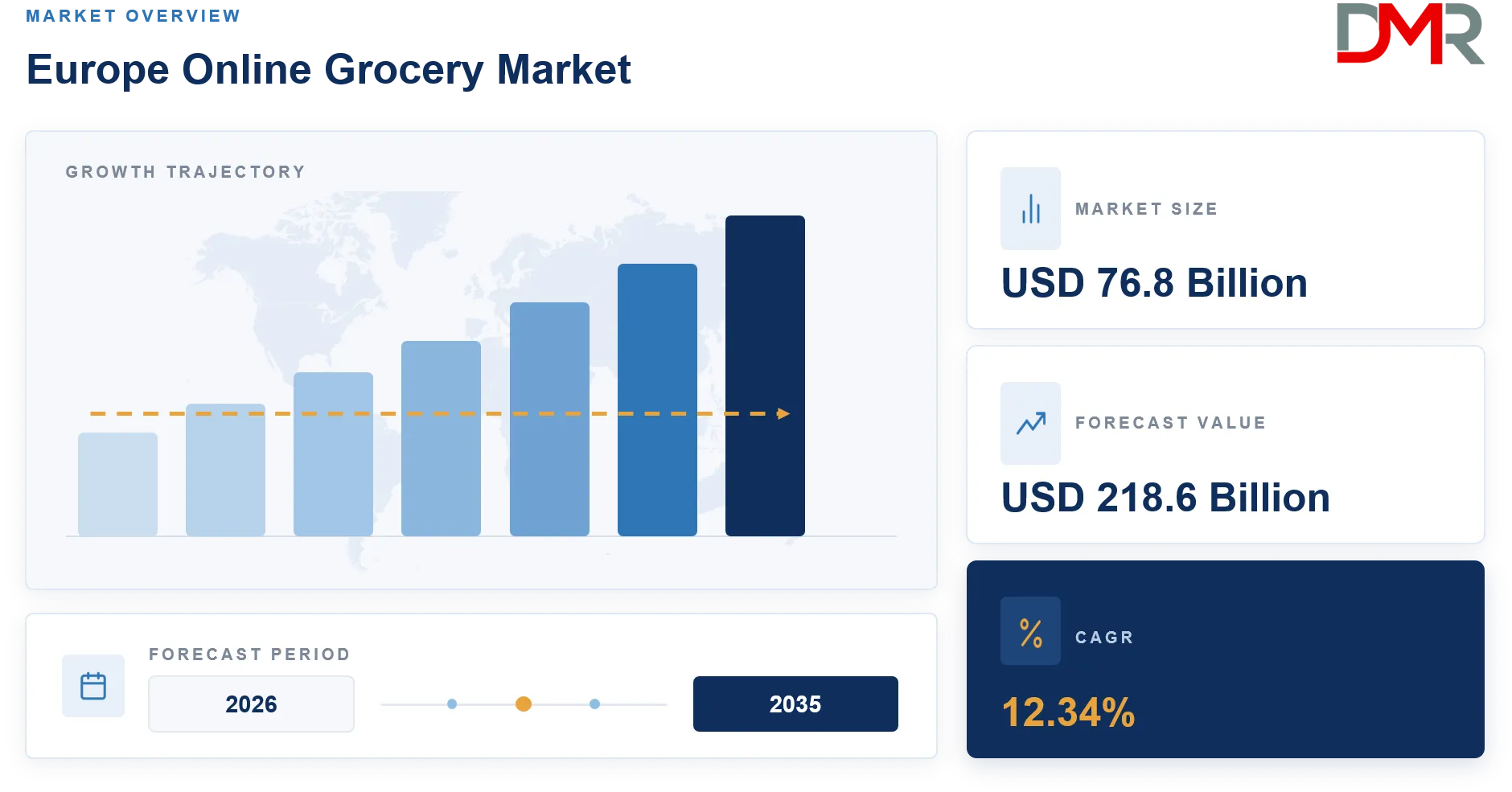
- Market Value: Europe online grocery market is valued at USD 42.8 billion in 2026 and is expected to reach USD 368.5 billion by 2035.
- CAGR: Europe online grocery market is expected to grow at a CAGR of 27.1% from 2026 to 2035.
- By Product Type Analysis: Staples and cooking essentials led the product type segment with a 24.5% share in 2026.
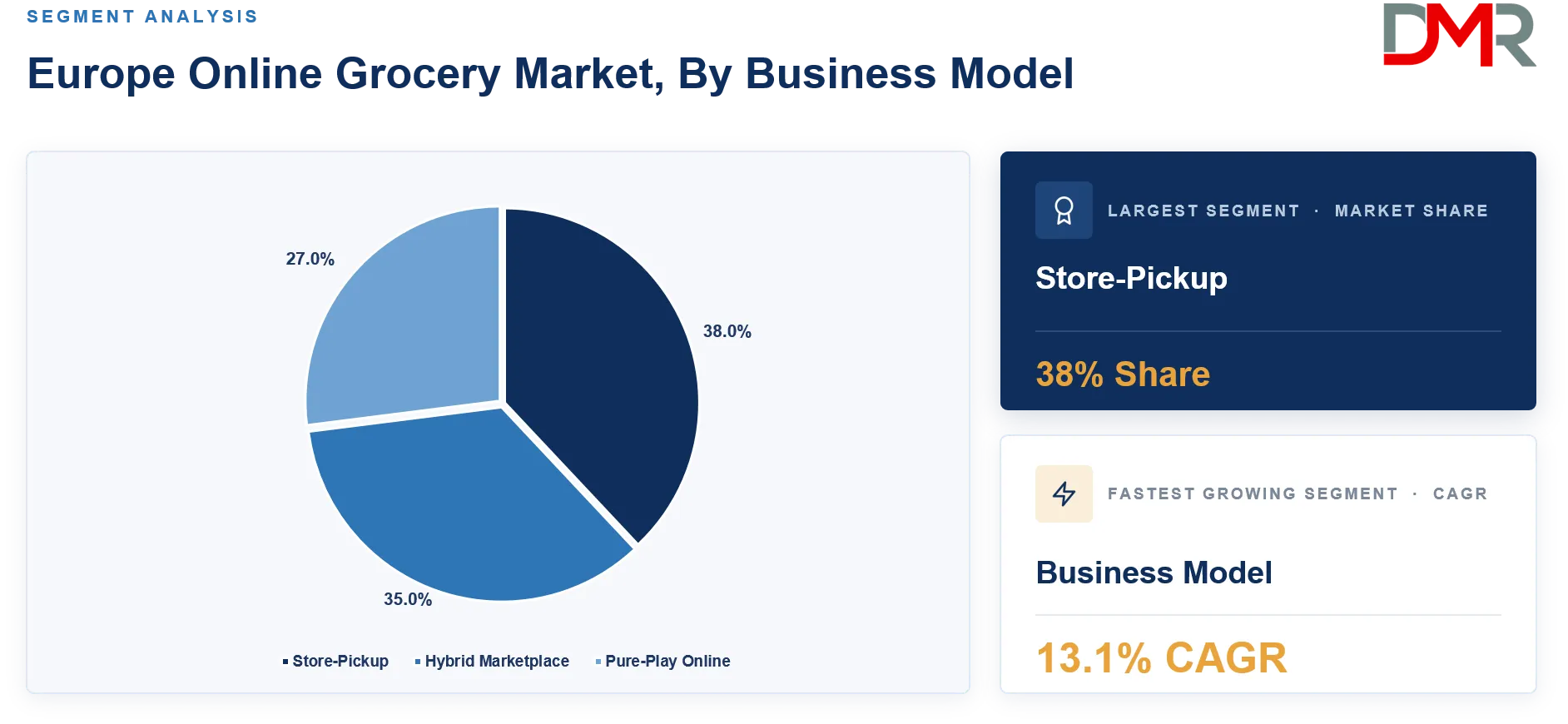
- By Business Model Analysis: Store-pickup led the business model segment with a 38.0% share in 2026.
- By Platform Analysis: App-based platforms dominated the platform segment with a 68.5% share in 2026.
- Country Analysis: The United Kingdom led the Europe online grocery market with a 34.9% revenue share in 2026.
- Major Players: Ocado, Carrefour, Colruyt Group, Tesco, and ICA ruppen, and Others.
What is the Europe Online Grocery Market and its Market Size?
The Europe online grocery market size is projected to be valued at USD 42.8 billion in 2026 and is expected to reach USD 368.5 billion by 2035, expanding at a CAGR of 27.1% during the forecast period. Online grocery retail includes digital ordering of food, beverages, household staples, fresh produce, dairy, meat, seafood, bakery products, and other everyday goods through retailer websites and mobile applications. Fulfilment may take place through store pickup, retailer-operated delivery networks, marketplaces, or dedicated online distribution infrastructure.
ℹ
To learn more about this report –
Download Your Free Sample Report Here
Europe provides a strong foundation for grocery ecommerce because digital purchasing is already embedded in consumer behaviour. Eurostat reported that 77% of EU internet users purchased or ordered goods or services online in 2024, up from 59% in 2014. This wider ecommerce maturity lowers the behavioural barrier for grocery retailers seeking to increase digital order frequency. Market development is increasingly linked to omnichannel convenience, personalised promotions, loyalty integration, inventory visibility, flexible delivery windows, and the economics of last-mile fulfilment rather than digital access alone.
Use Cases
- Weekly Household Shopping: Consumers use online grocery platforms for planned basket purchases covering cooking ingredients, packaged foods, dairy, produce, beverages, and household necessities, reducing the time required for repeated supermarket visits.
- Click-and-Collect Shopping: Store-pickup services allow customers to order digitally and collect groceries from a nearby supermarket, combining ecommerce convenience with lower last-mile delivery requirements for retailers.
- On-Demand Grocery Orders: Mobile platforms support smaller, urgent purchases such as missing meal ingredients, beverages, snacks, breakfast products, and household essentials with shorter fulfilment windows.
- Personalised Grocery Purchasing: Retail apps use purchase histories, loyalty accounts, saved baskets, recommendations, and personalised promotions to simplify repeat purchases and increase customer engagement.
- Corporate and Institutional Procurement: Digital grocery channels can support small offices, hospitality operators, care providers, and other organisations that require convenient ordering, scheduled replenishment, transparent product availability, and consolidated purchasing.
How AI/Gen AI is Transforming the Europe Online Grocery Market?
Artificial intelligence is becoming more closely integrated with online grocery operations because grocery ecommerce involves large product catalogues, frequent purchases, perishable inventories, local demand variation, and narrow fulfilment margins. Retailers can use predictive systems to improve demand forecasting, replenishment, substitution decisions, delivery-slot allocation, pricing, promotions, and warehouse or store-picking efficiency. Customer-facing applications can also rank frequently purchased products, recommend complementary items, automate basket creation, and improve search results when shoppers use conversational or incomplete product descriptions.
Generative AI expands these capabilities by creating more natural interactions between consumers and digital grocery services. Shoppers may increasingly search by meal, dietary preference, household size, budget, or occasion instead of individual product names. A grocery application can translate these requests into suggested baskets while checking product availability and preferences. For retailers, the value lies in connecting conversational commerce with inventory, loyalty, merchandising, and fulfilment systems. The technology is therefore shifting online grocery platforms from static digital catalogues toward more personalised purchasing environments, while data governance and recommendation accuracy remain essential for customer trust.
Key Drivers in the Europe Online Grocery Market
Omnichannel Grocery Retail is Increasing Digital Order Adoption
European supermarkets are integrating physical stores with apps, websites, pickup points, delivery fleets, and loyalty programmes, making online purchasing part of the standard grocery journey rather than a separate retail channel. Store-based fulfilment allows established retailers to use existing locations as local inventory and picking hubs. This is particularly relevant for frequent grocery purchases, where consumers value accurate availability and convenient collection times. The model also supports the strong position of store-pickup, which represented 38.0% of the market in 2026.
Mobile Commerce is Reshaping Grocery Purchasing Behaviour
Smartphone-led purchasing is strengthening online grocery demand as consumers increasingly manage product search, loyalty accounts, promotions, payments, delivery slots, and repeat baskets within one application. App-based platforms held a 68.5% market share in 2026, highlighting the importance of mobile interfaces in grocery ecommerce. Apps can reduce friction through saved preferences, personalised offers, digital receipts, real-time order updates, and one-click reordering, creating a practical path for retailers to improve purchase frequency and customer retention.
Restraints in the Europe Online Grocery Market
Last-Mile Fulfilment Creates Margin Pressure
Online grocery economics remain challenging because orders often contain low-margin products, temperature-sensitive items, heavy beverages, and goods requiring careful handling. Retailers must manage picking labour, packaging, refrigerated transport, narrow delivery windows, failed deliveries, and product substitutions while competing on price. These costs can make small baskets particularly difficult to fulfil profitably. Companies are responding through pickup services, minimum-order thresholds, delivery subscriptions, automation, route optimisation, and higher order-density strategies.
Fresh Food Quality Can Limit Full Digital Conversion
Fresh vegetables, fruit, meat, bakery items, and dairy products create a different ecommerce challenge from packaged goods because customers often prefer to judge freshness, ripeness, size, and condition personally. Poor substitutions or damaged products can quickly reduce trust in an online grocery service. Retailers therefore need strong quality-control standards, accurate stock information, suitable cold-chain processes, transparent substitution policies, and effective refund systems. Maintaining these capabilities across large store networks raises operating complexity and can slow adoption among quality-sensitive shoppers.
Growth Opportunities in the Europe Online Grocery Market
Store-Based Fulfilment Offers Scalable Omnichannel Expansion
Existing supermarket networks provide European retailers with an opportunity to expand ecommerce without relying entirely on capital-intensive central fulfilment centres. Stores can act as local picking locations, click-and-collect points, and rapid-delivery hubs while serving traditional shoppers at the same time. Tesco and Ocado demonstrate contrasting fulfilment approaches, with Tesco historically using its store estate extensively while Ocado developed highly automated fulfilment infrastructure. This illustrates how European operators can select fulfilment models according to order density, geography, basket size, and capital requirements.
Personalisation Can Increase Basket Value and Purchase Frequency
Retailers possess valuable transaction data through loyalty schemes and digital accounts, creating opportunities to personalise promotions, reminders, substitutions, product discovery, and meal-based recommendations. Grocery purchasing is highly repetitive, so reducing the effort needed to rebuild recurring baskets can improve digital retention. Personalisation can also help retailers introduce private-label products, identify complementary purchases, and target price-sensitive households with relevant offers. The commercial opportunity is strongest when recommendation systems combine customer preferences with real-time stock and local fulfilment capacity.
Trends in the Europe Online Grocery Market
Profitability is Replacing Pure Order Growth as a Strategic Priority
European grocery ecommerce strategies are becoming more focused on profitable scale. Retailers are assessing picking costs, delivery density, automation investment, minimum baskets, promotional spending, and fulfilment utilisation instead of pursuing digital sales growth at any cost. Ahold Delhaize reported that its ecommerce operations reached profitability on a fully allocated basis during 2025 while full-year online sales increased 13.3% at constant exchange rates. This indicates how mature operators are working to convert omnichannel adoption into financially sustainable growth.
Hybrid Fulfilment Models are Gaining Strategic Importance
The distinction between supermarkets and pure online grocers is becoming less rigid as companies combine stores, automated facilities, pickup services, delivery fleets, and third-party platforms. In May 2026, Asda announced an agreement with Ocado to modernise its UK ecommerce technology, including systems supporting store fulfilment and last-mile operations from 2027. Such partnerships show that grocery retailers increasingly view technology infrastructure as modular, allowing them to combine internal assets with specialist capabilities rather than depend on a single fulfilment architecture.
Research Scope and Analysis
The Europe online grocery market is segmented based on product type, business model, platform, purchase type, and country. The study examines consumer purchasing behaviour, digital retail adoption, fulfilment infrastructure, competitive strategies, platform development, merchandising models, and changing demand across European grocery markets. It also evaluates how mobile commerce, store networks, automation, loyalty ecosystems, and delivery economics influence market growth.
By Product Type
Staples and cooking essentials dominated the product type segment with a 24.5% market share in 2026. The category benefits from predictable consumption cycles and includes products that households purchase repeatedly, making it particularly suitable for saved baskets and digital reordering. Cooking oils, flour, rice, pasta, seasonings, sauces, cereals, pulses, and other pantry goods generally carry lower selection risk than highly perishable products. Consumers can evaluate brands, package sizes, prices, and nutritional information without physically examining items. These characteristics support larger planned baskets and enable grocery platforms to use replenishment reminders and personalised recommendations to stimulate repeat demand.
ℹ
To learn more about this report –
Download Your Free Sample Report Here
By Business Model
Store-pickup accounted for 38.0% of the Europe online grocery market in 2026. Click-and-collect offers an attractive balance between consumer convenience and retailer fulfilment economics because it removes residential last-mile delivery from many transactions. Established grocers can use supermarkets as fulfilment nodes while customers select collection locations and available time slots digitally. The model is valuable in markets where retailers already operate dense physical networks. It also gives shoppers greater scheduling flexibility than conventional store visits while allowing retailers to consolidate picking processes, strengthen digital engagement, and cross-utilise their physical assets.
By Platform
App-based platforms held 68.5% of the market in 2026, making mobile applications the leading digital interface for European grocery purchases. Grocery shopping naturally suits app-based engagement because customers make frequent transactions and repeatedly purchase many of the same products. Retail applications can combine search, loyalty programmes, personalised pricing, stored payments, shopping lists, digital coupons, delivery tracking, and repeat-order functions. Push notifications also enable retailers to communicate promotions or delivery availability directly. As competitive differentiation moves beyond simple product availability, app usability and personalisation are becoming important components of customer retention.
The Europe Online Grocery Market Report is Segmented on the Basis of the Following:
By Product Type
-
Bakery and Confectionery
- Meat and Seafood
- Snacks and Beverages
- Staples and Cooking Essentials
- Dairy Products
- Vegetables and Fruits
- Others
By Business Model
-
Store-Pickup
- Hybrid Marketplace
- Pure-Play Online
By Platform
By Purchase Type
Countries Analysis
United Kingdom Online Grocery Market
The UK represents Europe's most developed online grocery environment within this market assessment. Tesco combines a large physical store network with home delivery and collection, while Ocado has built its position around online grocery operations and fulfilment technology. Competitive intensity is also encouraging retailers to invest in automation, loyalty, digital pricing, store picking, and faster delivery options. In August 2026, Ocado remained one of the fastest-growing UK grocery retailers by sales, demonstrating continued consumer engagement with digitally enabled grocery models.
Germany Online Grocery Market
Germany represents a significant expansion opportunity because of its large grocery expenditure base, established supermarket groups, high urban purchasing power, and mature ecommerce infrastructure. Online grocery operators must compete with a strong discount-store culture and consumer sensitivity to grocery prices, making fulfilment efficiency and value positioning important. Retailers can expand adoption through reliable delivery windows, app-based promotions, broader fresh-food ranges, and integration between local stores and digital ordering. Major urban centres provide particularly favourable conditions for improving order density and reducing delivery cost per basket.
France Online Grocery Market
France has a distinctive online grocery structure supported by the widespread use of click-and-collect and strong participation from established hypermarket and supermarket groups. Carrefour and Auchan can leverage physical retail assets, purchasing scale, private-label ranges, loyalty systems, and store-based fulfilment to strengthen digital services. Pickup formats align well with suburban shopping patterns by allowing customers to order online while avoiding home-delivery charges. Future growth is expected to centre on app personalisation, improved fresh-product availability, automated preparation, retail media integration, and more efficient connections between stores and ecommerce inventories.
Italy Online Grocery Market
Italy's online grocery opportunity is developing around rising digital retail familiarity and expanding urban delivery infrastructure. Grocery purchasing remains influenced by local preferences, fresh-food quality, regional assortment differences, and frequent interaction with physical food retailers. Successful ecommerce strategies therefore require more than broad product catalogues. Platforms must provide dependable produce quality, clear origin information, suitable substitutions, competitive delivery economics, and localised merchandising. Large metropolitan markets provide a useful base for delivery density, while retailer partnerships and store-pickup services can extend digital reach beyond core urban areas.
Spain Online Grocery Market
Spain provides growth potential through high smartphone usage, established supermarket networks, tourism-driven urban economies, and increasingly integrated retail apps. The combination of large cities and strong regional grocery operators creates opportunities for multiple fulfilment models, including store picking, scheduled delivery and click-and-collect. Fresh produce, beverages, packaged foods and cooking essentials can benefit from improved digital merchandising and personalised promotions. Retailers that integrate loyalty programmes, local assortments, inventory accuracy and efficient last-mile planning are better positioned to increase online basket frequency.
By Country
- Spain
- Italy
- France
- United Kingdom
- Germany
- Others
Competitive Landscape
The Europe online grocery market features established supermarket groups, digitally focused grocery operators, marketplace models, and technology-enabled fulfilment providers. Competition increasingly centres on fulfilment economics, customer retention, delivery reliability, product availability, loyalty data, mobile experience, automation, and the ability to profitably manage fresh-food orders.
Some of the prominent players in the Europe Online Grocery Industry are:
- Ocado
- Carrefour
- Colruyt Group
- Tesco
- ICA Gruppen
- Auchan
- Koninklijke Ahold Delhaize
- Others
Regulatory Landscape
The Europe online grocery market operates within a mature regulatory framework covering food safety, consumer rights, digital commerce, data protection, payments, packaging, and sustainability. EU food information rules require online grocery retailers to provide mandatory product information before purchase, making accurate ingredients, allergen details, nutrition data, and product descriptions important for digital catalogues. The General Data Protection Regulation also shapes how retailers manage customer profiles, loyalty data, personalised promotions, and behavioural analytics. Consumer protection rules influence pricing transparency, subscriptions, returns, and digital transactions, while the Digital Services Act adds responsibilities for qualifying online intermediaries. Packaging and waste policies are also becoming more relevant as grocery delivery increases the use of transport packaging. These requirements raise compliance costs but create opportunities for platforms that integrate traceability, reliable product data, privacy controls, and sustainable fulfilment into their ecommerce infrastructure.
Investment and White Space Analysis
Investment opportunities in the Europe online grocery market are shifting from rapid customer acquisition toward profitable fulfilment, automation, personalisation, and stronger omnichannel infrastructure. With the market projected to rise from USD 42.8 billion in 2026 to USD 368.5 billion by 2035, investors and grocery groups have significant white space in technologies that lower picking and last-mile costs. Opportunities include automated fulfilment, micro-fulfilment systems, route optimisation, inventory visibility, cold-chain technology, retail media, personalised shopping tools, and integrated click-and-collect platforms. App-based channels, which held 68.5% share in 2026, also provide room for loyalty-led commerce and higher purchase frequency. Further white space exists in underserved secondary cities and in specialised digital assortments covering premium, local, healthy, and convenience products. Store-pickup infrastructure is especially attractive because retailers can use existing locations to expand digital capacity while limiting costly home-delivery operations.
Recent Developments
-
February 2026: Ocado announced a cost-reduction programme targeting £150 million in technology and support savings, including approximately 1,000 job cuts, to support its goal of becoming cash-flow positive during 2026.
- February 2026: Carrefour reported €2.158 billion in 2025 operating profit and continued integrating its Cora and Match acquisition in France, despite €210 million in integration costs.
- July 2026: Colruyt Group partnered with KION to establish an R&D centre focused on developing and industrialising next-generation supply-chain robotics, strengthening its automation capabilities.
- February 2026: Tesco signed a three-year strategic partnership with Mistral AI, including a joint AI lab to develop generative-AI applications for retail operations, employee productivity and customer experience.
- February 2026: ICA Gruppen reported that ICA Sweden’s online grocery sales increased 10.7% in 2025 and confirmed continued investment in e-commerce, logistics and automation, including better utilisation of its Brunna warehouse.
- July 2026: Auchan received French competition-authority approval to convert 165 supermarkets to Intermarché or Netto banners under a franchise arrangement, with rebranding planned from October 2026.
- February 2026: Koninklijke Ahold Delhaize completed its acquisition of Belgian convenience-food distributor Delfood, expected to add more than €200 million in annual sales to its European segment.
Report Details
| Report Characteristics |
| Market Size (2026) |
USD 42.8 Bn |
| Forecast Value (2035) |
USD 368.5 Bn |
| CAGR (2026–2035) |
27.1% |
| Historical Data |
2021 – 2025 |
| Forecast Data |
2027 – 2035 |
| Base Year |
2025 |
| Estimate Year |
2026 |
| Segments Covered |
By Product Type (Bakery and Confectionery, Meat and Seafood, Snacks and Beverages, Staples and Cooking Essentials, Dairy Products, Vegetables and Fruits, and Others), By Business Model (Store-Pickup, Hybrid Marketplace, and Pure-Play Online), By Platform (Web-Based and App-Based), By Purchase Type (Subscription and One-Time), By Country (Spain, Italy, France, United Kingdom, Germany, and Others) |
| Regional Coverage |
Europe |
Frequently Asked Questions
What is the current size of the Europe Online Grocery Market?
▾ The Europe online grocery market is valued at USD 42.8 billion in 2026 and is forecast to reach USD 368.5 billion by 2035.
What is the growth rate of the Europe Online Grocery Market during?
▾ The Europe online grocery market is expected to grow at a CAGR of 27.1% during the forecast period from 2026 to 2035.
Which country dominates the Europe Online Grocery Market?
▾ The United Kingdom leads the Europe online grocery market with a 34.9% revenue share in 2026, supported by digital adoption.
What factors are driving the growth of the Europe Online Grocery Market?
▾ Mobile shopping, store pickup, digital payments, faster fulfilment, and omnichannel retail are driving Europe online grocery market growth.
What are the major challenges restraining the Europe Online Grocery Market?
▾ High last-mile costs, fresh food quality, complex fulfilment, and narrow retail margins restrain Europe online grocery market growth.
Which segment holds the largest share of the Europe Online Grocery Market?
▾ Staples and cooking essentials lead the Europe online grocery market product type segment with a 24.5% share in 2026.
Who are the leading companies in the Europe Online Grocery Market?
▾ Ocado, Carrefour, Colruyt Group, Tesco, ICA Gruppen, Auchan, and Koninklijke Ahold Delhaize are leading Europe online grocery market companies.
How is AI influencing the Europe Online Grocery Market?
▾ AI supports the Europe online grocery market through demand forecasting, personalised offers, inventory planning, and route optimisation.
What are the future opportunities and trends in the Europe Online Grocery Market?
▾ Automation, personalised apps, store pickup, faster fulfilment, and omnichannel expansion offer Europe online grocery market opportunities.