Market Snapshot
- Market Size (2026): USD 8.6 Bn
- Forecast Value (2035): USD 32.5 Bn
- CAGR (2026-2035): 15.9%
- Leading Offering (2026): Cloud Storage & File Hosting, around 41%
- Leading Deployment Mode (2026): Public Cloud-Only, close to 57%
- Key Players: Google, Microsoft, and Deutsche Telekom, among others
What is the Europe Personal Cloud Market and its Market Size?
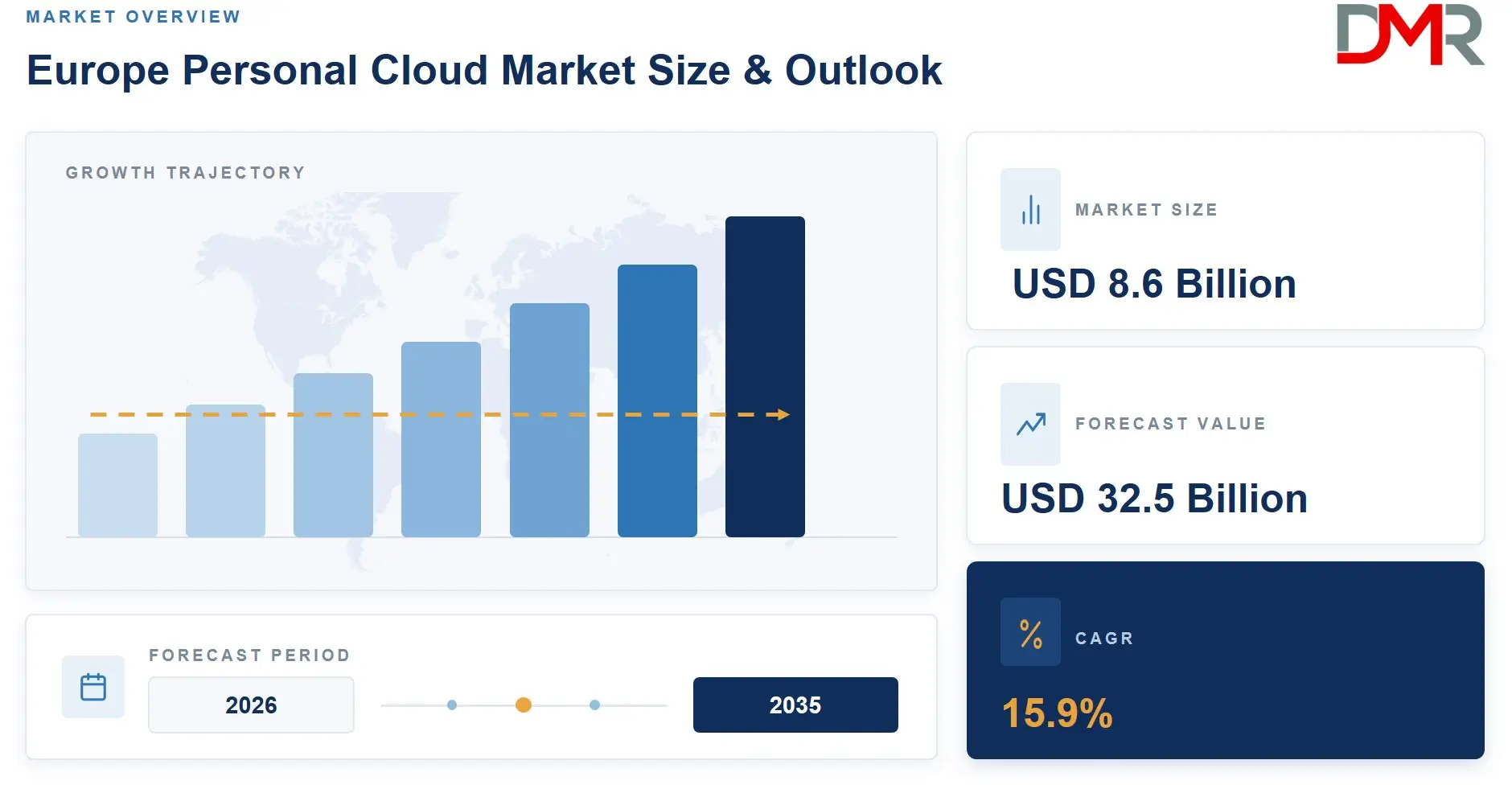
The Europe Personal Cloud Market size is estimated to reach USD 8.6 Bn in 2026 and is further anticipated to reach USD 32.5 Bn by 2035, at a CAGR of 15.9%.
ℹ
To learn more about this report –
Download Your Free Sample Report Here
These figures capture consumer and prosumer demand for subscription storage, automated backup, and file synchronisation purchased and consumed inside Germany, France, the UK, Italy, Spain, and the rest of the region, not the worldwide revenue booked by vendors headquartered there. Personal cloud in this scope covers storage lockers, device backup, photo and video libraries, and the NAS hardware that often pairs with them. Buyers range from individual smartphone owners to multi person households synchronising files across several devices.
Demand concentrates among households with two or more connected devices, since one subscription typically covers an entire family. Freelancers and home based workers add a second growth pocket, backing up client files without paying for enterprise grade collaboration suites. Smartphone camera resolution keeps climbing, so photo and video volume per household is rising faster than the number of new subscribers, pushing existing customers toward higher storage tiers. Device manufacturers also pre load storage apps at the point of sale, converting hardware purchases into recurring cloud revenue.
Data protection law is reshaping vendor selection more directly in Europe than elsewhere, since households increasingly ask where their files are stored before they subscribe. Providers that keep data on servers inside the European Union use this to compete against larger, US headquartered platforms on trust. Telecom operators are also entering the category by bundling storage allowances with mobile and broadband plans, extending personal cloud into households that never shopped for one.
Rest of Europe, spanning the Nordics, Benelux, and Central and Eastern European markets, contributes a smaller but steadily rising share as broadband penetration and smartphone upgrade cycles catch up with the five largest economies.
Use Cases
- Household Photo and Video Backup: A family with several smartphones subscribes to a mid tier storage plan so that photos and videos upload automatically from every device, guarding memories against a lost or damaged phone.
- Hybrid Storage for Data Conscious Users: Privacy aware households in Germany and France increasingly pair a paid cloud tier with a personal NAS device, reflected in hybrid deployment holding close to 28% of deployment mode revenue in 2026, keeping sensitive files on premise.
- Freelancer Client File Backup: An independent designer or consultant in the UK or Italy uses a personal cloud subscription to back up client deliverables and project archives automatically overnight, avoiding a dedicated business storage contract while still meeting client confidentiality expectations.
- Telecom Bundled Storage for New Subscribers: A mobile operator in Spain bundles a modest storage allowance into a mid tier phone plan, converting subscribers who never searched for cloud storage into active users who later upgrade once storage runs low.
Key Takeaways
- Market Size & Share: The Europe Personal Cloud Market is valued at USD 8.6 Bn in 2026, expanding at a CAGR of 15.9% through 2035.
- Offering Analysis: Photo & Video Management is the fastest growing offering, expanding at a CAGR of 24.8% through 2035.
- Demand Concentration: Germany, the UK, and France lead regional demand, anchored by Germany's cluster of domestic storage and hosting providers.
- Deployment Shift: Hybrid cloud and local storage deployment is growing at 22.1% annually as data conscious households pair subscriptions with NAS hardware.
- Subscription Upgrade: Paid family and multi user plans are expanding at 21.4% a year as households consolidate accounts into a single shared plan.
- Channel Expansion: Telecom operator bundled distribution is the fastest growing channel at a 20.7% CAGR, reaching households that never shopped directly.
How AI/Gen AI is Transforming the Europe Personal Cloud Market?
Artificial intelligence is turning personal cloud storage into an active organisation and protection layer for personal data across Europe. Providers use on device models to sort, tag, and surface photos and documents automatically. Ransomware detection is a second focus, flagging unusual encryption patterns before a backup set is compromised. European vendors increasingly process recognition on device rather than sending raw images to central servers.
Generative features remain a smaller part of the picture than in enterprise software, since most AI investment here targets classification and search, not content creation. Large language model assistants are appearing inside storage apps, letting users search files using natural language instead of folder names. Providers also apply machine learning to predict storage needs and pre position files. The near term opportunity is making existing storage more useful, not generating new content.
- Computer Vision Photo Tagging: Automatic recognition of faces, locations, and objects across a photo library, enabling natural language search.
- LLM Based File Search: Assistants that retrieve documents, images, and backups by describing their content rather than a file name or folder.
- Anomaly Detection for Ransomware: Behavioural models that flag abnormal encryption or deletion activity and pause synchronisation before a device overwrites clean backups.
- Predictive Storage Tiering: Usage pattern models that anticipate which files a household will need next and cache them locally, reducing sync delay across devices.
Key Drivers in the Europe Personal Cloud Market
Two forces are pulling demand for personal cloud services across Europe in different but reinforcing ways.
- Rising Device and Content Density per Household: European households now own several internet connected devices per person, from smartphones to tablets to smart home cameras, and each device generates photos, video, and documents that need a shared, synchronised home. As camera resolution and video length both continue to climb, the volume of content a typical household wants to protect grows faster than the number of new subscribers entering the market. Providers respond by pushing existing customers toward higher storage tiers rather than relying only on new sign ups, keeping average revenue climbing even where smartphone penetration has plateaued.
- Data Residency Preference Among European Buyers: Households and small businesses across the region increasingly ask where their data physically sits before choosing a provider, a preference sharpened by years of public debate around cross border data transfers. Providers that can point to storage located inside the European Union, and that publish clear data handling terms, use this as a genuine differentiator against larger platforms headquartered outside the region. Telecom operators and domestic hosting firms have built marketing campaigns around local storage, converting a compliance requirement into a consumer facing selling point.
Restraints in the Europe Personal Cloud Market
Two brakes slow otherwise steady adoption across the region.
- Free Tier Ceilings Cap Conversion: Ecosystem players routinely offer several gigabytes of storage free with a device or an email account, and a large share of casual users never exceed that ceiling. Converting a free user into a paying subscriber typically requires either a life event, such as buying a new phone with a larger camera, or a scare, such as running out of space during an upload. Because that trigger point is unpredictable, providers cannot reliably forecast conversion timing, which slows revenue growth even where the installed base of free accounts is large and growing.
- Price Sensitivity Against Bundled Alternatives: Smartphone and laptop manufacturers frequently include a baseline storage allowance with new hardware, and telecom operators layer additional allowances into mobile contracts at little marginal cost. Standalone storage specialists compete against these bundled offers, which are often perceived by consumers as effectively free since they arrive attached to a purchase the household was making anyway. Independent providers must therefore compete on features such as privacy, family sharing, or NAS integration rather than on price, narrowing the pool of buyers willing to pay a separate subscription for capacity alone.
Growth Opportunities in the Europe Personal Cloud Market
Two pockets of unmet demand stand out for providers willing to specialise.
- SOHO and Freelancer Bundles: Europe's freelance and micro business population has grown steadily as remote and hybrid work normalises, creating a buyer segment that needs more storage and reliability than a casual consumer but does not want to pay for full enterprise software. Providers that package personal cloud storage with lightweight invoicing, client file sharing links, and version history at a modest price premium can capture this segment without building a full business suite, positioning the upgrade as a natural next step for a freelancer outgrowing a free personal account.
- NAS Integrated Hybrid Plans: Consumer network attached storage sales have created an installed base of households that already own local storage hardware but still want off site backup for disaster protection. Cloud providers that offer a discounted hybrid tier explicitly designed to back up a NAS device, rather than treating local storage and cloud storage as competing choices, can convert existing hardware owners into subscribers without asking them to give up the local control that led them to buy a NAS device, while still guaranteeing an off site copy exists if the hardware fails.
Trends in the Europe Personal Cloud Market
Two shifts in buyer behaviour are visible across the category right now.
- Consolidation Around Family Plans: Providers are shifting pricing away from per user tiers toward flat family plans that cover five or six accounts under one subscription and one storage pool. This mirrors how streaming services restructured pricing around households rather than individuals, and it is pushing average storage allowances per plan higher even as headline subscription prices stay roughly flat, since providers absorb the extra capacity cost in exchange for reduced churn from multi person households that rarely cancel a shared plan once several family members depend on it for everyday access.
- Storage as a Retention Tool for Telecom Operators: Mobile and broadband operators increasingly treat bundled cloud storage as a switching cost rather than a standalone revenue line, since a customer with years of backed up photos is less likely to change provider even if a competitor offers a cheaper tariff. This has turned storage allowances into a loyalty mechanism embedded quietly inside contract renewals, shifting competitive attention away from headline storage pricing and toward how deeply a provider's app is integrated into a household's daily use across phones, tablets, and computers.
Research Scope and Analysis
Segment performance is assessed across five axes: offering, deployment mode, end user, subscription model, and distribution channel. Each axis identifies the sub-segment carrying the largest share of 2026 revenue and the one expanding fastest through 2035, along with the commercial reason behind each position.
ℹ
To learn more about this report –
Download Your Free Sample Report Here
By Offering
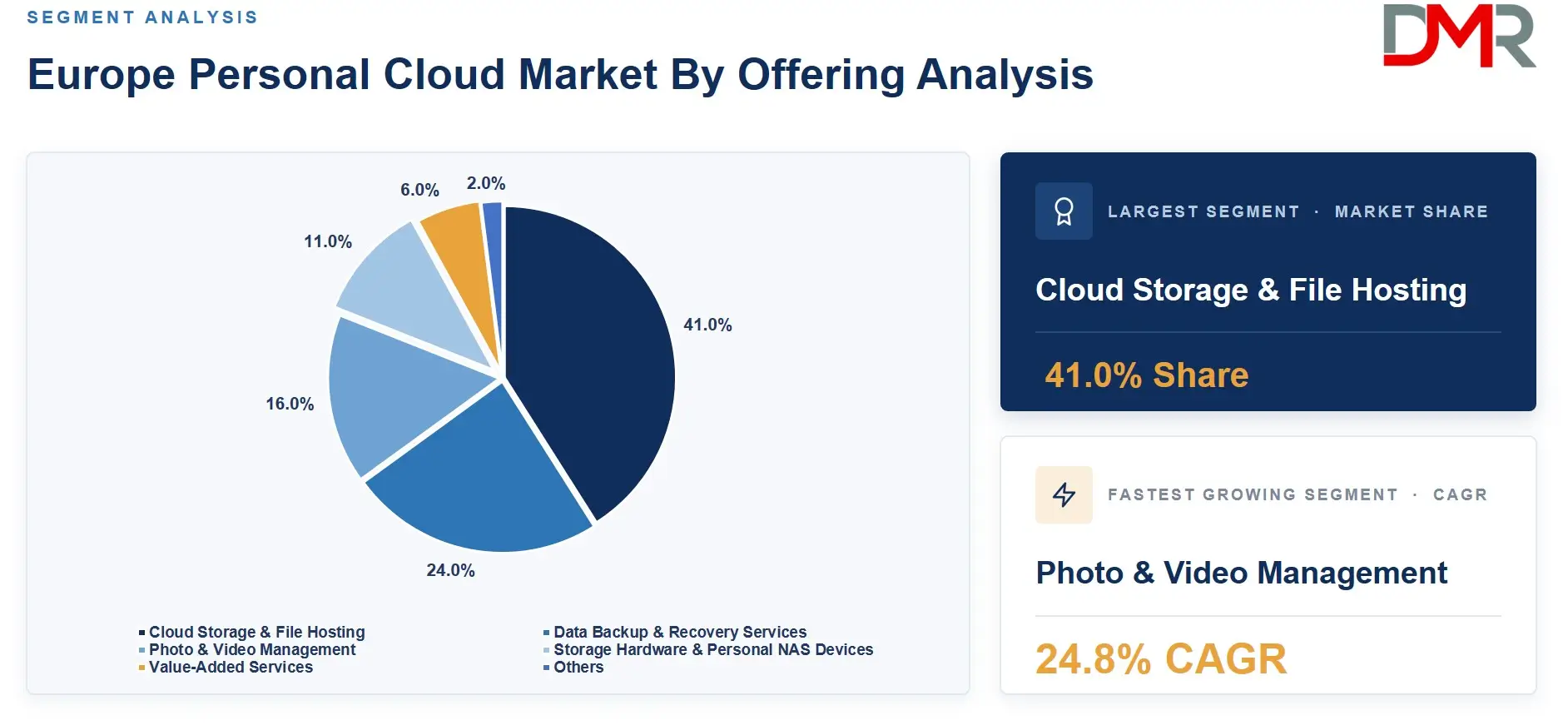
Cloud Storage & File Hosting holds the largest share of 2026 revenue by offering, accounting for close to 41%, since it is the default entry point for nearly every personal cloud subscription. Its position is reinforced by device makers that default new accounts into a general purpose storage locker before any backup feature is configured. Growth, however, is concentrated in Photo & Video Management, expanding at a CAGR of 24.8% between 2026 and 2035 as smartphone camera resolution and video length rise faster than new subscriber additions. Households already paying for general storage are upgrading specifically to accommodate media libraries, making photo and video handling the main trigger for tier upgrades.
By Deployment Mode
Public Cloud-Only deployment leads the axis in 2026, holding approximately 57% of revenue, because it requires no hardware purchase and lets a household start protecting files within minutes of installing an app. Device makers reinforce this by bundling public cloud accounts directly into new phones, laptops, and tablets. The steeper trajectory sits with Hybrid Cloud & Local Storage, growing at a CAGR of 22.1% through 2035 as privacy conscious households in Germany, France, and the Nordics pair a cloud tier with a NAS device to keep sensitive files on premise. On-Premise/NAS-Only deployment remains a smaller niche favoured by technically confident users who prefer full control over their data and are comfortable managing their own backups.
By End User
Individual/Retail Consumers account for the largest share of 2026 revenue at close to 52%, reflecting that most personal cloud subscriptions begin as a single user decision even when a household later adds accounts. Their scale reflects sheer subscriber count rather than high spend per account, since individual plans carry a lower average storage allowance than family plans. The fastest growing group is SOHO/Freelancers & Micro-Businesses, expanding at a CAGR of 23.6% as Europe's independent workforce grows and increasingly needs reliable client file backup without the cost of a business grade contract. Family/Multi-Device Households sit between the two, upgrading steadily as providers push flat family pricing that rewards several connected accounts under one subscription.
By Subscription Model
Paid Individual Plans remain the largest subscription model in 2026, representing around 38% of revenue, since most users still enter on a single account before household consolidation occurs. Free/Freemium tiers retain a meaningful share as an acquisition channel that feeds future paid conversions, particularly once a user nears the storage ceiling of a free account. Growth is fastest in Paid Family/Multi-User Plans, expanding at a CAGR of 21.4% as providers restructure pricing around shared storage pools rather than per user allowances, encouraging households to consolidate subscriptions into one family plan. Prosumer and power user tiers remain a smaller, steady contributor from freelancers and content creators who need more capacity than a standard household plan provides.
By Distribution Channel
OEM Bundled distribution, where storage arrives pre installed on a new device, leads the channel split in 2026 with approximately 44% of revenue, since it places a cloud account in front of every new device buyer without any separate marketing spend. Direct-to-Consumer sign up remains the second largest channel, driven by users actively searching for more capacity. The fastest growing channel is Telecom Operator Bundled distribution, at a CAGR of 20.7%, as mobile and broadband operators increasingly fold storage allowances into contract renewals to reduce churn. Retail and electronics store sales of NAS hardware round out the smaller physical channel, serving buyers who prefer to own their storage hardware outright.
The Europe Personal Cloud Market Report is Segmented Based on the Following
By Offering
- Cloud Storage & File Hosting
- Data Backup & Recovery Services
- Photo & Video Management
- Storage Hardware & Personal NAS Devices
- Value-Added Services
- Others
By Deployment Mode
- Public Cloud-Only
- Hybrid Cloud & Local Storage
- On-Premise/NAS-Only
- Others
By End User
- Individual/Retail Consumers
- Family/Multi-Device Households
- SOHO/Freelancers & Micro-Businesses
- Others
By Subscription Model
- Paid Individual Plans
- Free/Freemium (Base Tier)
- Paid Family/Multi-User Plans
- Prosumer/Power-User Plans
- Others
By Distribution Channel
- OEM Bundled (Pre-installed on Devices)
- Direct-to-Consumer (App/Web Sign-up)
- Telecom Operator Bundled
- Retail/Electronics Stores (NAS Hardware)
- Others
Regulatory Landscape
Data protection law is the most consequential regulatory force on personal cloud providers in Europe, since the General Data Protection Regulation and the Data Act set expectations for where consumer files sit. Enforcement has tightened steadily, pushing providers to publish clearer data location disclosures and build storage inside the Union. This has opened space for domestically headquartered hosting firms to compete against larger platforms on data location rather than price alone. The compliance burden falls hardest on smaller providers, who must fund audits without a larger platform's scale. Regulatory direction is expected to keep favouring providers that can demonstrate verifiable in region storage.
Technology Analysis
Personal cloud infrastructure across Europe is shifting from simple file replication toward AI assisted organisation and on device processing. Storage providers are investing in on device recognition models that classify photos and detect threats without sending raw files to central servers, shaped by regional privacy expectations. The commercial opening lies in selling this privacy preserving processing as a differentiator against platforms relying on centralised analysis. A key risk is computational cost, since on device processing needs more capable hardware and cannot always match larger models. Providers that solve this balance well can win data conscious households without sacrificing search and organisation features.
Competitive Landscape
Competition in the Europe personal cloud market spans three groups: device and platform ecosystems that bundle storage with hardware, independent storage specialists competing on privacy and price, and telecom operators bundling allowances into connectivity contracts. Concentration is moderate, since ecosystem players hold the largest installed base of free and low tier accounts but rarely dominate the paid, higher capacity segment where independent providers compete directly. Basis of competition has shifted from raw storage price toward data location and family sharing features, and domestically headquartered hosting and telecom firms have used data residency commitments to win share from larger, non European platforms, particularly in Germany and France. Consolidation activity remains limited, with most firms expanding organically or through channel partnerships rather than acquisition.
Some of the Prominent Players in the Europe Personal Cloud Market Are
- Google
- Microsoft
- Apple
- Amazon
- Dropbox
- Synology
- Western Digital
- Seagate
- QNAP
- Netgear
- pCloud
- Internxt
- Proton AG
- Tresorit
- IDrive
- Backblaze
- Sync.com
- Mega Limited
- Icedrive
- Koofr
- Degoo
- CloudMe
- Filen
- Nextcloud GmbH
- ownCloud
- Egnyte
- Box
- TerraMaster
- Deutsche Telekom
- OVHcloud
- Hetzner Online
- STRATO AG
- Free (Iliad Group)
- Orange S.A.
- Telefonica
- Vodafone Group
- Telecom Italia (TIM)
- BT Group
- KPN
- Swisscom
- Other Key Players
Recent Developments
- In June 2026, Deutsche Telekom expanded MagentaCLOUD storage allowances for postpaid customers in Germany, bundling extra capacity into existing contracts rather than a new paid tier.
- In February 2026, OVHcloud opened an additional storage region in France dedicated to consumer workloads, reducing latency for personal cloud applications built on its infrastructure.
- In October 2025, Proton AG expanded Proton Drive's family plan capacity across its European subscriber base, targeting households consolidating multiple individual accounts into one shared plan.
- In July 2025, Internxt raised a new funding round to expand its privacy focused storage infrastructure hosted within the European Union, citing demand from data residency conscious customers.
- In March 2025, Swisscom extended its cloud storage bundle to additional broadband tariffs across Switzerland, folding personal backup capacity into standard household internet contracts for new subscribers.
Report Details
| Report Characteristics |
| Market Size (2026) |
USD 8.6 Bn |
| Forecast Value (2035) |
USD 32.5 Bn |
| CAGR (2026-2035) |
15.9% |
| Historical Data |
2021 - 2025 |
| Forecast Data |
2026 - 2035 |
| Base Year |
2025 |
| Segments Covered |
By Offering, By Deployment Mode, By End User, By Subscription Model, and By Distribution Channel |
| Regional Coverage |
Europe - Germany, France, The UK, Italy, Spain, Rest of Europe |
Frequently Asked Questions
How big is the Europe Personal Cloud Market?
▾ The Europe Personal Cloud Market was valued at approximately USD 8.6 Bn in 2026 and is projected to reach USD 32.5 Bn by 2035, expanding at a CAGR of 15.9%. Growth is driven by rising device density per household, increasing photo and video volumes, and telecom operators bundling storage allowances into contracts across the region.
What is the growth rate of the Europe Personal Cloud Market?
▾ The market is forecast to expand at a CAGR of 15.9% between 2026 and 2035. This pace reflects steady subscriber growth combined with faster growth in storage consumption per household, as camera resolution and video length outpace the rate at which new users enter the category across Germany, France, and the wider region.
Which country holds the largest share in the Europe Personal Cloud Market?
▾ Germany holds the largest share of regional demand, supported by its large base of connected households and a cluster of domestically headquartered hosting and telecom providers offering data residency guarantees. The UK and France follow closely behind, forming the three largest national markets in the region, ahead of Italy and Spain.
Who are the key players in the Europe Personal Cloud Market?
▾ Key players include Google, Microsoft, Apple, Dropbox, Deutsche Telekom, OVHcloud, and Proton AG, among others. Competition spans large device and platform ecosystems, independent European specialists such as pCloud and Internxt, and telecom operators that bundle storage into mobile and broadband contracts. Domestically headquartered hosting firms have also gained ground offering verifiable in region storage.
What are the leading offerings in the Europe Personal Cloud Market?
▾ Cloud Storage & File Hosting leads the offering split, accounting for close to 41% of 2026 revenue, followed by Data Backup & Recovery Services at around 24%. Photo & Video Management is the fastest growing offering, expanding at a CAGR of 24.8% as smartphone media volumes keep climbing across the region.
How is data privacy regulation shaping the Europe Personal Cloud Market?
▾ Data protection rules, including the General Data Protection Regulation and the Data Act, push providers to store consumer files inside the European Union and disclose data locations clearly. This has strengthened domestically headquartered hosting and telecom firms, which compete against larger international platforms by offering verifiable in region storage for privacy conscious households.
What role does AI play in the Europe Personal Cloud Market?
▾ Artificial intelligence is used mainly for photo and document organisation, natural language file search, and ransomware detection rather than content generation. Providers increasingly favour on device processing over centralised analysis to align with regional privacy expectations, a design choice that is becoming a competitive differentiator across the Europe Personal Cloud Market.