Global FDI Perspective of Big Data Technology Market Snapshot
- Global Big Data Technology Market Size, 2026: USD 444.6 billion
- Projected Market Size, 2035: USD 1,333.8 billion
- Global CAGR, 2026–2035: 13.0%
- Leading FDI Type: Greenfield Investment, 46%
- Leading Investment Focus: Big Data Software & Platforms, 44%
- Leading Technology Focus: Cloud Big Data, 39%
- Leading End-Use Industry: BFSI, 20%
- Fastest-Growing Segment: Artificial Intelligence & Machine Learning, 16.5% CAGR
- Leading Region, 2026: North America, 36.5%
What is the Global FDI Perspective of Big Data Technology and its Market Size?
Big Data Technology encompasses the hardware, cloud infrastructure, databases, data lakes, data warehouses, integration platforms, analytics software, visualization tools, artificial intelligence and machine-learning technologies used to capture, store, process, govern and extract value from very large and complex datasets. The market also includes technology platforms that enable real-time analytics, predictive modelling, automated decision-making and AI applications.
ℹ
To learn more about this report –
Download Your Free Sample Report Here
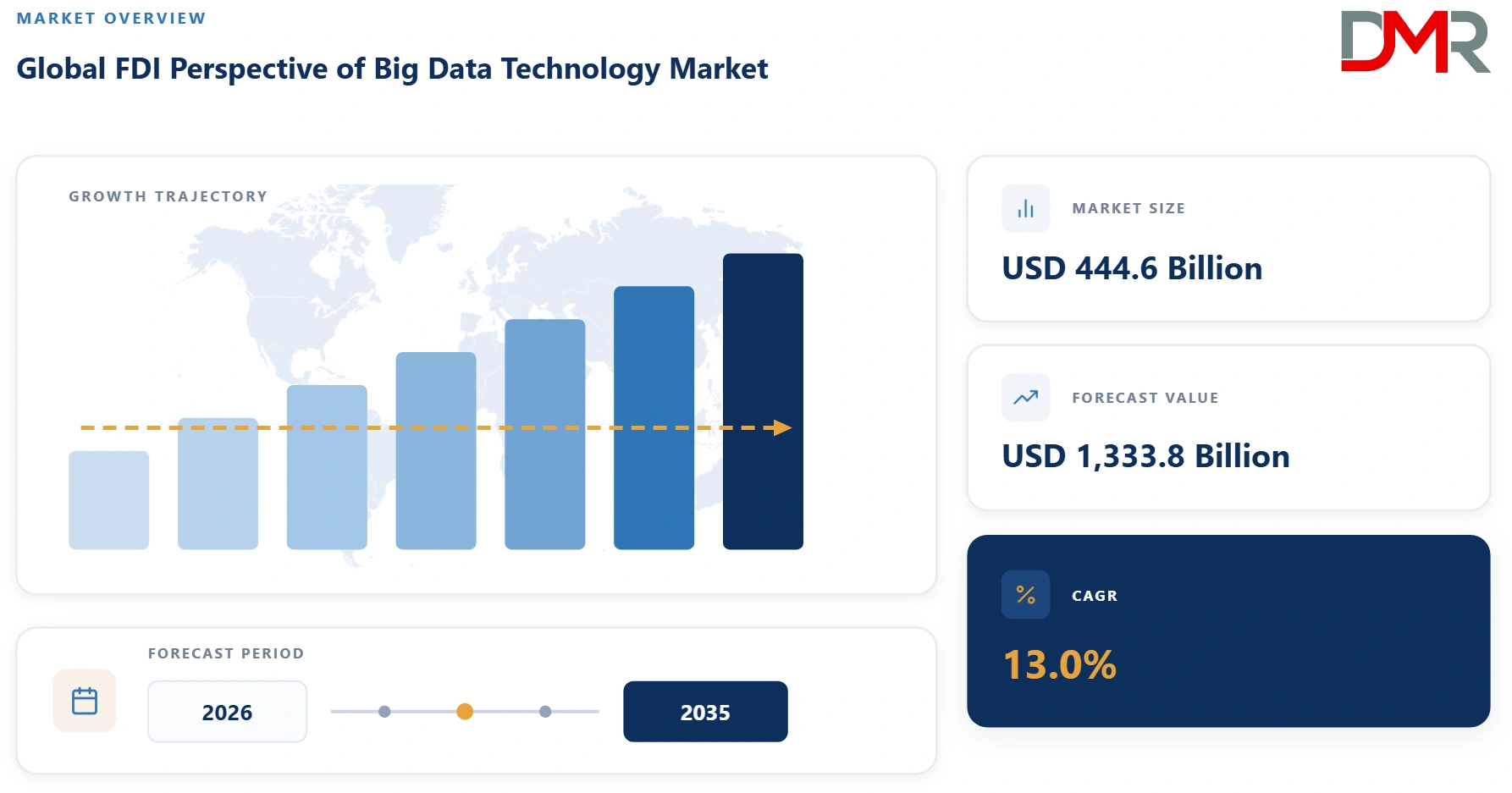
The global market is estimated at USD 444.6 billion in 2026 and is projected to reach approximately USD 1,333.8 Billion by 2035, representing a 13.0% CAGR.
Growth is being supported by enterprise digitization, cloud migration, increasing IoT and connected-device volumes, AI adoption, cybersecurity requirements and the need to turn operational data into real-time intelligence. Published research likewise identifies rising data volumes, cloud adoption, advanced analytics and AI/ML integration as major growth factors.
Use Cases
- Predictive Analytics: Uses historical and real-time datasets to forecast demand, equipment failures, customer behaviour and financial risks.
- Fraud Detection: Combines transaction, behavioural and contextual data to identify suspicious activities and reduce financial losses.
- Personalized Customer Experience: Analyzes customer interactions and preferences to improve recommendations, pricing and retention strategies.
- Supply Chain Optimization: Integrates logistics, inventory, supplier and demand data to improve forecasting and operational resilience.
- Healthcare Intelligence: Supports clinical analytics, population-health management, drug discovery and personalized treatment decisions.
- Smart Operations: Uses IoT, edge computing and real-time analytics to optimize factories, utilities, transport systems and infrastructure.
Key Takeaways
- The global Big Data Technology Market is estimated at USD 444.6 billion in 2026 and could exceed USD 1.3 trillion by 2035.
- AI/ML integration, cloud migration and enterprise data modernization are the principal growth catalysts.
- Greenfield investment represents the largest FDI structure because new data centres, cloud regions and AI infrastructure require significant new physical capacity.
- Big Data Software & Platforms lead investment focus, while Cloud Big Data remains the largest technology category.
- AI and Machine Learning is expected to be the fastest-growing technology focus, benefiting from demand for enterprise AI, agentic applications and predictive analytics.
- North America remains the largest market, while Asia-Pacific is expected to record the fastest regional growth.
- FDI is increasingly concentrated in data centres, AI compute, semiconductor ecosystems and sovereign digital infrastructure. UNCTAD estimates that digital-economy FDI has become an increasingly important share of global investment.
How AI/Gen AI is Transforming the FDI Perspective of Big Data Technology Market?
AI and machine learning are shifting big-data platforms from passive data storage and reporting systems toward intelligent decision engines. Organizations increasingly integrate lakehouses, data warehouses and real-time data pipelines with foundation models, predictive models and AI agents. This is creating demand for vector databases, semantic layers, feature stores, model governance and real-time data architectures. Microsoft and Databricks, for example, are expanding integration between enterprise data, AI agents and governed analytics platforms.
The primary benefits are faster decision-making, lower data-processing costs, automation of repetitive analytical tasks and improved utilization of enterprise information. Cloud infrastructure also allows companies to scale computing and storage dynamically without building equivalent on-premises capacity.
The competitive landscape is consequently shifting from traditional database vendors toward integrated data-and-AI platforms. Vendors increasingly compete on interoperability, AI readiness, governance, security, cloud portability and ability to place enterprise data directly into AI workflows. Oracle's 2026 AI Database initiatives and Microsoft's Fabric strategy illustrate this convergence between databases, analytics and AI.
Key Drivers in the Global FDI Perspective of Big Data Technology Market
Accelerating AI and Data-Centric Enterprise Transformation
AI adoption is becoming a major structural driver of Big Data Technology investment. Enterprise AI applications require high-quality, governed and continuously refreshed data, making data platforms a prerequisite for successful AI deployment. Companies are therefore increasing spending on data lakes, lakehouses, real-time pipelines, vector databases, metadata management and AI governance rather than treating analytics as an isolated IT function.
Cloud Migration and Expansion of Digital Infrastructure
Cloud adoption is transforming the economics of big-data deployment by allowing enterprises to access elastic storage and computing capacity without building large physical infrastructure footprints. Hybrid and multicloud architectures are particularly important for multinational companies seeking flexibility, regulatory compliance and regional data residency.
Restraints in the Global FDI Perspective of Big Data Technology Market
Data Privacy, Sovereignty and Regulatory Fragmentation
Data-intensive businesses face growing requirements concerning personal-data protection, cross-border transfers, AI governance, cybersecurity and data localization. Regulatory fragmentation can increase the cost of deploying a standardized global data architecture and may discourage investment where foreign ownership or cross-border data movement is restricted.
Growth Opportunities in the Global FDI Perspective of Big Data Technology Market
Sovereign AI and Regional Data Infrastructure
Sovereign AI, sovereign clouds and locally operated data platforms represent a significant FDI opportunity as governments seek greater control over strategic data and AI capabilities. Demand is expanding for national AI factories, government clouds, regulated-sector data centres and localized analytics platforms.
AI-Native Data Platforms and Data Governance
The next investment cycle will increasingly favour platforms that combine data management, analytics, AI development, security and governance. Rather than purchasing numerous disconnected tools, enterprises are moving toward unified data estates capable of supporting both traditional analytics and AI agents.
Trends in the Global FDI Perspective of Big Data Technology Market
Convergence of Data Platforms and AI
Traditional distinctions between databases, analytics, business intelligence and AI are disappearing. Vendors increasingly position data platforms as the foundation for agentic AI, enabling models to access governed enterprise information in real time.
Infrastructure Becomes an Investable AI Asset Class
AI is turning data centres, compute infrastructure and specialized networking into investment opportunities for infrastructure funds and institutional investors. In 2026, NVIDIA announced plans with major financial institutions to create financing platforms targeting more than USD 500 billion of third-party capital for AI infrastructure.
Research Scope and Analysis
The market is segmented from an FDI perspective by FDI Type, Investment Focus, Technology Focus and End-Use Industry. These dimensions distinguish how international capital enters the ecosystem, where it is allocated, which technologies receive investment and which industries generate demand.
ℹ
To learn more about this report –
Download Your Free Sample Report Here
By FDI Type Analysis
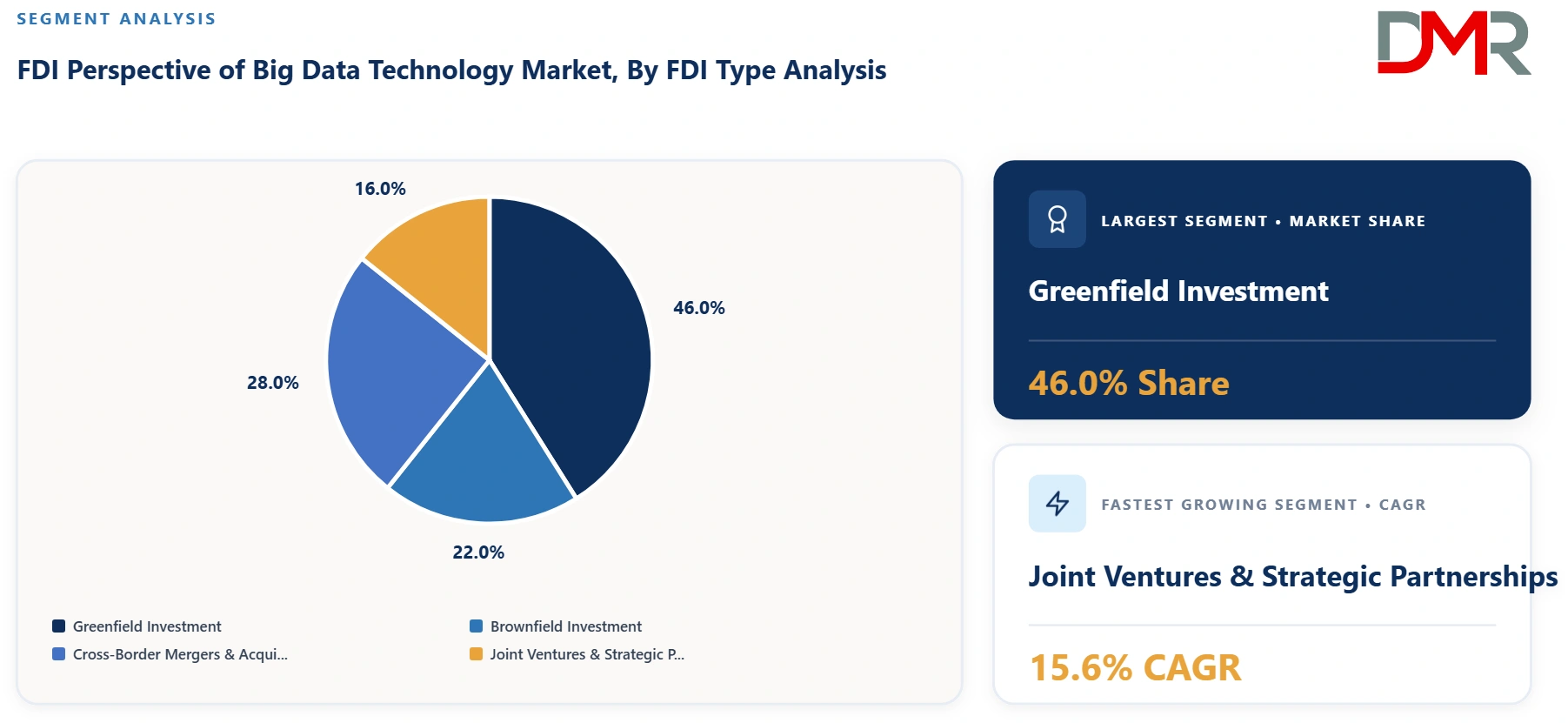
Greenfield Investment is estimated to dominate FDI-linked Big Data Technology investment in 2026, accounting for approximately 46%, reflecting the capital intensity of new data centres, cloud regions, AI factories and digital infrastructure. Greenfield projects provide multinational technology companies with direct control over infrastructure, security, capacity planning and regional data residency. Cross-Border Mergers & Acquisitions are the second-largest category at approximately 28%, supported by technology consolidation and strategic acquisition of analytics, cybersecurity and AI capabilities. Joint Ventures & Strategic Partnerships represent around 16%, increasingly important where projects require local infrastructure, government support or large-scale financing. Brownfield Investment accounts for roughly 10% but remains strategically relevant for upgrading existing data centres and enterprise infrastructure. Greenfield is expected to remain dominant, while strategic partnerships are likely to record the fastest growth as AI infrastructure projects become too capital-intensive for single investors. UNCTAD's finding that data centres generated more than USD 270 billion of announced FDI in 2025 reinforces the importance of new-build investment.
By Investment Focus Analysis
Big Data Software & Platforms represent the dominant investment focus, with an estimated 44% share in 2026, driven by demand for data-management platforms, analytics, databases, lakehouses, AI-ready data architectures and governance solutions. Big Data Infrastructure ranks second at approximately 34%, reflecting strong investment in data centres, servers, high-performance computing, storage and networking. Big Data Analytics Services account for approximately 22%, supported by enterprise modernization, implementation and managed analytics. Software and platforms are expected to maintain leadership, but infrastructure is attracting exceptionally large individual investments because of the physical requirements of AI workloads. The fastest-growing investment pocket is expected to be AI-native software and data platforms, as enterprises seek integrated environments capable of supporting analytics, generative AI and agentic workflows.
By Technology Focus Analysis
Cloud Big Data leads the technology segment with an estimated 39% share in 2026, supported by enterprise cloud migration, elastic storage requirements and the expansion of hyperscale infrastructure. Artificial Intelligence & Machine Learning represents approximately 28%, but is the fastest-growing category at an estimated 16.5% CAGR, reflecting rapid adoption of generative AI, predictive analytics, AI agents and machine-learning operations. Data Lakes & Data Warehousing hold around 18%, followed by Data Integration & Management at approximately 9% and Data Security & Governance at 6%. AI/ML is expected to gain share fastest because organizations increasingly view high-quality data as the prerequisite for enterprise AI. Microsoft's Fabric strategy and Oracle's AI Database developments illustrate the convergence of databases, analytics and AI.
By Investor Type Analysis
Technology Companies are expected to dominate the Investor Type segment of the FDI Perspective of Big Data Technology Market, accounting for approximately 43% share in 2026. Their leadership is supported by hyperscale cloud providers, semiconductor companies, enterprise software vendors and AI firms investing directly in data centres, cloud regions, AI infrastructure and data platforms. Private Equity & Venture Capital Firms represent the second-largest category at approximately 27%, driven by investments in high-growth analytics, AI, cybersecurity and data-management companies. Financial Institutions account for around 17%, while Corporate & Industrial Investors contribute approximately 13%. Technology Companies are expected to remain dominant, whereas Private Equity & Venture Capital Firms are projected to be the fastest-growing investor category, supported by increasing investment in AI-native data platforms, analytics software and digital infrastructure. The growing involvement of infrastructure-focused funds and institutional capital is also expanding the investor base beyond traditional technology companies.
By Enterprise Size Analysis
Large Enterprises are expected to dominate the Enterprise Size segment of the FDI Perspective of Big Data Technology Market, representing approximately 72% share in 2026. Large multinational organizations account for the majority of investment because they possess the capital, global operations and complex data environments required for large-scale cloud migration, AI deployment, data modernization and international infrastructure projects. Small & Medium Enterprises (SMEs) account for approximately 28% but are expected to register the faster growth rate as cloud-based Big Data platforms reduce upfront infrastructure requirements and make advanced analytics accessible without major capital expenditure. Large enterprises will continue to lead due to substantial spending by BFSI, telecommunications, manufacturing, healthcare and government organizations, while SMEs will increasingly adopt managed analytics, SaaS-based data platforms and cloud-native AI solutions. Consequently, the SME segment is expected to gain market share gradually through 2035 as technology costs decline and scalable cloud services become more widely available.
By End Use Industry Analysis
Banking, Financial Services & Insurance (BFSI) is estimated to be the largest end-use segment with approximately 20% of market revenue in 2026, owing to intensive use of big data for fraud detection, credit scoring, risk management, personalization, trading and regulatory reporting. IT & Telecommunications is the second-largest segment at approximately 18%, benefiting from network analytics, customer intelligence, cloud workloads and AI infrastructure. Manufacturing follows at around 15%, supported by predictive maintenance, industrial IoT and smart-factory applications. Retail and e-commerce account for approximately 12%, while healthcare and life sciences represent 11%. Government, energy and utilities, and transportation/logistics account for the remaining demand. Manufacturing, healthcare and government are expected to see particularly strong growth as analytics expands beyond customer-facing applications into operational and public-sector decision-making.
The Global FDI Perspective of Big Data Technology Market Report is segmented on the basis of the following:
By FDI Type
- Greenfield Investment
- Brownfield Investment
- Cross-Border Mergers & Acquisitions
- Joint Ventures & Strategic Partnerships
By Investment Focus
- Big Data Infrastructure
- Big Data Software & Platforms
- Big Data Analytics Services
By Technology Focus
- Cloud Big Data
- Artificial Intelligence & Machine Learning
- Data Lakes & Data Warehousing
- Data Integration & Management
- Data Security & Governance
By Investor Type
- Technology Companies
- Private Equity & Venture Capital Firms
- Financial Institutions
- Corporate & Industrial Investors
By Enterprise Size
- Large Enterprises
- Small & Medium Enterprises
By End-Use Industry
- Banking, Financial Services & Insurance
- Healthcare & Life Sciences
- IT & Telecommunications
- Retail & E-Commerce
- Manufacturing
- Government & Public Sector
- Energy & Utilities
- Transportation & Logistics
Regional Analysis
North America is the Leading Region in the Global FDI Perspective of Big Data Technology Market
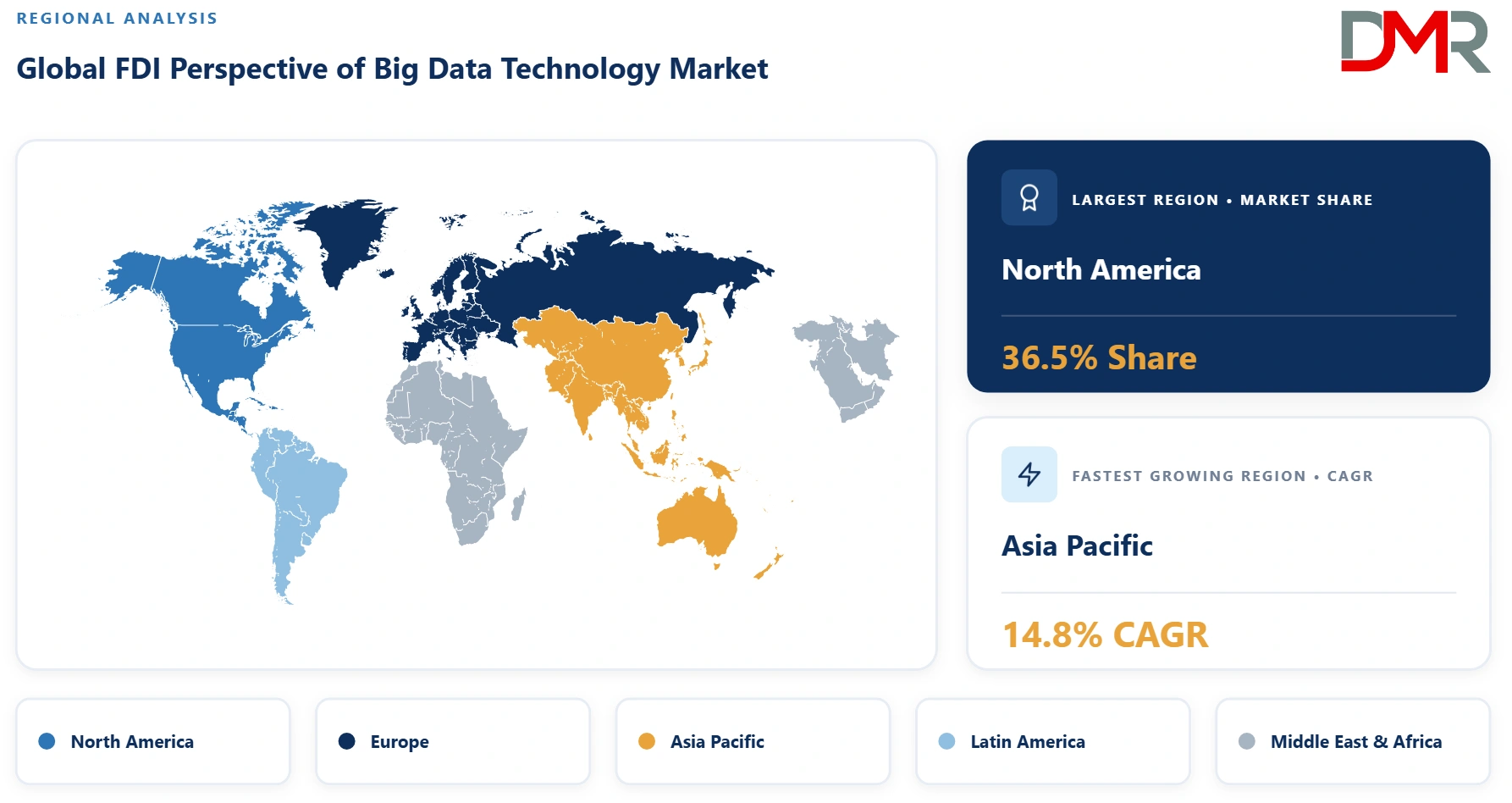
North America is expected to maintain its leading position, accounting for approximately 36.5% of the global market in 2026, equivalent to roughly USD 162.3 billion. The region benefits from a mature cloud ecosystem, high enterprise software spending, strong AI investment, advanced data-centre infrastructure and the presence of leading technology vendors. The United States remains the primary regional investment destination because of its concentration of hyperscalers, AI companies, venture capital, private equity and institutional infrastructure investors. North America is also a major source of outbound FDI into digital infrastructure and technology companies. UNCTAD identifies the United States among the leading hosts of data-centre investment, alongside France and South Korea.
ℹ
To learn more about this report –
Download Your Free Sample Report Here
Asia Pacific is the Fastest-Growing Region in the Global FDI Perspective of Big Data Technology Market
Asia-Pacific is projected to be the fastest-growing region, with an estimated 14.8% CAGR through 2035. Growth is driven by rapid digitization, large consumer populations, e-commerce, fintech, manufacturing automation, cloud adoption and government-backed AI initiatives. China, Japan, India, South Korea, Singapore and Southeast Asian markets are attracting investment in cloud regions, semiconductor ecosystems and AI infrastructure. Emerging Asia is particularly important from an FDI perspective because UNCTAD reports that approximately 80% of greenfield digital-sector investment in the Global South is concentrated in only ten economies, mostly in Asia.
The Europe FDI Perspective of Big Data Technology Market
Europe's Big Data Technology Market is estimated at approximately USD 111.2 billion in 2026 and is projected to reach around USD 322 billion by 2035, representing an estimated 12.7% CAGR. Growth is supported by industrial digitalization, automotive analytics, financial services, healthcare, manufacturing and government modernization. Europe's regulatory environment also creates demand for data governance, privacy-enhancing technologies and compliant AI architectures. The EU Data Act has applied since September 2025, while the AI Act reached its general applicability milestone in August 2026, increasing demand for compliance-oriented data and AI infrastructure.
Latin America FDI Perspective of Big Data Technology Market
Latin America's market is estimated at approximately USD 26.7 billion in 2026 and is projected to reach around USD 78 billion by 2035, reflecting a 12.6% CAGR. Brazil and Mexico are the major demand centres, supported by fintech, e-commerce, telecom modernization, retail analytics and digital public services. Increasing cloud adoption and the expansion of regional data centres should encourage additional FDI, while financial inclusion creates substantial demand for analytics-based credit scoring and fraud detection.
MEA FDI Perspective of Big Data Technology Market
The Middle East & Africa market is estimated at approximately USD 20.0 billion in 2026 and is forecast to reach approximately USD 60 billion by 2035, representing a 13.2% CAGR. Gulf markets are leading regional investment through smart-city programmes, sovereign AI initiatives, cloud-first government strategies and large-scale data-centre development. Saudi Arabia and the UAE are expected to capture a disproportionate share of investment, while Africa represents longer-term white-space potential because digital infrastructure remains underfunded. Saudi Arabia's Cloud First Policy explicitly promotes cloud adoption across government technology investments.
Major Countries Analysis
United States FDI Perspective of Big Data Technology Market
The U.S. market is estimated at approximately USD 142 billion in 2026 and could reach USD 416 billion by 2035, representing an estimated 12.7% CAGR. Demand is supported by hyperscale cloud providers, financial services, healthcare, technology companies, defence and advanced manufacturing. AI infrastructure, data centres, enterprise AI platforms and cybersecurity are major investment themes.
Japan FDI Perspective of Big Data Technology Market
Japan's market is estimated at approximately USD 20 billion in 2026 and is projected to reach approximately USD 53 billion by 2035, representing an estimated 11.5% CAGR. Manufacturing, automotive, robotics, healthcare and financial services are key adopters. Ageing demographics and labour shortages further support investment in automation, predictive analytics and AI-enabled operations.
Saudi Arabia FDI Perspective of Big Data Technology Market
Saudi Arabia's market is estimated at approximately USD 3.2 billion in 2026 and could reach roughly USD 11.3 billion by 2035, implying an estimated 15.0% CAGR. Vision 2030, smart-city development, cloud-first government policies, sovereign data requirements and AI infrastructure are major catalysts. The country's PDPL also increases demand for compliant data-management and governance capabilities.
Regulatory Landscape
Regulation is becoming a core determinant of Big Data Technology FDI. In Europe, GDPR governs personal-data processing, while the EU Data Act establishes rules intended to increase access to connected-device data and improve the competitiveness of cloud markets.
The EU AI Act is also materially affecting data and AI architecture, with most provisions becoming applicable from August 2026, subject to transitional exceptions. India has operationalized its data-protection framework through the Digital Personal Data Protection Act 2023 and DPDP Rules 2025, while Saudi Arabia applies its Personal Data Protection Law and rules governing international data transfers. These policies increase compliance costs but simultaneously create demand for data governance, security, localization and privacy-enhancing technologies.
Investment and White Space Analysis or Epidermatology based on the network
The largest white spaces are sovereign AI infrastructure, emerging-market cloud regions, data-security platforms, AI-ready data management, data observability and regulated-industry analytics. UNCTAD estimates that digital-economy FDI averaged approximately USD 122 billion annually in recent years and represented 8.3% of global FDI during 2021–2023, up from 5.5% during 2012–2014. Yet core digital infrastructure in developing countries remains significantly underfunded. This creates opportunities for infrastructure funds, sovereign wealth funds, technology companies and strategic investors to establish regional data centres, cloud capacity, cybersecurity capabilities and local data/AI platforms.
By Region
North America
Europe
- Germany
- France
- The U.K.
- Italy
- Spain
- Rest of Europe
Asia-Pacific
- China
- Japan
- India
- Australia
- South Korea
- Rest of APAC
Latin America
- Mexico
- Brazil
- Rest of LATAM
Middle East & Africa
- Saudi Arabia
- The UAE
- South Africa
- Rest of MEA
Competitive Landscape
The Big Data Technology Market is moderately consolidated at the infrastructure and platform layers but highly fragmented across analytics applications and services. Large technology companies compete through integrated cloud, database, AI and analytics ecosystems, while specialized vendors differentiate through data governance, observability, industry-specific analytics, AI infrastructure and developer tools. Key competitive strategies include strategic partnerships, M&A, cloud alliances, geographic expansion, sovereign-cloud offerings and investment in AI-native products. Major participants include Microsoft, Oracle, NVIDIA, Databricks, IBM, Google, Amazon Web Services, Snowflake, SAP, Salesforce, Teradata, Cloudera, Palantir and Accenture. Competitive differentiation increasingly depends on AI integration, data interoperability, security, governance, performance and total cost of ownership.
Some of the prominent players in the Global FDI Perspective of Big Data Technology Market are:
- IBM
- Microsoft
- Oracle
- SAP
- Amazon Web Services (AWS)
- Google Cloud
- Salesforce
- Teradata
- Cloudera
- Snowflake
- Databricks
- Palantir Technologies
- SAS Institute
- Qlik
- Informatica
- Tableau
- MicroStrategy
- Splunk
- TIBCO Software
- Domo
- Hewlett Packard Enterprise
- Dell Technologies
- Cisco Systems
- NVIDIA
- Intel
- Huawei
- Alibaba Cloud
- Tencent Cloud
- Hitachi Vantara
- Fujitsu
- NEC Corporation
- NTT DATA
- Accenture
- Tata Consultancy Services (TCS)
- Infosys
- Wipro
- HCLTech
- Cognizant
- Capgemini
- Tech Mahindra
- Other Key Players
Recent Developments
- In August 2026, NVIDIA partnered with Apollo, BlackRock, Blackstone, Brookfield, Goldman Sachs and KKR on financing platforms targeting more than USD 500 billion of third-party capital for AI infrastructure, demonstrating the emergence of new institutional financing models around compute and data infrastructure.
- In August 2026, Databricks announced USD 5 billion in new financing at a USD 190 billion valuation, highlighting strong investor appetite for integrated data-management and AI application platforms. Reuters reported annualized revenue above USD 7 billion and continued investment in its lakehouse and AI products.
- In July 2026, Microsoft and Databricks expanded their strategic partnership into the 2030s, deepening Azure Databricks integration and connecting enterprise data, AI agents, governance and Microsoft business applications.
- In July 2026, NVIDIA and SK Group announced a proposed USD 500 billion-plus AI infrastructure initiative, covering AI factories and next-generation memory and illustrating the increasing scale of cross-border investment in AI-enabled data infrastructure.
- In April 2026, Oracle expanded Oracle AI Database@Google Cloud, integrating Gemini Enterprise capabilities to provide natural-language access to enterprise data while extending regional availability.
Report Details
| Report Characteristics |
| Market Size (2026) |
USD 444.6 Bn |
| Forecast Value (2035) |
USD 1,333.8 Bn |
| CAGR (2026–2035) |
13.0% |
| The US Market Size (2026) |
USD 142.0 Bn |
| Historical Data |
2021 – 2025 |
| Forecast Data |
2026 – 2035 |
| Base Year |
2025 |
| Segments Covered |
By FDI Type, By Investment Focus, By Technology Focus, By Investor Type, By Enterprise Size, By End-Use Industry |
| Regional Coverage |
North America – The US and Canada; Europe – Germany, France, The UK, Italy, Spain, Rest of Europe; Asia-Pacific – China, Japan, India, Australia, South Korea, Rest of APAC; Latin America – Mexico, Brazil, Colombia, Argentina, Rest of LATAM; Middle East & Africa – Saudi Arabia, The UAE, South Africa, Rest of MEA |
Frequently Asked Questions
What is the projected size of the FDI Perspective of Big Data Technology Market in 2035?
▾ The FDI Perspective of Big Data Technology Market is estimated to increase from USD 444.6 billion in 2026 to approximately USD 1,333.8 Million by 2035.
What is the expected CAGR of the FDI Perspective of Big Data Technology Market between 2026 and 2035?
▾ The FDI Perspective of Big Data Technology Market is projected to expand at an estimated 13.0% CAGR from 2026 to 2035.
What are the principal growth drivers of the FDI Perspective of Big Data Technology Market?
▾ AI adoption, cloud migration, enterprise digitization, increasing data volumes and investment in digital infrastructure are major drivers of the FDI Perspective of Big Data Technology Market.
Which technology segment is growing fastest in the FDI Perspective of Big Data Technology Market?
▾ Artificial Intelligence and Machine Learning is expected to be the fastest-growing technology segment, with an estimated 16.5% CAGR in the FDI Perspective of Big Data Technology Market.
Which region leads the FDI Perspective of Big Data Technology Market?
▾ North America leads the FDI Perspective of Big Data Technology Market with approximately 36.5% share in 2026, supported by advanced cloud and AI infrastructure.
Which region is expected to grow fastest in the FDI Perspective of Big Data Technology Market?
▾ Asia-Pacific is projected to be the fastest-growing region in the FDI Perspective of Big Data Technology Market, with an estimated 14.8% CAGR through 2035.
Who are the key players in the FDI Perspective of Big Data Technology Market?
▾ Key players in the FDI Perspective of Big Data Technology Market include Microsoft, Oracle, NVIDIA, Databricks, IBM, Google, AWS, Snowflake, SAP, Salesforce and Palantir.
What are the major segments covered in the FDI Perspective of Big Data Technology Market?
▾ The FDI Perspective of Big Data Technology Market is segmented by FDI Type, Investment Focus, Technology Focus, Investor Type, Enterprise Size, End-Use Industry and Region.