Market Snapshot
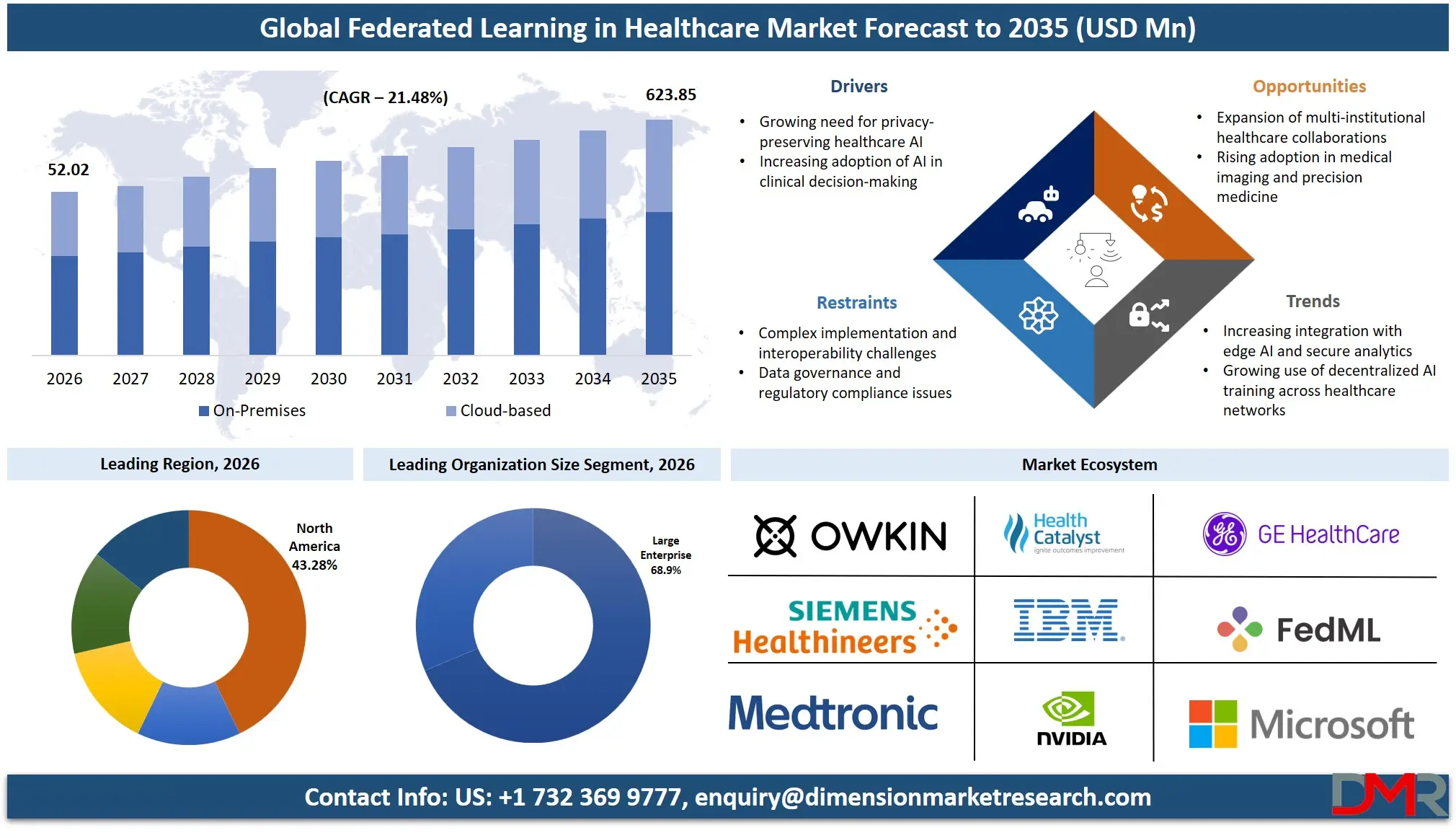
- The Global Federated Learning in Healthcare Market is valued at USD 42.82 Million in 2025, reached USD 52.02 Million in 2026, and is projected to hit USD 623.85 Million by 2035 at a CAGR of 21.48%.
- Drug Discovery and Development leads all application segments with a 38.62% share in 2026.
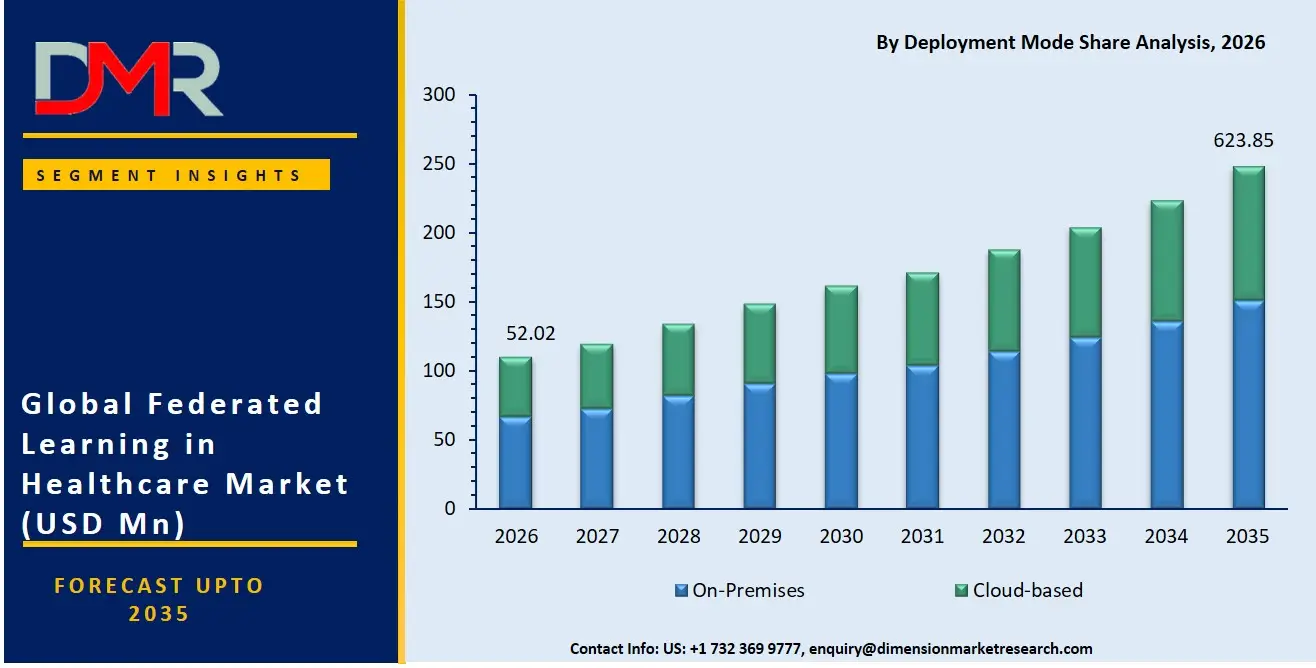
- On-premises deployment accounts for 60.72% of the market by deployment mode in 2026.
- Hospitals and Healthcare Providers represent the largest end-user group with a 41.25% share in 2026.
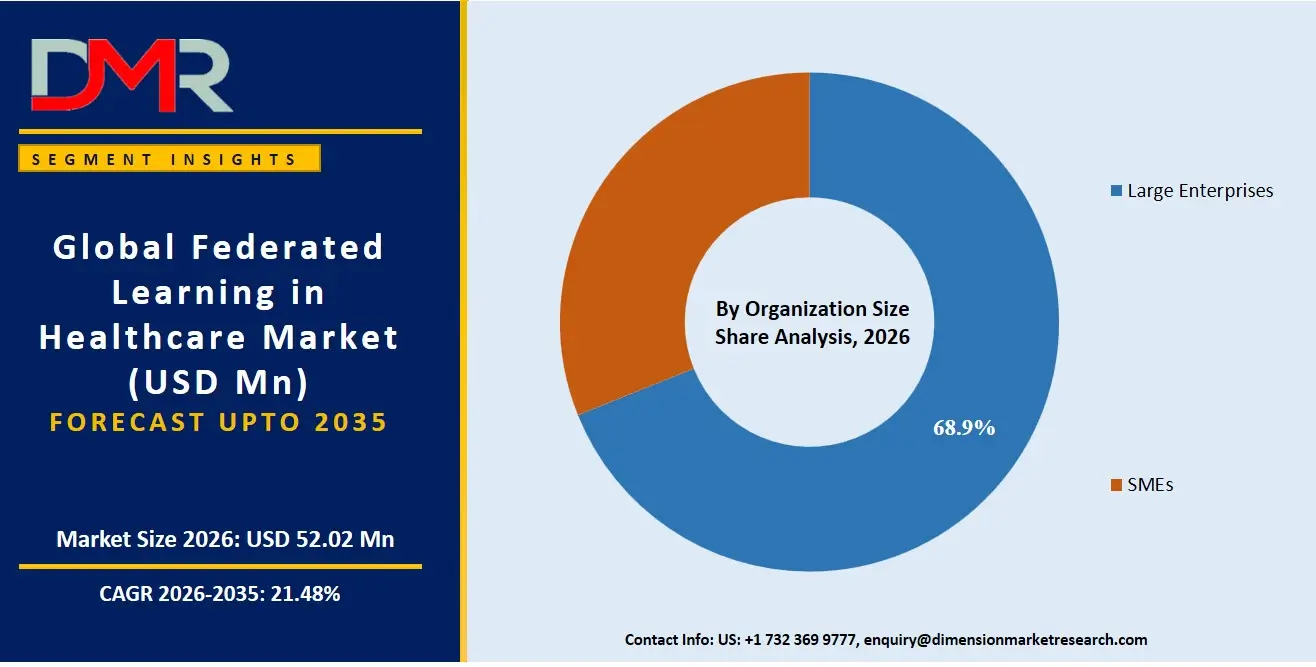
- Large Enterprises hold a 68.92% share by organization size in 2026.
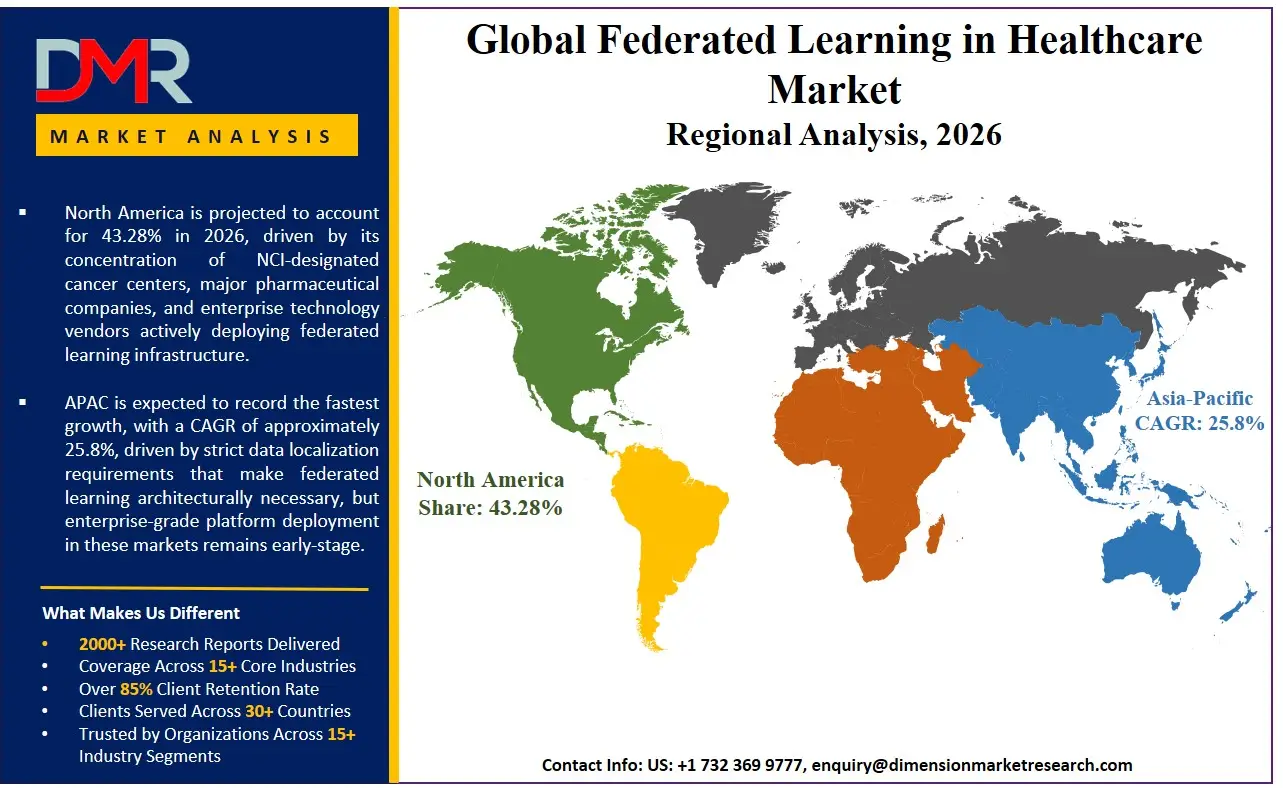
- North America leads all regions with a 43.28% market share in 2026, anchored by the United States.
- Asia Pacific is the fastest-growing regional market across the 2026 to 2035 forecast period.
- Key players include Health Catalyst, NVIDIA Corporation, Owkin Inc., Siemens Healthineers, FedML, IBM Corporation, Medtronic, Microsoft, GE Healthcare, and Google LLC.
Market Overview
Federated learning in healthcare is a distributed AI training approach that allows multiple institutions to build shared machine learning models without transferring raw patient data. The market covers platforms, frameworks, and services that enable privacy-preserving model development across hospitals, research centers, pharmaceutical firms, and government bodies. Traditional centralized AI training is excluded from this scope. Product segments span drug discovery, medical imaging, EHR analytics, remote patient monitoring, and genomics.
ℹ
To learn more about this report –
Download Your Free Sample Report Here
Federated Learning in Healthcare Market sits at the intersection of healthcare AI and data privacy technology. As reported by Scientific Reports in 2025, a study on privacy-preserving federated learning for healthcare data mining recorded 17,000 article accesses and 70 citations within its publication cycle. Academic engagement at this level typically precedes commercial procurement cycles by 12 to 24 months. Federated learning is not a theoretical proposition in healthcare. It is an operationally proven architecture moving from pilot programs into production enterprise deployments.
Recurring software and service contracts are reshaping how healthcare AI platforms generate revenue. Platform providers that combine clinical validation records with compliance certification hold structural advantages over pure-technology entrants. Institutions that standardize on one federated platform also adopt that vendor's compliance frameworks, governance tools, and upgrade roadmaps, creating switching costs that deepen with every deployment cycle and every model trained.
Market Size and Forecast
The Global Federated Learning in Healthcare Market size is estimated at USD 52.02 Million in 2026 from USD 42.82 Million in 2025, and is projected to reach USD 623.85 Million by 2035, exhibiting a CAGR of 21.48% during the forecast period.
Historical growth reflects sustained investment in privacy-preserving AI infrastructure across North American and European healthcare networks alongside accelerating deployment in Asia Pacific. Kakao Healthcare's 2024 breast cancer recurrence prediction project trained a federated model across approximately 25,000 patients. The federated model achieved a prediction score of 0.8482, outperforming every individual hospital model in the range of 0.6397 to 0.8362. Demonstrated clinical superiority over single-institution models is the most powerful commercial validation signal in enterprise healthcare AI procurement.
Cancer AI Alliance's 2025 platform spanning data from over 1 million patients across 4 NCI-designated cancer centers confirms that federated learning has crossed from academic research into production-scale clinical infrastructure. The upside scenario activates if major healthcare systems accelerate federated infrastructure investment following these demonstrated outcomes, pulling forward demand by two to three years. The downside scenario materializes if regulatory fragmentation between HIPAA and GDPR persists. Institutions operating across US and European markets face compounded compliance costs that extend deployment timelines and stall enterprise procurement when technical interpretation differences remain unresolved.
Drug Discovery and Development Analysis
Drug Discovery and Development led the By Application segment with a 38.62% share in 2026.
Pharmaceutical institutions require AI models trained on patient data from multiple clinical trial sites without transferring sensitive records. Federated learning directly solves this constraint, making it the preferred architecture for multi-site drug development programs where data governance is non-negotiable. No other AI training architecture satisfies both performance and compliance requirements simultaneously for multi-site pharma programs.
Medical Imaging and Diagnostics is the second major application area, with radiology and pathology departments generating high-volume imaging data under strict privacy obligations. Electronic Health Record Analytics addresses one of the most fragmented data environments in healthcare, where EHR systems vary by vendor, structure, and coding standard across institutions. Remote Patient Monitoring applies federated learning to IoMT-generated data streams from wearables and connected devices, reflecting growing institutional awareness that decentralized monitoring data requires privacy-preserving architectures. Genomics and Precision Medicine uses federated models for cross-institutional genomic analysis, with precision medicine consortia building federated genomic AI where no single institution holds sufficient data volume independently.
On-Premises Deployment Analysis
On-premises deployment accounted for 60.72% of By Deployment Mode demand in 2026, the highest of any category.
ℹ
To learn more about this report –
Download Your Free Sample Report Here
Hospitals and research institutions subject to HIPAA and GDPR maintain strong preferences for infrastructure that keeps patient data within their physical control. For these buyers, on-premises federated deployment is not a preference. Compliance requirements in specific regulatory contexts make cloud alternatives insufficient for certain institutional mandates. Vendors that offer flexible deployment architectures hold broader addressable markets than those optimized for cloud only.
Cloud-based deployment is gaining adoption where regulatory constraints permit and where multi-hospital coordination demands scalable orchestration. Kakao Healthcare's 2024 multi-hospital deployment used Google Kubernetes Engine to coordinate federated AI training across 16 Korean hospitals. Cancer AI Alliance received cloud infrastructure support from Amazon Web Services, Google, and Microsoft in 2025. Cloud deployment share will expand as regulatory clarity improves and hybrid architectures mature across major healthcare markets through 2035.
Hospitals and Healthcare Providers Analysis
Hospitals and Healthcare Providers captured a 41.25% share of By End-Use demand in 2026, ahead of all other categories.
Hospitals own the largest repositories of clinical patient data and face the most immediate pressure to use AI responsibly. Federated learning allows hospital networks to collaborate on AI model development without violating patient confidentiality obligations. The combination of high case volume, established AI deployment needs, and direct payer accountability makes hospitals the primary and most commercially accessible end-user segment for federated platform providers.
Pharmaceutical and Biotechnology Companies represent the second major end-user group, using federated learning to train drug discovery models on real-world patient data across clinical trial sites and hospital partners. Research Institutions drive academic validation and framework development, translating experimental federated frameworks into proven clinical methodologies that hospital procurement teams require before committing budgets. Government and Regulatory Bodies are emerging as active participants, with NCI-designated cancer centers and national digital health programs adopting federated architectures to enable cross-agency analytics without centralizing sensitive citizen health records.
Large Enterprises Analysis
Large Enterprises held a 68.92% share of By Organization Size demand in 2026, leading all categories.
ℹ
To learn more about this report –
Download Your Free Sample Report Here
Large hospital systems, major pharmaceutical companies, and established research institutions possess the IT infrastructure, legal teams, and capital required to deploy and maintain federated learning platforms. Compliance with HIPAA and GDPR at scale demands organizational resources that most smaller institutions cannot sustain independently. Large enterprise dominance is structural rather than cyclical, rooted in compliance capacity rather than technology preference alone.
Small and Medium Enterprises represent an underserved but structurally important segment. Smaller research institutions and specialty clinics hold valuable niche datasets, particularly in rare disease and regional population health. Open-source frameworks are specifically designed to lower the technical barrier for smaller organizations to participate in federated networks as data contributors. Providers that build onboarding pathways for smaller institutions expand the total network value of their federated platforms without requiring smaller buyers to operate full platform stacks independently.
Medical Imaging Data Analysis
Medical Imaging Data held the dominant position across By Data Modality categories in 2026.
Medical imaging is the most mature data modality in federated healthcare AI deployment. The TrustFed 2026 framework evaluated over 430,000 medical images across 6 imaging modalities, confirming that imaging federated learning has the deepest technical validation of any data type in Federated Learning in Healthcare Market. Hospitals with radiology and pathology workloads are the primary buyers, and production deployments in this modality are already underway across multiple institutions globally.
Electronic Health Records Data present both the largest data volume opportunity and the highest standardization challenge, with EHR systems differing significantly across vendors and geographies. Genomic Data carries the highest sensitivity classification among all healthcare data modalities and faces the most stringent cross-border transfer restrictions. Federated learning is particularly well-suited for genomic datasets because these cannot be shared without severe privacy risk. Precision medicine consortia and cancer research alliances are building federated genomic AI models, and this modality will grow in strategic importance as personalized medicine scales commercially through 2035.
Differential Privacy-enabled Systems Analysis
Differential Privacy-enabled Systems led the By Technology Integration segment with the broadest enterprise deployment footprint in 2026.
Differential privacy adds mathematically guaranteed noise to model updates, preventing individual patient data from being reconstructed through model outputs. Health-FedNet's September 2025 framework achieved a 12% improvement in chronic disease diagnostic accuracy while maintaining HIPAA and GDPR-aligned privacy protection. This combination of clinical performance improvement and regulatory compliance makes differential privacy the most deployable technical integration for enterprise healthcare buyers across all institution sizes.
Secure Multi-party Computation-enabled Systems offer stronger privacy guarantees than differential privacy alone but carry higher computational overhead, making them most relevant for institutions handling genomic and psychiatric records. Blockchain-integrated Federated Learning adds immutable audit trails to model updates, with a July 2025 Scientific Reports paper on blockchain-enabled federated privacy frameworks accumulating 8,383 accesses and 26 citations, confirming strong research and industry interest in accountable federated governance. Edge AI-enabled Federated Learning deploys model training directly on hospital workstations and IoMT sensors, with a July 2025 study on IoMT-based federated patient monitoring reaching 5,558 accesses and 14 citations, reflecting active institutional interest in edge-based real-time clinical monitoring architectures.
Key Market Segments
By Application
- Drug Discovery and Development
- Medical Imaging and Diagnostics
- Electronic Health Record (EHR) Analytics
- Remote Patient Monitoring
- Genomics and Precision Medicine
- Others
By Deployment Mode
By End-Use
- Hospitals and Healthcare Providers
- Pharmaceutical and Biotechnology Companies
- Research Institutions
- Government and Regulatory Bodies
By Organization Size
- Large Enterprises
- Small and Medium Enterprises
By Learning Architecture
- Horizontal Federated Learning
- Vertical Federated Learning
- Federated Transfer Learning
By Data Modality
- Medical Imaging Data
- Electronic Health Records (EHR) Data
- Genomic Data
By Technology Integration
- Differential Privacy-enabled Systems
- Secure Multi-party Computation-enabled Systems
- Blockchain-integrated Federated Learning
- Edge AI-enabled Federated Learning
Regional Analysis
North America held a 43.28% share in 2026, anchored by the US market at USD 9.12 Million.
ℹ
To learn more about this report –
Download Your Free Sample Report Here
North America's leadership reflects its concentration of NCI-designated cancer centers, major pharmaceutical companies, and enterprise technology vendors actively deploying federated learning infrastructure. The US market grows at a CAGR of 18.36% through 2035, slightly below the global rate of 21.48%, confirming that international markets are closing the adoption gap. Cancer AI Alliance's 2025 platform, supported by Amazon Web Services, Google, Microsoft, and NVIDIA, exemplifies the public-private collaboration density that sustains North America's structural advantage.
Asia Pacific is the fastest-growing regional market across the forecast period. Kakao Healthcare built a 16-hospital federated network in South Korea in July 2024 using Google Kubernetes Engine, targeting expansion to cover nearly 20 million people's health data by end-2024. Japan, China, and India each have large patient populations, active national digital health programs, and strict data localization requirements that make federated learning architecturally necessary, but enterprise-grade platform deployment in these markets remains early-stage. Europe operates under GDPR, which simultaneously creates the strongest regulatory justification for federated learning and the most detailed compliance requirements for any deployment. Latin America remains early-stage with adoption concentrated in larger hospital networks in Brazil and Mexico. The Middle East and Africa market concentrates in GCC nations evaluating federated architectures that enable cross-agency analytics while preserving citizen data sovereignty.
Key Regions and Countries
North America
Europe
- Germany
- France
- The UK
- Spain
- Italy
- Rest of Europe
Asia Pacific
- China
- Japan
- South Korea
- India
- Australia
- Rest of APAC
Latin America
- Brazil
- Mexico
- Rest of Latin America
Middle East & Africa
- GCC
- South Africa
- Rest of MEA
Market Dynamics
Multi-Institutional AI Collaboration and Privacy Breaches Drive Federated Platform Adoption
Cancer research is providing the most visible proof of federated learning's enterprise value. As reported by Scientific Reports in April 2025, more than 30% of healthcare organizations globally experienced a data breach within the previous year. This breach rate creates direct, measurable demand for AI architectures that keep patient data local while enabling cross-institutional learning. Privacy-preserving data utilization is not a theoretical benefit for healthcare buyers. Regulatory consequences of centralized data exposure are existential for hospital procurement teams.
Rhino Health collaborated with NVIDIA in June 2024 to deliver an enterprise-hardened federated computing platform using NVIDIA FLARE, enabling privacy-preserving AI collaborations across healthcare and life sciences institutions. Health-FedNet's September 2025 framework reported a 12% improvement in chronic disease diagnostic accuracy while maintaining HIPAA and GDPR-aligned privacy protection. Kakao Healthcare's multi-hospital deployment reduced the timeline for large-scale federated healthcare AI analysis from more than 2 years to 4 months, translating directly into faster clinical insights and lower research costs that procurement teams can quantify in budget justifications.
Regulatory Complexity and Model Aggregation Risks Slow Enterprise Deployment
Compliance with HIPAA, GDPR, and institution-specific data governance rules creates layered technical and legal requirements for every federated deployment. Institutions operating across US and European markets must satisfy multiple, sometimes conflicting, standards simultaneously. Model aggregation across diverse healthcare datasets introduces bias risks that restrain adoption. Institutions with different patient populations, data collection standards, and clinical workflows produce heterogeneous data that can undermine clinical reliability if bias mitigation tools are not standardized across platforms.
Trust deficits between competing institutions compound these technical challenges. Hospitals operating in the same markets are reluctant to share even federated model updates that could reveal strategic clinical capabilities. Governance frameworks and contractual protections must accompany technical solutions, adding time and cost to every deployment cycle. Vendors that address these institutional trust barriers through structured governance tools hold a differentiation advantage that pure technical performance cannot replicate.
Precision Oncology, Pharma Partnerships, and Imaging Infrastructure Create High-Value Entry Points
Precision oncology represents the highest-value near-term opportunity. Cancer AI Alliance's platform confirmed that federated networks can train AI models on multimodal oncology data from multiple leading cancer centers while keeping patient data secure and local. Plans to scale to dozens of AI models across additional centers create a replicable template for cardiology and rare disease research consortia. For platform providers, consortium deployments generate multi-year contract commitments that are structurally difficult to displace once clinical workflows integrate around federated model outputs.
Enterprise adoption of federated computing infrastructure in medical imaging is expanding through proven solutions. NVIDIA FLARE's deployment across multi-institutional imaging collaborations in 2024 and 2025 confirms that imaging data, which is high in volume and regulatory sensitivity, is becoming a primary procurement use case. Owkin's January 2025 launch of K1.0 Turbigo as an AI-powered operating system for drug discovery using federated learning with multimodal patient data signals that pharma-facing federated platforms are transitioning from research tools to commercial products, opening recurring revenue models for providers serving life sciences buyers.
Market Trends
Cloud-Native Infrastructure and Multi-Modal Data Frameworks Reshape Federated AI Architecture
Cloud and open-source framework integration is becoming the default architecture for federated healthcare AI. Flower Labs raised USD 20 Million in February 2024 to mainstream federated and decentralized AI, specifically targeting healthcare as a primary application domain. The investor profile combining enterprise software funds with open-source ecosystem backers signals that cloud-native federated infrastructure is where enterprise spending is concentrating. Institutions that build federated infrastructure now will establish model governance advantages that late adopters cannot easily replicate once consortium membership requirements and protocol standards are set.
Market Competition Overview
The Federated Learning in Healthcare Market is fragmented at the platform layer but consolidating around enterprise-grade infrastructure providers. Large technology companies with existing healthcare cloud relationships bundle federated learning capabilities into broader healthcare AI contracts, creating barriers for standalone federated platform vendors competing on features alone. Flower Labs raised USD 20 Million in February 2024 to mainstream federated and decentralized AI, reflecting how open-source frameworks are reshaping the competitive boundary by lowering entry barriers for smaller institutions while compressing pricing power for commercial providers serving mid-market healthcare buyers.
Competitive differentiation is shifting from core federated learning functionality to privacy enhancement layers. Providers integrating differential privacy, secure multi-party computation, and blockchain-based audit trails are building compliance-oriented moats that pure performance competitors cannot easily replicate. Royal Philips redirected EUR 0.8 Billion in productivity savings toward next-generation MRI software in a parallel dynamic that illustrates how incumbents in adjacent healthcare technology markets reinvest operational savings into compliance-driven software advantages. Providers that build domain-plus-platform combinations combining clinical expertise with technology scale will be difficult to displace once embedded in multi-year research or clinical operations contracts.
Company Profiles
Health Catalyst positions itself as a healthcare data platform provider with federated learning capabilities embedded within its broader analytics infrastructure. Existing long-term contracts with hospital systems create natural distribution channels for federated AI products. The strategic risk is that its identity as a data warehousing vendor may slow enterprise perception of it as a primary federated AI infrastructure provider in a market where specialized platforms are gaining clinical credibility faster than general analytics platforms.
NVIDIA Corporation anchors its federated healthcare strategy around NVIDIA FLARE, an open-source framework purpose-built for privacy-preserving AI in healthcare and life sciences. Its collaboration with Rhino Health in 2024 and 2025 delivered an enterprise-hardened federated computing platform supporting multi-institutional medical imaging and drug discovery programs. Owkin Inc. launched K1.0 Turbigo in January 2025, an AI-powered operating system for drug discovery using federated learning with multimodal patient data, marking its transition from research tool to commercial product targeting pharmaceutical and clinical diagnostics buyers. Siemens Healthineers applies federated learning within its medical imaging and diagnostics portfolio, targeting hospital radiology and pathology departments with its embedded position in hospital imaging infrastructure giving it procurement advantages that standalone federated platform vendors lack.
Key Players
- Health Catalyst
- NVIDIA Corporation
- Owkin Inc.
- Siemens Healthineers
- FedML
- IBM Corporation
- Medtronic
- Microsoft
- GE Healthcare
- Google LLC
Supply Chain and Value Chain Analysis
The federated learning in healthcare value chain begins with raw clinical data generated at the institutional level, including medical imaging files, EHR records, genomic sequences, and IoMT monitoring streams. No raw patient data moves across the chain. This structural characteristic makes the supply side of federated healthcare AI fundamentally different from conventional software value chains. Maximum value creation occurs at the model aggregation and validation layer, where federated model updates from multiple institutions combine into a generalized AI model. External validation of Kakao Healthcare's federated model achieved a score of 0.7769, equivalent to approximately 92% of the internal federated model's performance, confirming the level of generalizability that clinical decision-makers require before deploying federated AI outputs in patient-facing workflows.
The biggest bottleneck in the chain is data standardization before federated training can begin. EHR systems, imaging formats, and genomic data schemas vary significantly across hospitals and geographies. Kakao Healthcare's platform supplies approximately 100 different healthcare data types to participating hospitals to support machine learning-ready clinical workflows, illustrating the scope of data preparation infrastructure required before model training starts. Technology infrastructure providers, including cloud platforms and hardware vendors, control the orchestration and compute layers, sitting between data-holding institutions and model consumers and giving them significant influence over platform interoperability standards and pricing architecture.
Regulatory Landscape
The Federated Learning in Healthcare Market operates within one of the most complex regulatory environments in enterprise AI. HIPAA governs patient data handling in the United States while GDPR applies across European jurisdictions. Both frameworks prohibit unauthorized transfer of identifiable patient data, creating a direct legal mandate for privacy-preserving AI architectures. Kakao Healthcare's platform supplies approximately 100 different healthcare data types to participating hospitals to support machine learning-ready clinical workflows within regulatory boundaries, illustrating the standardization burden that every multi-institutional deployment must address before operating compliantly across jurisdictions.
NCI-designated cancer centers participating in Cancer AI Alliance's 2025 federated platform operate under both federal research regulations and institutional review board requirements. The architecture trained AI models on structured, de-identified datasets from over 1 million patients while keeping data local to each center, demonstrating that federated learning is in some research contexts the only compliant architecture available. Regulatory frameworks are creating indirect market entry barriers that favor established providers. Vendors without demonstrated HIPAA and GDPR compliance certification face extended procurement timelines at large hospital systems and pharmaceutical companies. Non-compliant vendors are effectively excluded from the addressable market regardless of technical performance credentials.
Investment and White Space Analysis
Investment is concentrating in enterprise-grade federated platform infrastructure and clinical AI validation. Cancer AI Alliance's 2025 federated platform received backing from Amazon Web Services, Google, Microsoft, NVIDIA, Deloitte, Ai2, and Slalom, covering datasets from over 1 million patients across 4 NCI-designated cancer centers with plans to scale to dozens of AI models. This level of multi-vendor investment commitment in a single consortium confirms that oncology federated AI is the most commercially validated use case and the clearest near-term revenue opportunity for platform providers. The investor profile combining enterprise software funds with open-source ecosystem backers across the broader market signals that capital is approaching from multiple thesis angles simultaneously.
Rare disease and cardiology federated AI represent underserved white space with structurally attractive characteristics. Patient populations are smaller, data is highly fragmented across specialist centers, and no single institution holds sufficient data volume to train reliable AI models independently. These constraints make federated learning the only viable AI architecture for these disease areas, creating a captive addressable market before competitive crowding occurs. Asia Pacific outside South Korea presents high-growth white space with low current competition from established providers. Japan, China, and India each have large patient populations and strict data localization requirements that make federated learning architecturally necessary. EHR analytics and genomic data modalities represent investment white space at the technology integration layer, where medical imaging has attracted the most mature infrastructure investment and EHR and genomic federated frameworks are receiving growing academic attention but limited enterprise-grade platform development.
Recent Developments
- 2024 Kakao Healthcare. Clinical study completion. Kakao Healthcare completed a federated learning breast cancer recurrence prediction study on approximately 25,000 patients, using around 15,000 patients from four hospitals for training and 10,000 patients from a fifth hospital for external validation.
- January 2025 Owkin Inc. Commercial product launch. Owkin launched Owkin K1.0 Turbigo, an AI-powered operating system for drug discovery and diagnostics using federated learning with multimodal patient data drawn from its network of research institutions, marking its transition from a research-focused provider to a commercial platform operator targeting pharmaceutical and clinical diagnostics buyers.
- October 2025 Cancer AI Alliance. Platform launch. Cancer AI Alliance, including Dana-Farber Cancer Institute, Memorial Sloan Kettering, Fred Hutch, and Johns Hopkins, launched the first scalable federated learning platform for multi-center cancer research. The platform enables AI model training across centers on data from over 1 million patients while keeping all data secure and local, with 8 initial research projects launched and plans to scale to dozens of AI models and additional centers.
Report Details
| Report Characteristics |
| Market Value (2025) |
USD 42.82 Million |
| Market Value (2026) |
USD 52.02 Million |
| Forecast Revenue (2035) |
USD 623.85 Million |
| CAGR (2026–2035) |
21.48% |
| Base Year for Estimation |
2025 |
| Historic Period |
2020 – 2024 |
| Forecast Period |
2026 – 2035 |
| Report Coverage |
Revenue Forecast, Market Dynamics, Competitive Landscape, Recent Developments |
| Segments Covered |
By Application (Drug Discovery and Development, Medical Imaging and Diagnostics, Electronic Health Record Analytics, Remote Patient Monitoring, Genomics and Precision Medicine, Others), By Deployment Mode (On-premises, Cloud-based), By End-Use (Hospitals and Healthcare Providers, Pharmaceutical and Biotechnology Companies, Research Institutions, Government and Regulatory Bodies), By Organization Size (Large Enterprises, Small and Medium Enterprises), By Learning Architecture (Horizontal Federated Learning, Vertical Federated Learning, Federated Transfer Learning), By Data Modality (Medical Imaging Data, Electronic Health Records Data, Genomic Data), By Technology Integration (Differential Privacy-enabled Systems, Secure Multi-party Computation-enabled Systems, Blockchain-integrated Federated Learning, Edge AI-enabled Federated Learning) |
| Regional Analysis |
North America – US and Canada; Europe – Germany, France, The UK, Spain, Italy, and Rest of Europe; Asia Pacific – China, Japan, South Korea, India, Australia, and Rest of APAC; Latin America – Brazil, Mexico, and Rest of Latin America; Middle East & Africa – GCC, South Africa, and Rest of MEA |
| Competitive Landscape |
Health Catalyst, NVIDIA Corporation, Owkin Inc., Siemens Healthineers, FedML, IBM Corporation, Medtronic, Microsoft, GE Healthcare, Google LLC |
| Customization Scope |
Customization for segments and region or country level will be provided. Additional customization can be done based on requirements. |
| Purchase Options |
Three license options: Single User License, Multi-User License (Up to 5 Users), Corporate Use License (Unlimited Users and Printable PDF). |
Frequently Asked Questions
What is the biggest investment opportunity in Federated Learning in Healthcare Market?
▾ Rare disease research, EHR analytics, and Asia Pacific outside South Korea represent the three highest-conviction underserved opportunities. The market grows from USD 42.82 Million in 2025 at a CAGR of 21.48% through 2035, with oncology federated AI confirmed as the most commercially validated near-term entry point through Cancer AI Alliance's multi-vendor backed platform.
Who are the top companies in Federated Learning in Healthcare Market?
▾ Health Catalyst, NVIDIA Corporation, Owkin Inc., Siemens Healthineers, FedML, IBM Corporation, Medtronic, Microsoft, GE Healthcare, and Google LLC lead the market. NVIDIA and Google hold particular infrastructure influence through NVIDIA FLARE and Google Kubernetes Engine deployments across multiple production federated healthcare networks globally.
Which segment is growing fastest in Federated Learning in Healthcare Market and why?
▾ Genomics and Precision Medicine is the fastest-emerging application segment. Genomic datasets cannot be shared without severe privacy risk, making federated learning the only viable AI training architecture. Precision medicine consortia and cancer research alliances are building federated genomic AI models that will grow in strategic importance as personalized medicine scales commercially through 2035.
Which region is growing fastest in Federated Learning in Healthcare Market and why?
▾ Asia Pacific is the fastest-growing regional market. The global CAGR of 21.48% exceeding the US rate of 18.36% confirms that Asia Pacific's faster adoption pace is pulling overall global growth above North America's baseline. South Korea's Kakao Healthcare network provides the operational template that other Asia Pacific markets are beginning to replicate.
What is the biggest challenge holding Federated Learning in Healthcare Market back?
▾ Regulatory fragmentation between HIPAA and GDPR creates compounded compliance costs for institutions operating across US and European markets. Model aggregation across heterogeneous healthcare datasets introduces bias risks that risk-averse hospital procurement teams treat as deployment barriers. Data standardization across incompatible EHR systems and imaging formats adds preparation overhead before federated training can begin at any multi-institutional deployment site.