Global Fixed Line Communication Market Snapshot
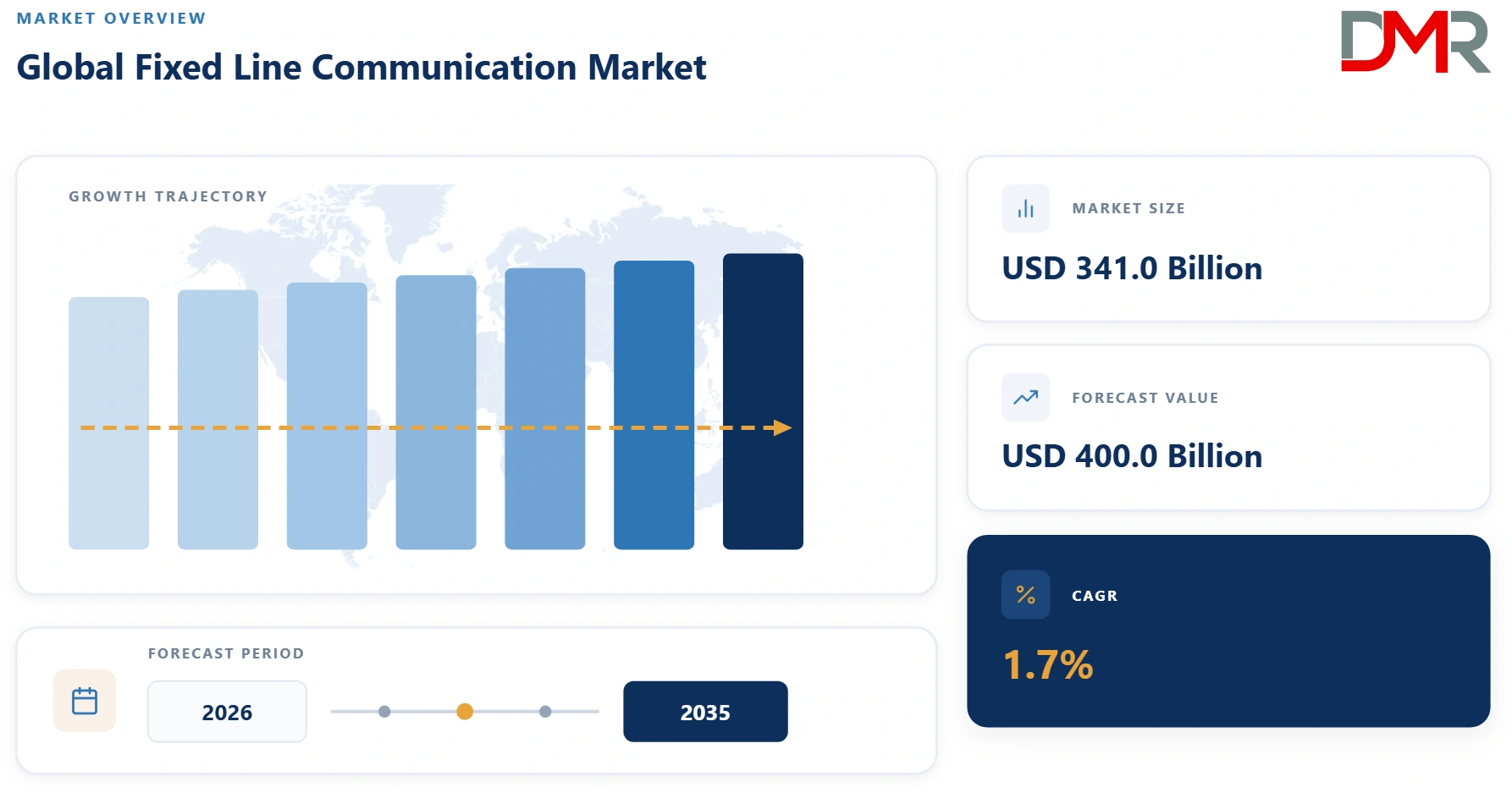
- Market Size in 2026: USD 341.0 billion
- Market Size in 2035: USD 400.0 billion
- Global CAGR, 2026-2035: 1.7%
- Leading Service Type Segment: Broadband Internet Services, 61% share
- Leading Technology Segment: Fiber Optic, 58% share
- Leading End-User Segment: Residential, 52% share
- Fastest-Growing Segment: Fixed Wireless Access, 7.2% CAGR
- Leading Region in 2026: Asia-Pacific, 39.5% share
What is the Global Fixed Line Communication and its Market Size?
The global Fixed Line Communication Market is estimated at USD 341.0 billion in 2026 and is projected to reach approximately USD 400.0 billion by 2035, representing a 1.7% CAGR. The relatively moderate headline growth masks significant structural change: traditional fixed voice and legacy copper services are declining, while fiber broadband, enterprise Ethernet, dedicated Internet access, cloud connectivity and fixed wireless access are expanding.
ℹ
To learn more about this report –
Download Your Free Sample Report Here
Fixed networks remain the backbone of digital connectivity even as mobile networks proliferate. ITU data indicate that global fixed-broadband penetration reached 20.1 subscriptions per 100 inhabitants in 2025, while fixed telephone penetration fell to approximately 9.9 per 100 inhabitants. ITU also notes that fixed networks continue to carry the majority of global Internet traffic, underscoring their importance to cloud computing, AI workloads, streaming, data centers and enterprise applications.
Use Cases
- Residential broadband: High-speed Internet supports streaming, gaming, remote work, education, telehealth and connected-home applications.
- Enterprise networking: Fiber, Ethernet and dedicated connectivity provide predictable bandwidth for distributed offices and corporate applications.
- Data-center connectivity: High-capacity fixed networks connect data centers, cloud platforms, Internet exchanges and enterprise workloads.
- Voice communication: Fixed voice remains important for enterprises, public institutions, contact centers and legacy business communications.
- Government connectivity: Public-sector networks connect government offices, schools, hospitals and digitally enabled public services.
- Backhaul and wholesale connectivity: Fixed networks provide transport capacity for mobile operators, ISPs, content providers and communications infrastructure.
Key Takeaways
- Market Size: The market is estimated at USD 341.0 billion in 2026, rising to USD 400.0 billion by 2035.
- Growth: The 2026-2035 CAGR of 1.7% reflects mature-market saturation and declining legacy services offset by fiber and enterprise connectivity.
- Primary Driver: Migration from copper and legacy broadband to fiber and high-capacity networks remains the central structural growth engine.
- Dominant Segment: Broadband Internet Services leads with an estimated 61% share in 2026.
- Technology Leadership: Fiber Optic holds approximately 58% of market revenue and is expanding at the expense of DSL.
- Fastest Growth: Fixed Wireless Access is projected to grow around 7.2% annually, particularly in underserved and hard-to-reach locations.
- Regional Leadership: Asia-Pacific represents approximately 39.5% of 2026 revenue, supported by China, Japan, India and rapidly digitizing Southeast Asian economies.
- Competitive Direction: Operators increasingly combine fiber, wireless, cloud, cybersecurity and managed services into converged connectivity propositions.
How AI/Gen AI is Transforming the Fixed Line Communication Market?
AI and cloud computing are increasing demand for fixed networks capable of delivering substantially higher bandwidth, lower latency and greater reliability. Fiber-to-the-home, XGS-PON, 25G PON, advanced Ethernet, software-defined networking and high-capacity optical transport are being deployed to support AI workloads, cloud applications, data centers, video and real-time collaboration. OECD data show the accelerating substitution of legacy fixed technologies by fiber.
The benefits extend beyond speed. Fiber provides higher capacity and longer network lifecycles, while network automation can reduce provisioning and maintenance costs. AI-enabled network operations can identify anomalies, predict failures and optimize capacity before congestion affects customers. Cloud-based service management also allows operators to package connectivity with cybersecurity, SD-WAN and managed services.
Technology is therefore shifting competition away from basic connectivity toward network quality, reliability, customer experience and integrated digital services. Operators with large fiber footprints can bundle broadband with mobile, cloud, security and entertainment, while alternative providers increasingly use FWA to compete in locations where fiber economics are unfavorable.
Key Drivers in the Global Fixed Line Communication Market
Fiber Migration and Network Modernization
The migration from copper, DSL and older cable infrastructure toward fiber is the most important structural driver. Fiber enables symmetrical gigabit connectivity, lower latency and much greater capacity, making it increasingly essential for cloud computing, AI, high-definition video, gaming, remote work and data-intensive enterprise applications.
Rising Data Intensity from Cloud, AI and Digital Services
Fixed networks are becoming critical infrastructure for AI-enabled applications, cloud computing, digital commerce, streaming, telemedicine and enterprise collaboration. Unlike mobile networks, fixed connections can provide consistently high capacity to homes, offices and data centers, supporting increasingly data-intensive workloads.
Restraints in the Global Fixed Line Communication Market
High Capital Requirements and Difficult Last-Mile Economics
Fiber deployment requires substantial capital for civil works, ducts, poles, rights-of-way, labor, electronics and customer installation. Rural areas and low-density communities can generate insufficient subscriber density to justify conventional fiber economics. Permitting delays and fragmented municipal processes further increase deployment costs.
Growth Opportunities in the Global Fixed Line Communication Market
Fiber Expansion in Underserved Markets
Large underserved populations remain a significant opportunity for fiber operators, infrastructure funds and wholesale network providers. Emerging markets can leapfrog older fixed technologies as falling fiber equipment costs, government programs and demand for broadband accelerate deployment.
Converged Connectivity and Enterprise Services
Operators can increase revenue per connection by combining fixed broadband with mobile, SD-WAN, cybersecurity, cloud connectivity, managed Wi-Fi and business communications. The shift is particularly attractive because basic broadband pricing is increasingly competitive.
Trends in the Global Fixed Line Communication Market
Fiber Becomes the Default Premium Access Technology
Fiber is progressively replacing DSL and competing directly with cable and FWA for premium residential and enterprise customers. OECD evidence confirms that fiber has overtaken legacy fixed technologies across many developed markets.
Convergence of Fixed and Wireless Connectivity
The boundary between fixed and mobile communications is narrowing. Operators increasingly sell broadband, mobile and digital services as a single connectivity proposition, using fiber where economics are favorable and FWA where speed-to-market is more important.
Research Scope and Analysis
The market is segmented by Service Type, Technology, Network Infrastructure, Enterprise Size, End User and Application. Estimates reflect service revenue rather than network equipment sales and account for the migration from legacy fixed voice toward broadband, fiber, enterprise data and converged connectivity.
ℹ
To learn more about this report –
Download Your Free Sample Report Here
By Service Type Analysis
Broadband Internet Services is the dominant service category, representing an estimated 61% share in 2026, supported by residential Internet demand, cloud usage, streaming, remote work and digital services. The second-largest category is Data Communication Services, with approximately 11%, covering business connectivity and managed data transport. Voice Services remain significant at roughly 13%, but continue to decline as PSTN and traditional fixed telephony migrate toward IP-based communications. The fastest-growing category is estimated to be Dedicated Internet Access, with a CAGR of approximately 5.8%, driven by enterprises requiring predictable bandwidth, cloud access and improved network resilience. Private Line and Ethernet Services account for approximately 5% and 4%, respectively, but remain valuable because of their high revenue intensity and relevance to data centers, financial institutions and large enterprises. The overall service mix therefore continues to migrate from mass-market voice toward IP connectivity and higher-value enterprise services.
By Technology Analysis
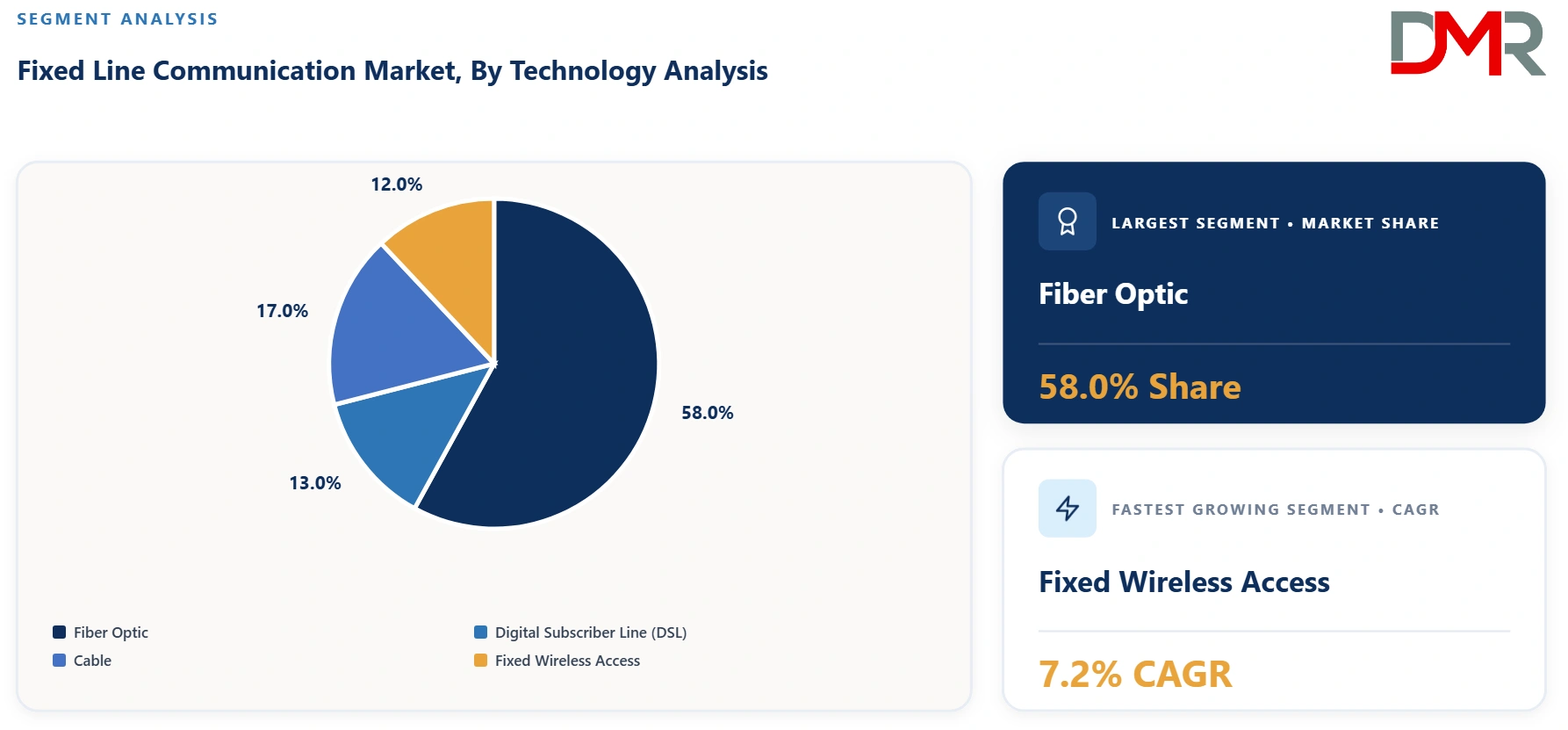
Fiber Optic is the dominant technology, accounting for approximately 58% of 2026 market revenue. Its leadership reflects superior bandwidth, low latency, long asset life and increasing demand for symmetrical multi-gigabit connectivity. Cable ranks second at approximately 17%, retaining substantial installed-base advantages in North America and selected European markets. DSL represents around 13% and is declining rapidly as operators retire copper infrastructure. Fixed Wireless Access holds approximately 12%, but is the fastest-growing technology at an estimated 7.2% CAGR through 2035. FWA is particularly attractive where fiber deployment is expensive or slow, including rural communities, suburban expansion areas and multi-dwelling units. The technology mix is consequently moving toward a two-track model: fiber for high-capacity permanent infrastructure and FWA for flexible, rapidly deployable access.
By Network Infrastructure Analysis
The Access Network dominates with an estimated 67% share in 2026, because the access layer connects homes, offices and institutions directly to operators' networks and captures most last-mile investment. Backhaul Networks represent approximately 21%, supported by increasing data traffic between access networks, mobile sites, data centers and core facilities. Core Networks account for approximately 12%. The fastest-growing component is backhaul, with an estimated 3.4% CAGR, as operators increase capacity to support fiber access, 5G transport, cloud services and data-center traffic. Access remains the largest category but increasingly relies on fiber-rich architectures and automated provisioning. Investment priorities are therefore shifting from maintaining legacy copper toward scalable optical transport, while core networks increasingly incorporate software-defined architectures and higher-capacity routing.
By Enterprise Size Analysis
Large Enterprises account for an estimated 63% of enterprise-oriented fixed communication revenue, making them the dominant enterprise-size category. Large organizations typically require multiple geographically diverse connections, dedicated Internet access, Ethernet, private lines, cloud connectivity, SD-WAN and cybersecurity. Small and Medium Enterprises account for approximately 37% but are expected to record the faster growth, at roughly 3.5% CAGR, as affordable fiber, managed broadband and cloud-based business applications become more accessible. SMEs are increasingly adopting business-grade connectivity without purchasing traditional private infrastructure. The second-largest enterprise opportunity is therefore not necessarily a larger bandwidth connection, but bundled services that combine broadband, security, Wi-Fi, collaboration and managed networking. Operators that simplify procurement and offer flexible monthly pricing can capture this underserved portion of the market.
By End User Analysis
Residential users represent approximately 52% of market revenue in 2026, making them the largest end-user segment because of the scale of home broadband subscriptions. Commercial users account for about 25%, followed by Telecom Operators at 15% and Government at approximately 8%. Commercial and government connectivity is typically higher-value per connection because of dedicated bandwidth, redundancy, service-level agreements and managed services. The fastest-growing end-user category is expected to be commercial users, at approximately 3.2% CAGR, driven by cloud migration, distributed workplaces, cybersecurity requirements and AI-enabled applications. Residential growth remains steady but is increasingly driven by speed upgrades and premium tiers rather than substantial subscriber growth in mature economies.
By Application Analysis
Internet Connectivity is the largest application, representing approximately 54% of 2026 revenue, reflecting the central role of fixed broadband in residential and commercial digital activity. Enterprise Networking follows with around 18%, while Data Center Connectivity represents approximately 11%, Voice Communication 10%, and Video and Multimedia Services 7%. Data-center connectivity is the fastest-growing application, with an estimated 7.0% CAGR, supported by cloud computing, AI infrastructure and interconnection requirements. Voice communication is expected to decline as traditional fixed voice is replaced by mobile and IP-based alternatives. Conversely, high-capacity connectivity between data centers, cloud platforms, enterprises and Internet exchanges is becoming strategically important, increasing the value of optical transport and dedicated connectivity.
The Global Fixed Line Communication Market Report is segmented on the basis of the following:
By Service Type
- Voice Services
- Broadband Internet Services
- Data Communication Services
- Dedicated Internet Access
- Private Line Services
- Ethernet Services
By Technology
- Fiber Optic
- Digital Subscriber Line (DSL)
- Cable
- Fixed Wireless Access
By Network Infrastructure
- Access Network
- Backhaul Network
- Core Network
By Enterprise Size
- Small & Medium Enterprises
- Large Enterprises
By End User
- Residential
- Commercial
- Government
- Telecom Operators
By Application
- Voice Communication
- Internet Connectivity
- Enterprise Networking
- Data Center Connectivity
- Video and Multimedia Services
Regional Analysis
Asia Pacific is the Leading Region in the Global Fixed Line Communication Market
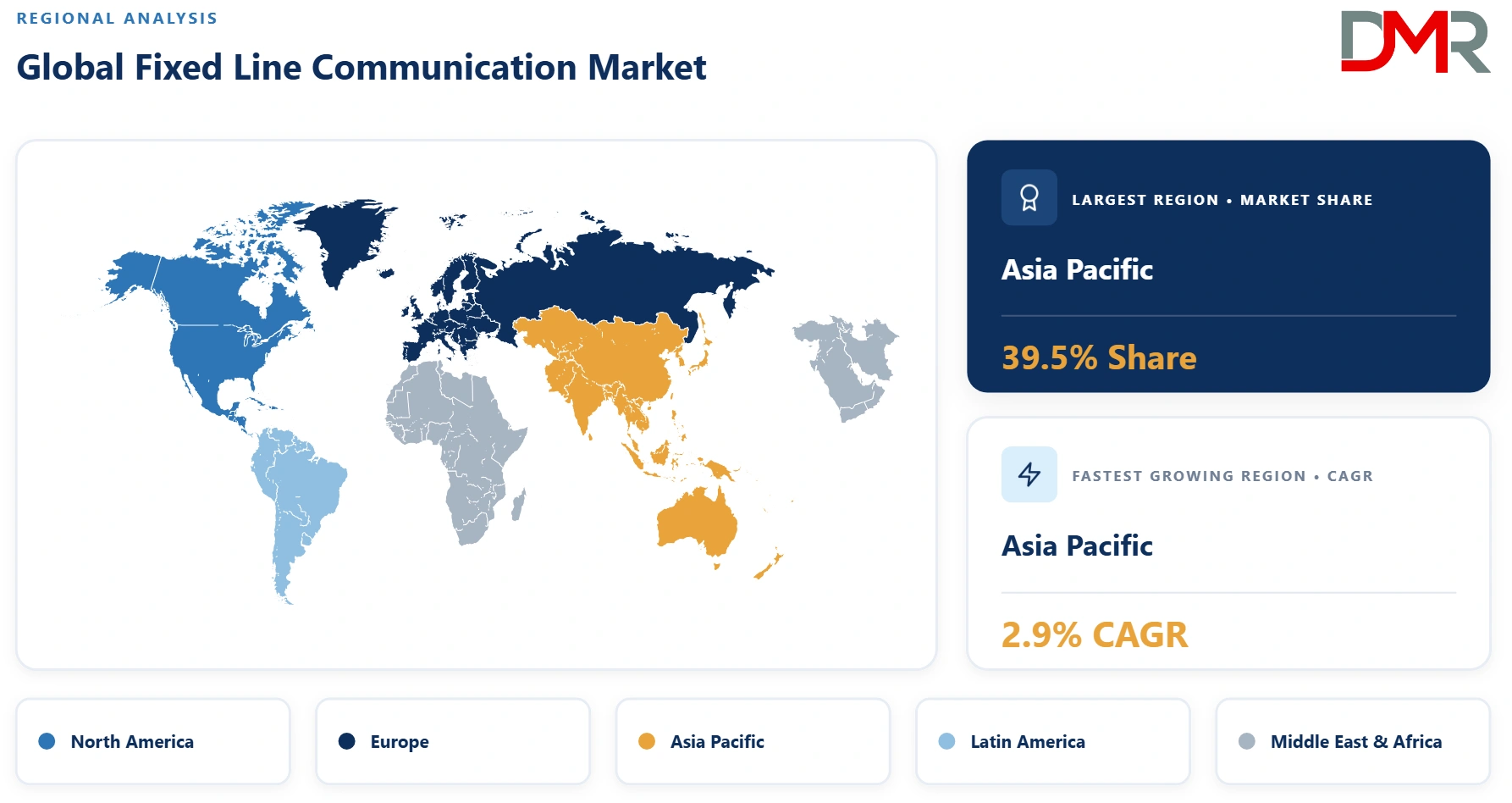
Asia-Pacific is expected to retain its leading position, representing approximately 39.5% of global Fixed Line Communication Market revenue in 2026, or roughly USD 134.7 billion. China, Japan, India, South Korea and increasingly Southeast Asian economies underpin regional scale. The region benefits from enormous subscriber bases, extensive fiber deployment, dense urban populations, large data-center markets and aggressive digital-transformation programs. ITU data show Asia & Pacific fixed-broadband penetration at 21.4 subscriptions per 100 inhabitants in 2025, above the global average of 20.1. China provides scale, Japan provides advanced optical infrastructure, while India and ASEAN provide significant incremental growth opportunities.
ℹ
To learn more about this report –
Download Your Free Sample Report Here
Asia Pacific is the Fastest-Growing Region in the Global Fixed Line Communication Market
Asia-Pacific is also projected to be the fastest-growing major region, with an estimated 2.9% CAGR from 2026 to 2035. Growth is concentrated in India, Southeast Asia and other emerging Asian markets where fixed broadband penetration remains below mature-market levels. India's fixed-broadband base stood at approximately 37.7 million subscriptions in 2024, while household Internet access has continued to expand. Operators are investing in fiber, FWA, data centers and enterprise connectivity as digital commerce, cloud adoption and AI workloads increase.
The Europe Fixed Line Communication Market
Europe is estimated at approximately USD 68.2 billion in 2026 and is projected to reach USD 72.6 billion by 2035, representing a 0.7% CAGR. The market is mature, with subscriber growth constrained by high penetration and declining legacy voice. Fiber migration, enterprise connectivity, data centers and copper switch-off programs remain the principal growth drivers. The EU's Gigabit Infrastructure Act became fully applicable in May 2026, targeting faster and lower-cost deployment through infrastructure sharing, streamlined procedures and coordinated civil works.
Latin America Fixed Line Communication Market
Latin America is estimated at USD 25.6 billion in 2026, increasing to approximately USD 31.9 billion by 2035, at a 2.5% CAGR. Growth is driven by urbanization, fiber deployment, rising household Internet adoption and enterprise digitalization. Brazil and Mexico account for the largest regional opportunities, while secondary cities and underserved rural areas offer substantial white space. FWA is expected to complement fiber where terrain, population density and deployment costs make fixed-wireline expansion difficult.
MEA Fixed Line Communication Market
The Middle East & Africa market is estimated at USD 25.6 billion in 2026, reaching approximately USD 32.5 billion by 2035, at a 2.7% CAGR. Gulf countries are investing heavily in fiber, smart-city infrastructure, cloud computing and data centers, while African markets present significant greenfield opportunities. Saudi Arabia and the UAE lead the region in advanced fixed connectivity, whereas African markets remain more dependent on mobile and wireless access. Government-backed digital-transformation programs are increasingly supporting broadband investment.
Major Countries Analysis
United States Fixed Line Communication Market
The U.S. market is estimated at USD 77.0 billion in 2026, rising to approximately USD 85.0 billion in 2035, representing a 1.1% CAGR. Fiber expansion, cable network upgrades, FWA and enterprise connectivity are the main drivers. The U.S. BEAD program provides USD 42.45 billion for broadband deployment, while 50 of 56 eligible entities had received approval for final proposals by February 2026.
Japan Fixed Line Communication Market
Japan is estimated at USD 29.5 billion in 2026, reaching approximately USD 32.9 billion by 2035, at a 1.2% CAGR. High fiber penetration, advanced enterprise networking, data centers and optical-network innovation underpin the market. Government policy increasingly links digital infrastructure, AI, data centers and all-photonic networks, supporting continued investment in high-capacity fixed infrastructure.
Saudi Arabia Fixed Line Communication Market
Saudi Arabia is estimated at USD 6.8 billion in 2026, growing to approximately USD 9.0 billion by 2035, at a 3.2% CAGR. Vision 2030-driven digitization, smart cities, cloud and data-center development, enterprise connectivity and nationwide fiber investment are key drivers. The Kingdom is positioned as a high-value connectivity market because government, enterprise and consumer digitalization are occurring simultaneously.
Regulatory Landscape
The regulatory environment increasingly focuses on universal broadband access, infrastructure sharing, network quality, consumer transparency and efficient deployment. In Europe, the Gigabit Infrastructure Act is designed to reduce deployment costs and simplify access to physical infrastructure and permits while supporting gigabit connectivity. In the United States, the BEAD program represents a USD 42.45 billion federal broadband investment framework, with 2026 implementation increasingly moving toward project awards and construction. India applies the Standards of Quality of Service of Access (Wireline and Wireless) and Broadband Regulations, 2024, while TRAI continued regulatory activity in 2026 concerning digital-connectivity ratings, tariffs and broadband policy.
Investment and White Space Analysis or Epidermatology based on the network
The regulatory environment increasingly focuses on universal broadband access, infrastructure sharing, network quality, consumer transparency and efficient deployment. In Europe, the Gigabit Infrastructure Act is designed to reduce deployment costs and simplify access to physical infrastructure and permits while supporting gigabit connectivity. In the United States, the BEAD program represents a USD 42.45 billion federal broadband investment framework, with 2026 implementation increasingly moving toward project awards and construction. India applies the Standards of Quality of Service of Access (Wireline and Wireless) and Broadband Regulations, 2024, while TRAI continued regulatory activity in 2026 concerning digital-connectivity ratings, tariffs and broadband policy.
By Region
North America
Europe
- Germany
- France
- The U.K.
- Italy
- Spain
- Rest of Europe
Asia-Pacific
- China
- Japan
- India
- Australia
- South Korea
- Rest of APAC
Latin America
- Mexico
- Brazil
- Rest of LATAM
Middle East & Africa
- Saudi Arabia
- The UAE
- South Africa
- Rest of MEA
Competitive Landscape
The Fixed Line Communication Market is moderately concentrated at the national level but fragmented globally, with incumbent telecom operators, cable companies, fiber specialists, wholesale infrastructure companies and wireless operators competing for connectivity revenue. The competitive focus is moving from subscriber acquisition alone toward fiber footprint, network reliability, service quality, converged fixed-mobile propositions, enterprise solutions and customer retention. M&A has become particularly important because acquiring an existing fiber footprint can be faster and more capital-efficient than building from scratch. Operators are also investing in XGS-PON, FWA, network automation, cloud connectivity, cybersecurity and managed services. Pricing remains important in residential broadband, while enterprise customers emphasize SLA performance, redundancy, security and latency.
Some of the prominent players in the Global Fixed Line Communication Market are:
- Huawei Technologies
- Nokia
- Cisco Systems
- ZTE
- Broadcom
- CommScope
- Arista Networks
- Ericsson
- Ciena
- Juniper Networks
- Adtran
- Calix
- DZS
- Ribbon Communications
- Corning
- Prysmian Group
- FiberHome Technologies
- NEC Corporation
- Fujitsu
- Allied Telesis
- AT&T
- Verizon Communications
- Deutsche Telekom
- China Telecom
- China Unicom
- NTT
- Orange
- Telefónica
- Vodafone Group
- BT Group
- Comcast
- Charter Communications
- KDDI
- Telstra
- Swisscom
- Singtel
- Telenor
- Telia Company
- Rogers Communications
- Reliance Jio
- Other Key Players
Recent Developments
- In July 2026, AT&T reported that its Internet Air FWA service had reached two million subscribers, with more than half also using AT&T wireless services.
- In June 2026, AT&T introduced simplified fiber plans, including discounts for customers combining home Internet and wireless services, highlighting the growing importance of bundled connectivity.
- In May 2026, Deutsche Telekom reported that more than 13 million German homes could directly connect to its fiber network, with FTTH customers reaching 2.2 million.
- In March 2026, AT&T launched OneConnect, combining home Internet and wireless connectivity under a single subscription and reinforcing the industry's shift toward fixed-mobile convergence.
- In February 2026, AT&T completed its USD 5.75 billion acquisition of Lumen's Mass Markets fiber business, adding more than one million subscribers and more than four million fiber locations.
- In January 2026, Verizon completed its acquisition of Frontier, bringing Frontier's fiber network into Verizon and creating approximately 30 million fiber passings across 31 states and Washington, D.C.
Report Details
| Report Characteristics |
| Market Size (2026) |
USD 341.0 Bn |
| Forecast Value (2035) |
USD 400.0 Bn |
| CAGR (2026–2035) |
1.7% |
| The US Market Size (2026) |
USD 77.0 Bn |
| Historical Data |
2021 – 2025 |
| Forecast Data |
2026 – 2035 |
| Base Year |
2025 |
| Segments Covered |
By Service Type, By Technology, By Network Infrastructure, By Enterprise Size, By End User, By Application |
| Regional Coverage |
North America – The US and Canada; Europe – Germany, France, The UK, Italy, Spain, Rest of Europe; Asia-Pacific – China, Japan, India, Australia, South Korea, Rest of APAC; Latin America – Mexico, Brazil, Colombia, Argentina, Rest of LATAM; Middle East & Africa – Saudi Arabia, The UAE, South Africa, Rest of MEA |
Frequently Asked Questions
What is the size of the Global Fixed Line Communication Market in 2026?
▾ The Global Fixed Line Communication Market is estimated to reach USD 341.0 billion in 2026.
What will the Global Fixed Line Communication Market size be by 2035?
▾ The Global Fixed Line Communication Market is projected to reach approximately USD 400.0 billion by 2035.
What is the CAGR of the Global Fixed Line Communication Market?
▾ The Global Fixed Line Communication Market is expected to expand at a 1.7% CAGR from 2026 to 2035.
What are the key factors driving the Global Fixed Line Communication Market?
▾ The market is driven by fiber-optic network expansion, rising data traffic, cloud computing, AI workloads, enterprise digitalization, and demand for high-speed broadband.
Which segment dominates the Global Fixed Line Communication Market?
▾ Broadband Internet Services is the leading service segment, accounting for approximately 61% of the Global Fixed Line Communication Market in 2026.
Which technology is growing fastest in the Global Fixed Line Communication Market?
▾ Fixed Wireless Access (FWA) is expected to be the fastest-growing technology segment, with an estimated 7.2% CAGR during 2026-2035.
Which region dominates the Global Fixed Line Communication Market?
▾ Asia-Pacific leads the Global Fixed Line Communication Market, accounting for approximately 39.5% of global market revenue in 2026.
Who are the key players in the Global Fixed Line Communication Market?
▾ Key players include AT&T, Verizon, Deutsche Telekom, China Telecom, Orange, NTT, BT, Vodafone, and other regional telecom operators.