What is the Floating Offshore Wind Market Size?
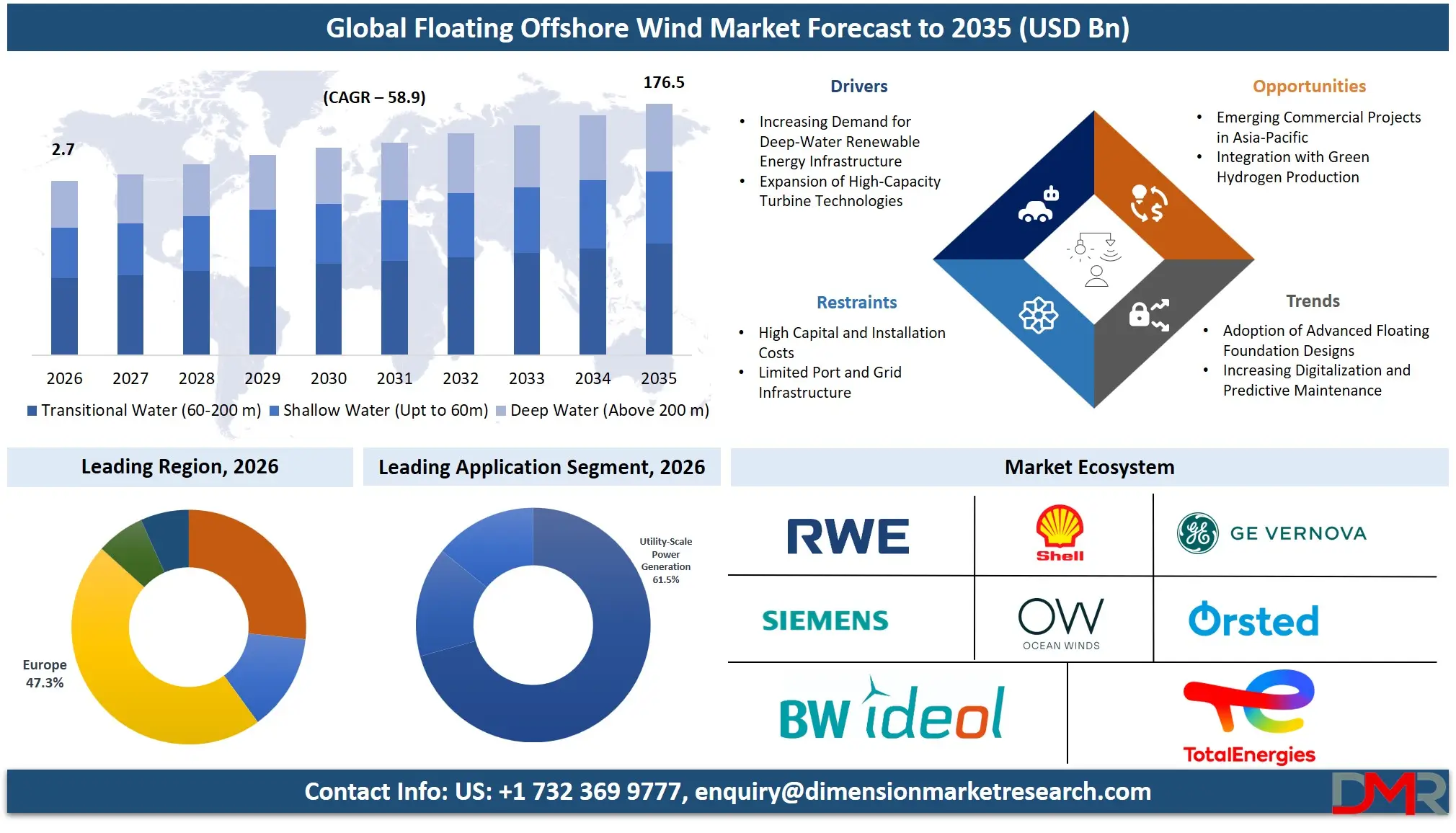
The Floating Offshore Market size is expected to be USD 2.7 billion in 2026 and increase at a compound annual growth rate of 58.9% to USD 176.5 billion in 2035 due to the increasing usage of electric cars and cellphones.
ℹ
To learn more about this report –
Download Your Free Sample Report Here
The Floating Offshore Wind Market refers to the entire global business environment concerned with the planning, manufacture, installation, operations, and maintenance of floating offshore wind energy systems used in the generation of renewable energy from deep-water environments.
The floating offshore wind market encompasses the use of floating platforms, offshore wind turbines, anchor and mooring systems, subsea cable transmission, offshore substations, engineering services, installation activities, and maintenance services, among others. This enables energy production through wind energy technology in areas where traditional offshore wind installations on fixed structures are unfeasible. The growth of this market is attributed to investment in renewable energy infrastructures, increased global carbon reductions pledges, rising demand for renewable power generation, and offshore wind development initiatives in Europe, North America, and the Asia Pacific regions. Technology innovations in the form of highly productive turbines of more than 15 MW capacity, AI-based predictive maintenance systems, floating hybrid foundation technology, digital monitoring platforms, and coupling with green hydrogen production have greatly boosted growth within this market.
ℹ
To learn more about this report –
Download Your Free Sample Report Here
The US Floating Offshore Wind Market
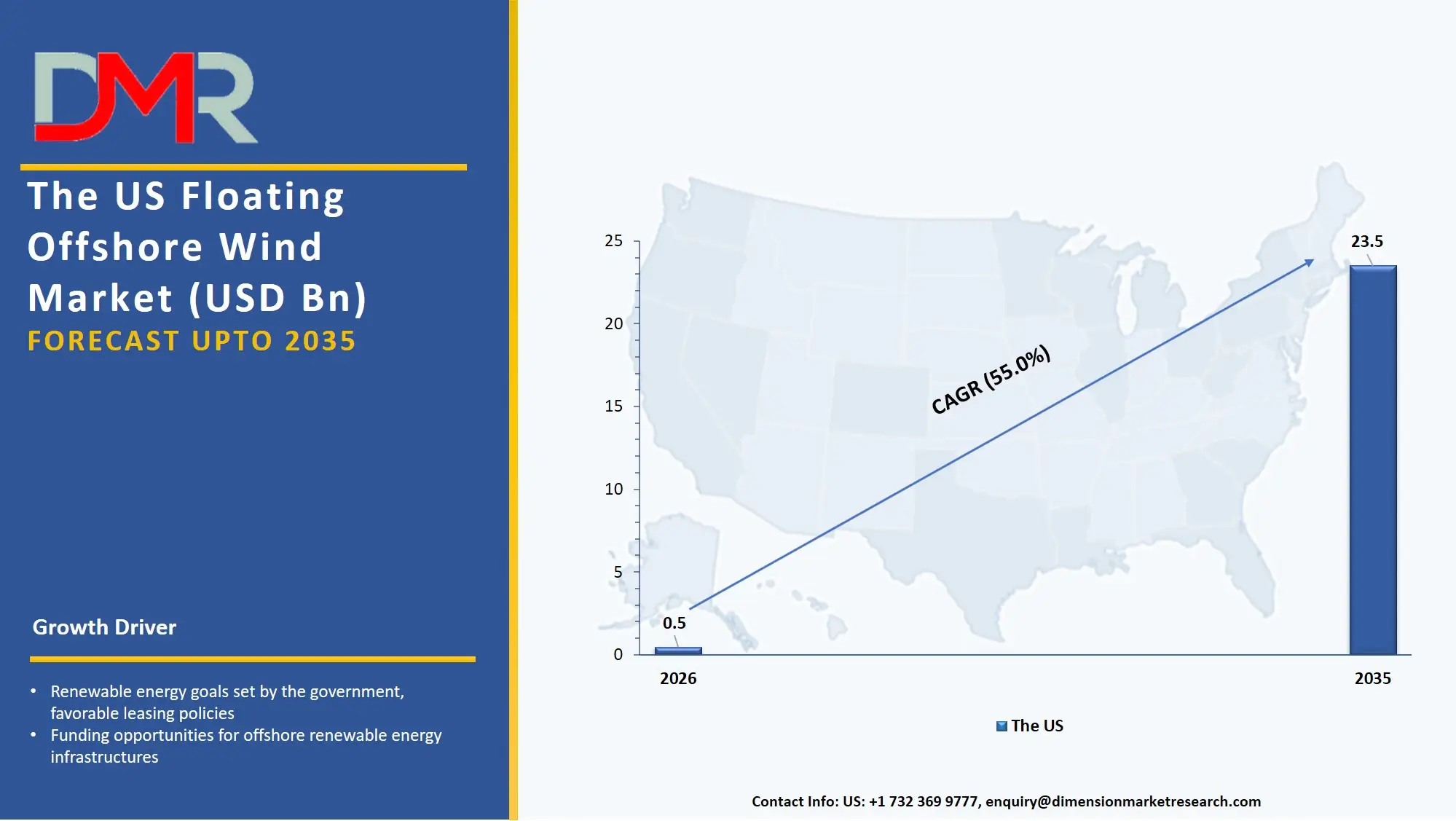
The US Floating Offshore Market size is estimated to be USD 500 million in 2026 and is expected to increase at a CAGR of 55.0% over the forecast period.
ℹ
To learn more about this report –
Download Your Free Sample Report Here
The US Floating Offshore Wind Market is growing owing to renewable energy goals set by the government, favorable leasing policies, and funding opportunities for offshore renewable energy infrastructures. The deep waters found in the coastal areas of California and the Pacific Coast provide an opportunity for floating wind turbines since fixed-bottom wind turbines are not ideal in this environment. There are government initiatives to promote floating wind turbines through leasing auctions, tax credits, and upgrading the transmission infrastructure. Companies in the utilities sector and project developers are also investing in floating offshore wind technology.
Europe Floating Offshore Wind Market
The Europe Floating Offshore Market size is estimated to be USD 1.3 billion in 2026 and at a CAGR of 52.9% over the forecast period.
One of the leading regions in the Floating Offshore Wind market is Europe because of its strict de-carbonization process, infrastructure for offshore wind power, and favorable policies for climate-based initiatives like the European Green Deal. The UK, Norway, France, and Portugal are some of the nations actively working on developing floating wind energy technology through auctions, rewards, and research funds. Presently, Europe is experiencing an increase in large-scale turbine installations and semi-submersible structures. Moreover, Europe has proven to have a lot of specialists in maritime engineering and offshore supply chain management.
Japan Floating Offshore Wind Market
The market size of Japan Floating Offshore will be USD 121 million in 2026 and at a CAGR of 57.5% in the forecast period.
Floating Offshore Wind Market in Japan is witnessing continuous growth due to scarcity of land, deep coastlines, and a comprehensive strategy for energy transition in Japan. Initiatives undertaken by the government to encourage renewables and achieve carbon neutrality are motivating investors to consider floating offshore wind. Companies are partnering with foreign vendors to create local solutions for floating turbines that would be able to withstand typhoons. The fast-growing urban energy requirements, higher power prices, and energy security concerns after reduced nuclear dependency are some additional factors fueling the adoption of floating offshore wind farms.
Key Takeaways
- Market Size & Forecast: The Floating Offshore Market size is projected to reach USD 2.7 billion in 2026 and is anticipated to have a value of USD 176.5 billion in 2035.
- Growth Rate & Outlook: The Floating Offshore Market size is set to grow at a compound annual growth rate of 58.9% during the forecast period of 2026 to 2035.
- Primary Growth Drivers: Some of the major growth drivers in the market include Increased Rise in Increased Demand for Floating Offshore Wind Energy Systems, and more.
- Key Market Trends: Some of the major trends in the market are Increased Digitization and Predictive Maintenance Solutions, and more.
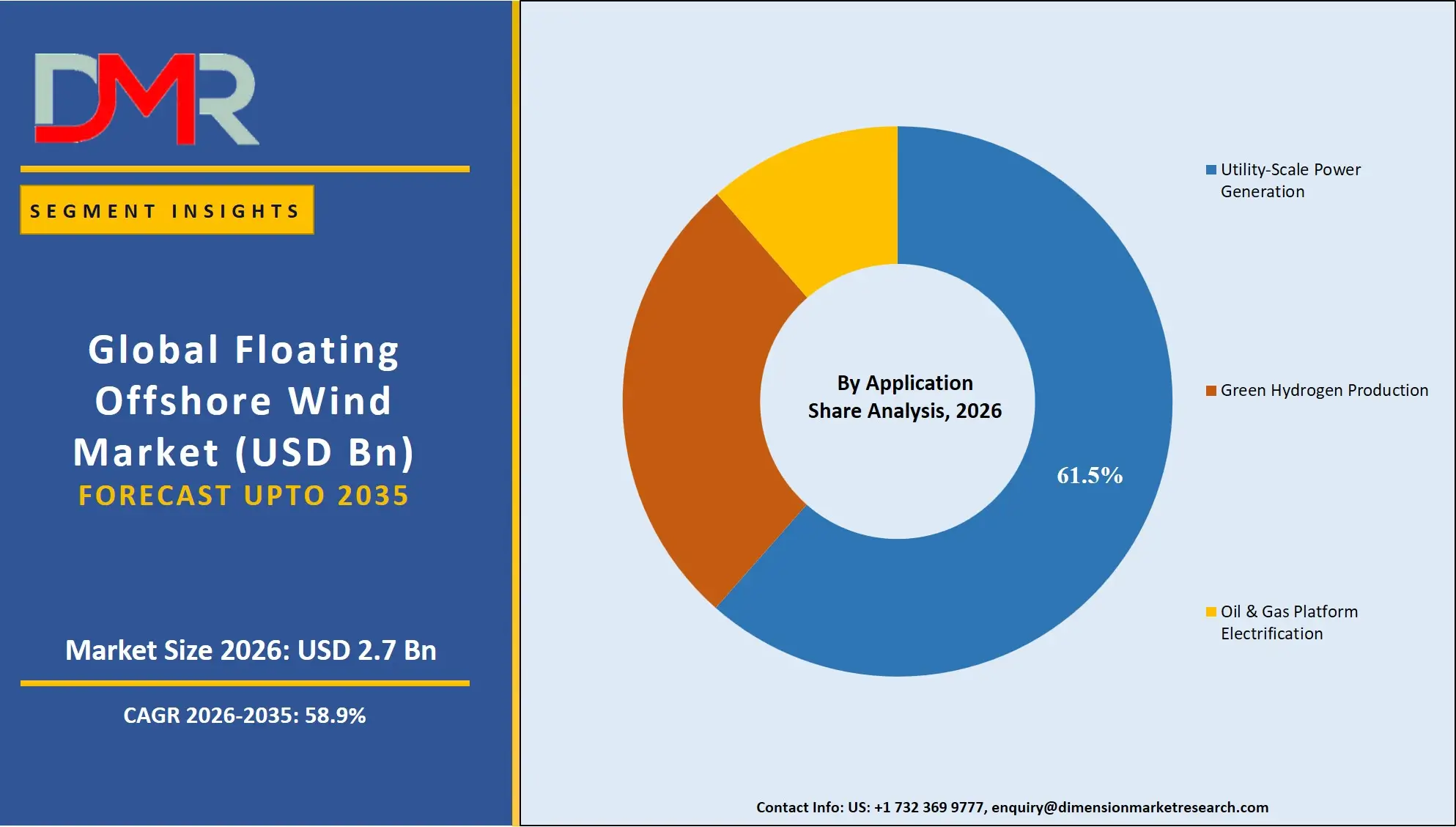
- By Application: The utility-scale power generation segment is anticipated to get the majority share of the Floating Offshore market in 2026.
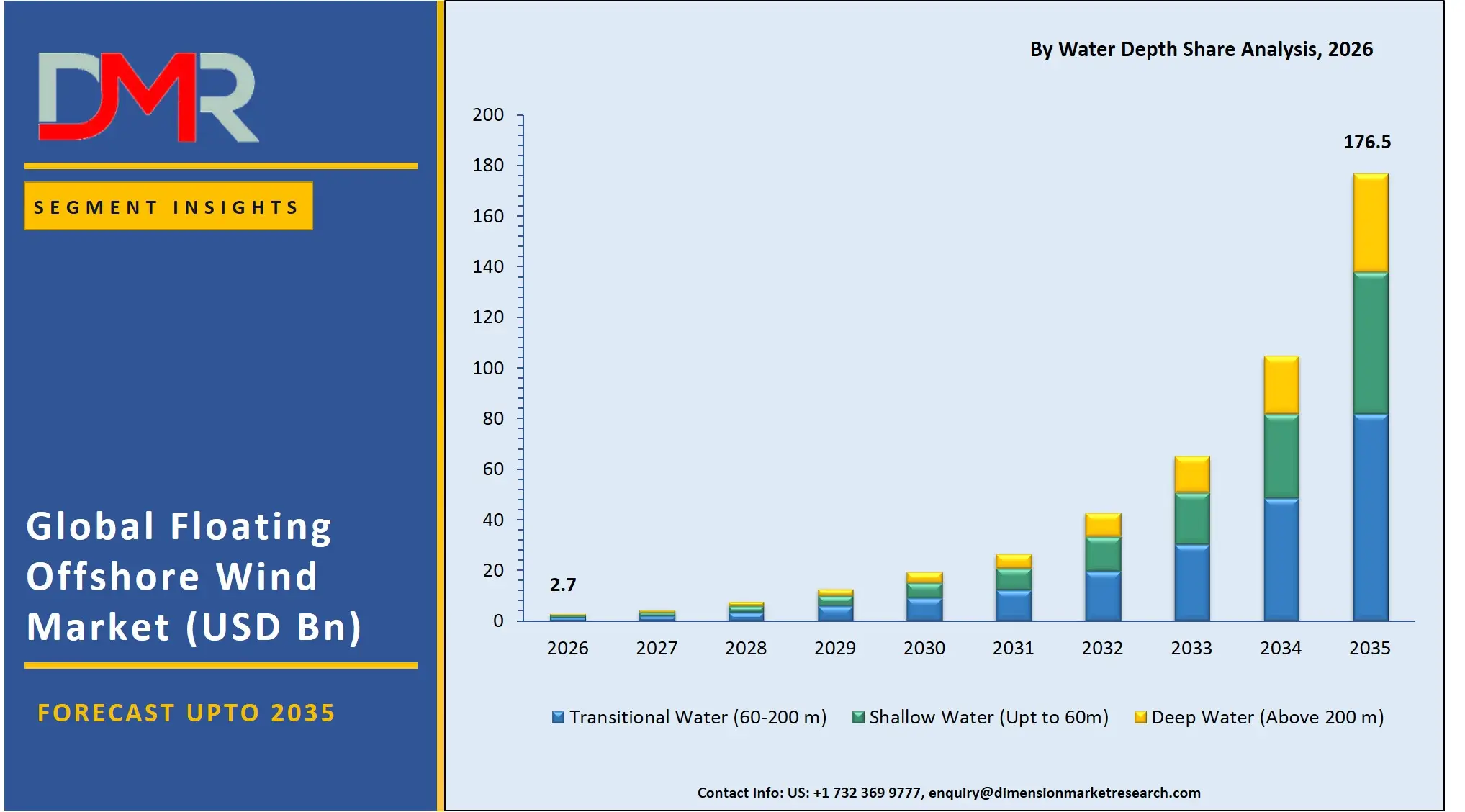
- By Water Depth: Transitional Water (60-200 m) segment is expected to get the largest revenue share in 2026 in the Floating Offshore market.
- By Component: Floating Foundation segment is expected to get the largest revenue share in 2026 in the Floating Offshore market.
- Regional Leadership: Europe is set to lead the Floating Offshore market with an estimated 47.3% share in 2026.
What is the Floating Offshore Wind?
Floating Offshore Wind is an innovative concept related to offshore wind power plant technologies that utilize floating structures and are placed in deep-water environments where fixed bottom structures cannot be utilized. Floating structures, wind turbines, mooring system, undersea cables, and offshore substations are used in floating offshore wind projects. Floating offshore wind plants provide an opportunity to tap into strong wind energy sources situated far away from land. Various technological advancements including larger turbines of capacity over 15 MW, hybrid floating structure, AI-driven prediction models for maintenance, and use in conjunction with green hydrogen production are rapidly advancing this technology.
Use Cases
- Electricity Generation at Utility Scale Through Renewable Energy: The deployment of floating wind farms offshore can be considered a novel trend in the generation of power on a large scale, particularly in deeper waters. This enables utility providers to include a variety of renewable energy sources in their power generation mix.
- Production of Green Hydrogen: The offshore wind energy industry is now using floating wind farms to power up the electrolysis process to produce green hydrogen by means of renewable energy produced offshore. This is significant in supplying decarbonized hydrogen in industries such as manufacturing and transportation.
- Electrification of Oil & Gas Platforms: Companies operating offshore oil and gas platforms are using floating offshore wind farms to generate power through renewable energy to run the platforms. In this way, they are lowering carbon footprints from offshore operations and abiding by environmental regulations.
- Offshore Island & Coastal Area Electrification: The deployment of floating wind farms is being used to provide renewable energy to islands and remote coastal areas with poor grid connection.
How AI Is Transforming the Floating Offshore Wind Market
AI is revolutionizing the floating offshore wind sector through increased efficiency, predictive maintenance, and energy forecasting capabilities. AI-based analysis tools track the performance, weather condition, structural dynamics, and machine health status in real-time to increase efficiency and save on maintenance expenses. AI is also being used for efficient offshore installations and enhanced mooring system performance during variable marine conditions.
AI is further being applied for improved electrical power generation forecasting and efficient grid connections through data analysis from wind speeds, ocean currents, and electricity demand variations. Autonomous aerial vehicles are increasing safety in offshore operations while reducing risks. AI is also being used to create digital twins of offshore turbines for better simulations of turbine behavior and design improvements of offshore platforms.
Market Dynamic
Driving Factors in the Floating Offshore Wind Market
Increased Demand for Floating Offshore Wind Energy Systems
In light of the increasing need for carbon neutral sources of energy and production of environmentally friendly electricity, there is an increased demand for floating offshore wind energy systems. It is well-known that most countries possess deep water bodies within their coastal waters where the installation of such energy devices cannot take place unless floating models are used. The evolution of floating foundations and turbines as well as improved installation methods are contributing to the rapid advancement of the industry and are being invested in by many countries to improve their generation capacity.
Restraints in the Floating Offshore Wind Market
Significant Capital and Installation Costs
The development of floating offshore wind energy systems is associated with considerable capital expenditure due to high expenses involved in the construction of floating foundations, moorings, undersea cables, offshore substations, as well as special ships that will install the system. Floating offshore wind power systems entail more complicated technical procedures compared to fixed offshore wind energy installations, leading to higher project costs. The problem of financing, logistics issues, and volatility of the price of materials may affect the economics of the project.
Opportunities in the Floating Offshore Wind Market
Floating Offshore Wind Projects in Asia-Pacific Region
There is much potential for developing floating offshore wind power in the Asia-Pacific region owing to the high electricity consumption, deep-water coastline, and ambitious renewable energy goals. There are several countries in the region that are supporting floating wind projects through favorable policies and demonstrations. The factors of industrialization and urbanization have led to a push towards offshore renewable energy generation. These regions provide substantial prospects for equipment suppliers, engineering firms, and infrastructure contractors for floating offshore wind power projects.
Trends in the Floating Offshore Wind Market
Increased Digitization and Predictive Maintenance Solutions
With increasing digitization, offshore floating wind farms have become a new trend, as companies install advanced systems, IoT sensors, and tools to conduct predictive maintenance analysis. The real-time performance tracking will help in identifying early signs of wear and tear in terms of structural fatigue and failure of turbines. In addition, digitization has been helpful in optimizing maintenance plans and prolonging the life span of the turbines.
Research Scope and Analysis
Scope of Floating Offshore Wind Market Research includes platforms technology, turbine capacity, depth of water bodies, product segmentsm, components, applications, and stages of projects in key world regions. Analysis takes into consideration market trends, innovations in technology, financial flows, regulations, competition dynamics, and potential for growth in the market.
ℹ
To learn more about this report –
Download Your Free Sample Report Here
By Platform Type Analysis
The semi-submersible type is estimated to account for the major share of 42.8% in the global Floating Offshore Wind market by 2026, considering its excellent stability, easier assembly process, and adaptability to various depths of water bodies. Semi-submersibles are favored by many users for their capability of being completely assembled at the port facilities and then hauled offshore. The ability to accommodate turbines with a power output of over 15 MW has added to the popularity of these platforms. Tension leg platforms are anticipated to be the most promising segment in terms of expansion, attributing to their higher stability against motions and lesser structural oscillations in adverse marine environments. The rising interest of companies in developing renewable power projects in deep waters along with the development of lighter mooring systems is driving prospects for advanced floating platforms.
By Turbine Capacity Analysis
For the 10 MW-15 MW category, it is anticipated that market share will amount to 39.4% by 2026 due to the growing preference shown by developers to use turbines with large capacity in order to generate electricity at offshore locations more efficiently and decrease levelized cost of energy. The selected size category ensures a perfect match of technical characteristics in terms of installation possibility, safety, and power production, thus making it ideal for the implementation of commercial-scale floating offshore projects. Nonetheless, the most promising outlooks can be seen for the market share of the category 'Above 15 MW' owing to breakthrough innovations in turbine technology.
By Water Depth Analysis
Water depths transitioning from 60 to 200 meters are estimated to make up almost 46.2% of the Floating Offshore Wind Market by 2026, on account of attractive installation costs and rising feasibility within the offshore waters. These depths offer an opportunity to tap into good wind energy sources while keeping infrastructure expenses and maintenance costs to a minimum, in comparison to ultra-deep waters. The rise in transitional water depths can be attributed to lower risk factors in terms of technology as well as commercial prospects associated with the same. However, it is deep water depths, those exceeding 200 meters, which are projected to grow the fastest owing to technological developments as well as the need to harness offshore wind energy in areas where fixed bottom turbines cannot be installed.
By Component Analysis
The floating foundations are predicted to lead the market by accounting for 36.7% of the market share in 2026 since they form the backbone of floating offshore wind facilities, and contribute a considerable percentage to the total cost of the project. The rapid growth of the demand for more sophisticated steel and concrete-based floating platforms has been observed due to the rising requirement for sustainable offshore wind solutions that would accommodate large turbine sizes at deeper water depths. Nevertheless, it is expected that the electrical systems will grow the fastest due to the growing number of dynamic subsea cables, offshore substations, and transmission upgrades for grid connectivity. The increasing installation of commercial scale floating wind farms along with green hydrogen projects has led to an increased need for offshore electrical systems.
By Application Analysis
Utility-scale power generation will dominate the market share of about 61.5% in 2026, considering that floating offshore wind power projects have mainly been established to provide renewable electricity in bulk to the country's grid systems. Offshore wind farm development is favored by governments and utilities owing to their ability to help countries meet their decarbonization objectives and boost energy security. Large-scale wind farms are supported by favorable policies and auctions along with growing corporate demand for clean energy. Simultaneously, green hydrogen will remain the most rapidly growing application segment because of its potential for hydrogen production using offshore renewable electricity.
By Project Stage Analysis
It is estimated that commercial projects will form about 48.9% of the Floating Offshore Wind Market in 2026 as the movement from pilot tests towards utility-scale implementation continues in terms of government initiatives and energy company endeavors. Commercial projects are being increasingly approved on account of increased faith in floating platforms, better funding models, and favorable regulations. The rise in the number of offshore leasing in Europe and Asia-Pacific will further help in the predominance of the segment. In addition, pre-commercial projects are also estimated to see exponential growth owing to the ongoing experimentation by developers on cutting-edge technologies in relation to turbines, mooring systems, among others.
The Floating Offshore Wind Market Report is segmented on the basis of the following:
By Platform Type
- Semi-Submersible
- Steel Semi-Submersible
- Concrete Semi-Submersible
- Spar-Buoy
- Ballasted Spar
- Hybrid Spar
- Tension Leg Platform (TLP)
- Vertical TLP
- Multi-Column TLP
- Barge
- Single Hull Barge
- Multi-Hull Barge
By Turbine Capacity
- Up to 5 MW
- 5 MW–10 MW
- 10 MW–15 MW
- Above 15 MW
By Water Depth
- Shallow Water (Up to 60 m)
- Transitional Water (60–200 m)
- Deep Water (Above 200 m)
By Component
- Floating Foundations
- Hull Structures
- Ballast Systems
- Stability Systems
- Turbines
- Blades
- Nacelles
- Towers
- Generators
- Electrical Infrastructure
- Dynamic Cables
- Offshore Substations
- Export Cables
- Mooring & Anchoring Systems
- Mooring Lines
- Anchors
- Connectors
By Application
- Utility-Scale Power Generation
- Green Hydrogen Production
- Oil & Gas Platform Electrification
By Project Stage
- Pilot & Demonstration
- Pre-Commercial
- Commercial Scale
Regional Analysis
Leading Region in the Floating Offshore Wind Market
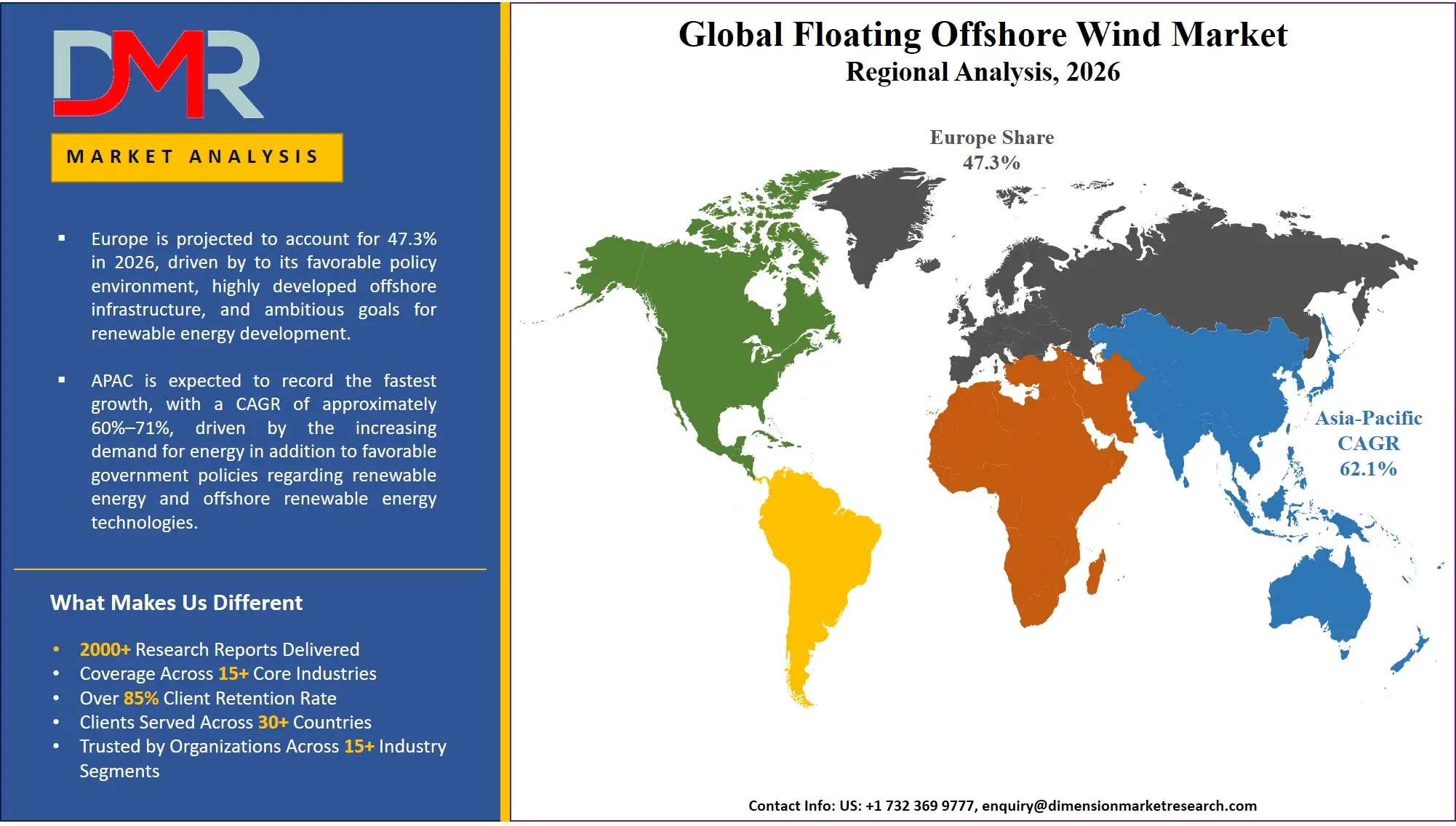
Europe will likely lead the Floating Offshore Wind Market with an estimated 47.3% share in 2026 owing to its favorable policy environment, highly developed offshore infrastructure, and ambitious goals for renewable energy development. The countries in Europe such as UK, Norway, France, and Portugal have been making efforts towards deploying commercial floating wind farms by conducting auctions, offering financial incentives, and promoting research in the sector. The region has a highly developed maritime industry, experienced offshore supply chain, and strong collaborations between utilities and technology suppliers. The deployment of large projects in the North and Celtic seas, along with policies related to climate change through the European Green Deal, makes Europe the leader in the deployment of floating offshore wind technology.
ℹ
To learn more about this report –
Download Your Free Sample Report Here
Fastest Growing Region in the Floating Offshore Wind Market
Asia Pacific is forecasted to have the fastest growth rate compared to all other regions across the globe in the Floating Offshore Wind market owing to the increasing demand for energy in addition to favorable government policies regarding renewable energy and offshore renewable energy technologies. Several countries such as Japan, South Korea, China, and Australia are implementing floating wind energy technologies as a means of reducing their dependency on fossil fuels. Since the region has deep coasts, there will be a need for floating wind energy technologies since the fixed bottom approach cannot be implemented here.
By Region
North America
Europe
- Germany
- The U.K.
- France
- Italy
- Russia
- Spain
- Benelux
- Nordic
- Rest of Europe
Asia-Pacific
- China
- Japan
- South Korea
- India
- ANZ
- ASEAN
- Rest of Asia-Pacific
Latin America
- Brazil
- Mexico
- Argentina
- Colombia
- Rest of Latin America
Middle East & Africa
- Saudi Arabia
- UAE
- South Africa
- Israel
- Egypt
- Rest of MEA
Competitive Landscape
Technological rivalry, partnerships, and innovations that drive down costs and boost efficiency are the key aspects defining the Floating Offshore Wind Market. The participants in the Floating Offshore Wind Market are devoting considerable attention to innovations in the area of floating foundations, turbines, remote management systems, and comprehensive offshore power solutions. The obstacles facing companies in terms of entering this market consist in the necessity to make heavy investments, overcome engineering hurdles, and obtain relevant authorizations. Growing trends include collaborative ventures and offshore pilot programs, among others.
Some of the prominent players in the global Floating Offshore Wind are:
- Ørsted
- Equinor
- Siemens Gamesa Renewable Energy
- Vestas Wind Systems
- GE Vernova
- Principle Power
- BW Ideol
- Ocean Winds
- Shell
- TotalEnergies
- RWE
- Copenhagen Infrastructure Partners
- Aker Solutions
- Hexicon
- Mingyang Smart Energy
- Goldwind
- Doosan Enerbility
- Marubeni Corporation
- Hitachi Energy
- EDF Renewables
- Other Key Players
Recent Developments
- In May 2026, The Spanish government is set to allocate provisionally EUR 212 million (approximately USD 241 million) through the Spain's Recovery, Transformation and Resilience Plan towards the modernization of six ports that will be dedicated to the development of offshore wind energy projects and other marine energies. The plan will benefit from the support provided to ports like Gijón, Las Palmas, Tarragona, Castellón, and the ports of A Coruña and Ferrol-San Cibrao.
- In May 2026, The joint venture between EDP Renewables and ENGIE called Ocean Winds has announced electricity generation from its first floating offshore wind project called Éoliennes Flottantes du Golfe du Lion (EFGL) of 30 MW capacity. EFGL is located about 16 km off the French coast and consists of three wind turbines of 10 MW each that will provide renewable power to Southern France. Built in collaboration with Banque des Territoires, EFGL serves as a showcase for the potential of floating offshore wind farms in the deep sea of the Mediterranean. The wind farm is anticipated to produce 110,000 MWh of renewable power annually for the next 20 years.
- In April 2026, The Tokyo Metropolitan Government has announced its intention to construct the world's biggest floating offshore wind farm adjacent to the Izu Islands. This project, which is scheduled to be completed by 2035, will reportedly produce more than 1 GW of power that will be utilized by the Izu Islands and the metropolitan city of Tokyo. With an energy production capacity of over 1 GW, the proposed project will be almost ten times bigger than the current biggest operational floating offshore wind farm in Norway.
Report Details
| Report Characteristics |
| Market Size (2026) |
USD 2.7 Bn |
| Forecast Value (2035) |
USD 176.5 Bn |
| CAGR (2026–2035) |
58.9% |
| Historical Period |
2021 – 2025 |
| Forecast Period |
2027 – 2035 |
| Base Year |
2025 |
| Estimate Year |
2026 |
| Segments Covered |
By Platform Type, By Turbine Capacity, By Water Depth, By Component, By Application, By Project Stage |
| Regional Coverage |
North America – The US and Canada; Europe – Germany, The UK, France, Russia, Spain, Italy, Benelux, Nordic, & Rest of Europe; Asia-Pacific – China, Japan, South Korea, India, ANZ, ASEAN, Rest of APAC; Latin America – Brazil, Mexico, Argentina, Colombia, Rest of Latin America; Middle East & Africa – Saudi Arabia, UAE, South Africa, Turkey, Egypt, Israel, & Rest of MEA |
Frequently Asked Questions
How big is the Floating Offshore Market?
▾ The Floating Offshore Market size is expected to reach USD 2.7 billion by 2026 and is projected to reach USD 176.5 billion by the end of 2035.
What is the CAGR of the Floating Offshore Market from 2026 to 2035?
▾ The market is growing at a CAGR of 58.9 percent over the forecasted period.
What factors are driving the growth of the Floating Offshore Market?
▾ Increased Demand for Floating Offshore Wind Energy Systems, and more are the factors driving the growth of the Floating Offshore Market.
What are the major trends in the Floating Offshore Market?
▾ Increased Digitization and Predictive Maintenance Solutions, and more are some of the major trends in the market.
Who are the key players in the Floating Offshore Market?
▾ Some of the key players in the Floating Offshore Market include Shell, GE, Siemens and more.
How is the Floating Offshore Market segmented?
▾ The Floating Offshore Market is segmented by platform type, turbine capacity, water depth, component, application, project stage.
Which region held the largest share of the Floating Offshore Market in 2026?
▾ Europe is set to lead the Floating Offshore market with an estimated 47.3% share in 2026.
Which region is expected to grow the fastest in the Floating Offshore Market?
▾ Asia Pacific is the fastest-growing region in the Floating Offshore market during the forecast period