Market Snapshot
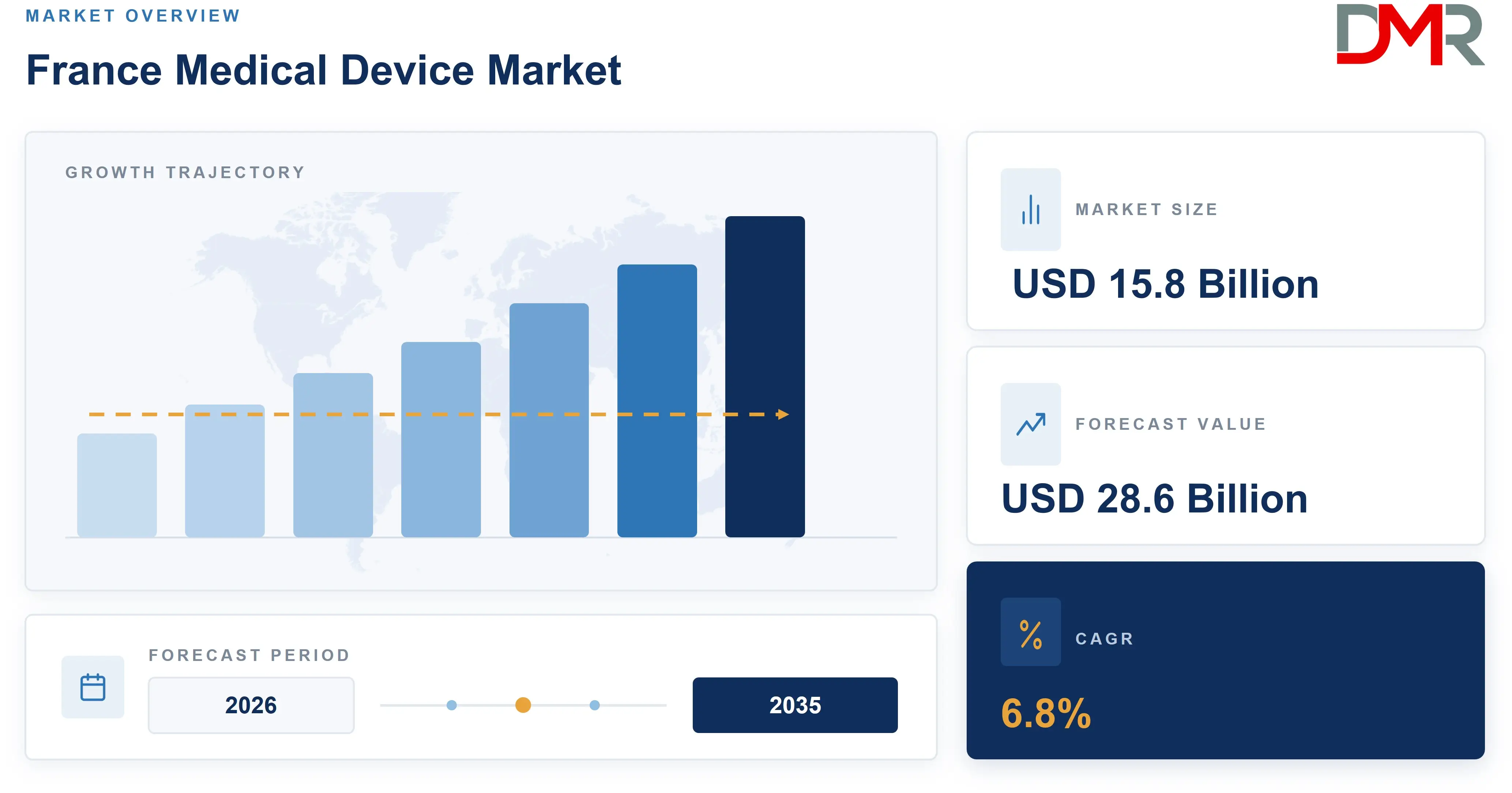
- Market Size (2026): USD 15.8 Bn
- Forecast Value (2035): USD 28.6 Bn
- CAGR (2026-2035): 6.8%
- Leading Product Type (2026): Diagnostic Imaging Devices, approximately 24%
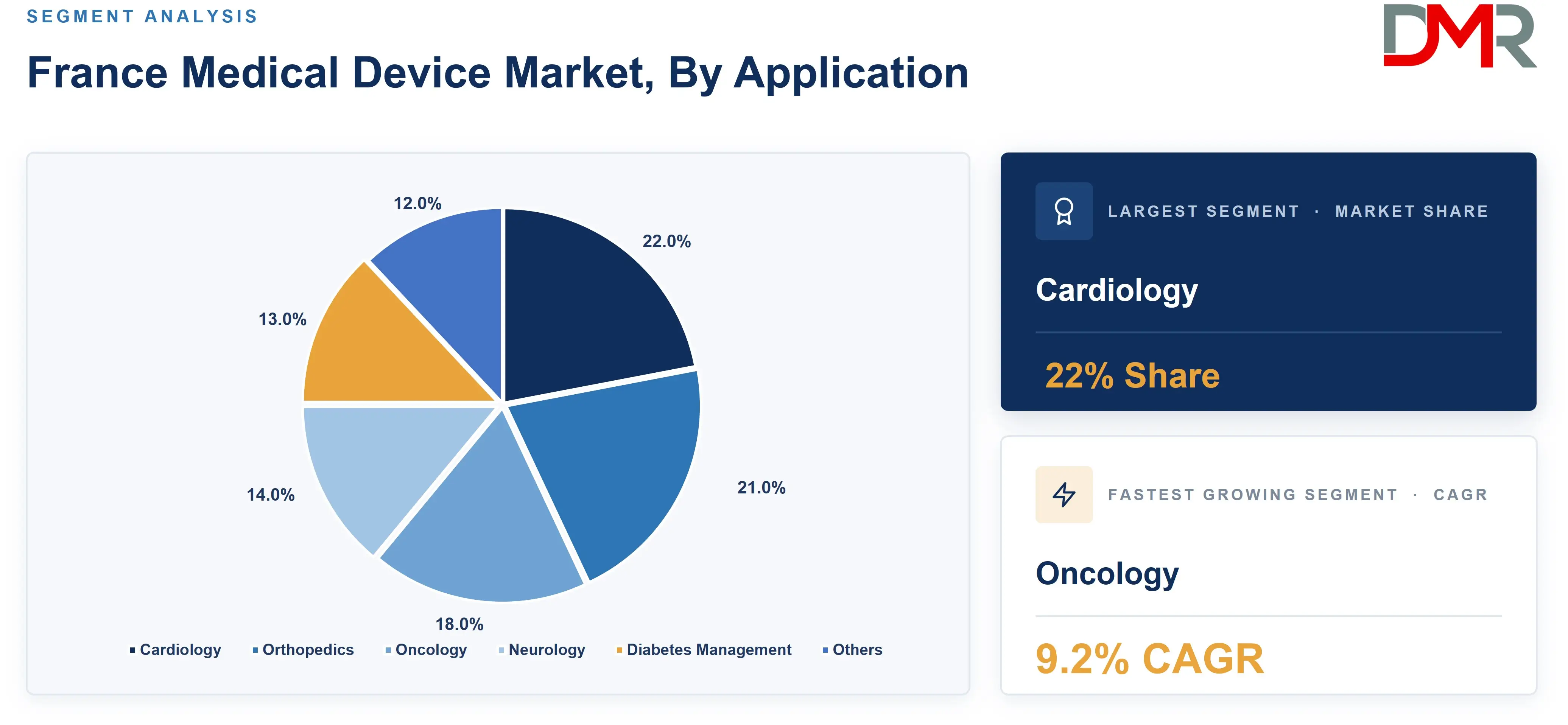
- Leading Application (2026): Cardiology, around 22%
- Key Players: bioMerieux, Medtronic, Siemens Healthineers and others
What is France Medical Device Market and its Market Size?
The France Medical Device Market size is estimated to reach USD 15.8 Bn in 2026 and is further anticipated to reach USD 28.6 Bn by 2035, at a CAGR of 6.8%.
ℹ
To learn more about this report –
Download Your Free Sample Report Here
The figures above cover demand for medical devices purchased, installed or reimbursed for use inside France, not the worldwide revenue of device makers headquartered in the country. The scope spans diagnostic imaging systems, in vitro diagnostic kits and analyzers, cardiovascular implants, orthopedic hardware, patient monitoring equipment and surgical instruments that move through French public hospitals, private clinics, diagnostic laboratories and home care providers.
Purchasing in this market runs through a small number of gatekeepers rather than open retail demand. Regional health agencies and hospital group purchasing structures set tender terms for capital equipment, the Haute Autorite de Sante rules on reimbursement eligibility for new device categories, and private clinic networks negotiate directly with suppliers for consumables and implants. A device that clears European conformity marking still needs a domestic reimbursement code before it reaches meaningful volume, which makes market access as commercially decisive as the underlying technology.
What is changing structurally is the balance between hospital based capital spend and distributed, connected care. Recertification obligations under the European Union Medical Device Regulation are pushing smaller manufacturers to rationalize product lines, while a dedicated reimbursement pathway for digital health tools is pulling monitoring and diagnostic support software into funded care pathways for the first time. Both forces are reshaping who wins tenders and how devices are priced.
Use Cases
- Public Hospital Imaging Renewal: French hospital groups formed under regional cooperation structures are pooling procurement budgets to replace aging computed tomography and magnetic resonance fleets in a single tender, with imaging equipment accounting for close to 24% of 2026 device spend across these renewal cycles.
- Home Dialysis Delivery: Renal care providers place peritoneal and home hemodialysis systems with patients outside major cities, cutting travel burden for chronic kidney disease patients and shifting recurring consumable revenue away from hospital dialysis units.
- Ambulatory Orthopedic Surgery: Day case surgical centers now perform hip and knee procedures that once required overnight admission, using shorter acting implant systems and instrument trays sized for faster turnover between cases.
- Rural Diabetes Telemonitoring: Connected glucose sensors and insulin delivery devices, reimbursed through an experimental care funding route, let endocrinology teams manage patients in areas with limited specialist access without requiring in person visits for routine adjustments.
Key Takeaways
- Market Size & Share: The market is estimated at USD 15.8 Bn in 2026, rising to USD 28.6 Bn by 2035.
- Product Type Analysis: Diagnostic Imaging Devices lead with a share of roughly 24% in 2026, while Patient Monitoring Devices post the fastest sub segment growth at a CAGR of 9.9%.
- Demand Concentration: Hospitals account for close to 46% of 2026 device demand, the largest single point of purchase in the market.
- Regulatory Momentum: European Union Medical Device Regulation recertification is compressing supplier lists in several device classes ahead of upcoming compliance deadlines.
- Technology Adoption: Artificial intelligence enabled diagnostic systems are expanding at a CAGR of 14.3%, the fastest of any technology segment tracked.
- Channel Shift: Online and direct to provider channels are projected to grow at 13.1% annually as procurement moves toward digital tendering platforms.
How AI/Gen AI is Transforming the France Medical Device Market?
Artificial intelligence adoption in this market is concentrated in diagnostic support rather than novel hardware. Radiology departments are pairing existing imaging fleets with computer vision software that flags suspected fractures, nodules and cardiovascular abnormalities for radiologist review, which shortens reporting queues without requiring new capital equipment. Laboratory networks are layering machine learning onto in vitro diagnostic analyzers to catch anomalous results before they leave the lab.
Generative tools are appearing mainly in administrative and regulatory workflows rather than clinical decision making. Manufacturers use large language model based document processing to draft and update the technical files required for European Union Medical Device Regulation submissions, a task that previously consumed significant regulatory affairs headcount. Hospital procurement teams are piloting similar tools to compare tender specifications against supplier catalogs.
- Computer Vision Triage: Automated flagging of abnormal imaging studies for priority radiologist review.
- Regulatory Document Automation: Large language model assisted drafting of technical documentation and post market surveillance reports.
- Predictive Maintenance: Sensor data models that forecast servicing needs for imaging and monitoring equipment before failure.
- Diagnostic Pattern Recognition: Machine learning models embedded in laboratory analyzers to detect result anomalies in real time.
Key Drivers in the France Medical Device Market
Two forces of different kinds are pushing device demand higher through the forecast period.
- Aging Population and Chronic Disease Burden: France's population over 65 continues to expand, and with it the volume of patients managing cardiovascular disease, diabetes and degenerative joint conditions. Each of these conditions drives recurring device demand rather than a one time purchase, from cardiac rhythm monitors to insulin delivery systems to orthopedic implants replaced or revised over a patient's lifetime. Hospitals and clinics are budgeting for higher patient throughput in cardiology and orthopedic departments specifically, which is lifting capital equipment orders in those specialties ahead of the market average. Because the demographic shift is structural rather than cyclical, suppliers are treating it as a multi year planning input rather than a short term demand spike, which is visible in longer term supply contracts being negotiated with hospital groups.
- Digital Health Reimbursement Pathways: A dedicated experimental funding route now allows telemonitoring and remote diagnostic support tools to receive reimbursement before they clear the standard evaluation process, which previously kept connected devices out of funded care entirely. This has opened a funded route to market for remote patient monitoring platforms in diabetes, cardiology and respiratory care that did not exist a few years ago. Device makers are redesigning products specifically to qualify for this pathway, and several digital health specialists have restructured commercial teams around it. The effect is most visible in Patient Monitoring Devices, which are growing faster than the broader Product Type axis as a direct result.
Restraints in the France Medical Device Market
Two brakes are working against otherwise favorable demand conditions.
- European Union Medical Device Regulation Compliance Cost: Recertifying an existing device catalog under the current regulation requires clinical evidence, technical documentation and notified body review that smaller and mid sized French manufacturers often cannot absorb without external financing. Several manufacturers have already withdrawn lower volume product lines rather than fund recertification, which is narrowing supplier lists in categories like specialized surgical instruments and legacy implant designs. Notified body capacity remains constrained relative to submission volume, which extends approval timelines for even well resourced applicants. The near term effect is fewer competitive tenders in some device classes, which softens the pricing pressure buyers might otherwise expect.
- Hospital Budget and Tariff Pressure: Public hospital groups operate under fixed diagnosis related group tariffs that do not automatically adjust for higher priced device technology, which forces procurement teams to trade volume for unit price when negotiating capital equipment purchases. This is compressing margins on premium imaging and monitoring systems even where clinical demand is strong. Suppliers are responding with extended service and financing agreements rather than straightforward equipment sales, spreading hospital payments over multiple budget cycles to preserve deal volume.
Growth Opportunities in the France Medical Device Market
The clearest white space sits outside the traditional hospital procurement channel.
- Home Healthcare Channel Buildout: Reimbursed telemonitoring and home dialysis programs are creating a distribution channel that barely existed a decade ago, and suppliers with direct to patient logistics capability are capturing share that hospital focused competitors cannot easily reach. Home Healthcare is already the fastest growing end use segment in the market, and providers that build nursing support and equipment logistics around connected devices are positioned to defend that lead as reimbursement expands to additional chronic conditions.
- Ambulatory Surgical Center Adjacency: The shift of orthopedic and cardiovascular procedures into day case ambulatory surgical centers is creating demand for instrument and implant systems sized for faster turnover, a specification that differs meaningfully from equipment built for overnight hospital stays. Manufacturers that redesign trays and sterilization workflows specifically for ambulatory throughput can secure preferred supplier status with these centers before larger incumbents adapt their hospital focused product lines.
Trends in the France Medical Device Market
Two shifts in buyer behavior are reshaping how devices are sold rather than what is sold.
- Outcome Linked Procurement: Hospital groups are increasingly structuring tenders around patient outcome metrics and total cost of care rather than unit price alone, particularly for cardiovascular implants and monitoring systems where readmission avoidance carries direct budget consequences. Suppliers that can demonstrate real world outcome data from existing French installations are winning renewal tenders even at a price premium, a departure from the price led tendering that dominated the previous decade.
- Centralized Group Purchasing: Regional hospital cooperation structures are consolidating procurement authority away from individual facilities, which is concentrating tender value into fewer, larger contracts. This favors suppliers with the balance sheet and service infrastructure to support multi site rollouts, and is pushing smaller specialist manufacturers toward distribution partnerships rather than direct hospital sales relationships.
Research Scope and Analysis
Segment performance is assessed across five axes: product type, application, end use, technology and distribution channel. Each axis identifies the sub segment carrying the largest share of 2026 revenue and the one expanding fastest through 2035, with the commercial reason behind each position.
ℹ
To learn more about this report –
Download Your Free Sample Report Here
By Product Type
Diagnostic Imaging Devices hold the largest share by product type in 2026, accounting for close to 24% of revenue, reflecting the capital intensity of computed tomography, magnetic resonance and ultrasound fleets that hospital groups renew on multi year cycles regardless of broader budget pressure. In Vitro Diagnostics sits close behind on the back of steady laboratory testing volume. Growth, however, is concentrated in Patient Monitoring Devices, expanding at a CAGR of 9.9% between 2026 and 2035 as reimbursed telemonitoring pulls connected monitoring hardware into funded home care pathways that did not previously exist. That shift is drawing investment away from one time capital purchases and toward recurring device and service revenue.
By Application
Cardiology leads by application, holding approximately 22% of 2026 revenue on the strength of an aging population carrying a high burden of cardiovascular disease and the recurring device replacement cycle that condition requires. Orthopedics follows closely given steady joint replacement volume. The steeper trajectory sits with Oncology, projected to grow at a CAGR of 9.2% as diagnostic and treatment planning devices tied to cancer care expand alongside rising screening rates and earlier stage detection protocols that call for more frequent imaging and monitoring.
By End Use
Hospitals remain the dominant end use setting, accounting for nearly 46% of 2026 demand, since capital equipment purchasing and complex procedures are still concentrated in acute care facilities with the infrastructure to support them. Growth, however, is concentrated in Home Healthcare, expanding at a CAGR of 11.5% as reimbursed telemonitoring and home dialysis programs shift recurring device and consumable demand out of hospital settings entirely. Diagnostic and imaging centers hold a stable middle position, benefiting from outpatient referral volume that hospitals increasingly route externally.
By Technology
Conventional Devices still account for the largest technology share in 2026, at around 52%, because the installed base of non connected imaging, monitoring and surgical equipment across French hospitals remains large and is replaced gradually rather than all at once. The steeper trajectory sits with Artificial Intelligence enabled Diagnostic Systems, forecast to grow at a CAGR of 14.3% as software layered onto existing imaging and laboratory hardware becomes a standard purchase criterion in new tenders rather than an optional add on.
By Distribution Channel
Direct Tenders and Public Procurement dominate distribution, capturing close to 44% of 2026 volume, a direct consequence of hospital groups and regional health agencies controlling most capital equipment purchasing through formal tender processes. Third party distributors remain important for smaller clinics and private practices. Growth, however, is concentrated in Online Channels, expanding at a CAGR of 13.1% as digital tendering platforms and e procurement portals reduce the administrative overhead of smaller equipment and consumable orders.
The France Medical Device Market Report is Segmented Based on the Following
By Product Type
- Diagnostic Imaging Devices
- In Vitro Diagnostics
- Cardiovascular Devices
- Orthopedic Devices
- Patient Monitoring Devices
- Surgical Instruments
- Others
By Application
- Cardiology
- Orthopedics
- Oncology
- Neurology
- Diabetes Management
- Others
By End Use
- Hospitals
- Diagnostic and Imaging Centers
- Ambulatory Surgical Centers
- Home Healthcare
- Clinics
- Others
By Technology
- Conventional Devices
- Connected and Digital Health Devices
- Artificial Intelligence enabled Diagnostic Systems
- Wearable Devices
- Others
By Distribution Channel
- Direct Tenders and Public Procurement
- Third Party Distributors
- Retail Pharmacies
- Online Channels
- Others
Regulatory Landscape
Every device sold into France now operates under the European Union Medical Device Regulation, which replaced a lighter touch directive with mandatory clinical evidence, unique device identification and stricter notified body review. Compliance deadlines for legacy device classes are tightening through the forecast period, and notified body capacity has not scaled at the same pace as submission volume, which is stretching approval timelines industry wide. The commercial opening sits with manufacturers that treat recertification as a chance to consolidate and modernize product portfolios rather than a defensive cost, since thinner competitor lists in several device classes are already easing pricing pressure. The risk is that smaller domestic manufacturers without the balance sheet to fund multi year compliance programs exit categories entirely, concentrating supply and, over time, hospital tender pricing power in fewer hands.
Technology Analysis
Software layered onto existing hardware, rather than new device categories, is where technology investment is concentrated. Artificial intelligence enabled diagnostic support, already installed alongside imaging and laboratory equipment in leading hospital groups, is shifting from pilot programs to standard tender specifications. What is shifting now is buyer expectation: procurement teams increasingly ask suppliers to demonstrate software roadmaps, not just hardware specifications, before shortlisting. The commercial opening favors incumbents who can bundle diagnostic software with existing service contracts rather than pure software vendors without a hardware installed base to build from. The brake is interoperability, since French hospital information systems vary in how readily they accept third party software, which slows integration timelines and keeps some smaller vendors locked out of the largest hospital groups regardless of clinical performance.
Competitive Landscape
Competition in the France Medical Device Market runs on two distinct fronts. Large diversified suppliers compete on installed base, service infrastructure and the balance sheet needed to fund European Union Medical Device Regulation compliance across broad product portfolios, while domestic specialists compete on clinical relationships, faster regulatory navigation for niche device categories and closer alignment with French reimbursement rules. Hospital group purchasing has concentrated tender value into fewer, larger contracts, which favors suppliers able to support multi site rollouts and extended financing terms. Domestic manufacturers retain an advantage in categories tied closely to French clinical practice and reimbursement pathways, where global suppliers move more slowly.
Some of the Prominent Players in the France Medical Device Market Are
- Medtronic
- Siemens Healthineers
- GE HealthCare
- Philips
- Johnson & Johnson MedTech
- Abbott Laboratories
- Becton Dickinson
- Boston Scientific
- Stryker
- Baxter International
- B. Braun
- Fresenius Medical Care
- bioMerieux
- Carmat
- Implanet
- Urgo Group
- Vygon
- Withings
- Voluntis
- Diabeloop
- Quantel Medical
- EOS imaging
- Cousin Biotech
- Theradiag
- NG Biotech
- Sensome
- Air Liquide Healthcare
- Alcyon
- Fisher & Paykel Healthcare
- Draeger
- Getinge
- Terumo Corporation
- Olympus Corporation
- Nipro Corporation
- Hologic
- ResMed
- Linde Healthcare
- Sysmex Corporation
- Sartorius Stedim Biotech
- Ypsomed
- Other Key Players
Recent Developments
- In February 2026, Withings widened distribution of its connected blood pressure monitoring line into French pharmacy retail networks, expanding patient access to devices eligible for home monitoring reimbursement.
- In January 2026, bioMerieux opened an additional diagnostics manufacturing line at its Marcy l'Etoile site to increase output of in vitro diagnostic testing kits for domestic and export demand.
- In November 2025, Carmat secured an extension of French reimbursement coverage for its artificial heart implant under the country's early access innovation funding route.
- In June 2025, GE HealthCare signed a multi year framework agreement with a French public hospital cooperation group to supply magnetic resonance and computed tomography systems across several sites.
- In March 2025, Air Liquide Healthcare extended its home respiratory therapy service network into additional French regions, adding device delivery and patient support capacity.
Report Details
| Report Characteristics |
| Market Size (2026) |
USD 15.8 Bn |
| Forecast Value (2035) |
USD 28.6 Bn |
| CAGR (2026-2035) |
6.8% |
| Historical Data |
2021 - 2025 |
| Forecast Data |
2026 - 2035 |
| Base Year |
2025 |
| Segments Covered |
By Product Type, By Application, By End Use, By Technology and By Distribution Channel |
| Regional Coverage |
France |
Frequently Asked Questions
How big is the France Medical Device Market?
▾ The France Medical Device Market is estimated at USD 15.8 Bn in 2026. Demand spans diagnostic imaging, in vitro diagnostics, cardiovascular and orthopedic devices, patient monitoring equipment and surgical instruments purchased across French hospitals, clinics, laboratories and home care providers, with hospital procurement remaining the single largest point of purchase.
What is the growth rate of the France Medical Device Market?
▾ The market is projected to grow at a CAGR of 6.8% between 2026 and 2035, reaching USD 28.6 Bn by the end of the forecast period. Growth is led by patient monitoring devices, home healthcare demand and artificial intelligence enabled diagnostic systems, each expanding faster than the broader market average.
What is driving demand in the France Medical Device Market?
▾ Demand is driven primarily by an aging population carrying a rising chronic disease burden, which lifts recurring device use in cardiology, orthopedics and diabetes care, alongside a dedicated reimbursement pathway that has opened funded access for telemonitoring and remote diagnostic devices previously excluded from standard coverage.
Who are the key players in the France Medical Device Market?
▾ Key players include Medtronic, Siemens Healthineers, GE HealthCare, bioMerieux, Withings, Carmat and Air Liquide Healthcare, among others. Competition splits between diversified global suppliers with large installed bases and domestic specialists whose clinical relationships and reimbursement expertise favor niche device categories.
Which product type leads the France Medical Device Market?
▾ Diagnostic Imaging Devices lead the product type axis, holding approximately 24% of 2026 revenue, supported by ongoing hospital fleet renewal cycles for computed tomography, magnetic resonance and ultrasound systems that continue regardless of broader budget constraints elsewhere in the market.
How is technology reshaping the France Medical Device Market?
▾ Artificial intelligence enabled diagnostic software layered onto existing imaging and laboratory hardware is the fastest expanding technology segment, growing at a CAGR of 14.3%, as hospital procurement teams increasingly treat software capability as a standard tender requirement rather than an optional feature.
What is the France Medical Device Market expected to be worth by 2035?
▾ The France Medical Device Market is expected to reach USD 28.6 Bn by 2035, up from an estimated USD 15.8 Bn in 2026, reflecting sustained demand growth across imaging, monitoring, orthopedic and diagnostic device categories serving the French healthcare system.