Market Overview
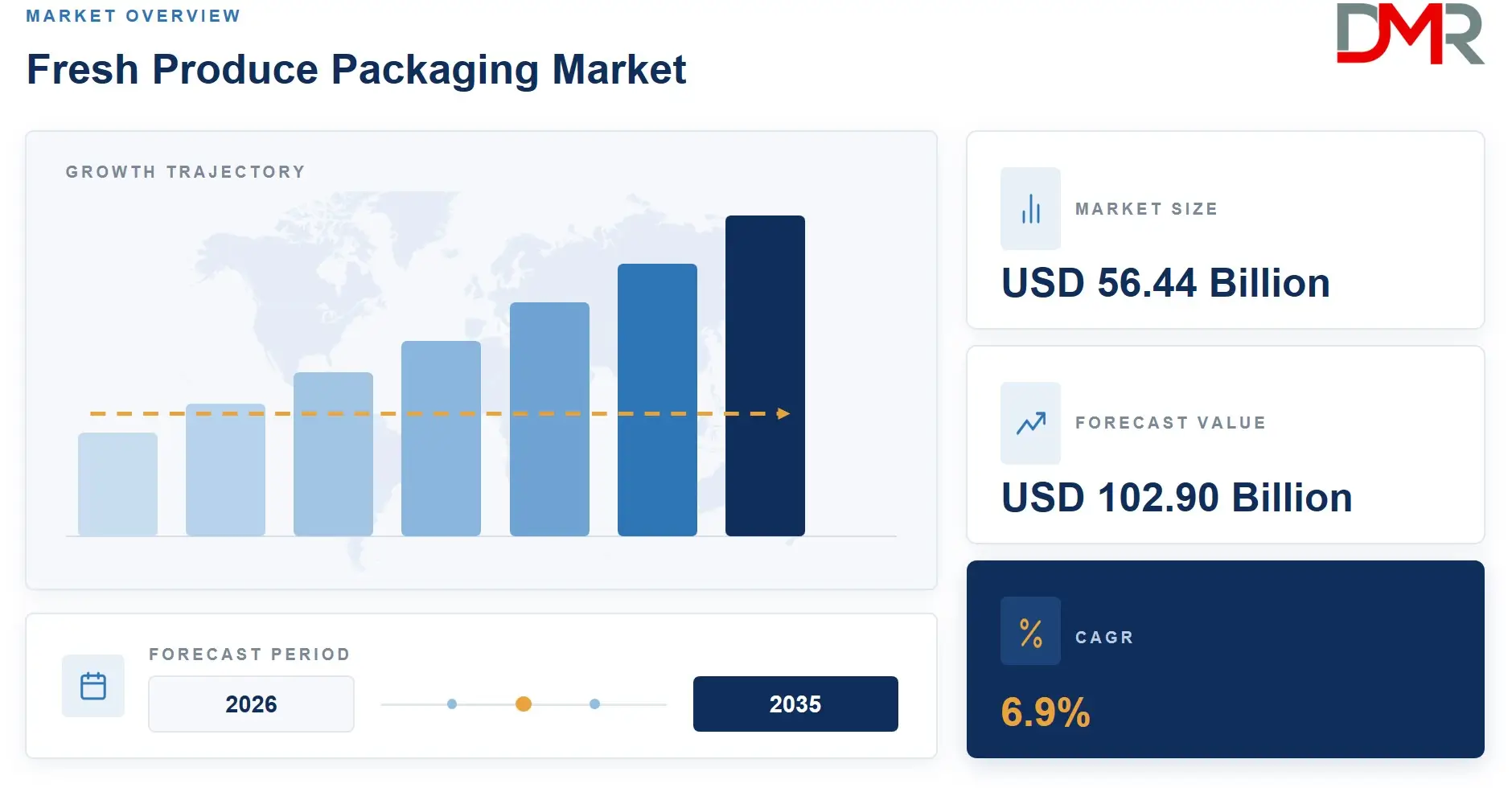
The Global Fresh Produce Packaging Market size is estimated at USD 56.44 Billion in 2026, and is projected to reach USD 102.90 Billion by 2035, exhibiting a CAGR of 6.9% during the forecast period. A fall–winter 2025–2026 survey of 1,052 fresh-produce product lines found that 81% used plastic packaging, as reported by the Public Interest Network. Plastic's dominance reflects entrenched retailer sourcing habits built on cost efficiency and shelf-life performance rather than sustainability preference.
The gap between plastic dependency and consumer-stated sustainability expectations now creates regulatory and reputational pressure that vendors cannot defer indefinitely. Fresh produce packaging sits at the intersection of food safety, cold logistics, and retail merchandising. The market covers primary containment formats, protective secondary packaging, and modified atmosphere technologies applied directly to perishable produce at farm, processor, or packing-house level. Fresh Food Packaging formats designed for direct shelf presentation increasingly carry temperature-performance and shelf-life claims that blur the boundary between packaging and food preservation systems. Post-harvest loss reduction is the clearest commercial driver connecting packaging investment to measurable food-system returns. Food Packaging suppliers who can demonstrate shelf-life extension data now hold negotiating advantage over commodity film producers, because buyers across retail and foodservice chains can price that performance benefit directly against shrinkage cost. The forecast CAGR of 6.9% reflects this shift from cost-minimization purchasing toward value-based packaging procurement.
ℹ
To learn more about this report –
Download Your Free Sample Report Here
Key Takeaways
- The market size is USD 56.44 Billion in 2026, and is projected to hit USD 102.90 Billion by 2035 at a CAGR of 6.9%.
- By Packaging Type: Flexible Packaging led with a 45.7% share in 2026.
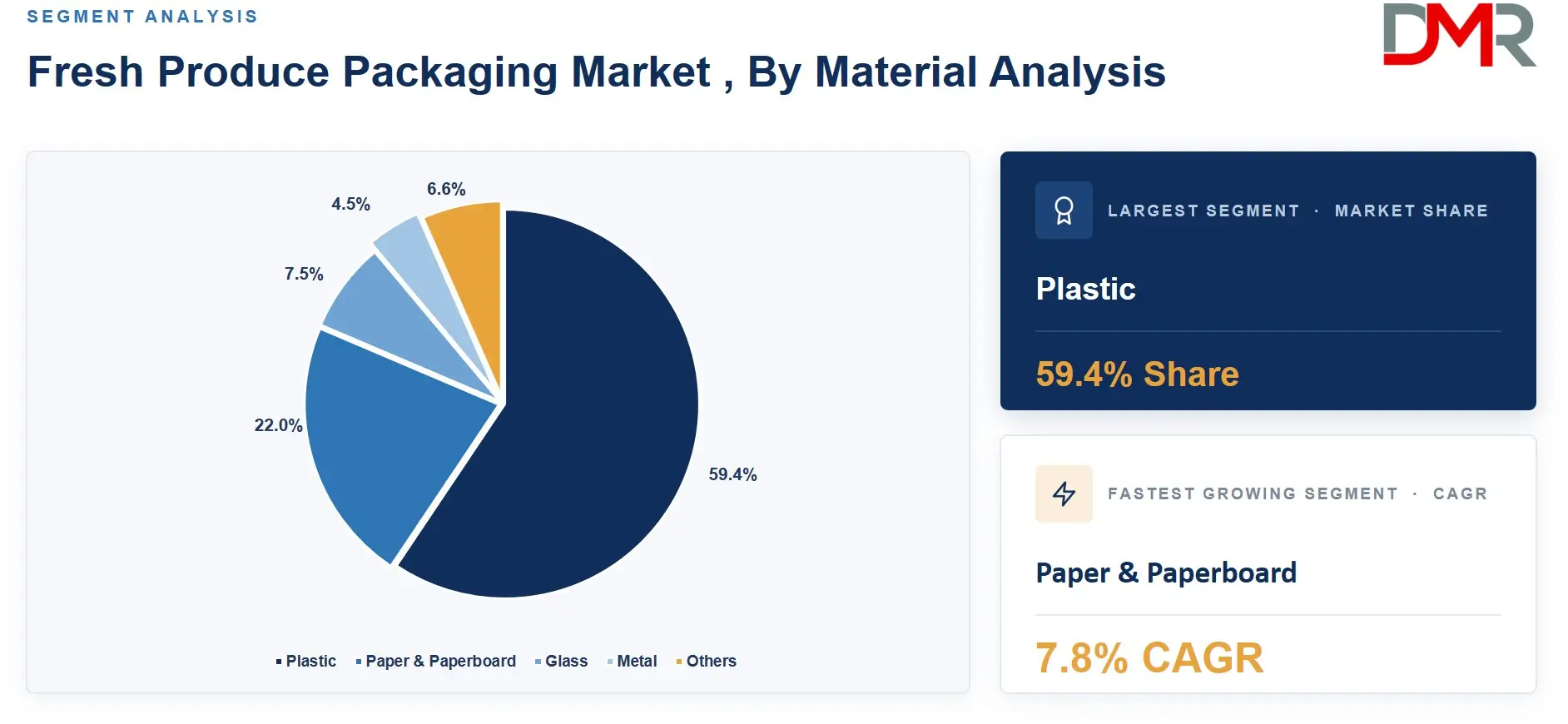
- By Material: Plastic led with a 59.4% share in 2026.
- By Application: Fruits led with a 57.6% share in 2026.
- By Technology: Modified Atmosphere Packaging led with a 51.9% share in 2026.
- By Distribution Channel: Supermarkets/Hypermarkets led with a 60.3% share in 2026.
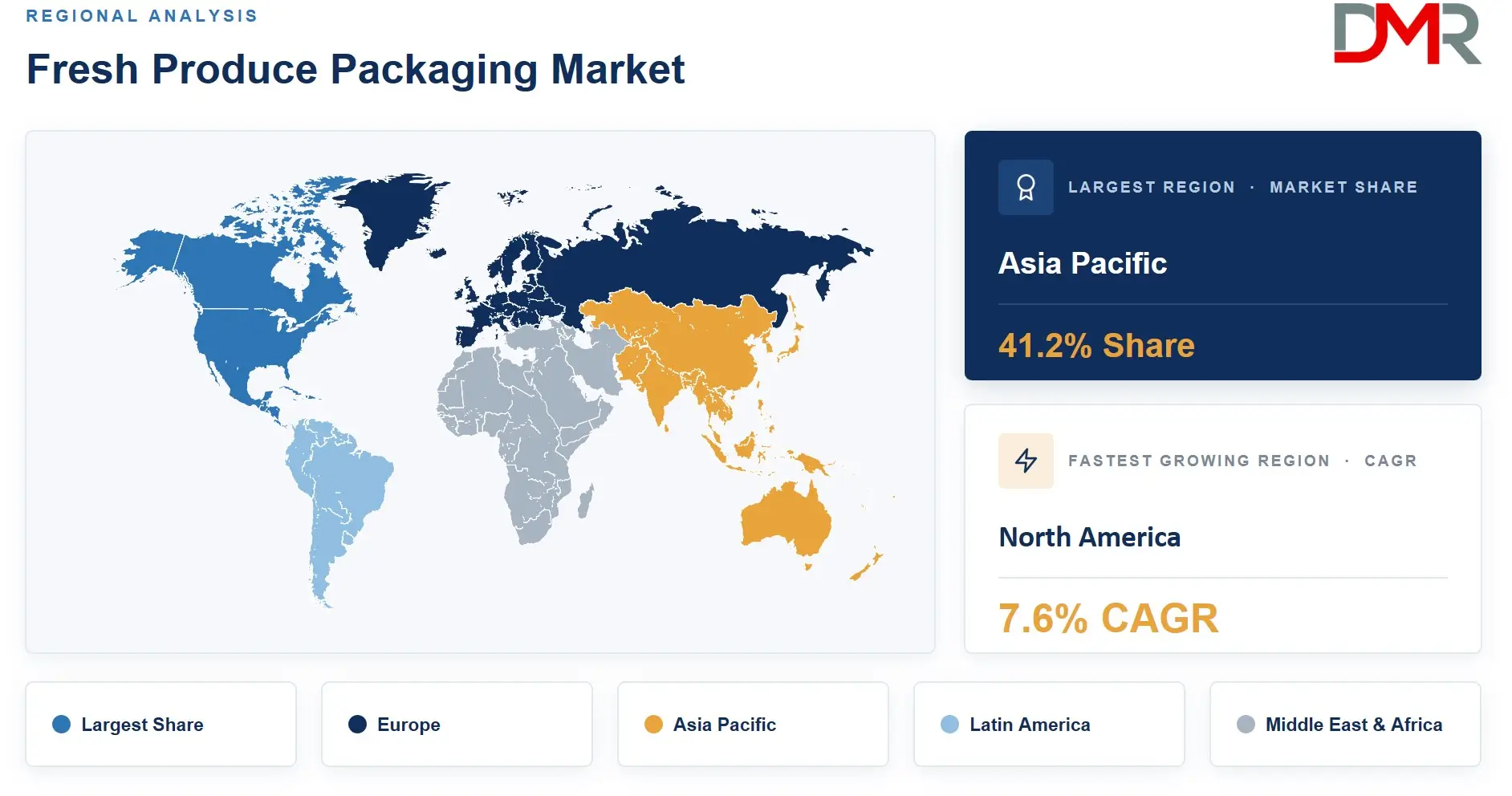
- By Region: Asia Pacific led with a 41.2% share, valued at USD 20.1 Billion, in 2026.
- Top key players: Amcor Plc, DS Smith Plc, Mondi Group, Smurfit Westrock, Sealed Air Corporation.
Packaging Type Analysis
Flexible Packaging led the Packaging Type segment with a 45.7% share in 2026. Flexible formats command nearly half of packaging type demand because they minimize material cost per unit while delivering the gas-barrier performance that modified atmosphere applications require. Film-based solutions scale from small retail punnet formats to bulk export bags without retooling, which makes them the default choice for high-volume fruit and vegetable packers operating across multiple SKUs. Retail buyers accept flexible formats because they reduce package-to-produce weight ratios and lower inbound freight costs. Rigid Packaging serves a distinct performance tier where product protection during transit outweighs material cost. Fresh basil packaged in a rigid plastic clamshell used approximately 36 times as much plastic per liter of produce as basil secured only with a plastic twist tie, as reported by the Public Interest Network, illustrating the material-intensity trade-off buyers accept when damage prevention is the priority. Rigid formats face the strongest regulatory pressure in markets with single-use plastic restrictions, creating an opening for fiber-based clamshell alternatives. Others including paper bags and reusable crate liners remain niche but are gaining specification in European retail supply chains where closed-loop return schemes are operational. Ryp Labs reported in 2025 that its biodegradable antimicrobial packaging stickers extended fresh-produce shelf life by 40%–100%, with strawberries gaining one to two additional days and citrus gaining up to 20 additional days, as cited by Waste360. A packaging format that delivers measurable shelf-life extension without requiring capital investment in MAP equipment gives small and mid-scale packers a cost-accessible route to premium positioning. Vendors offering such add-on technologies alongside conventional flexible formats capture a broader share of the value chain than those selling film alone.
Material Analysis
With a 59.4% share in 2026, Plastic outpaced all other Material categories. Plastic's majority share reflects its unmatched combination of barrier performance, formability, and per-unit cost at commercial scale. Polyethylene and polypropylene films dominate high-volume fruit and vegetable lines because no alternative material currently matches plastic's ability to be heat-sealed at high line speeds while maintaining the oxygen and moisture transmission rates that MAP technology requires. Sustainable Food Packaging development is the most active area of material R&D as converters race to engineer bio-based and compostable substrates that meet the same technical benchmarks. Paper and Paperboard is the fastest-growing material category, driven by EU single-use plastics regulation and retailer sustainability commitments that are pulling fiber-based trays and wraps into categories previously owned entirely by plastic film. Glass holds a niche position in premium and organic produce segments where consumer perception of purity justifies the added weight and cost. Metal sees limited fresh produce application but retains relevance in specialty hermetic formats. The Others category covers bio-based films and compostable laminates, which are scaling commercially but still represent a small fraction of total material demand.
ℹ
To learn more about this report –
Download Your Free Sample Report Here
Application Analysis
Fruits accounted for 57.6% of Application demand in 2026, the highest of any category. Fruits generate the dominant share of packaging demand because fresh fruit categories combine high perishability, long export supply chains, and retail presentation requirements that all necessitate active packaging investment. Berries, stone fruits, and tropical produce require controlled gas atmospheres, mechanical protection, and moisture management simultaneously, which drives per-unit packaging spend well above vegetable equivalents. A 2025 modified atmosphere packaging study found that MAP treatments kept strawberries free of visible fungal decay through the full measured storage period, while conventionally packaged strawberries showed visible fungal growth on day 13, as published in the International Journal of Food Science and Technology. The performance gap between MAP-treated and conventional fruit packaging provides the clearest data-backed justification for premium packaging investment at buyer level. The 2025 study tested three modified atmosphere combinations across the fruit packaging formats. After 13 days at 4°C, oxygen levels fell to 0.25%, 0.25%, and 0.05% across the three MAP formats, while carbon dioxide levels reached 33.15%, 35.55%, and 40% respectively, as reported by the academic journal. On storage day seven, strawberries in the MAP2 format recorded a color-lightness value of 40.22 compared with 34.54 in conventional packaging, confirming better retention of visual brightness. These technical specifications give procurement teams quantifiable metrics to justify MAP adoption as a shrinkage-reduction investment rather than a premium cost line. Vegetables hold the second-largest application share. Root vegetables and brassicas tolerate longer distribution windows with less intensive packaging, but bagged salads and pre-cut vegetables have pulled leafy and specialty vegetable categories into higher-specification film requirements. Others covers herbs, sprouts, and edible flowers, where compact high-value formats command packaging premiums disproportionate to their volume contribution.
Technology Analysis
A 51.9% share made Modified Atmosphere Packaging the clear leader across Technology categories in 2026. MAP's majority position reflects decades of cold chain integration across berry, stone fruit, and salad categories where oxygen and carbon dioxide control directly reduce shrinkage costs measurable in retailer P&L data. The MAP packaging line parameters tested in 2025 academic research used a 0.5-second vacuum stage, 0.80-second gas stage, and a 1.50-second sealing stage at 130°C for 250-gram strawberry packs, as published in the International Journal of Food Science and Technology. These specifications illustrate that MAP is no longer a bespoke high-investment technology; commercial line speeds and standardized seal parameters have made MAP accessible to mid-scale packers. Temperature Controlled Packaging Solutions that combine MAP film with insulating secondary packaging are now entering export formats where refrigerated logistics remain inconsistent. Active Packaging is the fastest-growing technology segment, capturing attention in fruit export chains where ethylene absorbers and antimicrobial coatings extend commercial life without requiring gas-flush equipment investment. Intelligent Packaging incorporating time-temperature sensitive labels is migrating from pharmaceutical cold chain into mainstream produce retail, creating a new data layer for freshness monitoring at point of sale. The Others category includes reusable crate systems and vacuum skin packs, which occupy premium niches within controlled-environment agriculture supply chains.
Distribution Channel Analysis
Supermarkets/Hypermarkets captured 60.3% of the Distribution Channel segment in 2026, ahead of all rivals. Large-format retail chains set the specification standards that ripple across the entire fresh produce packaging supply chain. Their private-label produce programs require consistent branded packaging across high-volume fresh lines, which standardizes film grades, tray dimensions, and MAP protocols for the converters who supply them. Supermarket shrink reduction mandates have directly accelerated MAP adoption across perishable SKUs by tying supplier performance metrics to visible freshness at store level. Convenience Stores represent a growing secondary channel as urban single-serve produce formats expand across Asia Pacific and European markets. Online Retail is the fastest-growing distribution channel, requiring protective packaging formats that survive last-mile logistics without the cushion of refrigerated display cases. Others covers foodservice and wholesale formats, where bulk specification remains dominant but retail-ready packaging concepts are penetrating premium restaurant supply chains.
Key Market Segments
By Packaging Type
- Flexible Packaging
- Rigid Packaging
- Others
By Material
- Plastic
- Paper & Paperboard
- Glass
- Metal
- Others
By Application
By Technology
- Modified Atmosphere Packaging
- Active Packaging
- Intelligent Packaging
- Others
By Distribution Channel
- Supermarkets/Hypermarkets
- Convenience Stores
- Online Retail
- Others
Regional Analysis
Asia Pacific led the Regional segment with a 41.2% share, valued at USD 20.1 Billion, in 2026.
Asia Pacific
Asia Pacific's 41.2% share reflects the concentration of global fresh produce production, processing, and export infrastructure across China, India, Southeast Asia, and Australia. China alone accounts for the world's largest volumes of fresh fruit and vegetable output, and its domestic retail modernization has pulled supermarket-standard packaging requirements into supply chains that previously operated with minimal primary packaging. Cold chain infrastructure expansion across Vietnam, Thailand, and Indonesia is creating downstream demand for temperature-responsive produce packaging that did not exist at commercial scale five years ago. As per research by the Public Interest Network, a 2025–2026 survey of grocery stores across five U.S. cities found that stores serving Asian produce categories carried the broadest range of plastic-intensive formats, reflecting Asian export supply chain standards. Cold Chain investment in the region is a primary catalyst for sustained packaging market expansion through 2035.
North America
North America is the most regulated fresh produce packaging market, with U.S. FDA Food Safety Modernization Act traceability requirements driving demand for QR-code-enabled and digitally trackable packaging formats. Retail consolidation among major grocery chains concentrates specification power in the hands of a small number of buyers, which accelerates the pace at which new packaging standards become commercial requirements across the entire supplier base. The USDA's sustained investment in fresh produce packaging innovation reinforces domestic converter competitiveness against lower-cost import alternatives.
Europe
Europe's regulatory environment is the most restrictive globally for single-use plastic produce packaging, with EU directives actively mandating plastic reduction timelines that are forcing converter and retailer investment into fiber-based and compostable alternatives ahead of commercial demand signals. Germany, France, and the UK are the largest markets by volume and are the primary test beds for retail-ready fiber tray formats that producers are now scaling for pan-European distribution. Spain and Italy, as major fresh produce exporters, face dual compliance requirements serving both domestic EU markets and export destinations with differing standards.
ℹ
To learn more about this report –
Download Your Free Sample Report Here
Latin America
Latin America functions primarily as a fresh produce export origin rather than a mature packaging consumption market. Brazil and Mexico generate significant packaging demand at the packing-house level for export-grade citrus, berry, and tropical fruit formats destined for North American and European retail. Domestic retail packaging standards remain lower than export requirements, creating a dual-market dynamic where local packers maintain two separate packaging specifications.
Middle East & Africa
The Middle East imports the majority of its fresh produce and represents a growing end-market for export-grade packaging standards from European and Asian origin countries. Africa presents a structurally different opportunity where packaging demand is driven by post-harvest loss reduction rather than retail presentation. Smallholder aggregation supply chains in Sub-Saharan Africa require low-cost protective formats that reduce the estimated 40%–50% post-harvest loss rates that currently characterize farm-to-urban produce distribution.
Key Regions and Countries
North America
Europe
- Germany
- France
- The UK
- Spain
- Italy
- Rest of Europe
Asia Pacific
- China
- Japan
- South Korea
- India
- Australia
- Rest of APAC
Latin America
- Brazil
- Mexico
- Rest of Latin America
Middle East & Africa
- GCC
- South Africa
- Rest of MEA
Macroeconomic Impact
Currency volatility across key produce-exporting economies directly affects packaging cost structures, because resin pricing for polyethylene and polypropylene films is denominated in U.S. dollars while packaging production costs in Asia Pacific and Latin America are borne in local currencies. Dollar strengthening compresses converter margins in export-origin markets while simultaneously reducing the U.S. dollar cost of imported packaging for North American buyers. Inflation-driven energy cost increases weigh disproportionately on thermoforming and extrusion-intensive packaging operations where energy is a primary variable cost. Trade policy shifts affect fresh produce packaging demand indirectly through their impact on export volumes. Parkside launched Popflex, a recyclable lidding film for fresh produce trays, in March 2024, targeting markets where export documentation and customs compliance for packaging materials had become a competitive differentiator. Interest rate environments that constrain working capital for mid-scale fresh produce packers slow adoption of higher-specification packaging formats that require upfront investment in MAP or active packaging equipment.
Market Dynamics
Driver: Shelf-Life Extension Reducing Retailer Shrinkage Losses
Farmer-led trials conducted in August and September 2025 showed that strawberries stored in unvented containers remained saleable for 2–5 days longer than those in conventional vented clamshells, as reported by Practical Farmers. Retailers operating on 1%–2% net margins in fresh produce treat every additional day of shelf life as a direct profit improvement, not a packaging cost. Vendors who can quantify days-of-saleability gains per packaging format hold a measurable negotiating advantage over commodity film suppliers. A 2025 active modified-atmosphere-packaging study published in the International Journal of Food Science and Technology found that all three MAP treatments kept strawberries free of visible fungal decay through the full measured storage period, while conventionally packaged produce showed visible fungal growth on day 13. Shrinkage data of this specificity converts packaging from a cost center to a measurable revenue-protection tool in retailer category management decisions. The implication for packaging vendors is that field-validated performance data now matters as much as price in competitive tender processes. Cold chain infrastructure expansion across Southeast Asia and Sub-Saharan Africa is pulling forward demand for temperature-responsive packaging formats that can function where refrigeration is intermittent. Fresh produce packers entering these logistics environments require packaging that compensates for temperature fluctuations rather than assuming controlled cold chain conditions throughout the distribution window. Packaging solutions engineered for ambient-tolerant shelf-life extension address a supply-chain gap that conventional MAP formats, designed for maintained cold chain, cannot fill.
Restraint: Plastic Restriction Legislation Fragmenting Compliance Requirements
Conflicting plastic restriction legislation across the EU, U.S. states, and Asian markets creates a compliance burden that falls disproportionately on multi-market fresh produce exporters. Free plastic-film produce bags were available in 88% of the grocery stores surveyed during 2025–2026, as reported by the Public Interest Network, indicating that retail infrastructure still defaults to plastic even as regulations tighten. A packer shipping to five destination markets simultaneously now faces five potentially different packaging specifications for the same product, which fragments economies of scale and raises changeover costs at packing-house level. Consumer resistance to packaged fresh produce on sustainability grounds complicates the commercial case for shelf-life extension packaging at retail buyer level. Shoppers in Northern European markets actively reject visibly packaged produce in categories like loose fruits and root vegetables, regardless of the freshness benefit the packaging provides. Retail buyers caught between consumer sentiment and shrinkage mandates are demanding packaging solutions that are simultaneously invisible, sustainable, and high-performing, a combination that current material science cannot consistently deliver at commodity price points.
Opportunity: Active Packaging Targeting Post-Harvest Loss in Export Chains
Active packaging incorporating ethylene absorbers and antimicrobial coatings addresses post-harvest loss in tropical fruit export chains, where losses between farm gate and end retailer can exceed 30% of harvested volume. Findings from the Fraunhofer Institute confirmed that IFCO reusable produce containers reduced fresh-product damage by up to 98% compared with single-use packaging, establishing a quantified baseline for the damage reduction potential that premium protective formats can target. Packaging suppliers that can demonstrate loss-reduction performance at scale unlock a procurement conversation with produce exporters who measure packaging ROI against spoilage cost rather than per-unit price. In April 2026, Mondi introduced new eco-friendly barrier paper and corrugated concepts at Interpack, targeting the active packaging opportunity in fresh produce categories where plastic replacement without shelf-life penalty remains the primary technical challenge. QR-code-enabled traceability packaging satisfies EU and U.S. FSMA digital provenance requirements while simultaneously delivering the supply chain data that retail buyers increasingly require for category management. Vendors who combine active preservation chemistry with digital traceability infrastructure position themselves at the highest-value tier of the produce packaging market.
Porter's Five Forces
Competitive rivalry among established converters is high because the market's top players Amcor, Sealed Air, Mondi, and Smurfit Westrock compete across overlapping geographies and product categories with similar technical capabilities. The threat of new entrants is moderate; capital requirements for MAP film extrusion and thermoforming lines create barriers at scale, but the 2025 farmer-led strawberry study tested four distinct packaging formats across four replicates at two farms, as reported by Practical Farmers, illustrating that smaller-scale format innovation remains accessible to new technology developers targeting specific crop categories. Supplier power is concentrated among resin and fiber commodity producers whose price cycles are driven by energy markets and trade flows outside converter control. A MAP packaging line operating at specified parameters used a 0.5-second vacuum, 0.80-second gas, and 1.50-second sealing stage at 130°C for 250-gram packs, as published in the International Journal of Food Science and Technology, demonstrating that process equipment standardization is reducing differentiation at the production level and increasing buyer power. The threat of substitutes is rising as bio-based films, reusable crate systems, and antimicrobial coatings challenge the incumbent MAP-and-film paradigm across multiple crop categories simultaneously.
AI and Gen AI Impact
Artificial intelligence is reshaping fresh produce packaging at the quality inspection and waste-reduction stages of the value chain. Computer vision systems deployed at packing lines now detect surface defects, size anomalies, and color deviations at line speeds that human inspection cannot match, enabling real-time diversion of sub-grade produce before it enters premium packaging and reduces average pack quality. PeelON reported in 2025 that its breathable, compostable RamPeel packaging extended rambutan shelf life by as much as 3 times and reduced spoilage by up to 95%, as cited by Fresh Plaza, with material formulation optimized through computational modeling of gas transmission rates across tropical temperature ranges. AI-assisted formulation development compresses the time from bio-based material concept to commercial specification from years to months. Generative AI is beginning to influence packaging design and customer communication workflows, but its most commercially significant near-term application in this market is demand forecasting. Produce packers who integrate AI-driven harvest volume forecasting with packaging inventory management reduce overstock and understock costs that currently force expensive last-minute packaging procurement. Laggards who continue managing packaging inventory through manual demand signals risk margin compression as early movers use forecast accuracy as a lever to negotiate better converter pricing and lead times.
Market Trends
Fiber-Based and Compostable Formats Displacing Plastic Across Retail Categories
Plastic-free product lines were found in nine of the ten produce categories examined in the 2025–2026 survey, as confirmed by the Public Interest Network, establishing that plastic-free packaging is already commercially viable across nearly all fresh produce segments. RamPeel's plant-based rambutan packaging breaks down into natural components within 180 days under home-composting conditions, as reported by Fresh Plaza, setting a compostability benchmark that retail buyers are beginning to adopt as a minimum specification. In April 2026, Dow and RDM Group launched Multiboard CirculaRR, a fiber-based solution engineered specifically for sustainable fruit trays, signaling that major material science players view fiber-based produce formats as a high-priority commercial development area. Biodegradable Packaging solutions that meet both compostability standards and shelf-life performance requirements are the primary growth vector for material innovation investment through 2035.
Market Competition Overview
The fresh produce packaging market is moderately consolidated at the top, with a small number of global converter groups holding broad geographic and product-category coverage, while a fragmented mid-tier of regional specialists competes on price and proximity to packing-house customers. Amcor, Sealed Air, Mondi, and Smurfit Westrock collectively cover flexible films, rigid trays, corrugated secondary packaging, and MAP technology, giving them cross-selling leverage that smaller single-category converters cannot replicate. Competitive advantage at the top tier is increasingly built on integrated packaging system capability, where the vendor supplies film, gas-flush equipment specification, and shelf-life performance guarantee as a bundled offer. In October 2025, Smurfit Westrock opened a USD 95 million corrugated facility dedicated to fresh-produce boxes, signaling that the largest players are committing fixed-asset capital to secure long-term supply agreements with major fresh produce exporters rather than competing on spot market terms. Mid-tier converters are responding by specializing in niche crop categories or bio-based material formats where the top players have not yet established scale. Share is shifting toward players who can demonstrate measurable post-harvest loss reduction, traceable supply chains, and regulatory compliance documentation across multiple destination markets simultaneously.
Pricing Analysis
Fresh produce packaging prices vary substantially across format, material, and volume tier. In 2025 farmer-led trials, vented plastic clamshells cost $0.17–$0.25 each, while unvented clamshells cost $0.24–$0.25 each, mason jars cost $1 each, and a household vacuum jar sealer cost $30, as reported by Practical Farmers. The cost differential between conventional and alternative formats is modest at unit level but compounds materially at commercial packing volumes of hundreds of thousands of units per season, making per-unit cost the dominant purchase criterion for commodity fresh produce packers. Strawberries remained saleable for seven days in unvented clamshells versus three days in mason jars, as confirmed by Practical Farmers, demonstrating that a marginal per-unit price premium for higher-specification formats translates into measurable shrinkage reduction that offsets packaging cost at retailer level. Market leaders price MAP and active packaging solutions at a premium justified by performance guarantees rather than competing on material cost per square meter. Challengers in the mid-tier typically enter new accounts on price and attempt to migrate buyers toward performance-based contracts after demonstrating shelf-life gains over one or two seasons.
Company Profiles
Amcor Plc is the largest flexible packaging converter in the fresh produce segment by global revenue and geographic reach. The company's strategy centers on integrating MAP film capability with sustainable material development, positioning Amcor as a full-system supplier rather than a commodity film producer. In February 2026, Argos Packaging & Protection launched two innovative films for sustainable fresh packaging, broadening the competitive set that Amcor must track as bio-based film technology moves from pilot to commercial scale. Amcor's primary competitive risk is that its scale creates organizational inertia relative to smaller specialists who can commercialize novel materials faster. Smurfit Westrock holds a structurally differentiated position in the corrugated secondary packaging segment of fresh produce, where its fiber expertise provides an advantage as EU single-use plastic mandates pull retailer specifications toward paper-based primary and secondary packaging simultaneously. The company's work with fresh produce supplier Cultipalta demonstrates integrated supply chain optimization capability beyond packaging supply alone. Strategic risk for Smurfit Westrock centers on fiber cost volatility and the capital intensity of the corrugated manufacturing base it is actively expanding.
Key Players
- Amcor Plc
- DS Smith Plc
- Mondi Group
- Smurfit Westrock
- Sealed Air Corporation
- Sonoco Products Company
- Berry Global Inc.
- Pactiv Evergreen Inc.
- Tetra Pak International S.A.
- Coveris Holdings S.A.
- International Paper Company
- WestRock Company
- Klöckner Pentaplast Group
- Huhtamaki Oyj
- Greif, Inc.
- ProAmpac Holdings LLC
- Constantia Flexibles Group GmbH
- Uflex Ltd.
- Novolex Holdings, LLC
- Winpak Ltd.
Supply Chain and Value Chain Analysis
The fresh produce packaging value chain runs from resin and fiber producers through film extruders, thermoformers, and corrugated converters to packing-house operators who apply packaging at or near harvest origin, before the packaged product enters cold chain logistics, retail distribution, and ultimately consumer purchase. Maximum value is created at the converter level, where technical capability in MAP film specification and active coating chemistry commands the highest margins in the chain. Smurfit Westrock's packaging and logistics optimization for fresh produce supplier Cultipalta reduced supply-chain emissions by up to 32%, as reported by Smurfit Westrock, demonstrating that value chain integration beyond packaging supply into logistics design is a commercially viable service extension for large converters. The biggest bottleneck in the value chain sits at the packing-house interface, where the speed of packaging line changeovers determines how efficiently a packer can switch between crop types, formats, and destination-market specifications. Converters who design packaging formats for rapid changeover compatibility reduce one of the most significant operational cost drivers for their customers. Raw material supply risk concentrates in petrochemical resin markets, where price spikes from energy disruptions propagate through the entire flexible packaging segment within one to two contract cycles.
Regulatory Landscape
The European Union's Single-Use Plastics Directive and its associated packaging regulation revisions are the most consequential regulatory forces currently reshaping the fresh produce packaging market. EU requirements mandate recycled content minimums, reusability standards, and plastic reduction targets that are forcing converters and retailers to accelerate fiber and compostable material adoption ahead of commercially mature supply chains for those alternatives. The U.S. Food Safety Modernization Act's traceability rule, which takes effect for covered produce categories, requires serialized packaging data that creates demand for QR-code-integrated and digitally readable packaging formats across the North American fresh produce supply chain. China's plastic restriction policies and extended producer responsibility frameworks are beginning to influence packaging specifications in the world's largest fresh produce production market. Exporters shipping from Asia Pacific to EU or North American destinations must comply with the more stringent destination-market regulations, effectively setting EU standards as the global floor for export-grade fresh produce packaging across the top commercial trade lanes.
Investment and White Space Analysis
Public sector investment is actively de-risking private capital deployment in fresh produce packaging innovation. The 2026 IFPA Packaging Innovation Program selected seven packaging-technology companies backed by a $5 million USDA investment, with each company eligible for non-dilutive funding of $50,000–$250,000, as reported by the International Fresh Produce Association. The USDA awarded 22 grants in July 2025 for research, validation, pilot testing, and commercialization of new packaging technologies for U.S. fruit and vegetable exporters, as confirmed by USDA's Foreign Agricultural Service. Together, these programs signal that regulatory and trade authorities view packaging innovation as a food security and export competitiveness priority, not merely a commercial R&D category. The clearest white space is in sustainable format performance convergence. Switching to the lowest-plastic packaging option already available in stores reduced the average retailer plastic-intensity score by 73%, as reported by the Public Interest Network, without requiring any undeveloped technology. Private capital targeting fiber-based active packaging that matches MAP-level shelf-life performance at competitive per-unit cost addresses the largest unmet commercial specification in the retail fresh produce category. Smallholder-accessible packaging solutions for African and South Asian farm-to-urban aggregation chains represent an underserved segment where post-harvest loss reduction ROI is clear but commercially viable format options remain scarce.
Recent Developments
- February 2026: Amcor expanded its production scale by integrating Berry Global's manufacturing lines, broadening its flexible film output capacity across fresh produce packaging formats.
- December 2025: Sealed Air acquired Printpack do Brasil for USD 85 million, strengthening its berry and fresh produce packaging footprint in Latin America.
- November 2025: Mondi acquired Schumacher Packaging to add ventilated tray production capability, extending its fresh produce packaging portfolio into corrugated formats.
- November 2024: Monomoy Capital Partners acquired Oliver Packaging & Equipment Co, augmenting its presence in fresh produce packaging equipment and format solutions.
- January 2026: Amcor announced a USD 120 million capacity expansion to increase output of polylactic acid produce-pack formats, targeting the compostable film segment of the fresh produce market.
Report Scope
| Report Characteristics |
| Market Value (2026) |
USD 56.44 Billion |
| Forecast Revenue (2035) |
USD 102.90 Billion |
| CAGR (2026 to 2035) |
6.9% |
| Base Year for Estimation |
2025 |
| Historic Period |
2020 to 2024 |
| Forecast Period |
2026 to 2035 |
| Report Coverage |
Revenue Forecast, Market Dynamics, Competitive Landscape, Recent Developments |
| Segments Covered |
By Packaging Type (Flexible Packaging, Rigid Packaging, Others), By Material (Plastic, Paper & Paperboard, Glass, Metal, Others), By Application (Fruits, Vegetables, Others), By Technology (Modified Atmosphere Packaging, Active Packaging, Intelligent Packaging, Others), By Distribution Channel (Supermarkets/Hypermarkets, Convenience Stores, Online Retail, Others) |
| Regional Analysis |
North America (US and Canada), Europe (Germany, France, The UK, Spain, Italy, and Rest of Europe), Asia Pacific (China, Japan, South Korea, India, Australia, and Rest of APAC), Latin America (Brazil, Mexico, and Rest of Latin America), Middle East & Africa (GCC, South Africa, and Rest of MEA) |
| Competitive Landscape |
Amcor Plc, DS Smith Plc, Mondi Group, Smurfit Westrock, Sealed Air Corporation, Sonoco Products Company, Berry Global Inc., Pactiv Evergreen Inc., Tetra Pak International S.A., Coveris Holdings S.A., International Paper Company, WestRock Company, Klöckner Pentaplast Group, Huhtamaki Oyj, Greif Inc., ProAmpac Holdings LLC, Constantia Flexibles Group GmbH, Uflex Ltd., Novolex Holdings LLC, Winpak Ltd. |
| Customization Scope |
Customization for segments and region or country level will be provided. Additional customization can be done based on requirements. |
| Purchase Options |
Three license options: Single User License, Multi-User License (Up to 5 Users), Corporate Use License (Unlimited Users and Printable PDF) |
Frequently Asked Questions
What is the biggest investment opportunity in the Fresh Produce Packaging market?
▾ The clearest investment opportunity is in fiber-based and compostable packaging formats that can match the shelf-life performance of incumbent plastic MAP films. Retailers in EU markets are under regulatory pressure to reduce plastic intensity, and the Public Interest Network's 2025–2026 survey confirmed that switching to lowest-plastic formats already in stores could reduce retailer plastic-intensity scores by 73% without requiring unproven technology. Investors who back converters bridging the performance gap between sustainable materials and MAP-level shelf-life extension address both regulatory compliance demand and commercial shrinkage-reduction requirements simultaneously.
Who are the top companies in the Fresh Produce Packaging market?
▾ The five leading companies are Amcor Plc, DS Smith Plc, Mondi Group, Smurfit Westrock, and Sealed Air Corporation. These players collectively cover flexible film, corrugated secondary packaging, MAP technology, and active packaging formats across all major fresh produce exporting and importing regions. Each has made acquisition or capacity investments between 2024 and 2026 to extend geographic reach or add capability in sustainable packaging formats.
Which segment is growing fastest in the Fresh Produce Packaging market and why?
▾ Paper & Paperboard is the fastest-growing material segment, driven by EU single-use plastics regulation and retailer sustainability mandates that are actively shifting fresh produce packaging specifications away from plastic film and thermoformed trays. Active Packaging is the fastest-growing technology segment, capturing procurement interest because ethylene absorbers and antimicrobial coatings extend commercial shelf life without requiring gas-flush capital investment. Both segments benefit from the same underlying commercial pressure: buyers need packaging that satisfies sustainability requirements without accepting shorter shelf life.
Which region is growing fastest in the Fresh Produce Packaging market and why?
▾ Asia Pacific leads regional growth, supported by cold chain infrastructure expansion across Southeast Asia and sustained growth in fresh produce export volumes from China, India, and Vietnam. The region held a 41.2% share of the global market in 2026, valued at USD 20.1 Billion, and domestic retail modernization continues to pull supermarket-standard packaging requirements into supply chains that previously operated with minimal primary packaging. Rising middle-class consumer demand for packaged fresh produce in urban markets across the region sustains the structural demand underpinning forecast growth through 2035.
What is the biggest challenge holding in the Fresh Produce Packaging market back?
▾ Conflicting plastic restriction legislation across the EU, U.S. states, and Asian markets is the primary structural challenge, because multi-market exporters must maintain multiple packaging specifications for identical products destined for different regulatory environments. Consumer resistance to visibly packaged fresh produce in Northern European markets adds a market-side constraint that complicates retailer demand for both sustainability and shelf-life extension simultaneously. No single packaging format currently satisfies regulatory compliance, consumer sustainability preference, and MAP-level shelf-life performance at commodity price points.