Market Snapshot
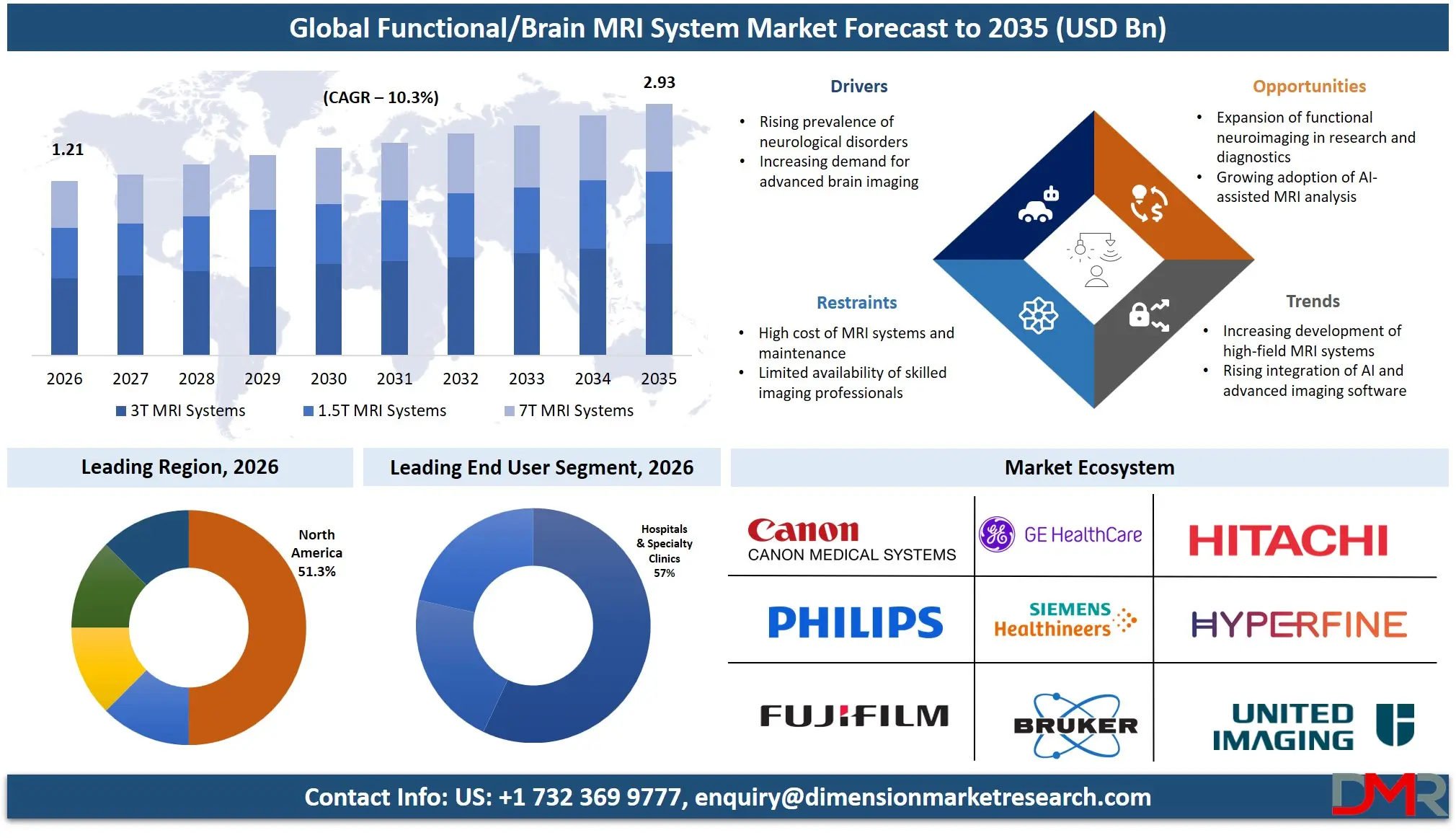
- The Global Functional/Brain MRI System Market is valued at USD 1.1 Billion in 2025, reached USD 1.21 Billion in 2026, and is projected to hit USD 2.93 Billion by 2035 at a CAGR of 10.3%.
- 3T MRI Systems hold the largest share by field strength, driven by widespread clinical adoption across neurosurgical centers globally.
- Brain Tumor and Lesion Planning is the dominant application segment, with 82.0% of newly installed 3-Tesla bases in 2026 including dedicated surgical border mapping software.
- Magnets and Electromagnets are the fastest-growing component segment, supported by ultra-high-field hardware investment across research and clinical centers.
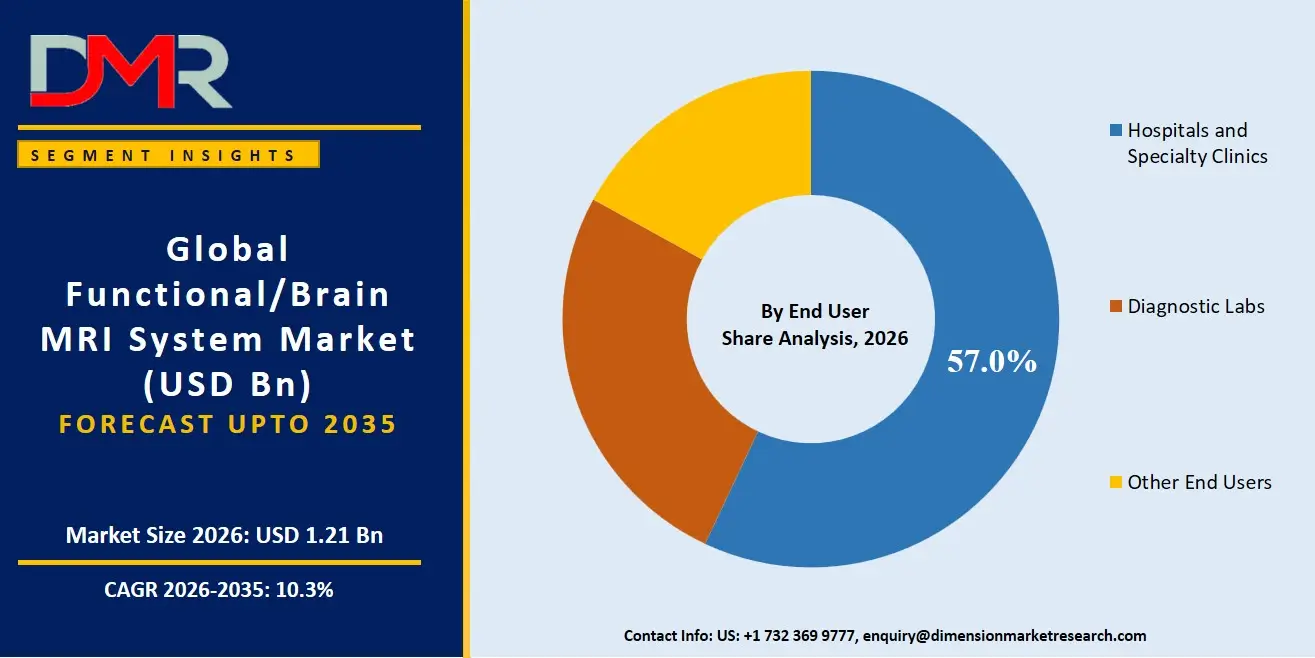
- Hospitals and Specialty Clinics represent the largest end-user segment by revenue contribution and installed volume.
- North America leads all regions with a 51.34% market share in 2026, valued at USD 0.62 Billion.
- Asia Pacific is the fastest-growing regional market across the 2026 to 2035 forecast period.
- Key players include Siemens Healthineers, GE HealthCare, Royal Philips, Artinis Medical Systems B.V., and Canon Medical Systems.
Market Overview
The Functional/Brain MRI System Market covers hardware platforms, radiofrequency coil assemblies, magnet systems, cooling infrastructure, and integrated functional software for clinical and research neuroimaging. The market excludes standalone MRI systems configured exclusively for non-neurological indications. This boundary concentrates the addressable market around higher-value, higher-complexity installations where clinical outcomes depend on functional brain mapping capability. Product categories span surgical planning, neurodegenerative diagnostics, and psychiatric assessment.
ℹ
To learn more about this report –
Download Your Free Sample Report Here
Functional MRI adds clinical utility that standard structural MRI cannot provide. Mapping active brain regions in real time during surgical planning or disease monitoring makes fMRI a distinct and premium category. Recurring software and service contracts already represent 45.0% of total medical OEM imaging revenues in 2025. This shift toward structured contract pricing reduces hospital upfront capital strain and generates more predictable vendor revenue streams, reshaping how buyers and vendors structure procurement agreements across the market.
Platform consolidation is defining the current competitive structure. Meituan's approach in analogous technology markets confirms the pattern visible in medical imaging. A small number of global OEMs control installed base, service contracts, and software ecosystems in functional neuroimaging. Switching costs are high once a hospital standardizes on a specific OEM platform, and the clinical validation burden for alternative platforms creates a durable structural moat for incumbents at every procurement cycle.
Market Size and Forecast
The Global Functional/Brain MRI System Market size is estimated at USD 1.21 Billion in 2026 from USD 1.1 Billion in 2025, and is projected to reach USD 2.93 Billion by 2035, exhibiting a CAGR of 10.3% during the forecast period.
Historical growth reflects sustained investment in premium neuroimaging infrastructure across North American and European hospital networks alongside early-stage expansion in Asia Pacific diagnostic centers. As per GE HealthCare investor disclosures, Q4 2025 imaging revenue reached USD 2.55 Billion, growing 6.6% YoY, driven by premium 3-Tesla and ultra-high-field scanner sales in the United States and Europe. Capital expenditure investments reached USD 482.0 Million in 2025, up from USD 401.0 Million in 2024, with a major portion targeting AI-enabled neuroimaging platforms. When the largest OEMs expand manufacturing capacity ahead of consensus demand, it validates the upper range of the forecast.
The upside scenario depends on broader payer coverage expansion and faster 7-Tesla clinical fMRI adoption outside academic centers. Payer networks adjusted reimbursement policies in 2026 to cover advanced neuroimaging for demyelinating and complex neurological disorders. If that policy shift accelerates across additional indications, hospital capital budgets will reallocate toward fMRI system upgrades ahead of the base forecast. The downside scenario centers on capital expenditure delays in large hospital networks, particularly across Asia and parts of Europe. Royal Philips reported delayed healthcare capital spending in China as a direct factor behind its flat 2025 revenue performance. A sustained delay across emerging markets would compress volume growth and extend hardware refresh cycles beyond forecast assumptions.
3T MRI Systems Analysis
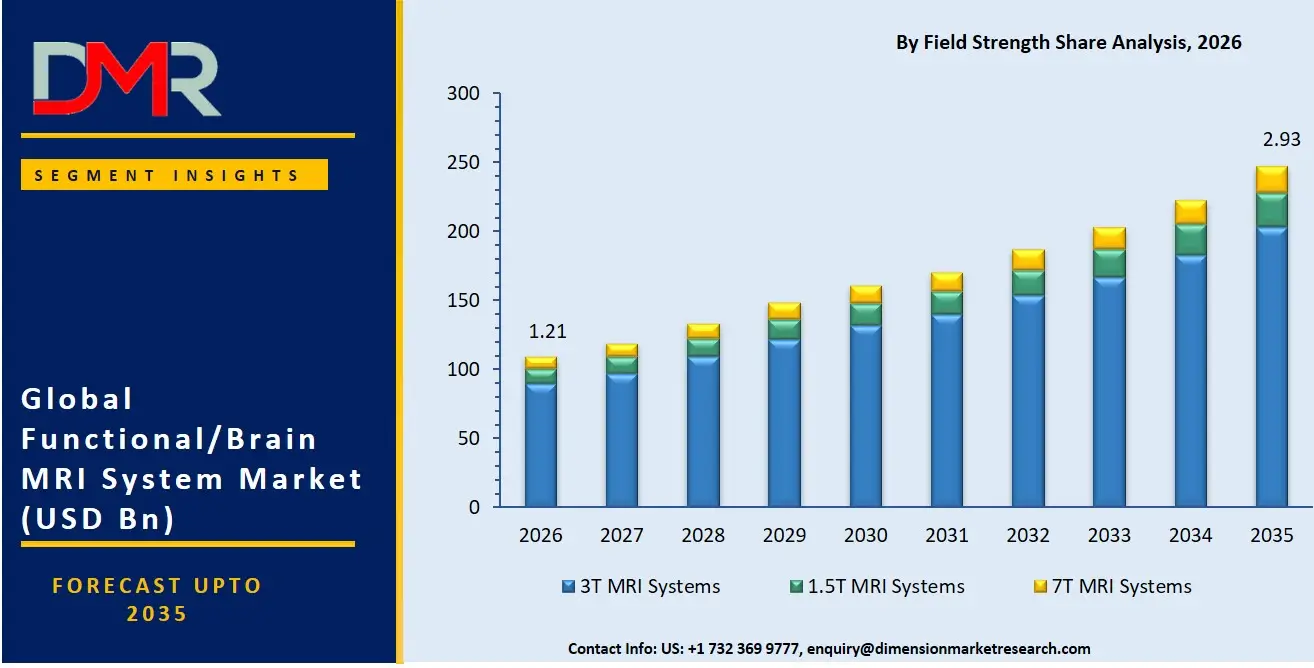
3T MRI Systems led the By Field Strength segment with an 82.0% software attachment rate across new installations in 2026.
ℹ
To learn more about this report –
Download Your Free Sample Report Here
Three-Tesla systems deliver the clinical balance of high spatial resolution, acceptable signal-to-noise ratio, and manageable total installation cost that neurosurgical and neurological centers require. As per data from clinical tracking sources, 82.0% of newly installed 3-Tesla premium neuroimaging bases in 2026 included dedicated surgical border mapping software. Hospitals now treat functional mapping software as a core clinical requirement rather than an optional upgrade. Vendors that bundle software effectively hold stronger renewal and expansion positions within existing accounts.
1.5T MRI Systems serve as the entry-level clinical neuroimaging platform across cost-sensitive hospital environments, sustaining demand in settings where advanced fMRI protocols are not yet a clinical priority. 7T MRI Systems are concentrated in academic medical centers and specialized neuroscience research institutes. Clinical 7-Tesla human fMRI trials showed that 93.0% of multiple sclerosis patients exhibit distinct gray matter cortical lesions during early disease stages, confirming enhanced diagnostic specificity over conventional 1.5T architectures. As FDA clearances for upgraded 7-Tesla hardware expand in 2025 and 2026, this segment is migrating from research-only settings into routine psychiatry and neurodegenerative disease workflows.
Brain Tumor and Lesion Planning Analysis
Brain Tumor and Lesion Planning accounted for the dominant share of By Application demand in 2026, ahead of all other categories.
Brain tumor planning has become the core clinical justification for fMRI system procurement across major hospital networks. Every new scanner installation in an oncological neurosurgery program generates a parallel functional software revenue stream. Presurgical Functional Mapping works directly alongside tumor planning by identifying eloquent cortex regions that surgeons must preserve during resection, benefiting from the same payer coverage expansion as brain tumor indications.
Epilepsy Evaluation uses functional MRI to localize seizure foci non-invasively, driving adoption in specialized surgical programs that require precise functional mapping to minimize post-surgical neurological deficits. Neurorehabilitation and Stroke Recovery applies fMRI to monitor cortical reorganization following stroke events, expanding clinical use beyond the surgical suite into longer-term patient management. Neurodegenerative Disorders represent a structurally important segment as aging populations in North America, Europe, and Asia Pacific drive sustained diagnostic volume. Psychiatry and Mental Health is an emerging segment that benefits from increased availability of approved 7-Tesla hardware and pulse sequences in 2025, enabling clinicians to move beyond symptom-based diagnosis toward imaging-supported biomarker assessment.
Magnets and Electromagnets Analysis
A fastest-growing position made Magnets and Electromagnets the clear leader across By Component categories in 2026.
Ultra-high-field system expansion and 3-Tesla platform upgrades both require advanced superconducting magnet assemblies as their core enabling component. Supply chain pressures on imported superconducting magnet assemblies contributed to GE HealthCare's Q4 2025 organic margin compression to 10.4%, confirming that magnet supply is a live operational constraint across the industry. Vendors without diversified magnet sourcing strategies face direct margin exposure at every hardware production cycle.
RF Coils are a critical signal-quality determinant in functional brain MRI. Custom radiofrequency coil upgrades expand clinical utility of existing scanner installations without requiring full hardware replacement, making them an attractive capital-efficient option for facilities managing constrained procurement budgets. Cooling Systems represent a structural cost challenge for ultra-high-field installations, with helium requirements adding ongoing operational cost and supply dependency. Royal Philips addressed this directly through helium-free 3.0T MRI system introductions in 2025. Shim Systems manage magnetic field homogeneity at 7-Tesla field strength, representing a recurring upgrade and service revenue opportunity for OEMs supporting ultra-high-field clinical installations.
Hospitals and Specialty Clinics Analysis
Hospitals and Specialty Clinics captured the dominant share of By End User demand in 2026, ahead of all rivals.
ℹ
To learn more about this report –
Download Your Free Sample Report Here
Clinical utilization rates within hospitals and specialized care facilities are climbing as brain tumor and lesion extent-of-resection planning drives core functional software acquisition. The combination of high case volume, established neurosurgery programs, and payer reimbursement coverage makes hospitals the primary and most commercially accessible end-user segment for major OEM sales teams. No other end-user category generates the procurement scale or service contract depth that hospital networks provide.
Diagnostic Labs perform neuroimaging under referral arrangements with hospital networks, serving patients who do not require inpatient surgical workup. Point-of-care neuroimaging expansion following multiple FDA 510(k) clearances for portable and flexible MRI platforms in 2026 will gradually shift some diagnostic volume toward lab-based settings, particularly for outpatient neurodegenerative screening.
Academic research centers, government-funded neuroscience institutes, and clinical trial facilities drive adoption of ultra-high-field 7-Tesla systems and multimodal imaging protocols. The Individual Brain Charting project released its fifth high-resolution fMRI dataset update in January 2026, integrating 18 distinct cognitive tasks under standardized 3T scanner conditions. Academic end users generate the clinical evidence that eventually justifies hospital procurement decisions, making them an upstream influence on broader market adoption timelines.
Key Market Segments
By Field Strength
- 3T MRI Systems
- 1.5T MRI Systems
- 7T MRI Systems
By Application
- Brain Tumor and Lesion Planning
- Presurgical Functional Mapping
- Epilepsy Evaluation
- Neurorehabilitation and Stroke Recovery
- Neurodegenerative Disorders
- Psychiatry and Mental Health
By Component
- Magnets and Electromagnets
- RF Coil
- Cooling System
- Shim System
By End User
- Hospitals and Specialty Clinics
- Diagnostic Labs
- Other End Users
Regional Analysis
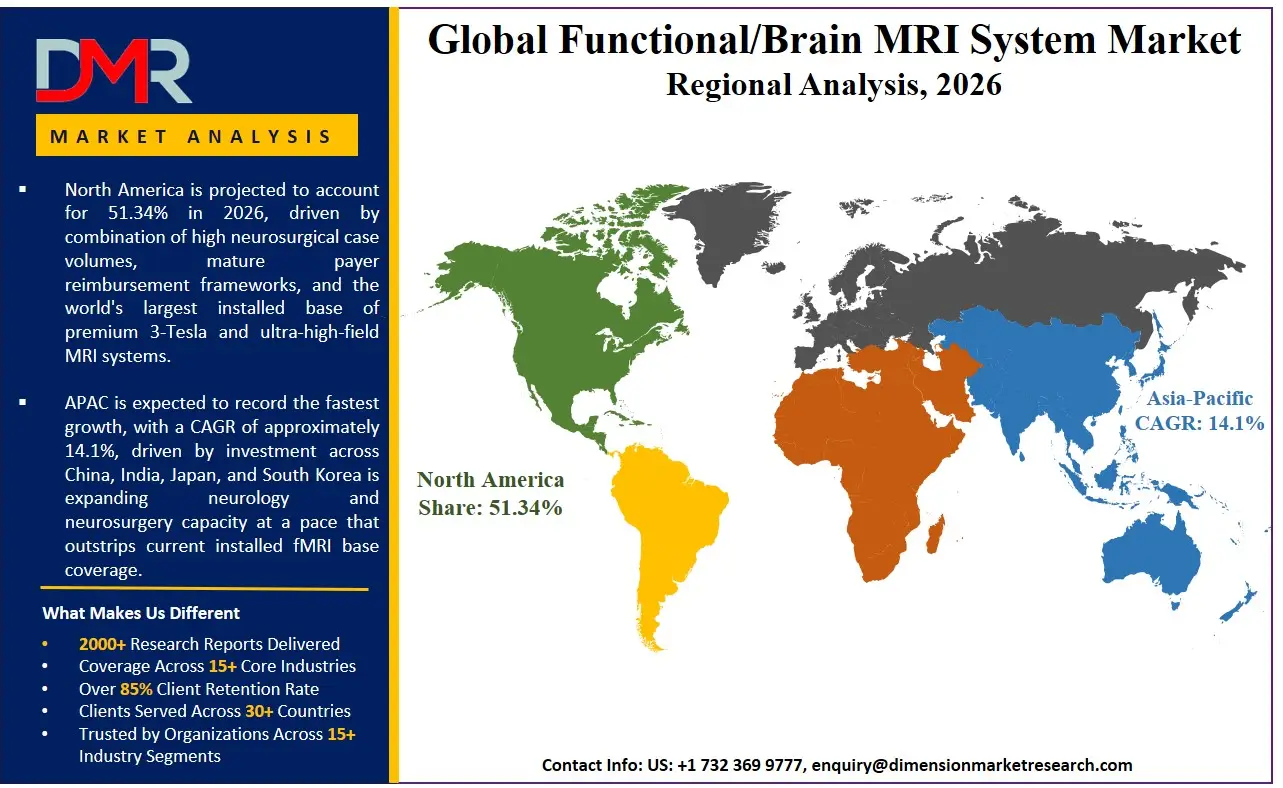
North America held a 51.34% share in 2026, valued at USD 0.62 Billion.
ℹ
To learn more about this report –
Download Your Free Sample Report Here
North America's leadership reflects a combination of high neurosurgical case volumes, mature payer reimbursement frameworks, and the world's largest installed base of premium 3-Tesla and ultra-high-field MRI systems. The U.S. FDA's official use of real-world resting-state fMRI evidence in device regulatory decisions in 2026 reinforces the region's role as the primary regulatory and clinical standard-setter for functional neuroimaging globally. Procurement cycles in North American hospital networks directly influence purchasing behavior in Europe and Asia Pacific with a lag of one to three years.
Asia Pacific is the fastest-growing regional market across the forecast period. Healthcare infrastructure investment across China, India, Japan, and South Korea is expanding neurology and neurosurgery capacity at a pace that outstrips current installed fMRI base coverage. Delayed healthcare capital expenditure in China, cited directly in Royal Philips' flat 2025 segment revenue performance, signals that procurement timelines in the region's largest market remain subject to policy-driven interruption.
Europe holds a well-established position in clinical and research neuroimaging, with the PREDICTOM consortium's March 2026 multi-center protocol building population-scale functional neuroimaging infrastructure across the region. The US market at USD 63.8 Billion anchors North America's position, while Latin America remains early-stage with Brazil and Mexico leading regional demand. The Middle East and Africa market concentrates in GCC countries, where sovereign healthcare investment programs are upgrading diagnostic infrastructure across major public and private hospital networks.
Key Regions and Countries
North America
Europe
- Germany
- France
- The UK
- Spain
- Italy
- Rest of Europe
Asia Pacific
- China
- Japan
- South Korea
- India
- Australia
- Rest of APAC
Latin America
- Brazil
- Mexico
- Rest of Latin America
Middle East & Africa
- GCC
- South Africa
- Rest of MEA
Market Dynamics
Neurosurgical Adoption and Payer Coverage Expansion Drive Clinical Procurement
Neurosurgical centers are replacing invasive cortical mapping procedures with task and resting-state fMRI across major hospital networks in 2025. Non-invasive fMRI reduces patient risk and procedure time while delivering comparable spatial accuracy for mapping eloquent cortex before tumor resection or epilepsy surgery. Research centers increased multi-modal diffusion tensor imaging and BOLD fusion sequence acquisition by 45.0% at major European radiology networks in 2025, confirming that multimodal protocols are exiting the pilot stage and entering standard clinical workflows.
Payer networks adjusted medical necessity criteria in 2026 to cover structural and functional neuroimaging for demyelinating and complex neurological disorders. This reimbursement expansion directly lowers the financial barrier to adoption for smaller regional hospitals that previously could not justify the capital investment. Wider insurance coverage converts latent clinical demand into active procurement decisions within annual budget cycles. Swiggy shareholders approved a QIP to raise capital in December 2025 in a parallel dynamic showing how capital availability defines market pace across technology sectors. In functional neuroimaging, payer coverage performs the same market-unlocking function.
High Total Cost of Ownership and Signal Distortion Constrain Ultra-High-Field Adoption
The upfront capital cost of clinical fMRI systems, particularly 7-Tesla configurations, creates a hard ceiling on adoption outside well-funded academic and urban hospital networks. Maintenance contracts, helium cooling requirements, and shielded room construction add substantial ongoing operational costs.
Ultra-high-field 7-Tesla systems introduce magnetic field non-uniformity and electromagnetic wave interactions that create signal voids and image distortions in clinical fMRI studies. These artifacts require post-processing corrections that add time, specialized expertise, and software cost to every scan workflow. Facilities without dedicated MRI physicists cannot manage this consistently. Both the capital cost barrier and the technical complexity barrier concentrate ultra-high-field clinical fMRI within a narrow tier of institutions, limiting the addressable market for the segment's highest-value hardware configurations.
FDA Clearances and Point-of-Care Platforms Open Non-Traditional Care Settings
Major medical OEMs secured FDA clearances for upgraded 3-Tesla high-detail clinical MRI scanners in 2026. These clearances opened procurement cycles at hospitals that had been holding capital spending pending regulatory confirmation of new hardware generations. Multiple FDA 510(k) clearances for portable and flexible MRI platforms in 2025 are simultaneously opening neuroimaging services at outpatient centers, rehabilitation facilities, and remote clinical sites. Reliance Retail's JioMart expansion to 5,000 plus pin codes in October 2025 demonstrates in a different sector how distribution reach unlocks demand that concentrated infrastructure models cannot serve. Point-of-care neuroimaging follows the same logic.
Early movers that secure distribution and service agreements at non-traditional neuroimaging sites before the major OEMs build dedicated channel programs will establish durable account positions at lower competitive intensity than traditional hospital markets. Zepto's pre-IPO funding at a $7 Billion valuation in October 2025 reflects investor recognition of first-mover infrastructure value in high-growth distribution channels. Vendors that build portable fMRI channel programs now are acquiring the same kind of structural advantage in a market where incumbent OEMs have not yet prioritized non-hospital distribution.
Market Trends
AI Multimodal Fusion and Resting-State fMRI Enter Regulatory and Clinical Frameworks
The PREDICTOM consortium launched a standardized multi-center neuroimaging protocol across Europe in March 2026, integrating 3T hardware from GE HealthCare and Siemens Healthineers to merge resting-state fMRI, diffusion imaging, and structural 3D scans into a unified cloud-based diagnostics ecosystem for early Alzheimer's risk detection. Simultaneous EEG-fMRI multi-modal reconstruction models achieved a spatial Structural Similarity Index of 0.98 in 2026, validating deep learning frameworks for fusing electrophysiological temporal data with blood-oxygenation hemodynamic metrics. Cross-modal bidirectional decoders achieved an electrophysiological coherence metric of 0.55, preserving delta-to-gamma spectral power bands across 512-dimension shared representation spaces. These benchmarks confirm that AI-driven multimodal fusion is crossing from research utility into clinical deployment readiness.
Market Competition Overview
The Functional/Brain MRI System Market is highly consolidated. A small number of global OEMs control the majority of installed base, service contracts, and software ecosystems. Hospitals that standardize on one OEM's hardware platform also adopt that vendor's software, service agreements, and upgrade roadmaps. Switching costs are high, and the clinical validation burden for alternative platforms creates a durable structural moat for incumbents. As reported by research data, Royal Philips Q4 2025 adjusted EBITA margin held at 11.8%, sustained by commercial introductions of helium-free 3.0T MRI systems embedded with AI-driven functional scanning software.
Recurring revenue is reshaping competitive positioning across the market. Royal Philips redirected EUR 0.8 Billion in operational savings from its FY2025 productivity program toward next-generation MRI software development. Vendors with the largest installed bases generate the most recurring revenue, which they reinvest into next-generation platform development. This creates a compounding advantage that widens the gap between the top global players and the rest of the market with each product cycle. Competitive differentiation is shifting from hardware performance alone toward AI software integration, service contract depth, and total cost of ownership management.
Company Profiles
Siemens Healthineers holds the strongest competitive position in the functional brain MRI market by multiple measures. Imaging segment revenue reached EUR 12.8 Billion in FY2024, supported by a global patent portfolio exceeding 24,000 active filings covering 7-Tesla clinical fMRI hardware and software architectures. This intellectual property depth protects Siemens Healthineers from direct hardware replication while its comprehensive global installed base creates a recurring service and software revenue stream that competitors cannot quickly displace.
GE HealthCare is competing aggressively on manufacturing capacity and AI-enabled platform development. Imaging segment revenue reached USD 9.25 Billion in FY2025, growing 4.40% from USD 8.86 Billion in FY2024. Royal Philips' Diagnosis and Treatment segment recorded 0% comparable sales growth for the full year 2025 due to commercial headwinds and delayed capital spending in China, though its helium-free 3.0T MRI platform directly addresses the total cost of ownership barrier limiting hospital adoption in cost-sensitive markets. Zepto raised $450 Million in a pre-IPO round in October 2025. Artinis Medical Systems B.V. completed the acquisition of Twente Medical Systems International B.V. in May 2024, integrating optical brain-oxygenation measurements with high-density electrophysiological signals, occupying a defensible niche in multimodal brain monitoring where combined fNIRS and EEG capability addresses clinical needs that conventional MRI-only platforms cannot serve.
Key Players
- Siemens Healthineers
- GE HealthCare
- Royal Philips
- Artinis Medical Systems B.V.
- Canon Medical Systems
Supply Chain and Value Chain Analysis
The Functional/Brain MRI System value chain begins with suppliers of superconducting magnet assemblies, cryogenic materials, precision gradient coil components, and radiofrequency coil systems. Geographic concentration of superconducting magnet production limits alternative sourcing options for OEMs. GE HealthCare's Q4 2025 margin compression confirmed that OEMs cannot fully absorb input cost pressures without margin consequences. Maximum value creation sits at the software and service layer, where functional imaging software, AI-driven reconstruction tools, and recurring service contracts generate compounding revenue that hardware sales alone cannot match.
Blinkit, Zepto, and Swiggy Instamart planned collective employment of over 400,000 workers by March 2025 in a parallel sector dynamic illustrating how workforce scale defines delivery capacity. In functional neuroimaging, the equivalent constraint is specialized MRI physicist and clinical application specialist availability. Facilities without dedicated technical staff cannot operate ultra-high-field systems reliably, making human capital a bottleneck that limits installed base utilization as much as hardware availability does. Vendors that build application specialist support into service contracts reduce this constraint and deepen account stickiness beyond the hardware procurement relationship.
Regulatory Landscape
The U.S. FDA serves as the primary regulatory authority shaping global functional brain MRI system approvals. The FDA's official use of real-world resting-state fMRI evidence in device regulatory decisions in 2025 marks a structural shift in submission standards. Vendors that build resting-state fMRI datasets into their preoperative software workflows now have a direct pathway to align product development with evolving FDA evidence requirements. The Confederation of All India Traders launched its nationwide campaign demanding a 28% GST on e-commerce purchases in May 2025 as a parallel regulatory pressure dynamic in a different sector. In medical imaging, the equivalent pressure takes the form of reimbursement policy constraints that can delay procurement as effectively as tax changes compress margins in consumer platforms.
Major OEMs secured FDA clearances for upgraded 3-Tesla high-detail clinical MRI scanners in 2026, directly triggering new hospital procurement cycles. Multiple FDA 510(k) clearances for portable and flexible MRI platforms in 2025 expanded the regulatory-approved use environment for functional neuroimaging beyond traditional hospital scanner rooms. In Europe, the PREDICTOM consortium's March 2026 protocol effectively established a de facto technical standard for functional neuroimaging in early Alzheimer's detection. Vendors whose hardware and software meet this consortium's specifications gain preferential access to participating hospital networks across Europe. Payer policy expansion in 2026 extended medical necessity coverage for advanced neuroimaging across demyelinating and complex neurological disorders, removing the financial barrier that had limited fMRI adoption to well-funded centers.
Investment and White Space Analysis
Current investment is flowing most heavily into AI-enabled neuroimaging platform development and ultra-high-field 7-Tesla system expansion. Royal Philips reallocated EUR 0.8 Billion in operational savings toward helium-free 3.0T MRI system software development. Both the largest OEMs and institutional investors are concentrating capital in the premium clinical tier, confirming that the upper range of the forecast reflects genuine procurement pipeline rather than speculative demand. Late entrants now face a structurally more difficult investment environment as incumbent installed bases deepen software and service lock-in with each renewal cycle.
Psychiatry and mental health represents the highest-potential underserved application segment. Payer reimbursement for psychiatric neuroimaging is less developed than for oncological or neurosurgical indications, creating a timing gap between clinical capability and commercial realization. Asia Pacific represents the highest-growth white space at a regional level, with healthcare infrastructure investment across China, India, Japan, and South Korea expanding neurology capacity faster than the current installed fMRI base can serve. Point-of-care neuroimaging at non-traditional care sites is an emerging white space created directly by multiple FDA 510(k) clearances for portable and flexible MRI platforms in 2025. Vendors that build distribution and service models for outpatient centers and rehabilitation facilities before the major OEMs develop dedicated channel programs will establish durable account positions at structurally lower competitive intensity than the hospital market.
Recent Developments
- May 2026 MIT Bioengineers. Technology development. Bioengineers at MIT developed target-responsive liposomal nanoparticle reporter sensors called LisNRs, which alter structural water channels to brighten or dim whole-brain functional MRI signals in response to low-concentration neurochemicals, advancing molecular-level fMRI sensitivity.
- May 2024 Artinis Medical Systems B.V. Acquisition. Artinis completed the acquisition of Twente Medical Systems International B.V., integrating optical brain-oxygenation measurements with high-density electrophysiological signals and accelerating the development of combined fNIRS and EEG headcap mapping technologies for multimodal brain assessment.
Report Details
| Report Characteristics |
| Market Value (2025) |
USD 1.1 Billion |
| Market Value (2026) |
USD 1.21 Billion |
| Forecast Revenue (2035) |
USD 2.93 Billion |
| CAGR (2026 to 2035) |
10.3% |
| Base Year for Estimation |
2025 |
| Historic Period |
2020 to 2024 |
| Forecast Period |
2026 to 2035 |
| Report Coverage |
Revenue Forecast, Market Dynamics, Competitive Landscape, Recent Developments |
| Segments Covered |
By Field Strength (3T MRI Systems, 1.5T MRI Systems, 7T MRI Systems), By Application (Brain Tumor and Lesion Planning, Presurgical Functional Mapping, Epilepsy Evaluation, Neurorehabilitation and Stroke Recovery, Neurodegenerative Disorders, Psychiatry and Mental Health), By Component (Magnets and Electromagnets, RF Coil, Cooling System, Shim System), By End User (Hospitals and Specialty Clinics, Diagnostic Labs, Other End Users) |
| Regional Analysis |
North America – US and Canada; Europe – Germany, France, The UK, Spain, Italy, and Rest of Europe; Asia Pacific – China, Japan, South Korea, India, Australia, and Rest of APAC; Latin America – Brazil, Mexico, and Rest of Latin America; Middle East & Africa – GCC, South Africa, and Rest of MEA |
| Competitive Landscape |
Siemens Healthineers, GE HealthCare, Royal Philips, Artinis Medical Systems B.V., Canon Medical Systems |
| Customization Scope |
Customization for segments and region or country level will be provided. Additional customization can be done based on requirements. |
| Purchase Options |
Three license options: Single User License, Multi-User License (Up to 5 Users), Corporate Use License (Unlimited Users and Printable PDF) |
Frequently Asked Questions
What is the biggest investment opportunity in Functional/Brain MRI System Market?
▾ Psychiatry and mental health and Asia Pacific represent the two highest-potential underserved opportunities. Point-of-care neuroimaging at non-traditional care sites, enabled by multiple FDA 510(k) clearances for portable MRI platforms in 2025, adds a structurally new demand channel at lower competitive intensity than the hospital market.
Who are the top companies in Functional/Brain MRI System Market?
▾ Siemens Healthineers, GE HealthCare, Royal Philips, Canon Medical Systems, and Artinis Medical Systems B.V. lead the market. Siemens Healthineers holds the broadest intellectual property position with over 24,000 active patent filings covering clinical fMRI hardware and software architectures.
Which segment is growing fastest in Functional/Brain MRI System Market and why?
▾ Psychiatry and Mental Health is the fastest-emerging application segment, benefiting from increased availability of approved 7-Tesla hardware and pulse sequences in 2026. Early neurobiological disease stratification is scaling into routine psychiatric frameworks as imaging-supported biomarker assessment replaces purely symptom-based diagnosis.
Which region is growing fastest in Functional/Brain MRI System Market and why?
▾ Asia Pacific is the fastest-growing regional market across the forecast period. Healthcare infrastructure expansion across China, India, Japan, and South Korea is creating new neurology and neurosurgery capacity that the current installed fMRI base cannot yet fully serve.
What is the biggest challenge holding Functional/Brain MRI System Market back?
▾ High total cost of ownership restricts adoption outside well-funded academic and urban hospital networks. Signal voids and image distortions caused by magnetic field non-uniformity at 7-Tesla field strength add post-processing complexity that limits ultra-high-field deployment to facilities with dedicated MRI physics expertise.