GCC Cooling-as-a-Service (CaaS) Market snapshot
- GCC Cooling-as-a-Service (CaaS) Market size in 2026 is: USD 474.1 Million
- GCC Cooling-as-a-Service (CaaS) Market size in 2035 is: USD 1,422.2 Million
- GCC Cooling-as-a-Service (CaaS) Market CAGR from 2027 to 2035 is: 13.0%
- Space Cooling is the leading cooling type segment: 62.2%
- Subscription-Based is the leading contract model segment: 58.9%
- Commercial Buildings is the leading end user segment: 32.6%
- Process Cooling is the fastest-growing cooling type segment: 13.6% CAGR
- Pay-Per-Use is the fastest-growing contract model segment: 13.8% CAGR
- Data Centers is the fastest-growing end user segment: 13.9% CAGR
- Saudi Arabia is the leading country in the GCC Cooling-as-a-Service (CaaS) Market: 38.9%
- The UAE is the fastest-growing country in the GCC Cooling-as-a-Service (CaaS) Market: 14.1% CAGR.
What is the GCC Cooling-as-a-Service (CaaS) Market? GCC Cooling-as-a-Service (CaaS) Market size.
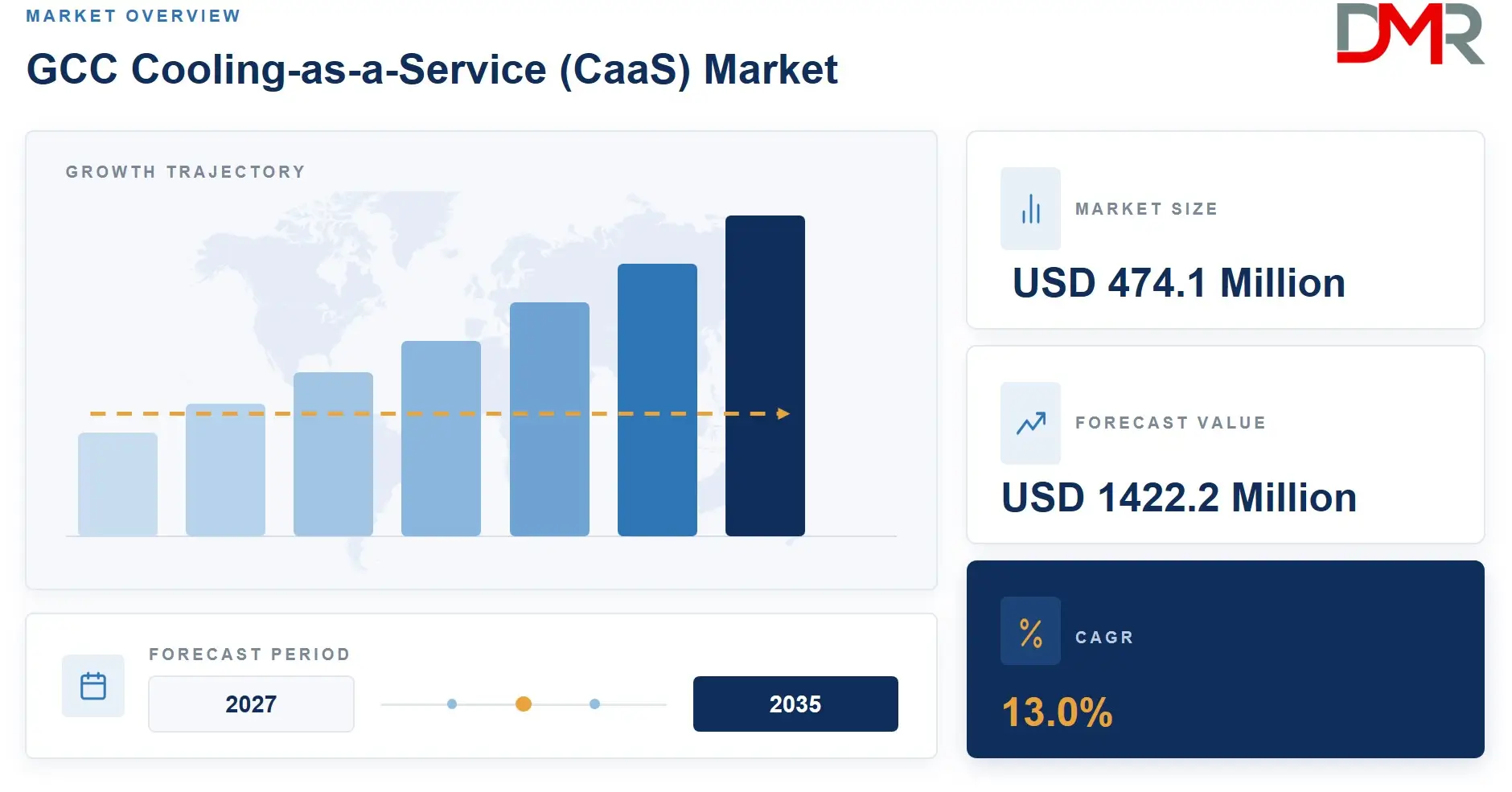
The GCC Cooling-as-a-Service (CaaS) Market size is valued at USD 474.1 Million in 2026, and it is further anticipated to reach a market value of USD 1,422.2 Million by 2035 at a CAGR of 13.0%.
ℹ
To learn more about this report –
Download Your Free Sample Report Here
GCC Cooling as a Service Market growth factors include the growing need for energy-efficient cooling systems, infrastructural developments, and increased investments in commercial and industrial sectors. It allows organizations to get cooling services without having to spend on purchasing expensive equipment and maintenance. Growing investments in data centers, increasing cooling requirements, and regional sustainability initiatives are creating market opportunities across Saudi Arabia, the UAE, Qatar, Kuwait, Oman, and Bahrain.
Use Cases
- Commercial Building Cooling Management: The cooling of commercial buildings, such as shopping malls and offices in GCC, is achieved through Cooling-as-a-Service. Through this service, cooling is provided through the installation of cooling services through contractual agreements that make it unnecessary for the building owners to invest heavily in cooling systems. Commercial buildings constitute one of the important areas where CaaS is applicable, especially due to high demands for air conditioners.
- Industrial Process Cooling: In an industry, Cooling-as-a-Service is used for keeping the temperature under control to support the operations of various processes and machines. Food processing, chemical plants, pharmaceuticals, and manufacturing industries need cooling services because the quality of their products depends on the process conditions and cooling needs. With the help of CaaS, businesses can avoid managing their cooling machines by leaving this responsibility to service providers.
- Data Center Cooling Optimization: The cooling of data centers is necessary in order to avoid overheating and ensure optimal functioning of the servers, storage units, and other hardware used in the networking structure. Cooling as a Service will enable the users to have access to the cooling system without having to manage their own systems and all the associated problems that come with it. With the growing investment in digital infrastructure and cloud computing in the GCC, a demand for such services has emerged.
- Healthcare Facility Cooling Services: Health care facilities such as hospitals, diagnostic laboratories, and health care organizations need to ensure that they maintain proper temperature levels for the welfare of the patients, the functioning of medical equipment, and storage of sensitive materials that need controlled temperature levels. The cooling services help with the maintenance of proper cooling systems in health care organizations by operating the systems efficiently and properly monitoring their performance. This method ensures proper budgeting of cooling expenditure.
Key Takeaways
- Market Growth: The GCC Cooling-as-a-Service (CaaS) Market is projected to grow from USD 474.1 million in 2026 to USD 1,422.2 Million in 2035, at a CAGR of 13.0% from 2027 to 2035. Rising cooling demand, infrastructure development, industrial expansion, and increasing focus on energy efficiency are supporting market growth.
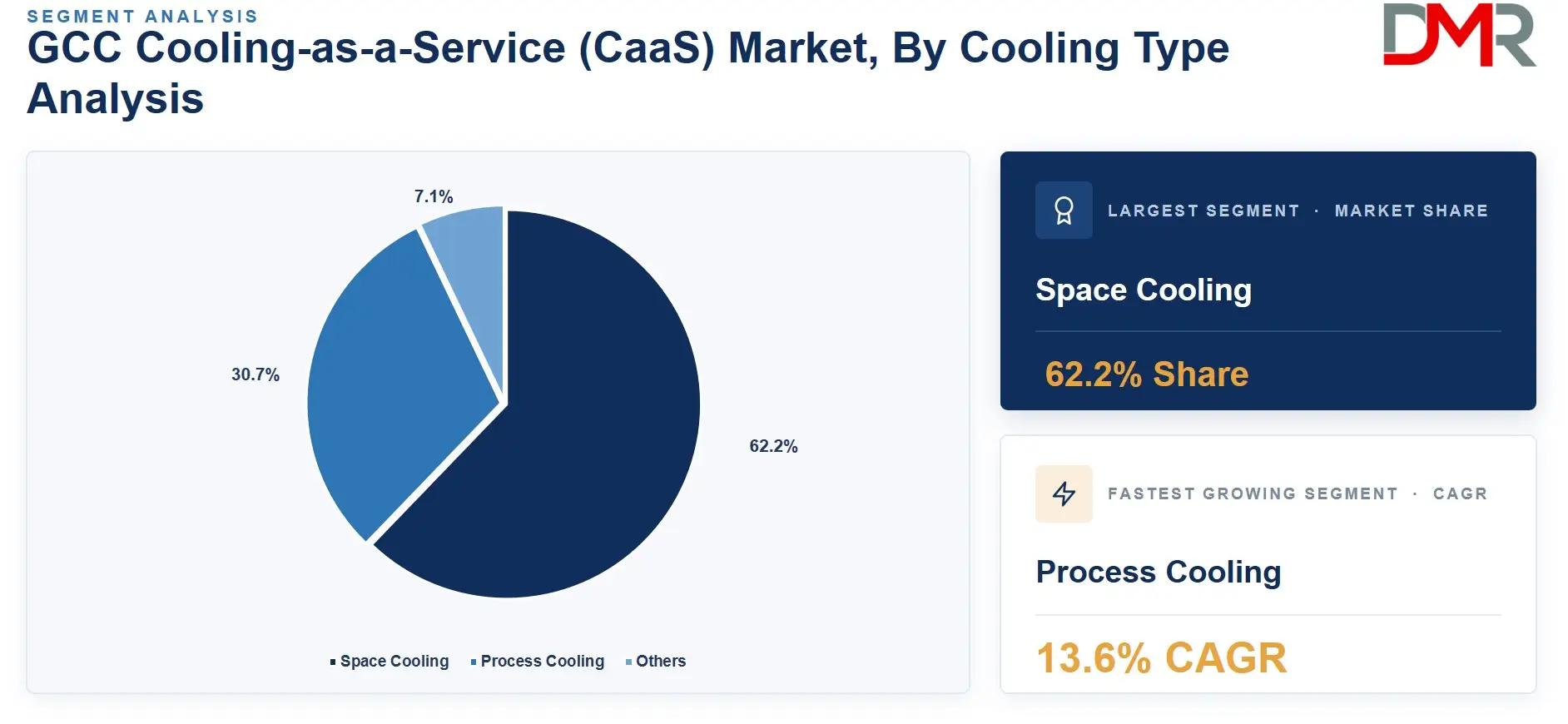
- Space Cooling Dominates the Cooling Type Segment: Space Cooling accounts for 62.2% of the market in 2026, driven by high air-conditioning demand across commercial buildings and other facilities. Process Cooling is the fastest-growing segment, with a CAGR of 13.6%, supported by industrial expansion and increasing demand for efficient temperature-controlled processes.
- Subscription-Based Dominates the Contract Model Segment: Subscription-Based contracts hold 58.9% of the market in 2026, supported by predictable payments, lower upfront costs, and professional maintenance services. Pay-Per-Use is the fastest-growing segment, with a CAGR of 13.8%, driven by flexible payment options and usage-based cost management.
- Commercial Buildings Dominate the End User Segment: Commercial Buildings account for 32.6% of the market in 2026, supported by rising cooling requirements in offices, shopping malls, and business complexes. Data Centers are the fastest-growing segment, with a CAGR of 13.9%, driven by expanding digital infrastructure and increasing demand for reliable cooling systems.
- Saudi Arabia Dominates the Country Market: Saudi Arabia accounts for 38.9% of the market in 2026, supported by infrastructure development, commercial construction, industrial investments, and high cooling requirements.
- The UAE Is the Fastest-Growing Country Market: The UAE is expected to grow at a CAGR of 14.1% from 2027 to 2035, driven by commercial real estate development, data center investments, hospitality expansion, and increasing demand for energy-efficient cooling solutions.
How AI/Gen AI Is Transforming the GCC Cooling-as-a-Service (CaaS) Market?
AI and Generative AI are improving the GCC Cooling-as-a-Service (CaaS) Market by helping service providers manage cooling systems more efficiently and reduce operating costs. AI-based technologies analyze real-time data, weather conditions, and equipment performance to adjust cooling requirements and minimize energy waste. Predictive maintenance helps identify potential equipment issues before they lead to costly breakdowns, improving system reliability and reducing downtime. Generative AI supports operational decision-making by analyzing performance data, preparing reports, and identifying opportunities for improvement. These technologies are particularly relevant for commercial buildings, industrial facilities, and data centers, where reliable cooling is essential. In Saudi Arabia and the UAE, growing infrastructure investments and increasing focus on energy efficiency are creating opportunities for AI-enabled cooling solutions. Overall, AI adoption can help CaaS providers improve service quality, optimize energy consumption, and support sustainability goals.
Key Drivers
Growing Cooling Demand Due to Extreme Climatic Conditions
The GCC nations witness long summers with extremely hot weather conditions that lead to huge cooling needs in all types of properties. The constant use of air conditioning results in a need for proper cooling arrangements that ensure maintenance of constant temperature in the interiors throughout the year. With the help of Cooling as a Service, the customers get continuous cooling facility without having to manage any kind of complex machinery and operations. The rising need for cooling in shopping complexes, hotels, hospitals, and office complexes increases the need for cooling as a service.
Increasing Preference for Asset-Light Cooling Solutions
Firms in the GCC region are increasingly adopting asset-light business strategies so as to retain capital. Traditional cooling systems involve high costs at the onset in terms of buying, installing, and implementing the technical systems. The Cooling-as-a-Service concept cuts back on these costs in that equipment ownership and operation is transferred to service providers. Business organizations can channel their money towards the main business objectives while at the same time paying for the cooling services on a periodic basis.
Restraints
High Capital Requirements for Cooling Service Providers
There is a high capital requirement that is needed by the providers of cooling services in terms of investments in cooling systems, installations, infrastructure, and technologies. Recovery of such capital requires the commitment of customers in the long run. Financing and investment recovery periods may limit the growth of small service providers in the GCC region. In addition, there is uncertainty regarding the occupation of the projects and cooling consumption which makes cooling projects capital intensive to finance.
Contractual Challenges and Customer Issues with Long-Term Contracts
A cooling as a service contract entails complex contractual elements that address issues related to consumption costs, commitment of capacity, service level commitments, tariff changes, and equipment ownership. Customer concerns related to price transparency, flexibility, and sole reliance on a service provider may discourage customers from engaging in long-term contracts. The issues related to measurement of cooling consumption and service-level commitment make it harder for customers to engage with such services. Variations in contractual approaches and regulatory framework in GCC countries could prolong negotiations.
Growth Opportunities
Expansion of Data Center Infrastructure Across GCC Countries
Growing investments in cloud computing, AI, and digital infrastructure have opened up many opportunities for Cooling-as-a-Service (CaaS) providers in GCC countries. The need for thermal management of data centers is constant in order to sustain the performance of equipment and avoid any disruptions. Hyperscale and colocation data centers, especially those being developed in Saudi Arabia and the United Arab Emirates, open up more opportunities for CaaS providers to provide cooling infrastructure on a service basis.
Potential to Convert Existing Cooling Systems into Service Models
The significant presence of traditional cooling systems in the GCC countries offers chances for market players to convert customer owned cooling infrastructure to outsourced cooling systems. Old chillers and inefficient cooling technology in old buildings offer chances for service providers to either take over, upgrade or replace existing cooling systems. With the help of retrofitted CaaS models, service providers will be able to target buildings that have been using their own internal cooling infrastructure.
Trends
Integration of AI and IoT in Cooling Service Management
More and more cooling-as-a-service companies have started integrating AI, IoT sensors, and analytics technology into their management platforms. This allows them to monitor in real time how much cooling is being used, the performance of the equipment, changes in temperature, and efficiency of the whole process. Predictive maintenance lets companies detect possible issues that may lead to disruptions in the service before they arise. Cooling optimization helps allocate resources better. Digital technology has revolutionized cooling services in the GCC region.
Growing Adoption of Sustainable Cooling Technologies
There is a rising trend among CaaS firms in the GCC to utilize sustainable technology in their offerings. Some of the technological trends that can be noted here include efficient chillers, lower global warming potential refrigerants, thermal energy storage systems, and alternative water sources. New possibilities with geothermal cooling have the potential to provide another avenue for decreasing reliance on power-dependent cooling systems. The utilization of these technologies contributes to sustainability goals of the region while also enhancing environmental attributes of outsourcing cooling services.
Research Scope and Analysis
The GCC Cooling-as-a-Service (CaaS) Market is segmented based on Cooling Type into Space Cooling, Process Cooling, and Others, Contract Model into Subscription-Based, Pay-Per-Use, and Others, End User into Commercial Buildings, Industrial Facilities, Data Centers, Residential Buildings, Healthcare Facilities, Hospitality & Tourism, and Others. Geographically, the market is segmented into Saudi Arabia (KSA), United Arab Emirates (UAE), Qatar, Kuwait, Oman, and Bahrain.
ℹ
To learn more about this report –
Download Your Free Sample Report Here
By Cooling Type Analysis
The Space Cooling segment dominates the GCC Cooling-as-a-Service (CaaS) Market with a share of 62.2% in 2026, supported by extreme climatic conditions, extensive air-conditioning requirements, and widespread adoption of outsourced cooling services across commercial and residential buildings. The Process Cooling segment is expected to grow at the fastest CAGR of 13.6% during 2027–2035, driven by expanding industrial infrastructure, increasing manufacturing activities, and growing demand for reliable temperature-controlled industrial operations.
By Contract Model Analysis
The Subscription-Based segment leads the market with a share of 58.9% in 2026, supported by predictable cooling expenses, reduced upfront investments, and customer preference for long-term service agreements. The Pay-Per-Use segment is expected to register the highest CAGR of 13.8% during 2027–2035, driven by increasing demand for consumption-based pricing, flexible payment structures, and greater control over cooling expenditure based on actual utilization.
By End User Analysis
The Commercial Buildings segment accounts for the largest market share of 32.6% in 2026, supported by extensive cooling requirements across shopping malls, office complexes, retail establishments, and increasing adoption of outsourced cooling infrastructure. The Data Centers segment is projected to grow at the highest CAGR of 13.9% during 2027–2035, driven by expanding cloud computing infrastructure, increasing deployment of high-density servers, and growing demand for uninterrupted and energy-efficient thermal management services.
The GCC Cooling-as-a-Service (CaaS) Market Report is segmented based on the following:
By Cooling Type
- Space Cooling
- Process Cooling
- Others
By Contract Model
- Subscription-Based
- Pay-Per-Use
- Others
By End User
- Commercial Buildings
- Industrial Facilities
- Data Centers
- Residential Buildings
- Healthcare Facilities
- Hospitality & Tourism
- Others
Country Analysis
Saudi Arabia is the Leading Country in the GCC Cooling-as-a-Service (CaaS) Market
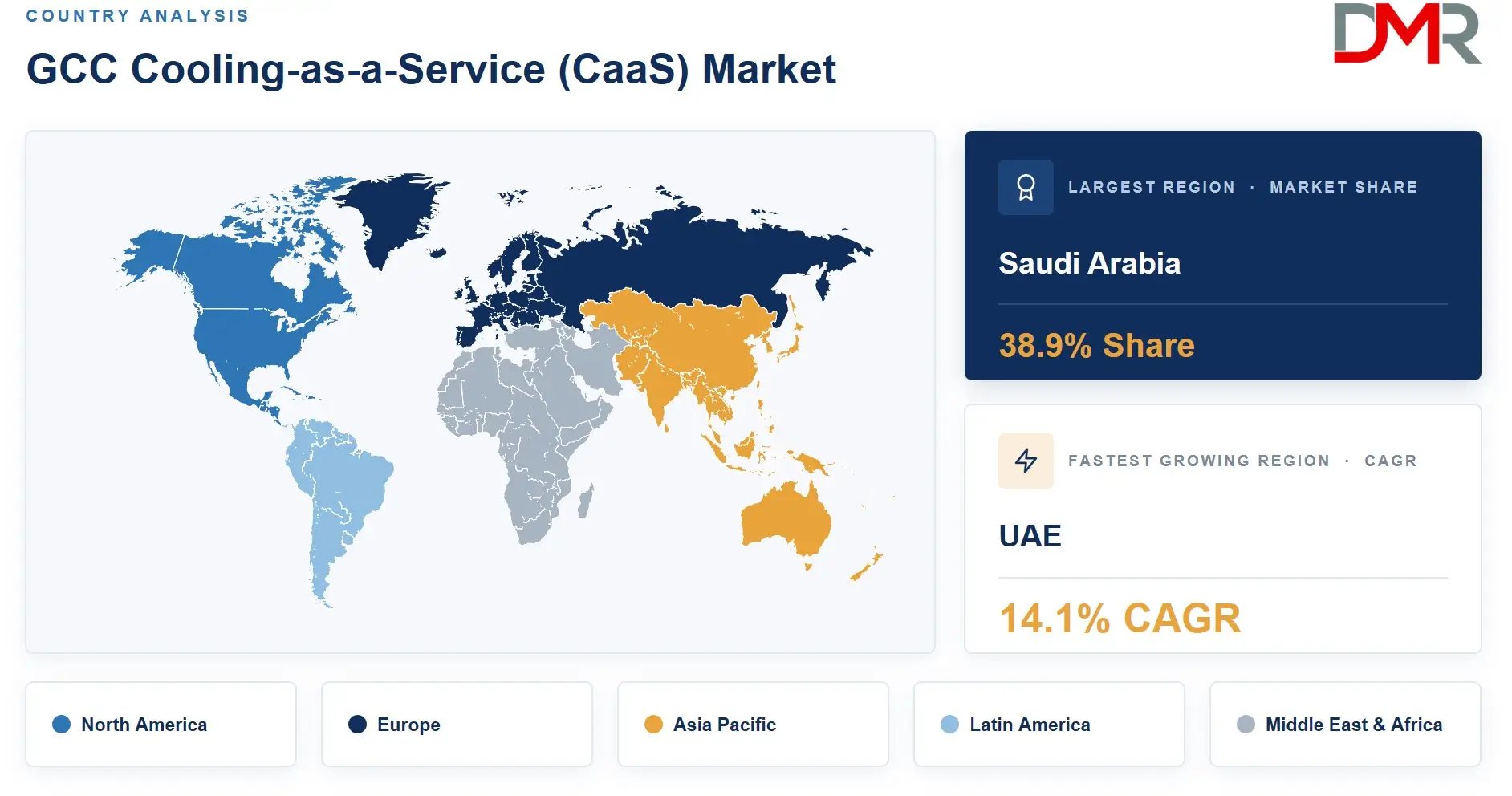
Saudi Arabia dominates the GCC Cooling-as-a-Service (CaaS) Market, accounting for 38.9% of the total market share in 2026. This dominance is supported by extreme climatic conditions, rapid infrastructure development, expanding commercial and industrial facilities, and substantial investments in large-scale urban development projects. Saudi Vision 2030 initiatives, increasing construction of smart cities, and growing demand for energy-efficient cooling solutions further strengthen market growth. Additionally, the expansion of shopping malls, healthcare facilities, industrial complexes, and hospitality infrastructure is encouraging the adoption of outsourced cooling services through long-term contractual arrangements.
ℹ
To learn more about this report –
Download Your Free Sample Report Here
The UAE is the Fastest-Growing Country in the GCC Cooling-as-a-Service (CaaS) Market
The UAE is expected to register the highest CAGR of 14.1% during 2027–2035, emerging as the fastest-growing country in the GCC Cooling-as-a-Service (CaaS) Market. Growth is supported by expanding data center infrastructure, rapid commercial development, increasing adoption of sustainable building technologies, and growing preference for energy-efficient cooling services. The country's established district cooling infrastructure, smart city initiatives, and sustainability commitments are further accelerating the adoption of service-based cooling models. Additionally, increasing demand for flexible cooling contracts, advanced thermal management technologies, and modernization of existing cooling infrastructure is creating significant expansion opportunities for Cooling-as-a-Service providers across the country.
Investment and White Space Analysis
The GCC Cooling-as-a-Service (CaaS) Market presents attractive investment opportunities driven by expanding commercial infrastructure, industrial development, data center construction, and growing demand for energy-efficient cooling solutions. Saudi Arabia and the UAE offer significant investment potential, supported by smart city developments and sustainability initiatives. Investments in advanced chillers, liquid cooling technologies, and thermal energy storage can generate recurring revenue through long-term service agreements. Significant white space opportunities exist in converting conventional cooling infrastructure into service-based models, particularly across aging commercial and residential buildings. Additionally, small and medium-sized businesses, seasonal facilities, and underserved locations in Oman, Bahrain, and Kuwait offer untapped potential. Flexible pricing models, modular cooling solutions, and customized service agreements can help providers expand their customer base and strengthen regional market presence.
Technology Analysis
The GCC Cooling-as-a-Service (CaaS) Market is evolving through advancements in energy-efficient cooling systems, intelligent monitoring technologies, and sustainable thermal management solutions. High-efficiency chillers, variable-speed compressors, and thermal energy storage systems are helping service providers optimize energy consumption and reduce operational costs. The integration of artificial intelligence (AI), Internet of Things (IoT) sensors, and predictive analytics enables real-time performance monitoring, automated temperature control, and preventive maintenance. Liquid cooling technologies are gaining importance in data centers, where increasing computing densities require advanced heat management solutions. Additionally, low-global-warming-potential refrigerants and water-efficient cooling technologies support regional sustainability objectives. These technological advancements enable CaaS providers to improve service reliability, accurately monitor cooling consumption, enhance operational efficiency, and deliver customized solutions across diverse end-user industries.
By Country
- Saudi Arabia
- United Arab Emirates (UAE)
- Qatar
- Kuwait
- Oman
- Bahrain
Competitive Landscape
The GCC Cooling-as-a-Service (CaaS) Market is characterized by competition among established district cooling operators, energy service companies, and specialized cooling solution providers. Prominent players include National Central Cooling Company PJSC (Tabreed), Empower, Emicool, Johnson Controls International plc, ENGIE S.A., City Cool, Taka Solutions, Stout Energy, Marafeq Qatar, Saudi Tabreed and Qatar Cool. These companies compete through energy-efficient cooling technologies, flexible contractual arrangements, competitive pricing, and reliable service delivery. Market participants focus on infrastructure expansion, strategic partnerships, digital monitoring, and customized cooling solutions to strengthen their regional presence. Increasing demand for sustainable cooling, growing infrastructure investments, and evolving customer preferences are encouraging companies to diversify their service portfolios, improve operational efficiency, and establish long-term relationships with commercial and industrial customers.
Some of the prominent players in the GCC Cooling-as-a-Service (CaaS) Market are:
- National Central Cooling Company PJSC (Tabreed)
- Emirates Central Cooling Systems Corporation PJSC (Empower)
- Emirates District Cooling LLC (Emicool)
- Johnson Controls International plc
- ENGIE S.A.
- City Cool
- Taka Solutions
- Stout Energy
- Marafeq Qatar
- Saudi District Cooling Company (Saudi Tabreed)
- Qatar District Cooling Company (Qatar Cool)
- Others
Recent Developments
- In November 2026, National Central Cooling Company PJSC (Tabreed) announced that its connected cooling capacity increased by 15% year-on-year, reaching 1.59 million refrigeration tons (RT) as of September 30, 2026. The increase was primarily supported by the acquisition of PAL Cooling and the addition of 19,900 RT through organic expansion over the preceding 12 months. The company also reported a year-on-year increase of 0.5% in cooling consumption during the first nine months of 2026.
- In October 2026, Emirates Central Cooling Systems Corporation PJSC (Empower) announced that it had awarded a contract for excavation and foundation work for its new district cooling plant at Dubai Science Park. The proposed facility will have a cooling capacity of 47,000 refrigeration tons (RT). The development forms part of the company's efforts to expand its district cooling infrastructure and accommodate growing cooling requirements across Dubai.
Report Details
| Report Characteristics |
| Market Size (2026) |
USD 474.1 Mn |
| Forecast Value (2035) |
USD 1,422.2 Mn |
| CAGR (2027–2035) |
13.0% |
| Historical Data |
2021 – 2025 |
| Forecast Data |
2027 – 2035 |
| Base Year |
2026 |
| Segments Covered |
By Cooling Type, By Contract Model, By End User |
| Regional Coverage |
GCC – Saudi Arabia (KSA), United Arab Emirates (UAE), Qatar, Kuwait, Oman, and Bahrain. |
Frequently Asked Questions
How big is the GCC Cooling-as-a-Service (CaaS) Market?
▾ The GCC Cooling-as-a-Service (CaaS) Market is valued at USD 474.1 Million in 2026 and is projected to reach approximately USD 1,422.2 Million by 2035.
What is the CAGR of the GCC Cooling-as-a-Service (CaaS) Market from 2027 to 2035?
▾ The GCC Cooling-as-a-Service (CaaS) Market is anticipated to grow at a compound annual growth rate (CAGR) of 13.0% during the forecast period from 2027 to 2035.
What factors are driving the growth of the GCC Cooling-as-a-Service (CaaS) Market?
▾ The GCC Cooling-as-a-Service (CaaS) Market is driven by extreme climatic conditions, increasing cooling requirements across commercial and residential buildings, and growing demand for reliable cooling services. Additionally, the increasing preference for asset-light business models is encouraging organizations to adopt outsourced cooling solutions, reducing upfront capital investments and operational responsibilities through flexible service agreements.
What are the major trends in the GCC Cooling-as-a-Service (CaaS) Market?
▾ The major trends in the GCC Cooling-as-a-Service (CaaS) Market include the growing integration of AI, IoT, and predictive analytics for real-time cooling management, equipment monitoring, and predictive maintenance. Additionally, increasing adoption of sustainable cooling technologies, including energy-efficient chillers, low-global-warming-potential refrigerants, and thermal energy storage systems, is encouraging service providers to focus on energy efficiency, environmental sustainability, and improved operational performance.
Which country held the largest share of the GCC Cooling-as-a-Service (CaaS) Market in 2026?
▾ Saudi Arabia holds the largest share of the GCC Cooling-as-a-Service (CaaS) Market in 2026, accounting for 38.9% of the total market.
Which country is expected to grow the fastest in the GCC Cooling-as-a-Service (CaaS) Market?
▾ The UAE is expected to be the fastest-growing country in the GCC Cooling-as-a-Service (CaaS) Market during 2027–2035, registering a CAGR of 14.1%. Growth is supported by expanding data center infrastructure, rapid commercial development, increasing adoption of sustainable building technologies, and growing demand for energy-efficient cooling services. Additionally, established district cooling networks, smart city initiatives, flexible cooling service agreements, and increasing modernization of existing cooling infrastructure are supporting market growth across the country.
Who are the key players in the GCC Cooling-as-a-Service (CaaS) Market?
▾ The key players in the GCC Cooling-as-a-Service (CaaS) Market include National Central Cooling Company PJSC (Tabreed), Emirates Central Cooling Systems Corporation PJSC (Empower), Emirates District Cooling LLC (Emicool), Johnson Controls International plc, ENGIE S.A., City Cool, Taka Solutions, Stout Energy, Marafeq Qatar, Saudi District Cooling Company (Saudi Tabreed), Qatar District Cooling Company (Qatar Cool), among others.
How is the GCC Cooling-as-a-Service (CaaS) Market segmented?
▾ The GCC Cooling-as-a-Service (CaaS) Market is segmented based on Cooling Type into Space Cooling, Process Cooling, and Others, Contract Model into Subscription-Based, Pay-Per-Use, and Others; and End User into Commercial Buildings, Industrial Facilities, Data Centers, Residential Buildings, Healthcare Facilities, Hospitality & Tourism, and Others. Geographically, the market is segmented into Saudi Arabia (KSA), United Arab Emirates (UAE), Qatar, Kuwait, Oman, and Bahrain.