Global Generative AI in the Software Development Lifecycle Market Snapshot
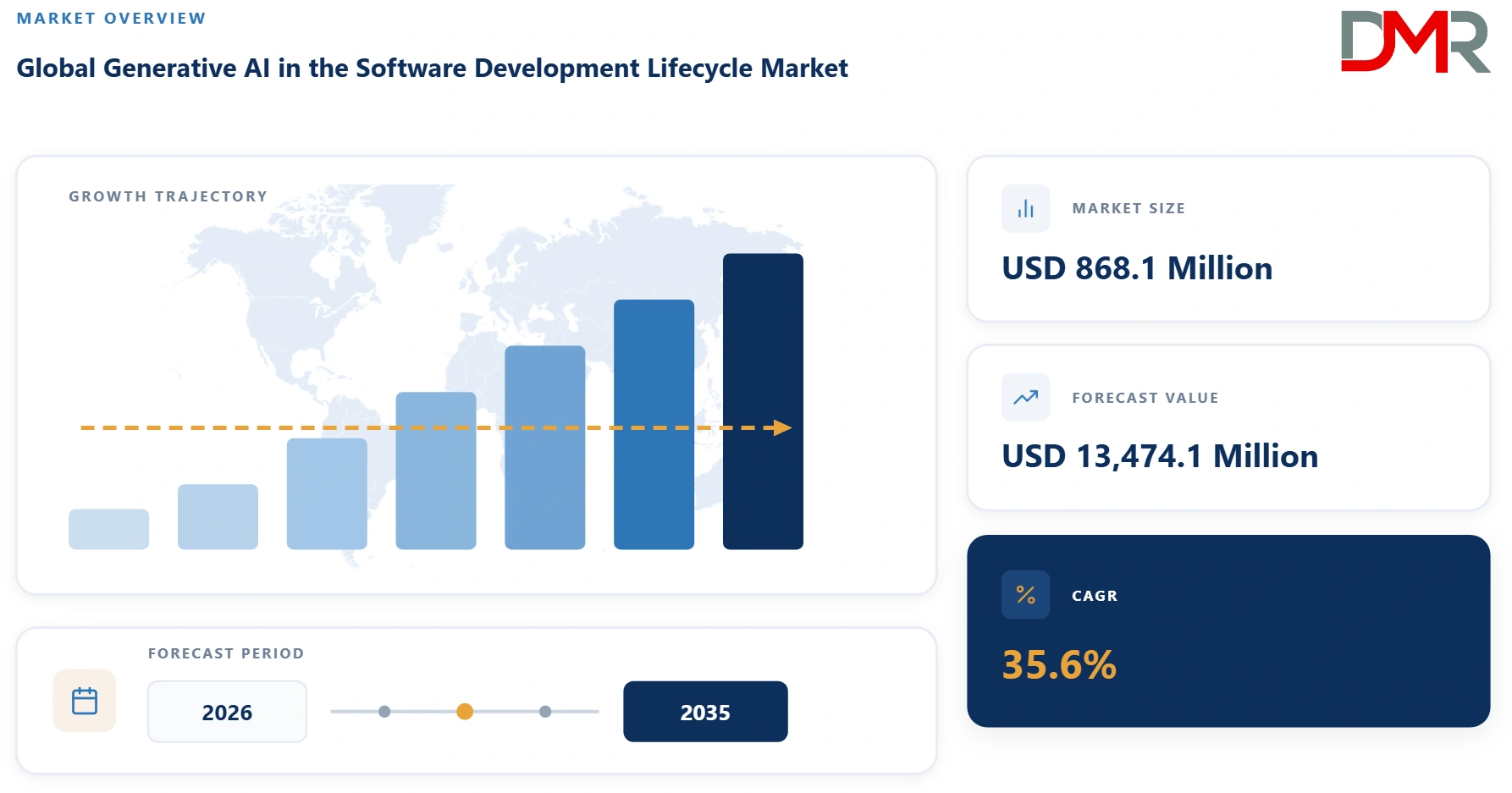
- Global Market Size in 2026: USD 868.1 million
- Global Market Size in 2035: USD 13,474.1 million
- Global CAGR from 2026 to 2035: 35.6%
- Code Generation & Auto-Completion is the leading Application segment in 2026: 38.0%
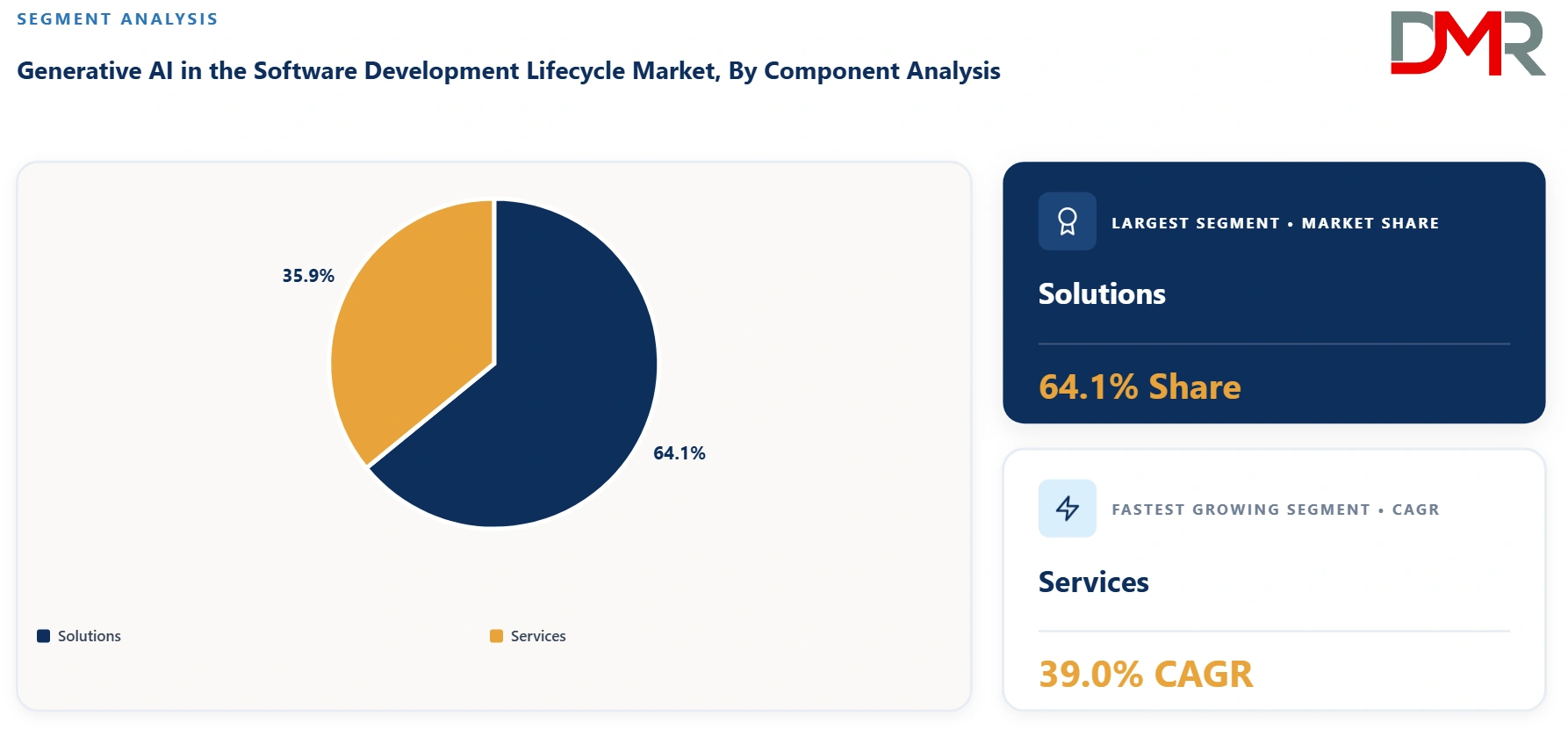
- Solutions is the leading Component segment in 2026: 64.1%
- Cloud-Based is the leading Deployment segment in 2026: 74.0%
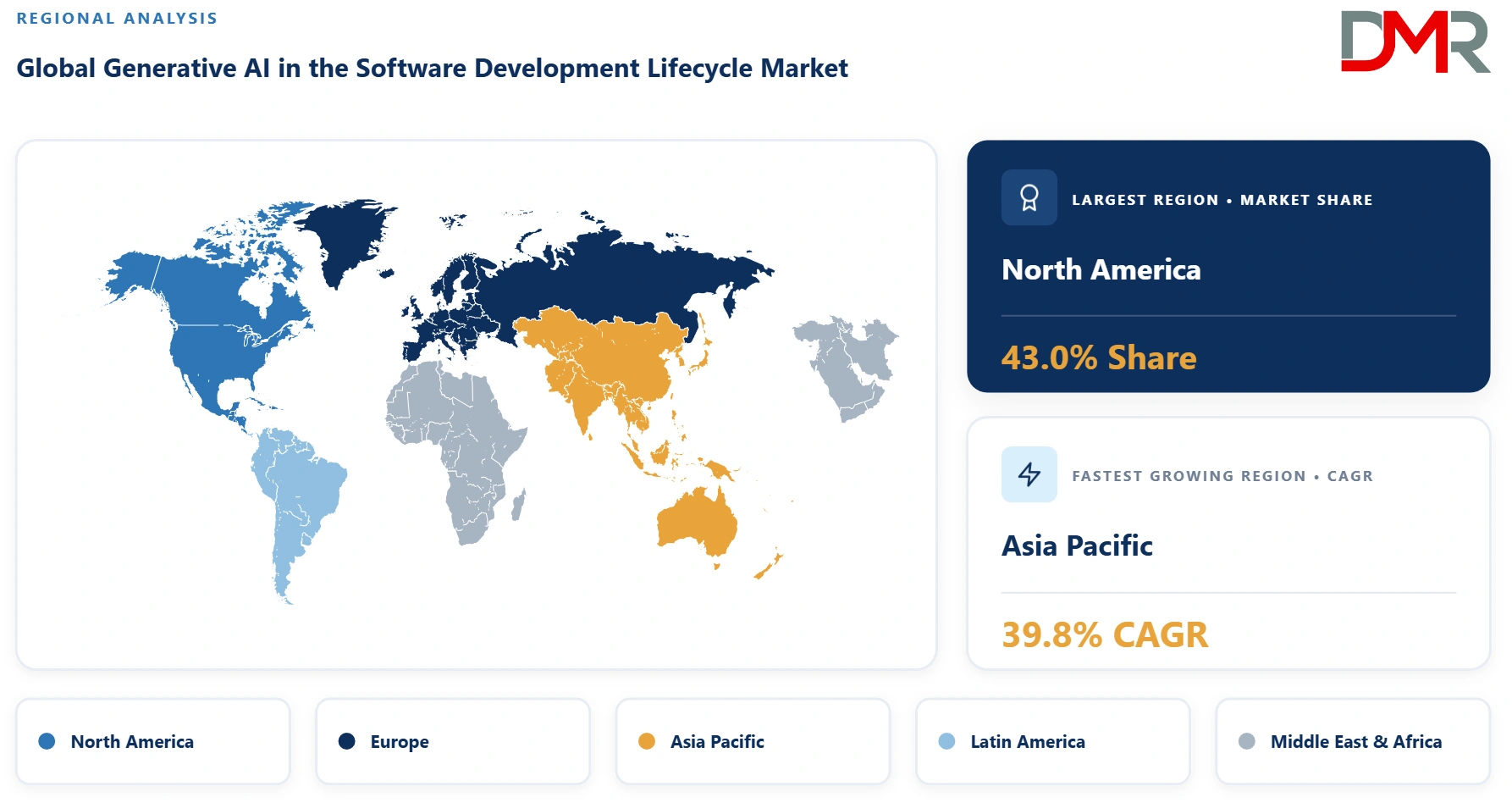
- North America is the leading Region in 2026: 43.0%
- Asia Pacific is the fastest-growing Region: 39.8%
What is the Global Generative AI in the Software Development Lifecycle and its Market Size?
The Global Generative AI in the Software Development Lifecycle (SDLC) Market is projected to reach USD 868.1 million in 2026 and approximately USD 13,474.1 million in 2035, at a CAGR of 35.6% over a forecasted period of 2026 to 2035.
ℹ
To learn more about this report –
Download Your Free Sample Report Here
Generative AI in the SDLC is described as the use of foundation models, coding assistants, repository-aware agents, and associated integration services that support planning, building, testing, securing, documenting, releasing, and maintaining software applications. The industry covers solutions that offer capabilities around code generation and explanation; defect and vulnerability detection; test and technical documentation writing; as well as repository and development operations management. There has been growing demand in this segment due to the need for fast cycles and improved engineering productivity while holding the human developer accountable.
Use Cases
- Code Generation & Modernization: AI models write software for the developer to use. This could be anything from a new function to an entire codebase, migration, and anything in between.
- Automated Testing & Quality Assurance: Gen AI writes code for test suites. The models analyze failed test runs, explain to the developer what went wrong and what the tests were checking. The developer also has the ability to generate a test suite from a specification document.
- Debugging, Security & Code Review: AI models for code analysis help in all stages of the software development life cycle. AI can recommend code fixes to eliminate security risks. When a developer submits a pull request for a fix, the models analyze the request to ensure no other bugs are introduced and provide summaries of changes.
- Documentation & DevOps: DevOps and site reliability engineers generate site reports, release notes, and documentation on architecture for the product to help end users, all while following compliance protocols.
Key Takeaways
- Global Market Value: The global generative AI in the software development lifecycle market is expected to reach a value of USD 13,474.1 million by 2035, growing from USD 868.1 million in 2026.
- Market Growth Rate: The market is anticipated to expand at a CAGR of 35.6% from 2026 to 2035, driven by growing investments by enterprises in software development and coding with AI.
- Application Segment: Code generation & auto-completion accounted for the largest share of the application segment, accounting for 38.0% in 2026, driven by the growing popularity of AI coding assistants, programming and developer productivity solutions.
- Component Segment: Solutions hold the largest estimated component share at 64.1% in 2026, supported by demand for AI development platforms, coding assistants, and software engineering tools.
- Deployment Segment: Cloud-Based deployment leads with an estimated 74.0% share in 2026, supported by demand for scalable development platforms and flexible infrastructure.
- Regional Leadership: North America holds the largest estimated regional share at 43.0% in 2026, supported by its concentration of technology companies, cloud infrastructure, and enterprise AI investment.
- Fastest-Growing Region: Asia Pacific is projected to register the fastest growth, with an estimated CAGR of 39.8% through 2035, supported by expanding software development across developing countries.
How AI/Gen AI is Transforming the Generative AI in the Software Development Lifecycle Market?
AI-assisted development tools are rapidly gaining traction in software engineering. Language prompts can be used to generate code, and tools with knowledge of the repo can be used to find relevant files in the project, suggest changes, and generate tests. These capabilities can aid teams during planning, development, debugging, documentation, pre-deployment, and maintenance. While AI code agents improve automation, they still require verification, security checks, and validation by humans. The best use cases within enterprises involve coupling with existing tools in version control, CI/CD pipelines, access controls, and code quality. Governance and developer experience become very important aspects in addition to model capabilities.
Key Drivers in the Global Generative AI in the Software Development Lifecycle Market
Pressure to Increase Developer Productivity
Software backlogs continue to grow, schedules are becoming shorter and shorter, and organizations are looking to support more applications while not adding more staff members at the same rate. The repetitive tasks like boilerplate code, writing tests, refactoring, and documentation can be done faster using Generative AI. The value proposition is best when suggestions are built into the tools developers use and when the output is reviewed and tested according to standard practices.
Enterprise Application Modernization
Large organizations are upgrading legacy apps, moving infrastructure, and updating complex integrations. Generative AI helps developers comprehend unfamiliar code bases, translate older code patterns, create migration scripts, and document system dependencies. These tasks generate a need for tools that provide long-context repository retrieval, architecture awareness, and integration with enterprise engineering platforms.
Restraints in the Global Generative AI in the Software Development Lifecycle Market
Security, Intellectual Property, and Data Governance Risks
It is possible that this source code includes confidential logic, customer data, credentials, or licensed third-party components. It's important for businesses to consider policies on the retention of data, deployment controls, model training duration, generated code provenance, and possible prompt-injection attacks from untrusted repositories. Uncertainty regarding generated code and software licensing can slow the rollout of code across an organization, especially in highly regulated industries.
Unreliable Output and Verification Costs
Automatic generation of changes can cause the same problem and can still include incorrect business logic, hidden dependencies, performance degradation, and/or security vulnerabilities. However, if outputs require a lot of debugging or if the automation results in more pull requests than reviewers can keep up with, it's possible for teams to lose the efficiency benefits they're hoping to gain. The necessity of evaluation benchmarks, test coverage, secure coding standards, and clear human accountability is key to achieving reliable returns.
Growth Opportunities in the Global Generative AI in the Software Development Lifecycle Market
Secure Private and Hybrid AI Coding Environments
As the information found in sensitive repositories grows in importance, there is a growing demand for better control over access to the model, contextual retrieval, telemetry, and policy enforcement. Private deployment, hybrid inference, role-based access, auditability, and integration with internal development platforms are some of the ways vendors can differentiate. These capabilities can be leveraged to drive adoption in banking, healthcare, government, and critical infrastructure sectors.
Agentic Automation Across Engineering Workflows
One of the emerging areas is shifting from single code suggestion to a coordinated approach to handling code issues, implementation, test execution, documentation, and pull request preparation. Agentic tools that are run in scope with visible checkpoints can add new value for platform engineering teams under the scoped permissions. Solutions that can be proven to be reliable and fit the existing CI/CD processes have a better chance of being captured into enterprise spending.
Trends in the Global Generative AI in the Software Development Lifecycle Market
Repository-Aware and Multi-Step Coding Agents
AI assistants are no longer just dealing with single queries; they're collaborating with repositories, development tools, and issue trackers. They might suggest correlated file changes, execute tests, and generate changes for people assessment. The market is thus moving away from just counting code produced and towards workflow integration, clear agent actions, and quality control.
Governance and Outcome-Based Adoption
Companies are transitioning from experimentation to standard procurement, secure configuration, developer training, and performance monitoring. Adoption, time-to-merge, defect rate, test quality, and engineering satisfaction are being measured by the buyer. This leads to a need for a centralized administration, model routing, policy tools, observability, and transparent cost controls for teams.
Research Scope and Analysis
The market is analyzed by component, deployment mode, application, end user, and geography. Component is separated into solutions and services; deployment includes cloud-based and on-premises implementations; applications span development and software-quality activities; and end-user analysis distinguishes development/DevOps teams from security/SecOps professionals.
ℹ
To learn more about this report –
Download Your Free Sample Report Here
By Component Analysis
Solutions hold the highest estimated component share at 64.1% in 2026. This category includes AI coding assistants, development agents, test-generation tools, and integrated software development lifecycle platforms. Recurring subscriptions and widespread use across engineering teams support solutions spending. Services include consulting, implementation, customization, integration, training, and managed support. Services are estimated to record the highest CAGR at approximately 39.0% from 2026 to 2035, as enterprises invest in deployment and governance. Complex enterprise projects often require help connecting AI tools to repositories, approval processes, and security policies.
By Deployment Mode Analysis
Cloud-based deployment holds the highest estimated market share at 74.0% in 2026. Hosted platforms offer rapid onboarding, scalable computing capacity, frequent model updates, and connections to cloud repositories. These capabilities allow development teams to introduce AI assistance across coding, testing, and documentation workflows. Cloud-based deployment is also estimated to record the highest CAGR at approximately 38.0% from 2026 to 2035. On-premises systems remain relevant where proprietary code, data residency, latency, or internal governance requires greater control. Hybrid deployment arrangements can combine locally managed development environments with approved external models.
By Application Analysis
Code generation and auto-completion hold the highest application share at 38.0% in 2026. Developers use these capabilities to draft new code, transform existing code, and complete repetitive programming tasks. Testing and quality assurance is estimated to record the highest CAGR at 42.5% from 2026 to 2035. Demand for automated test creation, broader coverage, and earlier defect identification supports this growth. Code optimization, bug detection, debugging, security assistance, and documentation extend AI use across the software development lifecycle. Enterprises may adopt several applications together as they connect AI tools with repositories and delivery pipelines.
By End User Analysis
Software engineers and DevOps professionals hold the highest estimated end-user share at 82.0% in 2026. Their daily work in development environments, repositories, testing systems, and delivery pipelines creates frequent opportunities to use AI assistance. Security professionals and SecOps are estimated to record the highest CAGR at 38.2% from 2026 to 2035. They use related capabilities to explain vulnerabilities, suggest remediation, review code, and support secure development practices. As adoption expands, organizations must define access controls, output review, and responsibilities across engineering and security teams.
The Global Generative AI in the Software Development Lifecycle Market Report is segmented based on the following:
By Component
- Solutions
- Services
- Consulting & Advisory
- Integration & Implementation
- Training & Support
By Deployment Mode
By Application
- Code Generation & Auto-Completion
- Code Optimization & Refactoring
- Bug Detection & Debugging
- Testing & Quality Assurance
- Documentation & Knowledge Management
- Other Applications
By End User
- Software Engineers & DevOps Professionals
- Security Professionals & SecOps
Regional Analysis
North America is the Leading Region
North America holds the highest estimated regional share of the generative AI in the software development lifecycle market at 43.0% in 2026. Its calculated CAGR is 33.5% from 2026 to 2035. The region benefits from a concentration of AI model developers, cloud providers, software vendors, and large enterprise engineering teams. U.S. organizations are integrating coding assistants into development workflows, while Canada’s AI research and software services support adoption. Buyers increasingly assess repository integration, security controls, and the reliability of generated code. Demand also extends to testing, documentation, and modernization tools as enterprises seek productivity gains across the software development lifecycle.
ℹ
To learn more about this report –
Download Your Free Sample Report Here
Asia Pacific is the Fastest-Growing Region
Asia Pacific is the fastest-growing region, with an estimated CAGR of 39.8% from 2026 to 2035. It holds an estimated 22.0% share of the global market in 2026. Growth is supported by expanding software delivery teams, cloud infrastructure, domestic digital services, and enterprise modernization. India and China provide large developer bases, while Japan, South Korea, and Australia contribute demand from established technology firms and regulated industries. Organizations are applying generative AI to code generation, testing, debugging, and software maintenance. Adoption will vary by country as buyers assess language support, data handling, procurement requirements, and rules governing access to AI models.
Europe Generative AI in the Software Development Lifecycle Market
Europe holds an estimated 20.0% share of the global market in 2026 and is projected to grow at a 34.0% CAGR through 2035. Enterprises in Germany, the United Kingdom, France, Italy, and Spain are incorporating AI assistance into software engineering and application modernization. Demand is influenced by requirements for personal data protection, software supply-chain security, and oversight of AI-generated outputs. Controlled deployment options and audit trails can help large organizations evaluate these tools. Vendors also need to integrate with established repositories, testing systems, and approval processes. These requirements shape purchasing decisions as European teams expand AI use across development workflows.
Latin America Generative AI in the Software Development Lifecycle Market
Latin America accounts for an estimated 8.0% of the global market in 2026 and is projected to grow at a 36.0% CAGR through 2035. Brazil and Mexico are notable demand centers, supported by IT services firms, nearshore development teams, and growing software businesses. Developers are adopting AI assistance for coding, automated testing, debugging, and application modernization. Cloud migration can make these tools easier to deploy across distributed teams. Subscription costs and developer training will influence adoption, particularly among smaller firms. Larger enterprises must also establish policies for code access, output review, and data handling before extending AI tools across their engineering organizations.
Middle East & Africa Generative AI in the Software Development Lifecycle Market
The Middle East and Africa holds an estimated 7.0% share of the global market in 2026 and is projected to grow at a 37.0% CAGR through 2035. Saudi Arabia and the UAE are important demand centers as governments and enterprises invest in digital platforms and local software capabilities. South Africa and other technology hubs offer opportunities in banking software, IT services, and cloud applications. Generative AI can assist development teams with coding, testing, documentation, and modernization work. Purchasing decisions may depend on secure code handling, deployment controls, and integration with existing systems. Training and implementation services can support adoption across organizations with differing levels of AI readiness.
Major Countries Analysis
United States Generative AI in the Software Development Lifecycle Market
The United States represents approximately 37.8% of the global market in 2026 and is projected to grow at a CAGR of 33.7% from 2026 to 2035. Adoption spans software vendors, cloud providers, financial institutions, and enterprise IT teams with large developer workforces. These organizations use AI assistance for code creation, testing, documentation, and maintenance. Competition increasingly centers on integration with developer workflows, the reliability of AI agents, security controls, and generated code quality. Enterprise buyers also need ways to manage access to proprietary repositories and review AI outputs. These requirements influence how tools move from individual use to broader organizational deployment.
Japan Generative AI in the Software Development Lifecycle Market
Japan offers opportunities for AI-assisted application modernization, enterprise software maintenance, embedded development, and quality assurance. Development teams can use generated code explanations and test cases to manage complex legacy systems and transfer knowledge between engineers. AI assistance may also help organizations improve productivity while maintaining established review and testing practices. Japanese-language support, protection of proprietary code, and integration with existing engineering platforms are important adoption factors.
Saudi Arabia Generative AI in the Software Development Lifecycle Market
Saudi Arabia’s digital transformation initiatives are creating opportunities for AI-assisted software delivery across public services, finance, telecommunications, and large enterprises. Coding assistants can help local teams generate code, document systems, create tests, and modernize applications. Implementation demand may increase as organizations connect these tools to existing repositories and development controls. Buyers will assess sensitive-code handling, cybersecurity requirements, and approved cloud or controlled deployment environments. Developer training and governance processes will also affect how widely tools are used within organizations.
Regulatory Landscape
The market is influenced by privacy and data-protection rules, cybersecurity obligations, software licensing, intellectual-property disputes, and emerging AI governance frameworks. The EU AI Act can be relevant depending on the use and role of AI systems, while the GDPR applies to applicable personal-data processing. U.S. and other national procurement rules, sector-specific requirements, and cross-border data transfer controls also affect deployments. The NIST AI Risk Management Framework and secure software development practices provide useful voluntary governance references. Regulatory treatment depends on jurisdiction and specific deployment use case.
Investment and White Space Analysis
Investment is expanding around coding agents, repository-context infrastructure, AI software testing, developer security, and enterprise orchestration. White-space opportunities include privacy-preserving coding assistants, on-premises inference for sensitive enterprises, multi-language legacy migration tools, AI-generated test maintenance, and audit-ready agent execution. Another gap is reliable evaluation of actual software outcomes: organizations need evidence on defect reduction, review burden, code maintainability, and productivity rather than counting generated lines alone.
By Region
North America
Europe
- Germany
- France
- The U.K.
- Italy
- Spain
- Rest of Europe
Asia-Pacific
- China
- Japan
- India
- Australia
- South Korea
- Rest of APAC
Latin America
- Mexico
- Brazil
- Rest of LATAM
Middle East & Africa
- Saudi Arabia
- The UAE
- South Africa
- Rest of MEA
Competitive Landscape
The generative AI in the software development lifecycle market includes hyperscale cloud providers, developer-platform vendors, specialized AI coding companies, and application security firms. Competition centers on code quality, integration with development environments and CI/CD pipelines, and the ability to complete complex tasks across a repository. Enterprise customers also evaluate data controls, governance features, pricing, and measurable effects on developer productivity. Established platforms can offer AI tools through existing customer relationships and development workflows. Specialized providers compete by addressing specific tasks, such as test generation, code review, security remediation, or autonomous development, while giving teams greater choice over models and deployment options.
Some of the prominent players in the Global Generative AI in the Software Development Lifecycle Market are:
- Microsoft Corporation (GitHub Copilot)
- OpenAI (Codex)
- Amazon Web Services (Amazon Q Developer)
- Google LLC (Gemini Code Assist)
- Anthropic (Claude Code)
- GitLab Inc. (GitLab Duo)
- JetBrains s.r.o.
- Tabnine
- Anysphere (Cursor)
- Sourcegraph
- Replit, Inc.
- Snyk Limited
- IBM Corporation
- Atlassian Corporation
- ServiceNow, Inc.
- Harness, Inc.
- CloudBees, Inc.
- Cognition AI (Windsurf)
- Other Key Players
Recent Developments
- In May 2025, GitHub launched its Copilot coding agent in public preview, allowing developers to assign GitHub issues directly to Copilot. The agent autonomously analyzes repositories, implements code changes, runs tests, and creates pull requests for developer review.
- In April 2025, OpenAI introduced Codex CLI, an open-source coding agent operating within local terminal environments. The tool enables developers to generate, modify, and understand code through natural language instructions, supporting automated programming tasks and streamlined software development workflows.
- In May 2025, OpenAI launched its cloud-based Codex software engineering agent, enabling developers to delegate coding tasks within isolated cloud environments. The agent can analyze repositories, implement changes, execute tests, and support parallel development workflows under human supervision.
Report Details
| Report Characteristics |
| Market Size (2026) |
USD 868.1 Mn |
| Forecast Value (2035) |
USD 13,474.1 Mn |
| CAGR (2026–2035) |
35.6% |
| The US Market Size (2026) |
USD 328.5 Mn |
| Historical Data |
2021 – 2025 |
| Forecast Data |
2027 – 2035 |
| Base Year |
2025 |
| Segments Covered |
By Component (Solutions and Services), By Deployment Mode (Cloud-Based and On-Premises), By Application (Code Generation, Code Optimization, Bug Detection, Testing & Quality Assurance, Documentation, and Others), By End User (Software Engineers & DevOps Professionals, Security Professionals & SecOps) |
| Regional Coverage |
North America – The US and Canada; Europe – Germany, France, The UK, Italy, Spain, Rest of Europe; Asia-Pacific – China, Japan, India, Australia, South Korea, Rest of APAC; Latin America – Mexico, Brazil, Rest of LATAM; Middle East & Africa – Saudi Arabia, The UAE, South Africa, Rest of MEA |
Frequently Asked Questions
How big is the Generative AI in the Software Development Lifecycle Market?
▾ The global market is valued at USD 868.1 million in 2026 and is projected to reach USD 13,474.1 million by 2035.
What is the CAGR of the Generative AI in the Software Development Lifecycle Market from 2026 to 2035?
▾ The market is projected to grow at a CAGR of 35.6% from 2026 to 2035, supported by increasing AI adoption.
What factors are driving the growth of the Generative AI in the Software Development Lifecycle Market?
▾ Increasing demand for faster software development, automated coding, reduced development costs, legacy modernization, and improved developer productivity drives market growth.
What are the major trends in the Generative AI in the Software Development Lifecycle Market?
▾ Major trends include AI coding assistants, autonomous development agents, automated testing, intelligent debugging, repository-aware tools, and cloud-based development platform integration.
Which region held the largest share of the Generative AI in the Software Development Lifecycle Market in 2026?
▾ North America held the largest estimated share at 43.0% in 2026, supported by AI investment, cloud infrastructure, and enterprise adoption.
Which region is expected to grow the fastest in the Generative AI in the Software Development Lifecycle Market?
▾ Asia Pacific is expected to grow fastest, with an estimated CAGR of 39.8%, supported by expanding digital transformation and AI adoption.
Who are the key players in the Generative AI in the Software Development Lifecycle Market?
▾ Key players include Microsoft, GitHub, Google, Amazon Web Services, IBM, OpenAI, GitLab, JetBrains, Tabnine, and Sourcegraph, among others.
How is the Generative AI in the Software Development Lifecycle Market segmented?
▾ The market is segmented by component, deployment mode, application, end user, and region, covering diverse AI-powered software development solutions.