What is the Geopatriation Cloud Services Market Size?
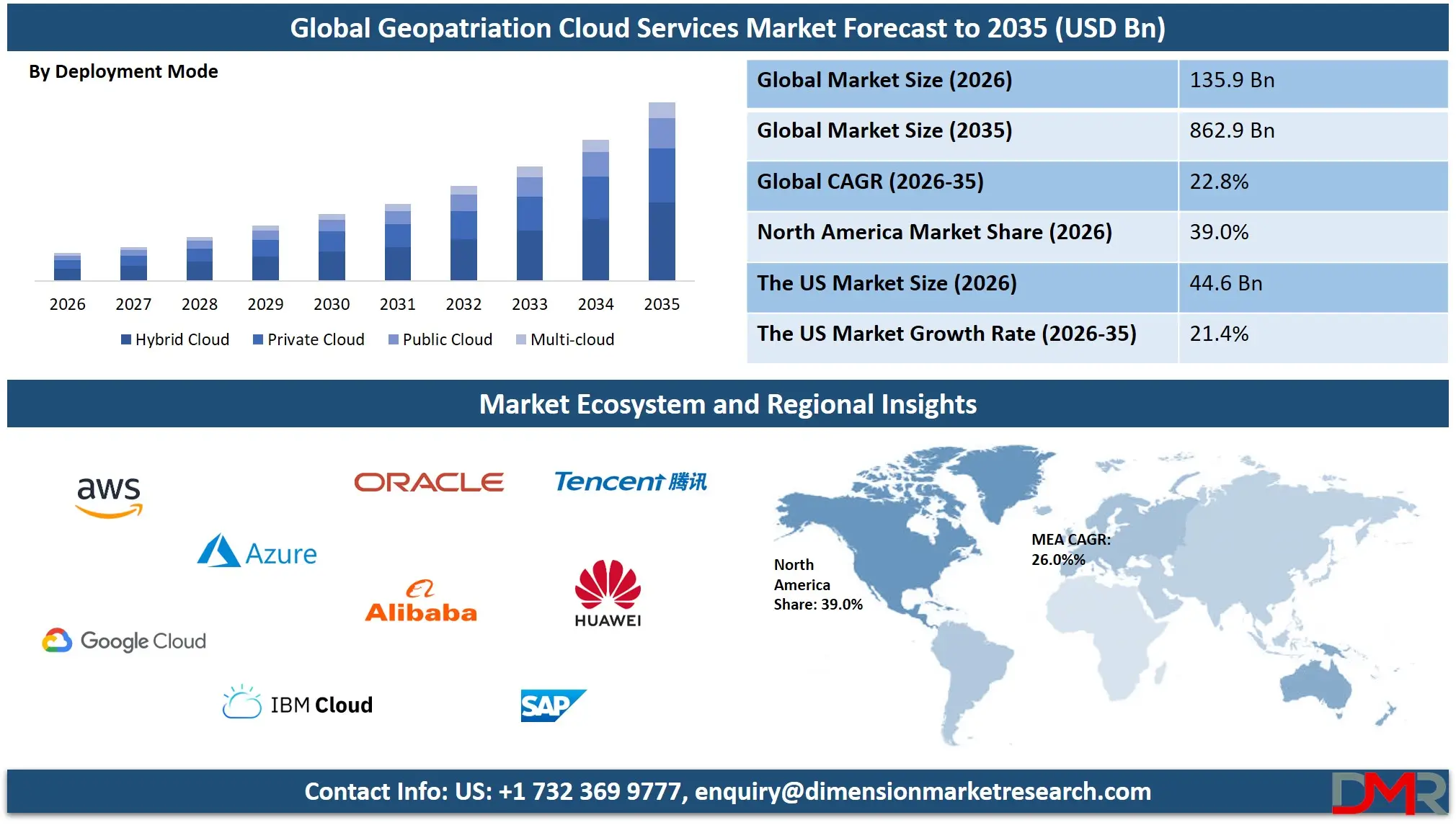
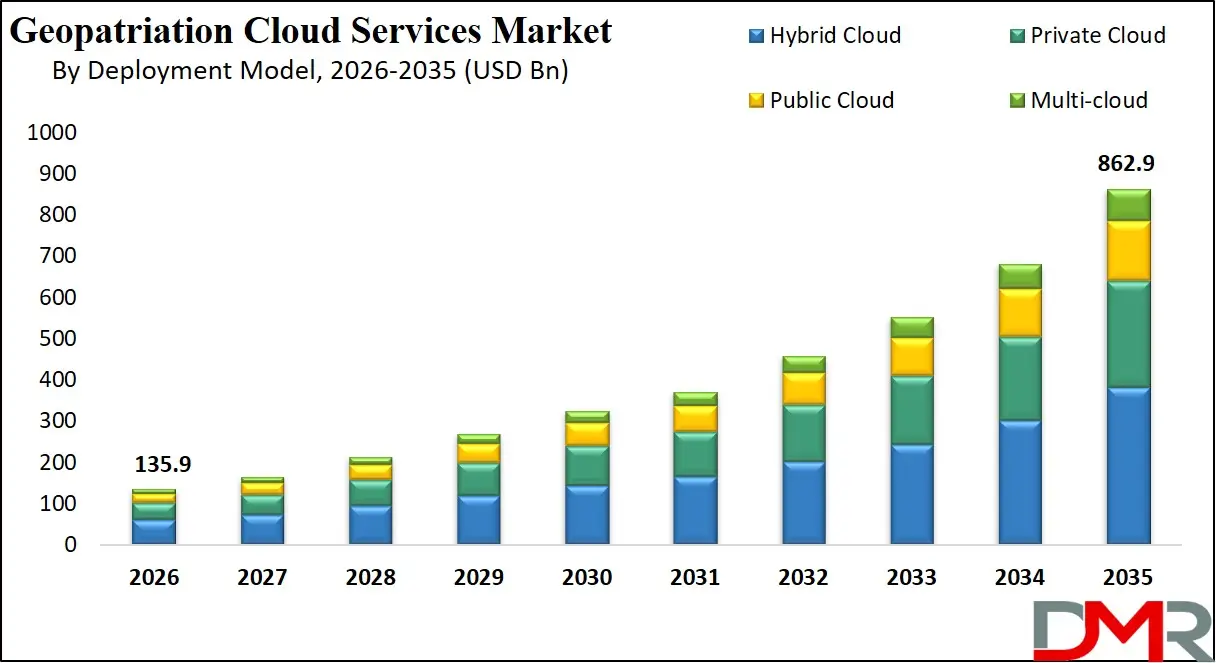
The Global Geopatriation Cloud Services Market, driven by data sovereignty, sovereign cloud infrastructure, and cloud repatriation solutions, is projected to reach USD 135.9 billion in 2026 and grow at a 22.8% CAGR to USD 862.9 billion by 2035, supported by rising demand for data localization, regulatory-compliant cloud computing, and hybrid cloud governance.
ℹ
To learn more about this report –
Download Your Free Sample Report Here
The Geopatriation Cloud Services Market refers to cloud solutions that enable data relocation and storage within national or regional jurisdictions to ensure data sovereignty, regulatory compliance, and geopolitical risk control. The market is expanding due to rising geopolitical tensions, stricter data localization laws, and increasing demand for sovereign control over critical data infrastructure. According to the European Commission–aligned digital sovereignty framework, over 80% of public sector cloud initiatives in Europe prioritize data localization requirements.
Growth is further driven by BFSI, healthcare, and government sectors that require secure, compliant, and jurisdiction-bound data environments. Enterprises are increasingly shifting workloads from global hyperscalers to sovereign and hybrid cloud models to reduce compliance risk and improve governance. Future expansion will be supported by national cloud programs and geopatriation strategies integrating global scalability with local control. The market is expected to become a core pillar of global cloud infrastructure transformation.
ℹ
To learn more about this report –
Download Your Free Sample Report Here
US Geopatriation Cloud Services Market
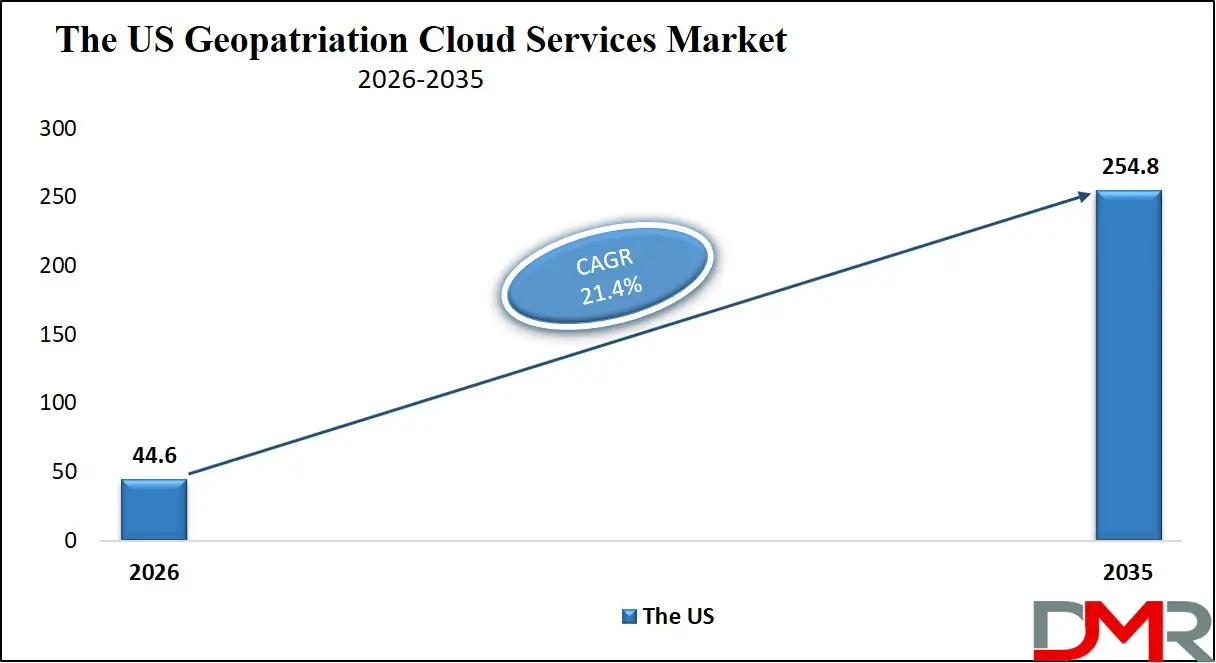
The US Geopatriation Cloud Services Market is projected to reach USD 44.6 billion in 2026 and grow at a compound annual growth rate of 21.4%, reaching USD 254.8 billion.
ℹ
To learn more about this report –
Download Your Free Sample Report Here
The US Geopatriation Cloud Services Market is driven by rising adoption of sovereign cloud infrastructure, data repatriation services, and compliant hybrid cloud models across regulated sectors. Growth is supported by increasing federal and state data security regulations and concerns over foreign data jurisdiction risks. According to the U.S. Government Accountability Office (GAO), federal agencies are accelerating cloud modernization to improve data control and security. BFSI, defense, and healthcare sectors are key adopters due to strict compliance needs. Future growth will be driven by AI-enabled sovereign clouds and multi-cloud governance frameworks enhancing data sovereignty and operational security.
Europe Geopatriation Cloud Services Market
Europe Geopatriation Cloud Services Market is anticipated to reach USD 29.8 Bn in 2026, expanding with a CAGR of 22.4%. Growth is driven by strict EU data sovereignty regulations and GDPR-led compliance requirements pushing enterprises toward localized cloud infrastructure. Increasing adoption of sovereign and hybrid cloud models is enabling secure workload migration and regional data control. Rising investments in EU-backed digital sovereignty initiatives are further accelerating market expansion across public and private sectors.
Japan Geopatriation Cloud Services Market
Japan Digital Provenance Market is anticipated to reach USD 6.8 Bn in 2026, expanding with a CAGR of 23.7%. Growth is driven by increasing demand for data authenticity, traceability, and secure digital content verification across industries. Strong government focus on digital transformation and cybersecurity resilience is accelerating adoption of provenance technologies. Rising integration of AI, blockchain, and advanced analytics is further strengthening trust and transparency in Japan's digital ecosystem.
Key Takeaways
- Market Size: The Global Geopatriation Cloud Services Market projected to be valued at USD 135.9 billion in 2026, reaching approximately USD 862.9 billion by 2035, reflecting strong adoption of sovereign, hybrid, and compliance-driven cloud infrastructures across regulated industries.
- Growth Rate and Outlook: The market is projected to expand at a CAGR of 22.8% from 2026 to 2035.
- Primary Growth Drivers: Growth is fueled by rising data localization regulations, increasing geopolitical risks, and growing enterprise demand for secure cloud repatriation and jurisdiction-controlled infrastructure.
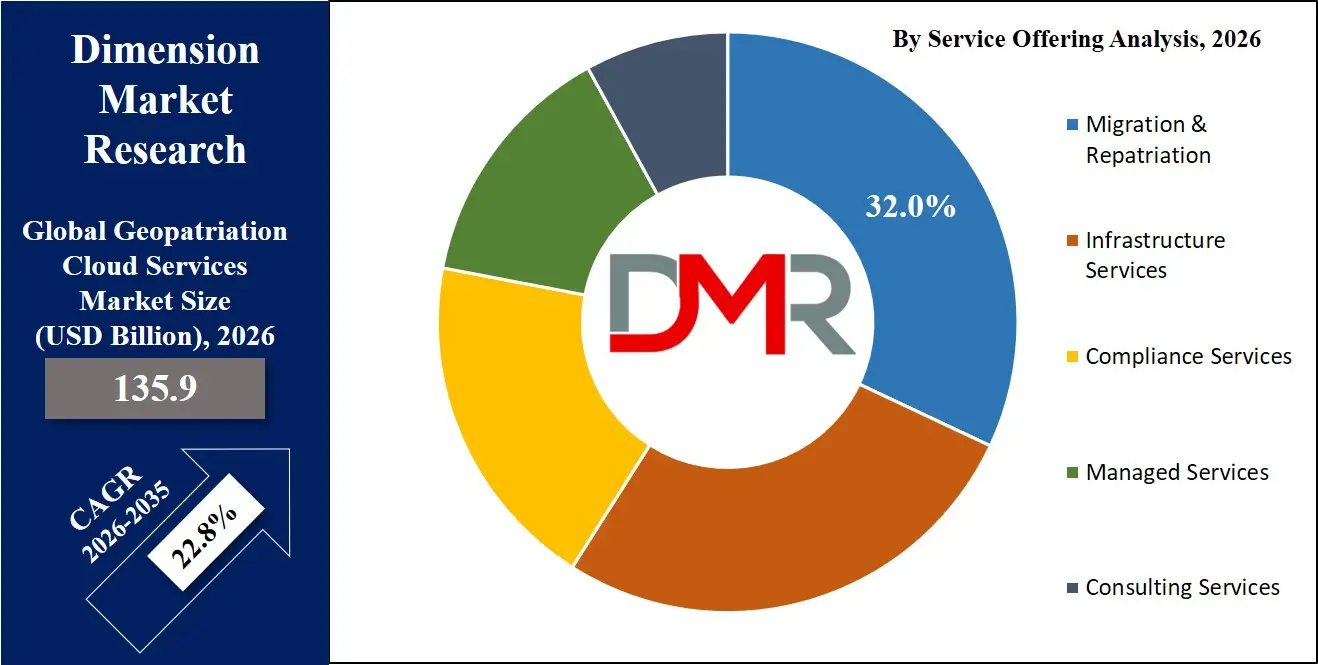
- By Service Offering Analysis: Migration & Repatriation dominates the Service Offering segment with 32.0% share in 2026, driven by large-scale workload shifts from global hyperscalers to sovereign and localized cloud environments.
- By Deployment Model Analysis: Hybrid Cloud leads the Deployment Model segment with 44.0% share in 2026, as enterprises prefer flexible architectures combining scalability with regulatory compliance and data control.
- By End-use Industry Analysis: BFSI dominates the End-use Industry segment with 27.0% share in 2026, owing to strict financial regulations, sensitive data management needs, and high adoption of sovereign cloud solutions.
- Regional Leadership: North America leads the market with 39.0% share in 2026, supported by advanced cloud infrastructure, strong regulatory frameworks, and high adoption across regulated industries.
What is Geopatriation Cloud Services?
Geopatriation Cloud Services are services that allow organizations to store, process and repatriate data across national or regional borders to guarantee data sovereignty, compliance, and geopolitical risk management. It is propelled by the growing attention of the world to laws on data localization and sovereign cloud policies, as the European Commission emphasizes in its digital strategy framework on public sector clouds usage. Enterprises and governments are moving workloads out of the global hyperscalers to sovereign and hybrid cloud environments to retain jurisdiction over sensitive data. The model is popular in the controlled industries like BFSI, healthcare and defense. Overall, it is a move towards compliance-centric, jurisdiction-conscious cloud infrastructure management.
Use Cases
- Government Data Localization: Geopatriation cloud services enable governments to store and process citizen data within national boundaries to ensure legal compliance and security. It supports e-governance platforms, national ID systems, and tax administration databases. This reduces dependency on foreign cloud jurisdictions and strengthens digital sovereignty.
- BFSI Regulatory Compliance: Banks and financial institutions use geopatriation cloud models to meet strict financial data residency and audit requirements. It ensures secure handling of transactions, customer data, and risk analytics within compliant environments. This helps reduce regulatory penalties and enhances trust in digital banking systems.
- Healthcare Data Protection: Healthcare providers adopt geopatriation cloud services to securely manage electronic health records and patient data within regulated jurisdictions. It ensures compliance with medical data protection laws and improves data privacy. This also supports secure sharing of records between authorized national healthcare systems.
- Defense and Critical Infrastructure Security: Defense organizations and critical infrastructure operators use sovereign cloud environments to protect sensitive operational and intelligence data. It ensures high-level security, restricted access, and controlled data flow. This minimizes risks of cyber threats and foreign data exposure.
How AI is Transforming the Geopatriation Cloud Services Market
AI is transforming the Geopatriation Cloud Services Market by enabling automated data localization, compliance monitoring, and sovereign workload management across cloud environments. It improves real-time governance and cybersecurity by detecting risks within jurisdiction-bound data systems.
AI also optimizes data routing and infrastructure efficiency in hybrid sovereign clouds. Overall, it makes geopatriation cloud models more secure, intelligent, and regulation-driven.
Market Dynamics
Key Drivers in the Global Geopatriation Cloud Services Market
Increasing Data Sovereignty Laws.
Governments of the world are introducing tougher legislation on data localization and sovereignty that is forcing businesses to save and process information within domestic borders. This change in regulation is one of the major reasons behind the use of geopatriation clouds in various industries. It makes sure that sensitive data is subject to the jurisdiction of domestic legal regulations, eliminating the risk of cross-border compliance. The most affected sectors are BFSI, healthcare and defense because of intense regulatory oversight. This is causing a faster request of sovereign and geo-fenced cloud infrastructures.
Increasing Cloud Security and Compliance Needs
The increasing cyber threats and data breaches have caused organizations to focus on safe cloud environments. Geopatriation cloud services offer increased control over data access, encryption and governance policies. This assists businesses to satisfy high audit and compliance standards effectively. It also minimizes the risk of foreign surveillance and lack of authorization to access data. As such, businesses are moving to compliance-based cloud architectures.
Restraints in the Global Geopatriation Cloud Services Market
Expensive Infrastructure and Migrations
Implementation of geopatriation cloud systems involves heavy commitment in local data facilities and safe infrastructure. The process of migration between the global hyperscalers can be complicated with the re-architecture of current workloads. These are a disincentive to SMEs and developing economies due to its high initial cost. Moreover, the maintenance and compliance monitoring is costly and consumes time. This restricts its adoption in price-sensitive markets.
Limited Global Interoperability
Stringent data localization regulations limit free cross-border data exchange and interconnectedness to global cloud environments. This poses a problem to multinational organizations which have several jurisdictional operations. It also minimises the ability to flexibly allocate work and global scale. Businesses can experience data synchronization and application performance inefficiencies. This makes the operational fragmentation one of the major restraints.
Growth Opportunities in the Global Geopatriation Cloud Services Market
Increase in National Sovereign Cloud Programs
National cloud infrastructure initiatives are gaining popularity among governments as a means of enhancing digital sovereignty. These applications are generating immense demand of geopatriation cloud services. They also promote inter-cooperation between the domestic cloud providers and the public sector. This is especially high in areas like Europe, Middle East and Asia Pacific. It creates important possibilities of localized cloud ecosystem creation.
Expansion of AI-Compliance Automation
AI is permitting auto-compliance and data control in sovereign clouds. This minimizes human intervention and enhances regulatory accuracy in complex data. AI also improves routing efficiency of data classification and jurisdiction. It helps in the real-time risk detection and enforcement of policies. This generates new development opportunities of smart geopatriation cloud platforms.
Trends in the Global Geopatriation Cloud Services Market
Move to Hybrid Sovereign Clouds
There is a tendency toward the use of hybrid architectures enabling enterprises to offer both the global and local data control. This strategy enables organizations to strike a balance between performance, cost effectiveness and compliance. Sensitive workloads can be selectively geopatriated to hybrid sovereign clouds. It is emerging as a favorite model among big organizations and governments. This is a trend that is transforming cloud infrastructure strategies across the world.
Rise of Multi-Jurisdiction Cloud Governance
Organizations are also adopting cloud governance models that fulfill various national policies at the same time. This is motivated by the growing digital trade restrictions and data protection regulations in the world. It allows the movement of data in and out of regions in a structured way. Cloud orchestration systems are policy-driven systems that are being invested by enterprises. This is resulting in more intricate yet very secure global cloud ecosystems.
Research Scope and Analysis
By Service Offering Analysis
Migration & Repatriation services will be the most popular service offering segment with a projected 32.0% share in 2026, due to the dynamism of increasing the workloads off global hyperscalers onto sovereign and locally controlled cloud systems as a compliance and data sovereignty requirement.
ℹ
To learn more about this report –
Download Your Free Sample Report Here
A growing number of enterprises are concentrating on workload migration, modernization of the systems, and data repatriation to minimize geopolitical and regulatory risks. Infrastructure services are also vital support services as they offer localized computational services, storage and dedicated data centers that retain data within a national boundary. These services provide secure, scalable, and compliant operations in the cloud, as well as providing complete control over the infrastructure. Combined, they make up the backbone of geopatriation cloud adoption.
By Data Governance Analysis
It is projected that Data Residency will control the data governance segment with an approximate market share of 46.0% in 2026 due to the growing regulatory requirements that require organizations to store and handle data within the national borders to guarantee compliance, security, and sovereignty. Localized storage is becoming a priority of the enterprises to minimize the risks of foreign jurisdiction and comply with the laws of data protection issued by the government. Meanwhile, Data Jurisdiction is concerned with identifying ownership and control of data under legislation of particular jurisdictions despite the fact that the information can be processed in various systems or environments. It allows organizations to deal with compliance requirements in various countries as well as to have flexibility in operations. Combined, these governance models play a pivotal role in the provision of secure and regulation-congruent cloud operation in geopatriation models.
By Deployment Model Analysis
The Hybrid Cloud will take over the deployment model segment with approximately 44.0% share in 2026 due to its capability to balance both scalability and regulatory compliance through a mix of flexibility provided by a public cloud and control of a private infrastructure. Hybrid models are favored by the enterprises because sensitive workloads can be handled locally, and the global cloud resources can serve the operations that are not critical, which is also applicable in the case of geopatriation. Instead, the usage of Private Cloud is mainly used in fully isolated and dedicated settings where organizations need full control in terms of data, security, and infrastructure within the country borders. Government, defense and highly regulated industries that cannot share infrastructure are the most frequent users of it. Both models can be used together to secure, flexible, and compliance-driven cloud architectures.
By Architecture Analysis
Multi-tenant architecture is expected to dominate the architecture segment with around 53.0% share in 2026, driven by its cost efficiency, scalability, and ability to support multiple organizations on shared but securely isolated infrastructure within geopatriation cloud environments. Enterprises prefer this model for non-sensitive and moderately regulated workloads while still maintaining compliance through strong logical data separation. Single-tenant architecture, in contrast, provides fully dedicated infrastructure for a single organization, ensuring maximum data isolation, security, and control over resources within sovereign cloud setups. It is widely used in government, defense, and highly regulated sectors where strict compliance and zero data sharing are required. Together, both architectures support balanced deployment of secure and scalable geopatriation cloud systems.
By Implementation Model Analysis
National Cloud will take the largest share of the implementation model with approximately 48.0% in 2026 due to high government-led efforts aimed at developing fully sovereign, in-country cloud infrastructure to guarantee data security, compliance, and digital sovereignty. These platforms are popular in the use of critical workloads of the public sector and regulated enterprise workloads that demand strict jurisdictional control. Regional Cloud, however, can be found in many countries in a specific geographical bloc, allowing to share compliance frameworks yet preserving some aspects of data sovereignty. It promotes transnational cooperation and infrastructure at scale in companies that are based on multiple jurisdictions. The two models jointly facilitate regulation-compliant geopatriation cloud adoption.
By Application Analysis
The application segment is likely to be dominated by Compliance Management in 2026 with a share of approximately 30.0% due to the growing regulatory demand to ensure data sovereignty and audit preparedness and compliance with jurisdiction-defined cloud governance models in geopatriation contexts. Businesses use it to constantly track, report, and enforce compliance on cloud infrastructures that are distributed. Data Migration, in its turn, is an important part of transferring workloads, applications, and datasets between the global hyperscalers to the sovereign or localized cloud systems while causing minimal disruption and data integrity. It aids in the modernization of old systems and helps organizations to meet national data residency criteria. Both applications are crucial in developing compliant and transition-ready geopatriation cloud ecosystems together.
By End-use Industry Analysis
BFSI is expected to dominate the end-use industry segment with around 27.0% share in 2026, driven by strict financial regulations, data sovereignty requirements, and the need for secure handling of sensitive customer and transaction data within geopatriation cloud environments. Banks and financial institutions are increasingly adopting sovereign and hybrid cloud models to ensure compliance, risk management, and audit transparency. Government & Defense, on the other hand, represents a highly critical segment focused on secure storage and processing of classified and citizen data within national boundaries to ensure digital sovereignty and national security. It relies on dedicated sovereign cloud infrastructures with strict access control and zero external dependency. Together, both sectors form the core demand base for geopatriation cloud services.
The Global Geopatriation Cloud Services Market Report is segmented on the basis of the following:
By Service Offering
- Migration & Repatriation
- Workload Migration
- Data Transfer
- System Rehosting
- Infrastructure Services
- Compute
- Storage
- Data Centers
- Compliance Services
- Monitoring
- Auditing
- Policy Enforcement
- Managed Services
- Operations
- Monitoring
- Optimization
- Consulting Services
By Data Governance
- Data Residency
- Data Jurisdiction
- Data Access Control
By Deployment Model
- Hybrid Cloud
- Private Cloud
- Multi-cloud
By Architecture
- Multi-tenant
- Single-tenant
By Implementation Model
- National Cloud
- Regional Cloud
- Enterprise Cloud
By Application
- Compliance Management
- Data Migration
- Data Protection
- Application Hosting
- Access Management
- Others
By End-use Industry
- BFSI
- Government & Defense
- IT & Telecom
- Healthcare
- Energy & Utilities
- Manufacturing
- Others
Regional Analysis
Leading Region by Market Share
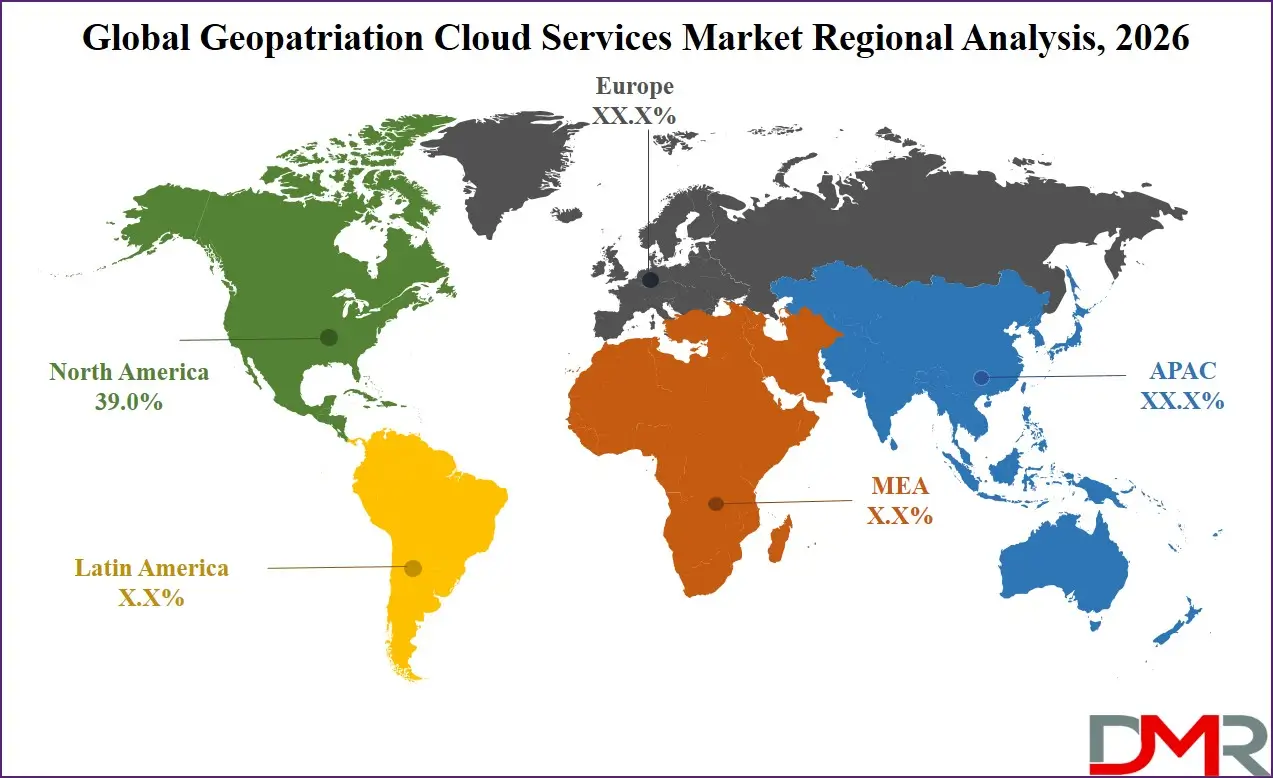
North America is projected to lead the market with ~39.0% share in 2026, driven by strong adoption of sovereign and hybrid cloud in BFSI, defense, and healthcare. Strict data regulations and sovereignty concerns are accelerating workload repatriation. High cloud maturity and advanced infrastructure support large-scale deployment. Enterprises are shifting to compliant, localized cloud environments to reduce jurisdictional risk.
ℹ
To learn more about this report –
Download Your Free Sample Report Here
Fastest-Growing Regional Market
The Middle East & Africa (MEA) is the fastest-growing region, driven by strong sovereign cloud programs and data localization mandates. Countries like Saudi Arabia and the UAE are heavily investing in national cloud infrastructure. Rising demand for secure, region-controlled data environments is accelerating adoption. Expansion of hyperscale data centers further supports rapid market growth.
By Region
North America
Europe
- Germany
- The U.K.
- France
- Italy
- Russia
- Spain
- Benelux
- Nordic
- Rest of Europe
Asia-Pacific
- China
- Japan
- South Korea
- India
- ANZ
- ASEAN
- Rest of Asia-Pacific
Latin America
- Brazil
- Mexico
- Argentina
- Colombia
- Rest of Latin America
Middle East & Africa
- Saudi Arabia
- UAE
- South Africa
- Israel
- Egypt
- Rest of MEA
Competitive Landscape
The competitive landscape is driven by demand for sovereign cloud, data localization, and compliance-focused solutions. Players compete on security, hybrid cloud integration, and geopolitical risk management. AI-driven governance is emerging as a key differentiator. Collaboration with governments for national cloud ecosystems is increasing.
Some of the prominent players in the Global Geopatriation Cloud Services Market are:
- Amazon Web Services (AWS)
- Microsoft Azure
- Google Cloud Platform
- IBM Cloud
- Oracle Cloud Infrastructure
- Alibaba Cloud
- Tencent Cloud
- Huawei Cloud
- SAP
- Salesforce
- VMware (Broadcom)
- OVHcloud
- DigitalOcean
- Rackspace Technology
- Equinix
- Cloudflare
- Oracle NetSuite Cloud
- Red Hat OpenShift
- Fujitsu Cloud
- NTT Communications Cloud
- Other Key Players
Recent Developments
- March 2026: Microsoft expanded its in-country sovereign cloud capabilities, introducing localized AI and cloud processing options across multiple regulated markets including Europe and Asia to support data residency requirements.
- February 2026: Gartner reported USD 80 billion sovereign cloud IaaS spending forecast for 2026, reflecting large-scale government-backed investments in localized cloud infrastructure globally.
- January 2026: AWS launched its European Sovereign Cloud, a fully EU-resident cloud infrastructure operated by EU-based entities to ensure strict data sovereignty and compliance with regional regulations.
Report Details
| Report Characteristics |
| Market Size (2026) |
USD 135.9 Bn |
| Forecast Value (2035) |
USD 862.9 Bn |
| CAGR (2026–2035) |
22.8% |
| Historical Data |
2021 – 2025 |
| Forecast Data |
2027 – 2035 |
| Base Year |
2025 |
| Estimate Year |
2026 |
| Segments Covered |
By Service Offering (Migration & Repatriation, Infrastructure Services, Compliance Services, Managed Services, Consulting Services), By Data Governance (Data Residency, Data Jurisdiction, Data Access Control), By Deployment Model (Hybrid Cloud, Private Cloud, Multi-cloud), By Architecture (Multi-tenant, Single-tenant), By Implementation Model (National Cloud, Regional Cloud, Enterprise Cloud), By Application (Compliance Management, Data Migration, Data Protection, Application Hosting, Access Management, Others), By End-use Industry (BFSI, Government & Defense, IT & Telecom, Healthcare, Energy & Utilities, Manufacturing, Others). |
| Regional Coverage |
North America – The US and Canada; Europe – Germany, The UK, France, Russia, Spain, Italy, Benelux, Nordic, & Rest of Europe; Asia-Pacific – China, Japan, South Korea, India, ANZ, ASEAN, Rest of APAC; Latin America – Brazil, Mexico, Argentina, Colombia, Rest of Latin America; Middle East & Africa – Saudi Arabia, UAE, South Africa, Turkey, Egypt, Israel, & Rest of MEA |
Frequently Asked Questions
How big is the Geopatriation Cloud Services Market?
▾ The Geopatriation Cloud Services Market is projected to be valued at USD 135.9 billion in 2026 and is projected to reach USD 862.9 billion by 2035, reflecting rapid expansion driven by sovereign and compliance-led cloud adoption.
What is the CAGR of the Geopatriation Cloud Services Market from 2026 to 2035?
▾ The market is expected to grow at a CAGR of 22.8% (2026–2035), supported by rising demand for data sovereignty, cloud repatriation, and regulatory-compliant infrastructure.
What factors are driving the growth of the Geopatriation Cloud Services Market?
▾ Growth is driven by increasing data sovereignty regulations, geopolitical tensions, and strict data localization laws, along with rising adoption of sovereign and hybrid cloud models.
What are the major trends in the Geopatriation Cloud Services Market?
▾ Key trends include the rise of national sovereign cloud programs, hybrid cloud geopatriation models, and AI-driven compliance automation.
Which region held the largest share of the Geopatriation Cloud Services Market in 2026?
▾ North America held the largest share in 2026 with approximately 39.0%, driven by advanced cloud infrastructure, strict regulatory frameworks, and strong adoption across regulated industries like BFSI, defense, and healthcare.
Which region is expected to grow the fastest in the Geopatriation Cloud Services Market?
▾ The Middle East & Africa (MEA) is expected to be the fastest-growing region, supported by national cloud initiatives, rising data localization mandates, and large-scale investments in sovereign cloud infrastructure, particularly in Saudi Arabia and the UAE.
Who are the key players in the Geopatriation Cloud Services Market?
▾ Amazon Web Services (AWS), Microsoft Azure, Google Cloud Platform, IBM Cloud, Oracle Cloud Infrastructure, Alibaba Cloud, Tencent Cloud, Huawei Cloud, SAP, Salesforce, VMware (Broadcom), OVHcloud, DigitalOcean, Rackspace Technology, Equinix, Cloudflare, Oracle NetSuite Cloud, Red Hat OpenShift, Fujitsu Cloud, and NTT Communications Cloud.
How is the Geopatriation Cloud Services Market segmented?
▾ By Service Offering, Data Governance, Deployment Model, Architecture, Implementation Model, Application, and End-use Industry.