Germany Battery Factory Automation Market Snapshot
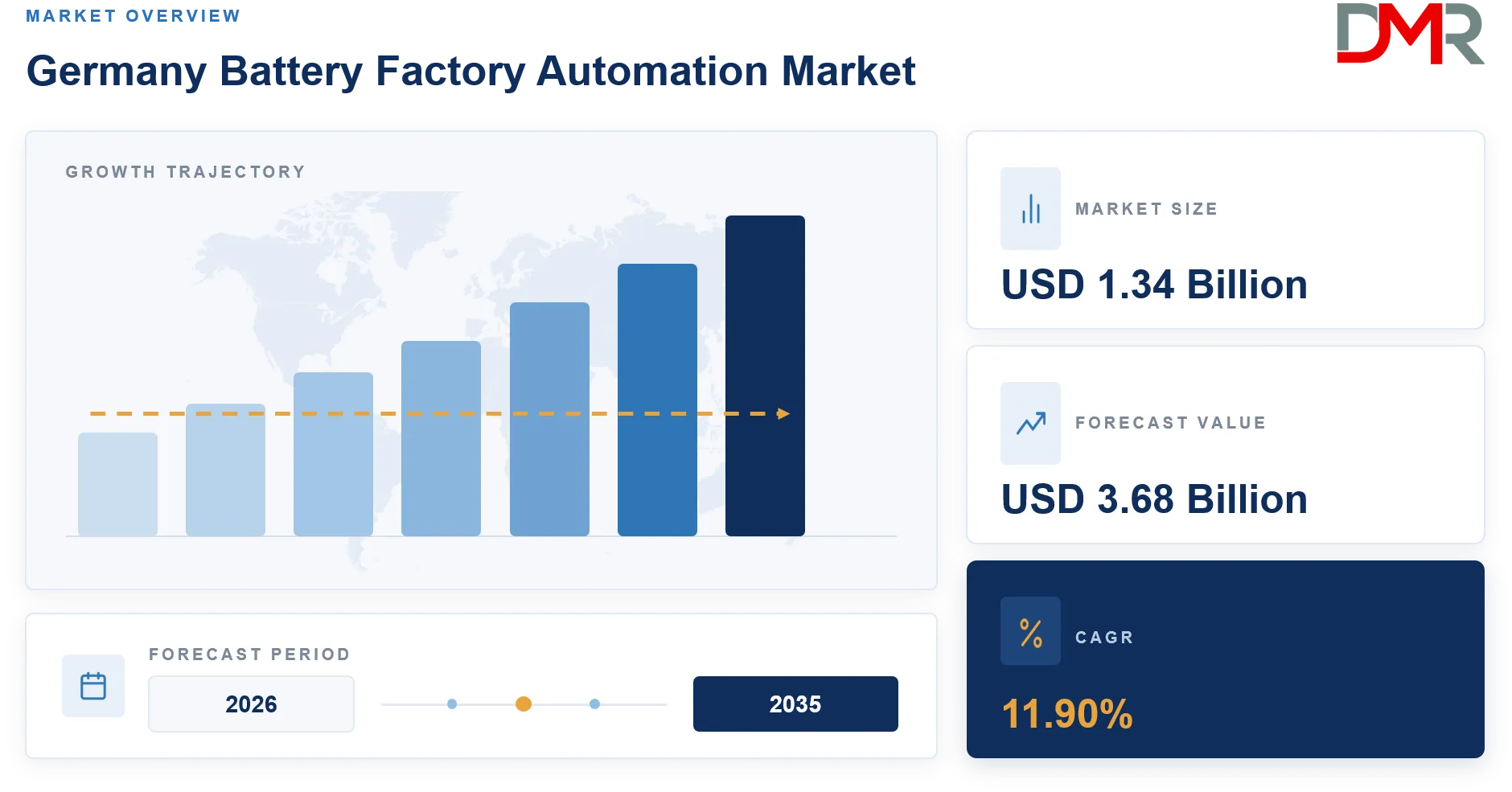
- Market Value: The Germany battery factory automation market is valued at USD 1.34 billion in 2026 and is expected to reach USD 3.68 billion by 2035.
- CAGR: The Germany battery factory automation market is expected to grow at a CAGR of 11.9% from 2026 to 2035.
- By Process Segment Analysis: Formation & testing dominated the process segment with a 17.8% share in 2026.
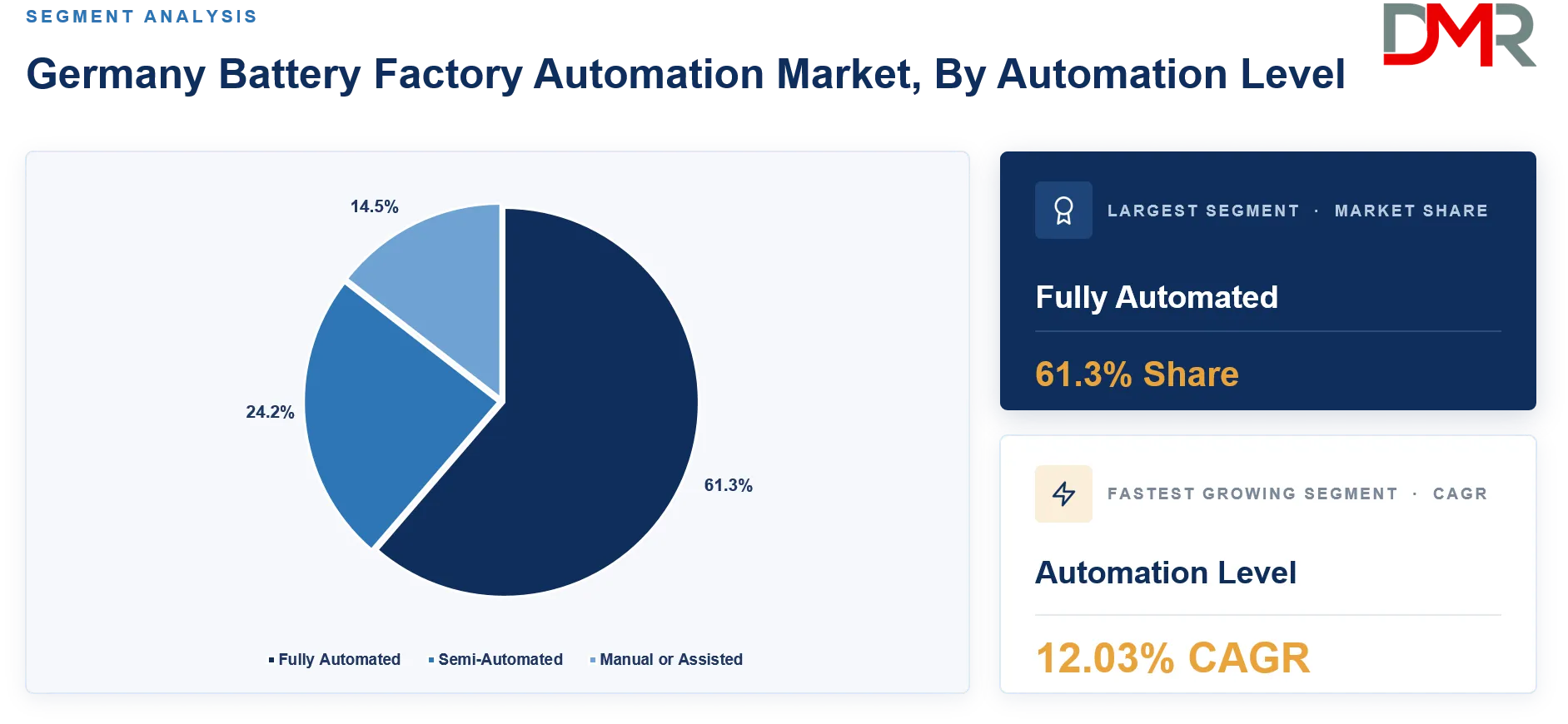
- By Automation Level Segment Analysis: Fully automated systems held a 61.3% share in 2026.
- By Battery Type Segment Analysis: Lithium-ion batteries accounted for a 91.6% share in 2026.
- By Battery Format Segment Analysis: Prismatic batteries led battery formats with a 43.8% share in 2026.
- Major Players: Bosch Rexroth, Dürr Group, GROB-WERKE, Siemens, and KUKA.
What is the Germany Battery Factory Automation Market and its Market Size?
The Germany battery factory automation market size is projected to be valued at USD 1.34 billion in 2026 and is projected to reach USD 3.68 billion by 2035, expanding at a CAGR of 11.9% during the forecast period. The market covers automated machinery, robotics, controls, testing systems, inspection equipment, material handling, industrial software, and integrated production platforms used across electrode processing, cell manufacturing, formation, module assembly, pack assembly, testing, and battery recycling.
ℹ
To learn more about this report –
Download Your Free Sample Report Here
Germany's battery factory automation demand is increasingly connected with domestic battery cell production, electric vehicle manufacturing, higher production traceability requirements, and efforts to reduce scrap during cell ramp-up. PowerCo began battery cell production at its Salzgitter gigafactory in December 2025, with initial capacity designed to scale to as much as 40 GWh annually. Such investments create demand for stacking systems, formation equipment, automated inspection, material movement, manufacturing execution software, machine controls, and end-of-line testing.
Use Cases
- Automated Cell Production: Battery manufacturers use robotics, servo motion, precision handling, stacking equipment, welding systems, and machine controls to produce cells with consistent dimensions and tight process tolerances. Automation supports higher throughput while reducing manual contact with sensitive electrodes and cells in dry-room production environments.
- Formation and Battery Testing: Automated formation, ageing, electrical testing, leak detection, safety verification, and performance grading systems process large numbers of cells with repeatable test procedures. These systems help manufacturers identify defects earlier, classify cells accurately, collect traceability data, and reduce the risk of unsuitable cells entering modules or battery packs.
- EV Module and Pack Assembly: Automotive and battery plants deploy robots, conveyors, joining systems, dispensing equipment, fastening technology, machine vision, and end-of-line testing to assemble battery modules and packs. Automation is especially valuable for handling heavy components, controlling joining parameters, maintaining takt time, and validating high-voltage battery systems before vehicle installation.
- Digital Production Control: Manufacturing execution systems, industrial control platforms, digital twins, process analytics, and machine connectivity provide production visibility across complex battery lines. German manufacturers use these technologies to monitor equipment status, trace process parameters, identify quality deviations, coordinate machines from different suppliers, and improve overall equipment effectiveness during production ramp-up.
- Battery Recycling Automation: Automated discharge, identification, dismantling, material handling, and sorting systems are becoming relevant as EV batteries reach end of life. Automation reduces worker exposure to high-voltage components and creates more consistent workflows for recovering modules, cells, metals, and reusable materials from increasingly diverse battery designs.
How AI/Gen AI is Transforming the Germany Battery Factory Automation Market?
AI-enabled analytics are expanding from isolated quality checks into production control, maintenance, and process optimization. Machine vision can analyze electrode surfaces, welds, cell geometry, connector placement, and assembly defects faster than manual inspection. Production models can combine sensor readings, equipment conditions, historical defect patterns, and test results to identify process drift before it produces a larger batch of scrap. This is important in lithium-ion manufacturing, where minor variations in coating, stacking, welding, filling, or formation can affect cell consistency. Predictive maintenance also helps plants identify abnormal vibration, temperature, motion, and electrical behavior in critical machinery, allowing maintenance teams to intervene before an unplanned line stop.
Generative AI is emerging as an additional layer for engineering and factory operations rather than replacing deterministic industrial controls. Engineers can use natural-language interfaces to retrieve maintenance procedures, summarize production alarms, examine machine documentation, and navigate manufacturing data. Digital engineering platforms can also accelerate equipment configuration, simulation, troubleshooting, and operator training. For Germany's battery factories, the highest commercial value is likely to come from combining industrial AI with MES, digital twins, machine vision, PLC data, and traceability systems. Plants still require validated controls and human oversight for safety-critical production decisions, making governed industrial deployment central to adoption.
Key Drivers in the Germany Battery Factory Automation Market
Expansion of Domestic Battery Cell Manufacturing Capacity
Germany's move toward localized battery production is creating direct demand for automated cell manufacturing and assembly technology. PowerCo started production at its Salzgitter gigafactory in December 2025 and plans to build initial annual capacity of up to 20 GWh, expandable to 40 GWh. Large-scale cell production requires synchronized coating, stacking, filling, formation, inspection, logistics, and data systems. This strengthens demand for turnkey automation, specialized machinery, controls, robotics, and factory software that can support rapid production ramp-up.
Automotive Electrification and High-Volume Production Requirements
Germany's automotive manufacturing base makes battery automation strategically important because EV battery systems must be produced at automotive-scale takt times while meeting strict safety and quality requirements. Automated handling, joining, dispensing, inspection, module assembly, pack assembly, and end-of-line testing increase repeatability and help manufacturers manage high-voltage products safely. The strong EV application share of 68.9% in 2026 demonstrates how closely battery factory automation growth is tied to vehicle electrification and local battery supply chains.
Restraints in the Germany Battery Factory Automation Market
High Capital Cost and Difficult Production Ramp-Up
Battery automation lines require large investments in machinery, dry-room compatible components, precision motion systems, inspection, testing, software, safety systems, and integration. A factory can also face substantial costs before reaching stable yield and throughput. Process changes during ramp-up may require equipment modifications, new recipes, software revisions, and additional validation. These risks can delay purchasing decisions, especially when battery chemistry, cell format, customer volumes, or production schedules remain uncertain.
Technology Changes Can Reduce Equipment Flexibility
Rapid changes in battery chemistry, cell design, electrode processing, module architecture, and pack concepts create automation challenges. Equipment optimized for one format or production sequence may require costly modification when manufacturers move to different dimensions or processes. The transition toward solid-state technologies, dry electrode processing, cell-to-pack designs, and new joining methods increases the value of modular automation. Suppliers that cannot provide flexible machine interfaces and reconfigurable systems may face slower adoption in future projects.
Growth Opportunities in the Germany Battery Factory Automation Market
Traceability and Digital Battery Passport Readiness
The EU Batteries Regulation creates an important opportunity for connected production systems. From February 18, 2027, electric vehicle batteries and certain industrial batteries must carry an electronic battery passport. This increases the strategic importance of reliable production records, serial-level identification, data integration, and traceability. Automation vendors can expand beyond machinery into MES, machine connectivity, inspection databases, serialization, analytics, and lifecycle data solutions that connect factory information with battery compliance workflows.
Automated Battery Recycling and Circular Manufacturing
Battery recycling offers a growing downstream opportunity for Germany's automation suppliers. End-of-life packs vary in design, state of charge, fastening methods, and cell configuration, making manual processing difficult and potentially hazardous. Automated discharge, robotic dismantling, machine vision, sorting, and material handling can improve worker safety and throughput. Germany's established machinery and automotive engineering base also creates opportunities for automation companies to connect battery production, reuse, remanufacturing, and recycling within a more circular manufacturing system.
Trends in the Germany Battery Factory Automation Market
End-to-End Digitalization of Battery Production Lines
Battery factories are moving from isolated automated machines toward digitally integrated production environments. Dürr and GROB have demonstrated concept-factory approaches that connect equipment, digital twins, production planning, MES and MOM systems, and process traceability. This architecture gives manufacturers a common data layer across electrode manufacturing, cell assembly, and downstream operations. Greater integration helps plants monitor yield, energy use, cycle time, equipment availability, and quality while simplifying coordination between machinery supplied by different vendors.
Compact and Modular Automation Platforms
Manufacturers increasingly want production systems that occupy less floor space and can adapt to changes in cell technology. In 2025, Dürr and GROB presented a battery cell concept factory designed around technologies including dry electrode coating and high-performance Z-folding, with a significantly reduced production footprint. Modular controls, flexible transport systems, scalable robotics, standardized interfaces, and software-defined equipment are becoming important because they allow factories to increase capacity or modify processes without rebuilding complete lines.
Research Scope and Analysis
The Germany battery factory automation market is segmented based on process, equipment type, automation level, battery type, battery format, application, manufacturing stage, and end user. The study evaluates automation demand across cell production, module and pack assembly, testing, inspection, production software, intralogistics, and emerging recycling applications. It examines the role of equipment performance, production scale, quality requirements, digitization, regulatory compliance, cell technology, and investment activity in shaping market growth.
ℹ
To learn more about this report –
Download Your Free Sample Report Here
By Process
Formation & testing led the process segment with a 17.8% share in 2026, equal to approximately USD 238.5 million of market value. Formation is one of the most equipment-intensive stages because newly produced cells must undergo controlled charging and discharging cycles before final grading. Large cell volumes also require automated electrical connections, temperature monitoring, ageing management, data collection, and sorting. The growing importance of battery safety and cell-level traceability supports continued investment in formation, ageing, performance testing, and automated quality verification.
By Automation Level
Fully automated systems accounted for 61.3% of the market in 2026, equivalent to approximately USD 821.4 million. Battery factories benefit from full automation because many production operations require high speed, repeatable positioning, contamination control, accurate process parameters, and continuous tracking. Robotics, conveyors, servo systems, machine vision, automated guided transport, PLC controls, and industrial software work together to limit manual handling. The segment should remain central as manufacturers seek higher throughput and lower production cost per cell.
By Battery Type
Lithium-ion batteries generated 91.6% of Germany battery factory automation revenue in 2026, or approximately USD 1.23 billion. Their dominance reflects their central role in electric vehicles, stationary storage, electronics, industrial products, and power tools. Lithium-ion cell production also involves numerous precision processes that are well suited to automation, including coating, calendaring, slitting, stacking, welding, electrolyte filling, formation, and inspection. Solid-state battery development creates a future opportunity, but lithium-ion technology remains the primary automation investment base.
By Battery Format
Prismatic batteries led with a 43.8% share in 2026, equal to approximately USD 586.9 million. Prismatic cells are important in automotive battery architectures because their rigid housings support structured module and pack integration. Their production creates demand for precise stacking, enclosure handling, welding, filling, sealing, inspection, and electrical testing. Automation suppliers that can adapt fixtures, transport systems, joining equipment, and inspection tools to varying prismatic dimensions are positioned to address changing vehicle-platform requirements.
The Germany Battery Factory Automation Market Report is segmented on the basis of the following:
By Process
- Mixing
- Coating
- Calendaring
- Slitting
- Stacking
- Cell Assembly
- Formation & Testing
- Module Assembly
- Pack Assembly
By Equipment Type
- Robotics
- Conveyors
- Coating Machines
- Calendaring Machines
- Slitting Machines
- Stacking Machines
- Testing Equipment
- Welding Equipment
- Inspection Systems
- Industrial Software
By Automation Level
- Fully Automated
- Semi-Automated
- Manual or Assisted
By Battery Type
-
Lithium-Ion
- Solid-State
- Lead-Acid
- Nickel-Metal Hydride
- Other Battery Types
By Battery Format
- Cylindrical
- Prismatic
- Pouch
By Application
- Electric Vehicles
- Consumer Electronics
- Energy Storage Systems
- Industrial Equipment
- Power Tools
By Manufacturing Stage
- Electrode Manufacturing
- Cell Manufacturing
- Cell Assembly
- Formation & Ageing
- Module Assembly
- Pack Assembly
- Testing & Inspection
- Recycling & Disassembly
By End User
- Automotive Manufacturers
- Battery Manufacturers
- Energy Storage Manufacturers
- Electronics Manufacturers
- Battery Recycling Companies
Competitive Landscape
The Germany battery factory automation market has a diverse competitive structure spanning complete production-line suppliers, automation platform vendors, robotics companies, specialist battery equipment manufacturers, testing companies, and engineering integrators. Bosch Rexroth competes with automation, motion, material handling, joining, controls, and digital production solutions across the battery value chain. Dürr and GROB have strengthened their position through integrated battery production concepts covering electrode processing, cell manufacturing, assembly, testing, and digitalization.
Siemens competes through factory automation, industrial software, digital twins, electrification, and manufacturing infrastructure, while KUKA, ABB, and FANUC address robotic handling, assembly, machine tending, logistics, and related automation requirements. Specialized companies compete through welding, inspection, formation, power electronics, assembly systems, and customized engineering. Competition is increasingly based on complete process integration, production yield, cycle time, energy efficiency, machine availability, software connectivity, traceability, modularity, and the ability to support rapid factory ramp-up. Vendors that combine equipment with digital services and lifecycle support are positioned to capture a larger share of future battery factory investments.
Some of the prominent players in the Germany battery factory automation industry are:
- Bosch Rexroth
- Dürr Group
- GROB-WERKE
- Manz AG
- ANDRITZ Schuler
- Siemens
- KUKA
- ABB
- FANUC
- Dynamic Automation
- Baumann Automation
- CMWTEC
- thyssenkrupp Automation Engineering
- ID Engineering & Services
- Automation WR
- Rosendahl Nextrom
- MANUGY
- Handtmann Systemtechnik
- KATOP Automation
- Digatron Power Electronics
- Others
Regulatory Landscape
Germany battery factory automation market growth is increasingly shaped by European battery, machinery, sustainability, and data requirements that influence how production lines are designed and operated. Regulation (EU) 2023/1542 introduces lifecycle requirements for batteries covering sustainability, safety, labeling, due diligence, recycled content, and information management. From February 18, 2027, covered EV and industrial batteries require an electronic battery passport, increasing demand for serialization, production traceability, inspection databases, MES connectivity, and reliable process data capture. The EU Machinery Regulation also strengthens requirements for machinery safety and conformity, which affects robotics, handling systems, testing stations, and integrated production lines. For automation suppliers, compliance is becoming a product differentiator. Battery manufacturers increasingly favor systems that can document process parameters, maintain auditable production records, support interoperable data exchange, and accommodate future regulatory updates without extensive factory redesign.
Investment and White Space Analysis
Investment opportunities in the Germany battery factory automation market are shifting from conventional standalone machinery toward integrated, flexible, and data-rich production systems. PowerCo's Salzgitter cell factory, which started production in December 2025, demonstrates the continuing localization of battery manufacturing and the need for scalable automation across cell production, formation, testing, inspection, and intralogistics. Attractive white spaces include automated battery recycling and disassembly, dry electrode processing, solid-state battery pilot lines, AI-supported inspection, digital twins, traceability software, flexible cell-format handling, and energy-efficient formation equipment. Opportunities also exist for mid-sized suppliers that can retrofit brownfield facilities instead of requiring complete line replacement. Vendors offering modular equipment, open software interfaces, predictive maintenance, lower energy consumption, and rapid commissioning can address manufacturers seeking to improve yield and capacity while limiting capital expenditure and technology-lock-in risk.
Recent Developments
- April 2026: Agile Robots SE completed acquisition of thyssenkrupp Automation Engineering, rebranding it Krause Automation, strengthening Germany's battery factory automation capabilities with 650 experts and 10 new locations across Europe and North America.
- April 2026: Siemens secured a circa €40 million framework agreement with Vulcan Energy for the Lionheart lithium project in Germany's Upper Rhine Valley, serving as Main Automation Contractor for extraction and processing plants through 2035.
- March 2025: Dürr AG and GROB-WERKE deepened their strategic partnership for battery cell production technology after Manz AG exited, offering nearly the entire battery cell production value chain from a European source.
Report Details
| Report Characteristics |
| Market Size (2026) |
USD 1.34 Bn |
| Forecast Value (2035) |
USD 3.68 Bn |
| CAGR (2026-2035) |
11.9% |
| Historical Data |
2021 - 2025 |
| Forecast Data |
2027 - 2035 |
| Base Year |
2025 |
| Estimate Year |
2026 |
| Segments Covered |
By Process (Mixing, Coating, Calendaring, Slitting, Stacking, Cell Assembly, Formation & Testing, Module Assembly, and Pack Assembly), By Equipment Type (Robotics, Conveyors, Coating Machines, Calendaring Machines, Slitting Machines, Stacking Machines, Testing Equipment, Welding Equipment, Inspection Systems, and Industrial Software), By Automation Level (Fully Automated, Semi-Automated, and Manual or Assisted), By Battery Type (Lithium-Ion, Solid-State, Lead-Acid, Nickel-Metal Hydride, and Other Battery Types), By Battery Format (Cylindrical, Prismatic, and Pouch), By Application (Electric Vehicles, Consumer Electronics, Energy Storage Systems, Industrial Equipment, and Power Tools), By Manufacturing Stage (Electrode Manufacturing, Cell Manufacturing, Cell Assembly, Formation & Ageing, Module Assembly, Pack Assembly, Testing & Inspection, and Recycling & Disassembly), and By End User (Automotive Manufacturers, Battery Manufacturers, Energy Storage Manufacturers, Electronics Manufacturers, and Battery Recycling Companies) |
| Regional Coverage |
Germany |
Frequently Asked Questions
What is the current size of the Germany Battery Factory Automation Market?
▾ The Germany battery factory automation market is valued at USD 1.34 billion in 2026 and USD 3.68 billion by 2035.
What is the growth rate of the Germany Battery Factory Automation Market during?
▾ The Germany battery factory automation market is forecast to grow at an 11.9% CAGR from 2026 through 2035.
What factors are driving the growth of the Germany Battery Factory Automation Market?
▾ EV battery production, gigafactory investment, and digitalization drive Germany battery factory automation market growth.
What are the major challenges restraining the Germany Battery Factory Automation Market?
▾ High capital costs, ramp-up risks, and technology changes restrain Germany battery factory automation market growth.
Which segment holds the largest share of the Germany Battery Factory Automation Market?
▾ Formation & testing leads the Germany battery factory automation market process segment with a 17.8% share in 2026.
Who are the leading companies in the Germany Battery Factory Automation Market?
▾ Bosch Rexroth, Dürr Group, GROB-WERKE, Manz AG, ANDRITZ Schuler, Siemens, KUKA, ABB, FANUC, Dynamic Automation, Baumann Automation, CMWTEC, thyssenkrupp Automation Engineering, ID Engineering & Services, Automation WR, Rosendahl Nextrom, MANUGY, Handtmann Systemtechnik, KATOP Automation, and Digatron Power Electronics are leading companies in the Germany battery factory automation market.
How is AI influencing the Germany Battery Factory Automation Market?
▾ AI supports inspection, predictive maintenance, process control, and yield gains in Germany battery factory automation.
What are the future opportunities and trends in the Germany Battery Factory Automation Market?
▾ Digital factories, traceability, recycling automation, and flexible lines create Germany battery automation opportunities.