Germany Food Processing Automation Market Snapshot
- Germany Food Processing Automation Market Size in 2026: USD 1.9 Billion
- Germany Food Processing Automation Market Size in 2035: USD 3.6 Billion
- Germany CAGR from 2026 to 2035: 7.4%
- Hardware is the leading component segment in 2026: 58.4%
- Programmable Logic Controllers and Industrial Control Systems is the leading automation type segment in 2026: 29.6%
- Packaging and Palletizing is the leading application segment in 2026: 34.2%
- Meat, Poultry, and Seafood is the leading food category segment in 2026: 27.8%
- Large Enterprises is the leading enterprise size segment in 2026: 65.4%
What is the Germany Food Processing Automation Market and its Market Size?
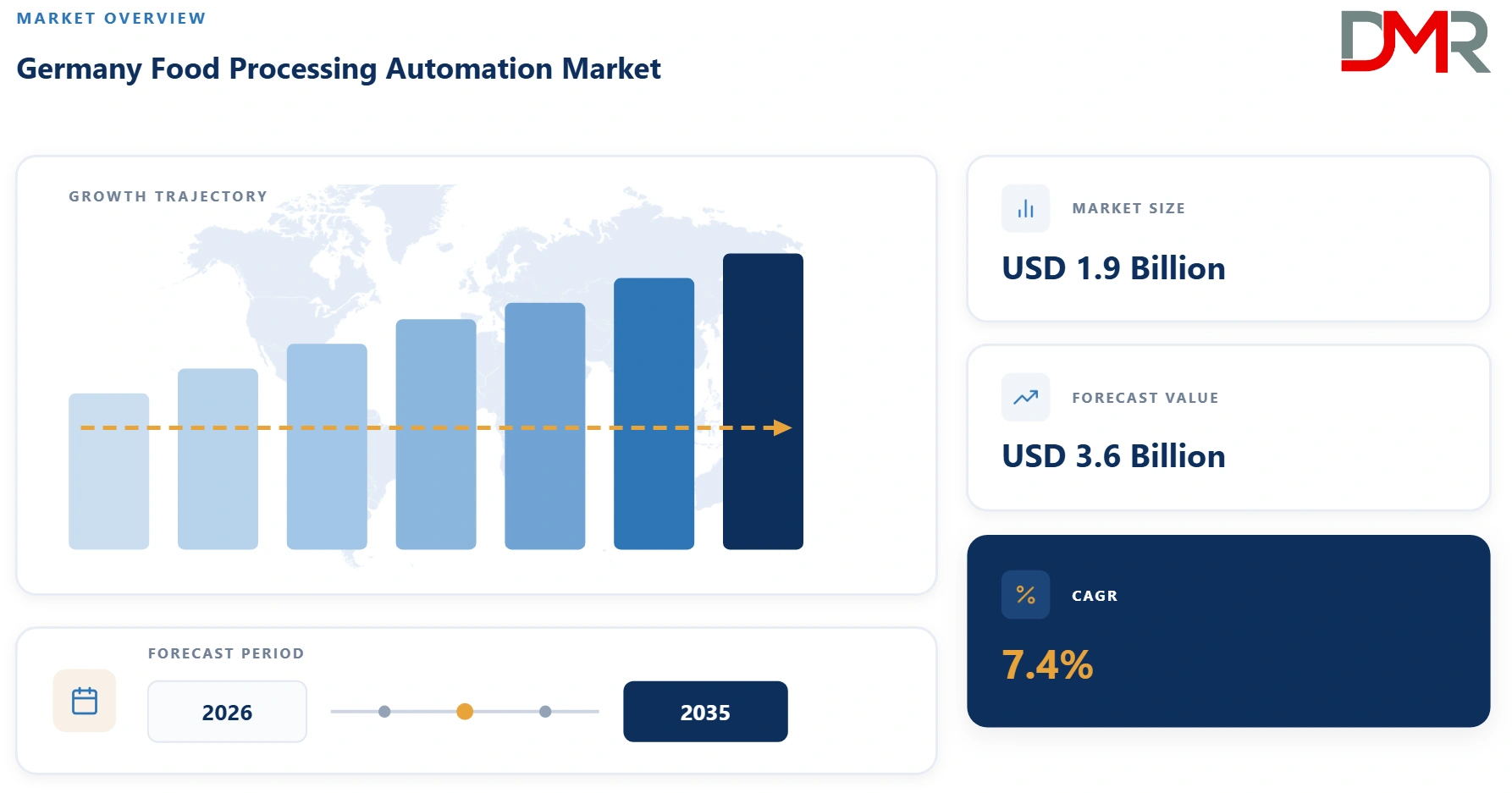
The Germany Food Processing Automation Market is projected to reach USD 1.9 billion in 2026 and grow at a compound annual growth rate of 7.4% through 2035 to reach USD 3.6 billion.
ℹ
To learn more about this report –
Download Your Free Sample Report Here
Food processing automation comprises integrated hardware, industrial software, robotics, sensors, controls, and associated services used to automate food manufacturing activities. Germany represents an important European market because of its substantial food industry, advanced engineering ecosystem, high manufacturing standards, and early adoption of Industry 4.0 technologies. Processors are investing in automated inspection, packaging, portioning, material handling, traceability, and production management to improve throughput, address workforce shortages, maintain hygiene, reduce waste, and satisfy increasingly stringent quality requirements.
Use Cases
- Automated Packaging and Palletizing: German food manufacturers deploy robotic pick and place equipment, case packers, labeling systems, conveyors, and palletizing robots to manage products at high speeds. These systems reduce repetitive manual work, minimize packaging errors, support frequent product changeovers, and maintain consistent output. Integrated vision and control technologies also verify labels, package integrity, barcodes, weights, and pallet configurations before products leave production facilities.
- Machine Vision Quality Inspection: Machine vision systems inspect food color, shape, size, surface condition, foreign materials, packaging seals, labels, and fill levels without slowing production. High resolution cameras combined with artificial intelligence help processors identify defects that conventional inspection may miss. Automated rejection mechanisms remove nonconforming products, improving food safety, reducing recalls, strengthening regulatory compliance, and maintaining consistent product quality across production batches.
- Automated Processing and Portioning: Meat, bakery, dairy, seafood, and convenience food manufacturers use programmable cutting, mixing, dosing, slicing, and portioning systems to deliver uniform products. Automation improves ingredient accuracy, minimizes giveaway, reduces direct employee contact, and supports hygienic production. Recipe management and programmable controls allow facilities to switch between products efficiently while preserving consistency, traceability, production speed, and equipment utilization levels.
Key Takeaways
- Market Size: The Germany Food Processing Automation Market is anticipated to be valued at USD 1.9 billion in 2026 and is forecast to reach USD 3.6 billion by 2035, expanding at a CAGR of 7.4%.
- Growth Outlook: Market expansion is supported by Industry 4.0 adoption, labor availability challenges, food safety requirements, production digitalization, growing demand for convenience foods, pressure to reduce waste, and increasing investment in flexible robotics, smart sensors, machine vision, predictive maintenance, digital twins, integrated manufacturing execution systems, and energy-efficient processing technologies.
- Primary Growth Drivers: Rising labor costs, an aging industrial workforce, strict hygiene requirements, greater product variety, shorter production cycles, stronger traceability expectations, and demand for consistent output are encouraging German food processors to modernize production lines. The country’s mature engineering, robotics, machinery, and industrial software ecosystem further supports the development and integration of automated food-manufacturing systems.
- By Component Analysis: Hardware is projected to dominate with a 58.4% share in 2026 due to extensive deployment of robots, programmable controllers, sensors, cameras, drives, conveyors, industrial computers, and control equipment. Services are expected to record the fastest growth at approximately 9.1% CAGR as processors require systems integration, modernization, cybersecurity, maintenance, training, and lifecycle support.
- By Automation Type Analysis: Programmable Logic Controllers and Industrial Control Systems are expected to lead with a 29.6% share in 2026, supported by their fundamental role in controlling processing lines and production equipment. Machine Vision Systems are projected to grow fastest at approximately 9.4% CAGR because of increasing demand for contactless inspection, defect recognition, traceability, and AI-enabled quality assurance.
- By Application Analysis: Packaging and Palletizing is projected to account for 34.2% of the market in 2026, driven by repetitive operations, high throughput requirements, diverse packaging formats, and strong potential for labor substitution. Quality Control and Inspection is expected to expand fastest at approximately 9.2% CAGR as processors adopt vision systems, sensors, X-ray inspection, and automated rejection technologies.
- By Food Category Analysis: Meat Poultry and Seafood is anticipated to dominate with a 27.8% share in 2026 because these products require hygienic handling, accurate cutting, temperature control, contamination prevention, and standardized portions. Fruits and Vegetables are expected to record the fastest growth at approximately 8.8% CAGR, supported by demand for automated sorting, grading, washing, cutting, and defect detection.
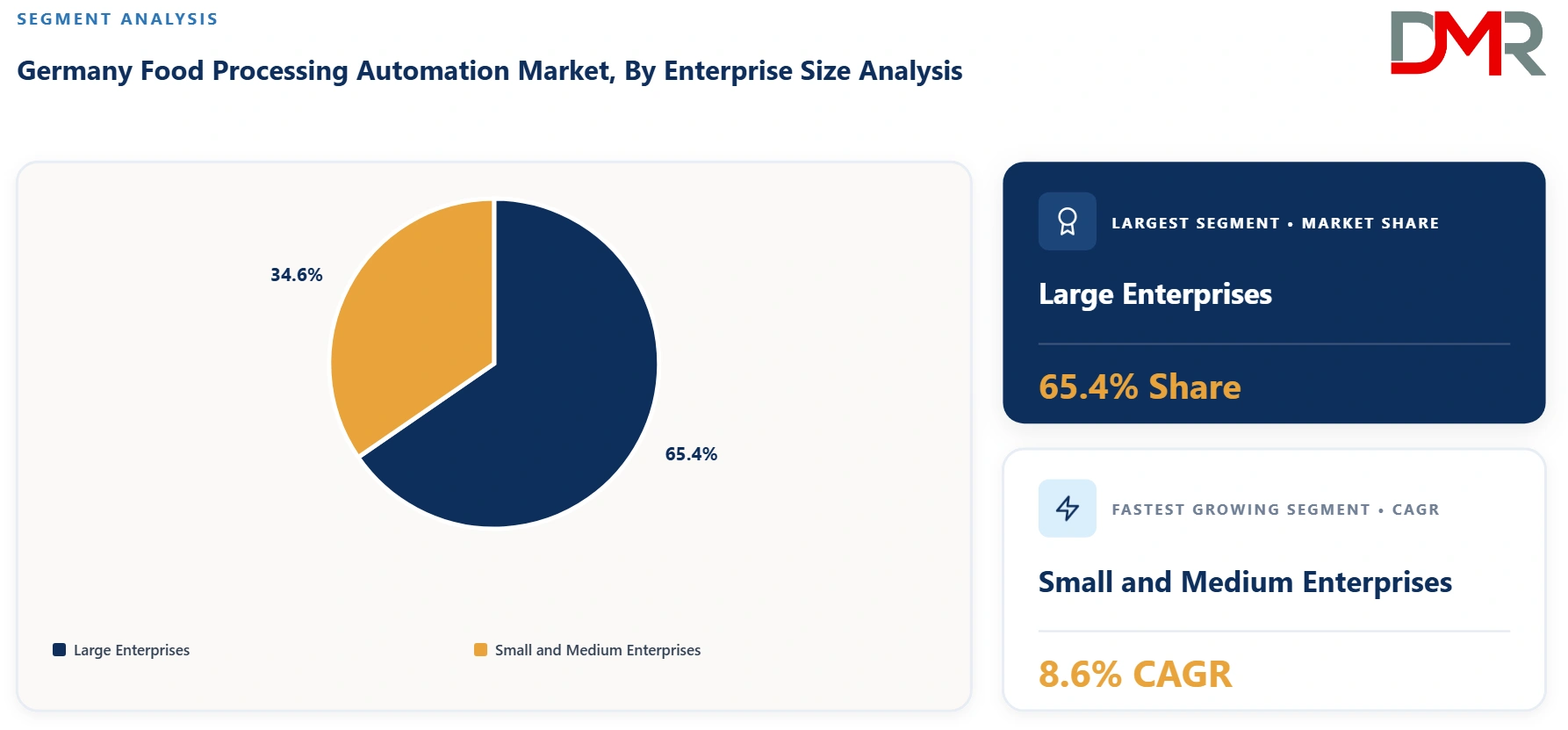
- By Enterprise Size Analysis: Large Enterprises are expected to lead with a 65.4% share in 2026 because they possess stronger capital resources and operate high-volume facilities that support attractive automation returns. Small and Medium Enterprises are projected to grow fastest at approximately 8.6% CAGR as modular robots, subscription software, standardized controls, and systems-integration services make automation more accessible.
How AI and Generative AI are Transforming the Germany Food Processing Automation Market?
Artificial intelligence is transforming German food processing by enabling predictive maintenance, intelligent inspection, adaptive production control, and real-time quality optimization. Machine-learning algorithms analyze equipment, temperature, vibration, image, and production data to detect abnormalities and reduce downtime. AI-powered vision systems improve grading and foreign-object identification, while digital twins simulate production changes before implementation. Generative AI assists engineers with control programming, maintenance instructions, documentation, and troubleshooting. Combined with MES, SCADA, sensors, and robotics, these technologies help processors increase yield, reduce energy consumption, improve traceability, and manage complex production environments.
Key Drivers in the Germany Food Processing Automation Market
Skilled Workforce Constraints and Rising Operating Pressure
Germany’s aging workforce and shortage of qualified manufacturing personnel are making automation strategically important for food processors. Repetitive packaging, palletizing, sorting, sanitation, and material-handling jobs are increasingly difficult to fill, particularly during night shifts and seasonal production periods. Robots and automated control systems enable plants to maintain throughput while assigning employees to supervision, maintenance, product development, and quality management. Germany recorded 26,982 industrial robot installations in 2024, representing 32% of European installations, demonstrating its strong automation foundation. Flexible automation also helps processors manage wage pressure without compromising safety or consistency.
Food Safety Traceability and Production Consistency
Strict European and German food regulations require manufacturers to maintain reliable hygiene, documentation, traceability, and quality control throughout processing. Automated systems continuously monitor temperature, pressure, weight, flow rates, contaminants, packaging seals, and ingredient quantities, reducing dependence on intermittent manual checks. Germany’s food and beverage industry generated approximately USD 270.1 billion in processed food and drink production in 2024, illustrating the scale of manufacturing operations requiring dependable quality systems. Integrated MES, SCADA, sensors, and machine vision platforms create digital production records, support rapid investigations, and reduce contamination, labeling, and formulation risks.
Restraints in the Germany Food Processing Automation Market
High Initial Investment and Uncertain Returns for Smaller Processors
Robotic cells, hygienic automation equipment, industrial controls, machine vision, software integration, and production-line modifications require considerable upfront investment. Smaller food processors may operate diverse products in limited batches, reducing equipment utilization and extending payback periods. Additional costs arise from feasibility studies, safety systems, employee training, programming, sanitation-compatible components, cybersecurity, maintenance, and production interruptions during installation. Energy prices and wider economic uncertainty may also cause processors to postpone capital projects. Although modular automation and leasing options are improving accessibility, financial limitations continue to constrain adoption among small bakeries, meat processors, dairies, and specialty food manufacturers.
Complex Integration with Legacy Equipment
Many German food factories contain machinery installed at different times and supplied by multiple vendors. These assets frequently use incompatible communications protocols, closed control platforms, undocumented interfaces, and limited data capabilities. Connecting older machines with modern MES, SCADA, cloud analytics, vision systems, and autonomous robots can require custom engineering and prolonged testing. Production cannot be interrupted easily because food facilities work within strict schedules and shelf-life constraints. Integration projects may also introduce cybersecurity vulnerabilities or data-quality issues. Shortages of engineers combining automation, operational technology, food processing, and information technology expertise further complicate modernization and raise implementation risks.
Growth Opportunities in the Germany Food Processing Automation Market
Scalable Automation for Small and Medium Enterprises
Small and medium food processors represent an important white-space opportunity as modular robots, cobots, plug-and-produce vision equipment, and cloud-based production systems reduce traditional adoption barriers. Suppliers can develop compact automation cells for packaging, loading, portioning, inspection, and palletizing that require limited factory space and can be reconfigured for multiple products. Equipment-as-a-service, leasing, remote support, and standardized integration packages can reduce initial expenditure. Solutions that offer intuitive programming and rapid changeovers will be particularly valuable because SMEs often lack specialist engineering teams and manufacture varied products in smaller batches. This creates opportunities for vendors, integrators, and software providers.
Sustainable and Resource-Efficient Food Production
Germany’s sustainability priorities create opportunities for automation technologies that reduce energy, water, ingredients, packaging material, and product waste. Smart sensors can monitor utility consumption at the equipment level, while AI platforms optimize heating, refrigeration, cleaning, mixing, and compressed-air operations. Accurate dosing and portioning reduce ingredient giveaway, and machine vision enables earlier removal of defective products. Predictive maintenance extends machinery life and prevents energy-intensive operating conditions. Suppliers that demonstrate measurable reductions in resource use and emissions can differentiate their solutions. Integration with digital twins, energy-management platforms, and lifecycle analytics will enable processors to connect automation investments with environmental and cost-performance targets.
Trends in the Germany Food Processing Automation Market
Growing Adoption of Collaborative and Hygienic Robotics
Collaborative and hygienic robots are gaining importance in applications involving delicate products, frequent changeovers, limited floor space, and close interaction with employees. Stainless-steel components, food-grade lubricants, washable surfaces, and high ingress-protection ratings allow robots to operate in demanding food environments. Cobots make automation accessible for smaller batches because they can be redeployed across packaging, loading, inspection, and palletizing tasks. German manufacturers are also integrating robotics with 3D vision, grippers, and AI to handle irregular food products. Demand is shifting from isolated robotic cells toward flexible systems connected with conveyors, controls, quality platforms, and production-management software.
Convergence of Operational Technology and Information Technology
Food processors are increasingly connecting shop-floor equipment with enterprise software, cloud platforms, digital twins, and analytics systems. This convergence gives plant managers real-time visibility into downtime, yield, waste, energy use, quality, inventory, and overall equipment effectiveness. Edge computing allows time-sensitive control and inspection processes to remain close to production while selected data is transferred for broader analysis. Open communication standards and interoperable architectures are becoming important purchasing criteria. However, growing connectivity is increasing demand for network segmentation, access controls, software updates, backups, and industrial cybersecurity services, making secure-by-design automation a central market trend.
Research Scope and Analysis
Germany Food Processing Automation Market is segmented by component into hardware software and services, by automation type into robotic process automation programmable logic controllers industrial control systems machine vision sensors instrumentation SCADA and MES software, by application into packaging sorting processing inspection material handling, by food category into bakery beverages dairy meat seafood fruits vegetables others, by enterprise size into large enterprises and SMEs.
ℹ
To learn more about this report –
Download Your Free Sample Report Here
By Component Analysis
Hardware is expected to dominate the component segment with 58.4% of market revenue in 2026, supported by demand for robots, PLCs, sensors, cameras, drives, controllers, and industrial computing systems. Services are projected to register the highest CAGR of approximately 9.1%, exceeding the overall market CAGR of 7.4%, as implementation, modernization, maintenance, cybersecurity, and training requirements increase.
By Automation Type Analysis
Programmable Logic Controllers and Industrial Control Systems are projected to lead the automation type segment with a 29.6% share in 2026 because they provide essential control across processing lines. Machine Vision Systems are expected to achieve the highest CAGR of approximately 9.4%, compared with the market CAGR of 7.4%, driven by AI-enabled inspection, grading, traceability, and contamination detection.
By Application Analysis
Packaging and Palletizing is anticipated to dominate the application segment with a 34.2% share in 2026, reflecting its repetitive nature and substantial potential for productivity improvement. Quality Control and Inspection is forecast to record the highest CAGR of approximately 9.2%, above the overall 7.4% CAGR, as manufacturers increase investment in automated inspection, machine vision, sensors, and real-time process verification.
By Food Category Analysis
Meat Poultry and Seafood is expected to lead the food category segment with a 27.8% share in 2026, owing to substantial requirements for hygienic handling, precise portioning, and temperature control. Fruits and Vegetables are projected to register the highest CAGR of approximately 8.8%, compared with the overall 7.4% CAGR, supported by automated washing, sorting, grading, cutting, and packaging.
By Enterprise Size Analysis
Large Enterprises are projected to dominate the enterprise size segment with a 65.4% share in 2026, supported by their high production volumes and greater capital availability. Small and Medium Enterprises are anticipated to achieve the highest CAGR of approximately 8.6%, above the overall market CAGR of 7.4%, as compact robots, cloud software, leasing, and modular automation reduce adoption barriers.
The Germany Food Processing Automation Market Report is Segmented Based on the Following
By Component
- Hardware
- Software
- Services
By Automation Type
- Robotic Process Automation
- Programmable Logic Controllers and Industrial Control Systems
- Machine Vision Systems
- Sensors and Instrumentation
- SCADA and MES Software
By Application
- Packaging and Palletizing
- Sorting and Grading
- Processing and Portioning
- Quality Control and Inspection
- Material Handling and Warehousing
By Food Category
- Bakery and Confectionery
- Beverages
- Dairy and Frozen Foods
- Meat, Poultry and Seafood
- Fruits and Vegetables
- Others
By Enterprise Size
- Large Enterprises
- Small and Medium Enterprises
Technology Analysis
Technology development is moving Germany’s food automation market from fixed machinery toward connected, intelligent, and adaptable production environments. PLCs remain central to deterministic control, while MES and SCADA platforms provide production visibility, recipe governance, scheduling, and traceability. Machine vision combined with deep learning improves inspection of variable and irregular food products. Edge computing enables rapid decisions near production equipment, while digital twins help manufacturers test layouts, recipes, and operating conditions virtually. Opportunities are increasing for interoperable platforms, low-code engineering, cobots, autonomous mobile robots, and predictive maintenance. Major risks include vendor lock-in, incompatible legacy systems, weak data governance, cyberattacks, and insufficiently trained personnel.
Regulatory Landscape
Germany’s food automation ecosystem is influenced by EU food hygiene, product safety, machinery, data protection, cybersecurity, and artificial intelligence requirements. The EU Machinery Regulation introduces provisions covering AI-powered safety functions and cybersecurity-related aspects of control software and safety systems. The AI Act, which entered into force in August 2024, is establishing governance obligations based on system risk. Automation suppliers must also support hygienic design, safe employee interaction, accurate documentation, traceability, and reliable conformity assessments. Regulatory complexity creates demand for compliant-by-design equipment, validation services, secure software, and auditable data systems. However, certification costs and evolving requirements may delay deployment, particularly for smaller manufacturers.
Competitive Landscape
The Germany Food Processing Automation Market is competitive and includes industrial automation companies, food-processing equipment manufacturers, robotics suppliers, machine-vision specialists, software developers, and systems integrators. Siemens, GEA Group, KUKA, Bosch, Beckhoff, and Festo benefit from established German engineering capabilities and strong customer relationships. International suppliers compete through integrated control, robotics, inspection, processing, and digital-manufacturing portfolios. Competition increasingly centers on hygienic design, interoperability, lifecycle services, cybersecurity, energy efficiency, AI capabilities, rapid changeovers, and measurable returns. Partnerships between equipment manufacturers, software providers, and local integrators remain essential for delivering complete production solutions.
Some of the Prominent Players in the Germany Food Processing Automation Market Are
- Siemens AG
- GEA Group AG
- KUKA AG
- Robert Bosch GmbH
- Beckhoff Automation GmbH and Co KG
- Festo SE and Co KG
- Krones AG
- MULTIVAC Group
- Syntegon Technology GmbH
- SEW Eurodrive GmbH and Co KG
- Pepperl and Fuchs SE
- SICK AG
- ifm electronic GmbH
- WAGO GmbH and Co KG
- B and R Industrial Automation GmbH
- Schneider Electric SE
- ABB Ltd
- Rockwell Automation Inc
- Honeywell International Inc
- Mitsubishi Electric Corporation
- Omron Corporation
- FANUC Corporation
- Yokogawa Electric Corporation
- Emerson Electric Co
- Endress and Hauser Group
- Tetra Pak International SA
- Bühler AG
- JBT Marel Corporation
- Alfa Laval AB
- KHS GmbH
- Ishida Co Ltd
- Key Technology Inc
- TOMRA Systems ASA
- Cognex Corporation
- Zebra Technologies Corporation
- Yaskawa Electric Corporation
- Universal Robots A S
- Stäubli International AG
- Pilz GmbH and Co KG
- Lenze SE
- Other Key Players
Recent Developments
- April 2026 – KUKA: KUKA presented smart automation technologies for packaging, food, and consumer-goods applications at interpack 2026. The portfolio included fast pick-and-place systems, hygienic robots, cleanroom robots, palletizing systems, heavy-duty robots, and autonomous mobile robots designed to support flexible, connected, end-to-end production.
- September 2025 – Rockwell Automation and Middleby: Rockwell Automation was selected by Middleby Food Processing to support development of a fully automated bacon production line unveiled at IFFA in Frankfurt. The collaboration demonstrates increasing integration of industrial automation, coordinated motion, processing machinery, and digital control across high-volume food production.
- July 2025 – KUKA and Clevertech: KUKA and Clevertech implemented a high-speed robotic pet-food handling system capable of processing 1,200 cans per minute with operational efficiency exceeding 98%. The solution demonstrates demand for scalable robotic handling, high-speed throughput, and integration with established sterilization and packaging operations.
- May 2025 – GEA Group: GEA showcased automation and processing innovations at IFFA 2025 in Frankfurt for meat, alternative proteins, and cheese production. The technologies focused on processing, slicing, packaging, production efficiency, product quality, and reduced energy consumption across food-manufacturing operations.
Report Details
| Report Characteristics |
| Market Size (2026) |
USD 1.9 Bn |
| Forecast Value (2035) |
USD 3.6 Bn |
| CAGR (2026–2035) |
7.4% |
| Historical Data |
2021 – 2025 |
| Forecast Data |
2026 – 2035 |
| Base Year |
2025 |
| Segments Covered |
By Component, By Automation Type, By Application, By Food Category, By Enterprise Size |
Frequently Asked Questions
How big is the Germany Food Processing Automation Market?
▾ The Germany Food Processing Automation Market is projected to reach USD 1.9 billion in 2026 and approximately USD 3.6 billion by 2035.
What is the CAGR of the Germany Food Processing Automation Market from 2026 to 2035?
▾ The market is expected to expand at a compound annual growth rate of 7.4% from 2026 to 2035.
What factors are driving the growth of the Germany Food Processing Automation Market?
▾ Growth is driven by labor shortages, rising operating costs, Industry 4.0 adoption, food safety requirements, production digitalization, strict traceability standards, and demand for consistent quality, higher throughput, reduced waste, and energy-efficient manufacturing.
What are the major trends in the Germany Food Processing Automation Market?
▾ Major trends include AI-enabled inspection, collaborative robotics, digital twins, predictive maintenance, IT and OT convergence, autonomous material handling, cloud-connected MES platforms, smart sensors, modular automation, and cybersecurity-focused industrial architectures.
Who are the key players in the Germany Food Processing Automation Market?
▾ Key players include Siemens, GEA Group, KUKA, Bosch, Beckhoff Automation, Festo, Krones, MULTIVAC, Syntegon, ABB, Schneider Electric, Rockwell Automation, Bühler, Tetra Pak, and JBT Marel.
How is the Germany Food Processing Automation Market segmented?
▾ The market is segmented by component, automation type, application, food category, and enterprise size. These categories cover hardware, software, services, robotics, industrial controls, machine vision, processing activities, food-manufacturing industries, large enterprises, and SMEs.