Germany Food Processing Equipment Market Snapshot
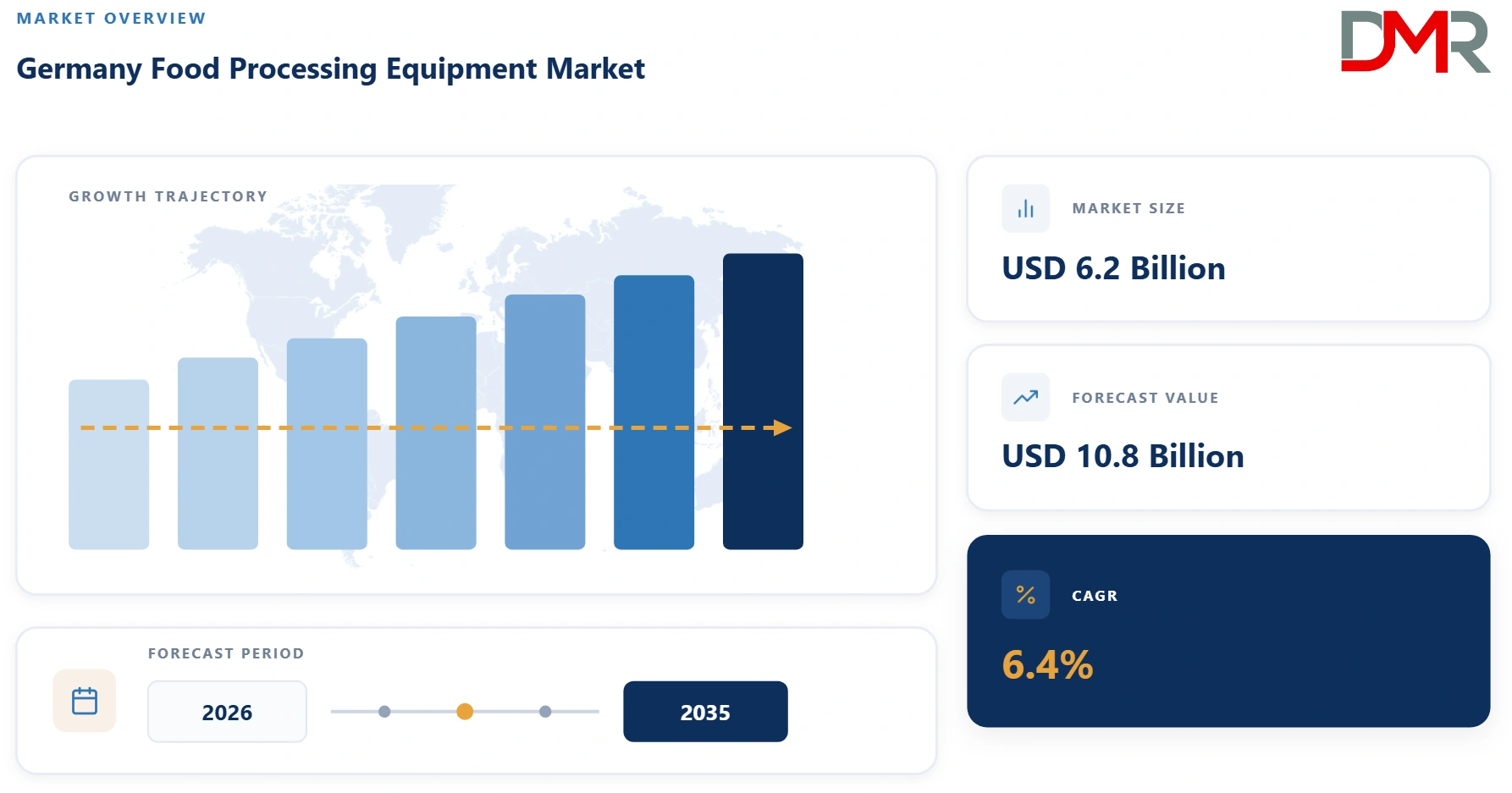
- Germany Food Processing Equipment Market Size in 2026: USD 6.2 Billion
- Germany Food Processing Equipment Market Size in 2035: USD 10.8 Billion
- Germany CAGR from 2026 to 2035: 6.4%
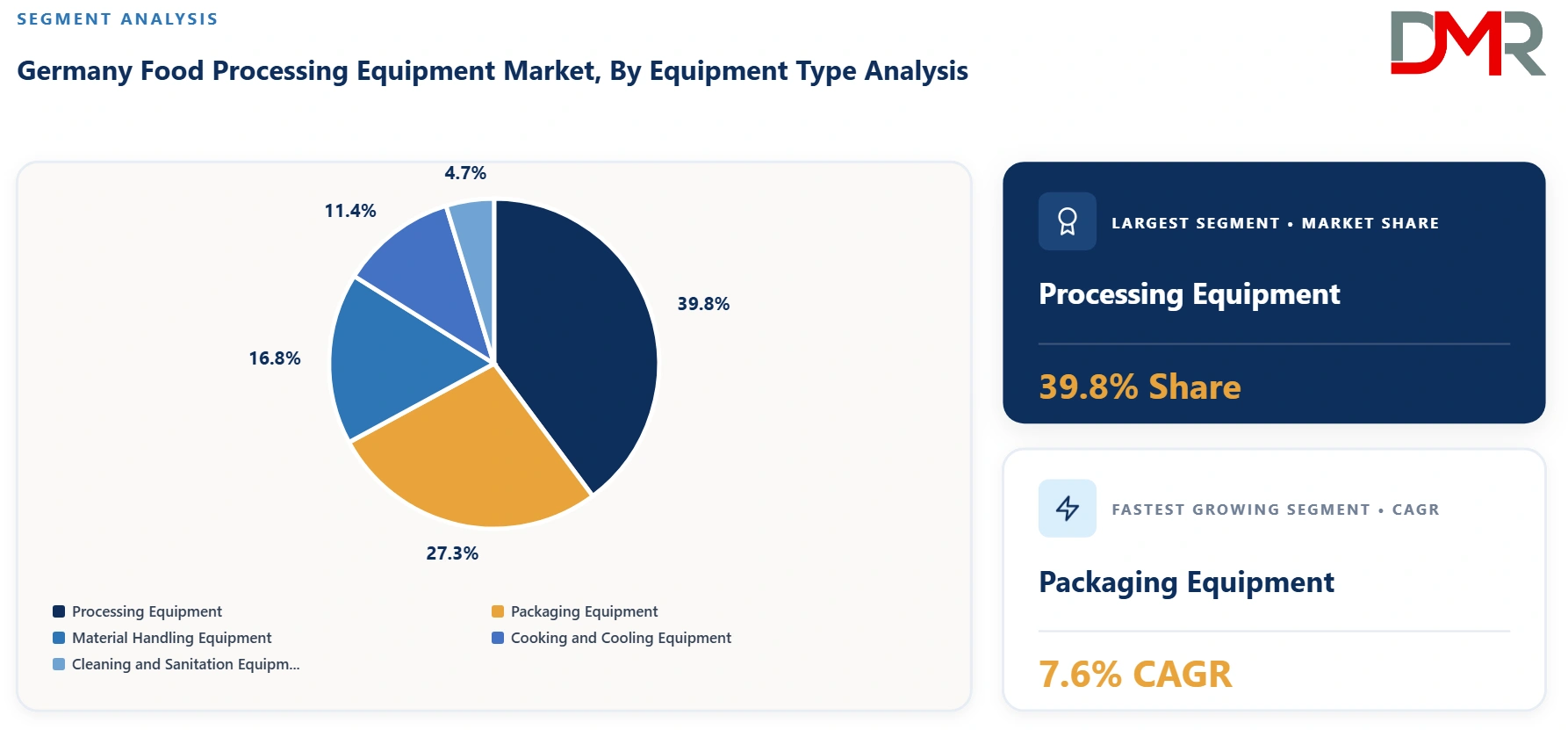
- Processing Equipment is the leading equipment type segment in 2026: 39.8%
- Automatic is the leading mode of operation segment in 2026: 58.3%
- Meat, Poultry and Seafood is the leading food category segment in 2026: 25.9%
- Large-Scale Food Processors is the leading end user segment in 2026: 61.2%
What is the Germany Food Processing Equipment Market and its Market Size?
The Germany Food Processing Equipment Market is projected to be valued at USD 6.2 Billion in 2026 and is projected to reach USD 10.8 Billion by 2035, expanding at a CAGR of 6.4% during the forecast period.
ℹ
To learn more about this report –
Download Your Free Sample Report Here
Growth is being propelled by Germany's position as Europe's largest food and beverage manufacturing sector and a global center of food processing engineering excellence, sustained modernization investment across the country's extensive meat, dairy, and bakery processing industries, and persistent labor shortages that continue to drive automation adoption across German food manufacturing facilities of all sizes. The maturing of hygienic, energy-efficient, and highly precise automated equipment reflecting Germany's broader industrial engineering strengths, growing processor investment in Industry 4.0-aligned smart factory and connected equipment systems, and continued export-oriented capacity expansion among German food and beverage manufacturers and equipment producers alike are reshaping the market from conventional equipment replacement cycles into a more strategic, data-driven, and sustainability-oriented capital investment category. Investment is accelerating as German processors integrate automation directly into broader digital manufacturing strategies while navigating rising energy costs and evolving European Union food safety and sustainability regulation.
Use Cases
- Automated Meat and Sausage Processing Line Modernization: German meat processors, particularly within the country's extensive sausage and processed meat manufacturing sector, invest in automated cutting, mixing, and portioning equipment to address persistent labor shortages while maintaining the precise quality and consistency standards associated with German meat products.
- Dairy Processing Equipment Upgrades for Capacity and Efficiency: German dairy processors invest in modernized pasteurization, separation, and packaging equipment to expand capacity and improve energy efficiency, supporting both domestic consumption and Germany's significant dairy export industry.
- Industry 4.0-Enabled Bakery and Confectionery Production: Industrial bakery and confectionery manufacturers integrate connected, sensor-equipped processing and packaging equipment into broader smart factory systems, enabling real-time production monitoring and predictive maintenance across high-volume production lines.
- Export-Oriented Equipment Manufacturing and Domestic Adoption: German food processing equipment manufacturers, many of which are global industry leaders, increasingly serve as both equipment exporters and early domestic adopters of their own advanced automation and digitalization technologies, reinforcing Germany's dual role as both equipment producer and sophisticated equipment user market.
Key Takeaways
- Market Size: The Germany Food Processing Equipment Market is anticipated to be valued at USD 6.2 Billion in 2026 and is forecast to reach USD 10.8 Billion by 2035, expanding at a CAGR of 6.4%.
- Growth Outlook: Market expansion is sustained by Germany's position as Europe's largest food and beverage manufacturing sector, persistent labor shortages driving automation adoption, and growing integration of Industry 4.0 digital manufacturing technology into food processing equipment investment.
- Primary Growth Drivers: Persistent food manufacturing labor shortages and rising wage costs, Germany's global leadership in food processing equipment engineering supporting rapid domestic technology adoption, growing integration of smart factory and connected equipment systems, and sustained export-oriented capacity investment are accelerating market growth.
- By Equipment Type Analysis: Processing Equipment is projected to lead the equipment type segment with a 39.8% share in 2026, reflecting its central role across Germany's extensive meat, dairy, and bakery processing operations. Packaging Equipment is the fastest-growing equipment type segment at 7.6% CAGR, driven by rising demand for automated, sustainable, and connected packaging line systems.
- By Mode of Operation Analysis: Automatic equipment is expected to dominate with a 58.3% share in 2026, reflecting Germany's advanced industrial automation adoption relative to many other European markets. Automatic is also the fastest-growing mode of operation segment at 7.9% CAGR, as persistent labor shortages and Germany's strong engineering capability continue to favor high levels of automation investment.
- By Food Category Analysis: Meat, Poultry and Seafood is expected to command a 25.9% share in 2026, underpinned by Germany's substantial and labor-intensive meat and sausage processing industry. Beverages is the fastest-growing food category segment at 7.4% CAGR, driven by continued modernization investment across Germany's significant beer, spirits, and broader beverage manufacturing sector.
- By End User Analysis: Large-Scale Food Processors are projected to dominate with a 61.2% share in 2026, reflecting greater capital availability for comprehensive automation and digitalization investment programs. Small and Medium-Sized Processors is the fastest-growing end user segment at 8.1% CAGR, driven by falling automation equipment costs and Germany's strong tradition of supporting Mittelstand manufacturing modernization.
Key Drivers in the Germany Food Processing Equipment Market
Persistent Labor Shortages Across German Food Manufacturing
Chronic difficulty recruiting and retaining plant-floor labor across Germany's food manufacturing sector, compounded by broader demographic aging trends and intense competition for skilled and unskilled manufacturing labor across German industry, is a primary driver of growth in the Food Processing Equipment Market. Physically demanding processing roles, particularly in meat and sausage processing, face persistent recruitment challenges. Rising wage costs further increase the financial case for automating repetitive and physically demanding tasks. As demographic and labor market pressures continue, automation investment is increasingly viewed as an operational necessity across the German food processing industry.
Germany's Global Leadership in Food Processing Equipment Engineering
Germany's position as home to numerous global leaders in food processing equipment design and manufacturing provides a distinctive structural advantage supporting rapid domestic technology adoption. German food processors benefit from close proximity to leading equipment manufacturers, deep technical engineering expertise within the domestic supplier base, and strong incentive for German equipment companies to showcase advanced technology within their home market before broader international commercialization. This engineering leadership and close domestic supplier relationship continues to support above-average automation and digitalization adoption rates within German food processing facilities relative to many other European markets.
Restraints in the Germany Food Processing Equipment Market
Rising Industrial Energy Costs Affecting Equipment Investment Payback Calculations
Germany's relatively high industrial energy costs, which have risen substantially in recent years amid broader European energy market dynamics, represent a meaningful restraint on the Food Processing Equipment Market. While energy-efficient equipment can help offset these costs over time, the higher energy cost environment also increases overall operating cost pressure on food processors, potentially constraining available capital for equipment modernization investment even as the theoretical energy-efficiency case for such investment strengthens. This dynamic requires processors to carefully evaluate equipment investment payback periods amid ongoing energy price volatility and uncertainty.
Growth Opportunities in the Germany Food Processing Equipment Market
Industry 4.0 and Smart Factory Integration for Food Processing
Germany's broader national leadership in Industry 4.0 manufacturing digitalization presents a substantial opportunity for food processing equipment vendors to develop and deploy connected, sensor-equipped, and AI-enabled equipment systems that integrate seamlessly into comprehensive smart factory environments. Vendors capable of offering equipment with robust digital connectivity, predictive maintenance capability, and integration with broader manufacturing execution and enterprise resource planning systems are well positioned to capture premium contracts from German food processors already oriented toward digital manufacturing transformation.
Energy-Efficient Equipment Addressing Rising German Industrial Energy Costs
Germany's elevated industrial energy cost environment presents a significant opportunity for equipment vendors offering meaningfully more energy-efficient processing, refrigeration, and thermal equipment alternatives. Vendors capable of demonstrating clear, quantifiable energy savings and favorable payback periods are well positioned to capture equipment replacement and modernization contracts, as German processors face strong financial incentive to prioritize energy efficiency alongside traditional automation and throughput considerations in equipment purchasing decisions.
Trends in the Germany Food Processing Equipment Market
Deepening Integration of Food Processing Equipment with Industry 4.0 Manufacturing Systems
German food processors are increasingly moving beyond standalone automated equipment toward fully integrated Industry 4.0 manufacturing environments in which processing, packaging, and quality control equipment share data through unified digital platforms supporting real-time production optimization, predictive maintenance, and comprehensive quality documentation. This trend reflects Germany's broader national manufacturing digitalization strategy and is increasingly differentiating equipment vendors based on digital integration capability rather than physical equipment performance alone.
Growing Emphasis on Energy Efficiency and Sustainability in Equipment Design
German food processors and equipment manufacturers are placing increasing emphasis on energy efficiency, water conservation, and overall environmental performance in equipment design and purchasing decisions, reflecting both Germany's elevated energy cost environment and strong national and corporate sustainability policy orientation. Equipment vendors are responding with more prominent energy consumption and efficiency performance data, positioning sustainability credentials as an increasingly important competitive differentiator alongside traditional automation and throughput capabilities.
Research Scope and Analysis
The Germany Food Processing Equipment Market is segmented by equipment type, mode of operation, food category, and end user, covering processing, packaging, material handling, cooking and cooling, and cleaning and sanitation equipment across meat, dairy, bakery, and beverage processing categories.
ℹ
To learn more about this report –
Download Your Free Sample Report Here
By Equipment Type Analysis
Processing Equipment is projected to dominate the Germany Food Processing Equipment Market with approximately 39.8% share in 2026, reflecting its central role across the country's extensive meat, dairy, bakery, and beverage processing operations. Packaging Equipment is expected to register the highest CAGR of 7.6% during 2026-2035, driven by rising processor investment in automated, connected, and increasingly sustainable packaging line systems aligned with both Industry 4.0 digitalization trends and European Union packaging regulation.
By Mode of Operation Analysis
Automatic equipment is anticipated to dominate the Germany Food Processing Equipment Market by mode of operation, accounting for approximately 58.3% share in 2026, reflecting Germany's advanced industrial automation adoption relative to many other European food manufacturing markets. Automatic equipment is also projected to register the highest CAGR of 7.9% between 2026 and 2035, as persistent labor shortages and Germany's strong domestic engineering capability continue to support high and increasing levels of automation investment across processing facilities of all sizes.
By Food Category Analysis
Meat, Poultry and Seafood is expected to lead the Germany Food Processing Equipment Market by food category, accounting for approximately 25.9% share in 2026, underpinned by Germany's substantial and labor-intensive meat and sausage processing industry requiring significant automated cutting, mixing, and portioning equipment investment. Beverages is projected to achieve the fastest CAGR of 7.4% during 2026-2035, driven by continued modernization investment across Germany's significant beer, spirits, and broader beverage manufacturing sector.
By End User Analysis
Large-Scale Food Processors are projected to dominate the Germany Food Processing Equipment Market with approximately 61.2% share in 2026, reflecting greater capital availability for comprehensive automation and Industry 4.0 digitalization investment programs. Small and Medium-Sized Processors are expected to register the fastest CAGR of 8.1% through 2035, driven by falling automation equipment costs and Germany's strong tradition of supporting Mittelstand manufacturing modernization through both public and private financing mechanisms.
The Germany Food Processing Equipment Market Report is segmented based on the following:
By Equipment Type
- Processing Equipment
- Packaging Equipment
- Material Handling Equipment
- Cooking and Cooling Equipment
- Cleaning and Sanitation Equipment
By Mode of Operation
- Automatic
- Semi-Automatic
- Manual
By Food Category
- Meat, Poultry and Seafood
- Dairy Products
- Bakery and Confectionery
- Beverages
- Fruits and Vegetables
- Others
By End User
- Large-Scale Food Processors
- Small and Medium-Sized Processors
- Artisanal and Specialty Food Producers
Technology Analysis
Technology development is central to the trajectory of the Germany Food Processing Equipment Market as vendors invest in AI-enhanced process control, advanced robotics, and comprehensive Industry 4.0 connectivity capable of integrating processing equipment into broader smart factory environments. Growing use of digital twin technology and predictive maintenance analytics is helping German processors reduce unplanned downtime and optimize production efficiency across increasingly complex, connected manufacturing systems. Opportunities are expanding for vendors developing energy-efficient equipment addressing Germany's elevated industrial energy cost environment, as well as equipment offering robust cybersecurity protection for increasingly networked and data-connected production systems. However, ensuring cybersecurity resilience across highly connected Industry 4.0 manufacturing environments, and managing the capital intensity of comprehensive digital integration, remain important considerations for both equipment vendors and processor customers.
Investment and White Space Analysis
Investment opportunities in the Germany Food Processing Equipment Market are expanding alongside persistent labor shortages, Germany's leadership in food processing equipment engineering and Industry 4.0 manufacturing digitalization, and sustained modernization investment across the country's meat, dairy, and bakery processing industries. Significant white space exists in fully integrated Industry 4.0 smart factory equipment systems, energy-efficient processing and refrigeration technology addressing rising German industrial energy costs, and cybersecurity solutions for increasingly connected manufacturing environments. Vendors with strong digital integration capability, energy efficiency credentials, and established relationships with major German food processors and equipment export customers are positioned to capture premium, longer-duration contracts. However, rising energy costs affecting processor capital availability, cybersecurity risk associated with increased equipment connectivity, and the capital intensity of comprehensive digital manufacturing transformation can constrain adoption pace for some processors.
Competitive Landscape
The Germany Food Processing Equipment Market is moderately consolidated and highly competitive, comprising numerous large, globally significant German food processing equipment manufacturers alongside international competitors and specialized Mittelstand equipment suppliers. Competition centers on engineering precision and reliability, Industry 4.0 digital integration capability, energy efficiency, and comprehensive after-sales service and technical support. Germany's substantial base of globally leading domestic equipment manufacturers provides German food processors with close access to advanced technology and strong technical support relationships, while international competitors compete on global scale and broader product portfolio breadth. Companies increasingly differentiate through digital connectivity and Industry 4.0 integration capability, energy-efficient equipment design, and comprehensive lifecycle service offerings rather than equipment sales alone.
Some of the prominent players in the Germany Food Processing Equipment Market are:
- GEA Group
- Krones AG
- MULTIVAC Group
- KHS Group
- Syntegon Technology
- VEMAG Maschinenbau
- Handtmann Group
- Maschinenfabrik Seydelmann
- PROBAT
- KRONEN GmbH
- Coperion
- Hosokawa Alpine
- Zeppelin Systems
- Alexanderwerk
- Fritsch Bakery Technologies
- RONDO
- Stephan Machinery
- Weber Food Technology
- TREIF Maschinenbau
- Schubert Group
- OPTIMA Packaging Group
- Gerhard Schubert GmbH
- Bizerba
- Minebea Intec
- Mettler-Toledo
- Bühler Group
- Tetra Pak
- Alfa Laval
- JBT Marel
- SPX FLOW
- The Middleby Corporation
- Heat and Control
- BAADER
- IMA Group
- SACMI
- Sidel
- Clextral
- Festo
- Bucher Industries
- Duravant
- Other Key Players
Recent Developments
- January 2026: GEA Group was selected to supply and commission a food-grade precision and biomass fermentation pilot line, strengthening its processing technology offering for alternative proteins and functional food ingredients.
- September 2025: Krones AG acquired a 60% stake in GHS Separationstechnik, expanding its process technology portfolio with decanter centrifuges used in vegetable oils, juices, alternative foods, and other processing applications.
- May 2025: MULTIVAC Group showcased advanced food processing and packaging solutions at IFFA 2025 in Frankfurt, emphasizing automation, connected production lines, efficiency, sustainable packaging, and processing technologies for meat and alternative proteins.
Report Details
| Report Characteristics |
| Market Size (2026) |
USD 6.2 Bn |
| Forecast Value (2035) |
USD 10.8 Bn |
| CAGR (2026–2035) |
6.4% |
| Historical Data |
2021 – 2025 |
| Forecast Data |
2026 – 2035 |
| Base Year |
2025 |
| Segments Covered |
By Equipment Type, By Mode of Operation, By Food Category, By End User |
| Country Coverage |
Germay |
Frequently Asked Questions
How big is the Germany Food Processing Equipment Market?
▾ The Germany Food Processing Equipment Market is valued at USD 6.2 Billion in 2026 and is projected to reach USD 10.8 Billion by 2035, reflecting sustained investment in automated, digitally integrated processing equipment across Germany's extensive meat, dairy, bakery, and beverage manufacturing industries.
What is the CAGR of the Germany Food Processing Equipment Market from 2026 to 2035?
▾ The market is projected to expand at a compound annual growth rate (CAGR) of 6.4% between 2026 and 2035, supported by persistent labor shortages, Germany's leadership in food processing equipment engineering, and growing Industry 4.0 manufacturing digitalization investment.
What factors are driving the growth of the Germany Food Processing Equipment Market?
▾ Growth is driven by persistent food manufacturing labor shortages and rising wage costs, Germany's global leadership in food processing equipment engineering supporting rapid domestic technology adoption, growing integration of smart factory and connected equipment systems, and sustained export-oriented capacity investment.
What are the major trends in the Germany Food Processing Equipment Market?
▾ Major trends include deepening integration of food processing equipment with Industry 4.0 manufacturing systems, growing emphasis on energy efficiency and sustainability in equipment design, and rising investment in AI-enhanced process control and predictive maintenance technology.
Who are the key players in the Germany Food Processing Equipment Market?
▾ Key market participants include GEA Group, Krones AG, Multivac Group, Bühler Group, and SIG Group, among other globally significant German and international food processing equipment manufacturers.
How is the Germany Food Processing Equipment Market segmented?
▾ The market is segmented by equipment type, mode of operation, food category, and end user, with demand analysis concentrated across Bavaria, North Rhine-Westphalia, Baden-Württemberg, and Lower Saxony.