Market Snapshot
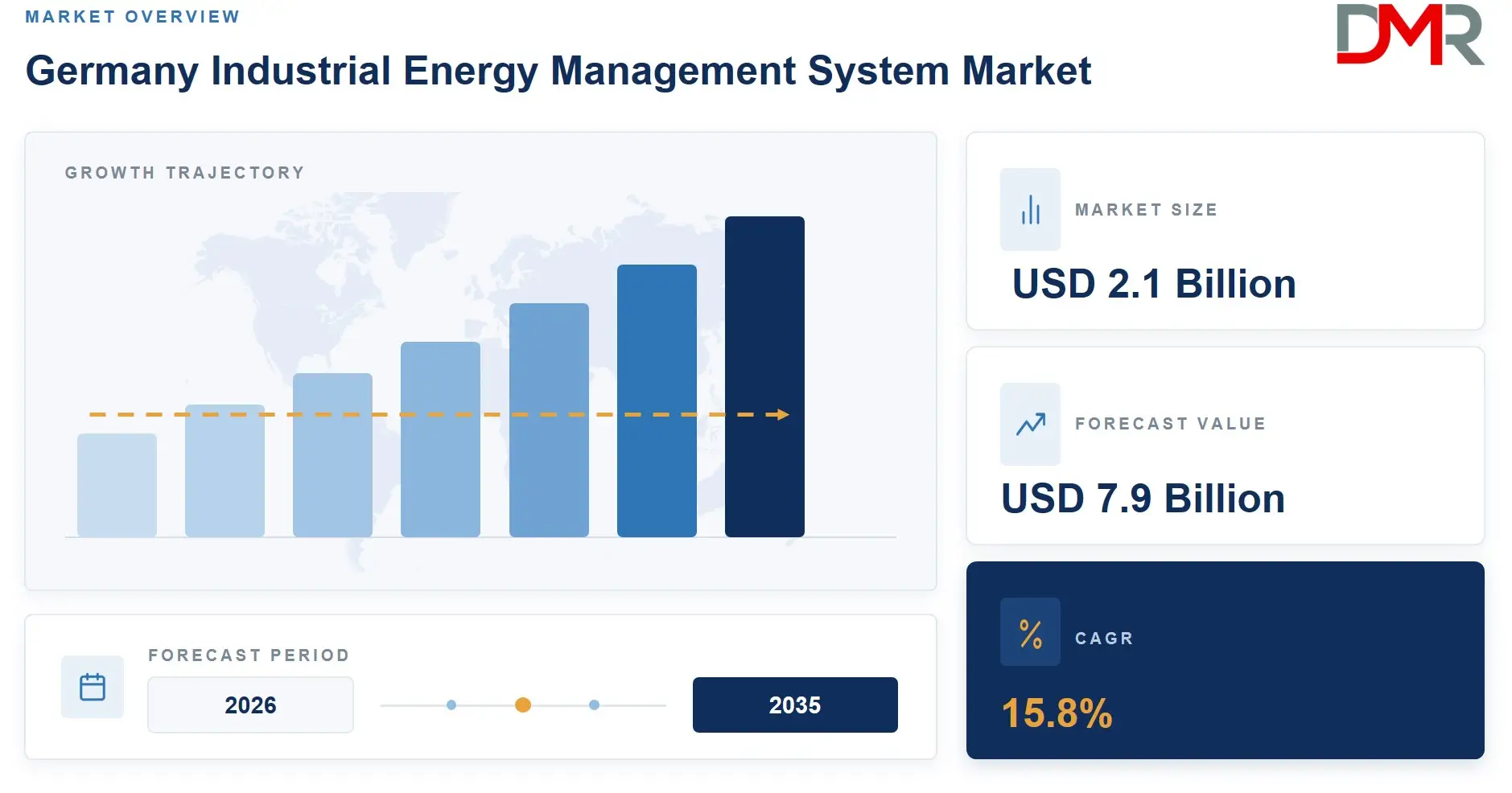
- Market Size (2026): USD 2.1 Bn
- Forecast Value (2035): USD 7.9 Bn
- CAGR (2026-2035): 15.8%
- Leading Component (2026): Software, around 44%
- Leading Application (2026): Energy Monitoring and Reporting, close to 32%
- Key Players: Siemens, SAP, Robert Bosch and others
What is the Germany Industrial Energy Management System Market and its Market Size?
The Germany Industrial Energy Management System Market size is estimated to reach USD 2.1 Bn in 2026 and is further anticipated to reach USD 7.9 Bn by 2035, at a CAGR of 15.8%.
ℹ
To learn more about this report –
Download Your Free Sample Report Here
An industrial energy management system combines metering hardware, control software and advisory services that let a manufacturing site measure, analyze and act on its own electricity, gas and compressed air consumption in near real time. In Germany the category spans standalone submetering retrofits on a single production line through to plant-wide platforms that feed data into an ISO 50001 certified energy management system and, increasingly, into corporate sustainability reporting. The market captures spending on the hardware, software licenses, integration and ongoing services that a facility inside Germany purchases, not the worldwide revenue of vendors headquartered here.
Buyers range from Mittelstand machine shops with a single sizeable grid connection to multi site automotive and chemical groups managing dozens of production halls under one energy controlling function. Purchases are led by plant engineering and sustainability teams, and increasingly by finance, since energy line items now sit inside statutory reporting rather than a discretionary efficiency budget. The figures in this report describe demand generated inside German industrial facilities during the year in question, a distinction that matters because several of the leading suppliers serving this market, Siemens and SAP among them, book the bulk of their group revenue outside Germany.
What is changing structurally is the shift from a compliance checkbox to an operating discipline. The recast EU Energy Efficiency Directive obliges any site consuming more than 85 terajoules a year to run a certified energy management system, and Germany's own Energy Efficiency Act layers a lower national threshold on top, pulling several thousand additional mid sized plants into scope through the back half of the decade. At the same time, industrial electricity prices that remain well above the pre 2021 baseline give the same software a second, purely commercial justification, pushing adoption past the population of sites that regulation alone would capture.
Use Cases
- Automotive Press Shop Retrofit: A Tier 1 automotive supplier in Baden-Wuerttemberg installs submeters across its stamping and welding lines to isolate machine-level consumption from building overhead, which lets plant engineers schedule energy-intensive press cycles around cheaper off-peak tariff windows and cuts avoidable idle-state draw.
- Chemical Site Compliance Reporting: A specialty chemicals producer operating above the federal energy-consumption threshold deploys a plant-wide platform to generate the audit trail its ISO 50001 certification body requires, replacing spreadsheet-based data collection that previously took engineers several weeks to assemble each reporting cycle.
- Mittelstand Machine Shop Subsidy Uptake: A family-owned precision-machining business with fewer than 250 employees adopts a cloud-based monitoring package eligible under the federal BAFA funding program, recovering a meaningful share of the purchase cost and turning a multi-year payback into a sub-two-year one.
- Food and Beverage Multi-Site Rollout: A brewing group standardizes one energy management platform across six production sites nationwide, giving its central utilities team a single dashboard for refrigeration, compressed air and steam loads that previously sat in separate, site-specific control systems.
Key Takeaways
- Market Size and Share: Germany's industrial energy management system market is valued at USD 2.1 Bn in 2026 and is set to reach USD 7.9 Bn by 2035.
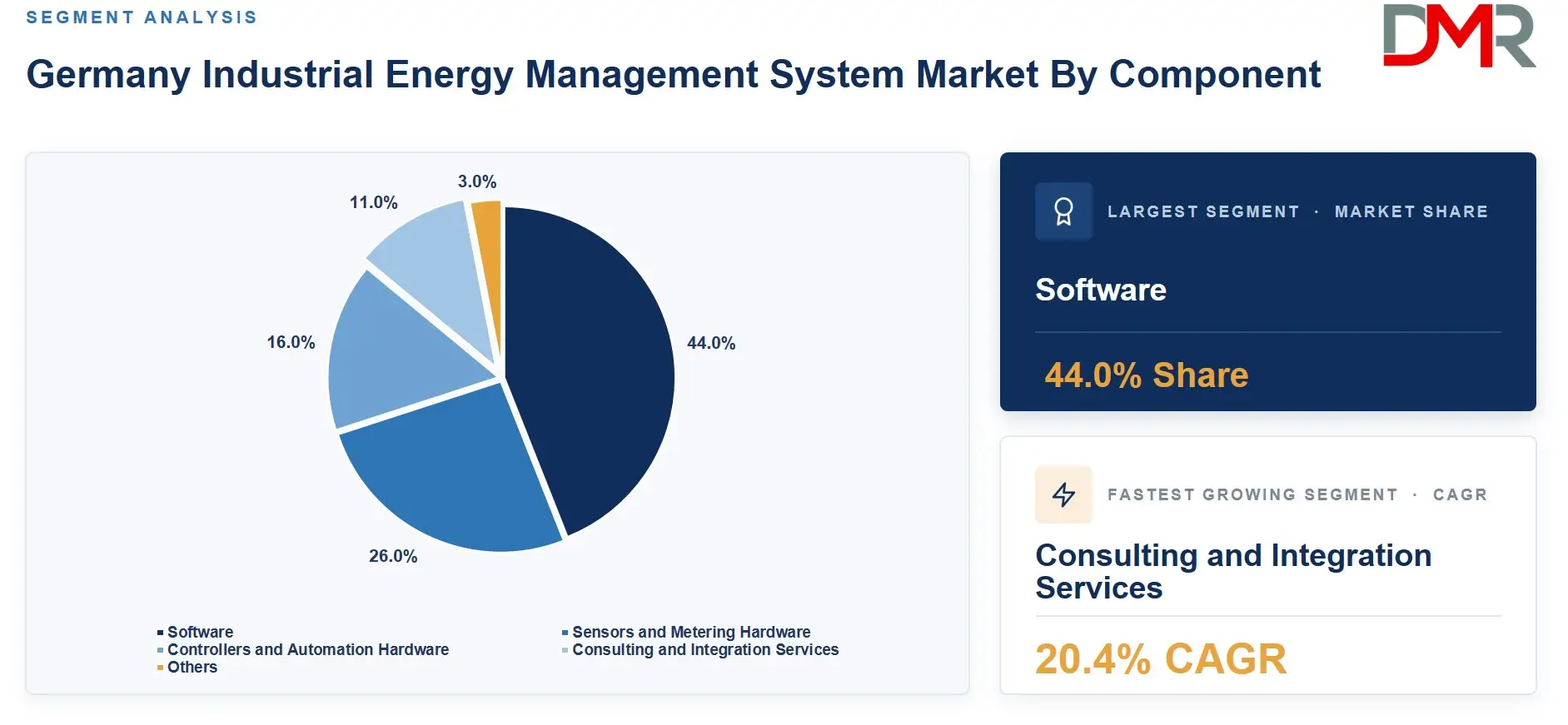
- Component Analysis: Software is expected to account for approximately 44% of 2026 revenue, the largest share of any component.
- Demand Concentration: Demand concentrates in Germany's automotive, chemical and metals processing corridors, home to the country's largest population of energy-intensive, compliance-obligated plants.
- Regulatory Momentum: The recast EU Energy Efficiency Directive brings sites consuming more than 85 TJ a year into mandatory scope, with first compliance audits due by October 2026.
- AI Adoption: The Predictive Maintenance and Analytics application is expected to grow at a CAGR of 22.8% through 2035 as vendors embed predictive analytics into monitoring platforms.
- Growth Rate: The market is forecast to expand at a CAGR of 15.8% between 2026 and 2035, outpacing Germany's broader industrial automation spend.
How AI/Gen AI is Transforming the Germany Industrial Energy Management System Market?
Artificial intelligence is entering German industrial energy management less as a headline feature and more as the layer that turns submeter data into an instruction a plant can act on. Because most sites already generate more consumption data than an engineering team can review manually, the practical value sits in models that flag an anomaly, forecast a load curve or recommend a setpoint change, rather than in a standalone chatbot. Vendors serving this market are building that capability into existing monitoring platforms instead of selling it as a separate product, which shortens the sales cycle for plants that already run a metering backbone.
The clearest gains so far are operational rather than exploratory. Predictive load forecasting lets a plant bid more accurately into demand-response and flexibility markets, and anomaly detection on compressor or chiller data catches drift before it shows up as a maintenance ticket. Generative components are used narrowly, mainly to draft the ISO 50001 documentation and energy performance indicator commentary that certification audits require, work that previously consumed engineering hours better spent on the underlying process.
- Predictive Load Forecasting: models trained on historical submeter data anticipate a site's next-day consumption profile, supporting participation in flexibility and demand-response programs.
- Anomaly Detection: machine learning flags abnormal compressor, chiller or furnace draw against a learned baseline, surfacing faults before they escalate into unplanned downtime.
- Automated Compliance Documentation: generative tools draft ISO 50001 energy review narratives and energy performance indicator summaries from structured platform data.
- Digital Twin Simulation: production-line digital twins model the energy impact of a scheduling or equipment change before it is applied on the shop floor.
Key Drivers in the Germany Industrial Energy Management System Market
Two forces are pulling German industrial sites toward formal energy management at a pace regulation alone would not achieve.
- Regulatory Compliance Mandates: The recast EU Energy Efficiency Directive requires any enterprise consuming more than 85 TJ a year to run a certified energy management system by October 2027, with Germany's own Energy Efficiency Act (EnEfG) layering a national threshold of 7.5 GWh on top and mandating either an ISO 50001 system or an equivalent environmental management system. First statutory audits under the recast directive fall due by October 2026, pulling procurement decisions forward from what would otherwise be a multi-year rollout. Because certification requires continuous measurement rather than a one-off audit, the mandate creates recurring demand for monitoring hardware and software, and it extends the obligated population down toward mid sized plants that previously managed energy informally.
- Industrial Electricity Price Volatility: German industrial power prices have stayed structurally above their pre-2021 level, and energy now represents a cost line large enough to draw board-level attention at energy-intensive sites. Plants that once treated a consumption spike as an unavoidable production cost are instead installing granular metering to identify which machine, shift or process step drives the bill, then using that visibility to shift load, negotiate flexible tariffs or participate in demand-response schemes. The BAFA Module 3 funding program, which currently reimburses a meaningful share of the purchase cost for qualifying small and mid sized companies, further lowers the payback period and brings the business case within reach of Mittelstand buyers.
Restraints in the Germany Industrial Energy Management System Market
Two brakes slow adoption even where the commercial case is otherwise strong.
- Legacy OT Integration Complexity: Much of German industrial capacity runs on programmable logic controllers, meters and building management systems installed a decade or more ago, often from different manufacturers and without a common communication protocol. Integrating this heterogeneous base into a single energy management platform typically requires custom connectors, on-site commissioning and, in older facilities, a partial hardware refresh before software can even begin collecting reliable data. For a plant already stretched on engineering headcount, that integration burden can push a project's real-world payback well beyond the horizon presented in a vendor's sales case, and it is a more common reason for delayed adoption than price resistance alone.
- Shortage of Energy Management Expertise: Certified energy managers and the engineers who can interpret granular consumption data remain scarce relative to the number of plants now required to run a formal ISO 50001 system. Smaller Mittelstand sites often lack a dedicated energy function altogether, leaving a purchased platform under-used because no one on staff has the time or training to act on what it reports. Vendors have responded by bundling managed services and remote monitoring around their software, but that raises the effective cost of ownership and narrows the addressable market to buyers willing to pay for an outsourced energy function rather than software alone.
Growth Opportunities in the Germany Industrial Energy Management System Market
The clearest white space sits where a specific buyer segment or delivery model remains under-penetrated.
- Mittelstand Managed Energy-as-a-Service: The majority of Germany's Mittelstand businesses sit below the scale needed to justify an in-house energy function, yet many now fall inside the EnEfG's lower consumption threshold. A subscription model that bundles metering hardware, software and a remote energy manager into one monthly fee removes both the capital outlay and the staffing gap that keep smaller Mittelstand plants from adopting a full platform, converting a segment currently served mostly by informal consultants into a recurring software relationship.
- Automotive and Chemical Cluster Retrofit: Germany's automotive supply chain in Baden-Wuerttemberg and Bavaria and its chemical processing corridor along the Rhine concentrate a disproportionate share of the country's energy-intensive production floor space, much of it running control systems that predate current metering standards. Vendors that build sector-specific retrofit packages, pre-configured for press shops, paint lines or continuous chemical processes rather than sold as generic monitoring software, can shorten the integration cycle that otherwise slows adoption in exactly the clusters where savings potential is highest.
Trends in the Germany Industrial Energy Management System Market
Two shifts are visible in how platforms are built and sold, distinct from the drivers above.
- Subscription and Outcome-Based Pricing: Vendors are moving away from perpetual software licenses toward subscription and, in a growing minority of contracts, savings-share pricing tied to a measured reduction in consumption. This shift lowers the upfront commitment for a Mittelstand buyer weighing a first energy management purchase and pushes vendors to keep improving the software after the sale, since renewal now depends on demonstrated performance rather than a one-time implementation fee.
- Granular Submetering Driven by Carbon Reporting: The move into CBAM's definitive phase and tightening corporate sustainability reporting requirements are pushing plants to submeter at the process or machine level rather than the building level that satisfied earlier compliance regimes. That finer granularity generates the auditable, machine-level data that carbon border and Scope 1 and 2 disclosures now demand, displacing the manual, invoice-based estimation that many sites relied on until this reporting cycle.
Research Scope and Analysis
Segment performance is assessed across five axes: component, deployment mode, application, end use industry and function. Each axis identifies the sub-segment carrying the largest share of 2026 revenue and the one expanding fastest through 2035, together with the commercial reason behind each position.
ℹ
To learn more about this report –
Download Your Free Sample Report Here
By Component
Software is projected to hold the largest share by component in 2026, accounting for approximately 44% of revenue, because a single monitoring platform can be layered across an existing meter and controller base without replacing hardware plants have already amortized, and because licensing increasingly captures the recurring analytics and compliance-reporting value that buyers now prioritize over the sensors themselves. Growth, however, is concentrated in consulting and integration services, expanding at a CAGR of 20.4% between 2026 and 2035, as the population of plants newly obligated under the recast Energy Efficiency Directive lacks the in-house expertise to commission a platform against a heterogeneous, decades-old OT environment and turns instead to specialist integrators to bridge that gap.
By Deployment Mode
Cloud-based deployment is expected to lead by deployment mode in 2026, holding around 45% of revenue, reflecting a preference among Mittelstand buyers for a model that avoids on-site server investment and lets a lean engineering team access dashboards remotely across multiple production halls. The steeper trajectory sits with hybrid deployment, forecast to grow at a CAGR of 21.6% through 2035, as energy-intensive plants that need local control for demand response increasingly pair an on-premise control layer with cloud-hosted analytics and reporting, a combination that neither a pure cloud nor a pure on-premise offering can satisfy on its own.
By Application
Energy monitoring and reporting is set to represent the largest application share in 2026, at close to 32%, since it is the baseline capability every ISO 50001 certification and EnEfG audit requires before a plant can pursue anything more advanced. The fastest-growing application is predictive maintenance and analytics, with a forecast CAGR of 22.8% from 2026 to 2035, pulled by the same anomaly-detection and load-forecasting models used elsewhere in the platform, which convert a compliance-driven monitoring purchase into an operational tool that plant managers actively use rather than a dashboard built only to satisfy an auditor.
By End Use Industry
Automotive and machinery manufacturing is projected to remain the largest end use industry in 2026, accounting for roughly 27% of revenue, given the sector's concentration of energy-intensive press, paint and assembly processes and its early exposure to EnEfG's consumption thresholds. Growth, however, is concentrated in pharmaceuticals and healthcare manufacturing, forecast to expand at a CAGR of 23.4% between 2026 and 2035, as that sector's stricter validated-process documentation requirements make granular, auditable energy data valuable well beyond cost control, and as several large German pharmaceutical manufacturers commit to Scope 1 and 2 reduction targets requiring the same underlying measurement infrastructure.
By Function
Monitoring and visualization functions are expected to hold the largest share by function in 2026, at approximately 34%, because visibility into consumption is the prerequisite every buyer needs before investing in automated control. The sharpest growth sits with analytics and optimization functions, projected to expand at a CAGR of 24.6% through 2035, as plants that have already installed monitoring move to the next stage and ask a platform to recommend, rather than simply report, where a setpoint or schedule change would cut consumption without affecting output.
The Germany Industrial Energy Management System Market Report is Segmented Based on the Following
By Component
- Software
- Sensors and Metering Hardware
- Controllers and Automation Hardware
- Consulting and Integration Services
- Others
By Deployment Mode
- On-Premise
- Cloud-Based
- Hybrid
- Others
By Application
- Energy Monitoring and Reporting
- Demand Response and Load Management
- Power Quality Management
- Predictive Maintenance and Analytics
- Others
By End Use Industry
- Automotive and Machinery Manufacturing
- Chemicals and Process Industries
- Metals and Metal Processing
- Food and Beverage
- Pharmaceuticals and Healthcare Manufacturing
- Others
By Function
- Monitoring and Visualization
- Control and Automation
- Analytics and Optimization
- Reporting and Compliance
- Others
Technology Analysis
The technology base in German industrial energy management is shifting from standalone metering toward integrated platforms combining IoT sensors, edge computing and cloud analytics on one data model. Interoperability is the constraint: plants running mixed-vendor PLCs and older meters need connectors that most vendors still build case by case rather than through a shared protocol, which slows deployment even where budget is available. The commercial opening lies with vendors shipping a pre-built connector library spanning Germany's common industrial automation stack, shortening the integration timeline that currently deters smaller buyers. The risk is fragmentation, as separate monitoring, demand response and compliance tools could leave plants managing several disconnected platforms instead of the single view buyers actually want, slowing the shift toward higher-value analytics and optimization functions.
Investment and White Space Analysis
Investment in German industrial energy management is concentrated in software companies building AI-assisted analytics on top of an established metering base, with funding increasingly directed at platforms that pair electricity procurement with consumption management rather than monitoring software alone. What is shifting now is buyer appetite moving from grant-funded pilot projects toward budgeted, board-approved rollouts as the EnEfG compliance deadline approaches. The clearest white space sits in the Mittelstand segment, where fewer than half of newly obligated mid sized plants have yet adopted a certified system, leaving a large addressable population still buying informally or not at all. The principal risk is that a slower-than-expected BAFA subsidy renewal cycle could delay purchasing decisions among exactly the smaller buyers this white space depends on.
Competitive Landscape
Competition in the German industrial energy management system market is fragmented across three distinct groups rather than dominated by a single leader. International automation and electrification majors compete on breadth, bundling energy management into a wider industrial software and hardware portfolio that a large multi-site buyer can standardize on across every plant. German engineering and software specialists compete on depth and local regulatory fluency, building products tuned to ISO 50001 and EnEfG documentation requirements that international platforms handle more generically. A third group of well-funded startups competes on speed and pricing, pairing electricity procurement with monitoring software in a single subscription aimed squarely at the Mittelstand segment the larger vendors serve less efficiently. Basis of competition is shifting from raw metering accuracy, now broadly commoditized, toward integration breadth, analytics quality and how quickly a vendor can bring a new site live.
Some of the Prominent Players in the Germany Industrial Energy Management System Market Are
- Siemens AG
- SAP SE
- Robert Bosch GmbH
- Phoenix Contact GmbH & Co. KG
- WAGO GmbH & Co. KG
- ifm electronic gmbh
- Weidmuller Interface GmbH & Co. KG
- Lenze SE
- Festo SE & Co. KG
- Beckhoff Automation GmbH & Co. KG
- Janitza electronics GmbH
- Kisters AG
- PSI Software SE
- Envidatec GmbH
- Etalytics GmbH
- Ampeers Energy GmbH
- EnOcean GmbH
- GreenPocket GmbH
- Enit Energy GmbH
- E.ON SE
- EnBW Energie Baden-Wuerttemberg AG
- MVV Energie AG
- RWE AG
- Schneider Electric SE
- ABB Ltd
- Honeywell International Inc.
- Eaton Corporation plc
- Rockwell Automation Inc.
- Emerson Electric Co.
- Johnson Controls International plc
- Danfoss A/S
- GE Vernova Inc.
- Mitsubishi Electric Corporation
- IBM Corporation
- C3.ai Inc.
- Verdigris Technologies Inc.
- EnergyCAP Inc.
- Yokogawa Electric Corporation
- Landis+Gyr AG
- Itron Inc.
- Other Key Players
Recent Developments
- In August 2026, BAFA updated its list of funding-eligible energy management software under Module 3 of the federal efficiency program, adding further platforms and confirming continued reimbursement of a meaningful share of purchase cost for small and mid sized applicants.
- In January 2026, Siemens and NVIDIA expanded their partnership to build an Industrial AI Operating System and named the Siemens Electronics Factory in Germany as the first site to run a fully AI-driven adaptive manufacturing blueprint, extending predictive analytics into shop-floor energy and process optimization.
- In January 2026, the EU Carbon Border Adjustment Mechanism entered its definitive phase, requiring exporters to submit verified, granular emissions data rather than invoice-based estimates, pushing German industrial exporters toward finer machine-level submetering.
- In May 2025, Berlin-based energy technology company trawa closed a EUR 24 million Series A funding round led by Headline to expand its combined electricity procurement and AI-controlled energy management software for German industrial and commercial customers.
Report Details
| Report Characteristics |
| Market Size (2026) |
USD 2.1 Bn |
| Forecast Value (2035) |
USD 7.9 Bn |
| CAGR (2026-2035) |
15.8% |
| Historical Data |
2021 - 2025 |
| Forecast Data |
2026 - 2035 |
| Base Year |
2025 |
| Segments Covered |
By Component, By Deployment Mode, By Application, By End Use Industry, By Function |
| Regional Coverage |
Germany |
Frequently Asked Questions
How big is the Germany Industrial Energy Management System Market?
▾ The Germany Industrial Energy Management System Market size is estimated at USD 2.1 Bn in 2026 and is projected to reach USD 7.9 Bn by 2035, at a CAGR of 15.8%.
What is the growth rate of the Germany Industrial Energy Management System Market?
▾ The market is expected to expand at a CAGR of 15.8% between 2026 and 2035, driven chiefly by regulatory compliance mandates and elevated industrial electricity prices that shorten software payback periods.
What is driving demand in the Germany Industrial Energy Management System Market?
▾ Demand is driven primarily by the recast EU Energy Efficiency Directive and Germany's own Energy Efficiency Act, which require certified energy management systems at energy-intensive sites, alongside industrial electricity prices that keep the software's payback period short.
Who are the key players in the Germany Industrial Energy Management System Market?
▾ Leading players include Siemens, SAP, Schneider Electric, ABB, Honeywell and Robert Bosch, alongside German specialists such as PSI Software, Kisters and Envidatec.
Which component holds the largest share in the Germany Industrial Energy Management System Market?
▾ Software holds the largest component share, accounting for approximately 44% of 2026 revenue, since it layers analytics and compliance reporting onto meters and controllers plants have already installed.
Which industries are driving demand for energy management systems in the Germany Industrial Energy Management System Market?
▾ Automotive and machinery manufacturing generates the largest share of demand, followed closely by chemicals and process industries, both sectors with concentrated, energy-intensive production floor space.
How is AI influencing the Germany Industrial Energy Management System Market?
▾ AI is embedded into existing platforms serving the Germany Industrial Energy Management System Market for predictive load forecasting and anomaly detection, with the predictive maintenance and analytics application forecast to grow at a CAGR of 22.8% through 2035.