Germany Precision Medical Device Market Snapshot
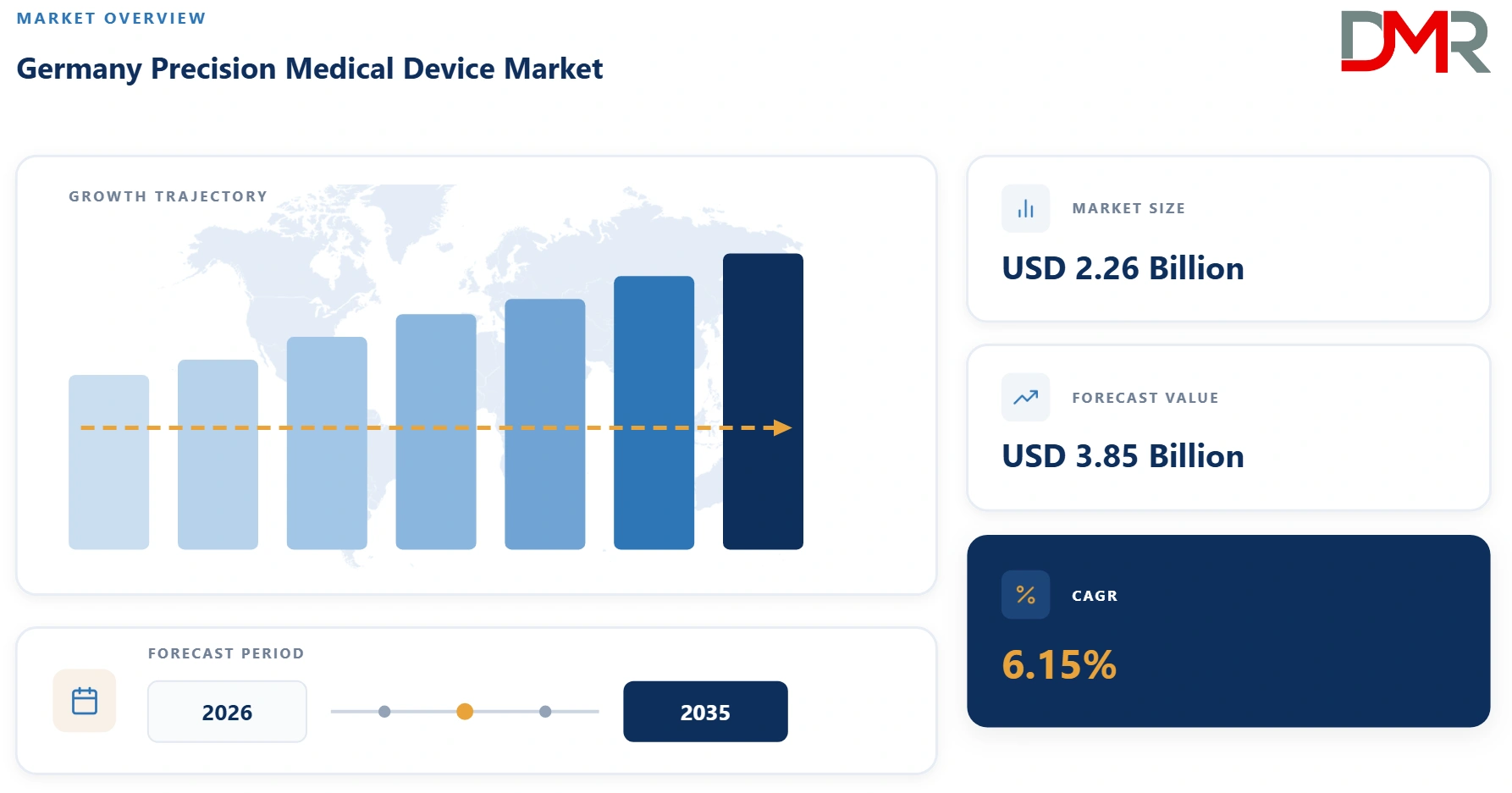
- Market Size, 2026: USD 2.26 billion
- Market Size, 2035: USD 3.85 billion
- CAGR, 2026–2035: 6.15%
- Leading Product Type: Surgical Instruments, 29%
- Leading Technology: Robotic & Computer-Assisted Technology, 27%
- Leading End User: Hospitals & Clinics, 62%
- Fastest-Growing Segment: AI-Enabled Technology , 10.8% CAGR
What is the Germany Precision Medical Device and its Market Size?
The Germany precision medical device market is estimated at USD 2.26 billion in 2026, rising to approximately USD 3.85 billion by 2035, equivalent to a 6.15% CAGR.
ℹ
To learn more about this report –
Download Your Free Sample Report Here
The Germany Precision Medical Device Market covers high-accuracy medical instruments, diagnostic and imaging equipment, monitoring systems, therapeutic devices, implants and interventional technologies designed to improve measurement accuracy, procedural control, personalization and clinical outcomes. The category includes conventional precision instruments as well as increasingly software-enhanced systems incorporating robotics, artificial intelligence, sensors, advanced imaging, 3D printing and miniaturized components. Germany's market is supported by a mature healthcare system, sophisticated hospital infrastructure, strong engineering capabilities and a large domestic medtech manufacturing base. The broader industry includes approximately 500,000 medical devices available on the German market, illustrating the breadth of the country's medical-technology ecosystem.
Use Cases
- Precision Surgery: High-accuracy instruments, robotic assistance and image guidance improve procedural control and reduce surgical invasiveness.
- Advanced Diagnosis: AI-assisted imaging, molecular diagnostics and high-resolution systems enable earlier and more precise disease detection.
- Patient Monitoring: Biosensors and connected monitoring devices continuously measure physiological parameters and support earlier intervention.
- Targeted Therapy: Precision delivery systems and neuromodulation technologies enable more controlled treatment with reduced collateral effects.
- Interventional Procedures: Microcatheters, image-guided systems and specialized implants support minimally invasive cardiovascular and neurological procedures.
- Rehabilitation: Sensor-enabled and digitally connected devices personalize rehabilitation programs and monitor patient progress.
Key Takeaways
- Market size: Estimated at USD 2.26 billion in 2026 and projected to reach approximately USD 3.85 billion by 2035.
- Growth: The modeled CAGR is 6.15%, consistent with the published Germany precision-device forecast.
- Primary drivers: Aging demographics, chronic disease, minimally invasive surgery, hospital digitization and precision diagnostics.
- Product leader: Surgical instruments are estimated to account for approximately 29% of 2026 revenue.
- Technology leader: Robotic and computer-assisted technologies represent the largest technology category, while AI-enabled devices are expected to expand fastest.
- End-user leader: Hospitals and clinics account for approximately 62% of demand.
- Competitive advantage: German engineering, clinical expertise, specialized SMEs and a strong export-oriented medtech ecosystem create a favorable innovation environment.
How AI/Gen AI is Transforming the Germany Precision Medical Device Market?
Artificial intelligence is shifting precision devices from passive instruments toward intelligent clinical systems. AI is increasingly embedded in imaging, radiation planning, pathology, intervention, monitoring and decision-support workflows. In May 2026, Siemens Healthineers received CE certification for AI contouring integrated with its Eclipse radiation-treatment planning system; the technology can automatically contour more than 200 predefined structures using CT and MR images.
AI reduces repetitive manual work, improves consistency and can shorten diagnostic or planning workflows. Its value is particularly high where large volumes of imaging or physiological data must be interpreted rapidly.
The competitive effect is significant: device manufacturers increasingly compete on algorithms, software integration, data quality and workflow connectivity rather than hardware alone. This favors companies capable of combining engineering, clinical validation, cybersecurity, software and regulatory expertise.
Key Drivers in the Germany Precision Medical Device Market
Rising Demand for Minimally Invasive and High-Precision Procedures
The increasing preference for minimally invasive interventions is one of the strongest structural drivers. Hospitals seek technologies that can improve procedural precision while reducing trauma, recovery time, complications and length of stay. Precision instruments, robotic systems, image-guided platforms, microcatheters and advanced implants directly address these requirements.
Germany's sophisticated hospital infrastructure provides a strong environment for adoption because university hospitals and specialist centers can serve as early clinical-adoption sites. The broader Germany medical-device market is already being driven by chronic disease and increasing surgical procedures.
AI, Digitalization and Data-Driven Clinical Workflows
Healthcare digitization is increasing demand for connected devices that combine sensors, imaging, analytics and software. AI allows precision devices to process information in real time, identify patterns and automate repetitive tasks.
Germany's engineering-intensive medtech ecosystem is well positioned for this transition. Medical-technology companies invest approximately 9% of revenue in R&D on average, while one-third of industry revenue reportedly comes from products less than three years old.
Restraints in the Germany Precision Medical Device Market
Regulatory Complexity and Compliance Costs
The EU Medical Device Regulation creates demanding requirements around clinical evidence, quality management, post-market surveillance and conformity assessment. Germany additionally operates within the Medical Devices Law Implementation Act and national surveillance structures. BfArM identifies the MDR, MPDG and associated implementing regulations as central elements of the German regulatory framework.
For precision devices incorporating AI or software, manufacturers must also manage software lifecycle, cybersecurity, clinical-performance and data-related requirements.
Growth Opportunities in the Germany Precision Medical Device Market
AI-Enabled Precision Diagnostics and Intervention
AI represents the strongest technology white space. Applications include automated imaging interpretation, AI-guided intervention, pathology, radiation planning, surgical navigation and continuous patient monitoring.
Home-Based and Decentralized Precision Care
Connected monitoring, wearable sensors, home dialysis, remote diagnostics and compact therapeutic devices can extend precision medicine beyond hospitals. The broader German precision-device market analysis identifies home care as an emerging high-growth area, while Germany's aging population creates structural demand for technologies that reduce hospital dependence.
Trends in the Germany Precision Medical Device Market
Convergence of Hardware, Software and AI
Precision medical devices increasingly operate as connected systems rather than isolated pieces of equipment. Sensors, imaging, cloud connectivity and algorithms are being integrated into surgical, diagnostic and therapeutic workflows.
Miniaturization and Personalized Treatment
Microfabrication, miniaturized sensors, advanced polymers and additive manufacturing are enabling smaller and more patient-specific devices.
Research Scope and Analysis
The Germany Precision Medical Device Market is segmented by Product Type, Technology, Application and End User. The segmentation emphasizes the transition from conventional precision hardware toward AI-enabled, connected and minimally invasive clinical systems.
ℹ
To learn more about this report –
Download Your Free Sample Report Here
By Product Type Analysis
Surgical Instruments are estimated to be the dominant product segment in 2026, accounting for approximately 29% of market revenue. Their leadership reflects Germany's large surgical infrastructure, strong domestic manufacturing capabilities and demand for microsurgical, minimally invasive and high-accuracy instruments. Diagnostic & Imaging Devices are estimated at roughly 24%, supported by high-value imaging systems and increasing AI integration. Monitoring & Measurement Devices account for approximately 18%, while Therapeutic Devices represent around 16%; Implantable & Interventional Devices account for approximately 13%. The fastest-growing product category is estimated to be Diagnostic & Imaging Devices at roughly 7.8% CAGR, as AI, image-guided intervention and earlier disease detection increase utilization. Within surgical instruments, minimally invasive instruments are expected to outperform traditional tools, while within imaging, AI-enhanced systems are gaining the strongest commercial momentum.
By Technology Analysis
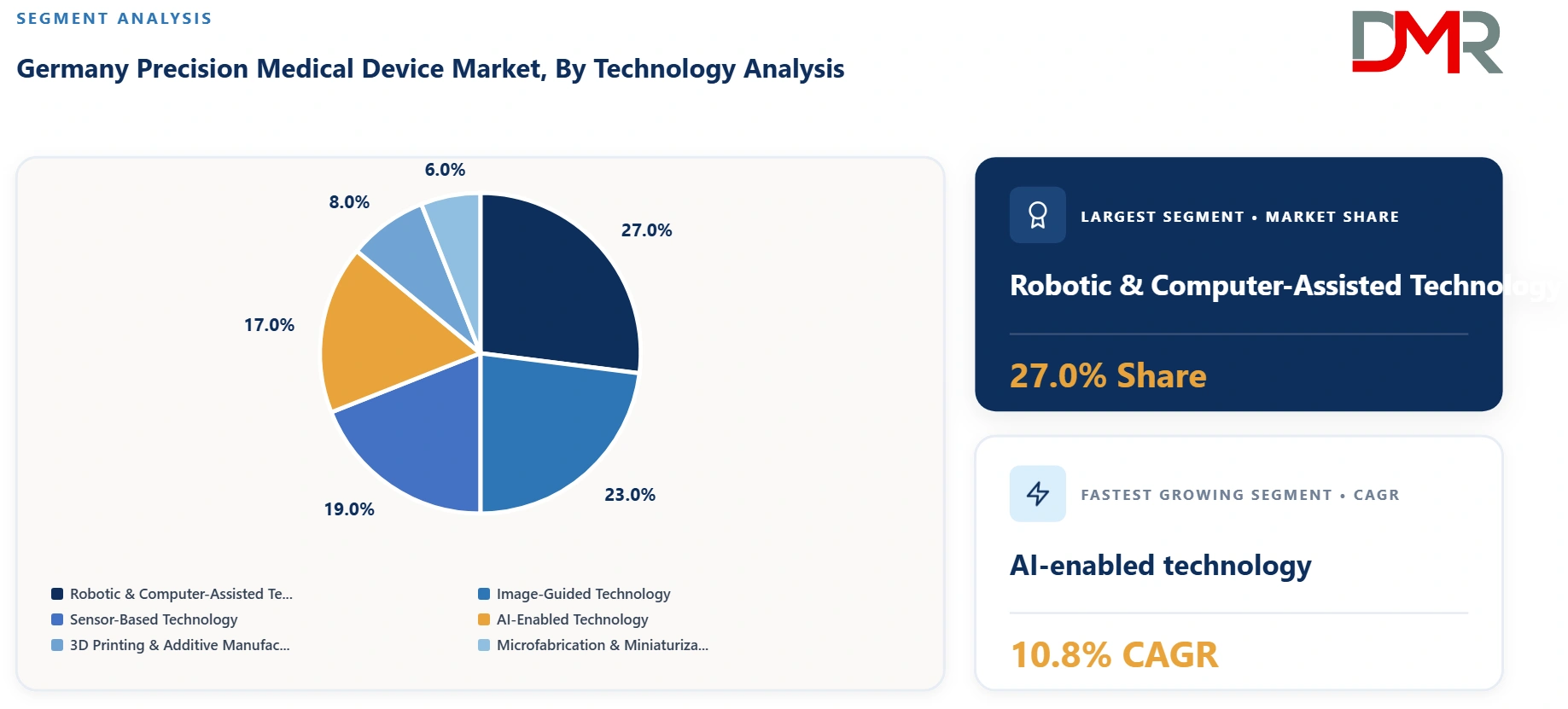
Robotic & Computer-Assisted Technology is estimated to lead the technology segmentation with approximately 27% share in 2026, reflecting growing adoption of computer-assisted surgery, navigation and precision intervention. Image-Guided Technology follows at approximately 23%, while sensor-based technology represents about 19%. AI-enabled technology currently represents an estimated 17%, but is projected to be the fastest-growing segment at approximately 10.8% CAGR through 2035. 3D printing and additive manufacturing account for about 8%, with microfabrication and miniaturization representing approximately 6%. AI's rapid growth is supported by clinical deployment in imaging and radiation planning. Siemens Healthineers' 2026 CE-marked AI contouring solution demonstrates the shift toward software-enhanced precision workflows.
By Application Analysis
Surgery is estimated to remain the largest application, representing approximately 34% of 2026 market revenue. General, orthopedic, neurosurgical, cardiovascular and ophthalmic procedures create significant demand for high-precision instruments and navigation systems. Diagnosis & Imaging accounts for approximately 27%, followed by Patient Monitoring at 16%, Drug Delivery at 13%, and Rehabilitation & Assistive Care at 10%. Diagnosis and imaging are expected to be the fastest-growing application at approximately 8.0% CAGR, reflecting increasing use of AI-supported imaging, high-resolution diagnostics and personalized disease detection. Ophthalmology is another attractive niche because of Germany's strong optical and medical-technology capabilities, while neurosurgery and cardiovascular intervention benefit from the increasing availability of high-resolution, real-time visualization.
By End User Analysis
Hospitals & Clinics dominate with an estimated 62% share in 2026, owing to their concentration of high-acuity procedures, diagnostic infrastructure, specialist personnel and capital equipment. Ambulatory Surgical Centers represent approximately 15%, Diagnostic Centers 11%, Specialty Clinics 7%, and Research & Academic Institutions 5%. Hospitals will remain the largest end-user category, but decentralized care is expected to grow more rapidly. Connected monitoring and compact therapeutic systems are enabling selected procedures and follow-up care outside traditional hospitals. Germany's broader healthcare environment and advanced university-hospital network provide important test beds for high-end precision technologies, while home and outpatient applications offer vendors a route to address workforce shortages and reduce pressure on inpatient capacity.
The Germany Precision Medical Device Market Report is segmented on the basis of the following:
By Product Type
- Surgical Instruments
- Precision Surgical Instruments
- Microsurgical Instruments
- Minimally Invasive Surgical Instruments
- Diagnostic & Imaging Devices
- Precision Imaging Systems
- Optical Diagnostic Devices
- Point-of-Care Diagnostic Devices
- Monitoring & Measurement Devices
- Physiological Monitoring Devices
- Biosensors
- Precision Measurement Devices
- Therapeutic Devices
- Targeted Drug Delivery Devices
- Neuromodulation Devices
- Energy-Based Therapeutic Devices
- Implantable & Interventional Devices
- Precision Implants
- Interventional Devices
- Microcatheters and Delivery Systems
By Technology
- Robotic & Computer-Assisted Technology
- Image-Guided Technology
- Sensor-Based Technology
- AI-Enabled Technology
- 3D Printing & Additive Manufacturing
- Microfabrication & Miniaturization
By Application
- Surgery
- General Surgery
- Orthopedic Surgery
- Neurosurgery
- Cardiovascular Surgery
- Ophthalmic Surgery
- Diagnosis & Imaging
- Patient Monitoring
- Drug Delivery
- Rehabilitation & Assistive Care
By End User
- Hospitals & Clinics
- Ambulatory Surgical Centers
- Diagnostic Centers
- Specialty Clinics
- Research & Academic Institutions
Regulatory Landscape
Germany's precision medical-device industry operates primarily under the EU Medical Device Regulation (MDR) 2017/745, IVDR 2017/746 where applicable, and Germany's Medical Devices Law Implementation Act (MPDG). BfArM is involved in device classification, serious-incident assessment, clinical-investigation processes and national medical-device information systems.
The regulatory environment is particularly important for AI-enabled devices because software functionality can affect classification, clinical evidence and post-market obligations. Medical devices are classified into Classes I, IIa, IIb and III according to MDR risk rules, while IVDs use Classes A through D.
As of 2026, EUDAMED implementation is also becoming a major operational consideration. BfArM states that the first four EUDAMED modules became subject to mandatory use from 28 May 2026, replacing the previous transitional reliance on DMIDS for the relevant registrations.
Investment and White Space Analysis
The most attractive investment opportunities are concentrated in AI-enabled diagnostics, image-guided intervention, robotic surgery, connected monitoring, home-based precision care and personalized implants. German medtech's SME structure creates opportunities for strategic investors seeking specialist technologies that can be integrated into larger platforms. The ecosystem is already attracting capital: Munich-based AI medtech company hema.to raised EUR 3.6 million in February 2025 for AI-based blood-data analysis and clinical expansion.
Additional white spaces include AI software that integrates with installed hospital equipment, low-cost precision devices for outpatient care, cybersecurity solutions for connected medical devices, sustainable manufacturing and precision technologies designed specifically for aging populations.
Competitive Landscape
The Germany Precision Medical Device Market is moderately fragmented but increasingly platform-oriented. German companies compete alongside multinational medtech leaders, with differentiation based on engineering quality, clinical evidence, precision, workflow integration, regulatory expertise and after-sales service. Major strategies include product innovation, strategic partnerships, acquisitions, software integration and geographic expansion.
Germany's domestic advantage comes from its combination of large medtech manufacturers and a dense network of specialized SMEs. Approximately 93% of German medical-technology companies have fewer than 250 employees, while around 68% of industry revenue is generated abroad, demonstrating both fragmentation and strong international orientation.
Some of the prominent players in the Germany Precision Medical Device Market are:
- Siemens Healthineers
- B. Braun Melsungen
- Fresenius Medical Care
- Carl Zeiss Meditec
- Drägerwerk
- Karl Storz
- Ottobock
- BIOTRONIK
- Aesculap
- Richard Wolf
- Getinge
- Paul Hartmann
- Erbe Elektromedizin
- Brainlab
- KARL STORZ
- SCHOTT Pharma
- Medtronic Germany
- Philips Germany
- GE HealthCare Germany
- Johnson & Johnson MedTech Germany
- Stryker Germany
- Intuitive Surgical Germany
- Olympus Germany
- Smith+Nephew Germany
- Boston Scientific Germany
- Edwards Lifesciences Germany
- Siemens Healthineers Diagnostics
- Leica Microsystems
- Hologic Germany
- Zimmer Biomet Germany
- Arthrex Germany
- B. Braun Aesculap
- KLS Martin Group
- Gebrüder Martin
- Richard Wolf GmbH
- Aesculap AG
- Schülke & Mayr
- WEINMANN Emergency
- PAJUNK
- VYGON Germanys
- Other Key Players
Recent Developments
- July 2026: Fresenius Medical Care introduced TherapyWise analytics for kidney replacement therapy, expanding data-driven and digitally enabled clinical decision support.
- June 2026: Siemens Healthineers introduced an AI-powered angiography system at University Medical Center Freiburg for real-time 2D/3D visualization during cardiac procedures.
- June 2026: ZEISS announced plans for Carl Zeiss AG to acquire up to €200 million of additional Carl Zeiss Meditec shares.
- May 2026: Siemens Healthineers received CE marking for AI Contouring integrated with the Eclipse radiation-treatment planning system.
- March 2026: B. Braun reported €9.4 billion in 2025 revenue and €584 million in R&D spending, while expanding automated manufacturing and digital solutions across infusion, surgery and dialysis.
- February 2025: Munich-based AI-medtech company hema.to raised €3.6 million to expand AI-based blood-data analysis and clinical validation.
Report Details
| Report Characteristics |
| Market Size (2026) |
USD 2.26 Bn |
| Forecast Value (2035) |
USD 3.85 Bn |
| CAGR (2026–2035) |
6.15% |
| Historical Data |
2021 – 2025 |
| Forecast Data |
2026 – 2035 |
| Base Year |
2025 |
| Segments Covered |
By Product Type, By Technology, By Application, By End User |
| Country Coverage |
Germany |
Frequently Asked Questions
What is the market size of the Germany Precision Medical Device Market in 2026?
▾ The Germany Precision Medical Device Market is estimated at approximately USD 2.26 billion in 2026, based on the published market forecast and modeled growth trajectory.
What will the Germany Precision Medical Device Market size reach by 2035?
▾ The Germany Precision Medical Device Market is projected to reach approximately USD 3.85 billion by 2035, reflecting sustained demand for advanced medical technologies.
What is the CAGR of the Germany Precision Medical Device Market?
▾ The Germany Precision Medical Device Market is expected to grow at approximately 6.15% CAGR from 2026 to 2035, driven by technological and demographic factors.
What are the key drivers of the Germany Precision Medical Device Market?
▾ The Germany Precision Medical Device Market is driven by aging demographics, chronic diseases, minimally invasive procedures, AI adoption, hospital digitization and personalized healthcare.
What are the major trends in the Germany Precision Medical Device Market?
▾ Major trends in the Germany Precision Medical Device Market include AI-enabled devices, robotic surgery, image-guided procedures, miniaturization, connected monitoring and personalized medical devices.
Which technology is growing fastest in the Germany Precision Medical Device Market?
▾ AI-enabled technology is expected to be the fastest-growing technology segment in the Germany Precision Medical Device Market, with an estimated CAGR of approximately 10.8%.
Who are the key players in the Germany Precision Medical Device Market?
▾ Key companies operating in the Germany Precision Medical Device Market include Siemens Healthineers, B. Braun, Fresenius Medical Care, ZEISS, Dräger, Medtronic, Philips and GE HealthCare.
How is the Germany Precision Medical Device Market segmented?
▾ The Germany Precision Medical Device Market is segmented by Product Type, Technology, Application and End User, covering surgical instruments, AI technologies, surgery, hospitals and other categories.